Health Literacy and Cultural Competence
By
Elizabeth Baker Mizelle
A Master‟s Paper submitted to the faculty of the University of North Carolina at Chapel Hill
In partial fulfillment of the requirements for the degree of Master of Public Health in
the Public Health Leadership Program.
Chapel Hill 2009
Signature______________________
Advisor:
Signature______________________
Second Reader:
TABLE OF CONTENTS
Page
TITLE PAGE 1
ABSTRACT 3-4
BODY 5-22
APPENDICES 23-26
Abstract
Low health literacy is common throughout the general population in the United States, and serves as an indicator for poor health outcomes across categories of race, socio-economic class, and ethnicity. The impact of low literacy can be measured by increased human suffering, and by financial burden. Multiple factors contribute to a higher rate of poor health literacy
among certain groups that are already more vulnerable to health disparities. As an example of the complex issues surrounding health literacy, I consider the Hispanic population in North Carolina. The Spanish-speaking population in North Carolina continues to grow and to become more diverse. It sits at the intersection of many cultural issues, and faces potential barriers to health literacy that include limited English proficiency, illiteracy in the native language(s), cultural norms, and discrimination.
In North Carolina, there is a need for health education among the Spanish-speaking population. Federal Title VI legislation requires that agencies funded with federal dollars,
including those awarded through the Maternal and Child Health Bureau Block Grants, make their services available to those with limited English proficiency. However, limited English
proficiency and limited health literacy continue to be barriers that prevent Latinos from receiving services and participating fully in their communities. Of particular concern is the health and wellbeing of children whose parents do not speak English well.
cooperated and shared their knowledge of the population and of techniques for dissemination that had been successful in the past. In this paper, I will explore factors that contribute to limited health literacy for Spanish-speakers, and assess strategies for utilizing, modifying and
Full Title Repeated and Centered Low Health Literacy: A public health crisis
“Nothing—not age, income, employment status, education level, and racial or ethnic group—affects health status more than literacy skills” (Partnership for Clear Health
Communication, 2009). Many public health leaders argue that health literacy is among the most important indicators of health outcomes. The Institute of Medicine‟s publication, Health
Literacy: A Prescription to End Confusion, served as a landmark study and focused attention on the problem of poor health literacy. It opens with a statement of the severity of the problem of poor health literacy: “Nearly half of all American adults—90 million people—have difficulty understanding and acting upon health information”(Committee on Health Literacy, 2004). Problems with health literacy have a profound impact on communication between health care providers and their patients. Problems in health communication also extend throughout the socio-ecological model of health and influence the ability of public health practitioners to
communicate with the public at the community and societal levels.
Health care providers and public health practitioners alike often rely on the assumption that people can read and understand health-related materials. However, “according to the National Adult Literacy Survey (NALS), as many as 44 million people (age 16 and older), or 23% of all adults in the United States are functionally illiterate. An additional 28% of all adults — 53.5 million people — had only marginally better reading and computational skills. This
suggests that nearly 50% of all adults may have problems understanding prescriptions, appointment slips, informed consent documents, insurance forms, and health education materials” (Center for Health Care Strategies, 2005). The National Adult Literacy Survey
(NALS) led to a more specific analysis of the aspects of literacy that contribute to overall
understanding of written materials; in 2003 the survey reported literacy scores for three areas: prose literacy, document literacy and quantitative literacy, and also simulated health literacy by asking respondents to complete tasks that would commonly be required in the clinical setting.
(Appendix A)
When considered by state, the 1992 National Assessment of Literacy Survey (NALS) indicates that North Carolinians function at the lowest literacy levels compared to people nationally, with the state ranking 41st in basic or below basic adult literacy levels. Even these estimates, which indicate a serious problem, may fail to capture the full extend of low health literacy. The NC Institute of Medicine writes, “these estimates of the numbers of people with low literacy levels probably underestimate the numbers of people who struggle to understand and process complex health information”(North Carolina Institute of Medicine, 2007).
Figure 2: Percentage of Adults in Each Health Literacy Level, by Race/Ethnicity (2003)
may understate the extent of the problem today, with the recent influx of immigrants and the aging of the population” (North Carolina Institute of Medicine, 2007).
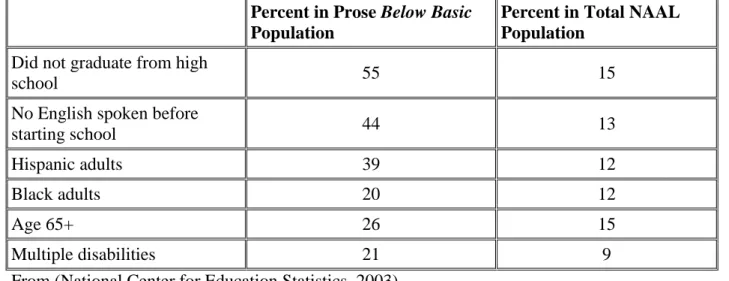
Figure 2: Adults With Below Basic Prose Literacy, Groups Over-represented in 2003
Percent in Prose Below Basic
Population
Percent in Total NAAL Population
Did not graduate from high
school 55 15
No English spoken before
starting school 44 13
Hispanic adults 39 12
Black adults 20 12
Age 65+ 26 15
Multiple disabilities 21 9
From (National Center for Education Statistics, 2003)
Low health literacy is not a new phenomenon, but has become an increasing problem as patients are expected to navigate an increasingly complex health care system, and to take an active role in their care. The problem of low health literacy has reached critical levels and has massive impact on North Carolina and the United States, whether it is measured in terms of human suffering, lost health opportunities, or the financial burden of poor communication within health care. In 2001, low functional literacy resulted in an estimated $32 to $58 billion in
Addressing the problem of Low Health Literacy
(Zarcadoolas, Pleasant, & Greer, 2006)More than 300 studies indicate that health-related materials far exceed the average reading ability of U.S. adults (Committee on Health Literacy, 2004). Health care providers are often unable to identify those with low literacy, or to adapt their approach so that patients can understand. People with low literacy often report being able to read and write well. Even those who are aware of their low-literacy may be reluctant to admit their situation or to ask for help. Physicians report being surprised by the low literacy levels of well-educated patients. “Many patients simply are either unaware of or unwilling to admit to having difficulty with health care information. Interestingly, the studies show that even though
individuals don‟t think they have a problem themselves, they believe others do”(Phizer, 2003). An overarching strategy that many groups, including the Institute of Medicine, the North Carolina Institute of Medicine, the Partnership for Clear Health Communication and the Center for Health Care Strategies advocate is simultaneously raising the level of patient health literacy and equipping health care providers to effectively communicate with patients who have low health literacy. Health care providers, particularly public health practitioners must “meet patients where they are” and communicate critical information in a way that they can immediately
understand. All means of communication, written and verbal, must be assessed for clarity.
Utilizing creative approaches, not limited to print media or verbal explanation alone is suggested. Patients, providers, and the community as a whole must also work to improve health literacy. Improved literacy enables patients to better inform themselves, and to better participate in making decisions about their care. Adequate literacy enables patients to take advantage of health information and implement preventative measures.
“A book alone cannot solve health and social challenges…” {{7 Zarcadoolas, Christina 2006/s154;}}. There is more to addressing problems with health literacy than teaching patients to read. Health communication and health literacy cannot be addressed in isolation. The
complexities of language, culture, education, and healing must be considered as efforts to improve health literacy are carried out within the cultural context of North Carolina. “Health literacy arises from a convergence of education, health services, and social and cultural factors. Although causal relationships between limited health literacy and health outcomes are not yet established, cumulative and consistent findings suggest such a causal connection.”(Committee on Health Literacy, 2004) Ethnic minority groups are disproportionately affected by low health literacy which may exacerbate and contribute to disparities in health outcomes. “At the same time, however, the majority of people with low literacy skills in the U.S. are white, native-born Americans, who represent the largest segment of the population. Others who are especially vulnerable to low health literacy are older patients, recent immigrants, people with chronic diseases, and those with low socioeconomic status” (Vernon, John A. et al, 2007).
In a practicum carried out as part of the Public Health Leadership Program at the UNC Gillings School of Public Health, I worked with the North Carolina Child Care Health and Safety Resource Center to investigate how the Spanish-language version of their award-winning Child Care Health and Safety Bulletin is utilized. The Child Care Health and Safety Bulletin is
audience, an important principle for any communication, is essential to health communication projects. Strategies and guidelines are important; I offer some suggestions below for
consideration. However, the art of communication cannot be reduced to a checklist, a writing style sheet, or a clinical protocol.
Adapting to cultural change: the Spanish-speaking population in North Carolina North Carolina has the fastest growing Latino population in the country. Both native North Carolinians and immigrants have encountered remarkable cultural change and both cultures have adapted. These changes have been the source of renewal and transformation for many counties; they have also been a source of conflict and “growing pains”. The Hispanic population increased from 76,726 in 1990 to 378,963 in 2000 and to 595,937 in 2007. Latinos made up 1.04% of the North Carolina population in 1999, 4.7% in 2000, and 7.1% in 2007 (U.S. Census Bureau, 2007). (Note: I use the terms Latino and Hispanic interchangeably, as they are used alternately in the source material for this paper.)
Hispanic Population in North Carolina 1990-2007 76,726 378,963 595,937 0 200000 400000 600000 800000
1990 2000 2007
Year P o p u la ti o n
(U.S. Census Bureau, 2007)
530,328 in 2002, with those numbers continuing to increase. (North Carolina Institute of Medicine, 2003) The Hispanic population has grown quickly in North Carolina, but Hispanics still make up a smaller percentage of the state population, at 7.2% in 2007, than of the national population, at 12.5% in 2007 (North Carolina Institute of Medicine, 2003).
Most Latinos, like many other groups, migrate for economic opportunities, either from Latin America or from other states in the US (North Carolina Institute of Medicine, 2003). Several factors contribute to the growth of the Hispanic (and overall population of those with Limited English Proficiency or LEP) in North Carolina. The first “wave” of immigrants to North Carolina were migrant workers who followed the need for workers in the agricultural industry. Migrant farm workers and their families continue to return to North Carolina each year. Each year, some migratory families settle rather than move on to follow the growing season. When one family has successfully settled, extended families tend to reunite, relocating to North Carolina from other states and countries. A growing economy has created more jobs in the textile, poultry, and furniture industries. Companies have actively recruited and encouraged workers to settle in North Carolina. Several large military complexes located throughout the state have also contributed to economic opportunities (Hakuta). “The rapid growth in the Hispanic population occurred not in isolation but in the context of strong population growth among blacks (21%) and whites (11%) in the new South states” (Kochhar, Suro, & Tafoya, 2005).
While the problem of health literacy is not unique to the Latino population, it is
“What is it about health literacy that makes this problem so difficult to address through sensible programs and planned interventions? First of all, we have to face the fact that basic literacy is not a problem limited only to health issues and concerns. The health care system cannot solve this problem alone. Many of those who immigrate to our country in search of employment and a better way of life arrive with only limited literacy in their native languages. Many have only limited formal educational backgrounds” (North Carolina Institute of Medicine, 2003).
In 2007, the American Community Survey estimates that 9.7% of people in North Carolina speak a language other than English in the home (with 6.5% speaking Spanish), and that 9.4% speak English “less than very well”(U.S. Census Bureau, 2007).(U.S. Census Bureau, 2007; U.S. Census Bureau, 2007) The difference in language is accompanied by cultural
differences that must also be addressed when working to improve health literacy and to create accessible documents. “The Hispanic population of preschool age (4 or younger) increased by 382 percent between 1990 and 2000, and the number of Hispanics added was far larger than the number of whites”(Kochhar et al., 2005). Despite the language barriers that they face, Hispanic parents of young children who do not speak English tend to seek out information about child health, safety and programs that will benefit their children. State agencies that receive federal funding are required to make their materials available in the language of their users, but this requirement is not always fulfilled.
Title VI: Limited English proficiency and health literacy
under any program or activity that receives Federal financial assistance….All organizations or individuals that are recipients of these funds from U.S. HHS have an obligation to ensure that LEP individuals have a meaningful and equal access to benefits and services” (NC DHHS Office of Citizen Services, 2009). Failure to make services and programs linguistically acceptable has been determined to be a form of discrimination under Title VI of the Civil Rights Act. Agencies are required to provide both interpretation services (face-to-face interpretation) and written materials in the language of the people that they serve. “In October and November of 2001, the Office of Civil Rights (OCR) of the US Department of Health and Human Services conducted a review of the NC Department of Health and Human Services and five of the local public health and DSS agencies. OCR found North Carolina to be out of compliance with Title VI by failing to provide adequate language assistance to groups who speak a primary language
other than English” {{4 North Carolina Institute of Medicine 2003/s151-152;}}.
There is no substitute for competent medical interpretation skills in the direct-care
Translation, transformation and filling in the gaps: reaching multiple Spanish-speaking audiences
Latinos come to North Carolina from various countries in Latin America, bringing a broad diversity of experiences. They come from cosmopolitan urban areas like Mexico City, and from isolated rural areas in Guatemala. Some hold the equivalent of masters and doctoral degrees from their home countries; others have never experienced formal education. Their exposure to ideas of health, to health care and to social programs varies widely. “Some are united as an ethnic group by a common heritage derived from Spanish language and culture, while others identify more with cultural heritages unique to their countries of origin” (North Carolina Institute of Medicine, 2003).
Designing health education materials to meet the needs of such a diverse audience is much like the task of designing materials for the „general public‟. “The term „general public‟ is actually misleading, as there are few times when the entire public can be addressed with the same message in the same manner. Public audiences need to be divided into groups, or segmented, and their needs in terms of literacy, understanding of numerical information (numeracy), cultural issues, foreign language use, and communication channels must be determined” (Nelson, Brownson, Remington, & Parvanta, 2002).
Efforts to use racial or ethnic background only as simplistic, straightforward predictors of beliefs or behavior, will lead to harmful stereotyping. Both the cultural definitions and the specific configuration of the target group are necessary for designing effective health promotion messages. It is difficult to reach any population with health promotion messages. It is much more difficult than promoting commercial products that offer instant gratification to those who
North Carolina Child Care Health and Safety Resource Center worked with various partners to explore ways to leverage an existing, high-quality publication to reach a wide range of readers. Recognizing that health promotion is always challenging, they recommended a variety of steps toward reaching a broad audience by adapting the existing material and disseminating it creatively.
Making a good product better: How to make good use of the Spanish Child Care Health and Safety Bulletin
The Child Care Health and Safety Bulletin is written at an eighth grade reading level. The primary audience is child care providers. CHICLE, a translation firm in Chapel Hill, NC is responsible for the Spanish translation. The Spanish version of the publication is distributed through the Child Care Resource and Referral (CCR&R) agencies throughout the state. It
contains a variety of articles, tips and suggestions, activities, and other material, as well as a tear-out page for child care providers to give to parents. The number of licensed Spanish-speaking child care providers in North Carolina is still quite small, and the Division of Child
In addition to promoting child health and safety, the partner agencies recognize that “making high-quality materials available encourages lower literacy populations to improve their literacy by practicing literacy skills. This is shown to be especially effective in for low-income families where interventions have successfully increased the number of days per week that they read with their children, and the number of books that they have in their homes” (National Institute for Literacy, 2008). Partners also expressed the desire to be able to respond to requests from Spanish-speaking families for more reading material in Spanish. There was a strong desire to preserve the value of the original Spanish document; partner agencies reported that it helps the Spanish-speaking child care providers view themselves as professional, may lead to an increase in licensed child care among the Spanish-speaking providers, and increases the Division of Child Development‟s ability to reach to providers who are Spanish speaking, and reduce the feeling of isolation among providers and parents who have a limited social network
Partner agencies reported that their clients express the need for Spanish-language materials to reach an audience with lower levels of health literacy. Instead of focusing on child care
“Simplified written materials, while helpful, are not the only way to improve understanding. Hohn recommends also using props, pictures, stories, and hands-on practice in patient
teaching”(Osbourne, 2003). Methods such as these, as well as radio, television and online media may also extend their reach.
Partner agencies reported several advantages to adapting the bulletin. One barrier to
compliance with Title VI legislation for Limited English Proficiency is a lack of funding. Partner agencies, whose business is caring for children and their families, often lack funding to provide appropriate translation and adaptation of materials. The bulletins give them a high-quality publication that they can use as a starting place, without having to create all new materials, which results in cost-savings and greater capacity. Partner agencies are able to extend the reach of the North Carolina Child Care Health and Safety Resource Center as well. The Resource Center, by its mission, is focused on the audience of child care providers, and receives its funding primarily from the Division of Child Development. They operate with a small staff and thrive on a specific set of activities. They are unable to extend their reach to the
Spanish-speaking community at large, but are interested in disseminating child health and safety
information. Partner agencies brought many ideas to the Resource Center about specific venues for dissemination that could be used to extend their reach (Appendix C). A good example is that the Spanish-language newspaper Que Pasa excerpts articles with credit to the Resource Center. Recommendations to improve health materials and health literacy
Latino stores, Spanish-language news papers, clinics with Spanish-language capacity, and word-of-mouth. “There are substantial racial/ethnic differences in perceptions of certain medical information sources. Medical information designed for minority populations may be more effective if disseminated through particular sources” (Williams, Anstrom, Friedman, & Schulman, 2007).
Partner agencies also made recommendations for the printed materials themselves that are echoed in the literature about health literacy. They suggest working closely with the target audience in the process of developing materials, and testing the materials before distributing them. Another technique that was discussed is developing materials first in the target language. In Communicating Public Health Information Effectively: A guide for practitioners, Nelson et. al. suggest, “working directly with populations that use English as a second language to gather input before developing informational materials is more effective than translating English language materials into foreign languages. These materials can be “back-translated” to ensure that the meaning is equivalent, but not necessarily a literal, translation of English” (Nelson et al., 2002). While this technique is not applicable to the Spanish edition of the Child Care Health and Safety Bulletin, which is already translated in a high-quality and useful format by professional translators, it could be a useful guideline to use when adapting materials based on the Bulletin. Dealing with complexity
addressed so your readers are not misled. One way do this is to preface information by stating that scientists continue to study and learn, indicating that what may seem correct today may change tomorrow” (Osbourne, 2004). One strategy is to combine written and oral explanations of complex information, and to attach an introduction or summary to complex documents. “If you cannot alter these documents, you can provide help to readers by writing easier-to-read
summaries that you attach” (Osbourne, 2004). When developing materials, “it‟s also important to remember that good writing takes a team….that team should include a subject-matter expert (usually a scientist or clinician) who can verify the accuracy of the material and at least one reader who understands and represents the intended audience” (Osbourne, 2004). Partner agencies also made this recommendation of including technical or content experts and members of the target audience whenever possible.
Practical guidelines for reaching lower-literacy readers
The Child Care Health and Safety Bulletin contains examples of good design practices that are recommended for all readers. It defines health-related terms that may be unfamiliar, avoids jargon, and is well-organized (Katz & Osbourne, 2002). When adapting this material for low-literacy readers, partner agencies suggested principles recommended by the Plain Language Action and Information Network. The plain language checklist produced by the suggests that writers serve the readers needs, use active voice and simple verb tense, use effective headings, use short sections and sentences, and make the document visually appealing by using a large enough font size and sufficient white space around text (Plain Language Action and Information Network (PLAIN)).
linked to the photos to highlight the most important message of the article. Because they were aware that members of their target audience, including those with lower literacy levels, tend to look first at the pictures and graphics to get a sense of the context of meaning for the articles, they would be most likely to read text that is directly associated with the photographs and graphics. They noted that the Bulletin uses photographs and graphics effectively, and thought that their target audience would be likely to say that the materials are “for me”, which they felt was an important indicator of whether the audience would make the effort to read and understand the materials. Photographs and graphics are best when the subjects represent members of the target audience in a positive way, and are easily recognizable. “Levie‟s literature review suggest that culturally relevant pictures will facilitate comprehension more than pictures that are not culturally relevant to the viewing audience. It is likely that this will be especially important for people in cultures that have had little contact with western medicine” (Houts, Doak C.C., Doak L.G., & Loscalzo, 2006). While members of the Spanish-speaking population in North Carolina have had at least some contact with western medicine and ideas, appropriate graphics and photographs serve to provide greater clarity.
Conclusion
Poor health literacy is one of the most complex and challenging problems facing public health efforts today. Low literacy is widespread, affecting a large percentage of the population, and its repercussions are felt throughout the health care system and public health initiatives. The impact of poor health literacy can be difficult to measure, but due to the widespread nature of the problem, it is assumed to be an underlying factor in health problems experienced by the
landmark studies by the Institute of Medicine have helped to establish this problem as an important topic for further research.
Low health literacy, a complex problem by nature, intersects with other complex problems for groups with Limited English Proficiency. The Spanish-speaking population in North Carolina is an example of a group that experiences intersecting barriers to optimal health outcomes. Agencies that serve this population must be aware of the barriers that they face, and work to improve communication. By improving agency understanding of health literacy and overall cultural competency, public health professionals can better serve this population.
The Spanish edition of the Child Care Health and Safety Bulletin is an example of a high-quality, award-winning publication that targets a specific audience, child care providers, but which can be adapted and modified by partner agencies to produce materials for a broader
Appendix A
Three Types of Literacy
NAAL is designed to measure functional English literacy. The assessment measures how adults use printed and written information to adequately function at home, in the workplace, and in the community.
Since adults use different kinds of printed and written materials in their daily lives, NAAL measures three types of literacy—prose, document, and quantitative—and reports a separate scale score for each of these three areas. By measuring literacy along three scales, instead of just one, NAAL can provide more comprehensive data on literacy tasks and literacy skills associated with the broad range of printed and written materials adults use.
The 2003 NAAL assessment questions were developed to permit measurement of these three types of literacy:
Prose literacy
The knowledge and skills needed to perform prose tasks, (i.e., to search,
comprehend, and use continuous texts). Examples include editorials, news stories, brochures, and instructional materials.
Document literacy
The knowledge and skills needed to perform document tasks, (i.e., to search, comprehend, and use non-continuous texts in various formats). Examples include job applications, payroll forms, transportation schedules, maps, tables, and drug or food labels.
Quantitative literacy
The knowledge and skills required to perform quantitative tasks, (i.e., to identify and perform computations, either alone or sequentially, using numbers embedded in printed materials). Examples include balancing a checkbook, figuring out a tip, completing an order form or determining the amount.
Appendix B
Participants in collaborative meetings to discuss the utilization of Spanish editions of NC Child Care Health and Safety publications.
Title Region/area served
Director, Childcare Health and Safety Resource Center Statewide MPH Student, UNC Gillings School of Public Health
VP, Early Education ASSP Elizabeth City,
CCR&R Region 1
Director, Division of Child Development Statewide
Latino Outreach Coordinator, Healthy Start Foundation Statewide Outreach director, East Coast Migrant Head Start Clayton Director, Childlinks Resource &Referral, Martin/Pitt Partnership for
Children
Martin/Pitt Latino Outreach Specialist, Child Care Resources Inc. Mecklenburg Latino Program Specialist, Child Care Networks Inc. Pittsboro Coordinator, Dare County Child Care Resource & Referral Dare,
CCR&R Region 1 Latino Program Specialist, Work Family Resource Center Forsyth,
Appendix C
Partner agency suggested strategies to distribute Spanish child health and safety information beyond the current audience of child care providers:
~ Link partner agency websites and provide alert when each bulletin or adaptation is released ~ Target health educators, outreach workers, and others who have regular contact with Latino clients, especially young families
~ Contact Healthy Start for ongoing work on list of Latino churches and work through contacts with Latino churches, including Catholic Social Services
~ Place in WIC office waiting rooms
~ Child Care Resource and Referral agencies (CCR&R) copy “parent page” or adapted articles on certain topics of interest and include with other information that they distribute to their local agencies that serve families with young children (DSS, Health Department, Latino stores, etc.) ~ Contact Spanish-language newspapers to see if they are looking for ideas and articles. Que Pasa currently uses articles and might serve as a contact
~ Smart Start newsletters are placed in museums and pediatric offices, and might include adapted or excerpted articles
~ Focus on media out of the Triangle area. Information about services is pretty well distributed in the Triangle but not in more rural areas
~ Disseminate health promotion topics via radio in more rural areas
~ Partner Student Action with Farmworkers (outreach workers contact migrant and seasonal farmworkers)
~ Contact Forsyth Tech Community College about Spanish version of early childhood certificate course and collaborate with instructors
~ Partner with Frank Porter Graham Child Development Institute at UNC. Utilize database of providers across the state that might benefit from information in Spanish. Explore possible collaboration with Dr. Diane Castro on Latino Choices for Child Care in the New South project
References
Center for Health Care Strategies. (2005). Fact sheets on health literacy: Impact of low health literacy skills on annual health care expenditures. Retrieved 3/12, 2009, from
http://www.chcs.org/publications3960/publications_show.htm?doc_id=291711
Committee on Health Literacy. (2004). In Nielsen-Bohlman L., Panzer A. M. and Kindig D. A. (Eds.), Health literacy: A prescription to end confusion (First ed.). Washington, DC: National Academies Press.
Council on Linkages Between Academia & Public Health. (2001). Core competencies for public health. Retrieved 3/11, 2009, from http://www.trainingfinder.org
Hakuta, K. Hispanic and limited english proficiency population growth in north carolina. Retrieved 3/10, 2009, from
http://www.stanford.edu/~kenro/LAU/States/NorthCarolina/NCPopGrow.htm
Houts, P. S., Doak C.C., Doak L.G., & Loscalzo, M. J. (2006). The role of pictures in improving health communication: A review of research on attention, comprehension, recall and
adherence. Patient Education and Counseling,
Kar, S. B., Alcalay, R., & Alex, S. (2000). Health communication: A multicultural perspective (First ed.) Sage Publications.
Kochhar, R., Suro, R., & Tafoya, S. (2005). The new latino south: The context and consequences of rapid population growth. Washington, DC: Pew Hispanic Center.
National Center for Education Statistics. (2003). National assessment of adult literacy. Retrieved 3/12, 2009, from http://nces.ed.gov.libproxy.lib.unc.edu/naal/kf_demographics.asp
National Institute for Literacy. (2008). Literacy promotion in health care settings. Retrieved 3/11, 2009, from http://www.nifl.gov/nifl/facts/health.html#promo
NC DHHS Office of Citizen Services. (2009). The title VI of the civil rights act of 1964 limited english proficiency (LEP): What DHHS employees and local agencies need to know. Retrieved 3/10, 2009, from http://www.dhhs.state.nc.us.libproxy.lib.unc.edu/ocs/title6.htm
Nelson, D. E., Brownson, R. C., Remington, P. L., & Parvanta, C. (Eds.). (2002). Communicating public health information effectively: A guide for practitioners. Washington, DC: American Public Health Association.
North Carolina Institute of Medicine. (2003). NC latino health.
North Carolina Institute of Medicine. (2007). Just what did the doctor order? addressing low health literacy in north carolina.August
Osbourne, H. (2003). In other words… communicating about health with new immigrants. On Call, November/December
Partnership for Clear Health Communication. (2009). Ask me three. Retrieved 3/11, 2009, from
http://www.npsf.org/askme3/index.php
Phizer, I. (2003). White paper on eradicating low health literacy:
the first public health movement of the 21st century. Retrieved 3/12, 2009, from
http://www.npsf.org/askme3/pdfs/white_paper.pdf
Plain Language Action and Information Network (PLAIN). Document checklist for plain language on the web. Retrieved 3/11, 2009, from
http://www.plainlanguage.gov.libproxy.lib.unc.edu/howto/quickreference/checklist.cfm
U.S. Census Bureau. (2007). 2007 american community survey 1-year estimates. Retrieved 3/11, 2009, from http://factfinder.census.gov.libproxy.lib.unc.edu/servlet/ADPTable?_bm=y&-
geo_id=04000US37&-context=adp&-ds_name=ACS_2007_1YR_G00_&-tree_id=307&-_lang=en&-_caller=geoselect&-format=
U.S. Department of Health and Human Services. (2000). Healthy people 2010: Understanding and improving health (2nd ed.). Washington, DC: U.S. Government Printing Office.
Vernon, John A. et al. (2007). Low health literacy: Implications for national health policy. Retrieved 3/11, 2009, from
http://npsf.org.libproxy.lib.unc.edu/askme3/pdfs/Case_Report_10_07.pdf