Hepatitis C A Public Health Treat: Review of Current Recommendations and Strategies
by
Shana M. Sanderson 20 November 2006
A Master's paper submitted to the faculty of the University of North Carolina at Chapel Hill in partial fulfillment of the requirements for the degree of Master of Public Health in
Abstract:
"Hepatitis C virus (HCV) is the most common chronic bloodborne infection in the United States." (Centers for Disease, 1998) It is estimated that 3.9 million to 5 million of the US population is infected with tbis virus. Transmission of HCV occurs primarily to those who have been exposed to large or repeated direct contact with infected blood. Persons at risk of exposure include those who have injected drug use, blood transfusions before 1992, solid organ transplantation from infected donors, unsafe medical practices, and occupational exposures to infected blood, and birth to an infected mother, and sex with an infected person, high-risk sexual practices, and possibly intranasal cocaine use. Hepatitis C is a common cause of cirrhosis, hepatocellular carinoma (HCC), and the most common reason for liver transplantation.
Current recommendations from the Center for Disease Control, National Institutes of Health, and United States Preventative Service Task Force (USPSTF) disagree on who is considered high risk for infection and who should be tested for HCV. Health care costs predictions for hepatitis C in the absence of liver transplant have been high.
Research, recommendations, and policies need to be addressed to fight this Public Health Problem.
We stand at the precipice of a grave threat to our public health ... It afflicts people from all walks of life, in every state, in every country. And unless we do something about it soon, it will kill more people than AIDS
Introduction
Hepatitis means inflammation of the liver. Inflammation of the liver can happen for several reasons. One reason is viral hepatitis C infection. "Following the identification of hepatitis A and hepatitis B, this disorder was categorized in 1974 as 'non-A, non-B hepatitis.' In 1989, the hepatitis C virus was identified and found to account for the majority of those patients with non-A, non-B hepatitis."(National Institutes, 2002) "Hepatitis C virus (HCV) infection is the most common chronic bloodbome infection in the United States." (Center for Disease, 1998) "Data from the Third National Health and Nutrition Examination Survey (NHANES III), conducted during 1988-1994, have
indicated that an estimated 3.9 million (1.8%) of Americans are infected with Hepatitis C." (Center for Disease, 1998) "Chronic liver disease is the tenth leading cause of death among adults in the United States, and accounts for 25,000 deaths annually, or
approximately 1% of all deaths."(Center for Disease, 1998) "It is one of the leading causes of chronic liver disease morbidity and mortality and the most common indication for liver transplantation." (Alter et al., 2004) "It is a common cause of cirrhosis and hepatocellular carcinoma (HCC) as well as the most common reason for liver
transplantation."(National Institutes, 2002). Hepatitis C and those affected with hepatitis C are a significant burden on our health care system. Public health and other prevention programs must be initiated.
This paper will address case definition of the disease, the epidemiology, the background, and current data and disease management and treatment, and demonstrate how hepatitis C is a public health problem. This paper will also address current
health care cost predictions and economic impact analysis, and review current programs within the United States. Based on recommendations and research suggested policy changes, specifically for hepatitis C in the United States, will be addressed and recommended.
According to the Center for Disease Controls Viral Hepatitis C website
(http://www.cdc.gov/ncidod/diseases/hepatitis/c/lbtinfo.htm), the discovery of HCV was reported in 1989, and the first blood test for HCV became available in May 1990, which identified most, but not all, donors infected with HCV. Improved blood tests were put into use in July of 1992. This website also suggests that an individual should be tested if notified of the possibility of having received blood that possibly contained the hepatitis C virus or if an individual received blood before July 1992.
Hepatitis C Case Definition
Hepatitis C can be categorized and diagnosed into two types of infection, acute (short term) and chronic (long term). Acute infections are those that are new, usually within 6 months after exposure. Chronic are infections that are acquired longer than 6 months ago. "After initial exposure, HCV RNA can be detected in blood within 1 to 3 weeks and is present at the onset of symptoms."(National Institutes, 2002) According to the National Digestive Disease Information Clearinghouse, "Acute hepatitis Cis
Chronic Hepatitis C/Background Data
Hepatitis C "accounts for about 15 percent of acute viral hepatitis, 60 to 70 percent of chronic hepatitis, and 50 percent of cirrhosis, end-stage liver disease, and liver cancer." (National Digestive, 2003) A distinct and major characteristic of hepatitis Cis its tendency to cause chronic liver disease. "At least 75 percent of patients with acute hepatitis C ultimately develop chronic infection, and most of these patients have accompanying chronic liver disease." (National Digestive, 2003) Often those witb chronic hepatitis C do not display signs or symptoms of liver disease or display any abnormality in serum liver enzymes. Due to this frequent lack of symptoms, hepatitis C is difficult to discern without the help of screening measures and more education strategies. "Chronic hepatitis C can cause cirrhosis, liver failure, and liver cancer. Researchers estimate that at least 20 percent of patients with chronic hepatitis C develop cirrhosis, a process that takes at least 10 to 20 years. After 20 to 40 years, a smaller percentage of patients with chronic disease develop liver cancer. Liver failure from chronic hepatitis C is one of tbe most common reasons for liver transplants in the United States. Hepatitis C is the cause of about half of the cases of primary liver cancer in the developed world." (National Digestive, 2003)
Treatment
present time, the optimal regimen appears to be a 24- or 48-week course of the combination of pegylated alpha interferon and ribavirin." (National Digestive, 2003) "Alpha interferon is a host protein that is made in response to viral infections and natural antiviral activity." (National Digestive, 2003) "Pegylation changes the uptake,
distribution, and excretion of interferon, prolonging its half-life." (National Digestive, 2003) Pegylation changes the treatment in that the injections can be given once weekly with a constant level of interferon in the blood, whereas standard interferon was given 3 times a week with intermittent and fluctuating levels. "Ribavirin is an oral antiviral agent that has activity against a broad range of viruses." (National Digestive, 2003) "By itself, ribavirin has little effect on HCV, but adding it to interferon increases the sustained response rate by two to threefold." (National Digestive, 2003) Two forms of
peginterferon have been developed, one called Pegasys which was developed by
Hoffman La Roche; and peginterferon alfa-2b developed by Scheing-Plough Corporation. "Ribavirin is an oral medication, given twice a day in 200-mg capsules for a total daily dose based on body weight." (National Digestive, 2003) These medications used in combination "have lead to improvements in serum ALT levels and disappearance of detectable HCV RNA in up to 70 percent of patients." (National Digestive, 2003) Duration of treatment is determined by HCV genotype. "Patients with genotype 2 and 3 have a high rate of response to combination treatment and the 24 week course is
Epidemiology (Person, Place, Time)
The epidemiologic characteristics of those affected with HCV infection show that it "occurs among persons of all ages, but the highest incidence of acute hepatitis C is found among persons aged 20-39 years, and males predominate slightly." (Center for Disease, 1998) "In the general population, the highest prevalence rates of HCV infection are found among persons aged 30-49 years and among males." (Center for Disease, 1998) But according to the NIH Consensus Development Program: Management of Hepatitis C: 2002, "Currently, persons aged 40-59 years have the highest prevalence of HCV
infection, and in this age group, the prevalence is highest in African Americans (6.1 percent)." (National Institutes, 2002) According to Armstrong et al, "Most were born between 1945 and 1964 and can be identified witb current screening criteria."
mother, and sex with an infected person, high-risk sexual practices, and possibly
intranasal cocaine use." (National Institutes, 2002) Luckily in mid 1992 a more sensitive test for antibodies to HCV was introduced and has virtually eliminated the risks that transfusions and organ transplants presented in the past. "High HCV seroprevalence rates (from15-50 percent) have occurred in specific subpopulations, such as the homeless, incarcerated persons, injection drug users, and persons with hemophilia who were treated with clotting factors before 1992." (National Institiutes, 2002) The National Health and Nutrition Examination Survey (NHANES) "is a population based household survey, it does not include certain groups with a substantially increased prevalence of infection such as persons who are incarcerated, homeless, or institutionalized." (National Institutes, 2002). According to the website http://www.epidemic.org/theFacts/theEpidemic, it is suspected that there are currently more than 5 million people in the US infected with Hepatitis C.
"This makes it one of the greatest public health threats faced in this century, and perhaps one of the greatest threats to be faced in the next century. Without rapid intervention to contain the spread of the disease, the death rate from hepatitis C will surpass that from AIDS by the tum of the century and will only get worse." (C. Everett Koop, 1998)
Current Reconunendations:
The Centers for Disease Control have a National Hepatitis C Prevention Strategy
that includes of the following elements:
•
•
•
"Communication of information about hepatitis C to health care and public health professionals and education of the public and persons at risk for infection;
Integration of hepatitis C prevention and control activities into state and local public health programs to identify, counsel, and test persons at risk for HCV infection; provide referral for medical evaluation of those found to be infected; and conduct outreach and community-based activities to address practices that put people at risk for HCV infection;
Surveillance to monitor acute and chronic disease trends and evaluate the effectiveness of prevention and medical care activities; and epidemiologic and laboratory investigations to better guide prevention efforts." (Centers for Disease, 2006)
The NIH Consensus Development Program website
http://consensus.nih.gov/2002/200HepatitisC2002116htm.htm, lists twelve
recommendations in regard to the management of hepatitis C:
•
•
•
•
•
•
•
Educate the American public on the transmission of HCV in order to better identify affected individuals and to institute preventive measures. Develop reliable, reproducible, and efficient culture systems for
propagating HCV and expand basic research in the pathogenic mechanisms underlying hepatitis fibrosis.
Promote the standardization and wide availability of diagnostic tests for HCV infection and its complications, leading to early diagnosis and the implementation of appropriate treatment practices.
Promote the establishment of screening tests for all groups at high risk of HCV infection, including IDU's and incarcerated individuals.
Expand the delineation of disease manifestations, noninvasive tests, and the role of liver biopsy, so that the application of current treatment practices may be refined.
Establish a Hepatitis Clinical Research Network for the purpose of conducting research related to the natural history, prevention, and the treatment of hepatitis C.
co-infection with HIV, patients with compensated cirrhosis, and HCV infections in transplant recipients. Such efforts should lead to decreased mobidity and mortality from the disease, as well as a decrease in the reservoir of disease.
• Institute measures to reduce transmission of HCV among IDU' s, including
providing access to sterile syringes through needle exchange, physician prescription, and pharmacy sales; and expanding the Nation's capacity to provide treatment for substance abuse. Physicians and pharmacists should be educated to recognize that providing IDUs with access to sterile syringes and education in safe injection practices may be lifesaving.
• Decrease the transmission of HCV from mother-to-infant by evaluating
strategies that interrupt this type of transmission.
• Compare new therapies to current treatments in non-responders, to include
not just antiviral agents but also combinations of antifibrotic drugs, immunomodulatory agents, and alternative therapies."
• Encourage a comprehensive approach to promote the collaboration among
health professionals concerned with management of addiction, primary care physicians, and specialist involved in various aspects of HCV to deal with the complex societal, medical, and psychiatric issues of IDUs
afflicted by the disease.
• Seek appropriate support from governmental agencies and the private
sector to address urgent research questions concerning the epidemiology and treatment of this disease. (National Institutes, 2002)
"When there is adequate evidence to determine the magnitude of the net benefit of
delivering a preventive service, the USPSTF assigns 1 of 4 letter grades, A, B, C, D;
which indicate that the net benefit is substantial, moderate, small, or none, respectively."
(Calonge, 2004)
These recommendations are communicated by letter grades that reflect the quality of evidence and the magnitude of net health benefit expected from delivering the preventive service. When the USPSTF finds insufficient evidence to determine the balance of health benefits or harms of delivering a preventive service, because of a lack of studies, poor-quality studies, or good-quality studies with conflicting results, the USPSTF assigns the service an I letter grade."
(Calonge, 2004)
The U.S. Preventative Services Task Force (USPSTF) recommends against routine
screening for hepatitis C virus (HCV) infection in asymptomatic adults who are not at
increased risk (general population) for infection (USPSTF Statement, 2004) and gave it a
or against routine screening for HCV infection in adults at high risk infection and gave it an I recommendation Therefore, an "I" recommendation is a call for additional research that would provide the appropriate evidence base to make either a positive or negative recommendation.
Graph I lists the Risk Factors.for Acute Hepatitis C United States, 1990-1995.
Other high risk 16% drug use 11% previous drug use not in within last6 months 5% intemasaV cocaine use 4% history of STDs 1% prision 9%1ow socioeconomic status (fewer years of education)
Pro's and Con's of Testing
Risk Factors for Acute Hepatitis C: United States, 1991 to 1995
Occupational4%
E!JIVDU illiiUnkown
DHousehold DOccupational •Transfusion
liil!Sexual (multiple partners)
I
Iii Other high Risk IAlter et al. Hepatology.
1997;26(suppl1:625·655
results in better customer service and better uses of resources. The integration of services maximizes the fiscal uses of all the resources.
The positive aspect of testing HCV high-risk individuals they will know their disease status. By incorporating HCV testing into the already developed counseling, testing, and referral process for HlV testing, education about hepatitis C transmission can be given before and after testing. Thus if individuals test positive, the argument can be made that they can protect others from disease. Those with positive results can also be offered harm reduction techniques to work on decreasing negative impact behaviors such as the intake of alcohol and drugs, which may speed up the negative effects caused by the virus. If individuals test negative they will be given the information needed for harm reduction (things that they can do to decrease their risk). Furthermore, many public health programs integrate STD and HlV services with hepatitis testing making it a great screening tool for other diseases with overlapping risks. Many programs also have
services to vaccinate for hepatitis A and B, which protects hepatitis C infected individuals from acquiring other viruses that attack the liver. HCV testing can also be an opportunity to educate, inform, and refer individuals to support groups, medical care, and other drug and alcohol groups within communities. Diagnosis of Hepatitis C may be a motivator for those clients to limit drug and alcohol intake, which they might not have done if they did not test. The USPTF states
2004)
itching, skin rash, nasal stuffiness, sinusitis, and cough." (National Digestive, 2003) Sometimes the treatment the side effects are worse than the disease. Furthermore not everyone is recommended for treatment. Contraindications to interferon therapy include "severe depression or other neuropsychiatric syndromes, active substance or alcohol abuse, autoimmune disease (such as rheumatoid arthritis, lupus erythematosus, or
psoriasis) that is not well controlled, bone marrow compromised and inability to practice birth control." (National Digestive, 2003) Individuals cannot be treated with Ribavirin if they have marked anemia, renal dysfunction, coronary artery or cerebrovascular disease, and inability to practice birth control. Individuals may feel overwhelmed to find out that they have a disease that may not qualify for treatment because they have an existing condition that excludes them from the treatment.
Health Care Cost Predictions/Economic Impact
"Although few prospective long-term survival and health care cost studies are available for hepatitis C, it has been possible to estimate the life-long economic impact of the disease for both the individual patient and for the U.S. population with chronic
the aggregate health care costs. (C. Everett Koop, 1998) Hepatitis C infects about 3.5
more people than hepatitis B. Hepatitis C accounts for one-third of the liver transplants in
the U.S. The cost per liver transplant is in the range of $280,000 for one year. Liver
transplantation for hepatitis C (approximately 1,000 HCV patients receive transplants per
year) alone reaches a cost of nearly $300 million per year.
"Moreover, the average lifetime cost for hepatitis C, in the absence of liver transplant, has been estimated to be about $100,000 for individual patients. Assuming that 80% of the 4.5 million Americans believed to be infected develop chronic liver disease, the total lifetime cost for this group (3.6 million) will be a staggering $360 billion in today' s dollars. Assuming an estimated survival of 40 years, the annual health care costs for the affected U.S. population with chronic hepatitis C may be as high as $9 billion." (C. Everett Koop, 1998)
According to Wong, Jet a! in the Estimating Future Hepatitis C Mobidity,
Mortality, and Costs in the United States, "From the year 2010 to 2019, our model projected 165,900 deaths from chronic liver disease and 27,200 from hepatocellular
carcinoma related to hepatitis C." (Wong, McQuillan, McHutchison, & Poynard, 2000)
"When compared with an age-matched general population over these 10 years, the
HCV-infected cohort would have 959,700 years of decompensated cirrhosis or hepatocellular
carcinoma and the loss of 3.09 million years of life." (Wong et a!., 2000) "Considering
those younger than 65, hepatitis C may lead to 720,700 years of decompensated cirrhosis
and hepatocellular carcinoma and the loss of 1.83 million years of life. (Wong et a!.,
2000) "Over the 10 years from 2010 to 2019, the societal cost of premature mortality for
those younger than 65 would be $54.2 billion, and the cost of morbidity for disability
related to decompensated cirrhosis and hepatocellular carcinoma would be $21.3 billion."
predicted that the cost to treat future HCV-related diseases would range from $6.5 to $13.6 billion for the years 2010 though 2019." (Wong eta!., 2000)
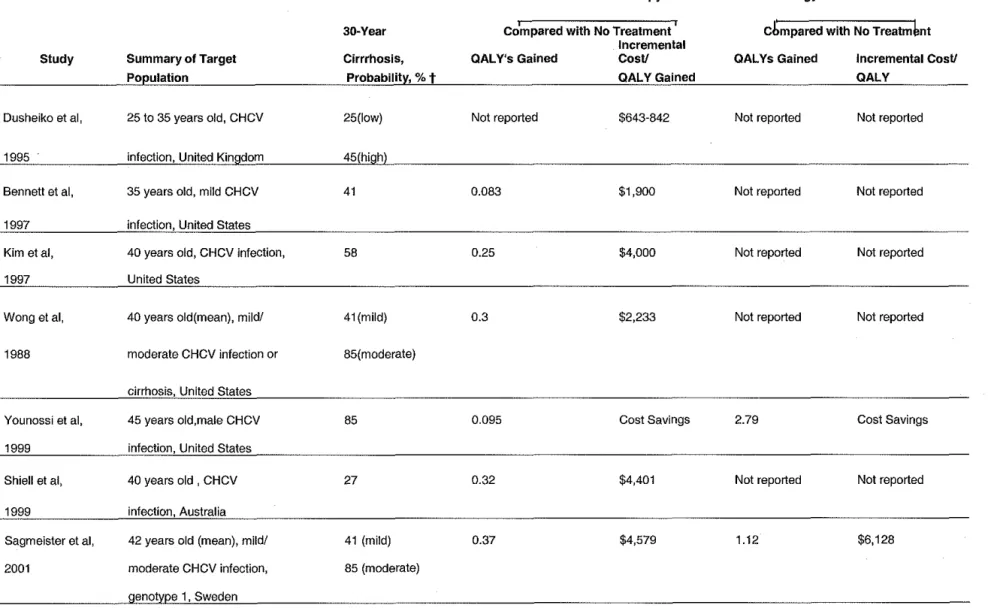
Solomon et al., in their study Cost-effectiveness of Treatment for Chronic
Figure 1. Selected Results on the Cost-effectiveness of Treatment for Chronic Hepatitis C Virius (CHCV) Compared with no Treatment
Interferon Monotherapy
Study
Dusheiko et al,
1995
Bennett et al,
1997
Kim etal,
1997
Wong etal,
1988
Younossi et al,
1999
Shiell et al,
1999
Sagmeister et al,
2001
30-Year
Summary of Target Cirrrhosis,
Population Probability, % t
25 to 35 years old, CHCV 25(1ow)
infection, United Kingdom 45(high)
35 years old, mild CHCV
infection, United States
40 years old, CHCV infection,
United States
40 years old(mean), mild/
moderate CHCV infection or
cirrhosis, United States
45 years old,male CHCV
infection, United States
40 years old , CHCV
infection, Australia
42 years old (mean), mild/
moderate CHCV infection,
genotype 1 , Sweden
41 58 41(mild) 85(moderate) 85 27
41 (mild)
85 (moderate)
~ '
Compared with No Treatment Incremental
QAL Y's Gained CosV QALYGained
Not reported $643-842
0.083 $1,900
0.25 $4,000
0.3 $2,233
0.095 Cost Savings
0.32 $4,401
0.37 $4,579
Pegylated~lnterferon
Cbmpared with
No
Treatm~ntQAL Ys Gained
Not reported Not reported Not reported Not reported 2.79 Not reported 1.12
Sennfait et al, 42 years old, mild/moderate 41 (mild)
2001 CHCV infection or cirrhosis, 85 (moderate)
genotype 1, Sweden
Stein et al, Mild/moderate CHCV 41 (mild)
2002 infection, United Kingdom 85(moderate)
Wong et al, 43 to 44 years old (mean) 41 (mild)
2002 CHCV infection, Belgium 85 (moderate)
Current Study 40 years old, CHCV infection, 30 (men)
Not reported
Not reported
Not reported
.047 (men)
Not reported
Not reported
Not reported
$36,300 (men) and
1.10 $5,900
1.06 $6,129
1.54 $786
.361 (men) $29,300 (Men) and
no fibrosis, genotype 1 , 9 (women) and 0.023 (women) $83,600 (women) and 0.238 (women) $48,000 (Women)
United States Abbreviation: QAL Y, quality-adjusted life year.
*Some figures have been estimated indirectly to enhance comparability between studies, for example those for which discounted benefits not reported Costs were converted to US dollars, where necessary, using official exchange rates. Details available from
authors.
Included in the 2003 El Paso County Department of Health of Environment Operational Plan for the HIV and Hepatitis C programs, "Center for Disease Control has estimated national medical and work-loss costs (excluding transplantation) of HCV patients to be over $600 million per year. (Walker, 2003) "In addition, an actuarial firm puts total health care costs of those infected with HCV at $15 billion a year." (Walker, 2003)
Current Programs In Other States
A presentation given by Laurie Schowalter at the 2005 Colorado Viral Hepatitis
& HIV co-Infection conference, Integrating Viral Hepatitis Into Existing Public Health Programs: Challenges and Opportunities reveals "Forty-eight states, three cities and the Indian Health Services are funded through CDC-DVH for a Hepatitis C Coordinator." (Schowalter, 2005) The average funding award is$ 77,000 to integrate with other public health programs. Also according to Schowalter "approximately 30 states have completed or are in the process of writing a State Hepatitis C/viral hepatitis Plan." (Schowalter, 2005) CDC lists the States that already have plans in place on their website
Recommendations for Policy Changes
The first recommendation for policy change involves the need for more research. More focused research is needed so that future program policies can be written. National Institutes of Health did identify some important areas in HCV research such as:
• The development of reliable, reproducible, and efficient culture systems for propagating the hepatitis C virus is considered to be of the highest priority. This goal is deemed essential not only for vaccine development but also for progress in the fundamental aspects of HCV biology, hepatic tropism, and rival
replication. Furthermore, this development will assist in new drug discovery, as well as enhance understanding of the mechanism of drug resistance.
• The role of genetic factors in the pathogenesis of HCV, including immune responses to infection, reasons for spontaneous resolution and variations in natural history, and responses to therapy, need further examination.
• Priority should be given to developing less toxic therapies and molecular-based agents that specifically inhibit viral replication and/or translation of Viral RNA. • Randomized controlled trials (RCT's) need to be carried out in special
populations of patients not represented in current trials to determine the
applicability of currently accepted treatment to these subgroups and the optimal doses and duration of therapy. These populations include children, patients with acute hepatitis, and patients in drug treatment programs. Research is also needed to define the best approaches to treating HCV in active drinkers, prisoners, those co-infected with HIV patients with concurrent renal disease and patients with major psychiatric illness.
• Little information exists to describe the natural history of the HCV viremia lasting 20 years or more. Studies are needed to examine the pattern of HCV disease progression in persons infected for at least two decades, including those infected as infants or children. (National Institutes, 2002)
Much of the current publication use data is based on the National Health and Nutrition Examination Survey (NHANES III, 1988-1994), which although was a national phone survey it did not include important populations such as incarcerated and homeless which hepatitis C has higher concentrations of infected individuals.
and categorized for the public to understand. The suggestion for high risk would include: injection drug users, hemodialysis patients, and recipients of transfusions or organs before 1992, those that received unprofessional piercing or tattooing, unsafe medical practices, and occupational exposure to infected blood, birth to an infected mother, sex with an infected person, high-risk sexual practices, and possibly intranasal cocaine use. The third recommendation is to encourage screening of all high risk groups. By doing this it will promote a standardization of screening. It will also allow those that are infected to be diagnosed earlier and thus allowing for implementation of appropriate treatment practices and better quality of care for those diagnosed. Development of testing procedures in specialized setting such as public health, correctional settings, drug
treatment and mental health facilities need to be implemented in multiple communities. Many programs must be developed without the appropriate funding available.
Furthermore, barriers to testing such as cost, lab tum-around times, lack of community resources and discrimination need to be addressed so that those at risk can learn their status.
The forth recommendation is to reduce the transmission of HCV. This can be done through education of the American public and especially by educating those
treatment needs to also be researched to prevent transmission. More education and screening is needed to prevent the transmission of mother-to-infant.
A firth recommendation is to develop new therapies to current treatment and prevention. This will be done witb more research, and will encourage the development of a vaccine. The development of the vaccine could prevent thousands from becoming infected and would also decrease the rate of liver transplantation. New therapies need to be developed to assist those individuals living with hepatitis C and have contraindications to current therapies because of other medical conditions such as depression and addiction.
Another recommendation is to encourage a comprehensive approach to promote the collaboration among the many health professionals concerned with the identification, management, and treatment of those affected with tbis virus. This disease incorporates many professionals including tbose that deal with addiction, primary care physicians, and specialist involved with various aspects of dealing with hepatitis C. A comprehensive approach is needed to guide those infected through the many providers of care that they will encounter through the management of their disease.
It would also be beneficial to create legislation and lobby for this disease and make it part of the national health agenda.
Conclusions
Hepatitis C is a major public health problem. It is the most common blood born pathogen in the United States, making HCV the most common indication for liver
Reference List:
Alter, M.,Seeff, L., Bacon, B., Thomas, T., Rigsby, m., & DiBisceglie, A. (2004). Testing for Hepatitis C Virus Infection Should Be Routine for Persons at Increased Rick for Infection. Annals oflntemal Medicine.141. 9, 715-717.
Alter eta!, Hepatology. 1997; 26 (Suppl1:625-655)
Armstrong, G., Wasley, A., Simard, E., McQuillian, G., Kuhnert, W., & Alter, M. (2006). The Prevalence of Hepatitis C Virus Infection in the United States, 1999 through 2002. Annals oflntemal Medicine. 144(10). 705-714.
Calonge, N., & Randhawa, G. (2004). The Meaning of the U.S. Preventive Services Task Force Grade I Recommendation: Screening for Hepatitis C Virus Infection.
Annals ofinternal Medicine,141,9, 718-719.
C. Everett Koop Institute at Dartmouth. (1998). Hepatitis C. Dartmouth, NH: Trustees of Dartmouth College, [Electronic version] Retrieved October 18, 2006 from
http://epidemic.org/theFacts/theEpidemic/
Center for Disease Control. (2006) State Hepatitis C/ Viral Hepatitis Prevention Plans. from http://www.cdc.gov/ncido<!fdiseases/hepatitis/partners/state_plans.htm Center for Disease Controls Viral Hepatitis C Website. (2006). Retrieved September
10,2006 from http://www .cdc.gov/ncidod/dieases/hepatitis/c/1 btinfo.htm Centers for Disease Control. (2006). National Hepatitis C prevention Strategy:
Implementation of tbe National Hepatitis C Prevention Strategy. In Viral Hepatitis C. Atlanta, GA: US Department of Health and Human Services. http://www.cdc.gov/ncidod/diseases/hepatitis/c/plan!Implement.htm
Centers for Disease Control. (1998). Recommendations for Prevention and Control of (HCV) Infection and HCV -Related Chronic Disease. In MMWWR
recommendations and reports (47(RR19), pp.1~39). Atlanta, GA: Centers for Disease Control.
Instone, S., Gilbert, T., & Mueller, M., (2003). Lessons Learned About Barriers to Hepatitis C Testing: Implications for Policy. Policy, Politics, & Nursing Practice.4 (4) 288-294.
National Digestive Diseases Information Clearinghouse (NDDIC). (2003, February). Chronic Hepatitis C: Current Disease Management (NIH Publication no. 03-4230). Bethesda, MD:NIH Publication
Salomon, J., Weinstein, M., Hammitt, J., & Goldie, S., (2003) Cost-effectiveness of Treatment for Chronic Hepatitis C Infection in an Evolving Patient Population. Journal of the American Medical Association. 290 (2), 228-237.
Schowalter, L. (2005). Intergrating Viral Hepatitis into Existing Public Health Programs: Challenges and Opportunities. Washington, DC: N atioinal alliance of Stante and Territorial AIDS Directors.
Walker, E. (2003) 2003 EPCDHE Operational Plan. Colorado Springs, CO: El Paso County Department of Health and Environment IDV /HCV Program.
Wong, J., McQuillan, G., McHutchison, J., & Poynard, T., (2000) Estimating Future Hepatitis C Morbidity, Mortality, and Costs in the United States. American Journal of Public Health. 90 (10), 1562-1569.
U.S. Preventive Services Task Force. (2004). Screening for Hepatitis C in Adults: