Coping with Information Disruption in A Simple Multi-Actor Information System
Marie-Laure Baron
University of Le Havre, CERENE-PETREL [email protected]
Hervé Mathieu
University of Le Havre, LITIS-PETREL [email protected]
Abstract
Information and knowledge management have become crucial to the development of a competitive edge on the market. This requires the gathering of complete and consistent information in an environment where companies are working increasingly with a vast network of partners. In this paper, we investigate the case of platforms on the tourism market selling trips in boxes thanks to a wide network of partners upstream (service providers) and downstream (distribution network). A particular case feature here is that the product is bought to be gifted which increases the complexity of the information gathering process. The information needs are defined as well as the potential information gaps. Solutions are discussed in order to reach information consistency through greater Information System integration: bridging information gaps appears to be mostly feasible but still leaves one actor in the shade. Platforms in the tourism market, even though they may get a good degree of qualitative information, will not achieve perfect information.
Keywords: Information System, Completeness, Consistency, Information Gap, Integration, Platform.
Introduction
Information has been hailed in recent years as a means for companies to develop a
competitive edge on the market (Porter and Millar 1985): it gives companies “new ways to
outperform their rivals”. Knowledge management is then focused on defining the necessary
information according to strategy and market needs, and on transforming this information
into knowledge. As stressed by (Aubertin 2004), in order to exploit its knowledge, a firm
must first be in a position to capture the proper data. Data processing and quick processing
should then rely on completeness and consistency of the data collected. The data collection
however is made complex because the value chain of companies is embedded in a larger
stream of activities (Porter and Millar 1985). The value system includes the value chains of
suppliers and the channels’ value chain. In many cases, considering the diversity of partners
prevents them from having a good picture of the processes at work or of the market they are
dealing with. Therefore, the way some companies manage to bridge that information gap is
of interest if it can benefit other companies.
In this paper, we are interested in Information Systems in the specific context of
platforms selling short stay tourism products in boxes such as Smartbox or Wonderbox.
These platforms act as intermediaries between final customers and service providers and
are set in the gift market. They coordinate and bind actors evolving on two separate markets
(two-sided markets). The buying and consumption process related to those platforms is a
complex process. Indeed, as we are dealing with an environment where different actors
intervene on the same process, a risk of having disruptions in the information chain does
exist. Thus, major constraints appear with the data collection on one hand and with the data
processing itself at a central level on the other hand. The problems to be solved in relation
to these constraints are twofold: the technical traceability of the goods the Information
System has to manage, and the management of a global centralized information system at
the platform level.
We will first present the companies studied in the case and the information needs in
relation with the sensitive processes as well as the information gaps. The difficulty of
tracing and integrating the information is demonstrated and finally, solutions to bridge the
information gaps are discussed. Such solutions provide improved consistency of the
Information System and may be particularly applied to the case of provider-customer
relationships.
Case Presentation
Several new companies have recently entered the market for tourism products through
short trips offered in a box such as the Smartbox: in a box the size of a CD, they offer a
thematic trip (“unusual escape”, “escape with dinner”, “culinary treats”, “adrenaline”,…),
usually acquired as a gift to be offered. In the box, one can find a voucher which can be
exchanged for a service provided by a tourist operator, who will return the voucher to the
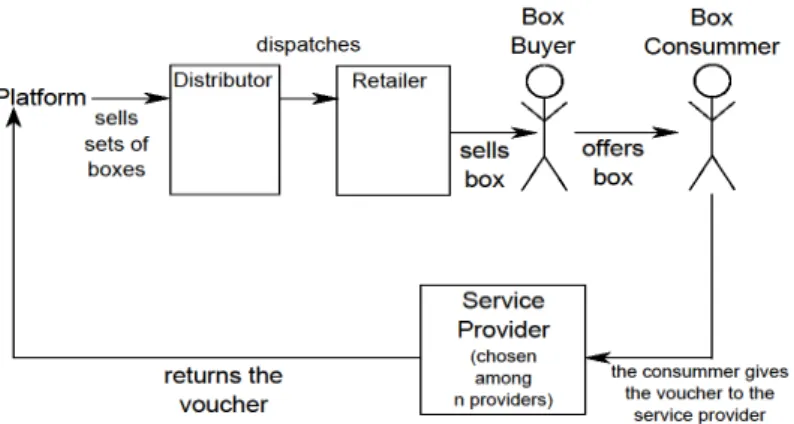
box producer for payment of the service provided (see graph 1 showing how the box and
voucher circulate during the consumption process). There is also a booklet featuring the list
of alternative service providers among which the beneficiary may choose from to consume
the service.
There may be 20, 50 or a hundred service alternatives in one box, spread over a given
territory (France, Britain,…), depending on the product definition, all of which may be
consumed at a chosen date. The beneficiary organizes his own transport and therefore the
box only offers the tourist service itself. Typically, for a given successful platform, a large
offer of boxes covers a wide price range from 50€ to 399€ and is intended for a vast target
(see Table 1 for main French company presentations).
Platforms, as pointed out by (Eisenmann et al. 2006), coordinate two sides of the market
through a number of rules that they set. The value generated by platforms then proceeds
from both sides of the market and lies in its coordination ability. The mastering of
information is therefore crucial for the purpose of enhancing and controlling the
coordination process.
Table 1
Presenting two main French platforms for short stay tourism products (Source: company websites
and Tourmag.com (march 29th 2010))
Platform Presentation of main companies
Smart & Co Created in 2003, employs 700 people in 20 countries in 2009, sales: 337 million €, 3,2 million gift boxes sold in 2009.European market leader with the Smart Box, and other brands such as Buyagift in the UK. About 70 competitors in France (mainly small competitors).
Wonderbox Created in 2004, employs 200 people in 2009, sales 60 million € (40% in December) with 8500 activities provided. Mainly on the French market.
The tourism platform here, as the creator and promoter of the tourism products, acts on
both sides of the market: on one side, it interacts with the retailers and the distribution
organizations by whose intermediary it promotes the offer; on the other side, the platform
interacts with a network of service providers willing to be included in the offer and with
whom contracts are signed to set the price of the service and delivery conditions. Each box
has a given life duration in relation with the length of the contracts signed with service
providers. Once the duration of the product is finished, at the end of the contract with the
providers, the service can’t be consumed anymore, and if everything goes according to
plan, all the boxes will have been sold and the services consumed. The standard duration is
of about 18 months. The value created by the tourism platform then proceeds from the
quality of the coordination of offer and demand between the two sides of the market in a
given period of time during which the box is purchased and then consumed.
Distribution of the products is intensive. Products are available in all possible channels:
internet website of the product creator, internet website of various affiliates, large retailers,
specialty retailers (depending on the theme of the box, beauty services in beauty shops...),
travel agencies which complete their offer with short stays, work councils and firms for
their incentive programs intended for their customers or their sales force, carry the
products. Moreover, the market is dynamic and needs to be fed with frequent product
launches and adaptation to events (Christmas, Valentine’s day, Mother’s day, Father’s
The variety of actors, providers, channels and services concerned, results in a complex
network of scattered agents. These elements make the data collection process difficult as
well as important to adapt to market conditions.
In graph 1, it is possible to follow the steps of the box from the point where it is created,
at the platform level, to the point where it is effectively consumed, at the service provider
level, and back to the platform. A support for the product traceability appears as we can
observe that the box or its voucher circulate all through the process. This first graph gives
us an overview of the global distribution process of the service and of the various actors
interfering in this process. The process is quite traditional is some aspects but includes a
specificity. It is traditional in the sense that the products flow through a network of
distributors or retailers to the hands of a purchaser. However, because the box is mainly
bought as a gift, the purchaser is not the consumer and we therefore have a potential
information gap. Because we have a voucher circulating, the information collection is in
some ways made easier than in other cases.
Figure 1 . Selling process of the boxed tourism product
Information Disruptions Related to the Global Process
Gathering the needed information will enable the platform to go through operational
management as well as new product launching more quickly and in a cheaper way when
fully exploiting the database thus created. However there is still to solve the problems
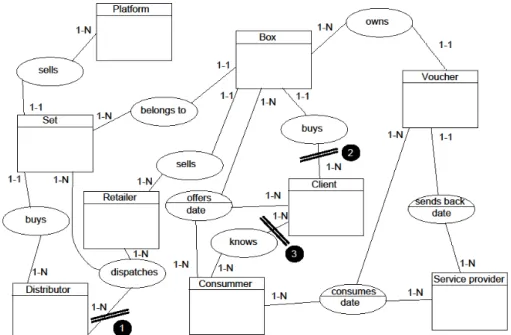
linked to lack of information (graph2), which leads us to the source of the collected data.
A “classic type” of information gap is due to the fact that the product is distributed
through intermediaries which may be more or less numerous in the channel. These
intermediaries may not necessarily transfer information about the customers to the
platforms as this information is private. Transfer of the information may also be costly in
terms of time and Information System investment which suggests that, even when possible,
this transfer may not always be actually achieved. In this particular case, the voucher
circulation enables to gather most of the information either through the distributor, or
information gaps 1 and 2 in graph 2 show that the platform may not know which retailer
sold a given box (or which store within a given retailer sold a given box), nor the
characteristics of the customer which bought the box. These two pieces of information may
however be of interest: the information on the box purchaser, to get a better picture of the
purchaser profile; the information about the store which sold the box may enable the
platform to design geographical consumption patterns which could lead to product
adaptation according to store sales. A codification of the voucher and the allotment of
orders per store, submitted to retailer agreement, may enable to obtain the information of
where exactly the box was purchased and relate with the consumption location by just using
the voucher. The purchaser however still remains unknown.
A less usual type of information gap is linked to the type of product: a product to be
gifted. In that particular environment, even though you may obtain information on the
purchaser, you still need to know, for a matter of data processing, who the purchase is
designed for. A last potential information gap is therefore related to finding out the link
between the person who makes the gift and the person who receives the gift.
Graph 2 gives a representation of the processes at work between the various interferers
in the global system. The main potential information gaps mentioned above are represented
with numbers 1, 2 and 3. These are only the main potential gaps, but of course, others may
appear due to the complexity and multiplicity of actors in the information chain.
Not only is the Information System built on a variety of types of actors, but there is also
a wide number of each type of actor, particularly at the distribution stage. The box may
indeed be held by 6 different levels and circulates through 6 levels:
• From the platform to the distributor (level 0 to 1),
• From the distributor to the retailer (level 1 to 2),
• From the retailer to the purchaser (level 2 to 3),
• From the purchaser to the consumer (level 3 to 4),
• From the consumer to the service provider (level 4 to 5).
For each box, moving to the next level, there is a large number of possible receivers. The
difficulty in such an Information System is due to the fact that there are multiple potential
nodes and that the breaking of the information chain at the stage of one particular node is
sufficient to make it impossible to trace the box through the whole process and therefore to
Figure 2. Presenting the different relations in the network of partners (information breakings)
When the multi-actor information system is built in a way that it links all the actors,
traceability is made easy. However, linking all the actors is more difficult when the
multiply in numbers and characteristics.
Figure 3. The numerous actors in the process and potential complexity of the information system
Coping With the Information Gaps in the Case of Tourism Platforms
We now discuss the effective and possible traceability along all the nodes of the chain.
Two specific aspects are studied in the objective of reaching data consistency: one aspect
relates to the technical traceability and another aspect relates to the potential difficulties in
driving the information back to the platform.
Possible technical traceability and information retrieval
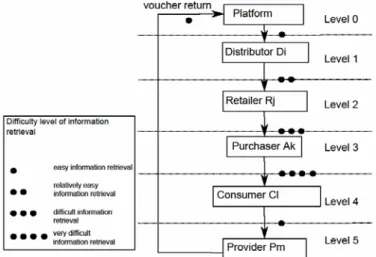
different levels of the distribution process in the current situation. As shown, technically the
most difficult step to pass is the one between the purchaser and the beneficiary of the box.
Indeed, between the other parties, tracing may be undergone quite easily by using the
voucher as thoroughly as possible. But there is no technical link between the purchaser and
the beneficiary of the box.
Another quite difficult step is the one linking the retailer to a given purchaser. Indeed,
getting information about the purchaser profile is technically feasible thanks to store cards.
However, this information may not be easy to gather: it depends on the ability of the retailer
to distribute the store card, to create incentives for the customer to use the card, and to
exploit massive data. This is particularly true when one considers that the boxes are a very
small and supplementary type of assortment for the store and account for only a small part
of store sales. There is little incentive for the retailers to focus on this particular
information. Traceability may technically be obtained however. Finally, even though the
tracing process may seem easy at the other stages, it is not obvious because of the number
of nodes involved and the possibility of having weak nodes at different stages of the
distribution process.
The retrieval of information presents more or less the same difficulties. Knowledge
about which distributors received the boxes is easy to gather as the platform sends the
boxes herself. Knowledge about where the distributor level sends the boxes is more
difficult to obtain and depends on specific agreements. The distributor must then keep track
of the information and retrieve it to the platform. Depending on the internal structure
between the distributor and the retailer this information is more or less accessible.
Obtaining the information about the purchase itself is made difficult because the tracing is
less qualitative as mentioned before (incomplete), and it may be costly to retrieve the
information to the platform. The link between the purchaser and the beneficiary of the box
is still difficult to make. Finally, information on the consumer may be retrieved through the
voucher handing at the service provider level. This way, the platform may know who the
Figure 4. Level of difficulty of information retrieval
The voucher itself is easily retrieved as it triggers the service provision payment to the
provider. The voucher may give information on: the box itself, the provider selected in the
box, location of consumption and location of purchase (if codified and pre-allotted for
stores), consumption dates and more information may be joined such as that gathered
through a simple questionnaire: on what occasion was the box gifted, by whom, age of
beneficiary,…filled in by the service provider.
The processes defined here thus feature difficult information integration at some
particular stages of the distribution process. We will now proceed to discuss the ways to
reach the finest possible tracing and information retrieval.
Coping with information gaps and discussion
There are several ways of coping with the potential information gaps in order to obtain
information completeness and consistency. An interesting field to solve this problem is
what is called interoperability between systems and enterprises (Bauer et al. 2005). The
concept of interoperability first appeared in the domain of computer science in the early
1990s and has been developed continuously and extensively in many domains such as
military, medical, transportation, software, etc… (DoD 2001) (ISO 16100 2002) (APFA
2004). Since then, many definitions related to this concept have been proposed. The most
quoted one was given by (IEEE 1990) which defines interoperability as the ability of two or
more systems or components to exchange information and to use the information that has
been exchanged. A number of interoperability frameworks have been developed in various
domains: IDEAS (Interoperability Development for Enterprise Application and Software)
(IDEAS 2003), AIF (ATHENA Interoperability Framework) (Athena 2004), EIF
(Enterprise Interoperability Framework) (Chen et al 2006). All these frameworks are very
conceptual.
would be to support the processes which are going across organization’s borders (Aubert et
al. 2002). One way is to perform the global Information System interoperability is to
interface the various systems between themselves. This first solution is however uneasy to
apply.
One reason for this is that the network of partners is very large and new partners may
enter at any time as well as former partners may drop out of the network. The variability of
the perimeter makes it difficult to grasp the information in a stable integrated system.
Moreover, some important nodes, such as the purchaser or the consumer do not have an
information system. Store cards or loyalty cards in general may enable to obtain
information and information feedback on the purchaser or consumer and on the link
between the two. However, as mentioned before, the information may still remain
incomplete, and information retrieval to the platform through the network of retailers with
various strategies and structures in far from being guaranteed. Obtaining complete and
consistent information at a central level is therefore not very credible if the solution
envisaged is to interface information systems: too complicated, too costly and not even
efficient.
Another solution is therefore to build a dedicated central system on which each of the
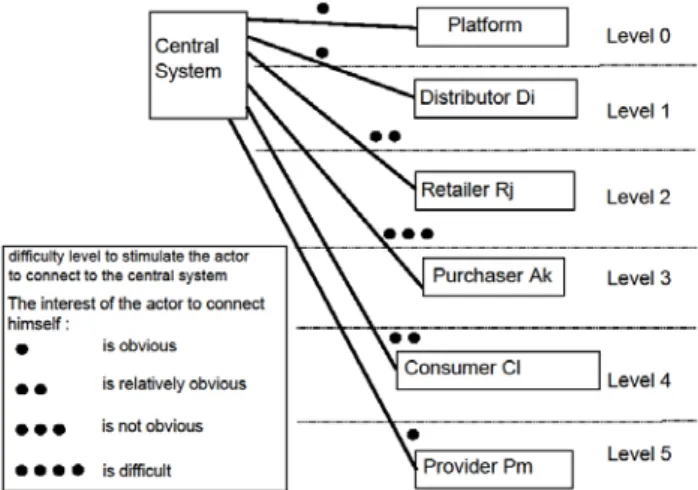
various actors may connect or be connected (graph 6). The main advantages of this system
are its flexibility compared to the previous hypothesis of interfacing and easy management.
Indeed, it is not necessary here to interface various and multiple information systems nor to
fight to centralize information: the information is naturally centralized.
Figure 5. Integrating information at a dedicated central system: incentives for partners to
forward information
Reliability of the system however requires that the information flows easily into the
system. Part of the information may be obtained easily through the use of the voucher as an
the voucher may enable to retrieve information on the place where it was sold, the place
where it was consumed, the consumption date (preferred period of consumption and cash to
cash cycle time), the provider selected within the box. Codification of the boxes and an
allotment at the platform level of the orders for the stores gives a good result in terms of
tracing and information retrieval of where the boxes were sold. More information has to be
keyed-in in order to reach easy management such as a list of potential providers for each
box and their characteristics or the contract dates with the providers during the life-time of
the boxes for renewal. Automatic search may also be organized in order to scrutinize
competitor’s offers and prices and identify discrepancies or opportunities. But as we’ve
mentioned before, the most difficult information to gather is the one concerning the
purchaser and consumer. Centralizing the information demands that incentives be created
for these actors to connect with the central system so that they can be traced and the
information retrieved immediately. Incentives may be of promotional type: winners at stake
for example. It is also possible to create some sort of reservation procedure such as the
beneficiary of the box has to connect and get known by the central system to make the
reservation or to validate the reservation process. This will enable the platform to gather
information on: the fact that the box offered is going to be used, the consumer profile,
occasion or reason of the gift and the characteristics of the gifter. This reservation
procedures may also enable the platform to gather information on difficulties of access
(reservation) to some providers at given dates, customer dissatisfaction and claims. If the
customers get used to using the platform website, this also reduces the platform dependency
on the network of retailers.
It appears in the end that the actor which is most difficult to grasp is the purchaser as
there is very little incentive for her to connect to the centralized Information System.
Therefore, the weak node in the global Information System is the purchaser which can only
be known through the retailer club card intermediary, in the case of web purchases and
through the information disclosed by the beneficiary which is necessarily limited due to
private protection behavior and regulations.
The main problem in the end in this information system is not linked to information
about the box beneficiary, but about the box purchaser which remains mostly unkown. The
weakest link in the information chain is therefore the purchaser. It is therefore possible to
create a reliable information chain between all actors except for the purchaser.
Conclusion
In this paper, we are interested by Information Systems, in the specific context of
platforms selling short stay tourism products. We showed the difficulty to apprehend the
buying and the consumption process, because of the possible breaking of the information
centralized system rather than through the interfacing of separate information systems. This
is done through centrally keyed information, automatic information integration (voucher
circulation) and voluntary customer connection to the central system. The weak link in this
chain is the purchaser of the box which remains the least known in the system. A particular
attention should therefore be given to find out mechanisms capable of gathering
information on the purchaser in order to complete the information chain and be capable of
exploiting thoroughly reliable data.
References
AFPA, Association pour Promouvoir le Français des Affaires, 2004. www.
pressefrancophone.org.
ATHENA Integrated Project, 2004. Requirement for interoperability framework,
product-based and process-product-based interoperability infrastructures, interoperability life-cycle
services, ATHENA deliverable A4.1.
Aubert B. and Dussart A., 2002. Systèmes d’Information Inter-Organisationnels, Rapport
Bourgogne, CIRANO.
Aubertin G., 2004. Cartographier les connaissances critiques, Management des
connaissances en entreprise, Lavoisier, Paris.
Bauer B. et al., 2005. Adaptive design of cross organizational business processes using a
model-driven architecture, International Conference on Business Information Systems
(Wirtschaftsinformatik 2005), Physica-Verlag, pp. 103-121.
Chen D. et al., 2006. Interoperability Knowledge Corpus, Intermediate Report, Deliverable
DI.1b, Network of Excellence InterOp, Contract No.IST-508011.
DoD, Department of Defense, 2001. Department of defense Dictionary of Military and
Associated Terms, United States of America Department of Defense.
Eisenmann T. et al., 2006. Strategies for Two-Sided Markets, Harvard Business Review,
October.
IDEAS, 2003. A gap Analysis –Required activities in Research, Technology and
standardisation to close the RTS Gap- Roadmaps and Recommendations on RTS
activites, IDEAS Deliverables.
IEEE, 1990. Standard Computer Dictionary - A Compilation of IEEE Standard Computer
Glossaries.
ISO 16100, 2002. Industrial automation systems and integration, Manufacturing software
capability profiling for interoperability, Part 1: Framework, ISO/TC 184/SC 5/WG 4.
Porter M.E. and Millar V.E., 1985. How information gives you competitive advantage,
Harvard Business Review, October.
Smartbox and Wonderbox, 2007, interviews of beneficiaries and providers.