International Research Journal of Pharmaceutical and Biosciences (IRJPBS) 3 (3) 1
RESEARCH ARTICLE
International Research Journal of Pharmaceutical and Biosciences
Pri
-
ISSN: 2394 - 5826http://www.irjpbs.com e-ISSN: 2394 - 5834
Screening of Antimicrobial Activity of Selected Herbal
Plants against
Shigella spp.
Isolated from Dysentery Cases
Kalaivani S1, Ramyabharathi V1, Shanthini S1, Senthamizhselvi S1, Ramesh K2
*
1Department of Biotechnology, Vivekanandha College of Arts and Sciences for Women
(Autonomous), Tiruchengode -637205.
2∗PG & Research Department of Microbiology, Adhiparasakthi College of Arts and Science
(Autonomous), Kalavai – 632 506.
Article info Abstract
Article history: Received 08 APR 2016 Accepted 12 APR 2016
*Corresponding author: [email protected]
Copyright 2016 irjpbs
Dysentery can be serious disease if timely appropriate treatment is not given. Shigella species are the major cause of bacillary dysentery, a disease characterized by severe abdominal cramps and the frequent, painful passage of low volume stool containing blood and mucus. Four major sero groups are available in Shigella species. In the present study five strains belonging to two species namely
Shigella dysenteriae and S. flexneri were isolated from the stool of
infected patients. They were identified on the basis of biochemical tests. Antimicobial activity of the five selected medicinal plant was carried out by disc diffusion and cold extraction methods. Results revealed Punica granatum as the best herb for use against all the five strains. The extracts of Mangifera indica exhibited high activity when compared to Acorus calamus and Artemesia paveiflora. These results suggest that active principles present in them and the mode of their action on organism are totally different. Therefore, it is essential to characterize the active principles and understand their mechanism of action for a commercial preparation of herbal drugs.
International Research Journal of Pharmaceutical and Biosciences (IRJPBS) 3 (3) 2
INTRODUCTION
Due to the indiscriminate use of antimicrobial drugs, microorganisms develop resistance to many antibiotics. In addition to this, many of them are known to have many side effects. So there is a need to screen the medicinal plants for possible antimicrobial properties. Medicinal plants are of great importance to the health of individuals and communities. The medicinal value of these plants lies in some chemical substances that produce a definite physiological action on the human body and these bioactive substances include tannins, alkaloids, carbohydrates, terpenoids, steroids and flavanoids [1].
These compounds are synthesized by primary or rather secondary metabolism of living organism. Secondary metabolites are chemically and taxonomically extremely diverse compounds with obscure function, so used human therapy [2]. Man has been using plant to cure different associated with pathogenic bacteria since antiquity. According to a study conducted by the WHO based on publication on pharmacopeias and medicinal plants in 91 countries, the number of medicinal plant is nearly 2100. About six to seven thousand species of medicinal plants out of about 17 to 18 thousand flowering plants are known to be use in folk (tribal) and officially recognized systems of medicine in India i.e. Ayurveda, Sidha, Unani and Homeopathy [3].
In India, the Ayurvedic system of medicine has been in use for over 1000 years. Medicinal plants have their values in the substance presence in various tissues. These active substances present in the storage organs of the plants namely leaf, latex, roots, stem, fruits, seeds and etc. Hence, the present study has been undertaken based on the world wide importance of the herbal medicinal plants has got in the recent year. In this present study,
five medicinal plants via, Mangifera indica (mamaram), Acorus calamus (Vasambu),
Artimesia parvirflora (Mariangolundu), Punica granatum (Maduli), Aegle marmelose (Vilvam) were taken for the analyses of antimicrobial activity against the Shigella spp. Isolated from dysentery cases.
MATERIALS AND METHODS Isolation of pathogens
A total of 20 stool samples were collected from one private hospital. All the samples were collected during early morning using sterile wide mouth container. The stool samples were subjected to gross examination for the presence of parasites. Microscopic examination was done on wet mount using Lugol’s iodine. Stool samples were inoculated in to the various
culture mediums incubated at 37°C for 24hrs. After incubation colony morphology was
observed and recorded.
Identification of Pathogens
International Research Journal of Pharmaceutical and Biosciences (IRJPBS) 3 (3) 3 by gram staining, motility, IMViC test, urease production, nitrate reduction, decarboxylation of lysine, ornithine and arginine, phenylalanine deaminase, oxidase, catalase and TSI agar test.
Plant selected for this study
Mangiferaindica (mamaram), Acoruscalamus (Vasambu), Artimesiaparvirflora
(Mariangolundu), Punicagranatum (Maduli), Aeglemarmelose (Vilvam). Collected plants
were shade dried under room temperature, after drying; the plants were powdered with the help of mechanical blender and subjected for extraction.
Soxhlet extraction
The powdered materials were placed in the soxhlet extractor, and then the organic solvents were added into the soxhelt extractor at the ratio 1:10 in to the each of the samples to extract anti-microbial compounds. The collected extracts were concentrated by exposing them in air and stored at 4°C until further use [4].
Cold extraction method
Measured amount of air-dried powdered plant material was taken in an aspirator bottle and powder was soaked in solvents for 3 days at room temperature. On 4th day, the extract was separated and centrifuged at 5,000 rpm for 5 minutes and supernatant was taken and evaporated in vacuum to get a viscous residue, the pellet were taken and weighed and dissolved in phosphate buffer and subjected to anti-microbial screening by disc diffusion method.
Antimicrobial screening of plant extract
Disc diffusion method was adapted to screen anti-microbial activity of plant extracts [5]. The Mueller Hinton agar plates were prepared and the overnight test culture was smeared on the agar surface using sterile cotton swab. About 50µl of plant extract was added into the sterile disc with the help of micropipettes, and then allowed for air dry. The disc contained plant extract were placed on agar surface. Positive (antibiotic disc) and negative (sterile disc) control were also maintained for comparison. After incubation the zone of inhibition was observed and recorded.
Antibiotic Assay
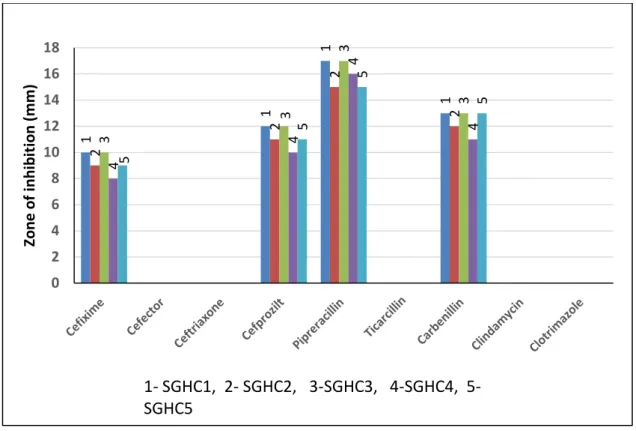
Antibiotic assay was performed to measure the multiple resistant nature of the isolates. Mueller Hinton agar was prepared and swabbed with test culture. Antibiotic discs (obtained from Hidden Markov models-med Laboratories Pvt., Mumbai) were placed at a regular interval and incubated aerobically at 37°C for 24 hours.
RESULTS AND DISCUSSION
International Research Journal of Pharmaceutical and Biosciences (IRJPBS) 3 (3) 4 products have been specifically targeted against resistant pathogenic bacteria [6]. Therefore the use of indigenous medicinal plants as an alternative to antibiotics is being extensively evaluated these days and is considered to play a significant role [7]. Diarrhea diseases are a major global public health problem. Infectious diarrhea (i.e. diarrhea due to microorganisms) being the most common of them. Shigellais being the most frequent cause of dysentery in developing countries. About 6,50,000 deaths have been reported worldwide annually due to Shigellosis [8]. World Health Organization has assigned very high priority to the Shigella
infection. Totally 20 samples were collected and were subjected to microbiological examination. Microscopic examination of stool sample was performed to find out nature and viscosity of the stool specimen. Preliminary protozoan parasites were screened by iodine wet mount method and six samples were found to positive to Amoeba, Giardia and Balantidiun. Shigella strains were isolated by the methodology described earlier and the
observation on selective medium showed specific colony growth. Characters of Shigella
species were differentiated by using biochemical test. Totally five Shigella strains (SGHC1,
SGHC2, SGHC3, SGHC4 and SGHC5) were isolated and differentiated as Shigella dysentriae
and Shigella flexneri.
The ethanolic and hexane extracts of five plant species namely Mangifera indica (Mango),
Punica granatum (Madulai), Artimesia parviflora (Mariangolundu) and Acorus calamus
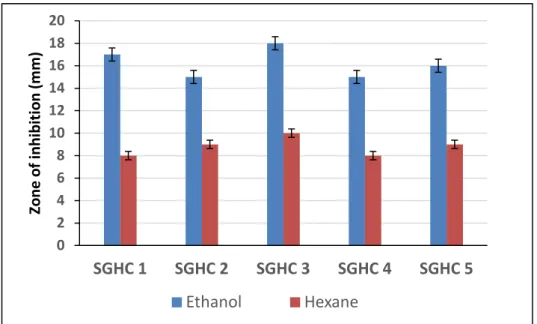
(Vasambu) were analyzed for their antimicrobial activity through disc diffusion method. Both ethanolic and hexane extracts of Punica granatum were found to be effective against all the five strains tested. However the zone of inhibition of ethanolic extract was higher (16.2mm) than the hexane extract (8.8 mm) (Figure 1 - 5). This result is in agreement with the use of leaf juice and the decoction of the bark in the treatment of dysentery [9, 10].
Fig. 1 - Antimicrobial activity of Punica granatum
0 2 4 6 8 10 12 14 16 18 20
SGHC 1 SGHC 2 SGHC 3 SGHC 4 SGHC 5
Zo
ne
o
f i
nhi
bi
tio
n (
m
m
)
International Research Journal of Pharmaceutical and Biosciences (IRJPBS) 3 (3) 5 Stem park of M. indica showed significant antibacterial and antifungal activities against
Streptococcus pneumonia, Enterobacter aerogenes, Klebsiella pneumonia and Candida
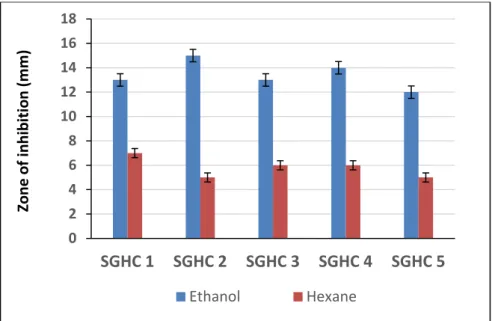
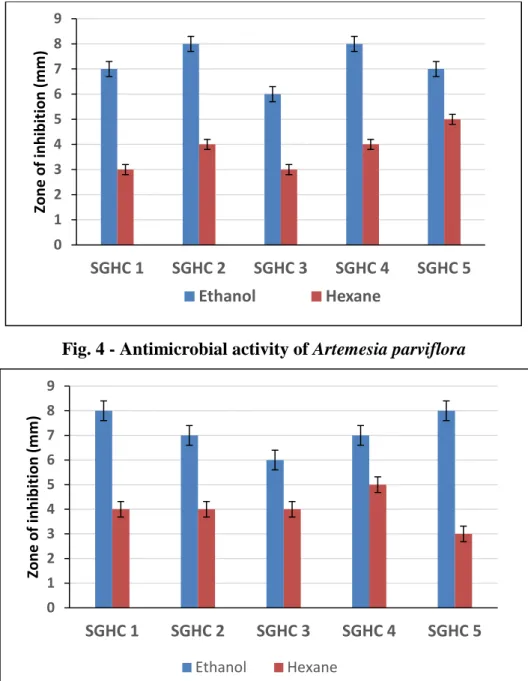
albicans [11]. The presence of phytoconstituents in the leaf extracts may be responsible for the antibacterial activity of the plant [12]. No research has been carried out on antimicrobial activity of seeds extract of mango (M. indica). In this study, the in vitro antimicrobial activity of ethanolic and hexane extracts of the seeds of mango (Mangifera indica) was investigated. All the five isolated strains were found to be sensitive to the two extracts of Mangifera indica. As in the previous case ethanolic extract showed higher efficiency. A similar trend was seen in the extracts of Artemesia parviflora, Acorus calamus and Aegle marmelose also. A comparative analysis of the five plant extracts indicates that Punica granatum is more effective than the other four.
Fig. 2 - Antimicrobial activity of Mangifera indica
Fig. 3 - Antimicrobial activity of Acorus calamus
0 2 4 6 8 10 12 14 16 18
SGHC 1 SGHC 2 SGHC 3 SGHC 4 SGHC 5
Zo
ne
o
f i
nhi
bi
tio
n (
m
m
)
Ethanol Hexane
0 1 2 3 4 5 6 7 8 9
SGHC 1 SGHC 2 SGHC 3 SGHC 4 SGHC 5
Zo
ne
o
f i
nhi
bi
tio
n (
m
m
)
International Research Journal of Pharmaceutical and Biosciences (IRJPBS) 3 (3) 6
Punica granatum (pomegranate) is one of the oldest known edible fruits. It has been widely used in traditional medicine in America, Asia, Africa and Europe for the treatment of different types of diseases. In addition to its ancient historical uses, pomegranate is used in several systems of medicine for a variety of ailments [13]. In Ayurvedic medicine, pomegranate is considered “a pharmacy unto itself” and is used as an anti-parasitic agent, a “blood tonic,” and to heal aphthae, and ulcers [14]. However, to date, very few studies have been conducted on the antimicrobial activity of P. granatum peels. Therefore, the present study was aimed to evaluate the antimicrobial activity of the ethanolic and hexane extract of
P. granatum peel against various enteric pathogens in vitro.
Fig. 4 - Antimicrobial activity of Artemesia parviflora
Fig. 5 - Antimicrobial activity of Aegle marmelose
0 1 2 3 4 5 6 7 8 9
SGHC 1 SGHC 2 SGHC 3 SGHC 4 SGHC 5
Zo
ne
o
f i
nhi
bi
tio
n (
m
m
)
Ethanol Hexane
0 1 2 3 4 5 6 7 8 9
SGHC 1 SGHC 2 SGHC 3 SGHC 4 SGHC 5
Zo
ne
o
f i
nhi
bi
tio
n (
m
m
)
International Research Journal of Pharmaceutical and Biosciences (IRJPBS) 3 (3) 7
Fig. 6 - Antibiotic assay
Prasanth et al., 2001, reported that, different extracts of P.granatum fruit showed some antibacterial activity against Proteus vulgaris and Bacillus subtilis [15]. Voravuthikunchai
et al., (2004) reported that P.granatum contains large amount of tannins (25%) and the antibacterial activity may be indicating the presence of some secondary metabolites [16]. In this study, it was also observed that Punica granatum extract is more effective than other four for controlling Shigella strains isolated from stools of infected patients. These results suggest that active principles present in them and the mode of their action on organism are totally different. Therefore, it is essential to characterize the active principles and understand their mechanism of action for a commercial preparation of herbal drugs.
REFERENCES
1. Edeoga HO, Okwu DE, Mbaebie BO: Phytochemical constituents of some Nigerian
medicinal plants. African Journal of Biotechnology, 2005, 4(7): 685-688.
2. Vasu K, Goud JV, Suryam A, Singara, Chary MA: Biomolecular and phytochemical
analyses of three aquatic angiosperms. African journal of Biotechnology, 2009, 4(7): 685-688.
3. Varahaloraovadlapudi, Behara M, Kaladhar DSVGK, Kumar SSVN, Swshagiri B,
Hohnpaul M: Antimicrobial profile of crude extract of Calotropis procera and Centella
asiatica against some important pathogens, Indian journal of science and
Technology, 2012, 5(8): 3132-3136.
1
1
1
1
2
2
2
2
3
3
3
3
4
4
4
4
5
5
5
5
0 2 4 6 8 10 12 14 16 18
Zo
ne
o
f i
nhi
bi
tio
n (
m
m
)
International Research Journal of Pharmaceutical and Biosciences (IRJPBS) 3 (3) 8
4. Tanira MOM, El-Sabban F, Fahim MA, Wasfi IA: Acetyl Salicylic acid alleviates
increases susceptibility to thrombosis in pial microvessels of dehydrated mice. J Vet Med Sci, 1994, 56:245-248.
5. Bauer AW, Kirby WMM, Sherris JC, Turck M: antibiotic susceptibility testing by a
standardized single disk method. The American Journal and clinical pathology. 1996, 45: 493 – 496.
6. Choi SH, Woo JH, Lee JE et al: Increasing incidence of quinolone resistance in human non-typhoid Salmonella enterica isolates in Korea and mechanisms involved in
quinolone resistance. Journal of Antimicrobial Chemotherapy. 2005, 56(6): 1111–
1114.
7. Ballal M, Ramamurthy T: Enteroaggregative Escherichia coli Diarrhea in Manipal.
Indian Pediatrics, 2005, 42: 722-723.
8. Bridi TF, Dasaram PG, Gntarlian D, Antia S: Need for bioassays to establish
antidiarrheal activity of two medicinal plants, journal of research find, 2001: 221 – 22.
9. Anonymous: Wealth of India, Publication and Information Directorate (CSIR), New
Delhi. 1969, 8: 317-324.
10.Satyavati GV, Gupta AK, Tandon N: Medicinal plants of India, Indian Council of
Medical Research, New Delhi, 1978, 2: 539-544.
11.Singh S, Khatoon S, Singh V, Kumar A, Rawat K, Mehrotra S: Antimicrobial Screening
of Ethnobotanically Important Stem Bark of Medicinal Plants. Pharmacognosy
Research. 2010, 2: 254-257.
12.Marjorie MC: Plant Products as anTimicrobial Agents. Clinical and Microbiology
Reviews. 1999, 12: 564-582.
13.Olapour S , Najafzadeh H: Evaluation Analgesic, Anti-Inflammatory and Antiepileptic Effect of Hydro Alcoholic Peel Extract of Punica granatum (pomegranate). Asian Journal of medical Sciences, 2010,2(6): 266-270.
14.Julie Jurenka MT: Therapeutic Applications of Pomegranate (Punica granatum L.): A Review. Alternative Medicine Review, 2008, 13(2): 128-144.
15.Prashanth D, Asha MK, Amit A: Antibacterial activity of Punica granatum. Fitoterapia. 2001, 72: 171-173.
16.Voravuthikunchai S, Lortheeranuwat A, Jeeju W, Sririrak T, Phongpaichit S, Supawita T: Effective medicinal plants against Enterohaemorrhagic Escherichia coli O157: H7.