Review
article
Criticality
in
the
brain:
A
synthesis
of
neurobiology,
models
and
cognition
Luca
Cocchi
a,*
,
Leonardo
L.
Gollo
a,
Andrew
Zalesky
b,
Michael
Breakspear
a,ca
QIMRBerghoferMedicalResearchInstitute,Brisbane,Australia b
MelbourneNeuropsychiatryCentre,TheUniversityofMelbourne,Melbourne,Australia c
MetroNorthMentalHealthService,Brisbane,Australia
ARTICLE INFO
Articlehistory:
Received23December2016 Receivedinrevisedform15June2017 Accepted13July2017
Availableonline19July2017 Keywords: Bifurcations Metastability Multistability Dynamics Power-law Cognition ABSTRACT
Cognitivefunctionrequiresthecoordinationofneuralactivityacrossmanyscales,fromneuronsand circuitstolarge-scalenetworks.Assuch,itisunlikelythatanexplanatoryframeworkfocuseduponany singlescalewillyieldacomprehensivetheoryofbrainactivityandcognitivefunction.Modellingand analysis methods for neuroscienceshould aim toaccommodate multiscale phenomena. Emerging researchnowsuggeststhatmulti-scaleprocessesinthebrainarisefromso-calledcriticalphenomena thatoccurverybroadlyinthenaturalworld.Criticalityarisesincomplexsystemsperchedbetweenorder anddisorder,andismarkedbyfluctuationsthatdonothaveanyprivilegedspatialortemporalscale.We reviewthecorenatureofcriticality,theevidencesupportingitsroleinneuralsystemsanditsexplanatory potentialinbrainhealthanddisease.
©2017ElsevierLtd.Allrightsreserved.
Contents
1. Introduction ... 133
2. Criticalityinphysicalsystems ... 133
2.1. Criticalityandbifurcations ... 133
2.2. Criticalityandphasetransitions ... 135
2.3. Theconceptualappealofcriticality ... 138
2.4. Self-organisedcriticality ... 139
3. Criticalityinthebrain ... 139
3.1. Rhythmicfluctuations,bifurcationsandslowingdown ... 139
3.2. Neuronalavalanchesandphasetransitions ... 139
3.3. Computationalaspectsofneuronalcriticality ... 141
3.4. Self-organisedneuronalcriticality ... 142
4. Challengesandpitfallsofthecriticalityhypothesis ... 142
5. Emergingroleofcriticalityincognition ... 143
5.1. Criticalityinbrainandbehaviour ... 144
5.2. Suppressionofcriticalityduringtaskperformance ... 145
6. Criticalityindisease ... 146
6.1. Bifurcationsandseizures ... 146
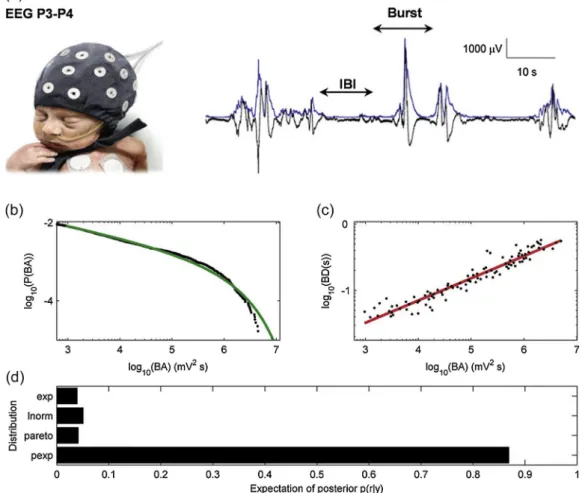
6.2. Cracklingnoiseandneonatalburst-suppression ... 146
6.3. Criticalityandneuropsychiatricdisorders ... 147
7. Summary ... 147
Abbreviations: ATP, AdenosineTriphosphate;BS,Burst suppression;DC, Directcurrent;DFA, Detrendedfluctuationanalysis;ECoG,Electrocorticography;EEG, Electroencephalogram;fMRI,Functionalmagneticresonanceimaging;GABA,Gamma-Aminobutyricacid;IBI,Inter-burstinterval;MEG,Magnetoencephalography;REM, Rapideyemovementsleep;SOC,Self-organisedcriticality;SWS,Slow-wavesleep;Tc,Criticaltemperature.
*Correspondingauthorat:QIMRBerghoferMedicalResearchInstitute,Brisbane,4006,QLD,Australia. E-mailaddress:[email protected](L.Cocchi).
http://dx.doi.org/10.1016/j.pneurobio.2017.07.002 0301-0082/©2017ElsevierLtd.Allrightsreserved.
ContentslistsavailableatScienceDirect
Progress
in
Neurobiology
Conflictsofinterest ... 148 Acknowledgments ... 148 References... 148
1.Introduction
Enormousstrideshavebeenachievedinneuroscienceacrossa hierarchyofscalesofenquiry,fromthevarietyofneuralcelltypes and their molecular biology, through the function of cortical circuitsand,inrecentyears,tothecomplexarchitectureof large-scale brain networks. Much of this success has been achieved withinresearchsilos,withafocusonscale-specificphenomena, partlymandatedbytheaperturesofvariousimagingtechnologies and partly by the training and cultures within the various neuroscientificdisciplines.Researchinneurosciencealsoproceeds withinalargelydescriptiveworld-view,withincreasingemphasis on the collation and statistical characterization of “big data” (Biswal et al., 2010; Markram et al., 2015). Whilst specific mechanismshave beenelucidatedacrossan arrayof basicand clinicalneurosciencedomains,importantchallengesremaintobe addressed: First, since correlations between behaviour and neuronal activityhave been documentedat almost everyscale ofanalysis,itseemsunlikelythatadescriptionofthebrainatany particularscalewillbesufficienttodescribebrainfunction.Howis neuralactivity integratedacrossscales togive risetocognitive function?Whatarethemechanismslinkingactivityacrossscales? Second,brainfunctiondoesnotonlyrelyupontheexecutionof particular functions, but also on adaptive switching from one functiontoanother,dependingoncontextandgoals.Whatarethe fundamentalprinciplesunderlyingsuchcomplex,flexible neuro-naldynamics?Third,whatarethemajortheoreticalframeworksto explainandunifythepropertiesofallthelargevolumesofdata currentlybeingaccrued?Fourth,howisinformationencodedby neurons–in theentropyof individualspikes,or vialikelihood functionsencodedbythedistributionsofpopulationactivity?
The principles that unify brain function across spatial and temporalscales remainlargelyunknown.However,comparable multi-scalechallengesexistinotherscientificdisciplines. Meteo-rology,forexample,spansscalesfromlocalwind guststhrough regionalweathersystemsuptoglobalclimatepatterns.Eachscale isnestedwithinalargerscale,suchthatthelocalvarianceinwind gusts depends upon the regional weather, which is likewise constrainedbyglobaltrendssuchasElNiño.Mathematiciansand physicistshavedevelopedaconsiderablearmouryofanalytictools toaddressmulti-scaledynamicsinahostofphysical,biological andchemicalsystems(Baketal.,1987).Chiefamongsttheseisthe notionofcriticality,anumbrellatermthatdenotesthebehaviourof asystemperchedbetweenorder(suchasslow,laminarfluidflow) anddisorder[suchastheturbulenceofafast-flowingfluid,(Shih etal.,2016)].Acriticalsystemshowsscale-freefluctuationsthat stretch from thesmallest to the largestscale, and which may spontaneouslyjump betweendifferentspatiotemporalpatterns. Despitetheirapparent randomnature,thefluctuationsin these systemsarehighly structured,obeyingdeep physicalprinciples thatshowcommonalityfromonesystemtotheother(so-called universality). They can hence be subject to robust statistical analysisandmodelling.
Criticalsystemsthusdisplaythetypeofcross-scaleeffectsand dynamic instabilities linking activity at different scales that is typicalofbrainfunctioning.Anemergingliteraturesuggeststhat brainfunctionmaybesupportedbycriticalneuraldynamics,with originalresearchthatcontinuestoflourish(DecoandJirsa,2012; Kelsoetal.,1992;Priesemannetal.,2014;Scottetal.,2014)onthe backgroundofanexistingbodyofreviewsandsyntheses(Beggs
andTimme,2012;Chialvo,2010;DecoandJirsa,2012;Boonstra etal.,2013;HesseandGross,2014;Kelsoetal.,1992;Plenzand Thiagarajan,2007;Priesemannetal.,2014;Schusteretal.,2014; Scottetal.,2014;ShewandPlenz,2013).Theprinciplessupporting the emergence of these patterns of activity are not yet fully understood but recent studies using neuroimaging techniques such as functional magnetic resonance imaging (fMRI) and electroencephalogram (EEG) (Deco et al., 2009; Linkenkaer-Hansen et al., 2001; Stam and de Bruin, 2004) have added to earlier work in slice preparations (Beggs and Plenz, 2003). Computational models also show that neural systems have maximum adaptability to accommodate incoming processing demands when they areclose toa criticalpoint (Fristonet al., 2012b;Friston,2000;GolloandBreakspear,2014;Kastneretal., 2015; Shew et al., 2009; Yang et al., 2012). Conversely, brain disorders,asdiverseasepilepsy,encephalopathy,bipolardisorder and schizophrenia maycorrespond toexcursionsfrom suchan optimalcriticalpoint.
Despitetheubiquityofcriticalityinmanybranchesofscience, itsapplicationtoneuroscienceisrelativelyrecentandunknownto many neuroscientists. When it is used, it is often invoked metaphorically;apracticewhichrisksmixingdistinctprocesses incorrectlyintoarubricterm.Researchintocriticalityhasmuchto offerneuroscientists,butneedstobeusedinaccordancewithits well-definedoperational criteria.Accumulatingevidenceshould alsobeviewedcautiouslyaccordingtoemergingpitfalls.Here,we firstrevisitthecorenotionofcriticalphenomenon andprovide examplesfromthephysicalsciences.Wethenreviewtheclassic and recent studies of neuronal criticality. We finally consider emergingapplicationsthatadvancenewtheoriesofhealthyand maladaptivecognitionusing theinnovativetoolsthatcriticality provides.
2.Criticalityinphysicalsystems
Criticalityreferstotheappearanceoferraticfluctuationsina dynamicalsystemthatisclosetolosingdynamicstability(Box1 andBox2).Becausethenatureoftheinstabilitycanvary(aswe reviewbelow),criticalityisabroadumbrellatermthatsubsumes several related phenomena but also excludes others. In this section,wepresentabriefpedagogicalaccountofcriticality.We firstconsidercriticalfluctuationsthatoccurclosetoinstabilityin systems consisting of only a few interacting components. This allowsustointroducecoresignaturesofcriticality;namelythe emergenceofscale-freetemporalfluctuations,slowingdownand multistability, defined below. We then consider criticality in complex systems composed of many interacting parts. These extra degreesof freedomallowfor theoccurrenceofscale-free spatiotemporal fluctuations known as avalanches. Finally, we considerself-organisedcriticality -thatis, theprocessbywhich criticality emerges without the need for external tuning of a controlparameter.
2.1.Criticalityandbifurcations
Wefirstconsiderdynamicalsystemscomposedofonlyafew interacting components. Consider theclassicexample inwhich twospeciesinteractaspredatorandprey.Whentheinteractions amongst thespecies areweakand alternativefoodsources are available,relativelysimplemodelspredictthatthepopulationsof
both species reach stable equilibria, and the processes of consumptionandreproductionoccuratasteadyrate(Berryman, 1992).However,iftheinteractionsbetweenthespeciesincrease (i.e.thepredatorsrelymoreheavilyupon thepreypopulation), therereachesacriticalpointofinteractivityabovewhichthetwo populationsbegintooscillate:Whenthepredatorpopulationis relatively low, the number of prey animals grows through unbalanced reproduction.This then yields a ready food source forthesurvivingpredators,whosepopulationincreases.However, astheincreasingnumbersofpredatorsconsumetheavailableprey species,thenumbersofthelatterthendecline,withasubsequent effectonthesurvivalofthepredators;thecyclethenbeginsanew.
Thistransitionfromsteadystatetocyclicbehaviourduetostrong interactions iscalled a bifurcation(Fig.1a).The strengthof the interactioniscalledacontrolparameterandthepointatwhichthe bifurcationoccursisdenotedthecriticalpoint.Forthreeormore interactingspecies,furtherbifurcationstomorecomplex dynam-icscanoccur,leadingfromperiodictochaoticoscillations(smooth anddeterministicbutaperiodicoscillations)(Arneodoetal.,1980; Vanoetal.,2006).
Therearetwocrucialvariationsonthissimpleexample.First physicalprocesses,suchasthepredator-preyexample,inevitably occurinthepresenceofsmallbutunceasingrandomfluctuations. Thisnoisearisesfromamyriadofcausessuchastheprobabilistic
Box1.Glossary
Theattractorofadynamicalsystemisthesetofallpointstraversedonceinitialtransientshavepassed.Attractorscanbefixed points(withsteadystatesolutions),limitcycles(periodic)orchaotic(deterministicbutdynamicallyunstableandaperiodic).
Thebasinofattractionofanattractoristhesetofallinitialconditionsthateventuallyflowontothatattractor.
Asystemcanhavemorethanoneattractorevenifallitsparametersarefixed.Suchasystemissaidtobemultistable.Such systemswillalsohavemultiplebasinsofattraction,separatedbybasinboundaries.Bistabilityoccursinamultistablesystem whichhasexactlytwoattractors.
Ametastablesystemdoesnothaveanyattractors.Itinsteadhasaseriesofsaddles(fixedpointswithattractingandrepelling subspaces)thatarelinkedintoacomplex(heteroclinic)cycle.Ametastablesystemwilljumpendlesslyfromtheneighbourhood ofonesaddletoanother.Metastablesystemsarealsocalledwinnerlesscompetition.
Anattractorthatonlychangesslightly(andsmoothly)whenitsunderlyingparametersarechangesissaidtobestructurally stable.Ifthetopology(shape)oftheattractorfundamentallychangesthentheattractorissaidtobeunstable–or,alternatively undergoabifurcation.Thevalueoftheparameteratwhichthatdiscontinuouschangeoccursissaidtobeacriticalorbifurcation point.
Asystemconsistingofmanyinteractingcomponentsmayexhibitasuddenchangeinstateinthepresenceofaslowlytuned controlparameter(suchastemperature).Suchatransitioniscalledaphasetransitionandtypicallyseparatesanorderedfroma disorderedstate.Technically,aphasetransitioncorrespondstoadiscontinuityinthethermodynamicfreeenergyofasystem.
Criticalityoccurswhenasystemispoisedatthepointofadynamicinstability.Becauseofthis,microscopicfluctuationsarenot dampedbutinsteadappearatallscalesofthesystem.Thisyieldspower-lawfluctuationsinthetemporaldomain(“crackling noise”)andthespatiotemporaldomain(“avalanches”).Acriticalsystemwillshowscalinglaws,suchthatasingle(universal) functioncanmaptheshapeoffluctuationsatanyscaleintothoseatthescaleabove(orbelow).
Bifurcations maybesuper-critical(whenstableoscillations appearabovethecriticalpoint)or sub-critical(whenazoneof bistabilityoccursbelowthecriticalpoint).Onlysupercriticalbifurcationscanyieldpowerlaw(critical)fluctuations:Sub-critical bifurcationsleadtomultistableswitchesthatoccuronacharacteristictimescale.
Phasetransitionsmaybecontinuous(secondorder)ordiscontinuous(firstorder).Mathematically,theseareequivalenttoa super- and sub-critical bifurcations, respectively. As with bifurcations, critical power law fluctuations only occur in the neighbourhoodofacontinuousphasetransition.Discontinuousphasetransitionscanyieldmultistableswitchingorcomplex mixturesofstates(suchasinboilingwater).
Somesystemsneedtobeexternallytunedbyacontrolparameterclosetotheircriticalpoint.Inothersystems,criticalitywill emergefrommanyinitialparametervalues,usuallyduetoplasticityandmemory.
Theorderparameterofacomplexsystemisamacroscopicobservablesuchasthemagneticfieldofaferromagnet.Anon-zero orderparameterarisesintheorderedstateofasystem,inthesupercritical(oractive)phase.Inthesubcriticalphase,theorder parameterremainsatzeroevenwiththeadditionofenergy.Suchastateiscalledanabsorbingstate.
Apowerlawexistsbetweentwovariablesxandyiftheyobeytherelationshipy/xk.Ifthepowerlawarisesinthesettingof criticality,thentheconstantkiscalledthecriticalexponent.Asystemshowspowerlawbehaviouriftheprobabilitydensity functionofitsfluctuationsobeysfðxÞ/xkforallvaluesofxgreaterthansomeminimumcut-offx
min.Apowerlawprobability
distributionisalsocalledaParetodistribution.ThecorrespondingcumulativedistributionobeysProbðXxÞ/1 x xmin
kþ1 forthesamecriticalexponentk.
Asystemissaidtobescale-freewhenitdoesn’thaveacharacteristictimeorlengthscale.Scale-freesystemsshowapowerlaw probabilitydistributionoverseveralordersofmagnitudewithanexponentkthatislessthan2.Correspondingly,thevarianceof ascale-freesystemisonlyboundedbythesystemsize.
Acomplexsystemshowsevidenceofslowingdownwhenitisclosetoacriticalpoint–thatis,thetimescaleofitsfluctuations (thecharacteristicreturntothemean)slowdown,changingfromafast(exponential)processtoaslowpowerlaw.
AsystemhasanexponentialdistributionwhenitsprobabilitydensityfunctionisgivenbyfðxÞ/ex=L:Thesystemhasasingle timescale,correspondingtotheconstantexponentL.
Anydistributionwhoseprobabilitydistributiondropsoffmoreslowlythananexponentialdistributionissaidtobeheavy-tailed. The Pareto distributionfðxÞ/xk is a classic heavytailed distribution but log-normal and stretchedexponential(Weibull) distributionsarealsoheavy-tailed.
Manyphysicalsystemsclosetoacriticalpointdohavesomeweakdampingthatactsonthelargestfluctuations:Thesesystems showanexponentially-truncatedpowerlaw,fðxÞ/xkex=L.
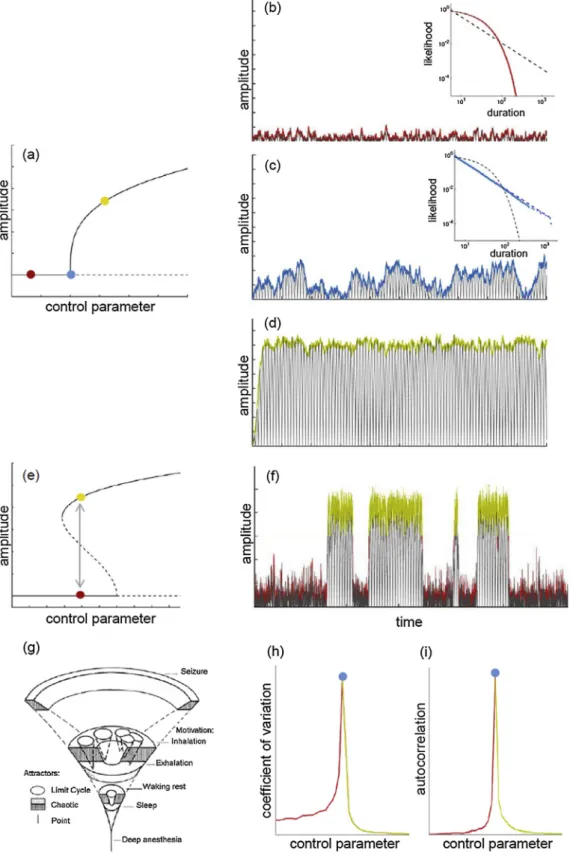
natureofindividualpredator-preyencountersaswellasinfluences not explicitly modelled (diseases, fluctuating environmental conditions etc). When the interactions between predator and preyareweak,theequilibriumstateisverystableandthepresence of suchrandom fluctuations only have a minor impacton the observedsteadystatepopulations.Likewise,iftheinteractionsare strong,thecyclicoscillationsinpopulationnumbersarealsovery stable:Theamplitudeoftheoscillationsisrelativelystableandthe noiseisagaineffectivelysuppressed.Moretechnically,awayfrom thecriticalpoint,thesystemissaidtobedynamicallystableandthe fluctuationsarestronglydamped,dropping offquickly(withan exponentialdecayrate).However,intheimmediatevicinityofthe criticalpoint,theperturbations growinmagnitude,dominating the observations because the system is less stable (or weakly stable).Thatis,thevarianceoftheobservedfluctuationsgrowsin magnitude.Moreover,thefluctuationsdecayslowly.Tobeprecise, thedecayoffluctuationsintimechangesfromafast(exponential, Fig. 1b, inset) to a slow (power-law, Fig. 1c, inset) process. Fluctuationswithpower-lawcorrelations are scale-free because theydonothaveacharacteristictimescale.Uponfurtherincreases inthecontrolparameter,thefluctuationsintheenvelopeofthe oscillationsquickly becomestable(Fig.1d)anddropoffquickly (exponentially,likewisetheinsetofFig.1b).
Hencenearthecriticalpointofabifurcation,weencountertwo centralfeatures ofcriticality:Highamplitudescale-free fl uctua-tions (Fig. 1h) and slowing down (i.e., longer autocorrelation, Fig.1i).Theselarge,slowfluctuationsaretermedcracklingnoise afterthesoundtheymakeifplayedaudibly(Sethnaetal.,2001). Asecondvariationconcernsthenatureofthebifurcationitself. Thepredator-preymodelexhibitsaclassicbifurcation,wherebya singlecriticalpointseparatestwodistinctbehaviours(steadystate andoscillatory)inparameterspace.Thisisdenotedasupercritical bifurcationbecausethecyclicoscillationsoccurforvaluesofthe controlparameterstrictlygreaterthanthecriticalpoint.However, subcriticalbifurcationsarealsopossible.Inthissetting,thereexists a region where the steady state solutions and the periodic oscillationsco-exist.Outsideofthiszone,thesystembehavesin thesamewayasthesupercriticalbifurcation(i.e.,asinglesteady stateoraperiodicpatternofactivity)(Fig. 1e).However,withinthis zone,thetwodynamicstatesco-exist(Fig. 1eandf).Noisecanthen pushthesystembetweenthesestablestates,causingerraticjumps betweenlow amplitude equilibrium and highamplitude oscil-lations (Fig.1f). This type of behaviour is called multistability
(Freyeretal.,2011;TognoliandKelso,2014).Weconsiderexamples ofmultistabilityinbrainandbehaviourbelow.
Althoughcriticalfluctuations(nearasupercriticalbifurcation) andmultistablefluctuations(duetoasubcriticalbifurcation)are mathematically related, theyyield quite distinct statistics: The former(slowfluctuations)followascale-freepowerlaw distribu-tion.Thisistheclassicmeaningofthetermcriticality.Noise-driven switchesbetweentwoormoremultistableattractorsdonotoccur withascale-freeprobability.Inthesettingoflargeadditivenoise, thetransitionsareakintoaPoissonprocessandthusfollowan exponentialdistribution.Withsmaller,state-dependentnoise,the systemtendstogettrappedneareachstate,withthetransitions thenfollowingaheaviertailedstretchedexponentialdistribution (Freyeretal.,2011,2012).Eitherway,suchmultistableswitching doesnotpossessscale-free(powerlaw)propertiesanddoesnot correspondtotheclassicnotionofcriticality.
2.2.Criticalityandphasetransitions
We have thus far considered relatively simple systems composed ofonlyafewcomponents,orwheretheelementsof thesystemarelumpedintoasmallnumberofvariables(suchasall predators and all prey species each being considered a single entity).Wenowmovetostudyingcriticalsystemscomposed of many interacting components such as magnetic spins in iron (Stanley, 1987),grainsofsandfallingontoapile(Baketal., 1988),or neurons (Plenz and Thiagarajan, 2007).On topof theexample consideredinFig.1,theseexamplesintroduceaspatialdimension throughwhichthecomponentsofthesysteminteract.
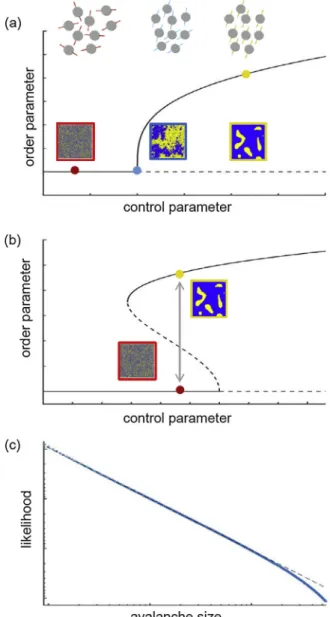
Theemergenceofamagneticfieldinaferromagneticmaterial (suchasiron)cooledbelowacriticaltemperature(Tc)isaclassic example of a phase transition.Suchmaterials have permanent magneticmoments(dipoles)duetothespinofunpairedelectrons in atomic or molecular electron orbits. These dipoles interact throughthemutualeffectsofthelocalfieldsthattheyimparton their immediate neighbours (Fig. 2a), causing neighbouring dipolestoalignandformlocaldomainsofcoherentfields.These effects partiallycountertheinfluenceofstochasticthermal and quantumeffects thatcauserandomflipsinthedirectionofthe dipoles.AttemperaturesgreaterthanTc,stochasticflipsdisrupt theformationoflargerdomainsand,intheabsenceofanexternal field,thematerialwillnotpossessamacroscopicmagneticfield. Slowcoolingofthematerialallowsdomainsofincreasingsizeto
Box2.Ten-PointSummary
1. Criticalityariseswhenasystemisclosetodynamicinstabilityandisreflectedbyscale-freetemporalandspatialfluctuations 2. Criticaltemporalfluctuations(cracklingnoise)occurinsimplesystemsclosetoabifurcation
3. Criticalspatiotemporalfluctuations(avalanches)occurincomplexsystemsclosetoaphasetransition
4. Cracklingnoiseandavalancheshavenowbeenobservedinawide varietyofneuronalrecordings,atdifferentscales, in differentspecies,andinhealthanddisease
5. Computational models suggest a host of adaptive benefits of criticality, including maximum dynamic range, optimal informationcapacity,storageandtransmissionandselectiveenhancementofweakinputs
6. 6.Resting-stateEEGandfMRIdatashowevidenceofcriticaldynamics
7. Theonsetofaspecificcognitivefunctionmayreflectthestabilizationofaparticularsubcriticalstateundertheinfluenceof sustainedattention
8. Mountingevidenceandmodelssuggestthatseveralneurologicaldisorderssuchasepilepsiesandneonatalencephalopathy reflectbifurcationsandphasetransitionstopathologicalstates
9. Novelinsightsintoneuropsychiatricdisorderssuchasschizophreniaandmelancholiamightalsobeobtainedbyleveraging thetoolsofcriticality,althoughthiscurrentlyremainssomewhatspeculative
10. Whiletheapplicationofcriticalitytoneuroscienceisanexcitingfield,progressneedstoproceedwithduecaution,using appropriatemethods,consideringalternativecomplexprocessesandusingcomputationalmodelsinpartnershipwithdata analysis
Fig.1.Criticalityinalowdimensionalsystemconsistingofafewinteractingcomponents.(a)Super-criticalbifurcationdiagram,depictingtheamplitudeofasystem'sstate variable(y-axis)asafunctionofacontrolparameter(suchasthestrengthofinteractions,x-axis).Whenthecontrolparameterisincreased,theactivityofthesystemswitches fromadampedequilibriumpoint(redcircle)tooscillatorybehaviour(yellowcircle).Thepointofchangeisknownasthecriticalpoint(bluecircle).(b)Inthepresenceof noise,thedampedsystem(redcircle)exhibitslowamplitude,rapidfluctuations.Thedurationofthesefollowsanexponentialprobabilitydistribution(reddots,inset).(c)At thecriticalpoint,thefluctuationshavehighvarianceandriseandfallslowly,followingapowerlawdistribution,correspondingtoalinearrelationshipbetweentheirduration andtheirlikelihoodindoublelogarithmiccoordinates(inset).Inaddition,theslopeofthisrelationisdescribedbyacriticalexponentofa=3/2.(d)Beyondthecriticalpoint, thesystemexhibitssustainedoscillations.Thefluctuationsintheamplitudeenvelopeoftheoscillationsarefastandsmall.(e)Sub-criticalbifurcationdiagram,withazoneof co-existence(or“bistability”)betweenthefixedpointandoscillatorybehaviours.Inthiscase,systemnoisenotonlydrivesfluctuationsaroundeachattractor,butcanalso drivesuddenanderraticjumpsbetweenthetwodynamicstatesasdepictedbythedoubleheadedarrow.(f)Examplebistabletimeseries.(g)Multistablebifurcationdiagram asreproducedfromFreeman(Freeman,1987),proposedasamodelforperceptualactivityintheolfactorysystem.Inthiscase,thenumberandcomplexityoftheattractorsis larger,however,theunderlyingprincipleisthesame.Criticalslowingdowncorrespondstoasharpincreaseinthecoefficientofvariationofthemeanamplitudeacross200 trials(h)andtheauto-correlationfunction(i)atthecriticalpoint.
form, although domains at the very largest scales continue to disappearintothebackgroundnoise.However,whenthematerial iscooledtoacriticalpoint(theCurietemperature),thesmaller domainscoalesceintoincreasinglylargeronesuntiltheyapproach thesizeoftheentiresystem.Thecoalescenceofsmalldomainsinto thoseofsuccessivelylargersizeiscalledanavalanche(Fig.2a).At theCurietemperature,avalancheshavenocharacteristicsizeand thusmayintermittentlysweepthroughtheentiresystem.These avalanches canbemeasuredempiricallyusing a large,external pick-up device (Cote and Meisel,1991; McClure and Schroder, 1976; Meisel and Cote,1992; Perkovic et al.,1995).Below the criticaltemperature,themutual interactionsamongst thespins
align intodomains that encompassnearlyeverydipole; atthis point,thematerialshowsacoherentferromagneticfield(despite ongoingdisorderattheatomicscales).Thetransitionthroughthe criticalpointinsuchahighdimensionalsystemiscalledaphase transition.
AphasetransitioninironcooledbelowitsCurietemperatureis a classic example of how simple internal interactions can overcome disorderandyield, througha criticalpoint, a macro-scopic field. The imposition of an external field of sufficient strengthonaferromagnetbelowthecriticalpointcancausethe fieldtosuddenlyswitchdirectionstoalignwiththeappliedfield (Vojta etal., 2013): Here,in contrast,the macroscopicorder is imposedexternally.
There are manysimilarities betweenbifurcationsand phase transition, including the presence of super- and subcritical varieties (Fig. 2b and c): These are called continuous and discontinuous or (second- and first-order) phase transitions in this context(Kimet al.,1997).Thetransitionfroma para-toa ferromagnet due tocooling,outlined above,isan exampleofa continuousphase transition.Thesuddenswitching ofthatfield duetoanexternalfieldisadiscontinuousone,asiswaterturning intovapourinthepresenceofheat(Stanley, 1987).Whenthephase transitionisdiscontinuous,thennoise-drivenmultistabilitymay also occur: Noise can induce switches between ordered and random states (Fig. 2b). Alternatively, as in the case of the (discontinuous)phasetransitionbetweenwaterandsteam,there can arise complex mixtures of both. Just as in the case of a bifurcation,however,multistabilityarisingduetoadiscontinuous phasetransitiondoesnotexhibitthescale-free,‘critical phenom-ena’discussedabove.Critical,powerlawscalinginthespatialand temporaldomainsisuniquetoacontinuousphasetransition.
Whilstweherefocuseduponthecanonicalexampleofspinsin a weakexternal field, the basic ingredients (local interactions, noise, alargenumberofsubsystems,anexternal influencethat brings weak coherence) occur widely and, as a result, phase transitionsareubiquitouslyobservedinnature(Stanley,1987).
Thetemporalbehaviourofaspatially-extendedsystemneara phasetransitionmirrorsthebehaviouroftwointeractingelements nearabifurcation–namelyslow,highamplitudefluctuations.These fluctuations,however,additionallyexhibitcomplexspatiotemporal processes – avalanches – that also show scale-free statistical properties. Away from the critical point, the likelihood of an avalanchedropsoffquickly(exponentially)withsize(thenumberof elements involved). In the classical example of magnetism, the domainsofcoherentspinsareverysmallathightemperatures.Ifthe temperatureistunedtowardsthecriticalpoint(Tc),thecoherent domainssporadicallyincreaseinsizeandtheensuingdistribution ofavalanchesizesdecaysslowlyasafunctionofspatialscale.The sizeofsuchdomainsmeasuredovertimeconvergestowarda scale-free (power law) effect (Fig. 2c). If the temperature is further reduced,largeandstablecoherentdomainsappearcorresponding totheemergenceofaninternalmagneticfield.
Thecorrelationlengthisausefulconceptinthissetting.Inthe disorderedphaseofthesystem(i.e.forweakexternalfields)only adjacent spins are correlated– distant spins are completely uncorrelated. As larger avalanches begin to appear at low temperature, electron spins becomecorrelated acrossthe scale ofthecorrespondingcoherentdomains.Thecorrelationlength– thespatialscale atwhichpairs ofelectronsareatleastweakly correlated–increases.Atthephase transition,asthesizeofthe coherentdomainsapproachesthatofthesystem,thecorrelation length diverges upwards. As a result, external perturbations appliedtoanypartofthesystemmayleadtoachangeinthestate ofthewholesystem.Putalternativelythesystemhasmaximum dynamic rangebecauseany smallperturbation hasachance of changingtheelectronspinsofsuchacriticalparamagneticsystem. Fig. 2.Phase transitions and avalanches in spatially extended systems. (a)
Continuous(orsecondorder)phasetransition.Thedisordered(random)phase (red)showslackofspatialorder(redsquare)withrandomlyorientedspinsina typicalphysicalsystemsuchasaferromagnetinaweakexternalfield.Theordered phase(yellow)showslargedomainsofco-alignedspins.Atthecriticalpoint(blue), avalanchesofcomplexpartially-ordereddomainsriseanddissolveacrossallscales (bluesquare),leadingtoapowerlawsizedistribution.(b)Phasetransitionscanalso bediscontinuous(alsocalledfirstorder).Aswithasub-criticalbifurcation,system noisethencauseserraticswitchingbetweenthedisorderedandorderedphases (doubleheadedarrow).(c)Cumulativeprobabilitydistributionoftherelationship betweenthesizeandlikelihoodofavalanchesatcriticality.Ascale-freeprocesses yieldsalinearscalingrelationshipindoublelogarithmiccoordinates(apowerlaw) withacriticalexponentofa=3/2.Notetheslightexponentialtruncationatthe righthandside,duetofinitesizeeffects.
Wehavefocuseduponphasetransitionsinspatiallyextended (embedded) systems, such as magnets and water which are dominatedbyinteractionsorcollisionsbetweentheneighbouring elementsofthesystem.However,thedescriptionofavalanchesin largeNsystemsdoes notinevitably refertospace. Abranching processisasimplemodelofaphasetransitionthatdescribeshow activatedelementsmayeitherdecay(toinactive)oractivateother elementswiththeprogressionof time(DeCarvalho andPrado, 2000).Criticalityoccurswhenthedecayandactivationratesarein equalratio.Thiscanonicalmodelofaphasetransition,whichhas beenusedtostudycriticalityinneuralsystems[e.g.(Beggsand Plenz,2003)],doesnotrequireaspatialdimension;metricssuchas thecorrelationlengthdonotmakesenseinthesemodels.Although suchabstractmodelsmaynottakespaceintoaccount,complex multi-unitphysicalsystemssuchasthebrainmustbeembeddedin space,andtheinteractionsbetweentheelementsareveryoften constrainedbytheirspatialproximity(Robertsetal.,2016).
Aswehaveseen,phasetransitionscanbeconsideredanatural extensionof thenotionof abifurcationfromsystemswithfew components,tothosewithmany.Theunderlyingmathematicsis verysimilar(infact,theso-calledLandauequation,usedtomodel generic phase transitions, is mathematically identical to the Normalformequationusedtodescribebifurcations).Historically, however,thetwophenomenahavebeenstudiedindifferentfields - bifurcations byapplied mathematicians, whereas phase tran-sitionswereclassicallythedomainofphysicists.Thislegacyhasled toa differenceintheuseofthecentralterms, sub-and super-criticality: In mathematics, “sub-” and “super-critical” qualify bifurcations, denoting distinct instabilities that differ in their underlyingmathematicalnature(Fig.1aande)and,asaresult,the behaviourtheyyield.Inphysics,thesetermsareusedtodescribe thephasesofthesystem.‘Subcritical’phaseisusedtodenotethe stable,absorbingstatebelowaphasetransition(Fig. 1a,reddotand Fig. 1b).Theterm“supercritical”isusedtodenotetheorderedstate above the transition, whereby the amplitude of the order parameter(y-axis)istypicallynon-zero(Fig.1a,yellowdotand Fig.1d).Itisunlikelythatanattemptedsynthesisofthoseterms herewouldpervadebothfields.Fortheremainderofthispaper,we usetheterms“sub-”versus“super-criticalbifurcation”todenote the type of instability, and “sub-” versus “super-critical state”, “activity”or“phase”todenotewhereaparticularsystemlieswith respectstothephasetransition.Ingeneral,sincetheinterpretation islargelydependentontheaudience,cautionisrequiredwhen interpretingorusingthosetermsmorebroadly.
Phasetransitionsandcriticalityhavebeendocumentedinavery broadrangeofphysicalsystemsovermanydecades(Kosterlitzand Thouless,1973;YangandLee,1952)andtheirstudyremainsoneof themostactive areasofresearchinbranchesof physicssuchas statisticalmechanics(Papanikolaouetal.,2011;Sethnaetal.,2001; Zapperi et al., 2005). The signatures of criticality have been documented in systems as diverse as flocking birds (Cavagna etal.,2010),earthquakes(BurridgeandKnopoff,1967;Carlsonand Langer,1989;RiceandRuina,1983);solarflares(Luetal.,1993), armedconflict(RobertsandTurcotte,1998),trafficjams(Nageland Herrmann,1993),andcapitalwealth(RobertsandTurcotte,1998)– even crumpled paper [(Houle and Sethna, 1996; Kramer and Lobkovsky,1996);forreviewsee(RobertsandTurcotte,1998)].
WeturntoevidenceforcriticalityinthebraininSection3after consideringitsunderlyingappeal.Butbeforemoving,itisinstructive to contextualize the importance of criticality as a theoretical frameworkandhowitmaycomeaboutinmanydistinctsystems. 2.3.Theconceptualappealofcriticality
Criticalityderivesitsbasicappealfromanumberof consider-ations. First, it speaks to the presence of a relatively simple
underlyingprocess– theresponse ofaweaklystablesystemto stochasticperturbations –arisinginverydifferentsettings.The processesthatdrivethesystemclosetoinstabilitycanbediverse– a build-up of fuel; varying temperature; a driving external magnetic field; strong interactions between species – but the collectiveresponseingeneratingslow,multiscalefluctuationsis shared.Likewise,themanyspecificdetailsofthesystemsdiffer markedly(e.g.,magneticspins,movingtectonicplates,neurons) but can be unified by their core dynamic nature – possessing interactionsamongtheircomponentsthaterraticallyamplifyand dampmicroscopicperturbations.Thisnotionof“universality”is veryappealingtoscientists whoseekunifyingprinciplesacross diverse systems. That is, the appearance of power-law and invariant scaling in markedly different systems suggests the importanceofprocessesthattranscendtheirparticular incarna-tion.Ofnote,thecharacteristicexponentinthepower-lawscaling that describethecritical fluctuations in manyof thesesystems typicallyconvergestoavalueof3/2.Theoreticalconsiderations supporttheemergenceofthisvalueinsystemsatthecuspofa phase transition (Zapperi et al., 1995). Thus, basic theoretical arguments unify diverse phenomena – this is the essence of universality(Stanley,1999).
Computational considerations also underlie the appeal of criticality.Herewereviewthecomputationalaspectsofcriticality inphysicalsystems.InSection3.3,wefocusonthecomputational advantagesofcriticalityinthebrain.Theearliestdemonstrations ofthecomputationaladvantagesofthecriticalstateweredoneina very simple and idealised system calledcellularautomata (CA), whosedynamicsevolvediscretelyinspaceandtimeaccordingto very simple interaction rules (Langton,1990). By changing an underlying interactionparameter,CAcanbe tunedtoconverge veryquicklytosimpleperiodic(spatiotemporal)structures,orto unstructured,chaoticprocesses.Inbetweenthesescenarios–at theso-called “edge ofchaos” – CAexhibit lengthymixtures of orderedanddisorganizedstructures.Theoreticalargumentsshow thatthecomputationalcomplexityofCAdiverge inthisregime. Thatis,ifoneconsiderstheinformationcontentofthesystemat eachtimepoint,thenumberofiterationsbeforeCAconvergeonto a stable solution becomes very long for this in-between state (although see(Mitchell et al.,1993) for an opposingposition). Depending upon one'sviewpoint,thesimplicityof CAis either conceptuallyappealing(sincecomplexityarisesfromverysimple laws)ordistracting,becausethephysicalmeaningofCAisunclear. However, the implications of the proposal – complexity from simplicity – are tantalising,underlying the influence of CA. Its catch-phrase“edgeofchaos”becameaverywell-knownwayto refertothecomputationaladvantagesofferedbythecriticalstate. Further research has shown that several other physical and biologicalsystemsalsohaveoptimalcomputationalpropertiesat criticality (Crutchfieldand Young,1988;Kauffmanand Johnsen, 1991;MoraandBialek,2011;Nykteretal.,2008).
Theappealofcriticalityalsofindssupportfromthermodynamic perspectives.Inastable,subcriticalsystem,randomfluctuations arising from thermal energy and other sources of entropy are confinedtothemicroscopicscale,likeagiantTVscreenshowing pixel-wisestatic.Whilethesemicroscopicfluctuationshavehigh entropy,meso-andmacroscopicscalesaredampedandarehence in afeatureless,low entropystate.Above thecriticalpoint, the macroscopicscale of thesystem can showinterestingfeatures, suchasperiodicstructuresandoscillations.However,fluctuations atfinerscalesareslavedtotheselarge-scalefeaturesandthusdo not express the potential entropy arising from the smallest microscopicscales.Inthesetwostates–sub-andsuper-critical, respectively,highentropycanbethoughtofasbeingtrappedat oneparticularscaleandunavailableatotherscales.Atthecritical state, microscopic fluctuations erratically disseminate to larger
scales through avalanches and crackles. These fluctuations introduce packets of disorder which accordingly increase the informationcontentofthesystemacrossallscales.Thatis,while criticalityincreasescorrelations–andthusdecreasesentropy–at thesmallestscale,it“transports”randomfluctuationsacrossscales increasingthetotalcomplexityofthesystem(Tononietal.,1994). 2.4.Self-organisedcriticality
Whyisitthatsomanysystemsfoundinnatureappeartobe perchedatacriticalpoint?In theorythecriticalpointbecomes confinedtoaverysmallrangeofvaluesasthesizeofthesystem increases(seeFig.1h).For anexperimental system suchas the paramagneticmaterialdiscussedabove,theexternalfieldcanbe carefully(manually)tuneduntilcracklingnoise and avalanches appear.However,for othersystems,suchasearthquakes, forest firesandflockingbirdsthefingerprintsofcriticalityseemtoarise internally without the need for careful tuning by an external observer.
Theanswertothisapparentdilemmaiscontainedinthenotion of self-organised criticality (SOC), a process whereby a complex systemisdriventowarditscriticalpointacrossaverywidesetof startingpointsandparametervalues.TheclassicexampleofSOC wasprovidedinthebehaviourofsand-pileavalanchesbythework ofPerBak(Bak,1990;Baketal.,1987,1988).Inessence,theslow additionofsandtotheapexof asand-pileleadstothegradual increase in the slope of its sides. Ata critical slope, scale-free avalanchesoffallingsandbegintooccur.Theslopeangledecreases witheachavalancheas(gravitational)energyisreleasedfromthe system,thenincreasesagainasnewsandisadded.Theslopedoes notneedtobetunedbytheexperimentalistbutnaturallyemerges fromtheinterplayoftheinteractionsbetweentheadjacentgrains ofsand,theexternal(gravitational)forceandtheslowadditionof sand.
ModellingSOCincomplexsystemswithweaklocalinteractions andnoise isa veryactivefield(Markovicand Gros,2014).Two mechanismsappearsufficientfortheappearanceofSOC–firstly thedissipationofenergyandsecondlysomeformof“memory”in thesystem.Forexample,alargeforestfireburnsthrougha build-upoftimberfuel:Energyhasdissipatedfromthesystemanda periodoftimemustnowpassuntilthereissufficientnewfuelfor fireofanyappreciablemagnitude.Likewise,alargeavalancheof sandinaslowlybuildingsandpilechangesthegradientofthepile. Timeandsmallavalanchesmustthenaccruebeforetheslopeof thepile is sufficientlysteeptotriggeranother largeavalanche. Again in seismology, tension from tectonic plates is released following a large earthquake and its aftershocks, such that subsequentlargeearthquakesareunlikelytofollowimmediately. Each of these systems is characterized by the build-up and subsequentdissipationof energyorresources,whose releaseis ‘remembered’ by the system until sufficient resources have recovered.Wewillencountersimilarconceptswhenwediscuss mechanismsofSOCinneuronalsystems(Section3.3).
3.Criticalityinthebrain
Theroleofcriticalityandmultistabilityinneurophysiological systemsofthebrainwasfirstarticulatedover3decadesagoby Walter Freeman following detailed empirical analyses and computationalmodels of therabbit olfactory bulb (Fig.1g). In particular,Freemanproposedthattheprocessofinhalationand exhalationacted,viamodulationofthegainofexcitatoryneurons, tosweeptheactivityoftheolfactorybulbthroughasub-critical bifurcationandhencethroughazoneofmultistability(Freeman, 1987, 1991). Sensory inputs, arising from contact of inhaled moleculeswithmembranereceptorsofolfactoryneurons,thenact
toselectivelyperturb thesystemontooneofseveralcompeting dynamicpatterns.Thisdynamicpatternwasproposedtoencode the olfactoryinput –the percept – until it destabilized during exhalationasthesystempassedagainintothezonewhereonlythe stable equilibrium solutionexists.We nowsurvey more recent examplesofcriticalityandmultistabilityinneuronalsystemsthat buildupontheforesightscontainedinFreeman'sprescientpapers. 3.1.Rhythmicfluctuations,bifurcationsandslowingdown
Themechanismsunderlyingmotorcoordinationhavebeenan intriguing area for the application of dynamic systems theory (Bressler and Kelso, 2001; Kelso and Clark,1982).One fruitful candidatehasbeenthestudyofrhythmicfingertapping.Atslow frequencies,humansareabletotapineitheroftwostablemodes: syncopationandanti-syncopation.However,athighfrequencies, the anti-syncopation modebecomes unstable and only the in-phase syncopationpatternisexpressed (Kelsoet al.,1986).The hallmarksofcriticalityareseenjustpriortothistransition,namely slowing, high amplitude movement fluctuations (Kelso, 1984, 2014).Toexplainthis,Haken,KelsoandBunzusedasub-critical bifurcationinasimplemodelofmotorcoordinationbetweenthe leftand rightmotorcortices(Hakenetal.,1985).Thetransition fromabimodaltounimodalpatternofbehaviouroccurredatthe criticalvalueofthemovementfrequency.Thisframeworkhasalso been employed to explain the transition between movement patterns induced by transcranial magnetic stimulation (TMS) (Kelso,2014).
Morerecent workoncriticalityhasfocusedonthetemporal fluctuationsobservedinthemajorrhythmsofEEGandMEGdata. Employingananalysiscalleddetrendedfluctuationanalysis(DFA), Linkenkaer-Hauser and colleaguesreportedthat the fluctuating amplitudesofthetwodominantoscillationsofthehumanbrain– the alpha and beta rhythms – exhibited scale-free temporal statistics (Linkenkaer-Hansenet al.,2001).Fluctuating levelsof synchronybetweenpairsofelectrodeshavealsobeenreportedto showscale-freestatistics(StamanddeBruin,2004).Likewise,the power spectrum of human neocortical activity acquired from invasiveECoGdatashowsscale-freetemporalbehaviouracrossa very broad range of frequencies (Miller et al., 2009). These frequenciesalsoshowmulti-scalenesting–thatis,theamplitude ofhighfrequenciesiscoupledtothephaseoflowerfrequencies;a patternthatisrecursivelyrepeatedfromveryslowtoveryhigh frequencies(Heetal.,2010).Computationalmodelsoflarge-scale neuronalactivity–neuralfieldmodels–suggestthatthecritical temporal statistics inthese electrocorticalrecordings mayarise fromasubcriticalbifurcationofactivityincorticothalamicloops (Freyeretal.,2009,2011).Suchmodellingproposesthat noise-drivenswitchingbetweenalowamplitudesteadystateandhigh amplitude oscillations (Fig. 1) yields the empirically observed criticalfluctuationsseenatrest(Freyeretal.,2012).
3.2.Neuronalavalanchesandphasetransitions
In2003,BeggsandPlenzfoundevidenceofcriticalbehaviourin the erratic spontaneous activity measuredin in vitro neuronal cultures(BeggsandPlenz,2003).Theydocumentedthetwosalient featuresofcriticalityinaspatiallyextendedcriticalsystem,namely power-lawscalingintime(thedurationofburstsofactivity)and space(thenumberofelectrodesspannedbyeachburst).Together withtheearlierworkofFreeman,thisfindingusheredincriticality as a term of clear relevance to complex neuronal multi-scale phenomenon.
Since these initial reports of avalanches in in vitro slice preparations by Beggs and Plenz, research into critical ava-lanche-like activity in spatiotemporal neural recordings has
proceededat greatpace (Plenzand Thiagarajan,2007; Schuster etal.,2014;Shew,2015).Observationsofscale-freespatiotemporal fluctuations in spontaneous,physiologicaldatahaveprogressed frominvitroslicepreparations(BeggsandPlenz,2003),toinvivo recordingsfromsuperficiallayersofcortex(Gautametal.,2015; GireeshandPlenz,2008)toawakenon-humanprimates( Peter-mannetal.,2009)[forareview,seeShewandPlenz(2013)]. Scale-free avalanches have been reported in human whole brain magnetoencephalographic(MEG) data(Shriki et al.,2013), and complex, scale-free spatial dependences, consistent with ava-lanches,havebeendescribedinwholebrainfunctional neuroim-aging (fMRI) data (Tagliazucchi et al., 2012). Notably, these recordingscrossbroadscalesofaperturefrommulti-unit record-ingstomacroscopicfieldpotentialsand wholebrainfunctional neuroimagingdata.
There is a growing focus in the imaging community on spontaneous (resting-state) fMRI data and the reproducible structurestheserevealinhealth(Damoiseauxetal.,2006;Zalesky etal.,2014)anddisease(Fornitoetal.,2015).Whereasthenumber ofchannelsinneurophysiologicalrecordings,suchasMEG,hasa modest upper bound (of several hundred), the high spatial resolutionoffMRIyieldsthousandsofvoxels(100,000voxels). Thesedatahencecontainthebreadthofspatialscalesrequiredto interrogatewhetherthespatialfluctuationsarescale-free(Eguiluz et al., 2005) and thus whether critical dynamics underlie the dynamic patternsseen at rest(Chialvo, 2012).Recentevidence frombothempirical(Tagliazucchietal.,2012)andcomputational (DecoandJirsa,2012)analysespointsinfavourofthisproposal. Amongthemostintriguingfindingsaretherecapitulationofthe classicresting-statenetworks(Yeoetal.,2011)bymodelsofcritical dynamicsarisingfromprimate(Honeyetal.,2007)and human (Haimoviciet al.,2013)structuralconnectomes.Analysis ofthe temporalstatisticsofresting-statefMRIandEEGalsosuggeststhat long-range,scale-freecorrelationsmayindeedlieattheveryheart oftheslowfluctuationsthatareobservedinthesedata(Vande Villeetal.,2010).
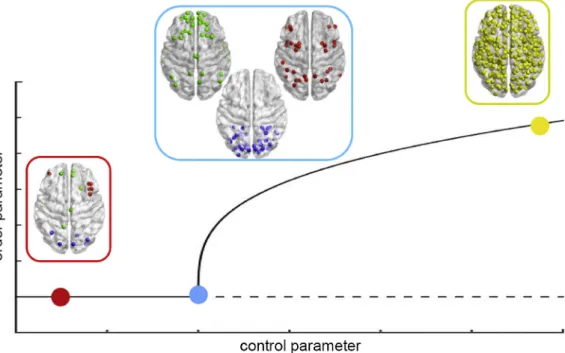
ThisemergingviewisschematicallysummarizedinFig.3.In the sub-critical zone, bursts of cortical activity are sporadic uncoordinated(redbox).Abovethecriticalvalue,corticalactivity is coupled too tightly and conversely, inadequately segregated (yellowbox).Resting-statenetworksfunctionatthecriticalvalue, where switching between network states occurs due to weak dynamicinstabilities(lightbluebox).
There is now a very well established relationship between resting state brain networks and the underlying structural connectome from which they arise (Honey et al., 2007; Zhou etal.,2006).Criticalityarisinginsimplesystemsdoesnotrequirea complexspatialsubstrate:Ratheraswehavereviewedabove,its hallmarkistheemergenceofcomplexspatiotemporalprocesses fromsimple,localinteractions.However,complexnetworksmay allowcritical-like behaviourto occurin a region of parameter space instead of a single point (Moretti and Muñoz, 2013). Moreover,intheprimatebrain,structural-functionalcorrelations arguefortheexistenceofarelationshipbetweencriticaldynamics and therelatively static underlying structural connectome. The natureofthisrelationshipbetweencriticalstatesinresting-state fMRI data and the connectome is not well understood. Highly interconnectedcorticalhubs,andbrainregionscomprisingthe so-called default-mode network may play a prominent role in maintainingresting-state networkdynamics (Gollo etal., 2015; Leechet al.,2012;Vasaet al.,2015;Cocchiet al.,2015)andin facilitating the efficient spread of avalanche events through macroscopicbrainnetworks(Misicetal.,2015).Theconstellation of densely connected hub regions – the rich club – appear to supportaslow,stabledynamic“core”whereasperipheralsensory regionsintroduce(rapid)stimuli-relatedvariabilityinthesystem (Bassettetal.,2013;Golloetal.,2015;Hassonetal.,2015).Sucha core-peripheryorganizationofbrainnetworkdynamicsspeaksto a hierarchy of time-scale fluctuations, in which hub regions integrateandregulatethenetworkdynamicslargelyoperatingat slow frequencies (Cocchi et al., 2016; Gollo et al., 2017, 2015; Hassonetal.,2008;Honeyetal.,2012;Murrayetal.,2014).Hub
Fig.3.Proposedroleofcriticalityinlarge-scale,resting-statebraindynamics.Inthesub-criticalregion,individualbrainregionsareeffectivelyuncoupled,showingalackof integration(redsquare).Conversely,inthesuper-criticalregion,integrationistoogreatandthereisalackofsegregation(yellow).Nearthecriticalpoint,anemergingbodyof workinEEG,MEGandfMRIsuggeststhatbrainsystemsshowadynamicbalanceofintegrationandsegregation(bluesquare),fluctuatingamongthevariousresting-state networks(andEEGrhythms).Cognitivefunctionrequiresaslightincursionawayfromthecriticalregimeleadingtoastabilizationofoneparticularnetwork,consistentwith theearlierproposalsofFreeman.
regionswithinthedefault-modebrainnetworkmayrepresenta structuralsignatureofnear-criticalbehaviour.Regionscomprising thisnetworkexhibitcoordinatedactivityintheresting-statewhen thecoherencebetweennodesofother“task-positive”networksis generallysuppressed(Cocchietal.,2013;Foxetal.,2005;Hearne etal.,2015).
Theseobservationssuggestmechanismsthroughwhichcritical dynamicsmayadaptto,andreshapethecomplexnervoussystems inwhichtheyoccur,particularlytherelationshipbetweensynaptic processes,functionalconnectivityandnetworktopology(Rubinov etal.,2009;Zhigalovetal.,2017).
3.3.Computationalaspectsofneuronalcriticality
ThepioneeringworkofFreeman(onbifurcations and multi-stability),andBeggsandPlenz(oncriticalavalanches)provided proof-of-principlesthatthescienceofcriticalitycouldbeusedto informourunderstandingofcomplexpatternsofactivityinthe brainand, byextension,behaviour. Researchinthese areashas accelerateddramaticallyand now yieldsa streamof important discoveriesspanningfromtheneuronal(Galand Marom,2013; Golloetal.,2013)tothewhole-brainscale(Kitzbichleretal.,2009). Asreviewedabove,thestudyofcriticalityinphysicalsystems usingsimplemodelssuggestedthatsystemsatthecriticalstateare endowedwithoptimalcomputationalproperties.Suchadvantages have recently been demonstrated in models and empirical recordings of critical neuronal systems[for review, see (Beggs, 2007; Shew and Plenz, 2013)]. Perhaps most crucially, optimal dynamicrange–thesensitivityofaneuronalsystemtorespondto, andamplify,inputsacrossabroadspectrumofintensities–was showntobemaximizedinmodelsofneuronalsystemstunedtoa criticalstate(KinouchiandCopelli,2006;Larremoreetal.,2011).In sliceculturesgrownonthesurfaceofmultielectrodearrays,Shew andcolleagueslaterprovidedempiricalevidenceforthisproposal, showingthatthemaximumdynamicrangetoelectrical perturba-tionwas indeedmaximizedwhenthecultureswere pharmaco-logicallymanipulatedtobeclosetocriticality(Shewetal.,2009). Recentelectrophysiologicalrecordingsfromtheanaesthetizedrat provided the first in vivo evidence that dynamic range in perceptualsystemsismaximizedwhenbackgroundactivityisat thecriticalpoint(Gautametal.,2015).
Anotherexampleofthecomputationaladvantagesofcriticality arisesfromsimplifiedneuronalmodelswhichpredicthighfidelity andoptimalinformation transmission(maximummutual infor-mation between sender and receiver) at criticality (Beggs and Plenz,2003;GreenfieldandLecar,2001):Thispredictionwasalso laterobservedinvitro(Shewet al.,2011)and morerecentlyin awake,behavingmice(Fagerholmetal.,2016).
Research in this field has also suggested that information storageandcapacity–theabilityofasystemtoencodeabroad repertoire of complex states from which information can be decoded(Gatlin,1972)–maybeoptimisedatcriticality.Again,this notionhasbeencapturedinsimpleneuralmodels(Bertschinger andNatschläger, 2004;HaldemanandBeggs, 2005;Yangetal., 2017)and alsodemonstrated inempirical recordings, including those arising in unperturbed (resting state) recordings ( Break-spear, 2001; Deco and Jirsa, 2012) as well as through careful pharmacological manipulations of in vivo neurophysiological recordings(StewartandPlenz,2006).Selectiveenhancementof weak(butnotstrong)stimulialsooccursnearaphasetransition (Copelli, 2014). It is also interesting to note that optimal computational properties can arise at both continuous and discontinuousphasetransitions(Golloetal.,2012).
A compelling argument for the advantage provided by the critical state derives from the analysis of psychophysics
experiments, which quantify therelationship betweenphysical stimuli and perceptual responses. Psychophysics relations may representtheearliestdocumentedevidenceofcriticaldynamicsin thenervoussystem(Kelloetal.,2010).Acrossavarietyofsensory modalities, these experiments showed power-law relations, knownasSteven'slaws,in whichtheperceivedpsychophysical or neuronal response F is given by: FðSÞ/Sm; where S is the stimuluslevelandmistheStevensexponent(Stevens,1975).To accountforthesaturationoftheresponsethatoccursforextreme stimuli,thepsychophysicsresponseismodelledbyasigmoidHill function:FðSÞ/FmaxSm= SmþSm0
;whereFmaxcorrespondstothe
saturated response, and S0 the input level for half-maximum
response. Importantly, this functionalso retains thepower-law regimegovernedbytheexponentm.Thispower-lawbehaviourhas akeyputativefunction:Itallowsanimalstodistinguishstimulus intensityvaryingacrossmanyordersofmagnitude.Assuch,the power-lawregimecancompressdecadesofstimulusvariationS intoasingledecadeofresponseF.Astandardmeanstomeasure thiscodingperformanceiscalledthedynamicrange.Thelargerthe dynamicrange,thebettertheabilitytodetectchangesinstimuli. Modelling the neuronal behaviour at the sensory periphery, KinouchiandCopellishowedthatalargedynamicrangeemerges from the collective response of a network of many interacting units,and,moreimportantly,thedynamicrangeisoptimalwhen thenetworkisatthecriticalstate(KinouchiandCopelli,2006). This work explains the long-lasting psychophysical scaling relations (Steven'slaw),and provides aclearexampleinwhich ameaningfulbiologicalfeatureisoptimisedatcriticality.Similarto earlierproposals,theworkofKinouchiandCopelliwasalsobased onafairlysimplemodelofneuronalactivity.Crucially,however, themodelgeneratedapredictionthatwassubsequentlyverified experimentally(Shewetal.,2009).
Theexplanationofthepower-lawregimeofpsychophysicslaws in terms of the optimal sensitivity of critical states was an importantcontribution.However,asusualinanalyticapproaches, somesimplificationsweremade,leadingtoatleasttwo conun-drums. The first challenge refers to the important trade-off betweensensitivityandspecificity.Thefindingthatoptimalsignal codingoccursatcriticalityimpliesmaximumsensitivity.Yet,the specificityofthisstateiscompromisedbecauseofincreasedlevels offluctuation.AsillustratedinFigs.1and2,criticalitycorresponds tothestatewiththelargestmacroscopicfluctuations.Thisiswhy thecriticalstateallowsfortheamplificationofstimuli ofsmall intensity,whichenhancestheabilitytodistinguishthestimulus intensityvaryingoverordersofmagnitude(i.e.,largesensitivity). However,theverysameeffectisalsoalimitationbecausethehigh fluctuationsofcriticalityreducethespecificityofthesystem.The issueiswhethertheimprovedsensitivityremainsbeneficialtothe systemwhenthereductioninspecificityisalsotakenintoaccount. Fortunately,asolutionforthesensitivity-specificityconflictexists inthepresenceofdiversityamongstcomponentsofthesystem. Heterogeneousexcitablesystemsexhibitrecruitmentpropertiesin which units are recruited following their order of excitability (Golloet al.,2016).Therefore,a stateofoptimalsensitivityhas units forming a subpopulation in a critical regime as well as subpopulations operating in a non-critical statewith improved reliability.Hence,optimisedsystemsrepresentthecoexistenceof subpopulationsofreliableunitsandpoorsensitivity(poisedaway fromtheircriticalstate)withasubpopulationofunreliableunits andgreatsensitivity(typicalofthecriticalstate).Inotherwords, optimalperceptualperformancemayrelyonthecontributionof criticalandnon-criticalunits(Gollo,2017).
The secondchallengeemerging fromtheexplanationof the power-lawregimeofpsychophysicslawsderivesfromtothefact that the critical state for optimal psychophysical response of
Kinouchiand Copelliseparatesanactive statefromaninactive state (Kinouchi and Copelli, 2006). The issue here is that the inactive state corresponds to an absorbing state in which the systemcannotescapeunlessexternalstimuliareprovided.Hence, ifthesystemfallsintothisstate,itwillgettrappedthere.Critical systemstypicallydofallintothisstatebecauseoftheirenhanced fluctuations.Ifthesystemcorrespondstothebrainorapartofthe nervoussystem,suchaninactivestatewouldbeexpectedtooccur ratherfrequently.However,suchsilentstatesarenotobservedin vivo.Thesolutiontothisissuealsoderivesfromtheincorporation of an essential, but often overlooked, ingredient: inhibition. Larremore and colleagues showed that ceaseless activity and criticalavalanchescoexistwhenasubstantialfractionoftheunits areinhibitory(Larremoreetal.,2014).Hence,evidenceisgradually accumulatingforthepreviouslyidealisedproposalthatbiological systems can exploit special features of the critical state. Meanwhile, modelssupporting this proposal are incrementally incorporatinggreaterphysiologicaldetail.
Researchintheauditorysystemhashighlightedtheadvantages conferredbyactiveresponsesofhairbundlespoisedinacritical state(Camaletetal.,2000;Eguíluzet al.,2000).Inresponse to sound-waveinput,hairbundlesoscillateandtheirdynamicsvary fromasteadytoanoscillatoryregime.Eachbundleistunedtoa particularnaturalfrequencyandadjacentcellsrespondmaximally tosuccessivepitches,givingrisetoatonotopicmapinthecochlea (Romanietal.,1982).Crucially,computationalmodellingsuggests thatactiveand nonlinearhairbundlesthatoperate nearaHopf bifurcationoptimisethecochlea'sperformanceandenhancethe mainfeaturesofauditorycoding,suchas,amplification,frequency selectivityandcompressivenonlinearity(Hudspeth,2008; Maoi-léidighetal.,2012).
3.4.Self-organisedneuronalcriticality
A growing body of empirical work has thus asserted the presenceofscale-freestatisticsacrossadiversityofinvitroandin vivo neural recordings, while computational models have highlighted its computational advantages. Of note, the critical activityobservedbyBeggsandPlenz(2003)wasstableformany hoursanddidnotrequirecarefultuningoftheparametersoftheir culture(i.e.thepH,temperature,etc).Simplemodelsofcriticality classicallyrelyuponfine-tuningofsystemparameterstoacritical value(Levinaetal.,2014).Whatisthebasisforarobustnessthat apparentlyeschewstheneedforsuchabalancingact?Asdiscussed above(Section2.4),analysesofcriticalsystemsinphysicalsystems reconcile this paradox by recourse to self-organised criticality (SOC).Inbrief,SOCariseswhentheinteractionsamongstsystem componentsare imbued with some formof plasticity, suchas whensystemenergyaccumulatesandisthendissipatedbya large-scale avalanche. During periods of quiescence, energy slowly accumulatesuntilittipsthesysteminto(orabove)criticality.The consequent energy dissipation briefly renders the system sub-criticaluntilfurtherenergyaccumulates.Thereisthusatimescale separationbetweenthefastsystemdynamicsandtheslowbuildup anddissipationofenergy.
Severalmodelsofcriticalityinthebrainincorporatesuchslow processes (Markovic and Gros, 2014). A considerable body of researchhasfocusedupontheroleofvariousformsofdynamical synapses (Levina et al., 2007; de Andrade Costa et al., 2015), includingsimpleactivity-dependentup-anddown-regulation(de Arcangelis, 2008), activity-dependent synaptic plasticity (de Arcangelis et al., 2006), synaptic potentiation (Stepp et al., 2015), short-term synaptic depression through depletion of synaptic vesicles (Bonachela et al., 2010; Levina et al., 2014; Mihalasetal.,2014;Millmanetal.,2010),Hebbian(VanKessenich etal., 2016)andanti-Hebbian synaptic plasticity(Cowanet al.,
2014;Magnascoetal.,2009),andspike-timedependentplasticity( Rubinovetal.,2011).Aswithphysicalsystems,the(relatively)slow synapticplasticityservestobroadenthecriticalpointtoabroad, stable region. Other neurobiological processes have also been proposed, includingbalanced excitation-inhibition andnetwork topology (Rubinov et al., 2011) and dynamic neuronal gain (Brochiniet al., 2016).More recently,therole of energy build-upanddissipationinphysicalsystemshasbeenrecastincritical neuralsystemsasthereplenishmentanddepletionofintracellular metabolic resources including Adenosine Triphosphate (ATP); (Robertsetal.,2014b;Stramagliaetal.,2015;Virkaretal.,2016). 4.Challengesandpitfallsofthecriticalityhypothesis
Despite this recent emergence of criticality research in neuroscience,lessons learnedinotherbranchesofscienceraise important pitfalls and caveats. First, inferring the presence of scale-free statistics in neuroscience data has classically rested uponfittingapower-law(orPareto)regressiontotheprobability distribution of the size of the temporal or spatial fluctuations (Figs.1and2).Thestatisticalprinciplesunderlyingthisexercise were critiqued in a highly influential survey by Clauset and colleagues (Clauset et al., 2009). While a linear regression in doublelogarithmiccoordinatescanyieldafitthatlooks impres-sive,suchaprocessisinsensitivetothedistributionofdataatthe right-handtail of thedistribution– thevery regionwhere the presenceofaheavy-tailedpowerlawneedstoberigorouslytested. Thisisbecausethenumberofempiricallymeasuredsamplesfound in the tail of the distribution is often too limited for robust inference.Another concernisthat thesamplesof a cumulative distribution function are not independent, whereas regression assumesdataindependence.Clausetandcolleaguesdevelopeda moreprincipledapproachbasedonmaximumlikelihood estima-tiontotestandcomparedifferentstatisticalmodelsofthedata, includingthe powerlaw,but alsoothercandidate heavytailed distributionsincludingthelognormalandstretchedexponential forms(Clausetetal.,2009;Vuong,1989).Inbrief,oncethebest fittingpower-lawparametersforanempiricaldatasethavebeen determinedwithmaximumlikelihoodestimation,the goodness-of-fitbetweenthefittedpowerlawandempiricaldistributionis tested withtheKolmogorov-Smirnov (K-S) statistic.To this end, Clausetandcolleaguesproposedtorandomlysampledatafromthe fittedpowerlaw,independentlyfitanewpowerlawtoeachof these newdata samples and then evaluate the goodness-of-fit between the new samples and the new power laws. This is repeatedmanytimestogenerateanempiricaldistributionofK-S statistics,whichcanthenbeusedtocomputeap-valuefortheK-S statistic corresponding to the observed data. If this p-value is significant,therandomlysampleddataisabetterfittothepower law than the observed data, and thus a powerlaw should be excludedasanappropriatemodel.Otherwise,ifthep-valueisnot significant,power-lawbehaviourissupportedandthefinalstepis to exclude other distributions as providing better evidence. Relativefitsaretypicallycomputedbetweencandidate distribu-tions (lognormal, stretched exponentials, etc.) using log-like-lihoods.
Using this approach, Clauset et al. (2009) revisited several physical phenomena thought to have scale-free statistics and showedthatseveralofthesedatawerebetterexplainedbyother long-taileddistributions, not powerlaws. These methods show thatthesameholdstrueformanyneuronalfluctuations(Roberts etal.,2014a).Forexample,itappearsthatfluctuatingalpharhythm follows a stretched exponential distribution, not a power law (Freyeretal.,2009).Inturn,biophysicalmodelssuggestthatthe alpharhythmarisesfromnoise-drivenmultistability,ratherthan beinggeneratedbyclassic(super-)criticality(Freyeretal.,2011).
A second caveat was issued by the empirical analyses and modellingworkofTomboulandDestexhe(TouboulandDestexhe, 2010, 2015) who showed that under certain situations, the aggregatebehaviourofnon-criticalstochasticsystemscouldyield irregulartimeserieswithpowerlawstatistics,albeitoveralimited range. This is an important issue which also highlights the importanceofnullmodelsforthedifferentexperimentalmethods (Farmer,2015).Thesefindingssuggestthatinferencesregarding criticality based on the observation of power law scaling in empiricaldatashould bemadewithcaution,particularlyif the scalingextendsforlessthantwoordersofmagnitudeortheslope ofthepowerlawissteep(Milleret al.,2009)–i.e. thescaling exponent
a
isgreaterthan2.5.Athirdcaveatconcernsotherclassesofinteresting,emergent phenomena. Non-trivial, emergent dynamics can arise through othercomplexnonlinearphenomena.Aclassicexampleisthatof so-called winnerlesscompetition(Melbourneetal.,1989; Rabi-novichetal.,2001)thathasbeenproposedtounderliecognitive tasks such as animal gait (Golubitsky et al., 1999), perceptual rivalry(AshwinandLavric,2010),andsequentialdecision-making (Rabinovich et al., 2008). Winnerless competition arises from metastable transitions along a sequence of unstable states (not unlikethedrawingsofM.C.Esher).Unlikecriticality,thesuccessive statesarenotweaklystable,butareunstable(Fig.4).Incommon withcriticalsystems, noiseplaysa crucial role ina metastable system. However, thestatistics of a metastable system are not powerlaws(Fig.4b).Ratherthedurationthatthesystemdwells neareachofitsstatesvariesinproportiontothelogarithmofthe noise amplitude (Ashwin et al., 2006). The temporal statistics thereforehaveacharacteristic(andrelativelyshort)timescale,and are not scale-free (Fig. 4b). While multistable (Fig. 4a) and metastable(Fig.4b)systemsarethereforerelated(particularlyin name!),theirstatisticsaredistinctandtheunderlyingnonlinear causes differ. Unfortunately, the two terms are often used interchangeably.
Anumber offinalcaveatspertain tothepractical aspectsof empirical data.First, the algorithm developed by Clausetet al. (2009) assumes thatthere is no upperbound totheempirical power-law distribution. This is a flawed assumption for most experimentaldata,whichinevitablyderivefromafinitenumberof sensors,andmaybiasmodelselection.Recentworkhasrevisited thisassumption,developingmethodsthattestthelikelihoodofa powerlawwithasimplecut-off(Langloisetal.,2014;Shewetal., 2015).Second,asmentionedabove,therangeofmanydatatested for power law scaling often span less than two orders of magnitude,yieldingdatathatisparticularlysparseinthe right-hand tail (precisely where power law scaling is most clearly expressed). Although the use of model estimation rather than linear regressionpartly mitigatesthis, disambiguating amongst thevariety of candidate heavy-tailed distributions can only be reliablyperformedwhenthedatascaleovermorethantwoorders ofmagnitude.Lengthyacquisitionsmayhelphere.Forexample, free-livingactivitypatternsinhumansderivedfromaccelerometry recordingsoversevenconsecutivedaysscaleacrossfourordersof magnitude:These allowfordisambiguationof composite expo-nential and truncated powerlawdistributions in active versus inactiveperiodsoftheday(Chapmanetal.,2016).
Finally,noisyfluctuationsinphysiologicaldatadonotonlyarise fromthesystemofinterest(i.e.neuralactivity),butalsofromthe imperfectmeasurementprocess:In thesetting of neurophysio-logical data, these fluctuations consist of additive noise from physiological sources(such as muscular activity, cardiovascular influences) as well as artefacts due to extraneous effects (e.g. thermal scanner noise, head motion).In principle, such effects couldleadtofalse positivesinpower-lawevaluation. However, these inputs are generally uncorrelated and their summation
therefore (according to the central limit theorem) likely to be Gaussian,notheavy-tailed.Nonetheless,careshouldbetakento disambiguate their contribution to any putative heavy-tailed system statistics in case one particular artefact (such as head movement in the scanner) dominates. Methods of doing this include:(i)takingindependentmeasurementsoftheseartefacts, suchastakingemptyscannerroomrecordings(Shrikietal.,2013) and ensuring that they do not possess the same statistics as attributedtotheunderlying neuronalsystem (Kitzbichler etal., 2009); (ii) using algorithms such as independent components analysisorsourcereconstructiontounmixneuronalfluctuations fromphysiologicalandmeasurementnoise(Freyeretal.,2009); (iii) and using a formal inversion framework that formally accommodatesmeasurementseffectsincludingspatialor tempo-ralfilteringandadditivenoise(Razietal.,2015).
Thesecaveatshighlightcrucialpoints.Whiletheapplicationof criticality toneuroscienceis anexcitingfield,progressneedsto proceedwithduecaution.Analysesofneurosciencedataforpower laws first needs to consider other heavy-tailed candidate distributions.Second,inferenceshouldultimatelybebasedupon modelsofthecausesoftheobservedstatisticsandavoidadirect inferenceofcriticalitythatisbasedonlyupondataanalysis.Third, computational models of neural systems that are based upon criticality shouldbe tested closelyagainst empiricaldata using appropriateframeworks(Daunizeauetal.,2009;Penny,2012)that allowdisambiguationagainstcompetingmodelsthatinvokeother nonlinearmechanisms[forreview,seeRobertsetal.(2015)].
While thesecaveats highlight important limitations, experi-mentalmanipulationsandrecenttheoreticaldevelopmentsoffer newopportunitiestoexplorethe“criticalityhypothesis”.Asnoted attheoutsetofthisreview,thenotionofuniversality(properties thattranscendthedetailsofaparticularsystemandarethusfound inmanydiversesettings)isoneofthecentralappealsofcriticality. Universalscalinglaws–suchasthepresenceofascalingfunction that inter-relates the common underlying shape of critical fluctuations across temporal and spatial scales (Sethna et al., 2001;Zapperietal.,2005)–canbeextractedfromdataandsubject tonull hypothesistesting(Friedman etal.,2012; Robertset al., 2014a).Relationshipsbetweentheexponentsofdifferent(spatial andtemporal)scalinglaws,mayalsobederivedfromempirical data(Friedmanetal.,2012;Robertsetal.,2014a)andbenchmarked against thesimple relationshipspredictedby themathematical theoryofphasetransitions(Sethnaetal.,2001).Also,asreviewed above,thetheoreticaladvantagesofcriticalityinneuronalmodels was demonstratedinaseriesofelegantempiricalstudiesusing pharmacologicalmanipulationtosweepsystemsfromsubcritical tocriticaltosupercritical(Gautametal.,2015;Shewetal.,2011, 2009; Tagliazucchi etal.,2016):Showinga suddenchangeina scalinglaw,correspondingtoa peakin informationcapacity or dynamicrange,providesconvergentevidencefortheoccurrenceof aphasetransitionintheunderlyingsystem.
5.Emergingroleofcriticalityincognition
Notwithstandingtheaforementionedcaveats,growing empiri-calandmodellingresearchclearlysupportstheviewthatneural dynamicslikelyoccurnearcriticalinstabilities.Therecognitionof thelimitationsofthisnewfieldsimplyshowsthatithasmatured beyondthe“proofofprinciple”stage(Feyerabend, 1993).Thescene isthussetforthetranslationofcriticalityintocognitiveandclinical brainresearch.
In Section 3.1, we noted a canonical example of critical fluctuations nearthetransition fromanti-syncopatedto synco-patedrhythmicfingertapping.Docriticaldynamicsgeneralizeto otherbehaviours?Accelerometer-basedanalysesoffreebehaviour inhumans(goingabouttheireverydaylives)showsthatperiodsof
inactivityexhibit power-law statistics (Nakamura et al., 2007), whose scaling coefficients differ between wake and sleep (Chapman et al., 2016) and differ again in major depression (Nakamura et al., 2008). Intriguingly, accumulating evidence suggeststhatperiodsofactivity–althoughlong-tailed–donot fit a powerlaw, but rather a stretchedexponential (e.g., inset Fig. 4a, depicting the Weibull distribution). This shift in the statistical proprieties of a system as a function of context is
emergingasapowerfultooltounderstandtheneuralprinciples supportinghealthyandpathologicalbrainfunctions.
5.1.Criticalityinbrainandbehaviour
In traditional cognitive neuroscience experiments, separate trialsaretypicallytreatedasindependent.However,theyarenot necessarilytreatedindependentlybyresearchparticipants.Indeed Fig.4.Differentexpressionsofinstabilityleadtodifferenttypesofcomplexdynamics.(a)Inamultistablesystem,noisedrivesasystemerraticallybetweendifferent attractors.Becausethesystemisbrieflytrappedineachbasinofattraction,thetimeseriesshowsarelativelylong-tailed(stretchedexponential)dwelldistribution,here showninlinear-logcoordinates(inset).(b)Inametastablesystem,therearenoattractors,butratherasequenceoflinkedunstablefixedpoints.Becausetheseareonlyweakly unstable,thesystemdwellsintheneighbourhoodofeach,butdoesnotshowtrapping.Thesequentialdwelltimesarethereforenotlong-tailedbutshowacharacteristic time-scalecorrespondingtothepeakinagammafunctionshownhereinlinearcoordinates(inset).Inacriticalsystem,asinglefixedpointisveryweaklyattractingorneutral. Systemnoiseleadstolongandunstructuredexcursionscorrespondingtoscale-freefluctuationsandcorrespondingpower-lawstatistics.Disambiguatingthesedifferent underlyingcausesofcomplexdynamicscanbeachievedwithcarefulanalysesofthesystemstatistics,togetherwithinversionofcorrespondingcomputationalmodels.