1
sn1618 1618fasAPPLICATIO S
U
FEATURES
DESCRIPTIO
U
TYPICAL APPLICATIO
U
The LT®1618 step-up DC/DC converter combines a tradi-tional voltage feedback loop and a unique current feedback loop to operate as a constant-current, constant-voltage source. This fixed frequency, current mode switcher oper-ates from a wide input voltage range of 1.6V to 18V, and the high switching frequency of 1.4MHz permits the use of tiny, low profile inductors and capacitors. The current sense voltage is set at 50mV and can be adjusted using the IADJ pin.
Available in the 10-Pin (3mm × 3mm) Exposed Pad DFN
and 10-pin MSOP packages, the LT1618 provides a com-plete solution for constant-current applications.
■ LED Backlight Drivers
■ USB Powered Boost/SEPIC Converters
■ Input Current Limited Boost/SEPIC Converters
■ Battery Chargers
, LTC and LT are registered trademarks of Linear Technology Corporation.
■ Accurate Input/Output Current Control: ±5% Over Temperature
■ Accurate Output Voltage Control: ±1%
■ Wide VIN Range: 1.6V to 18V
■ 1.4MHz Switching Frequency
■ High Output Voltage: Up to 35V
■ Low VCESAT Switch: 200mV at 1A
■ Available in (3mm × 3mm × 0.8mm) 10-Pin DFN and
10-Pin MSOP Packages
Constant-Current/
Constant-Voltage 1.4MHz
Step-Up DC/DC Converter
Efficiency Curve USB to 12V Boost Converter
(with Selectable 100mA/500mA Input Current Limit)
LOAD CURRENT (mA)
EFFICIENCY (%) 1618 TA01b 90 85 80 75 70 65 60 0 20 40 60 80 100 120 140 160 OFF ON SHDN IADJ VC VIN VOUT 12V SW ISN ISP FB LT1618 R1 909k R2 107k VIN 5V C1 4.7µF 10nF C2 4.7µF 1618 TA01a D1 L1 10µH 3 2 1 9 8 7 GND 5 10 4 C1: TAIYO YUDEN JMK212BJ475 C2: TAIYO YUDEN EMK316BJ475 D1: ON SEMICONDUCTOR MBR0520 L1: SUMIDA CR43-100 0.1Ω 2k 13k 20k 0V 3.3V 100mA 500mA 0V 3.3V
2
sn1618 1618fas VIN, SHDN Voltage ... 18V
SW Voltage ... 36V ISP, ISN Voltage ... 36V IADJ Voltage ... 6V FB Voltage ... 1.5V VC Voltage ... 1.5V DD PART MARKING TJMAX = 125°C, θJA = 160°C/W
Consult LTC marketing for parts specified with wider operating temperature ranges. LT1618EDD
ABSOLUTE AXI U
W
W
W
RATI GS
U
PACKAGE/ORDER I FOR ATIO
U
W
U
(Note 1) ORDER PART NUMBER LAFQ 1 2 3 4 5 FB ISN ISP IADJ GND 10 9 8 7 6 VC SHDN VIN SW NC TOP VIEW MS PACKAGE 10-LEAD PLASTIC MSOP
Junction Temperature ... 125°C Operating Temperature Range (Note 2) .. – 40°C to 85°C Storage Temperature Range
MSOP ... – 65°C to 150°C DFN ... – 65°C to 125°C Lead Temperature (Soldering, 10 sec) (MSOP) .... 300°C
MS PART MARKING LT1618EMS ORDER PART NUMBER LTNH TOP VIEW 11 DD PACKAGE 10-LEAD (3mm × 3mm) PLASTIC DFN 10 9 6 7 8 4 5 3 2 1 VC SHDN VIN SW SW FB ISN ISP IADJ GND TJMAX = 125°C, θJA = 43°C/W, θJC = 3°C/W
EXPOSED PAD (PIN 11) IS GND AND MUST BE SOLDERED TO PCB
ELECTRICAL CHARACTERISTICS
The ● denotes specifications which apply over the full operatingtemperature range, otherwise specifications are at TA = 25°C. VIN = 1.6V, VSHDN = 1.6V, unless otherwise noted.
PARAMETER CONDITIONS MIN TYP MAX UNITS
Input Voltage 1.6 18 V
Quiescent Current VSHDN = 1.6V, Not Switching 1.8 2.7 mA
VSHDN = 0V 0.1 1 µA
Reference Voltage Measured at FB Pin 1.250 1.263 1.276 V
● 1.243 1.263 1.283 V
Reference Voltage Line Regulation 1.6V < VIN < 18V 0.01 0.03 %/V
FB Pin Bias Current VFB = 1.263V, VIN = 1.8V ● ±2 ±12 nA
Error Amplifier Voltage Gain 180 V/V
Error Amplifier Transconductance ∆IC = ± 5µA 160 µmho
Error Amplifier Sink Current VFB = 1.35V, VC = 1V 15 µA
Error Amplifier Source Current VFB = 1.10V, VC = 1V 30 µA
Current Sense Voltage (ISP, ISN) VFB = 0V, VIADJ = 0V ● 47.5 50 52.5 mV
ISP, ISN Pin Bias Currents (Note 3) VISP= 1.85V, VISN = 1.80V, VIADJ = 0V 50 80 µA
(ISP, ISN) Common Mode Minimum Voltage 1.8 V
Switching Frequency VFB = 1V 1.25 1.4 1.6 MHz
VFB = 0V 550 kHz
Maximum Switch Duty Cycle ● 88 92 %
3
sn1618 1618fas
TYPICAL PERFOR A CE CHARACTERISTICS
W
U
TEMPERATURE (°C) – 50 FEEDBACK VOLTAGE (V) 125 1618 G02 0 75 1.270 1.265 1.260 1.255 1.250 4 2 0 – 2 – 4 – 25 25 50 100 VOLTAGE CURRENT
FB PIN BIAS CURRENT (nA)
TEMPERATURE (°C) – 50
PEAK CURRENT (A)
125 1618 G03 0 75 2.5 2.0 1.5 1.0 0.5 0 – 25 25 50 100 TEMPERATURE (°C) – 50
CURRENT SENSE VOLTAGE (mV)
125 1618 G04 0 75 52 51 50 49 48 – 25 25 50 100
IADJ PIN VOLTAGE (V)
0.0 0.2 0.4 0.6 0.8 1.0 1.2 1.4 1.6
CURRENT SENSE VOLTAGE (mV)
1618 G05 60 50 40 30 20 10 0 TEMPERATURE (°C) – 50
QUIESCENT CURRENT (mA)
125 1618 G06 0 75 2.5 2.0 1.5 1.0 0.5 0 – 25 25 50 100 VIN = 18V VIN = 1.6V
FB Pin Voltage and Bias Current Switch Current Limit
Current Sense Voltage
(IADJ Pin = 0V)
Current Sense Voltage
(VISP, ISN) Quiescent Current Switch Saturation Voltage
(VCE, SAT)
SWITCH CURRENT (A) 0 SATURATION VOLTAGE (mV) 2.0 1618 G01 0.5 1.0 1.5 500 400 300 200 100 0 TJ = 125°C TJ = –50°C TJ = 25°C
Note 1: Absolute Maximum Ratings are those values beyond which the life
of a device may be impaired.
Note 2: The LT1618 is guaranteed to meet performance specifications
from 0°C to 70°C. Specifications over the – 40°C to 85°C operating
temperature range are assured by design, characterization, and correlation with statistical process controls.
Note 3: Bias currents flow into the ISP and ISN pins.
Note 4: Switch current limit and switch VCESAT for the DD package is
guaranteed by design and/or correlation to static test.
ELECTRICAL CHARACTERISTICS
The ● denotes specifications which apply over the full operatingtemperature range, otherwise specifications are at TA = 25°C. VIN = 1.6V, VSHDN = 1.6V, unless otherwise noted.
PARAMETER CONDITIONS MIN TYP MAX UNITS
Switch VCESAT ISW = 1A (Note 4) 200 260 mV
Switch Leakage Current Switch Off, VSW = 5V 0.01 5 µA
SHDN Pin Current VSHDN = 1.6V 5 20 µA
Shutdown Threshold (SHDN Pin) 0.3 V
4
sn1618 1618fas
PI
N
U
FU
N
CTIO
U
N
S
U
FB (Pin 1/Pin 1): Feedback Pin. Set the output voltage by selecting values for R1 and R2 (see Figure 1):
R R V V OUT 1 2 1 263 1 = ⎛ ⎝ ⎜ ⎞ ⎠ ⎟ . –
ISN (Pin 2/Pin 2): Current Sense (–) Pin. The inverting input to the current sense amplifier.
ISP (Pin 3/Pin 3): Current Sense (+) Pin. The noninverting input to the current sense amplifier.
IADJ (Pin 4/Pin 4): Current Sense Adjust Pin. A DC voltage applied to this pin will reduce the current sense voltage. If this adjustment is not needed, tie this pin to ground.
GND (Pin 5/Pin 5): Ground Pin. Tie this pin directly to local ground plane.
NC (Pin 6/NA): No Connection for MS Package.
SW (NA/Pin 6): Switch Pin for DD Package. Connect this pin to Pin 7.
SW (Pin 7/Pin 7): Switch Pin. This is the collector of the internal NPN power switch. Minimize the metal trace area connected to this pin to minimize EMI.
VIN (Pin 8/Pin 8): Input Supply Pin. Bypass this pin with a capacitor to ground as close to the device as possible.
SHDN (Pin 9/Pin 9): Shutdown Pin. Tie this pin higher than 1V to turn on the LT1618; tie below 0.3V to turn it off.
VC (Pin 10/Pin 10): Compensation Pin for Error Amplifier. Connect a series RC from this pin to ground. Typical values are 2kΩ and 10nF.
Exposed Pad (NA/Pin 11): The Exposed Pad on the DD package is GND and must be soldered to the PCB GND for optimum thermal performance.
TYPICAL PERFOR A CE CHARACTERISTICS
W
U
TEMPERATURE (°C) – 50 SWITCHING FREQUENCY (MHz) 125 1618 G07 0 75 1.8 1.7 1.6 1.5 1.4 1.3 1.2 1.1 1.0 – 25 25 50 100 VIN = 18V VIN = 1.6V
FEEDBACK PIN VOLTAGE (V)
SWITCHING FREQUENCY (MHz) 1.2 1618 G08 0 0.2 0.8 1.6 1.4 1.2 1.0 0.8 0.6 0.4 0.2 0 0.4 0.6 1.0 TJ = 25°C
SHUTDOWN PIN VOLTAGE (V) 0 SHDN PIN CURRENT ( µ A) 20 1618 G09 5 10 15 50 45 40 35 30 25 20 15 10 5 0 TJ = – 50°C TJ = 25°C TJ = 125°C
Switching Frequency Frequency Foldback SHDN Pin Current
5
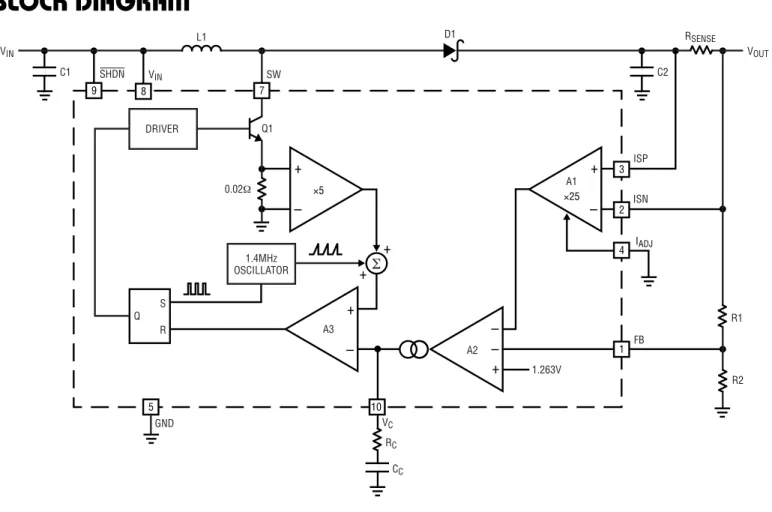
sn1618 1618fas 1.4MHz OSCILLATOR DRIVER – + – + + + – – + ×5 Σ Q Q1 S R – + A1 ×25 5 10 3 2 8 7 9 1.263V 4 1 SHDN IADJ GND VC RC CC VIN SW ISN ISP FB A2 A3 0.02Ω C1 C2 RSENSE VOUT VIN R1 R2 L1 D1Figure 1. LT1618 Block Diagram
BLOCK DIAGRA
W
OPERATIO
U
The LT1618 uses a constant frequency, current mode control scheme to provide excellent line and load regula-tion. Operation can be best understood by referring to the Block Diagram in Figure 1. At the start of each oscillator cycle, the SR latch is set, turning on power switch Q1. The signal at the noninverting input of PWM comparator A3 is a scaled-down version of the switch current (summed together with a portion of the oscillator ramp). When this signal reaches the level set by the output of error amplifier A2, comparator A3 resets the latch and turns off the power switch. In this manner, A2 sets the correct peak current level to keep the output in regulation. If the error amplifier’s output increases, more current is delivered to the output; if it decreases, less current is delivered. A2 has two inverting inputs, one from the voltage feedback loop, and one from the current feedback loop. Whichever inverting
input is higher takes precedence, forcing the converter into either a constant-current or a constant-voltage mode. The LT1618 is designed to transition cleanly between the two modes of operation. Current sense amplifier A1 senses the voltage between the ISP and ISN pins and provides a 25× level-shifted version to error amplifier A2. When the voltage between ISP and ISN reaches 50mV, the output of A1 provides 1.263V to one of the noninverting inputs of A2 and the converter is in constant-current mode. If the current sense voltage exceeds 50mV, the output of A1 will increase causing the output of A2 to decrease, thus reducing the amount of current delivered to the output. In this manner the current sense voltage is regulated to 50mV. Similarly, if the FB pin increases above 1.263V, the output of A2 will decrease to reduce the peak current level and regulate the output (constant-voltage mode).
6
sn1618 1618fas
Capacitor Selection
Low ESR (equivalent series resistance) capacitors should be used at the output to minimize the output ripple voltage. Multilayer ceramic capacitors are an excellent choice. They have an extremely low ESR and are available in very small packages. X5R and X7R dielectrics are preferred, as these materials retain their capacitance over wider voltage and temperature ranges than other dielectrics. A 4.7µF to 10µF output capacitor is sufficient for high output current designs. Converters with lower output currents may need only a 1µF or 2.2µF output capacitor. Solid tantalum or OSCON capacitors can be used, but they will occupy more board area than a ceramic and will have a higher ESR for
APPLICATIO
N
S I
U
N
FOR
U
M
ATIO
W
N
U
Inductor Selection
Several inductors that work well with the LT1618 are listed in Table 1, although there are many other manufacturers and devices that can be used. Consult each manufacturer for more detailed information and for their entire selection of related parts. Many different sizes and shapes are available. Ferrite core inductors should be used to obtain the best efficiency, as core losses at 1.4MHz are much lower for ferrite cores than for the cheaper powdered-iron ones. Choose an inductor that can handle the necessary peak current without saturating, and ensure that the inductor has a low DCR (copper-wire resistance) to mini-mize I2R power losses. A 4.7µH or 10µH inductor will be a good choice for many LT1618 designs.
Table 1. Recommended Inductors
L MAX HEIGHT PART (µH) (mΩ) (mm) VENDOR CDRH5D18-4R1 4.1 57 2.0 Sumida CDRH5D18-100 10 124 2.0 (847) 956-0666 CR43-2R2 2.2 71 3.5 www.sumida.com CR43-4R7 4.7 109 3.5 CR43-100 10 182 3.5 CR54-100 10 100 4.8 LQH3C1R0M24 1.0 78 2.0 Murata LQH3C2R2M24 2.2 126 2.0 (814) 237-1431 LQH3C4R7M24 4.7 260 2.0 www.murata.com
the same footprint device. Always use a capacitor with a sufficient voltage rating.
Ceramic capacitors also make a good choice for the input decoupling capacitor, which should be placed as close as possible to the VIN pin of the LT1618. A 1µF to 4.7µF input capacitor is sufficient for most applications. Table 2 shows a list of several ceramic capacitor manufacturers. Consult the manufacturers for detailed information on their entire selection of ceramic parts.
Table 2. Recommended Ceramic Capacitor Manufacturers
VENDOR PHONE URL
Taiyo Yuden (408) 573-4150 www.t-yuden.com Murata (814) 237-1431 www.murata.com Kemet (408) 986-0424 www.kemet.com
Diode Selection
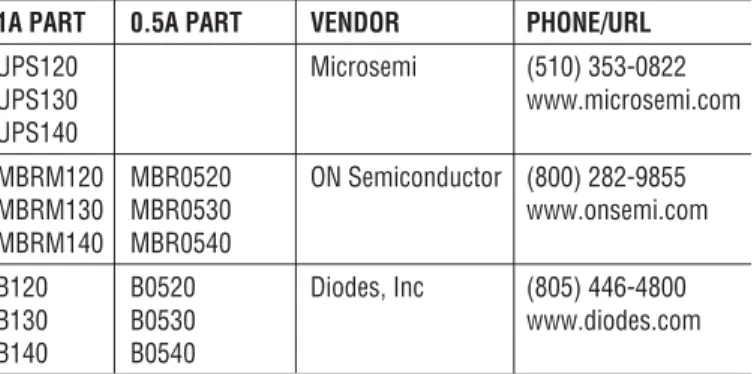
Schottky diodes, with their low forward voltage drop and fast switching speed, are the ideal choice for LT1618 applications. Table 3 shows several Schottky diodes that work well with the LT1618. Many different manufacturers make equivalent parts, but make sure that the component chosen has a sufficient current rating and a voltage rating greater than the output voltage. The diode conducts cur-rent only when the power switch is turned off (typically less than half the time), so a 0.5A or 1A diode will be sufficient for most designs. The companies below also offer Schottky diodes with higher voltage and current ratings.
Table 3. Recommended Schottky Diodes
1A PART 0.5A PART VENDOR PHONE/URL
UPS120 Microsemi (510) 353-0822 UPS130 www.microsemi.com UPS140 MBRM120 MBR0520 ON Semiconductor (800) 282-9855 MBRM130 MBR0530 www.onsemi.com MBRM140 MBR0540 B120 B0520 Diodes, Inc (805) 446-4800 B130 B0530 www.diodes.com B140 B0540
7
sn1618 1618fas
APPLICATIO
N
S I
U
N
FOR
U
M
ATIO
W
N
U
Setting Output Voltage
To set the output voltage, select the values of R1 and R2 (see Figure 1) according to the following equation.
R1 R2 VOUT 1 263 1 = ⎛ ⎝ ⎜ ⎞ ⎠ ⎟ . –
For current source applications, use the FB pin for over-voltage protection. Pick R1 and R2 so that the output voltage will not go too high if the load is disconnected or if the load current drops below the preset value. Typically choose R1 and R2 so that the overvoltage value will be about 20% to 30% higher than the normal output voltage (when in constant-current mode). This prevents the volt-age loop from interfering with the current loop in current source applications. For battery charger applications, pick the values of R1 and R2 to give the desired end of charge voltage.
Selecting RSENSE/Current Sense Adjustment
Use the following formula to choose the correct current sense resistor value (for constant current operation).
RSENSE = 50mV/IMAX
For designs needing an adjustable current level, the IADJ pin is provided. With the IADJ pin tied to ground, the nominal current sense voltage is 50mV (appearing be-tween the ISP and ISN pins). Applying a positive DC voltage to the IADJ pin will decrease the current sense voltage according to the following formula:
VISENSE=1 263V 0 8VIADJ
25 . – ( . )
For example, if 1V is applied to the IADJ pin, the current sense voltage will be reduced to about 18mV. This adjustability allows the regulated current to be reduced without changing the current sense resistor (e.g. to adjust brightness in an LED driver or to reduce the charge current in a battery charger). If the IADJ pin is taken above 1.6V,
the output of the error amplifier (the VC pin) will be pulled down and the LT1618 will stop switching.
A pulse width modulated (PWM) signal can also be used to adjust the current sense voltage; simply add an RC filterto convert the PWM signal into a DC voltage for the IADJ pin. If the IADJ pin is not used, it should be tied to ground. Do not leave the pin floating.
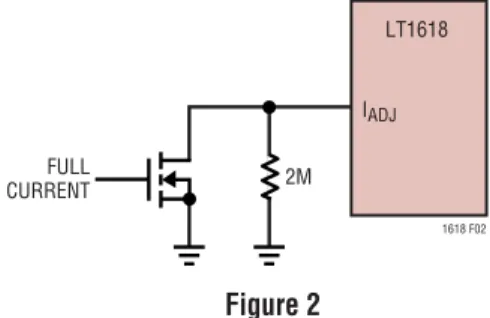
For applications needing only a simple one-step current sense adjustment, the circuit in Figure 2 works well. If a large value resistor (≥2MΩ) is placed between the IADJ pin and ground, the current sense voltage will reduce to about 25mV, providing a 50% reduction in current. Do not leave the IADJ pin open. This method gives a well-regulated current value in both states, and is controlled by a logic signal without the need for a variable PWM or DC control signal. When the NMOS transistor is on, the current sense voltage will be 50mV, when it is off, the current sense voltage will be reduced to 25mV.
Figure 2 LT1618 IADJ 2M FULL CURRENT 1618 F02
Considerations When Sensing Input Current
In addition to regulating the DC output current for current-source applications, the constant-current loop of the LT1618 can also be used to provide an accurate input current limit. Boost converters cannot provide output short-circuit protection, but the surge turn-on current can be drastically reduced using the LT1618’s current sense at the input. SEPICs, however, have an output that is DC-isolated from the input, so an input current limit not only helps soft-start the output but also provides excellent short-circuit protection.
8
sn1618 1618fas
APPLICATIO
N
S I
U
N
FOR
U
M
ATIO
W
N
U
Figure 3 LOAD VOUT L1 SWITCHNODE 1618 • F03 VIN HIGH FREQUENCY CIRCULATING PATH
When sensing input current, the sense resistor should be placed in front of the inductor (between the decoupling capacitor and the inductor) as shown in the circuits in the Typical Applications section. This will regulate the average inductor current and maintain a consistent inductor ripple current, which will, in turn, maintain a well regulated input current. Do not place the sense resistor between the input source and the input decoupling capacitor, as this may allow the inductor ripple current to vary widely (even though the average input current and the average inductor current will still be regulated). Since the inductor current is a triangular waveform (not a DC waveform like the output current) some tweaking of the compensation values (RC and CC on the VC pin) may be required to ensure a clean inductor ripple current while the constant-current loop is in effect. For these applications, the constant-current loop response can usually be improved by reduc-ing the RC value, or by adding a capacitor (with a value of approximately CC/10) in parallel with the RC and CC compensation network.
Frequency Compensation
The LT1618 has an external compensation pin (VC), which allows the loop response to be optimized for each applica-tion. An external resistor and capacitor (or sometimes just a capacitor) are placed at the VC pin to provide a pole and a zero (or just a pole) to ensure proper loop compensation. Numerous other poles and zeroes are present in the closed
loop transfer function of a switching regulator, so the VC pin pole and zero are positioned to provide the best loop response. A thorough analysis of the switching regulator control loop is not within the scope of this data sheet, and will not be presented here, but values of 2kΩ and 10nF will be a good choice for many designs. For those wishing to
optimize the compensation, use the 2kΩ and 10nF as a
starting point. For LED backlight applications where a pulse-width modulation (PWM) signal is used to drive the IADJ pin, the resistor is usually not included in the compensation network. This helps to provide additional filtering of the PWM signal at the output of the error amplifier (the VC pin).
Switch Node Considerations
To maximize efficiency, switch rise and fall times are made as short as possible. To prevent radiation and high fre-quency resonance problems, proper layout of the high frequency switching path is essential. Keep the output switch (SW pin), diode and output capacitor as close together as possible. Minimize the length and area of all traces connected to the switch pin, and always use a ground plane under the switching regulator to minimize interplane coupling. The high speed switching current path is shown in Figure 3. The signal path including the switch, output diode and output capacitor contains nano-second rise and fall times and should be kept as short as possible.
9
sn1618 1618fas
TYPICAL APPLICATIO S
U
LOAD CURRENT (mA) 0 EFFICIENCY (%) 80 75 70 65 60 50 100 150 200 1618 TA02b 250 300
4.5W Direct Broadcast Satellite (DBS) Power Supply with Short-Circuit Protection
Efficiency LHCP RHCP 0V 3.3V SHDN IADJ VC VIN SW ISN ISP FB LT1618 R1 100k R2 10k R5 24.9k VIN 12V C1 4.7µF CC 33nF C3 3.3µF C4 3.3µF 1618 TA02a D1 L1 33µH L3 2.2µH L2 33µH 3 2 1 9 8 7 GND 5 10 4
C1: TAIYO YUDEN EMK316BJ475 (408) 573-4150
C2: TAIYO YUDEN TMK316BJ105 (408) 573-4150 C3, C4: TAIYO YUDEN TMK325BJ335 (408) 573-4150 D1: ON SEMICONDUCTOR MBRM140 (800) 282-9855 L1, L2: SUMIDA CR54-330 (847) 956-0666 L3: SUMIDA CR43-2R2 (847) 956-0666 0.068Ω RC 2k C2 1µF Q1 MMBT3904 Q1 FMMT717 ZETEX D2 MURS110 13.5V/18.5V 22kHz NETWORK TUNING R3 10k R4 1k ADD 5V
10
sn1618 1618fas
2-Cell White LED Driver
2-Cell Luxeon LED Driver
TYPICAL APPLICATIO
N
U
S
SHDN IADJ GND VC VIN SW ISN ISP FB LT1618 R12M R2 160k VIN 1.6V TO 3V 10kHz TO 50kHz PWM BRIGHTNESS ADJUST C1 4.7µF CC 0.1µF C2 1µF 1618 • TA03 2.49Ω D1 L1 4.7µH 20mA 3 2 1 9 8 7 5 10 4 R3 5.1k C3 0.1µF C1: TAIYO YUDEN JMK212BJ475 (408) 573-4150C2: TAIYO YUDEN EMK316BJ105 (408) 573-4150
D1: ON SEMICONDUCTOR MBR0520 (800) 282-9855 L1: SUMIDA CLQ4D10-4R7 (847) 956-0666 SHDN IADJ GND VC VIN SW ISN ISP FB LT1618 332k D2 124k VIN 1.8V TO 3V C1 1µF 100nF C21 µF 1618 • TA12 0.15Ω D1 L1 10µH 350mA 3 2 1 9 8 7 5 10 4
C1, C2: TAIYO YUDEN JMK107BJ105KA D1: ON SEMICONDUCTOR MBR0520 D2: LUMILEDS LXHL-BW02 L1: SUMIDA CR43-100
11
sn1618 1618fas
TYPICAL APPLICATIO
N
U
S
Li Ion White LED Driver
SHDN IADJ GND VC VIN SW ISN ISP FB LT1618 R12M R2 100k VIN 2.7V TO 5V 10kHz TO 50kHz PWM BRIGHTNESS ADJUST C1 4.7µF CC 0.1µF C2 1µF 1618 • TA04 2.49Ω D1 L1 10µH 20mA 3 2 1 9 8 7 5 10 4 R3 5.1k C3 0.1µF C1: TAIYO YUDEN JMK212BJ475 (408) 573-4150 C2: TAIYO YUDEN TMK316BJ105 (408) 573-4150 D1: ON SEMICONDUCTOR MBR0530 (800) 282-9855 L1: SUMIDA CLQ4D10-100 (847) 956-0666
White LED Driver for 20 LEDs
SHDN IADJ GND VC VIN SW ISN ISP FB LT1618 R12M R2 121k VIN 2.7V TO 5V 10kHz TO 50kHz PWM BRIGHTNESS ADJUST C1 4.7µF CC 0.1µF C2 1µF 1618 • TA05 0.619Ω D1 L1 10µH 80mA 3 2 1 9 8 7 5 10 4 R3 5.1k C3 0.1µF 51Ω 51Ω 51Ω 51Ω C1: TAIYO YUDEN JMK212BJ475 (408) 573-4150 C2: TAIYO YUDEN TMK316BJ105 (408) 573-4150 D1: ON SEMICONDUCTOR MBR0530 (800) 282-9855 L1: SUMIDA CR43-100 (847) 956-0666
12
sn1618 1618fas
TYPICAL APPLICATIO
N
U
S
USB to 5V SEPIC Converter
Efficiency
USB SEPIC During Start-Up USB SEPIC Start-Up with Output Shorted
LOAD CURRENT (mA) 0 EFFICIENCY (%) 350 1618 F09b 100 250 80 75 70 65 60 50 150 200 300 1ms/DIV 1618 TA10 VOUT 2V/DIV IIN 50mA/DIV 1ms/DIV 1618 TA11 VOUT 2V/DIV 50mA/DIV SHDN IADJ VC VIN SW ISN ISP FB LT1618 R1 316k R2 107k VIN 5V C1 4.7µF 10nF C2 10µF 1618 • TA09a D1 L1 10µH L2 10µH 3 2 1 9 8 7 GND 5 10 4 0.1Ω 2k 13k 20k VOUT 5V C3 0.47µF IIN C1: TAIYO YUDEN JMK212BJ475 (408) 573-4150 C2: TAIYO YUDEN JMK316BJ106 (408) 573-4150
C3: TAIYO YUDEN EMK212BJ474 (408) 573-4150
D1: ON SEMICONDUCTOR MBR0520 (800) 282-9855 L1: SUMIDA CR43-100 (847) 956-0666 OFF ON 0V 3.3V 100mA 500mA 0V 3.3V
13
sn1618 1618fas
TYPICAL APPLICATIO S
U
Efficiency 12V Boost Converter with 500mA Input Current Limit
12V Boost Converter Start-Up with Input Current Limit
(VIN = 1.8V, ILOAD = 40mA)
12V Boost Converter Start-Up without Input Current Limit
(VIN = 1.8V, ILOAD = 40mA)
L0AD CURRENT (mA) 0 EFFICIENCY (%) 120 140 1618 TA06b 40 80 90 85 80 75 70 65 60 20 60 100 160 VIN = 5V VIN = 3.3V SHDN IADJ VC VIN SW ISN ISP FB LT1618 R1 909k R2 107k VIN 1.8V TO 5V C1 4.7µF 10nF C2 4.7µF 1618 • TA06a D1 L1 10µH 3 2 1 9 8 7 GND 5 10 4 0.1Ω 2k VOUT 12V C1: TAIYO YUDEN JMK212BJ475 (408) 573-4150
C2: TAIYO YUDEN EMK316BJ475 (408) 573-4150
D1: ON SEMICONDUCTOR MBR0520 (800) 282-9855 L1: SUMIDA CR43-100 (847) 956-0666 IL1 50µs/DIV 1618 TA07 VOUT 5V/DIV ILI 200mA/DIV 50µs/DIV 1618 TA08 VOUT 5V/DIV ILI 200mA/DIV
14
sn1618 1618fasPACKAGE DESCRIPTIO
U
DD Package 10-Lead Plastic DFN (3mm × 3mm) (Reference LTC DWG # 05-08-1698) 3.00 ±0.10 (4 SIDES) NOTE:1. DRAWING TO BE MADE A JEDEC PACKAGE OUTLINE M0-229 VARIATION OF (WEED-2). CHECK THE LTC WEBSITE DATA SHEET FOR CURRENT STATUS OF VARIATION ASSIGNMENT 2. DRAWING NOT TO SCALE
3. ALL DIMENSIONS ARE IN MILLIMETERS
4. DIMENSIONS OF EXPOSED PAD ON BOTTOM OF PACKAGE DO NOT INCLUDE MOLD FLASH. MOLD FLASH, IF PRESENT, SHALL NOT EXCEED 0.15mm ON ANY SIDE 5. EXPOSED PAD SHALL BE SOLDER PLATED
6. SHADED AREA IS ONLY A REFERENCE FOR PIN 1 LOCATION ON THE TOP AND BOTTOM OF PACKAGE
0.38 ± 0.10
BOTTOM VIEW—EXPOSED PAD 1.65 ± 0.10 (2 SIDES) 0.75 ±0.05 R = 0.115 TYP 2.38 ±0.10 (2 SIDES) 1 5 10 6 PIN 1 TOP MARK (SEE NOTE 6) 0.200 REF 0.00 – 0.05 (DD10) DFN 1103 0.25 ± 0.05 2.38 ±0.05 (2 SIDES)
RECOMMENDED SOLDER PAD PITCH AND DIMENSIONS 1.65 ±0.05 (2 SIDES) 2.15 ±0.05 0.50 BSC 0.675 ±0.05 3.50 ±0.05 PACKAGE OUTLINE 0.25 ± 0.05 0.50 BSC
15
sn1618 1618fas
PACKAGE DESCRIPTIO
U
MS Package 10-Lead Plastic MSOP
(Reference LTC DWG # 05-08-1661) MSOP (MS) 0603 0.53 ± 0.152 (.021 ± .006) SEATING PLANE 0.18 (.007) 1.10 (.043) MAX 0.17 – 0.27 (.007 – .011) TYP 0.127 ± 0.076 (.005 ± .003) 0.86 (.034) REF 0.50 (.0197) BSC 1 2 3 4 5 4.90 ± 0.152 (.193 ± .006) 0.497 ± 0.076 (.0196 ± .003) REF 8 9 10 7 6 3.00 ± 0.102 (.118 ± .004) (NOTE 3) 3.00 ± 0.102 (.118 ± .004) (NOTE 4) NOTE: 1. DIMENSIONS IN MILLIMETER/(INCH) 2. DRAWING NOT TO SCALE
3. DIMENSION DOES NOT INCLUDE MOLD FLASH, PROTRUSIONS OR GATE BURRS.
MOLD FLASH, PROTRUSIONS OR GATE BURRS SHALL NOT EXCEED 0.152mm (.006") PER SIDE 4. DIMENSION DOES NOT INCLUDE INTERLEAD FLASH OR PROTRUSIONS.
INTERLEAD FLASH OR PROTRUSIONS SHALL NOT EXCEED 0.152mm (.006") PER SIDE 5. LEAD COPLANARITY (BOTTOM OF LEADS AFTER FORMING) SHALL BE 0.102mm (.004") MAX
0.254 (.010) 0° – 6° TYP DETAIL “A” DETAIL “A” GAUGE PLANE 5.23 (.206) MIN 3.20 – 3.45 (.126 – .136) 0.889 ± 0.127 (.035 ± .005)
RECOMMENDED SOLDER PAD LAYOUT 0.305 ± 0.038 (.0120 ± .0015) TYP 0.50 (.0197) BSC
Information furnished by Linear Technology Corporation is believed to be accurate and reliable. However, no responsibility is assumed for its use. Linear Technology Corporation makes no represen-tation that the interconnection of its circuits as described herein will not infringe on existing patent rights.
16
sn1618 1618fas
Linear Technology Corporation
1630 McCarthy Blvd., Milpitas, CA 95035-7417
(408) 432-1900 ● FAX: (408) 434-0507 ● www.linear.com © LINEAR TECHNOLOGY CORPORATION 2001 LT/TP 0504 1K REV A • PRINTED IN USA
TYPICAL APPLICATIO
N
U
S
Buck Mode Luxeon LED Driver
SHDN IADJ VC VIN SW ISN ISP FB LT1618 VIN 16V C1 4.7µF 2.2nF 220pF 1618 TA14 D1 D2 700mA L1 47µH 3 2 1 9 8 7 GND 5 10 4 C1: TAIYO YUDEN TMK325BJ475MN D1: PHILIPS PMEG2010 D2: LUMILEDS DS45 L1: TOKO D104C 10k 0.07Ω
Li-Ion Buck-Boost Mode Luxeon LED Driver
SHDN IADJ VC VIN SW ISP ISN FB LT1618 100k 10k VIN 3.2V TO 5V C1 4.7µF 10nF C2 4.7µF 1618 TA13 D1 D2 350mA L1 3.3µH 2 3 1 9 8 7 GND 5 10 4 C1: TAIYO YUDEN JMK212BJ475KG C2: TAIYO YUDEN EMK316BJ475ML D1: ON SEMICONDUCTOR MBRM120 D2: LUMILEDS DS25
L1: NEC PLC-07453R3 0.15Ω
PART NUMBER DESCRIPTION COMMENTS
LT1613 550mA (ISW), 1.4MHz, High Efficiency Step-Up DC/DC Converter VIN: 0.9V to 10V, VOUT(MAX) = 34V, IQ = 3mA, ISD < 1µA,
ThinSOTTM
Package
LT1615/LT1615-1 300mA/80mA (ISW), Constant Off-Time, High Efficiency Step-Up VIN: 1.2V to 15V, VOUT(MAX) = 34V, IQ = 20µA, ISD < 1µA,
DC/DC Converter ThinSOT Package
LT1930/LT1930A 1A (ISW), 1.2MHz/2.2MHz, High Efficiency Step-Up VIN: 2.6V to 16V, VOUT(MAX) = 34V, IQ = 4.2mA/5.5mA,
DC/DC Converter ISD < 1µA, ThinSOT Package
LT1932 Constant Current, 1.2MHz, High Efficiency White LED VIN: 1V to 10V, VOUT(MAX) = 34V, IQ = 1.2mA, ISD < 1µA,
Boost Regulator ThinSOT Package
LT1944/LT1944-1 Dual Output 350mA/100mA (ISW), Constant Off-Time, VIN: 1.2V to 15V, VOUT(MAX) = 34V, IQ = 20µA, ISD < 1µA,
(Dual) High Efficiency Step-Up DC/DC Converter MS Package
LT1945 (Dual) Dual Output, Pos/Neg, 350mA (ISW), Constant Off-Time, VIN: 1.2V to 15V, VOUT(MAX) = ±34V, IQ = 20µA, ISD < 1µA,
High Efficiency Step-Up DC/DC Converter MS Package
LT1961 1.5A (ISW), 1.25MHz, High Efficiency Step-Up DC/DC Converter VIN: 3V to 25V, VOUT(MAX) = 35V, IQ = 0.9mA, ISD < 6µA,
MS8E Package
LTC3401/LTC3402 1A/2A (ISW), 3MHz, Synchronous Step-Up DC/DC Converter VIN: 0.5V to 5V, VOUT(MAX) = 6V, IQ = 38µA, ISD < 1µA,
MS Package
LT3461/LT3461A 0.3A (ISW), 1.3MHz/3MHz, High Efficiency Step-Up DC/DC VIN: 2.5V to 16V, VOUT(MAX) = 38V, IQ = 2.8mA, ISD < 1µA,
Converter with Integrated Schottky SC70 and ThinSOT Packages
LT3463/LT3463A 250mA (ISW), Boost/Inverter Dual, Micropower DC/DC Converter VIN: 2.4V to 15V, VOUT(MAX) = ±40V, IQ = 40µA, ISD < 1µA,
with Integrated Schottky Diodes DFN Package
LT3464 0.08A (ISW), High Efficiency Step-Up DC/DC Converter with VIN: 2.3V to 10V, VOUT(MAX) = 34V, IQ = 25µA, ISD < 1µA,
Integrated Schottky, Output Disconnect ThinSOT Package
LT3465/LT3465A Constant Current, 1.2MHz/2.7MHz, High Efficiency White LED VIN: 2.7V to 16V, VOUT(MAX) = 34V, IQ = 1.9mA, ISD < 1µA,
Boost Regulator with Integrated Schottky Diode ThinSOT Package
LT3467/LT3467A 1.1A (ISW), 1.3MHz/2.1MHz, High Efficiency Step-Up DC/DC VIN: 2.4V to 16V, VOUT(MAX) = 40V, IQ = 1.2mA, ISD < 1µA,
Converter with Integrated Soft-Start ThinSOT Package ThinSOT is a trademark of Linear Technology Corporation.