ISSN: 2347-7474 International Journal Advances in Social Science and Humanities
Available online at: www.ijassh.com
RESEARCH ARTICLE
Students Absorption of Materials Through using Blended Learning
in the Implementation of Curriculum
Alwen Bentri
*,
Abna Hidayati
,
Ulfia Rahmi
*
Department of Educational Technology, Padang State University, Jln. Prof. Dr. Hamka, Padang, Indonesia.
*Corresponding Author: Ulfia Rahmi
Abstract
The aim of this research is to describe the rate of mastery of student toward the material on Elementary School Curriculum Analysis course. The Blended learning strategy has been implemented to this course, yet it has not been researched to the rate of the absorptive capacity of student toward that material. This study uses descriptive quantitative method. The final score from both of classes is going to be analyzed and then compared by the absorptive capacity of student toward the material. The result of this study shows that there are some significant differences between the learning outcome using blended learning strategy formulation and face-to face lecture on curriculum implementation in Curriculum and Educational Technology Department. In this case, the absorptive capacity of student toward the material using blended learning strategy is better than the absorptive capacity of student using face-to face lecture.
Keyword: Blended learning, Student absorption.
Introduction
Implementation of this curriculum takes place during the process do not meet the standards as set forth in Regulation no. 32 in 2013, namely "The learning process in the educational unit organized in an interactive, inspiring, fun, challenging, motivating learners to actively participate and provide enough space for innovation, creativity, and independence in accordance with their talents, interests, and physical development as well as Psychological learners ". The Regulation also applies to the subjects Analysis of the Basic Education Curriculum.
This course has the competencies that students are expected after a series of curriculum implementation can know, understand and apply the concepts of study in school curricula, especially in primary education. In the lecture, students are required to be able to apply the concepts of curriculum and study of the current curriculum.
implementation of the curriculum. It can be said that the implementation of the curriculum is the result of the translation faculty of the curriculum as a written plan that is poured into the learning experience of students in learning activities.
Implementation of the curriculum in the form of learning activities in this class include; instructional planning, implementation of learning and learning outcomes assessment and evaluation of activities that have been carried out. Therefore, the lecturer acts as the party directly responsible for all activities of the implementation of the curriculum in order to prepare as best as possible. With the preparation of curriculum implementation in total which are intended not just to meet the demands of administration and can help implement the curriculum appropriately.
This is based on the consideration that the implementation of the curriculum becomes a learning process that has a high interactivity that students are inspired, fun, challenged, motivated, and actively participate. Application of blended learning course on Analysis of Primary Education Studies supported by the actual facilities that the university environment can be optimized utilization so that the learning process takes place as mentioned by Regulation No. 32 of 2013 is. Many campus facilities can be optimized utilization, such as the Internet. Students can access various web pages available via the campus network and communications equipment and technology at their disposal.
In this connection, according to Harding,
is learning that integrates the traditional face-to-face learning and distance learning that uses online learning resources and a variety of communication options that can be used by faculty and students. Learning implementation allows use of online learning resources, primarily web-based, without leaving face to face activities. With the implementation of blended learning, the learning more meaningful due to the diversity of learning resources that may be obtained. Then Thorne [2], argues that blended learning is a combination of multimedia technology, CD-ROM, video streaming, virtual classes, voicemail, e mail and teleconferencing, online text animations and video streaming. In blended learning, all combined in learning activities. Therefore blended learning be the perfect solution and can be tailored to the needs of learners.
Blended performed when macthing with the situation of students.Implementation of the curriculum with the implementation of blended learning has been done lately, but the rate of absorption is not known student of the material, especially in the Course of Basic Education Curriculum Analysis in the Department of Curriculum and Educational Technology.
Methodology
This research uses descriptive quantitative method to measure the success of students in the course Analysis Primary School Curriculum. Application of blended learning course on Basic Education Curriculum Analysis conducted on students who are active and registered in the course of the semester from January to June 2015. In the research process, the class is divided into two categories, namely the first class section with the code 201 420 040 037 (grade A) conducting lectures without dikombinaskan face to face with online learning. Then the class with the sexy code 201420040039 (class B) conduct face-to-face lectures by combining it with online learning. The final value of the two classes were analyzed, and then compared the absorption rate of students of the material between the two classes stretcher.
Discussion
Analysis of the level of absorption of students to course material on Basic Education Curriculum Analysis obtained from the students' final grades, namely recapitulation value minggan task, the value of midterms, assignments and grades the end of the semester students attend lectures during the semester. The final task is the replacement for the semester final exams are done by giving the final project to the students to determine the level of mastery and depth ability to analyze the basic education curriculum. The final task of the e-mail sent to faculty in accordance with the schedule set by the lecturer.
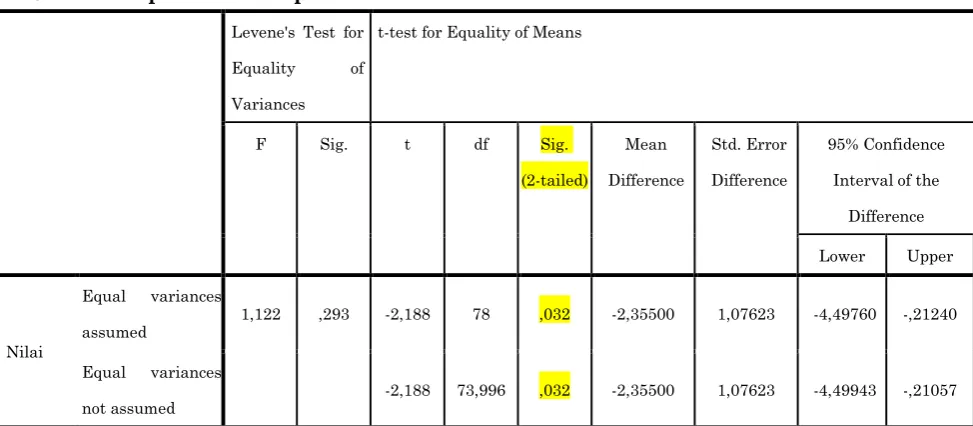
Based on data analysis that has been done at the level of significance value 0.05 is 0.032. The results can be seen in the analysis using the SPSS output,
Table 1: Independent samples test
Levene's Test for
Equality of
Variances
t-test for Equality of Means
F Sig. t df Sig.
(2-tailed)
Mean
Difference
Std. Error
Difference
95% Confidence
Interval of the
Difference
Lower Upper
Nilai
Equal variances
assumed 1,122 ,293 -2,188 78 ,032 -2,35500 1,07623 -4,49760 -,21240
Equal variances
not assumed -2,188 73,996 ,032 -2,35500 1,07623 -4,49943 -,21057
This means that the significance value <0.05, meaning that there is a significant difference between the results of learning to use a blended learning strategy formulation application with face to face meetings on the
implementation of the curriculum in the Department of Curriculum and Educational Technology has a high absorption level because it has a significant difference between the results of the second study group.
The level of absorption of students to the lecture material Analysis of the Basic Education Curriculum is the effect of the implementation of blended learning in the curriculum. Blended learning can be utilized in the implementation of a higher quality curriculum and functional for students. High absorption material by the students indicated blended learning can be passed on, but when the absorption of the low student to indicate blended learning material needs to be revised or terminated depending on the shortcomings in the implementation of blended learning. For that we need also
known weaknesses and shortcomings in the implementation of blended learning increase student absorption of the material so as to further the implementation of existing measures must be revised so that students effectively absorb the lecture material.
Blended learning contributes to the absorption of the material by the students due to the flexibility offered in the implementation of blended learning. In the implementation of the study, the implementation of blended learning is done in the experimental class, while the control class entirely conducted through face to face meetings.
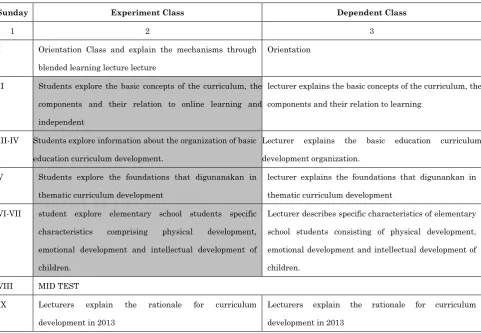
Here is presented mateik implementation of blended learning course on Basic Education Curriculum Studies Analysis.
Table 2: Mateik implementation of blended learning course on basic education curriculum studies analysis
Sunday Experiment Class Dependent Class
1 2 3
I Orientation Class and explain the mechanisms through
blended learning lecture lecture
Orientation
II Students explore the basic concepts of the curriculum, the
components and their relation to online learning and
independent
lecturer explains the basic concepts of the curriculum, the
components and their relation to learning
III-IV Students explore information about the organization of basic
education curriculum development.
Lecturer explains the basic education curriculum
development organization.
V Students explore the foundations that digunanakan in
thematic curriculum development
lecturer explains the foundations that digunankan in
thematic curriculum development
VI-VII student explore elementary school students specific
characteristics comprising physical development,
emotional development and intellectual development of
children.
Lecturer describes specific characteristics of elementary
school students consisting of physical development,
emotional development and intellectual development of
children.
VIII MID TEST
X-XI lecturer explains the thematic curriculum development procedures lecturer explained the procedure of thematic
curriculum development
XII Lecturer explaining aspects of the curriculum and
character formation in 2013, the procedure of formation of
character and also integrate the values of characters in the
learning
lecturer explain aspects of the curriculum and character
formation in 2013, the procedure of formation of character
and also integrate the values of characters in the learning
XIII Students explore the core competencies and basic education
level
lecturer explains the core competencies and core
competencies of each level of education
XIV lecturer explained the strategy of applying a scientific
approach to learning.
Lecturer explained the strategy applied scientific approach
XV Students explore evaluation techniques in the curriculum
in 2013
Lecturer describes evaluation techniques in the curriculum
in 2013
XVI FINAL EXAM
Online learning
Face to Face
Based on the above matrix, for experimental classes performed blended learning with online learning formula and formula 62.5% 37.5% face to face meetings. While the control class is done entirely with the face-to-face.
Therefore, absorption of the material students in the subject of Basic Education Curriculum Analysis of relevant research results Korkmaz and Karakus [3] regarding blended learning models that contribute more to the attitude of students towards subjects of Geography when compared to traditional learning models. Blended learning models contribute more to the students' critical power levels compared to traditional learning models.
Blended learning is a positive correlation between students 'attitudes toward the subjects of Geography and the level of students' critical thinking. The same thing happened in the course of Basic Education Curriculum Analysis blended learning that
contribute to students' ability to absorb the material.
Blended learning contributes to the absorption ability for students directly use traditional technology in the classroom, interaction, learning, time, and satisfaction, then influenced also by meteri delivery more effective by combining the advantages of delivering a message through face to face meetings with online learning.
According ... delivery through face to face colored with pedagogy while submission meteri through online learning offers a variety of presentation and novelty of the technology. Combining both increase the flexibility of the use of technology in meeting the time constraints between students and faculty adviser subjects.
students to have control over their own learning process and in turn improve critical thinking through the lecture that they follow.
Through online learning is applied to the course Analysis of the Basic Education Curriculum students are able to process information better in online learning environment in which they are forced to analyze their own material they learn. It means that the students are given the opportunity to process all the information that students obtain through online learning to help students develop insight, and then analyze it to see the relevance of such information in the material being studied. In this connection, Garrison and Kanuka [5] showed that high-quality interactive communications enjoyed in blended learning environment can facilitate critical thinking and high-level learning, and blended learning thereby increasing the absorptive capacity of students to the material students
learned.
Conclusion
Based on the research process, it can be concluded that the students absorption of the material by the application of blended learning course on Basic Education Curriculum Analysis is better if compared with the absorption of the material that follows the student perkulihan without using blended learning.
Based on these conclusions, suggestions for learning activities implemented by using blended learning need to increase access to the internet by students both on campus and off campus. While on the subject of Basic Education Curriculum Analysis in implementing the curriculum in the Department of Curriculum and Educational Technology, need to be evaluated on an ongoing basis to optimize perkualiahan activities [5-19].
References
1 Alwen Bentri (1993) Implementasi Kurikulum di SD Kecil dan Faktor-faktor yang Mempengaruhinya. Tesis tidak diterbitkan. Bandung: Program Pascasarjana Institut Keguruan dan Ilmu Kependidikan, p.23
2 Thorne Kaye (2003) Blended Learning: How to Integrate Online and Traditional Learning. Great Britain and United States: British Library
3 Korkmaz Özgen dan Karakuş, Ufuk (2009) The Impact of Blended Learning Model on student attitudes towards geography course and their critical thinking dispositions and levels. The Turkish Online Journal of Educational Technology-TOJET volume 8 Issue 4 Article 5.
4 Dziuban C, Moskal P, Hartman J (2004) Higher Education, Blended Learning and the Generations: Knowledge is Power-No More. Research Initiative for Teaching Effectiveness. LIB 118.
5 Garrison R, Kanuka H (2004) Blended Learning: Uncovering its Transformative Potential in Higher Education. The Internet and Higher Education, Volume 7, Issue 2.
6 Akhmad Sudrajat (2008) Pendekatan, Strategi,
Metode, Teknik dan Model
7 Akker Jan Van Den (1999) Design Approaches and Tools in Education and Training. Dordrecht:Kluwer Academic Publisher
8 Akker Jan Van Den (2006) Gravemeijer, Koeno. McKenney, Susan. and Nieveen, Nienke. 2006. Educational Design Research. Netherlands
9 Bersin Josh (2004) The Blended Learning Book; Best Practices, Proven Methodologies and Lessons Learned. United Stated: John Wiley & Sona, Inc.
10 Brown Abbie, Green Timpthy D (2011) The Essentials of Instructional Design; Connecting Fundamental Principles with Process and Practice. Boston: Pearson Education, Inc.
11 Dewi Salma Prawiradilaga (2009) Prinsip-prinsip Desain Pembelajaran. Jakarta: Kencana
12 Kaufman Roger, English Fenwick W (1979) Needs Assessment. New Jersey: Educational Technology Publication, Inc.
13 Kitchenham Andrew (2011) Blended Learning Across Disciplines: Models for Implementation. Information Science Reference.
14 MacDonald Janet (2008) Blended Learning and Online Tutoring; Planning Learner Support and Activity Design. England: GOWER HOUSE
15 Nieveen Nienke (1999) Prototyping to Reach Product Quality. Dordrecht:Kluwer Academic Publisher
16 Ornstein, Hunkins (2013) Curriculum Foundation, Principles and Issues. New Jersey: Pearson Education, Inc.
17 Redaksi Sinar Grafika (2006) Peraturan Pemerintah no 19 tahun 2005 tentang Standar Nasional Pendidikan. Jakarta: Sinar Grafika.
18 Plomp Tjeerd, Nieveen Nienke (2010) An Introduction to Educational Design Research. Proceeding of the seminar conducted at the East China Normal University, Shanghai (China), November 23-26.