Available online throug
ISSN 2229 – 5046
International Journal of Mathematical Archive- 3 (12), Dec. – 2012 4872
SEMI SIMPLE NEAR FILEDS GENEARTING FROM ALGEBRAIC K-THEORY
(SS-NF-G-F-AK-T)
N V Nagendram
1*Assistant Professor (Mathematics), Department of Science & Humanities,
Lakireddy Balireddy College of Engineering, L B Reddy Nagar, Mylavaram 521 230
Andhra Pradesh INDIA.
Dr. T V Pradeep Kumar
2Dr. Y Venkateswara Reddy
3Asst. Professor (Mthematics)
Professor (Mathematics) [Retd.]
Acharya Nagarjna University college of Engg.,
ANU College of Engineering, Nagarjuna Nagar
522510 Guntur District, Nagarjuna Nagar 522510
Nagarjuna Nagar 522510, Guntur District
Andhra Pradesh, INDIA.
Andhra Pradesh, INDIA.
(Received on: 15-11-12; Revised & Accepted on: 17-12-12)
ABSTRACT
I
n this paper we discussed about semi simple near fields generating efficiently from algebraic K-theory by defining required fundamental definitions, algorithms wherever necessary from near rings concept explained clearly by Gunter Pilz. Here we extended the concepts and derived some results on and applicable to semi simple near fields, simple near filed algebras, near field invariants and near filed centralizers keeping precisely under section 1 to section 5.Key words: near field, simple near field, semi simple near field, semi simple near field algebras, invariants,
centralizers.
Subject classification Code: AMS 2000 16D50, 16P20; 16P60.
SECTION 1: INTRODUCTION - SEMI SIMPLE NEAR FIELDS
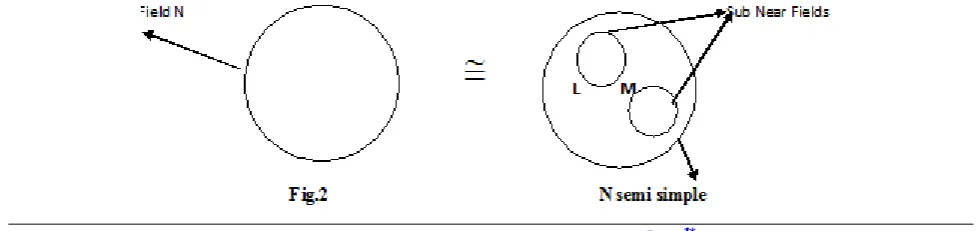
Definition 1.1: A near field N with 1 is a semi simple, or Left semi simple to be precise. If the free left N-module underlying N is a sum of simple N-module.
Fig. 1
Definition 1.2: A near field N with 1 is simple or left simple to be precise, if N is semi simple and any two simple left ideals (i.e., any two simple left sub near fields of N) are isomorphic.
Corresponding author:N V Nagendram1*
Assistant Professor (Mathematics), Department of Science & Humanities,
Note 1.3: A near field N is semi simple if and only if there exists a near field S and semi simple S-module M of finite length such that N ≅ EndS (M).
Lemma 1.4: Every semi simple near field is Artinian.
Proposition1.5: Let N be a semi simple near field. Then N is isomorphic to a finite direct product Π Ni for all i=1, 2,….n where each Ni is a simple near field.
Proposition 1.6: Let N be a simple near field. Then there exists a division field D and a positive integer n such that N ≅ Mn (D).
Definition 1.7: Let N be a near field with 1. Define radical of N to be the intersection of all maximal left ideals of N. The above defined definition uses left N-modules emphasized by me that η is the left radical of near field N.
Proposition 1.8: The radial of a semi simple near field is zero.
Proposition 1.9: Let N be a simple near field. Then N has no non-trivial two sided ideals and its radical is zero.
Proposition 1.10: Let N be an Artinian near field whose radical is zero. Then N is semi simple near field in particular, if N has no non – trivial two sided ideal, Then N is simple near field.
Note 1.11: The standard definition for a near field to be a semi simple is that “Its radical is zero” i.e., η = 0 Implies
∩ Mi = 0, where η is radical near field.
Example 1.12: Let Z is not a semi simple near field and the radical of Z is zero, Let N be a simple near field and then N has no non-trivial two sided ideal is true in N.
SECTION 2: MAIN RESULTS ON SEMI SIMPLE AND SIMPLE NEAR FIELD ALGEBRAS
In this section, I studied about Algebras of simple near fields and derived some results in the form of propositions and theorems of course with the help of proving lemmas and fundamental definitions.
Proposition 2.1: Let K be a field. Let P be a central simple near field algebras over K and Let Q be simple near field K-algebra. Then P ⊗K Q is a simple near field K-algebra. Moreover Z(P ⊗K Q) = Z(Q). i.e., every element of the center of P ⊗K Q has the form 1 ⊗ q for a unique element q ∈ Z(Q). In particular, P ⊗K Q is a central simple near field algebra over K if both P and Q are.
Proof: Let us assume for simplicity of exposition that dimK (Q) <∝.
The proof works for the element x = Σ pi ⊗ qi ∈ P ⊗K Q for i=1, 2… let pi ∈ P and qi ∈Q. Let I be any ideal or sub near field in P ⊗K Q. let x be a non-zero element of I of minimal length. After re-labelling the qi s we may and do assume that x has the form x = 1 ⊗bi + Σ ai for i=2, 3,…,r.
Let us consider [p ⊗ 1, x] ∈ I with p ∈ P whose length is less than the length of x.
So [ p ⊗ 1, x ] = 0for all p ∈ P. i.e., [ p, pi ] = 0 for all p ∈ P and i=2,3,…….,r. In other words, pi ∈ K for all i=2, 3… r.
Write pi = λi ∈ K and x =1 ⊗ q ∈ I where q = q1 + λ 2q2 + ……..+λ rqr ∈Q, q =0.
© 2012, IJMA. All Rights Reserved 4874 Let x = Σ pi ⊗ qi ∈ Z(P ⊗K Q) with p1,p2,…,pr ∈ P we have U = [ p ⊗ 1, x ] = Σ [ p,pi ] ⊗ qi for all p ∈ P.
Hence pi ∈ Z(P) = K for i=1,2,…,r and x = 1 ⊗ q for some q ∈ Q. The condition that 0 = [ 1⊗ y, x ] for all y ∈ Q implies that y ∈Z(Q) and hence x ∈1 ⊗ Z(Q). This completes the Proof of the proposition.
Corollary 2.2: Let P be a finite dimensional simple near field algebras over a filed K, and let n = dimK (P). If P is a central simple near field algebras over K, then P ⊗K P
opp → End
K(P) ≈ Mn(K). Conversely, if P ⊗K P
opp → End K(P) , then P is a central simple near field algebras over K.
Proof: Suppose that P is a central simple near field algebras over K. By proposition 2.1, P ⊗K Popp is a central simple near field algebras over K. Let us consider a mapping, α : P ⊗K Popp → EndK(P) which sends x ⊗ y to the element u → x u y ∈ EndK(P). The source of α is simple by known proposition 2.1, so α is injective mapping because it is clearly non-trivial. Hence it is an isomorphism because the source and the target have the same dimension over field K.
Conversely, suppose that P ⊗K Popp → EndK (P) and I is a proper ideal of A. Then the image of I ⊗K Popp in EndK (P) is a sub near filed and ideal of EndK (P) which does not contain IdP. So P is a simple near field K-Algebra. Let us define L: = Z (P), then the image of the canonical mapping P ⊗K P
opp
in End K(P) lies in the sub-algebra End L (P), hence L = K. This completes the Proof of the corollary.
Lemma 2.3:Let D be a finite dimensional central simple near filed over an algebraically closed near field K then D = K.
Corollary 2.4: The dimension of any central simple near field algebra over a near filed K is a perfect square.
Lemma 2.5: Let P be a finite dimensional central simple near field over a near filed K. Let F ⊆ P be an “over-field” of
K contained in P. then [ F : K ] / [ P : K ]1/2. In particular if [F: K]2 = [ P: K], then F is a maximal sub - near field of P.
Proof: Write [P: K] = n2, [F: K] = d. Multiplication on the left defines an embedding P ⊗K F → End F (P).
So, n2= [ P ⊗K F] divides [End F(P) : F] = (n2 /d)2, i.e., d2 /n2. so d divides n. This completes the Proof of the lemma.
SECTION 3: MAIN RESULTS ON SEMI SIMPLE AND SIMPLE NEAR FIELD ALGEBRAS
Lemma 3.1: Let P be a finite dimensional central simple near filed algebra over o near filed K. If F is a sub- near filed of P containing K, and [ F : K]2 = [P: K] , then F is a maximal sub near field of K and P⊗KF≅Mn(F),where n = [P : K]1/2 .
Proof: Since F is a maximal sub near field of P. consider the natural map α : P ⊗K F → End k (P), which is injective because P ⊗K F is simple near field and α is non trivial. Since the dimension of of the source and the target of α are both equal to n2, α is an isomorphism.
Proposition 3.2: Let P be a central semi simple near field algebra over a near field K. Then there exists a finite separable semi simple near filed extension F / K such that P ⊗K F ≅ Mn(N), where n = [ P:K]
1/2 .
Proof: It suffices to show that ⊗K F ≅ Mn ( Ksep ). Changing notation, we may assume that K = K sep By Weddurburn’s theore, we know that P ≅ Mn ( D), where D is a central division algebra over K = K
sep
. Write n = md and [ D : K ] = d2 , d ∈ N. Suppose that D ≠ K, i.e., d > 1. The char (K) = p > 0, and every element of D is purely inseparable over K. There exists a power q of p such that xq ∈ K for every element x in D. Then for the central semi simple near filed algebra B := D ⊗K (Kalg) ≅Mn(K alg),, we have yg belongs to Kalg for every element y ∈ B ≅Md(Kalg). The last statement is clearly false , since d >1 This completes the Proof of the proposition.
Theorem 3.3: Let Q be a finite dimensional central semi simple near - fields algebra over a near field K. Let P1, P2be simple K – sub-algebras of Q. Let θ : P1
→
~
P2 be a K – linear isomorphism of K-algebra. Then there exists an element t ∈ Qx such that θ (y) = t-1 y t for y ∈ P
1.
Proof: Consider the semi simple near field K-algebra N:= Q ⊗K P1opp, and two N-module structures on the K-vector space V underlying B: an element u ⊗ a with u ∈ Q and a ∈ P1opp operates either as b
uba for all b ∈ V, or as bTheorem 3.4: Let Q be a K-algebra and let P be a finite dimensional central simple K-sub-algebra of Q. Then the natural homomorphism α : P ⊗K ZB(A) → Q is an isomorphism.
Proof: Passing from K to Kalg, we may add do assume that P ≅ Mn(K), and we fix an isomorphism A
→
~Mn(K).
Firstly, we show that α is surjective. Given an element b ∈ Q, define elements bij ∈ Q for 1 ≤i, j≤n by bij:=
1
,
n kekibejk
=∑
where eki belongs to Mn(K) is the n x n matrix whose (k, i) –entry is equal to 1 and all other entries equalto 0. One can check that each bij commutes with all elements of P = Mn(K). The following computation
bij
eij
nj i
∑
, =1=
∑
n k j iekibejkeij
, ,=
eii
beji
n
j i
∑
, =1= b shows that α is surjective.
Suppose that 0 =
bij
eij
n
j i
∑
, =1, bij ∈ ZQ(P) for all 1 ≤i, j≤n. Then 0 =
∑
=n
k
eki
1
(
bij
eij
n
j i
∑
, =1) emk = blm ∀ 0 ≤ l, m ≤ n.
Hence α is injective. This completes the Proof of the theorem.
Theorem 3.5: Let Q be finite dimensional central semi simple near-field algebra over a field K, and let P be a semi simple near-field K-sub-algebra of Q. Then ZQ (P) is semi simple near-field and ZQ (ZQ (P)) =P.
Proof: Let C = EndK (P) ≅MN (K), where n= [P:K]. Inside the central semi simple near-field K-algebra Q⊗K C we have
two semi simple near-field K-sub-algebras, P⊗K K and K⊗K P. here the right factor of K⊗K P is the image of P in C= EndK (P) under left multiplication. Clearly these two semi simple near-field K-sub-algebras Q⊗K C isomorphic, since both are isomorphic to P as a K-algebra. By Noether-Skolem these two sub-algebras are conjugate in Q⊗K C by a suitable element of (Q⊗K C) x, therefore their centralizers i.e., respective double centralizers in Q⊗K C are conjugate, hence isomorphic.
Let’s compute the centralizers first: ZQ⊗K C (P⊗K K)=ZQ (P) ⊗K C, While ZQ⊗K C (K⊗K P)= Q⊗K Popp.
Since Q⊗K Popp is central semi simple near-field over K, so is ZQ (P) ⊗K C. Hence ZQ( P ) is semi simple near-field.
We compute the double centralizers: Z Q⊗K c (Z Q⊗K C (P⊗K K))= Z Q⊗K c (Z Q (P) ⊗K C)= Z Q (Z Q (P)) ⊗K K,
While Z Q⊗K C (Z Q⊗K C(P⊗K K))= Z Q⊗K C (Q⊗K Popp ) = K⊗K P
So Z Q (Z Q (P)) is isomorphic to P as K-algebras. Since P ⊆ Z Q (Z Q (P)), the inclusion is an equality.
This completes the Proof of the theorem.
SECTION 4: SOME INVARIANTS ON SEMI SIMPLE AND SIMPLE NEAR FIELD ALGEBRAS
In this section, I studied invariants on semi simple near field algebras and simple near filed algebras.
Lemma 4.1: Let K be a semi simple near field and let P be a finite dimensional semi simple K-algebra. Let M be an (P, P) – bi - module. Then M is free as a left P-module.
Definition 4.2: Let K be a semi simple near field, Q be a K-algebra, and let P be a finite dimensional semi simple k-sub-algebra of Q. Then Q is a free left P-module by lemma 4.1. We define the rank of Q over P, denoted [ Q : P ], to be the rank of Q as a free left P-module. Clearly [Q: A] = dimK(Q) / dimK(P) if dimK(P) < ∞.
Definition 4.3: Let K be a semi simple near field. Let Q be a finite dimensional semi simple K-algK-algebra, and let P be a simple K-sub-algebra of P. Let N be a left simple Q-module, and let M be a left simple P-module.
Define i(Q,P):= lengthQ(Q ⊕ P M), is called the index of P in Q.
© 2012, IJMA. All Rights Reserved 4876 Recall the [Q: P] is the P - rank of Qs, where Qs is free left P-module underlying is free left P-module underlying Q.
Note 4.4: Let P ⊂Q ⊂ R be inclusion of semi simple near field a algebras over a near field K. Then
I(R,P)= i(R,Q) i(Q,A), h(R,P) = h(R,Q) h(Q.P) and [R:P] = [R:Q] [ Q:A].
Lemma 4.5: Let K be an algebraically closed semi simple near field. Let Q be a finite dimensional semi simple K-algebra, and let P be a semi simple K-sub-algebra of Q. Let M be a semi simple P-module, and let N be a semi simple Q-module.
(i) N contains M as a left P-module. (ii)the following equalities hold good.
Dim K (Hom Q(Q ⊗P M, N)) = dim K(Hom P (M, N))
= dim K(Hom P (N, M)) = dim K(Hom Q (N, HomP(Q, M))
(iii) Assume in addition that P is simple. Then i(Q, P) = h(Q, P).
Proof: Statements (i) and (ii) are easy and the statement (iii) follows from the first equality in (ii). This completes the proof.
Lemma 4.6: Let P be a semi simple near field algebra over a field K. Let M be a non-trivial finitely generated left P-module, and Let P′:= End P(M). Then length P (M) = length P′ (Ps′), where Ps′ is the left Ps′- module underlying P′.
Proof: Write M ≅ Un, where U is a semi simple P-module. Then P′ ≅ Mn (D), where D: = is End P (U) is division algebra. So length P′ (P′s) = n = length P (M). This completes the proof of lemma.
SECTION 5: SOME CENTRALIZERS ON SEMI SIMPLE AND SIMPLE NEAR FIELD ALGEBRAS
In this section, I studied Centralizers on semi simple near field algebras and simple near field algebras.
Theorem 5.1: Let K be a semi simple near filed. Let Q be a finite dimensional central semi simple near filed algebra over K. Let P be a semi simple near filed K-sub-algebra of Q, and let P′:= ZQ(P). Let L= Z(P) = Z(P′). Then the following holds good.
[i] P′ is a semi simple near field K-algebra
[ii] P: = ZQ( ZQ(P)).
[iii] [Q : P′] = [:K], [Q: P] = [P′:K], [Q: K] = [P:K] [P′: K]
[iv] P and P′ are linearly disjoint over L and [v] If P is a central semi simple near field algebras over K, then P ⊗ P′
→
`Q.
Proof: Is obvious.
Proposition 5.2: Let P be a finite dimensional central semi simple near field algebra over K. Let F be an extension semi simple near field of K such that [F: K] = n: = [P: K]1/2. Then there exists a K-linear near field homomorphism F
P if and only if P ⊗K F ≅ Mn (F).Proof: Is obvious.
Theorem 5.3: Let K be a semi simple near field and let Q be a finite dimensional central semi simple near field algebra over L. Let N be a non-trivial Q-module of finite length. Let P be a semi simple near field K-sub-algebra of Q. Let P′:= Z Q(A) be the centralizer of P in Q. then we have a natural isomorphism say End Q (N) ⊗K P′
→
`
End P (N).
Proof: We know that P′ is a semi simple near field K-algebra, and H: = End Q (N) is a central semi simple near field K-algebra. So H ⊗K P′ is a semi simple near field K-algebra. Let J be the image of H ⊗K P′ in End P (N); clearly we have H ⊗K P′
→
`
J. Let S := End K (N); Let J′ := End J (N). Further, we have
J′ = End H (N) ∩ End P′ (N) = Q ∩ ZS (P′) = ZB(P′) = P. the second and fourth equality follows from the double centralizer theorem. Hence J = End P (N). This completes the proof.
REFERENCES
[01] A. Dress, on the decomposition of modules, BZ & Anaer. & fath. Sot. 75 (1969), 984-986.
[02] Bass I, II, K-theory and stable algebra, Pub. Math. I.H.E., 8. No.22 (1964), 5-m.
[03] Bass T-I, Modules which support non-singular forms, j. Algebra 13(1969), 246-252.
[04] Bass II, “algebraic K-theory “, Benjamen, Menlo Park, Cal., 1968.
[05] D Eisenbud and E G Evans, Every Algebraic set in N-space is the intersection of N Hyper surfaces, invent. Math. 19(1973), 107-112.
[06] A Note on Asymptotic value of the Maximal size of a Graph with ranbow connection number 2*(AVM-SGR-CN2*) IJAA, Jordan @ Research India Publications, Rohini, New Delhi, ISSN 0973-6964 Volume 5, Number 2 (2012), pp. 103-112.
[07] Polynomials over Euclidean Domain in Noetherian Regular Delta Near Ring Some Problems related to Near Fields of Mappings(PED-NR-Delta-NR & SPR-NF) IJMA, An International Peer Review Journal for Mathematical, Science & Computing Professionals ISSN: 2229-5046,Vol.3(8),pp no.2998 – 3002 August,2012
[08]Near Left almost near-fields (N-LA-NF) Conference: IJMSA@ mindreader publications, New Delhi on 23-04-2012 also for publication.
[09]A Generalized near fields and (m, n) Bi-Ideals over Noetherian regular Delta-near rings (GNF-(m, n) BI-NR-delta-NR) TMA, Greece, Athens, dated 08-04-2012.
[10]Applications of Linear Programming on optimization of cool freezers (ALP-on-OCF) IJPAM-2012-17-670 ISSN-1314-0744 Vol-75 No-3(2011).
[11]A Note on Algebra to spatial objects and Data Models(ASO-DM) AJMMS,USA, Copyright @ Mind Reader Publications, Rohini, New Delhi, ISSN. 2250-3102, Vol.1, No.2 (Dec. 2012), pp. 233 – 247.
[12]A Note on Pi-Regularity and Pi-S-Unitality over Noetherian Regular Delta near rings (PI-R-PI-S-U-NR-Delta-NR) IeJPAM-2012-17-669 ISSN-1314-0744 Vol-75 No-4(2011).
[13] Ideal Comparability over Noetherian Regular Delta near rings(IC-NR-Delta-NR) IJAA, Jordan, @ Research India publications, Rohini, New Delhi, ISSN 0973-6964 Vol:5,NO:1(2012), pp.43-53.
[14] A NOTE ON SUFFICIENT CONDITION OF HAMILTONIAN PATH TO COMPLETE GRPHS (SC-HPCG)”, IJMA-2(11), 2011, pp.1-6.
[15] On Noetherian Regular Delta near rings and their Extensions (NR-delta-NR)” IJCMS, Bulgaria, IJCMS-5-8-2011, Vol.6, 2011, No.6, 255-262.
[16] On Semi Noehterian Regular Matrix Delta near rings and their Extensions (SNRM-delta-NR) IJAA. Jordan© Research India Publications ISSN 0973-6964 Volume 4, Number 1 (2011), pp.51-55.
[17] On Boolean Noetherian Regular Delta near ring(BNR-delta-NR) IJCM Int. J. of Contemporary Mathematics, Vol. 2, No. 1-2,Jan-Dec 2011, Mind Reader Publications, ISSN No: 0973-6298, pp. 23-27.
[18] On Bounded Matrix over a Noetherian Regular Delta near rings(BMNR-delta-NR) IJCM, Vol. 2, No. 1-2, Jan-Dec 2011 ,Copyright @ Mind Reader Publications, ISSN No: 0973-6298,pp.11-16.
[19] On Strongly Semi Prime over Noetherian Regular Delta near rings and their Extensions (SSPNR-delta-NR) IJCM, Copyright@ Mind Reader Publications, Vol. 2, No. 1, Jan-Dec 2011, ISSN No: 0973-6298, pp.69-74.
[20] On IFP Ideals on Noetherian Regular Delta near rings(IFPINR-delta-NR) IJCM, Copyright@Mind Reader Publications, Vol. 2, No. 1-2, Jan-Dec 2011 , ISSN No: 0973-6298,pp.43-46.
© 2012, IJMA. All Rights Reserved 4878 [22] On Matrix’s Maps over Planar of Noetherian Regular delta-near–rings (MMPLNR-delta-NR) IJSMA, New Delhi December 18, 2011 ISSN. Vol., No., pp. 203-211.
[23] Some Fundamental Results on P- Regular delta-near–rings and their extensions (PNR-delta-NR) IJCM, Jan-Dec 2011, Copyright @ Mind Reader Publications, ISSN: 0973-6298, vol.2, No.1-2, PP.81-85.
[24] A Generalized ideal based-zero divisor graphs of Noetherian regular Delta-near rings (GIBDNR- d-NR) MA, Greece, Athens, ISSN: 1792- 9687 vol.1, no.1, 2011, 59-71, 1792-9709 (online), International Scientific Press, 2011.
[25] Inversive Localization of Noetherian regular Delta-near rings (ILNR- Delta-NR) IJPAM-ISSN.1314-0744 vol-75 No-3, pp No. SOFIA, 2012-17-668, Bulgaria.
[26] A note on Relations between Barnette and Sparse Graphs IJMA, An International Peer Review Journal for Mathematical, Science & Computing Professionals, ISSN 2229 – 5046 Vol. 2, No.12, pp no.2538-2542, 2011.
[27] On Semi Modules over Artinian Regular Delta near rings(S Modules-AR-Delta-NR) IJMA)", An International Peer Review Journal for Mathematical, Science & Computing Professionals ISSN: 2229-5046, Vol.3 (8), pp No.2991 - 2997, August, 2012.
[28] Optical Near field Mapping of Plasmonic Nano Prisms over Noetherian Regular Delta near fiedls (ONFMPN-NR-Delta-NR) Conference: IJMSA @ mind reader publications, New Delhi going to conduct on 15 – 16 th December 2012 also for publication.
[29] A Note on Present Trends on Yoga Apart From Medicine Usage and Its Applications (PTYAFMUIA). International Association of Journal of Yoga Thrapy, IAYT, Houstan U.S.A. September issue, 2012.
[30] A Note on Finite Pseudo Artinian Regular Delta near fields (FP AR-Delta-NF) IJAA, Jordan communicated on 22 nd August 2012.
[31] Generating near fields Efficiently: Theorems From Algebraic K-Theory (G-NF-E-TFA-K-T)" communicated to and provisionally accepted by an International Journal of Mathematical Archive (IJMA)", An International Peer Review Journal for Mathematical, Science & Computing Professionals on 20th September, 2012.