PLEASE CITE AS: Bischoping, K., & Gao, Z. (2020). 'Learn from Lei Feng!': Education, social context, and generational memories of a Chinese Communist hero. Historical Encounters: A journal of historical consciousness, historical cultures, and history education, 7(2), 10-25.
ISSN 2203 7543 | © Authors | This work is published under a Creative Commons Attribution 4.0 International License Publication Date: 6 April 2020 | Available Online: http://hej.hermes-history.net
'Learn from Lei Feng!': Education, social
context, and generational memories of a
Chinese Communist hero
Simon Fraser University, Canada
ABSTRACT: In this paper, we investigate Chinese generations’ memories of Lei Feng (1940-1962), a communist national role model famed for his countless everyday acts of serving others in a collectivist spirit. Using interviews with forty-one participants ranging from 18 to 81, we argue that four Chinese generations, as defined by their age (and education), have largely distinctive memories of, and attitudes toward, Lei Feng. The generation that received its early education during the heyday of the Lei Feng campaign largely remains devoted to him and references the “Lei Feng spirit” in characterizing contemporary China as morally declining. Their weathered predecessors, as well as the youngest consumerist generation, have a more detached or even irreverent perspective on Lei Feng’s legacy. The final generation, caught in China’s transition from a state-planned, revolutionary, virtuocratic society to one of free enterprise, consumerism, and meritocracy, holds the most heterogeneous perspectives. For several of this generation, the mismatch between their socio-political context and the pedagogical messages about Lei Feng has led to a painstaking interrogation of moral obligations in contemporary China.
KEYWORDS: Generational change, sociopolitical transformation, China
Introduction
In 1963, when our research interview participant, LXD, was ten years old, her elementary school class was suddenly summoned to an assembly in the schoolyard. There, for the first time, she heard stories of Lei Feng (1940-1962), an ordinary soldier whose life had progressed from a miserable childhood in the pre-Communist society, to a revolutionary epiphany. Lei Feng expressed his loyalty to the Party and love of the Chinese people in countless selfless acts in aid of others, even washing his comrades’ socks. As Chairman Mao (1966) famously commented in another context, “It is not hard to do one good deed; it is hard to do good deeds all your life” (p. 215). In 1963, a few months after Lei Feng’s accidental death, Mao launched a nation-wide campaign to encourage learning from Lei Feng. As a result, his stories became part of school curricula. Lei Feng’s image is frequently referenced in posters, songs, clothing, and various other artefacts of daily life in China, and Learn from Lei Feng Memorial Day continues to be celebrated annually.
Katherine
Bischoping
YorkUniversity,Canada
Scholars and the Chinese public disagree over whether what is called “the Lei Feng spirit,” remains salient in today’s China. At one extreme, for example, Farquhar (2002) analyses the use of Lei Feng’s image in health website advertising and concludes that his hearty virtuosity must continue to inspire Chinese audiences. An example at the opposite extreme would be Mitter (2003), who contends that in a China that has shifted to capitalism, stories of Lei Feng appeal only to “a few true believers” (p. 120). We concur with Geist’s (1990) more nuanced position, in which there is no singular definition of this spirit, so much as complex and shifting constellations of ideas about politics, social change, citizenship, interpersonal relations, and – of abiding interest in Chinese discourse (Lee, 2014) – morality. The Lei Feng story presented to students and to the public, meanwhile, has also undergone its share of transformations at different instances in Chinese history (see for example, Reed, 1995).
Our research participants, who range in age from 18 to 81 years, have had a considerable range of educational experiences, and – more broadly speaking – have varied experiences of the seas changes of China’s social, political, and economic history during a tumultuous near-century. Using their interview data, we show that variations in their stances toward the Lei Feng spirit and its enactment can be understood in terms of the phenomenon of generations, which potentially coalesce around signal events experienced during a formative life stage (Mannheim, 1952), and which are lastingly informed by these events and the associated opportunity structures (Inglehart & Flanagan, 1987). Our central research contribution is to propose that these varied generational stances toward Lei Feng are powerfully influenced by whether or not the hegemonic messages that each generation of students was exposed to in their early educational years aligns with the messages offered by their broader socioeconomic context.
We will now briefly summarise key points in China’s socio-political and educational history, outline our methods, and then address how our participants’ generational memories and present-day reflections on the notion of learning from Lei Feng relate to our thesis.
An overview of Chinese sociopolitical and educational transformations
The very oldest of our participants had been born during the Chinese civil wars (1927-1936, 1946-1950), which culminated in the Communist Party’s 1949 establishment of the People’s Republic of China (PRC). Poverty was rife; enthusiasm for the new society ran high; and as factory workers and peasants’ children received new opportunities, school enrolments and literacy vaulted (Deng & Treiman, 1997). The Party collectivized agriculture and created a planned economy in which, as one participant put it, “farmers were farming, and [factory] workers were working.” In other words, lifestyles were simple, with little opportunity for entrepreneurialism. Meanwhile, Lei Feng did not yet figure in the national imaginary.
While there was much scope to abide the slogan, “Learn from Lei Feng” in the classroom and in school-organised child labour, other subjects fell by the wayside (M. Li, 1990). Upon completing secondary schooling, many graduates were consigned to agricultural work, with no voice in the matter. The vocational school system was dismantled, because it was associated with a tiering that discriminated against the proletariat (Wu & Ye, 2018). Academics were termed “stinking intellectuals”, university education, which had hitherto been prized, became regarded as elitist, and enrolments plummeted.
Following Chairman Mao’s death, the Cultural Revolution ended. Under the new leadership of Deng Xiaoping, China’s economy was reconfigured in several waves of reforms that, according to Jennings and Zhang (2005), were regarded by Chinese of all ages as momentous. Beginning in 1978, the government decollectivized agriculture and permitted both entrepreneurialism and foreign investment, in other words, creating a new opportunity structure. Through educational reforms, the curriculum’s weighting toward ideology waned alongside students’ interest in it (M. Li, 1990), market-relevant vocational schools were reinstituted, and university enrolments again rose (Wu & Ye, 2018). Another turning point in the reforms came in the 1997-1998 mass privatisations of state enterprises. Thenceforth, opportunities changed further, as the state permitted further free enterprise, consumerism, and to a certain extent, greater freedom of expression. Meanwhile, significant pedagogical reforms saw increasing emphasis given to cultivating students’ curiosity, independence, and creativity (Della-Iacovo, 2009).
Lei Feng remains part of school curricula and public campaigns alike, with the state utilising his collectivist spirit to remedy social and political disorder. For instance, after students’ pro-democracy demonstrations at Tiananmen Square in 1989, the state promoted a new wave of Lei Feng-based pedagogy linked to patriotism (Kim, 2016). Yet, like other Party campaigns advocating obedience and public service, the Lei Feng campaigns have taken a consumerist guise (Steen, 2014). Lei Feng has been ‘rebranded’, becoming more individualistic (Hansen, 2015), or turning up in ‘newly-discovered’ photographs wearing a leather jacket and riding a motorcycle through Tiananmen Square (Steen, 2014).
Methods
Results
Demarcating generations
How to distinguish one generation from another is crucial to our analysis. As Cherrington (1997) notes, following from Mannheim (1952), much of generations scholarship has marked early adulthood as crucial to a generation’s potential formation (see also Clifford, 2017). Were we to simply replicate such an approach, we would demarcate generations according to the key events occurring during participants’ young adulthoods, that is, the founding of the PRC, the onset of the Cultural Revolution, and different waves of economic reforms, outlined above. However, through a more empirical strategy, one more attentive to participants’ voices, we have observed that participants’ memories and views about Lei Feng also hinge on their early school years (Clifford, 2017). That his story began with the sufferings and communist epiphany of his childhood might have made it especially resonant with children such as LXD, the 62-year old retired salesperson whose story we presented in our introduction, or ZSY, a 67-year old retired professor, who speaks here:
I was born in the new China, so lucky, without being oppressed by landlords, but how could Lei Feng, such a nice person, deserve to be oppressed in his childhood? Why was the landlord so evil? My thoughts at the time [of my childhood] were very simple. What I had in mind, sometimes, was that the landlord was so bad! How could he set his dog on people?
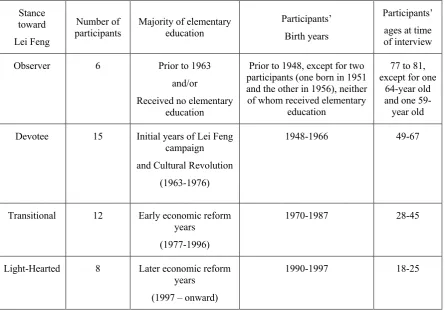
Accordingly, we divided participants into generations largely according to the period in which they had received the majority of their elementary education. However, we also draw from Sausmikat (2003) the observation that Mannheim’s theory permits social factors other than age to influence people’s standpoints. In particular, we will address how having no, or minimal, formal education seems pertinent to certain elder participants’ stances toward Lei Feng.
Stance toward Lei Feng
Number of
participants Majority of elementary education
Participants’ Birth years
Participants’ ages at time of interview
Observer 6 Prior to 1963 and/or
Received no elementary education
Prior to 1948, except for two participants (one born in 1951 and the other in 1956), neither of whom received elementary
education
77 to 81, except for one
64-year old and one 59-year old
Devotee 15 Initial years of Lei Feng campaign and Cultural Revolution
(1963-1976)
1948-1966 49-67
Transitional 12 Early economic reform years
(1977-1996)
1970-1987 28-45
Light-Hearted 8 Later economic reform years
(1997 – onward)
1990-1997 18-25
Because we are more interested in the participants’ stances toward Lei Feng than their generational identity per se, we take these stances as the basis to structure our discussion of results instead of strictly following chronology. More specifically, we will begin with a generation of devotees, the second-oldest generation, who express an ardent and enduring desire to emulate Lei Feng. Next, we move to the opposite end of the spectrum and discuss two detached generations; the oldest generation that impassively observes Lei Feng’s position as role model, and the youngest generation, whose light-heartedness about Lei Feng sometimes reaches the point of flippancy. Finally, we conclude our discussion with the remaining, transitional generation, whose members painfully search for their identity and relation to society through interrogating Lei Feng’s stories.
The generation of devotees
The Devotees are the peers of LXD and ZSY, whom we introduced earlier. They had received at least middle school education (in Canada, roughly the equivalent of Grades 7 to 9), and at the 1963 outset of the Lei Feng campaign, several of them were already in elementary or middle school. By 1978, when China’s economic reforms began, all had completed their early education and had also experienced the 1966-1976 Cultural Revolution. Today, this generation is popularly held to be controversial. Its activist Red Guard members’ participation in the Cultural Revolution is frequently construed as manifesting an idealism that veered into brutalism and a craving for power (Jiang & Ashley, 2000). Yet, this generation has also garnered sympathy for encountering a series of misfortunes, including the Great Famine of 1958-1962, the loss of educational opportunities, and mass unemployment during the 1990s economic reform (Hung & Chiu, 2003). We dub this generation the “Devotees” because its members exhibited the most enduring knowledge of, and reverence for, Lei Feng. They also distinguished themselves in their keenness to talk about Lei Feng, and in their outpouring of memories and reflections. During one interview that was underway outdoors, TXM, a junior high school-educated factory worker-turned-realtor who happened to be sitting on a nearby bench, took over the conversation for an hour.
The essence of the “Lei Feng spirit”, as TXM and other enthusiastic participants understood it, was derived from the revolutionary epiphany that had followed his childhood hardships. When a married couple looked at one photo of him reading Selected Works of Chairman Mao, they recounted this story together. The wife, a middle school-educated retired salesperson, spoke sympathetically of Lei Feng’s “too lonely, helpless” orphaned state, and the husband, a junior high school-educated office worker and driver, chimed in to underscore how the Party’s liberation had given Lei Feng cause to be thankful. The story, as they told it, closely mirrored the plot line of Lei Feng de shaonian shidai [Lei Feng’s Childhood] (Qian & Liu, 1966), the illustrated storybook that was the most widely-circulated work written for children about Lei Feng.
To this generation, the result for Lei Feng was a spirit that abnegated the self and rejected class enemies, while determinedly embracing collectivism. Two participants, quoting a stanza attributed to Lei Feng by Liaoning Ribao [Liaoning People’s Daily] (1963), put it this way:
Treat comrades like the breeze in spring Work hard like summer’s sunshine
Conquer individualism just like autumn’s wind sweeps away withered leaves And treat the enemy as ruthlessly as the cold of winter. (p. 3)
away to the poor, and make do by mending his old ones. Finally, these participants inextricably connected Lei Feng to Chairman Mao, often veering into long commentaries on Mao or the revolution without seeing a need to explicate their relevance to a Lei Feng interview. "One sentence from Chairman Mao is worth ten thousand ordinary sentences", said the retired salesperson mentioned earlier. This connection, however, was little noted by other generations. The Devotees had acquired their knowledge of Lei Feng through state-produced mass media often circulated via schools. Photographs and films had left a lasting impression on many participants, who during the interview envisioned him wearing his eponymous padded-cotton winter cap with earflaps, or figuring in various altruistic scenes. Further, singing – a medium distinctive in that it requires no material carrier – served as a tool for simultaneously delivering knowledge about Lei Feng and creating an affective affiliation with him. During the interview, one of the participants even began an impassioned rendering of the Lei Feng song, written in 1963 by military propagandists Hong Yuan and Sheng Mao (1963):
Learn from the good example of Lei Feng, Loyal to the revolution, loyal to the Party. Be clear about what to love and what to hate,
Never forget his [proletariat] origin: stand firm with a fighting spirit (translation by the authors).
The pocket-sized illustrated Lei Feng storybooks and collectible cards that the participants recalled welcoming as children, were paralleled by the textbooks that teachers used to give regular lectures on Lei Feng’s life, and the brochure, entitled “Learn from Lei Feng, the Great Role Model”, that a middle school-educated retired factory worker remembered having received in school. Schools also organised various activities through which students were meant to emulate him, such as cleaning bus station windows, collecting and donating manure to farmers, or helping wubaohu (people receiving social assistance because of age or disability) to fetch water.
Similar to the recollections found in other sources (see for example, C. Li, 2009, p. 97), some of our participants recalled having been required to do a few good deeds every week, and then record them for a class on diary keeping. In so doing, they were again emulating Lei Feng, who was understood to have carried out his good deeds modestly, but whose diary also famously enumerated those deeds and reflected on his process of self-transformation. The idea that the children’s diaries should have been intended for their teachers’ eyes, defies our usual understanding of diarizing as a private means of self-examination. Instead, it became one of many means through which a selfless revolutionary subjectivity was to be accomplished, leaving no gaps between one’s inner life and its outer performance (Wang, 2014). As Larson (2011) notes, diarizing became a bid for recognition in a society that Reed (1995) dubs a moral-political “virtuocracy”. In a similar vein, participant ZSY, the retired professor mentioned earlier, recalled her confusion when she received a poor grade on an essay she had written about returning lost money, just as Lei Feng had.
That TXM and others of her generation frequently punctuated their interviews with slogans is of additional interest because such idiomatic expressions have what Drew and Holt (1988) have called “a special robustness” (p. 398). That is, they encapsulate commonsensical – here, hegemonic – knowledge in a way that resists argument through its very familiarity. For example, take the rhyming slogan participants used to speak of Lei Feng’s clothes-mending practice: xin san nian, jiu san nian, fengfeng-bubu you san nian [new for three years, old for three years, and lasting another three years if mended]. In it, stretching one’s wardrobe is presented as unremarkably logical, enabling the giving away of new clothing. However, it would be erroneous to follow Gentz (2014) in thinking of this generation as gullibly accepting every slogan, or substituting slogans for coherent thought. Instead, several spoke as connoisseurs of the slogan genre, commenting on which would now seem foolish and which effectively reached the heart of a matter.
Finally, the Devotees used the Lei Feng spirit and the Maoism they associated with it as resources for assessing present-day China (for a similar example, see Hung & Chiu, 2003, p. 224). They frequently contrasted the virtuocratic revolutionary past, with its state-managed economy and largely poor, rural population, to the more individualistic, meritocratic, capital-driven, open, and urbanised contemporary society. TXM, for instance, was incensed to hear a famous television host comment sarcastically about Mao when “Communists fed you, gave you food and drink.” Nowadays, several of this generation opined, people were too eager to seize any opportunity to make money, too selfish, and too prone to coddling children whom TXM excoriated as “so f***ing spoiled.”
The Devotees also noted that a Lei Feng-like willingness to come to others’ aid had eroded in what Lee (2014) has called “the stranger society” of today’s China. According to Lee’s critical analysis, China’s drastic transition from a sociality emphasizing traditional kinship obligations to a Lei Feng-like collectivism in the communist era has left the newly capitalist China with no notion of a civil society in which strangers have obligations to one another. To Lee (2014), the Lei Feng spirit actually has contributed to China’s present moral crisis. The Devotees aptly reversed Lee’s argument by positing China’s contemporary society as the symptom and Lei Feng as the cure. For instance, they, like many participants brought up a figure currently salient in China’s moral landscape, that of the elderly swindler who feigns being in need and then blackmails Good Samaritans (Gao & Bischoping, 2018). In response to what they saw as moral corruption, the Devotees sought a renewal of the Lei Feng spirit, for in ZSY’s words, “If everyone learns from Lei Feng, who will cheat others?”
The detached generations
Having introduced the Devotees, with their lasting bond to Lei Feng, we now shift to the other end of the continuum occupied by the eldest and youngest generations, both of whom know comparatively little about Lei Feng, and view him with detachment.
The generation of observers
highly-educated or illiterate, members of this group have some notable commonalities. First, although the socio-political contexts in which these participants learned about Lei Feng were identical to those of the Devotees, the media through which they learned about him were fewer. In contrast to the books, school-organised labor and the associated diary-writing detailed by the Devotees, these six participants had typically learned of Lei Feng through radio broadcasts or the occasional movie such as The Days without Lei Feng (Wang, Kang & Lei, 1996).
The less educated participants among the Observers had but a vague, limited knowledge about Lei Feng. The shepherd, for instance, thought that Lei Feng still had a father in his adulthood, even though he had been orphaned in childhood. This participant also confused Lei Feng with other communist heroes who had died spectacular deaths, for instance, by fire or in battle. Most importantly, for all the Observers, the affective immersion in Lei Feng’s story which the Devotees had so palpably shown, was absent. Take for example, the musings about Lei Feng’s story by YHM, the 81-year old retired university administrator. He reflected on whether Lei Feng’s values were essentially communist or a manifestation of earlier Confucian values, and whether Lei Feng was indeed self-abnegating or actually tended to be so dressy as to wear leather shoes, which had been expensive in those days. In so doing, YHM located himself outside the Lei Feng story, both affectively and temporally, and thus able to detachedly contemplate alternate ways that he could have been written into official history.
While the Observers commended Lei Feng, they decidedly did not manifest a desire to emulate him through self-sacrifice. The data held several traces of this absence. For instance, when asked to name a Lei Feng-like deed, the street vendor in the sample pointed to another vendor, who was pouring water onto the hot pavement so as to cool it. Because a cooler street would encourage customers to linger and buy, this good deed arguably sprang more from a profit motive than from self-denial. For some other participants, it was younger people – and not they themselves – whom they expected to see emulating Lei Feng. From the opening sentences of her interview onward, WYZ, the retired factory worker, answered questions about praxis-based “learning from Lei Feng” by recollecting her children’s ages and educational stages, rather than society-wide acts of learning in which she had participated. She also spoke of Lei Feng Day as a day on which others would offer her shoe repairs and free haircuts, rather than as a day on which she served others. Similarly, even when former political educator WDF recalled using Lei Feng as a pedagogical tool, she consistently spoke of her university students’ interest in such learning, rather than her own.
Where WDF’s greater sympathies lay, we suggest, is evident in her reminiscences about the powerful experience of visiting soldiers wounded in the Korean War (1950-1953), during which she had been 13 to 16 years old:
WDF: We actually went to visit the injured People’s Volunteer Army soldiers, who had just come home from the front for rest and treatment. We went there to console them, and they told us how tough combat was on the Korean front, how they would fight the imperialist Americans, things like that. These were all real, vivid teaching materials, right?
ZG: Okay, while you consoled them, they gave you a vivid lesson. WDF: So we inherited some of the ideas from that time.
The childhoods of the eldest in this group would also have included extraordinary passages in Chinese history, marked by violence and by the reversal of fortunes of the wealthy and the impoverished. The civil war of 1946-1950, its dramatic stories of heroism, the 1949 proclamation of the PRC, the institution of collectivization and executions of landlords could have considerably impacted their formation as a generation in childhood. In Jennings and Zhang’s (2005) research on how generations in Shanghai identify the most momentous event of times past, a similar generation highlights the land reforms and the founding of the PRC.
all that newsworthy, nor might his particular form of exemplariness. However, perhaps as well-educated Party members, WDF and YHM similarly presented Lei Feng as continuing to be relevant, contextualizing him as “a hero of peace” and “popular in times of peace.”
The light-hearted generation
Alongside the oldest and least-educated participants, we found the eight youngest to speak of Lei Feng with detachment rather than devotion. This generation was represented largely by 18 to 21year old students at a vocational college, as well as by CL, a 25-year old medical editor. They have in common that their elementary schooling had succeeded – or, in CL’s case, overlapped with – the mass privatisation, and other radical economic reforms of 1997 onward. Lei Feng was allocated only scant time in the curriculum. Vocational college student RJJ recalled coming upon Lei Feng’s story purely by chance when searching online for a horror movie. One of his classmates recalled that Lei Feng had been mentioned only twice in politics and ideology classes. University-educated CL said that she had learned about Lei Feng by independently reading her primary school text, as her teacher had not spoken of him at all. The educational activity that the Light-Hearted generation most frequently mentioned was copying a poster of Lei Feng onto their school blackboard’s news display.
Like many of the Observers, these Light-Hearted participants’ knowledge was slight. Whether Lei Feng had leapt into a manure pit to rescue someone, had been tricked into aiding an elderly swindler, or had simply been “very loving” toward others was anyone’s guess. These participants’ comments on photos and the “Learn from Lei Feng” song were particularly telling. As he looked at a photo of Lei Feng helping an older woman cross the road, participant RJJ guessed that this woman was Lei Feng’s mother. He was startled to learn that Lei Feng’s mother had died in his childhood, a point that had so touched the hearts of the Generation of Devotees. Meanwhile, when a friend of RJJ’s looked at the photo of Lei Feng reading Mao’s works by flashlight, he could not guess what this reading material might be. Although they had heard the “Learn from Lei Feng” song, many had not assimilated the sense of the first line of its lyrics, which calls Lei Feng as “loyal to the revolution, loyal to the Party.”
These comments point to a significant change in the narrativization of Lei Feng’s life. To the Devotees, the oppression that this peasant child had experienced at the hands of landlords provided the narrative’s central conflict, while a revolutionary epiphany served as its climax. All Lei Feng’s subsequent good deeds and self-transformatory work flowed therefrom. In the narratives of the Light-Hearted, as in the textbooks, movies, and propaganda campaigns of a now capitalist, entrepreneurial China (Edwards & Jeffreys, 2010, p. 28; Reed, 1995; Roberts, 2015), such a conflict and climax were generally absent. The narrative’s teeth had been pulled, and with them, some of the specificities of historical context upon which some of the eldest had reflected. What remained to the Light-Hearted was a banal figure who was helpful for no impassioned reason.
another’s interviews, and RJJ helped himself to Zhipeng’s cigarettes, a mischievous act given their age difference. In addition, much about Lei Feng and the interviews amused them, including RJJ’s discovery that Lei Feng’s mother had died during his childhood. Participant CL even said that she had read about Lei Feng so as to poke fun at people who might speak of learning from him: “I tell them, you learn it: then die young!”
Such a stance was consistent with the youngest generation’s socioeconomic context. They had grown up in a China in which consumerist values such as pleasure, novelty, and status made more sense than did vestiges of collectivism (Jing & Ruiming, 2013). The Party’s hegemony increasingly faces market competition. In our young participants’ reception of these diverse messages, the consumerism was what stuck: RJJ considered public service advertisements showing Lei Feng to look “very handsome,” but CL condemned her Lei Feng satchel as, “So ugly! Makes me look like a bus conductor!” In CL’s view, while certain aspects of the accuracy of communist hero propaganda could be questioned, what mattered more was that Lei Feng was off-trend: “His moment has passed. Nowadays people are not interested in his stories.” Indeed, it is difficult to see the relevance of a hero known for darning his socks to a generation who can throw their satchels away.
The generation in transition
We now turn to the generation falling between the Devotees and the comparatively irreverent youth; a generation that, roughly speaking, comprises the students of the former, and the teachers of the latter. In comparison with their predecessors, few of whom had tertiary education, and whose most common occupation was as a factory worker, the majority of the 12 Transitionals had completed tertiary education and most held white-collar jobs, such as meteorologist or elementary school teacher. These participants’ expanded access to university education, as well as greater exposure to the diversity of thought offered by the internet, are representative of their generation in China more broadly (Guo & Guo, 2016).
The greater portion of the Transitionals’ early education had occurred during the initial post-Cultural Revolution economic reforms, and before the 1997 onset of large-scale privatisation. In their early school years, they had been exposed to a curriculum that remained nominally Communist, but that again extended beyond the narrow subject areas of politics, ideology, and moral education (M. Li, 1990). Sandwiched between well-informed Devotees and uninformed youth, members of this generation had an overall moderate, but heterogeneous, level of knowledge about Lei Feng. In their narratives, we see the drift toward those told by the youngest generation, which were devoid of any history of hardship and class struggle. For example, one Transitional factory worker who distinctly remembered having learned about Lei Feng from school textbooks was nonetheless startled to hear his Devotee father say that Lei Feng had treated the enemy “as ruthlessly as the cold of winter.” He repeated the phrase twice, finding it hard to assimilate to his image of Lei Feng as “doing good things, serving the people.”
It is not only heterogeneous views that distinguish this group of participants. Several also grappled with the contradictions between their collectivist early education and an increasingly capitalist social context. Theirs was a China in which they had seen some seize entrepreneurial or university educational opportunities, and others fall behind. These contradictions seemed to play out in their psychic landscapes, in questioning of the Lei Feng spirit that members of other generations rarely evinced. Instead of scoffing at Lei Feng as passé or observing him detachedly, such participants ruminated painstakingly, as though they continued to feel accountable for failing to meet the moral demands implicit in Lei Feng’s narrative. These ruminations were commonly expressed in terms of a monetary discourse, in calculations that pitted what one owed to the collective against what one owed oneself. For example, one salesperson and former soldier said:
I am happy to learn from Lei Feng if I’m able to. But it depends on one’s capacity. For example, if I have a thousand RMBs in my pocket, and someone needs help, I can give ten, fifty, or one hundred. Depending on my situation, any of those could be possible. But if I only have fifty RMBs: you ask me to donate ten to this person, I can’t do it.
Participant MN, a teacher of Grades 9 to 12 at an elite school in Beijing, was so distraught by moral expectations implicit in positioning Lei Feng as a role model that she terminated the interview. After recalling her childhood admiration of Lei Feng, and a later period of contemplation of his personality and deeds, MN said, “Now I feel he has nothing to do with us.” MN’s criticisms echo a general dislike, discussed by MacFarquhar (2015), of incessant do-gooders, who implicitly reproach ordinary people for failing to meet their standards. Her interview also reflected a specific disillusionment with Party propaganda about self-sacrifice. After inner debate, MN had uneasily concluded that self-interest could be permissible provided that it was also the interest of the collective. Though MN presented her conclusion as personal, hard-won, and critical of the Party, it finds a surprising parallel in the Party-managed conclusion to a nation-wide debate set off in 1980, when China Youth magazine published a letter boldly proposing that the fundamental selfishness of human nature meant that collectivist ideals could not be realised (Peng, 2008; Yan, 2011). When MN and other Transitionals invoked concerns about the collective when pondering how much to “learn from Lei Feng,” they took what Hall (2009) would call a “negotiated position.” That is, they did not resist the hegemonic position, so much as speak within mental horizons that had been hegemonically determined.
Let us return, at a less abstract level, to the calculations of what one owes to others, by revisiting the figure of the blackmailing elderly swindler, mentioned by many Devotees. When reflecting on the moral threat that swindlers posed, the Transitionals maintained that one must be judicious about acting in accordance with learning from Lei Feng. Upon hearing of our inquiry, one of barber CJW’s internet chat group friends sent her a rough poem to that effect:
Lei Feng is great, The society is cruel,
People’s thoughts are hard to fathom. The intention to help does exist, But you need to keep vigilant.
pure. However, while the Devotees idealistically proposed that reinvigorating the population’s Lei Feng spirit would restore the moral order, the Transitionals took a more pragmatic tack.
Conclusion
Our study of stances toward Lei Feng has served as an entry point to the understanding of intergenerational differences and conflicts as citizens of today’s China cast their eyes on their capitalist, consumerist, urbanised present and their collectivist, rural past. Contra most generational analyses, our research pays close heed to childhood, positioning it as an unsung phase of generational formation, potentially informing attitudes and shaping enduring affects related to understandings of social change, conceptions of morality, and inclinations about altruism toward strangers. In our study, it is elementary school pedagogy that paves the way to childhood’s potential significance. Among the participants who were comparatively detached and disinterested in learning from Lei Feng numbered those who were so old that they had been exposed to little formal Lei Feng education during China’s collectivist years; so uneducated that they had, in effect, sidestepped such education; or so young as to have received only a minimal, bland Lei Feng education presented in a thoroughly capitalist, consumerist China. These detached participants contrast starkly with the two generations who received the greatest elementary school education about Lei Feng. The affectively immersed Devotees had experienced a doggedly collectivist early education that was closely aligned with, and thoroughly penetrated by, its socio-political context. However, in the heterogeneous, conflicted, and sometimes painfully soul-searching views of the Transitionals, we posit that we can perceive the consequences of the fault line between an early collectivist education and a sociopolitical context rapidly shifting toward capitalism.
The limitations of the study’s conclusions need to be acknowledged. Within the scope of this analysis and our data, we could not fully examine the views of participants who were exceptions to general patterns, or extensively explore how higher education might influence participants’ reflective capacities. This may particularly be the case regarding the sample of only six Observers. Further, we note that many of our sample are from China’s capital, Beijing, and from nearby Hebei province, home to such notable communist legacies as the tomb of Dr Norman Bethune. Had our research been conducted in Hong Kong, site of the 2014 Umbrella Movement, we expect that participants might have voiced sharper criticism of Lei Feng. Finally, we wish to sound a note of caution about the ontological and epistemological approach to generations used herein. As is typical in generations scholarship, we have here inferred the existence of generations from the data. Such an analytic process runs the risk of reifying generations (for example, as perennially ‘Light-Hearted’), without taking into account that generations are more precisely conceived as moving targets or works-in-progress, partly real
yet also partly produced through discourses that reflect societal contestations and acts of moral regulation (Reulecke, 2008; Bischoping & Gao, 2017; Gao & Bischoping 2018).
Feng. Given President Xi Jinping’s determination to revive China’s socialist legacy (Lam, 2015), Lei Feng is likely to attract more attention in China’s education. Last, studies such as this may well garner less forthcoming responses or become ethically fraught to conduct.
References
Bischoping, K., & Gao, Z. (2018). Reframing generations scholarship through the eyes of ordinary Chinese. Chinese Sociological Dialogue, 3(2), 133–147.
Cherrington, R. (1997). Generational issues in China: A case study of the 1980s generation of young intellectuals. The British Journal of Sociology, 48(2), 302–320.
Clifford, R. (2017). Who is a survivor? Child Holocaust survivors and the development of a generational identity. Oral History Forum d’histoire orale, 37 (Special Issue on
Generations and Memory: Continuity and Change), 1-23.
Dello-Iacovo, B. (2009). Curriculum reform and ‘quality education’ in China: An overview.
International Journal of Educational Development, 29(3), 241–249.
Deng, Z., & Treiman, D. J. (1997). The impact of the Cultural Revolution on trends in educational attainment in the People's Republic of China. American Journal of Sociology,
103(2), 391–428.
Drew, P., & Holt, E. (1988). Complainable matters: The use of idiomatic expressions in making complaints. Social Problems, 35(4), 398–417.
Edwards, L., & Jeffreys, E. (Eds.). (2010). Celebrity in China. Hong Kong: Hong Kong University Press.
Farquhar, J. (2002). Appetites: Food and sex in post-socialist China. Durham, NC: Duke University Press.
Gao, Z., & Bischoping, K. (2018). The emergence of an elder-blaming discourse in 21st-century China. Journal of Cross-Cultural Gerontology, 33(2), 197–215.
Gao, Z., & Bischoping, K. (2019). The Communist hero and the April Fool's joke: The cultural politics of authentication and fakery. Social Anthropology, 27(3), 438-454. Geist, B. (1990). Lei Feng and the “Lei Fengs of the Eighties”’. Papers on Far Eastern
History, 42, 97–124.
Gentz, N. (2014). Negotiating the past: Narratives of the Cultural Revolution in history, literature, popular media and interviews. In T. Plänkers (Ed.), J. Hart (Trans.), Landscapes of the Chinese soul: The enduring presence of the Cultural Revolution (pp. 1–34). London, UK: Routledge.
Guo, S., & Guo, Y. (Eds.). (2016). Spotlight on China: Changes in education under China’s market economy. Boston, MA: Sense Publishers.
Hall, S. (2009). Encoding/Decoding. In M. G. Durham & D. M. Kellner (Eds.), Media and cultural studies: Keyworks (Revised, pp. 163–173). Oxford, UK: Wiley-Blackwell. Hansen, M. H. (2015). Educating the Chinese individual: Life in a rural boarding school.
Seattle, WA: University of Washington Press.
xuan [Selection of songs for revolutionary people] (p. 117). Shanghai, China: Shanghai wenyi chubanshe.
Hung, E. P. W., & Chiu, S. W. K. (2003). The lost generation: Life course dynamics and xiagang in China. Modern China, 29(2), 204–236.
Inglehart, R., & Flanagan, S. C. (1987). Value change in industrial societies. American Political Science Review, 81(4), 1289–1319.
Jennings, M. M., & Zhang, N. (2005). Generations, political status, and collective memories in the Chinese countryside. The Journal of Politics, 67(4), 1164–1189.
Jiang, Y., & Ashley, D. (2000). Mao’s children in the new China: Voices from the Red Guard generation. New York, NY: Routledge.
Jing, Q., & Ruiming, L. (2013). New trends among young Chinese consumers. SERI Quarterly, 6(1), 23.
Kim, J. (2016). Chinese migrant workers’ cynicism and the politics of ‘decent’ wage. In H. Steinmüller & S. Brandtstädter (Eds.), Irony, Cynicism and the Chinese State (pp. 63–83). New York, NY: Routledge.
Lam, W. W.-L. (2015). Chinese politics in the era of Xi Jinping: Renaissance, reform, or retrogression? New York, NY: Routledge.
Larson, W. (2011). The Freudian subject and the Maoist mind: The diaries of Hermine Hug-Hellmuth and Lei Feng. Psychoanalysis and History, 13(2), 157–180.
Lee, H. (2014). The stranger and the Chinese moral imagination. Stanford, CA: Stanford University Press.
Li, C. (2009). Mao’s last dancer. New York, NY: Penguin.
Li, M. (1990). Moral education in the People’s Republic of China. Journal of Moral Education, 19(3), 159–171.
Liaoning ribao. (1963, February 7). Lei Feng riji zhaichao [Excerpts from Lei Feng’s diary].
Renmin Ribao, p. 3.
MacFarquhar, L. (2015). Strangers drowning: Grappling with impossible idealism, drastic choices, and the overpowering urge to help. New York, NY: Penguin.
Mannheim, K. (1952). Essays on the sociology of knowledge. (P. Kecskemeti, Ed.). New York, NY: Routledge & Kegan Paul.
Mao, Z. (1966). Mao Zedong Yulu [Quotations from Mao Zedong]. (B. Lin, Ed.). Beijing China: Zhongguo renmin jiefangjun zongzhengzhibu.
Mitter, R. (2003). Old ghosts, new memories: China’s changing war history in the era of post-Mao politics. Journal of Contemporary History, 38(1), 117–131.
Peng, Y. (2008). A U-turn in the desert: Figures and motifs of the Chinese nineteen eighties. PhD Dissertation, University of Minnesota, Minneapolis, MN.
Qian, G., & Liu, H. (1966). Lei Feng de shaonian shidai [Lei Feng’s childhood]. Beijing, China: Lianhuahua chubanshe.
Reulecke, J. (2008). Generation/generationality, generativity, and memory. In A. Erll & A. Nünning (Eds.), Media and Cultural Memory/Medien und kulturelle Erinnerung (pp. 119– 125). New York, NY: Walter de Gruyter.
Roberts, R. (2015). Reconfiguring Red: Class discourses in the new millennium TV adaptation of The Red Detachment of Women. China Perspectives, 2015(2), 25–31. Sausmikat, N. (2003). Generations, legitimacy, and political ideas in China: The end of
polarization or the end of ideology? Asian Survey, 43(2), 352–384.
She, Y. (2015, December 18). Jiaoyu bu: Mao Zedong, Lu Xun, Lei Feng meiyou cong zhongxiaoxue jiaocai shanchu [Ministry of Education: No deletion of Mao Zedong, Lu Xun, and Lei Feng from middle and elementary school textbooks]. Xinlang Caijing [Sina Finance]. Retrieved from
http://finance.sina.com.cn/roll/2015-12-18/doc-ifxmszek7218403.shtml
Steen, A. (2014). “To live is to serve the people” – The spirit of model soldier Lei Feng in postmodernity. In A. Hulme (Ed.), The changing landscape of China’s consumerism (pp. 151–176). New York, NY: Elsevier.
Wang, T. (2014). The Cultural Revolution and overacting: Dynamics between politics and performance. London, UK: Lexington Books.
Wang, Z. (Producer), & Kang, N., & Lei, X. (Director). (1996). The days without Lei Feng
[Motion picture]. Beijing: China: Qingnian dianying zhipian chang & Beijing Zijincheng yingye gongsi.
Wu, X., & Ye, Y. (2018). Technical and vocational education in China. Singapore: Springer Yan, Y. (2011). The changing moral landscape. In A. Kleinman, Y. Yan, J. Jun, S. Lee, E.
Zhang, T. Pan, … J. Guo (Eds.), Deep China: The moral life of the person: What anthropology and psychiatry tell us about China today (pp. 36–77). Berkeley, CA: University of California Press.
Acknowledgements
We thank the editors and reviewers for their thoughtful comments, and the Georg Eckert Institute for International Textbook Research, the Faculty of Liberal Arts and Professional Studies, York University, and the Social Sciences and Humanities Research Council of Canada for their support.
About the Authors
Katherine Bischoping (PhD, University of Michigan), an Associate Professor of Sociology at
York University, studies the behind-the-scenes work of methodologists, gendered cultural narratives, and the role of narration in oral history and memory studies. Recently, Amber Gazso (York University) and she coauthored Analyzing Talk in the Social Sciences: Narrative, Conversation and Discourse Strategies (2016, Sage), and Yumi Ishii (University of Tokyo) and she co-edited a special issue of Oral History Forum d'histoire orale, entitled "Generations and Memory: Continuity and Change" (2017).
Zhipeng Gao holds a PhD in psychology from York University and is currently a SSHRC