ISSN: 2349-4468 International Journal of Advances in Management, Economics and Entrepreneurship
Available online at:
www.ijamee.info
RESEARCH ARTICLE
Effect of Risk Management Practices on the Performance of
Islamic Banks and Islamic Window in Sri Lanka
Ahamed Lebbe Abdul Rauf, Kamithu Lebbe Mohamed Irzath
Department of Accountancy and Finance, Faculty of Management and Commerce, South Eastern University of Sri Lanka.
Abstract
This study was aimed to analyze the relationship between risk management practices and financial performance in the Islamic banks in Sri Lanka. For achieving this objective, the study assessed the current risk management practices of the Islamic banks, Islamic windows and links them with the banks’ financial performance. The study used both the primary data from survey questionnaires and secondary data from annual reports. For this purpose the present study selected Risk environment, risk measurement, risk mitigation, risk monitoring and internal control as independent variables while return on assets (ROA) is utilized as dependent variables for the period from year 2010 to year 2015. For the statistical analyze purpose, the study used descriptive, correlation, and multiple regression model. The results revealed that independent variable factors impact on ROA of 85.4%. The further revealed that risk environment, risk measurement, risk monitoring and internal control system have positive significant level with financial performance and risk mitigation factor has no significant with financial performance. The results of the study shed some lights on the risk management practices of the Islamic banks in Sri Lanka. By assessing their risk management practices and linking them with financial performance, the study contribute in terms of recommending strategies to strengthen the risk management practices of the Islamic banks so as to increase the overall competitiveness in the Islamic banking industry.
Keywords: Risk environment, Risk measurement, Risk monitoring, Risk mitigation, Internal control.
Introduction
The Islamic banking industry is growing rapidly and gaining importance in the global financial scenario over last three decades. Islamic banks appeared to operate alongside conventional banks. This was done either through the opening of Islamic windows in conventional institutions or establishing separate banks or branches under the Islamic law that specialized in Islamic financial operations According to Ernst & Young, Islamic banking assets are to grow to $1.8 trillion in 2013 and beyond $2 trillion by 2014. Zaher and Hassan [1] predicted that Islamic banks are set to control some 4050 percent of Muslim savings by 2009/2010. Assets of the Islamic banking institutions worldwide is currently estimated at US$750 billion, registering an unprecedented growth of 20-30 percent per annum in the last ten years (Asian Bankers, 2008). Total worldwide assets managed in
accordance with the principles of Islamic finance are estimated at over US$ 800 billion, with growth of between 10% and 15% over the last ten years.
With the growing interests to search for the alternative to the conventional banking system in the post-2007/2008 global crisis, coupled with large potential customers’ base of over one billion Muslim population worldwide, the demand for the industry is expected to strengthen and grow even more rapidly.
liquidity infrastructure, legal requirements and governance underlying the Islamic banks’ operations. The Islamic banks have to also ensure that the risk management techniques which include risk identification and management being adopted should not be conflicting with the Shari’ah principles [2]. Moreover, in view of the increasing pressure of globalization, effective and efficient risk management in the Islamic financial institutions is particularly important as they endeavor to cope with the challenges of cross border financial flows.
Some argued that the Islamic banks performance and profitability are significantly affected due to need to allocate more resources to mitigate these risks. In particular, the greater risk mitigation requirements call for adequate capital and reserves, appropriate pricing and control of risks, strong rules and practices for governance, disclosure, accounting, and auditing rules, and suitable infrastructure that could facilitate liquidity management [3].
Due to the importance of risk management to the growth, resilience and survival of the Islamic banking institutions, this study attempts to analyze this topic from a new perspective.
Statement of the Problem
Introducing the profit-sharing concept as an alternative to interest-based banking, is the main principle of the Islamic banking. With a very young history of 30 years, Islamic banks are still in their infancy, and therefore have not yet established their image. During the introduction and current growth stages of their life cycle, many claims have been made about the performance and risk level of Islamic banks [4].
Ahmed [5] noted that as a new concept, Islamic banking is completely different from the conventional commercial banking as its total risk is the function of three different factors combined together. First factor of the risk originates from the new classification of the deposit holders. Since the depositors are not entitled to receive a fixed interest rate but are going to share the profit with Islamic bank according to a mutually agreed percentage.
Further Ahmed [6] noted that second factor of the risk in Islamic bank depends on the level of the coverage of interest charges ratio (net operating income over interest charges). Since interest is abolished for deposit holders and is replaced by profit sharing, the fixed interest payments is minimized or completely eliminated. Therefore, the coverage of interest charge ratio will be either very high or meaningless.
Further Ahmed [6] noted that the third factor of the risk in the Islamic bank is related to the new status of the loans given by these institutions. Islamic banks are based on the Islamic legal concepts of Shirkah (partnerships) and Mudarabah (profit sharing). Islamic banks raise funds from deposit holders on the basis of profit sharing and are advancing loans which can be considered as capital to entrepreneurs on the same basis. Profits accruing to entrepreneurs on the capital advanced by the bank are shared according to a mutually agreed percentage. Since interest rate on loans is replaced by profit sharing, and profits may be volatile, the risk of the loan portfolio will increase. Therefore the third factor of the risk, i.e. the conversion of loans into capital participation to companies, will make the Islamic bank riskier than the conventional commercial bank [6].
As a result, both the first factor (converting deposit holders into suppliers of equity) and the second factor (replacement of interest payments to deposit holders by profit sharing) have the tendency to lower the risk of Islamic banks but the third factor (interchanging fixed loan income with the participation into profit of loan customer) will have the potential to increase the risk of Islamic bank. The overall risk of an Islamic bank will be determined by the net effect of these three factors
Since Islamic banking in Sri Lanka is at introduction stage in product life cycle, much attention is being paid by industry players in order to build the industry so stronger. Hence, better risk management practices may lead the Islamic banking so healthier, which extremely reflect on financial performance of the bank. In line with research problem and issues this study is carried out the objectives of to assess the risk management practices and financial performances in the Islamic bank and Islamic window of conventional bank in Sri Lanka.
Methodology
Basel Committee on Bank supervision (1999
and 2001b) and Bank of Negara Malaysia [7] have proposed five important component to measure the risk practices of Islamic banks. Those variables namely risk environment, policies and procedures, risk measurement, risk mitigation and risk monitoring as well as internal control are functioning independently and those variables reflect level of risk that is being undergone by the banks. Its release a result of what extent the bank and financial institution should be vigilant in terms of taking necessary action. Healthy risk practices will give better financial results. Hence the variable called “Financial Performance” is taken as dependent variable to this study [8].
Figure: 1 Conceptual Frame Work
As this study covers Islamic Banking performance there are 25 licensed commercial bank in Sri Lanka [9]. The sampling frame covers one (01) fully Islamic bank and six (06) Islamic windows. Since the Islamic industry is an introduction stage in the Sri Lankan context, very few players are in the industry. In order to achieve objective of assessing the risk management practices in the selected Islamic bank and Islamic window in Sri Lanka period from 2010 to 2015, questionnaire were designed and distributed among respondents. The questionnaire consists of five point likert scale and close ended questions. The
questionnaire was surveyed in seven banks that are involving Islamic Banking and financial service. All respondents are male being executive level in the bank having more than 5 years executive experience. Financial performances from seven banks
that are included in this study have been abstracted from annual reports and personal visit to respective banks.
Data Presentation and Analysis
The summarized into understand the pattern of ROA performance of banks that are taken into this study. Financial performance is referred to profitability of a
the period, there was high growth of Islamic banking business since the demand for Islamic banking products was very high among customers. In the year 2013 there was a negative growth of ROA by all banks reporting to average growth of -17.59%. It is because of high growth of deposit portfolio than the growth of loan portfolio in the 2013. In other term, earning amount from financing by all banks from 2012 to 2013 has come down. From year 2013 to 2014, average growth of all seven banks showed a positive growth by 2.25%. It means that banks have managed the funds in manner which helps to mitigate the risk.
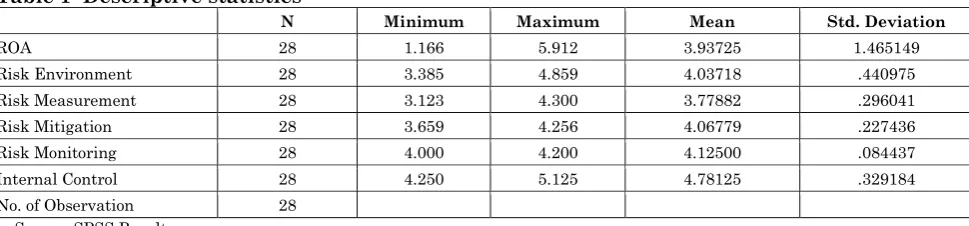
Table 1 gives overall idea of each variables that are tested in this study. ROA of all bank stands for with mean value of 3.94 and standard deviation of 1.465. Minimum value
of ROA is 1.116 where maximum value is 5.912. Mean value of risk environment practices is 4.03 with standard deviation of 0.440 representing minimum, maximum of 3.39, 4.86 accordingly. Risk measurement points out the mean value of 3.77 with Standard deviation value of 0.296. Risk mitigation practices carry the mean value of 4.06 where standard deviation value of .0227. Risk monitoring, internal control stands for the mean value 4.12, 4.78 accordingly. The highest mean value belongs to internal control system of the bank representing 4.78 with standard deviation value of 0.329 meanwhile risk measurement practices points out lowest mean value of 3.78 with standard deviation of 0.296.
Table 1 Descriptive statistics
N Minimum Maximum Mean Std. Deviation
ROA 28 1.166 5.912 3.93725 1.465149
Risk Environment 28 3.385 4.859 4.03718 .440975
Risk Measurement 28 3.123 4.300 3.77882 .296041
Risk Mitigation 28 3.659 4.256 4.06779 .227436
Risk Monitoring 28 4.000 4.200 4.12500 .084437
Internal Control 28 4.250 5.125 4.78125 .329184
No. of Observation 28
Source: SPSS Results
In linking the risk management practices and financial performance, the mean scores of each risk management practices are correlated with the ROA. Risk management practices are explained by risk management
environment, policies and procedures, risk measurement practices, risk mitigation practices, risk monitoring practices and internal control practices. Table 2 provides the correlation coefficients for all variables.
Table: 2 Correlation coefficients for all variables
ROA Risk Environment Risk Measurement Risk Mitigation Risk Monitoring Internal Control
ROA 1
Risk Environment .455* 1
Risk Measurement .420* .137 1
Risk Mitigation .629** .770** .289 1
Risk Monitoring .898** .348 .622** .612** 1
Internal Control .843** .675** .529** .846** .904** 1
*. Correlation is significant at the 0.05 level (2tailed). **. Correlation is significant at the 0.01 level (2tailed). Source: SPSS Results
Table: 2 Illustrates the strength of relationship between independent and dependent variables. Risk environment and rate of return shown a fair positive relationship 0.455 at 95% confident level meanwhile risk measurement practices and ROA have shown again a fair positive 0.420
positive relationship with ROA at 99% confidence level. Risk monitoring practices had very strong positive relationship 0.898 with ROA at 99% confidence level meanwhile internal control system was correlated with ROA at 99% confidence level
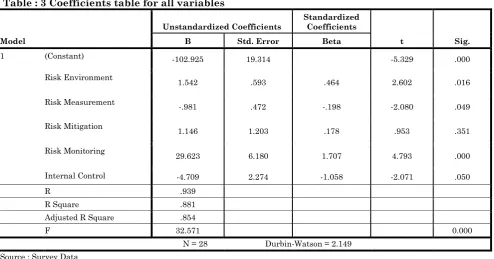
showing very strong positive relationship. Table 3 explain overall results of the study. The survey had no auto data correlation. It is confirmed by the value of Durbin-Watson, 2.149.
Table : 3 Coefficients table for all variables
Model
Unstandardized Coefficients Standardized Coefficients
t Sig.
B Std. Error Beta
1 (Constant) -102.925 19.314 -5.329 .000
Risk Environment
1.542 .593 .464 2.602 .016
Risk Measurement -.981 .472 -.198 -2.080 .049
Risk Mitigation
1.146 1.203 .178 .953 .351
Risk Monitoring 29.623 6.180 1.707 4.793 .000
Internal Control -4.709 2.274 -1.058 -2.071 .050
R .939
R Square .881
Adjusted R Square .854
F 32.571 0.000
N = 28 Durbin-Watson = 2.149 Source : Survey Data
Table 3 also explain that R value is 0.939 and R square is 0.881. The adjusted R value represents the value of 0.854. Adjusted R Square explains the relationship between ROA and risk components such as risk environment, risk measurement and risk mitigation, risk monitoring and internal control. According to the survey findings, 85.4 % of study is explained by risk components that are taken as variables for this study. Each of the variables has various level of influence on ROA.
R2 provides information about the goodness
of fit of the regression model. Based on relationship between variables, the following model introduced in the research methodology is re written as a
ROA = - 102.925 + 1.542 RE -0.981 RMe + 1.146 RMi + 29.623 RMo - 4.709 INTc + e
Where,
ROA = Return on Assets
RE = Risk EnvironmentRMe = Risk Measurement
RMi = Risk Mitigation RMo = Risk Monitoring
INTc = Internal Control
The Table 3 also illustrate that except risk mitigation, all other risk components are significant with ROA. Based on these findings, the study came to a conclusion whether to accept or reject an alternative
hypothesis. Since significant value for risk is less than the Alpha value, hence it is concluded the risk environment, risk measurement, risk monitoring and internal control has significant relationship of financial performance of Islamic bank and Islamic window. However, it is concluded that risk mitigation practices has no significant relationship with financial performance. It is confirmed by the previous study carried out. However Ariffin and Kassim [8] noted in his research that risk mitigation has significant relationship with financial performance [10-18].
Conclusion
changes on risk components will have certain level of impact on financial performance. More elaborately, risk environment, risk measurement, risk monitoring and internal control have significant level of relationship with financial performance. Based on the findings derived through study, it is concluded that better risk management practices has significant relationship with financial performance of Islamic bank and Islamic window in Sri Lankan context. However, strength of relationship (correlation) of each component of risk practices namely risk environment, risk measurement, risk
mitigation, risk monitoring, internal control vary from each other. Islamic banks are very keen to monitor risks since Islamic banking system in Sri Lanka is at introductory stage and top management of the bank pay more attention in order take industry to next higher level. Hence, Board of Director (BoD) has huge responsibility to maintain performance of the bank on a stable level
and keep the image of Islamic banking loyal among all stakeholders.
The recommendations are proposed in order to make banks to better enjoy risk practices that would lead the banks financially viable. Central bank of Sri Lanka should take necessary steps to attract more foreign direct investment (FDI) through Islamic bank by relaxing policies. Bank can have books on business process re –engineering and business continuity plan (BCP). These practices will mitigate operational risk. Best In –house Shari’ah team to monitor Islamic banking operation. Faster service can be provided by Islamic banking division in order to benchmark in the industry. More training can be provided to staff of bank (Local & foreign) to create more human capital. Islamic bank can introduce all types banking products as available in the conventional banks with approval of Sharia board. This study finding too is believed to give meaningful insights for the development of Islamic banking industry.
References
1 Zaher TS, Hassan MK (2001) A Comparative Literature Survey of Islamic Finance and Banking. Financial Markets, Institutions and Instruments, 10(4):156-199.
2 Khan, T and Ahmed, H (2001) Risk Management: An Analysis of Issues in Islamic Financial Industry, Occasional Paper 9. Jeddah, Saudi Arabia: Islamic Development Bank.
3 Sundarajan V, Errico L (2002) Islamic Financial Institutions and Products in The Global Financial Systems: Key Issues in Risk Management and Challenges Ahead. International Monetary Fund, Working Paper No WP/02/192.
4 Bashir MAH (2009) Risk and Profitability Measures in Islamic Banks: The Case of Two Sudanese Banks, Islamic Economic Studies, 6 (2):11-15.
5 Ahmed, H (2007) Risk Management Assessment Systems: An Application to Islamic Banks, Journal Islamic Economics Studies, 19(1):63-86.
6 Ahmed H, Khan T (2007) Risk Management in Islamic Banking: Hand Book of Islamic
7 Bank of Negara (2012) Concept Paper-Guide Lines Risk Governance, Accessed 07.02.2016.
8 Ariffin NM, Kassim S (2009) Risk Management Practices and Financial Performance of Islamic Banks: Malaysian Evidence, 8th International conference on Islamic Economic & Finance.
9 http://www.combank.lk/newweb/media- centre/entry/commercial-bank-commences-sharia-compliant-banking, accessed on 02.12.2015.
10 Abu Hussain H, Al-Ajmi J (2012) Risk Management Practices of Conventional and Islamic Banks in Bahrain. The Journal of Risk Finance, 13(3):21-27.
11 Adeusi SO, Akeke NI, Adebisi OS, Oladunjoye O (2014) Risk Management and Financial Performance of Banks in Nigeria, European Journal of Business and Management, 6(31)33-38.
12 Arora D, Agarwal R (2009) Banking Risk Management in India and RBI Supervision, available at: http://ssrn.com/abstract, accessed on 16.01.2016.
14 Rashidah AR, Ahnaf, AZI, Aliyu DM (2014) Risk Management Practices in Islamic Banking Institutions: A Comparative Study Between Malaysia and Jordan, The Journal of Applied Business Research , 30(5):1295-1304.
15 Rashidah AR, Apedzan K, Lateefat O, Omneya AS (2013) Risk Management Disclosure Practices of Islamic Banks in the Mena Region: An Empirical Analysis, Middle-East Journal of Scientific Research 15 (1) 152-160.
16 Mokni RBS, Dhekra, AE, Rachdi AH (2014) Risk Management Tools Practiced in Islamic
Banks: Evidence in MENA region, Journal of Islamic Accounting and Business Research, 5(1):77-97.
17
http://synergyy.com/wp- content/uploads/2014/06/Central-Bank-of-Sri- Lanka-Licensed-Commercial-Banks-Special- Banks-and-Finance-Company-%E2%80%93-Name-List-attached.jpg,accessed on 07.03.2016.