ARTIGO ORIGINAL
Fiability Study of Diabetes Empowerment Scale:
Short Version
Estudo de Fiabilidade da Escala de Capacidade de Controlo da Diabetes:
Versão Breve
1. Faculdade de Medicina. Universidade de Coimbra. Coimbra. Portugal.
2. Unidade de Saúde Familiar Topázio. Agrupamento de Centros de Saúde do Baixo Mondego. Coimbra. Portugal. 3. Faculdade de Ciências da Saúde. Universidade da Beira Interior. Covilhã. Portugal.
4. Faculdade de Economia. Universidade de Coimbra. Coimbra. Portugal.
5. Unidade de Saúde Familiar Marquês de Marialva. ADES Baixo Mondego. Cantanhede. Portugal. Recebido: 17 de Julho de 2014 - Aceite: 23 de Dezembro de 2014 | Copyright © Ordem dos Médicos 2015
Marcelo AVEIRO1, Luiz Miguel SANTIAGO2,3, Pedro LOPES FERREIRA4, José Augusto SIMÕES5
Acta Med Port 2015 Mar-Apr;28(2):177-181
RESUMO
Objetivo: Avaliar a correlação entre o valor obtido pelo instrumento de medição Diabetes Empowerment Scale - Short Form e o con-trolo da pessoa com diabetes medido pelo valor da hemoglobina glicada A1c.
Material e Métodos: Estudo observacional transversal pela aplicação do Diabetes Empowerment Scale - Short Form a pessoas com diabetes de três Unidades de Saúde Familiar da Região Centro de Portugal após realização de teste e reteste (primeiro por escrito e, passados cinco minutos, oralmente) para determinação da coerência interna através do valor de alfa de Cronbach em 20 elementos que não foram depois estudados. A aplicação a pacientes diabéticos foi feita após a consulta de enfermagem e antes da entrada na consulta médica. Foi realizada estatística descritiva e inferencial apos verificação da normalidade dos dados.
Resultados: Na primeira fase o valor de alfa de Cronbach de 0,90 a 1,00 relativamente aos oito itens da escala. Na aplicação escrita, a média de resultados foi de 3,78 ± 0,71 e na aplicação oral de 3,79 ± 0,65, p = 0,629. A amostra da segunda fase foi de 81 pessoas com diabetes, sendo 55,6% do sexo masculino. A idade média foi de 68,5 ± 1,1 anos com uma HbA1c média de 6,8 ± 0,2 e um tempo de evolução desde o diagnóstico de 9,2 ± 0,9 anos. A média da pontuação final da escala foi de 4,1 ± 0,8. Verificou-se uma correlação significativa entre a pontuação final e os níveis de Hba1C (ρ = -0,114; p = 0,312).
Conclusão: A Escala de Capacidade de Controlo da Diabetes – Versão Breve revelou ser uma escala fiável para medir a capacitação em doentes diabéticos em Portugal. Confirmou-se a presença de uma correlação estatisticamente significativa entre o resultado obtido no final da escala e o valor de HbA1c.
Palavras-chave: Diabetes Mellitus Tipo 2; Poder (Psicologia); Questionários.
ABSTRACT
Purpose: To compare the final score of the scale to the levels of HbA1c.
Material and Methods: Cross-sectional observational study by applying the Diabetes Empowerment Scale - Short Form to diabetics at three primary care units in the central region of Portugal. The test-retest (in writing first and, five minutes later, orally) was performed to access Cronbach‘s alpha in 20 patients not studied in the next phase. Then, the scale was applied to diabetic patients after nursing consultation and prior to entering the medical consultation. Descriptive and inferential statistics after checking for the normality of the data were performed.
Results: In the first phase Cronbach’s alpha was 0.90 to 1.00 in all of eight scale items. The average result obtained in the written phase was 3.78 ± 0.71 and in the oral 3.79 ± 0.64, p = 0.629. The sample of the second stage was of 81 diabetic patients, 55.6% male. Sample’s mean age was 68.5 ± 1.1 years, mean HbA1c of 6.8 ± 0.2 and mean time from diagnosis of 9.2 ± 0.9 years. The average final score of the scale was 4.1 ± 0.8. There was significant correlation between the final score and HbA1c levels (ρ = -0.114; p = 0.312).
Conclusion: The Portuguese version of the Diabetes Empowerment Scale – Short Form proved to be a reliable scale to measure empowerment in diabetic patients in Portugal. It was evident the presence of a statistically significant correlation between the results obtained at the end of the scale and HbA1c.
Keywords: Diabetes Mellitus, Type 2; Power (Psychology); Questionnaires.
INTRODUCTION
The latest data issued in November 2013 from the Diabetes Observatory Annual Report (Relatório Anual do Observatório da Diabetes) reveals that diabetes affects ap-proximately 8.3% of the world’s population. Apap-proximately 12.9% of the Portuguese population between 20 and 79 years of age had diabetes in 2012. From these, about 51.9% had a glycated haemoglobin (HbA1c) level below 6.5% and 25% with a value above 8%.1
In 2012, diabetes was associated with an estimated direct cost between 1,250 and 1,500 million euros. This corresponds to 9% of the total national health expenditure
ARTIGO ORIGINAL professionals and coping with stressful emotions. 3
The Diabetes Empowerment Scale (DES) was designed to allow for measurement of diabetes control self-efficacy, defined as someone’s ability to get involved in self-control tasks under specific situations such as glucose level’s monitoring and ordering meals in restaurants, among others. This is a 37-item, eight-dimension questionnaire from which only three dimensions were subsequently used as having the necessary internal consistency equal or above 0.8. It showed effective psycho-social and laboratorial improvements related to this empowerment program.4 A shorter eight-question version – DES-SF – was subsequently carried out, in order to allow for a more brief and global assessment and was originally applied to 229 patients, with an 0.84 reliability.5 The validity was confirmed by the fact that the scores of the questionnaire and the HbA1c levels have both shown a positive change upon a 6-week education program for patients with diabetes.5 In addition, this questionnaire has already been successfully used in several diabetes education programs aimed to assess psycho-social components.4-9
The DES-SF was linguistically and culturally adapted in 2013 to the Portuguese language by the Centro de Estudos e Investigação em Saúde at the University of Coimbra (CEISUC). Upon prior permission by the authors from the Michigan Diabetes Research and Training Center, the original version was translated using a translation/ retranslation approach. This was followed by a clinical review and a comprehension cognitive test in order to ensure an adequate interpretation of the questions by the patients.
Our study aimed to apply the questionnaire to patients with type-2 diabetes living in the Central Region of Portugal, in order to assess its reliability and validity by the Cronbach’s alpha test, as well as testing a possible correlation between the scores of the DES-SF and the HbA1c levels for the Portuguese population.
This scale may represent an important tool allowing for a better perception by the health teams dealing with people with diabetes as regards current necessities and unmet needs.
MATERIAL AND METHODS
This was a cross-sectional and observational study regarding the implementation of the DES-SF. An informed consent document and an epidemiological questionnaire were added to the DES-SF, in order to determine patient’s gender and schooling, the average level of the last two HbA1c determinations as well duration of diagnosis in years. The participation was voluntary, anonymous and confidential. An approval by the Ethics Committee at the Administração Regional de Saúde do Centro was obtained. The diabetic participant’s accompanying person was asked to apply the questionnaire whenever the participant was
unable to read or write.
After written authorization was obtained from the original authors, a DES-SF linguistic and semantic equivalent version was obtained at the CEISUC and the questionnaire was applied to a group of patients with type-2 diabetes, half of whom were on insulin therapy.
A two-stage field study was carried out with convenience samples. The first stage included the validity the scale’s reliability applied to 20 patients with diabetes attending the USF Marquês de Marialva, in Cantanhede. First, at the end of the follow-up examination the questionnaire was completed by the participant. Then after five minutes the interviewer orally applied the questionnaire and a comparison was made between both answers given to the same question.
The application of the questionnaire was then extended to other two Family Healthcare Units (Unidades de Saúde Familiar [USF]), namely Topázio and S. Julião. The questionnaire was once more completed by the participant upon the follow-up nursing diabetes examination carried out in January and February 2014 and the same methodology was applied.
The descriptive and inferential statistics analysis used the SPSS software, version 20.0, with the Student’s t-test for paired variables and the Mann-Whitney’s U-test, Pearson’s correlation test and ANOVA test were used upon continuous data normality demonstration.
RESULTS First Stage
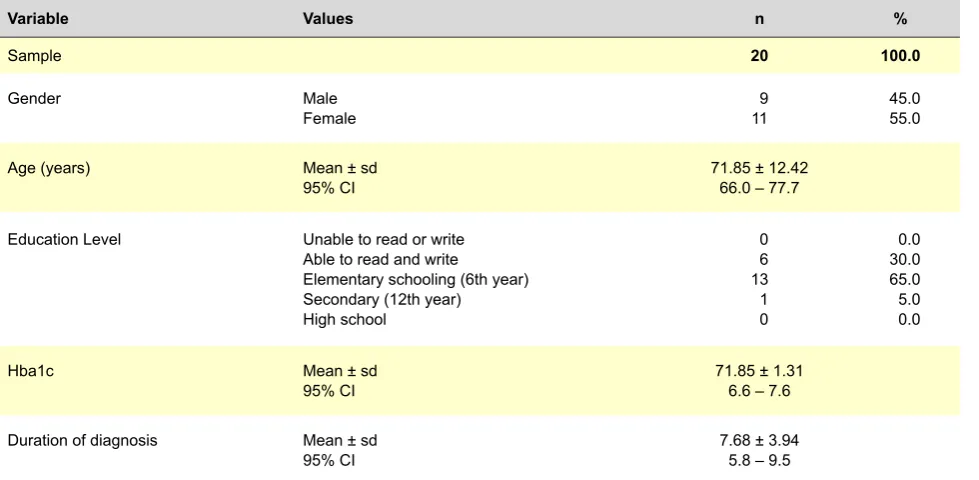
Our group of patients included 20 patients with diabetes attending the USF Marquês de Marialva in Cantanhede. They were mainly female (55.0%), with a primary educational level alone (65.0%), aged on average 71.9 ± 12.4 years and with 7.0 ± 1.3 HbA1c level averaged from the prior known two determinations. The average duration of diagnosis was 7.7 ± 3.9 years, as shown in Table 1.
Pearsons’s correlation and intra-class values were calculated for test-retest reliability and are shown in Table 2. The response average score was 3.8 ± 0.7 in the written and 3.8 ± 0.7 in the oral applications, p = 0.629.
Second Stage
The second stage used a larger sample of 81 patients with diabetes observed at the following health centres: USF Marquês de Marialva - Cantanhede, USF Topázio - Coimbra and USF S. Julião - Figueira da Foz.
ARTIGO ORIGINAL Table 1 - Socio-demographic and clinical data from patients in group 1
Variable Values n %
Sample 20 100.0
Gender Male
Female 911 45.0 55.0
Age (years) Mean ± sd
95% CI 71.85 ± 12.4266.0 – 77.7
Education Level Unable to read or write Able to read and write
Elementary schooling (6th year) Secondary (12th year) High school
0 6
13 1
0
0.0 30.0 65.0 5.0 0.0
Hba1c Mean ± sd
95% CI 71.85 ± 1.316.6 – 7.6
Duration of diagnosis Mean ± sd
95% CI 7.68 ± 3.945.8 – 9.5
sd, standard deviation; CI, confidence interval
Table 2 – Test-retest reliability in group 1
Item Em geral, eu acredito que… Pearson ICC
1 sei identificar os aspetos dos cuidados a ter com a minha diabetes com os quais estou insatisfeito 0.330 0.990
2 consigo atingir as metas relativas à minha diabetes 0.330 0.988
3 posso encontrar diferentes formas de ultrapassar os problemas para atingir as metas relativas
à minha diabetes 0.330 0.986
4 consigo arranjar forma de me sentir melhor mesmo tendo diabetes 0.330 1.000
5 sei como lidar de forma positiva com o stress relacionado com a diabetes 0.330 0.992 6 posso pedir ajuda por ter e para tratar a diabetes sempre que necessito 0.330 0.931
7 sei o que me ajuda a estar motivado/a para cuidar da minha diabetes 0.186 0.989 8 me conheço suficientemente bem para fazer as melhores escolhas para cuidar da minha
diabetes 0.330 1.000
ρ – Pearson’ correlation; ICC – intra-class correlation coefficient
The frequency distribution by the score given to each item in the scale is shown in Table 4.
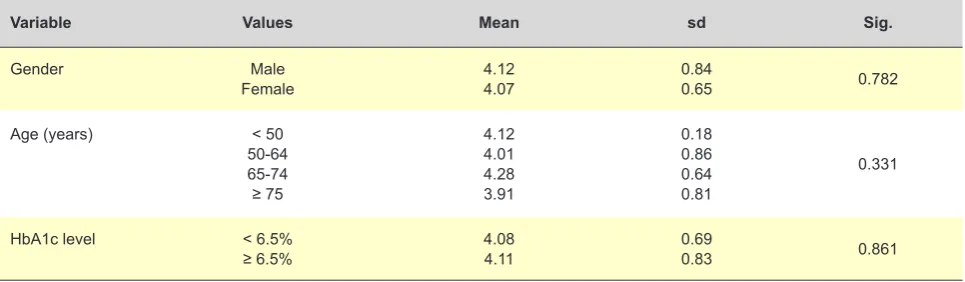
The average final score was 4. 1 ± 0.8 (95% confidence interval 3.9-4.3). As regards the internal consistency, Cronbach’s alpha of 0.871 was obtained. The values obtained by the DES-SF according to the different values of the variables gender and age are shown in Table 5. As shown in this Table, the distribution by gender, age or HbA1c level did not show any statistically significant difference. The relationship between the values obtained by the DES-SF scale and the duration of diagnosis was also analysed. The value of correlation found (ρ = -0.032; p = 0.779) showed no correlation between these two variables.
DISCUSSION
The first stage of this study aimed to assess the reliability of this scale for diabetes patient empowerment performed after translation and validity of the original Diabetes
Empowerment Scale - Short Form (DES-SF) in 2013, carried out by the Centro de Estudos e Investigação em Saúde da Universidade de Coimbra (CEISUC), Our group of patients used to assess this parameter is relatively aged with a similar distribution regarding gender and mostly including people with elementary schooling.
Cronbach’s alpha coefficient was used in order to assess this parameter. This is a coefficient used to measure a scale’s internal consistency and the value which was found (0.871) is considered very relevant. A test-retest was also carried out and a 0.330 correlation coefficient was found, showing the DES-SF’s stability over time.
ARTIGO ORIGINAL
previous measurements, was 6.8%, almost similar (6.9%) to the average level obtained from the 2012 SNS clinical records.1 The average duration of diagnosis (9.2 years) shows that this is a long-term disease where most of the respondents assigned scores above 4 to the statements that were presented, i.e. slightly or completely in agreement with what was presented. The average final score, including the scores in the 8 items of the scale was 4.1 ± 0.8, in line
Table 3 - Socio-demographic and clinical data from patients in group 2
Variable Values n %
Sample 81 100,0
Gender Male
Female 4536 55.6 44.4 Age (years) Mean ± sd
95% CI 68.5 ± 10.366.2 – 70.8 Education Level Unable to read or writeAble to read and write
Elementary schooling (6th year) Secondary (12th year) High school
3 17 54 5 2
3.7 21.0 66.7 6.2 2.5 Hba1c Mean ± sd95% CI 6.8 ± 1.36.5 ±7.1
Duration of diagnosis Mean ± sd
95% CI 7.4 – 10.09.2 ± 8.0
sd, standard deviation; CI, confidence interval
Table 4 - Distribution of the items in DES-SF
Item Strongly disagree
[1]
Somewhat disagree
[2] Neutral [3]
Somewhat agree
[4]
Strongly agree
[5]
n % n % n % n % n %
1 2 2.5 7 8.6 11 13.6 26 32.1 33 40.7
2 1 1.2 7 8.6 12 14.8 26 32.1 35 43.2
3 2 2.5 4 4.9 11 13.6 35 43.2 29 35.8
4 4 4.9 3 3.7 3 3.7 22 27.2 40 49.4
5 5 6.2 8 9.9 9 11.1 29 35.8 30 37.0
6 1 1.2 7 8.6 2 2.5 19 23.5 52 64.2
7 3 3.7 3 3.7 14 17.3 28 34.6 33 40.7
8 2 2.5 3 3.7 10 12.3 24 29.6 42 51.9
Note: See Table 2
Table 5 – DES-SF distribution
Variable Values Mean sd Sig.
Gender Male
Female 4.124.07 0.840.65 0.782
Age (years) < 50
50-64 65-74 ≥ 75
4.12 4.01 4.28 3.91
0.18 0.86 0.64 0.81
0.331
HbA1c level < 6.5%
≥ 6.5% 4.084.11 0.690.83 0.861
ARTIGO ORIGINAL with what was described in other studies. It follows, that in
our study, a lower average HbA1c level correlates with more consistent responses and improved empowerment.2,5-7,10 The results that we found led us to think that this group of patients is knowledgeable as regards type-2 diabetes control.2 In fact, patient empowerment paves the way for adequate therapy compliance and maintenance of well-being and good health.11,12
There is a limitation with the use of average HbA1c level for judging glycaemic control as levels below 6.5% are important for young patients with diabetes for whom a long disease duration lies ahead, whilst for ageing patients a higher level may be acceptable in order to prevent hypoglycaemia.13 Glycaemic profile through the day preventing from excessive glycaemic peaks would have been more relevant to determine the quality of diabetes control.13 Despite this shortcoming, we consider that these results are relevant, adding to the value of patient empowerment and improved diabetes control and should be considered as part of a composite indicator for patient’s follow-up, including healthcare, technical and scientific adjustment, empowerment and efficiency.
This scale allows for selection of the best options for optimal diabetes control.
CONCLUSION
DES-SF proved to be reliable in order to measure empowerment in Portuguese patients with diabetes. In addition, a positive correlation between DES-SF’s average value and HbA1c levels was found.
ACKNOWLEDGMENTS
The authors wish to acknowledge the nurses at the USF Marquês de Marialva, Topázio and S. Julião, as well as supervisors and technical advisory board for their cooperation, as well as to the patients that responded to the questionnaire.
CONFLICTS OF INTEREST
The authors declare not having any conflict of interest in writing this manuscript.
FINANCIAL SUPPORT
The authors declare not having any financial support in writing this manuscript.
REFERENCES
1. Gardete Correia L, Boavida JM, Fragoso de Almeida JP, Massano Cardoso S, Dores J, Sequeira Duarte J, et al. Diabetes: Factos e Números 2013 − Relatório Anual do Observatório Nacional da Diabetes. Lisboa: Sociedade Portuguesa de Diabetologia; 2013.
2. Leksell J, Funnell M, Sandberg G, Smide B, Wiklund G, Wikblad K. Psychometric properties of the Swedish Diabetes Empowerment Scale. Scand J Caring Sci. 2007;21:247-52.
3. Anderson RM, Funnell MM, Butler PM, Arnold MS, Fitzgerald JT, Feste CC. Patient empowerment. Results of a randomized controlled trial. Diabetes Care. 1995;18:943-9.
4. Anderson RM, Funnell MM, Fitzgerald JT, Marrero DG. The Diabetes Empowerment Scale: a measure of psychosocial self-efficacy. Diabetes Care. 2000;23:739-43.
5. Anderson RM, Fitzgerald JT, Gruppen LD, Funnell MM, Oh MS. The Diabetes Empowerment Scale-Short Form (DES-SF). Diabetes Care. 2003;26:1641-2.
6. Castillo A, Giachello A, Bates R, Concha J, Ramirez V, Sanchez C, et al. Community-based diabetes education for latinos: the Diabetes Empowerment Education Program. Diabetes Educator. 2010;36:586-94.
7. Sperl-Hillen J, Beaton S, Fernandes O, Von Worley A, Vazquez-Benitez G, Parker E, et al. Comparative effectiveness of patient education
methods for type 2 diabetes: a randomized controlled trial. Arch Intern Med. 2011;171:2001-10.
8. Tang TS, Funnell MM, Noorulla S, Oh M, Brown MB. Sustaining short-term improvements over the long-short-term: results from a 2-year diabetes self-management support (DSMS) intervention. Diabetes Res Clin Pract. 2012;95:85-92.
9. Tang TS, Funnell MM, Brown MB, Kurlander JE. Self-management support in ‘‘real-world’’ settings: an empowerment-based intervention. Patient Educ Couns. 2010;79:178-84.
10. Shiu AT, Wong RY, Thompson DR. Development of a reliable and valid Chinese version of the diabetes empowerment scale. Diabetes Care. 2003;26:2817-21.
11. Little P, Everitt H, Williamson I, Warner G, Moore M, Gould C, et al. Observational study of effect of patient centredness and positive approach on outcomes of general practice consultations. BMJ. 2001;323:908-11.
12. Howie JG, Heaney D, Maxwell M. Quality, core values and the general practice consultation: issues of definition, measurement and delivery. Fam Pract. 2004;21:458-68.