European Journal of Physical Education and Sport Science
ISSN: 2501 - 1235 ISSN-L: 2501 - 1235 Available on-line at: www.oapub.org/eduDOI: 10.46827/ejpe.v6i6.3287 Volume 6 │ Issue 6 │ 2020
TEACHING AND PRESENTING ASEAN
FOLK DANCES IN THE PHILIPPINES
Garcia, Marino A.i
Cebu Normal University Cebu City, Philippines
Abstract:
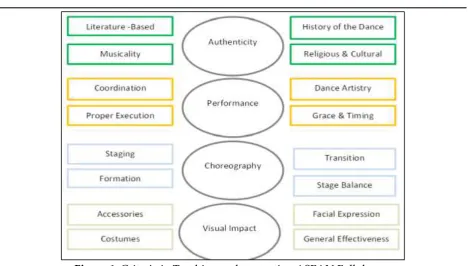
The study described how the physical education teachers teach and present ASEAN folk dances in the Philippines. ASEAN folk dances are luminous in Physical Education subject and commonly used by the teachers as dance presentations in different occasions. Mixed research design was utilized in the study wherein descriptive statistics, transcriptions and coding were employed in gathering, analyzing and interpreting the data. The result showed that physical education teachers have minimal knowledge on teaching ASEAN folk dances. The prevalent factors in the lack of knowledge were due to unavailability of seminar workshop in the country, limited opportunity for international dance workshop and the lack of printed dance literature available in published books. Moreover, the PE teachers were aware on how to teach these ASEAN folk dances in its authentic way through following the dance literature. In the same vein, there are four (4) emerging criteria that comprises different constructs/concepts in teaching and presenting an ASEAN folk dances: (1) authenticity which contains interpretation of the steps based on literature, history of the dance, musicality and cultural, and religious aspect (2); performance which encompasses proper execution, dance artistry and coordination (3); choreography that covers staging and floor patterns; and (4); visual impact that includes the costumes, accessories, facial expressions and general effectiveness. In conclusion, physical education teachers need to have proper knowledge and training in teaching ASEAN folk dances. Furthermore, standards, measures and norms are deemed necessary to set and practice by PE teachers in teaching and presenting ASEAN Folk dances. Therefore, it is recommended to the Department of Education (DepEd) and the Commission on Higher Education (CHED) in putting vision accounts on ASEAN folk dances to be part of the educational activities such as seminar dance workshops and strengthening the inclusion of these folk dances in Physical Education curriculum.
Keywords: ASEAN folk dances, choreographers, teaching, presenting, physical
education teachers
1. Introduction
Association of Southeast Asian Nations plus three countries (ASEAN + 3) that was established on August 8, 1967 is believed to be a medium of growth and development for all the member states. The folk dances of these ASEAN countries somehow serve as one of the ways for the Filipinos to understand the native lives, practices, customs, and cultures of the neighbouring countries. These ASEAN folkdances have been part of the Philippine Educational System and very luminous in the Physical Education curriculum. Further, teaching and learning dances benefits the teacher and learner since dancing is part of the dynamic cultural expression of all societies and every individual has the potential ability to dance. Folk dancing is a beautiful way in introducing to the young
children to the world’s rich diversity for them to have social enjoyment and at the same
time imbibing its culture (Wardle, 1997). The inclusion of folk dancing in the Physical Education program of schools is simply to develop such potential into actual skill and to expose everyone especially the youth to the many benefits of learning dance. ASEAN folk dances are somehow blended into the Philippine native culture. Thus, it has been performed in all occasions and programs held in school, in different communities and even in international conferences held in the Philippines. Dance, contrary to popular perception is not just mere entertainment. Dance is an activity that improves fitness and physical working capacity (Kirkendall & Calabrese, 1983), improvements the psychological wellbeing (Hui, Chui, & Woo, 2009), increased self-esteem (Quiroga, Krreutz, Clift, & Bongard, 2010) and anxiety reduction (Leste & Rust, 1990) which indeed more than entertainment as it was a psychological reinforcement and a form of social
dialogue. Further, dance uses all the senses in expressing one’s self through movements
which brings out various personalities (Kirsch, 2005; Kaufmann, 2011; Studer Lüthi and Züger, 2012). Furthermore, it is a body movement that brings conviction between nations; people demonstrate social and national wealth and harmony in dance.
Filipinos are known to cultivate the preservation of the ASEAN folk dances and cultures. As Philippines was chosen to host for the 12th ASEAN Summit last January 12
– 15, 2007 which was a good venue for the physical education teachers to boost their choreographed ASEAN folk dances (ASEAN, 2014). Philippines was declared as the ASEAN CITY of CULTURE (July 15, 2011) that proves that the country captured the ASEAN culture. This is somehow a great challenge for the Filipinos on how to maintain and to retain this declaration. The question that confronts the scenario of the PE teachers is how to retain these ASEAN folk dances in the bloodstream of dance in the Philippines. Though not all but most of the physical education teachers are known choreographers in the country, this is a big challenge to them to strengthen and to preserve these ASEAN
folkdances in the country and in the students’ life. This is also to answer UNESCO’s
Proclamations of Masterpieces of Oral and Intangible Heritage of Humanity which aims to raise the awareness on Intangible Cultural Heritage and encourage local communities to protect them and the local people who sustain these forms of cultural expression
can learn about our heritage and learn to appreciate the difference between heritages, the more powerful our reasons for respecting each other”. This simply explains that folk dances of each country are considered as intangible cultural heritage that needs protection and preservation to claim its own identity.
There were no solid studies that explained and described on how to teach and present the ASEAN folk dances in the country. Thus, this study presented ways for physical education teachers in teaching and presenting ASEAN Folk dances among physical education students. Furthermore, the end view of this study is to standardize the general criteria to be used as the basis for all choreographers, physical education teachers and dance enthusiasts in teaching and presenting the ASEAN folk dances.
2. Materials and Methods
2.1 Design
This study employed a mixed research design. Descriptive design using frequency and percentile was used to describe the responses of the respondents pertinent to the teaching and presenting of the ASEAN folk dances. A narrative inquiry design using interview and thematic analysis was used to answer how the physical education teachers teach and present the folk dances which served as the qualitative method of research. Thus, in exploring the ideas, experiences and beliefs of individual, in–depth interviews are deemed necessary (Legard & Ward, 2003).
2.2 Informants and Instruments
Survey questionnaire and semi structured interview guide were used in gathering data which focused on the eight key informants, who are physical education teachers and at the same time choreographers in different schools, colleges and universities in Cebu, Philippines. All the key informants are knowledgeable and able to choreograph these ASEAN folk dances in their respective institutions for the purposes of class activity and stage presentation for school programs and entertainment outside the institutions. The predetermined set of criteria as mentioned above were utilized to ensure validity and reliability of whatever verbatim accounts presented in this study. The verbatim accounts were presented in themes which undergone transcriptions and coding for data analyses and interpretations. In transforming qualitative information, coding was developed to cluster words or phrase which served as marker in the thematic analysis (Boyatzis, 1998).
2.3 Ethical Considerations
3. Results and Discussion
Folk dances are the mirrors of culture in one’s country and it is one of the responsibilities
of the physical education teachers to give justice of these dances while teaching and presenting it to the community for whatever purposes it may serve. Based on the gathered data, the following results and discussion are presented to answer on how to teach and present ASEAN Folk dances in the country.
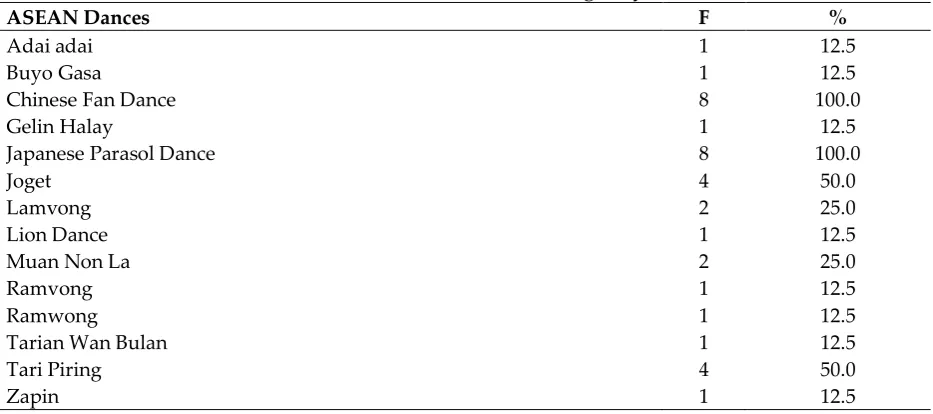
Table 1: Common ASEAN Folk Dances Taught by PE Teachers
ASEAN Dances F %
Adai adai 1 12.5
Buyo Gasa 1 12.5
Chinese Fan Dance 8 100.0
Gelin Halay 1 12.5
Japanese Parasol Dance 8 100.0
Joget 4 50.0
Lamvong 2 25.0
Lion Dance 1 12.5
Muan Non La 2 25.0
Ramvong 1 12.5
Ramwong 1 12.5
Tarian Wan Bulan 1 12.5
Tari Piring 4 50.0
Zapin 1 12.5
2000, Hattie, 2008; Organisation for Economic Co-operation and Development OECD, 2005, Rockoff, 2004, Rowe, 2003, Timperley and Alton-Lee, 2008). Teaching these folk dances require strong understanding and experience to qualify and quantify its
importance not only in the preservation of culture but the acquisition of the students’
skills in retaining its authenticity for the next generation to come.
Table 2: Acquisition of Learning of PE Teachers
Source of Learning F %
Books 6 75.0
Internet 7 87.5
Seminar Workshops 4 50.0
Trips Abroad 1 12.5
Majority of the PE teachers had acquired their source of learning from the internet with 87.5% and books with 75%. Fifty percent (50%) of the teachers learned it from seminar workshops as their source of learning the folk dances. Only one or 12.5% had a primary source for travelling abroad as an ethnographic researcher. Though, internet is a good source of learning but awareness in filtering the right information must be the first concern to avoid giving wrong information to the students. Seminar workshops are recommendable for it provide an active venue for learning. This kind of opportunity
supports the theory of Dewey in “Learning by Doing”. It is the doctrine of pragmatism which claims that the meaning of a proposition or idea lies in its practical consequences. Acquiring learning in this process is a commendable act by an educator. According to the informants, a seminar workshop here in Philippines on ASEAN folk dances is seemingly rare to happen, that is why they rely mostly on surfing the internet and books. This must be one of the reasons why they learned less on the different ASEAN folk dances. The quality of teaching equates the quality of the teacher in terms of academic portfolio coupled with right dispositions and personality traits (Bowles, Hattie, Dinham, Scull, & Clinton, 2014). Thus, the disposition of physical education teachers must be proactive in terms of finding ways and means in boosting their professional development in teaching since learning will never stop. Further, this could be an eye opener to the Department of Education (DepEd) and the Commission on Higher Education (CHED) in the Philippines to put vision account on ASEAN folk dances available to the educators.
Table 3: Ways of Teaching and Presenting the Dance
Bases in Teaching and Presenting f %
Literature 5 62.5
Modification of Dance 1 12.5
Literature - based and Modification 2 25.0
the respondents used both ways as bases in teaching and presenting the folkdances. According to the interview of the two informants, it is really appropriate to follow the dance literature in teaching a dance but with slight modifications to suit the needs of the students is acceptable. The culture is not constant; we should persevere in enriching our knowledge of our cultural differences because we can bridge them only if we are aware of them (Kuljis & Halloran, 2018). Further, there are many ways in which culture can be formed and maintained thus the preservation and dissemination of our folk dances must be our utmost concern since it is a living testimony of who we are and what we will be (Ekwelem, Okafor, & Ukwoma, 2011). Thus, folkdance should be reunited in such a way
that we become aware of our identity, one race, one country, one people. With the dances’
background in history, they represent a vital picture of our national life and culture. It is therefore essential, that for the real meaning and value of these dances, they be performed in their original form, in every case; authentic music, steps, instruction and costumes should be used. Moreover, dance is an important cultural form, it is not only because it offers a window to our past but, because, as we learn from the past, dance can be transformative agents in our present day world (Tullo, 2015). Whether in childlike imitation of the ways we see around us, in celebration of our triumphs, in supplication of a blessing, in working our desire to shape and master fear and anxiety or release a body from burden of work, or in the demonstration of the sheer joy and being alive, dance embodied the world. And because it is dynamic and creative, it does not only reflect the world, but it is the form of action upon the world. The importance of conservation, revival and promotion of our cultural heritage is deep, personal, almost primordial social factor and such needed to be taken seriously. It is very clear that in teaching these ASEAN folk dances it is a must to follow the dance literature so that in the process of transferring the learning to the students will be exact and correct. It is supported in idealism that knowledge is independent of sense perception or experience. This means that the idealist expects the teachers to be the role models of intellectual, moral, aesthetic, and vocational excellence to their students. They should teach by example.
4. Criteria in Teaching and Presenting ASEAN Folkdance
Figure 1: Criteria in Teaching and presenting ASEAN Folkdances
First construct/concept is authenticity of the dance which includes literature-based interpretation which means that dancers and/or choreographers following the published folk dances, musicality means the correct and appropriate usage of music, religious aspect, cultural aspect, history of the dance and musical notation. The informants were
in the same line of thinking that “as much as possible the dance should be as the same as
the original dance of the country” which in a way will show respect and admiration to
the country where that particular dance originated.
“The music much be original to begin with in teaching a folk dance.” KI-4.
“The depiction of religious and cultural aspect of the dance must put in place although out the dance.” KI-6.
“Always based your dance interpretation in a published literature.”KI-8.
“In teaching folk dance, always read about its history first so that you will be
guided.”KI-1.
Indeed, authenticity in teaching a dance must put first so that the heart and culture of the dance will not be sacrificed. Culture and religion is an integrated pattern of
people’s behavior, lifestyle, surviving records, and physical results (Fores, Mata, et. al, 2016). Without its authenticity, the dance does not present what is intended to portray for the culture of a particular country or community.
synchronized in dancing and the togetherness of the dancers in a dance presentation,
dancers’ artistry it is somehow related to technique which can be develop in constant practice of a certain dance, grace is the smooth and light movements with respect to gravity, timing is how the dancers listen to the beat of the music in dancing, mood is the emotions/feelings invested by the dancers in dancing, and proper execution is the exactness and preciseness of the movements.
“Dance artistry is indeed necessary to contextualize the meaning of the dance using the
body movements which will transcend to the audiences what is meant by the dance.”
KI-3.
“Dancing folk dances must be executed properly so that the dance will provide just understanding to the audience.” KI-4.
“What the audience will be looking if the dancers have grace and sense of timing
because it will have aesthetic value and pleasing to watch.” KI-7.
Performance allows the audience to walk with the story unfold in the dance. Overholser (2005) presented that folkdance performances have a great way in potentially comment and reflect on our contemporary life. Indeed, it will give us retrospections of the things of the past that we need to mirror it in our present life.
Choreography is the third construct/concept which includes staging it is used to give more entertaining factor, formations, transitions and stage balance. This is the part of presenting a dance wherein the individuality of the choreographers who are teaching the dance will be seen thus they are given a little discretion on how to stage a dance especially if the reason of presenting the dance is for entertainment purposes.
“If the dance will be presented for entertainment, it is necessary to stage it to look more appealing to the audience.”KI-2.
“Formation and transition are the two characteristics that a choreographer will not forget
because it is where the challenges and talents will be tested.”KI-6.
“I don’t like if the dance is not balance especially on stage.” KI-1.
Choreography of the dance also describes the culture of the people. A good
example is the dance “Banga” of the Ifugao which the dancers choreographed their walks as if they are walking / climbing the mountain to fetch water. Indeed, there are a lot of folk dances that reflect their own culture made of colorful, beautiful and vibrant characteristics that will delineate them from the others (Lia, 2008).
dance. This construct will give the total impression of the whole performance of the dance since this is the concept that will not change throughout the performance.
“I like to enhance the costume of the dance to add impact to the audience.”KI-5
“The right costume and accessories add beauty to the performance.”KI-4
“How the dancers smile captivates the mood and feeling of the audience.” KI-8
Visual impact talks about the totality of the dance presentation from the start until the end. The consistency of the presentation matters a lot to sustain the interest of the audience. In the Acculturation Theory by Berry explained how the individuals react when in contact with other culture (Ngo, 2008). In watching a folk dance presentation somehow allows us to be in contact with other culture through dance thus it is necessary to sustain the exactness when teaching and presenting a dance.
4. Recommendations
Teachers’ Professional Development most especially physical education teachers must be strengthened and encouraged to accentuate the quality of teaching in the Philippines.
Thus, improve the quality of the students’ outcomes in terms of pedagogy, content, and
knowledge. Further, the evaluation and implementation of the criteria in teaching and presenting ASEAN folk dances must be forwarded for possible validation and revision. Moreover, the Department of Education (DepEd) and the Commission on Higher Education (CHED) in the Philippines must put vision accounts on ASEAN folk dances to be part of educational activities such as seminar dance workshops and strengthening the inclusion of these dances in the Physical Education curriculum.
5. Conclusions
Teaching and presenting a dance in any genre and most specifically folk dance requires fundamental knowledge and actual experience to accentuate its importance and
contribution in the cultivation, expression and preservation of culture in one’s country.
In the same vein, standards, measures and norms are deemed necessary to set and to practice by physical education teachers in teaching and presenting ASEAN folk dances to ensure the appropriateness and correctness of its usage. Thus, improve the quality of teaching of the physical education teachers which is tantamount to students’
improvements.
Conflict of Interest
About the Author
Marino A. Garcia is an instructor and the Research Chair of College of Arts in Cebu Normal University College of Arts and Sciences, Cebu City, Philippines. He is a graduate of Bachelor in Secondary Education major in Physical Education, Health and Music. He is also a graduate of Master of Art in Teaching Human Kinetics in Southwestern University. Further, he is candidate for Doctor of Philosophy in Education major in Research and Evaluation. His areas of research interest are on physical activity, exercise science, human movement, and physical education.
References
Angioi M., Metsios G. S., Koutedakis Y., Wyon M. A. (2009). Fitness in contemporary dance: a systematic review. International journal of sports medicine.
Association of Southeast Asian Nations (ASEAN) (2014). Twelfth Asian Summit, Cebu City, Philippines, 9-15 January 2007. Retrieved from http://goo.gl/DeP7F3
Bowles, T. Hattie, J. Dinham, S. Scull, J. Clinton, J. (2014). Proposing a comprehensive model for identifying teaching candidates The Australian Educational Researcher, 41 (4) (2014), pp. 365-380
Bozatzis, R. E. (1998). Transforming qualitative information: thematic analysis and code development. SAGE Publications. London, Retrieved from https://goo.gl/KfYChn
Darling-Hammond, L. (2000). Teacher quality and student achievement Education Policy Analysis Archives, 8 (1) (2000), 10.14507/epaa.v8n1.2000
Dewey J. (1938). Retrieved from
https://opentextbc.ca/teachinginadigitalage/chapter/4-4-models-for-teaching-by-doing/
Ekwelem, V. O.; Okafor, V. N.; and Ukwoma, S. C., (2011). Preservation of Cultural Heritage: The Strategic Role of the Library and Information Science Professionals in South East Nigeria. Library Philosophy and Practice (e-journal).
http://digitalcommons.unl.edu/libphilprac/562
Flores, R. (1995). Dance for health: improving fitness in African American and Hispanic adolescents. Public health reports, 110(2), 189-193.
Fores, S. S., Mata, M. C., & et al. (2016). Argao’s La Torta Dance Festival: A Culture Mix of Colonial and Indigenous Elements. Global Journal of Human – Social Science (D) Volume XVI. Issue I. Version I.
Hattie, J. (2008). Visible learning: A synthesis of over 800 meta-analyses relating to achievement Taylor & Francis, Hoboken, NJ (2008)
Hui E., Chui B. T., Woo J. (2009). Effects of dance on physical and psychological well-being in older persons. Archives of gerontology and geriatrics 49: 45–50.
Kaufmann, K. (2011). Movement as a metaphor: how persistence, the Tao, and the wisdom of the ostrich helped build school dance programs. J. Phys. Educ. Recreat. Dance 82, 37–45. doi: 10.1080/07303084.2011.10598627
Kirsch, S. (2005). Im Tanz die Sinne erfahren. Die Ausbildung der Identität durcheine sinnesorientierte Tanzpädagogik. Hamburg: Verlag Dr Kovac. ˇ
Kuljis, J. & Halloran, P. (2018). Is it Important to Study: Cultural Differences? Journal of Computing and Information Technology - CIT 18, 2010, 2, 121–123 doi:10.2498/cit.1001807121
Legard, R. & Ward (2003). In-depth interview. SAGE Publications, London Lesté A., Rust J. (1990). Effects of dace on anxiety. Am J Dance Ther 12: 19–25.
Lia P. (2008). Ethnic and Non-native Philippine Folk Dances. Retrieved from
https://liapeory.wordpress.com/tag/philippines-folk-dances/
Maraz A., Király O., Urbán R., Griffiths M. D., Demetrovics Z. (2015). Why Do You Dance? Development of the Dance Motivation Inventory (DMI). PLoS ONE 10(3): e0122866. https://doi.org/10.1371/journal.pone.0122866
McCready, W. C. (1983). Culture, ethnicity, and identity: Current issues in research. Academic Pr. Retrieved from http://goo.gl/9zt0lH
Ngo, Van Hieu (2008). A critical Examination of acculturation theories. Critical Social Work, 2008 Vol. 9, No.1
O'Neill J. R., Pate R. R., Liese A. D. (2011). Descriptive epidemiology of dance participation in adolescents. Research quarterly for exercise and sport 82: 373–380. pmid:21957695
Overholser, L. (2005). A suggested framework for researching staged folk dance. Staging the Folk. Retrieved from http://www.fulbright.hu/book4/lisaoverholser.pdf Paulson, P. (1993). New work in dance education (Electronic version). Arts Education
Policy Review, 95(1),30 -44.
Quiroga Murcia C., Kreutz G., Clift S., Bongard S. (2010). Shall we dance? An exploration of the perceived benefits of dancing on well-being. Arts & Health 2: 149–163. Rockoff, J. E. (2004). The impact of individual teachers on student achievement: Evidence
from panel data American Economic Review, 94 (2) (2004), pp. 247-252, 10.1257/0002828041302244
Rowe, K. (2003). The importance of teacher quality as a key determinant of students' experiences and outcomes of schooling Proceedings of the Australian Council for Educational Research (ACER) Research Conference, “Building teacher quality:
What does the research tell us?”, ACER, Melbourne, Australia (2003), pp. 15-23 Studer-Lüthi, B., and Züger, B. (2012). Auswirkung einer Tanzinterventionauf
Körperkonzept und kognitive Fähigkeiten von regulär entwickelten Kindern. Musik Tanz Kunstther. 23, 70–77. doi: 10.1026/0933-6885/a000077
Taylor J., Taylor C. (1995). Psychology of dance. Human Kinetics Publishers.
Timperley, H. Alton-Lee, A. (2008). Reframing teacher professional learning: An alternative policy approach to strengthening valued outcomes for diverse learners Review of Research in Education, 32 (2008), pp. 328-369, 10.3102/0091732X07308968
Tullao, M. (2015). Philippine folk dance through the eyes of the Maloleneo youth.
http://www.earlychildhoodnews.com/earlychildhood/article_view.aspx?articleID
=301
United Nations Educational, Scientific and Cultural Organization (UNESCO), (2004) Masterpiece of the Oral and Intangible Heritage of Humanity. Retrieved from
http://www.unesco.org/culture/intangible-heritage/masterpiece.php
Wardle, P. (1997). Folk Dancing for Children. Retrieved from
https://www.google.com/search?q=Wardle,+P+(1997).+Folk+Dancing+for+childre
n.+Early+Childhood+News+.&ie=utf-8&oe=utf-8&client=firefox-b-ab&gfe_rd=cr&ei=tsryV_aDJ6iwmQWRsKzwDQ
Creative Commons licensing terms