DOI: 10.12962/j20882033.v31i1.5375
ORIGINAL RESEARCH
DESIGNING AN AUTOMATIC MICROCONTROLLER-BASED
DRYING MACHINE OF COFFEE BEANS
Derisma * | Afdholli Putra | Dodon Yendri
Dept. of Computer System, Universitas Andalas, Padang, Indonesia
Correspondence
*Derisma, Dept. of Computer Science, Universitas Andalas, Padang, Indonesia. Email: [email protected]
Present Address
Department of Computer System, Faculty of Information Technology, Universitas Andalas Padang, 25163 Indonesia
Abstract
This research aimed to create an automatic microcontroller-based coffee bean drying machine without the support of sunlight to produce SNI-standardized coffee beans with small water content or amounted to 12%. The appliance consists of a tube-shaped container with 50 cm length and 11 cm radius, soil moisture sensor, DS18B20 temperature sensor, heater, motor DC, relay two-channel, and Arduino Uno micro-controller. The drying works when soil moisture sensor detects 12% of water content from big coffee beans. The drying process is done by applying a heater to dry the cof-fee beans, and the motor DC is used as the rotator of the container to dry the cofcof-fee beans evenly. The temperature of the drying container is around 51°C-55°C because the surface of coffee beans will be damaged if the temperature is above 55°C. When the water content of coffee beans is low or equal to 12%, the drying process is termi-nated. The drying process of dense coffee beans (1 kg) with 25.34% of initial water content takes 60 minutes with 11.74% of final water content as a result, While the drying process with the help of sunlight required approximately 310 minutes with 11.83% of final water content. It has been proved that the drying with the machine was faster than the drying process through sunlight.
KEYWORDS:
Arduino Uno Microcontroller, Coffee Beans, Drying Machine, Moisture Indicator, Moisture Sensor, Water Content
1
INTRODUCTION
Coffee provides unique benefits for the well-being of the Indonesian people. Coffee is a valuable plant to ensure a sustainable economy for farmers in tropical and sub-tropical areas. Tropical and sub-tropical regions are the proper location for coffee cultivation[1]. Therefore, countries that dominate the world of coffee production are located in South America, Africa, and
During the drying process, the best water content for the coffee commodity is below 12%. If the water content is above 12%, thus, Aspergillus Ochraceous, Aspergillus Niger, and Penicillium molds would likely grow. These molds would grow quickly if the water content of the coffee is above 12%. The observation result has indicated that most of the coffees produced in Indonesia conceive above 12% water content before determined as the export standard. A farmer and collector level, the typical water content is above 16%. Even in some locations, the water content would reach 20%[7]. The solar-tub drying machine has been
successfully designed and fabricated by Syah[8].
The result of the functional test has indicated that weather conditions more influence the variety of solar collector and dryer. The drying of coffee beans itself requires weeks. Therefore, coffee beans drying machine with a better drying rate is needed. The drying machine of coffee beans with the active solar-tracking system through the application of temperature and SHT11 radiation sensors has been developed[9]. The deficiency is that the humidity and temperature sensors experienced more errors
when the received temperature exceeds the room temperature that, in general, reaches 45°C. The final quality of coffee depends on the curing of the cell membrane of coffee beans, which might get deteriorated during the drying process[10]. For the drying
temperature set at 35°C, the increasing drying rate caused the degradation of the coffee’s natural sensory quality. For the drying temperature set at 45°C, the drying rate’s degradation is described by thermal decay and the effect of unclear drying rate[10].
The farmers will no longer have to use the traditional method if they use this coffee bean drying machine. Thus, the needs of farmers can be fulfilled.
Such as accelerating the drying process, acquiring a good quality of coffee, also saving space. In this process, the masses of coffee beans in after and before the drying process can be discovered by using a useful system to reveal the water content in coffee beans as the drying process that reaches accurate dry rate to produce a good standard of coffee beans to improve food products. One of the technological developments is in the Arduino Uno microcontroller field that has been applied in various sectors. Nimrotham[11] experimented on a microcontroller unit (MCU) to control relative humidity and temperature in the chamber
for drying red chili. Therefore, this technology development, which became the next background of the problem in which the implementation of Arduino technology on industrial sector especially on the coffee factory is expected to be able of providing better effectivity and time efficiency during the drying process of coffee beans to facilitate farmers in producing good quality coffee. Previously, the drying machine of these coffee beans was shaped like an oven and equipped with a heating furnace below it, and its tool has not provided with microcontroller and sensors[8].
In the next research, the drying machine of coffee beans required supplement of energy from direct combustion of biomass in the form of coffee processing waste, namely the coffee husk to improve the performance of the tool and determined by weather[8]. In the next study, the drying machine of coffee beans controlled by a microcontroller by setting the temperature on
the time-based drying tub[12]. The latest research about the coffee drying machine used an active solar-tracking system to support
microcontroller and temperature sensors and ignore humidity[9]. Of the four studies above, two studies[8, 9]required sunlight
to dry coffee beans. The[12]study controlled the temperature on the coffee drying tub. Therefore, building an automatic drying
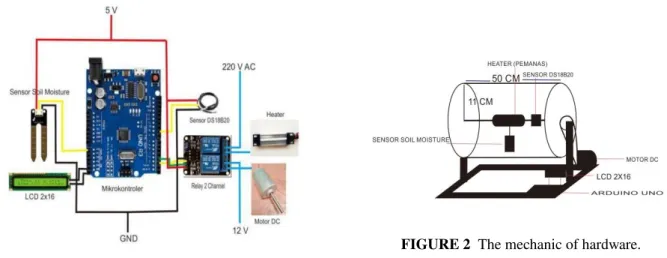
FIGURE 1 Series of hardware.
FIGURE 2 The mechanic of hardware.
Creating automatic drying machine of coffee beans h can be used for household level; (2)Discovering the duration in producing SNI-standard, coffee beans namely low water content or equal to 12%; (3)Accelerating the drying process of coffee beans by paring the duration of the drying process of coffee beans between the automatic drying machine of coffee beans and the drying with the help of sunlight.
2
METHOD
This research was using an experimental research method by connecting components and tools with different characteristics. Those components and tools were soil moisture sensor, DS18B20 sensor, motor DC, relay, LCD, heater, and Arduino Uno. DS18B20 temperature sensor with waterproof ability is fit to be used in measuring temperatures in hard or wet places. The drying system used an electrical heater because it will be functioned for the household level. In this research, the tools were tested to discover whether the provided input is consistent with the expected outcome. The object in this research was coffee beans that will be dried through heater with 55°C temperature, and the drying tub was rotated through motor DC for the water content in coffee beans to become 12%, and for the drying, the result will be even.
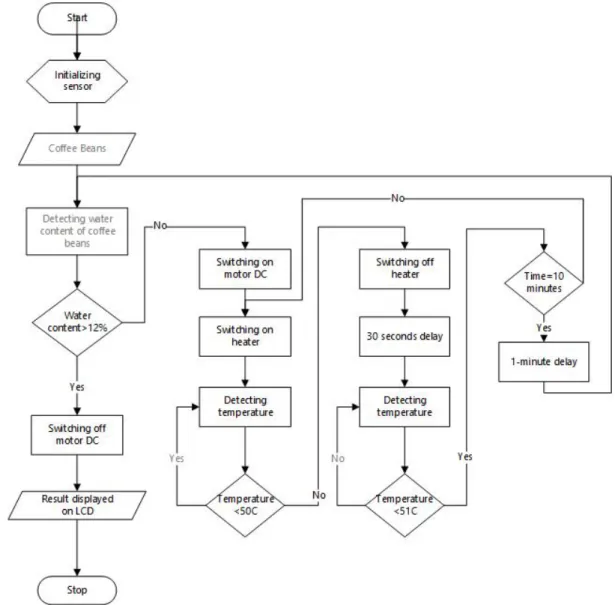
FIGURE 3 Flowchart of the drying process of coffee beans.
conducted for 10 minutes. Thus, the 1-minute delay is provided; if it is not, the drying process is performed. One minute delay is carried out to prevent any errors during the detection of coffee beans’ water content. The water content of coffee beans and the temperature of the container are displayed through LCD. When the water content of coffee beans is low or equal to 12%; thus, the drying process is finished.
3
RESULTS AND DISCUSSION
3.1
The Application of Hardware
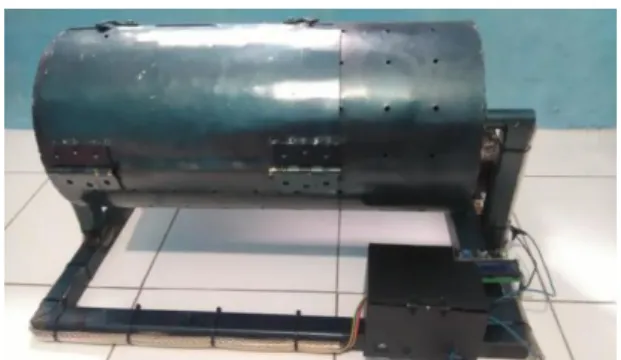
FIGURE 4 The mechanic of the tool.
FIGURE 5 The duration test of the drying process of 3 Kg coffee beans.
3.2
Testing
The testing of the drying process duration on an automatic coffee drying machine was aimed to compare the duration between the drying process on the machine and the help of sunlight. The testing was conducted through the drying with two attempts for 3 Kg weight and two attempts for 6 Kg of coffee beans. On the machine, the water content of coffee beans was checked every 10 minutes, so when 10 minutes have passed, the motor DC stopped, so the reading of water content can be measured.
3.3
The Duration Test of the Drying Process on Automatic Drying Machine
According to the test result, the first test on 3 kg of coffee beans has 23.56 of initial water content. However, in the 60th minute, 0% of water content was acquired because the soil moisture sensor did not hit the coffee beans, and the drying machine of coffee beans stopped because the water content was lower than 12%. When the sample of coffee beans was taken and measured on its water content by using grain moisture while it has 10.19% of water content. The second test on 3 kg of coffee beans has 26.75% of initial water content. The drying process was performed for 90 minutes to reach < 12% of water content. The final water content of 3 kg coffee beans on the second test was 11.21%. The graphic of the duration of the drying process of 3 kg of coffee beans can be seen in Figure 5.
The first test on 6 kg of coffee beans resulted in 23.81% of initial water content. The drying process was performed for 170 minutes to reach < 12% of water content. During the drying process, the fluctuation of water content was due to the large quantity of coffee beans. Thus, the water content of coffee beans has not been distributed evenly. However, in the 60th minute, the water content has no fluctuation. The rotation of the container caused this condition, so the coffee beans were adequate. The final water content of 6 kg coffee beans on the first test was 11.73%. The second test on 6 kg of coffee beans has 26.75% of initial water content. The drying process was performed fro 200 minutes to reach < 12% of water content. During the drying process, similar to the first test, the fluctuation was caused by a large quantity of coffee beans. Thus, the coffee beans were not distributed evenly.The final water content of 6 kg of coffee beans on the second test was 11.43%. The graphic of the duration of the drying process of 6 kg of coffee beans can be seen in Figure 6.
3.4
The Duration Comparison Test of the Drying Process between Automatic Drying Machine
and Sunlight
coffee beans. the help of sunlight.The drying process with machine and with
minutes with 11.83% of final water content. It can be seen that the drying temperature was profoundly affecting the drying time on coffee beans. The drying temperature can be set on the drying machine, while the drying process with the help of sunlight depended on the weather. The comparison graphic between the drying with the machine and the drying with the help of sunlight can be seen in Figure 7.
4
CONCLUSION
According to the conducted research and tests, we can conclude the following. First, the design of the automatic microcontroller-based drying machine of coffee beans can function properly in producing the water content during the drying process. The design uses the input of soil moisture sensor to measure the water content of coffee beans and DS18B20 sensor to adjust the tub temperature. The quantity of water being dried was up to 10.9%, 11.21%, 11.73%, and 11.43%. This result is parallel to the SNI-standardized coffee beans that once. Second, the duration of the drying process of coffee beans with an automatic drying machine required approximately 60 minutes, with 11.74% of final water content. The drying process with sunlight’s help required about 310 minutes and removed water up to 11.83%. It has been proved that the drying with the machine was faster compared to the drying process through sunlight.
To improve the deficiency, some improvements are required for better performance of tools. Several suggestions are provided as follows: the future studies should add methods in the drying process of coffee beans to accelerate the drying process and then replacing motor DC into motor AC to be able to rotate the tub with coffee beans on a large scale.
References
1. Novita, E , Syarief, R , Noor, E , & Mulato S. Peningkatan Mutu Biji Kopi Rakyat dengan Pengolahan Semi Basah Berbasis Produksi Bersih. Argoteknologi 2010;4(1):76–90.
2. Poltronieri P, Rossi F. Challenges in Specialty Coffee Processing and Quality Assurance. Challenges 2016;7(2):19. 3. Mayrowani H. Kebijakan Penyediaan Teknologi Pascapanen Kopi dan Masalah Pengembangannya. Forum Penelitian Agro
Ekonomi 2013;31(1):31.
4. C M Kopi, O Z Price, P Teknis, S Echo, P Abram, Riley D. Catatan Penting tentang Pemanenan dan Cara Mengolah Kopi. ECHO Asia Note Articles 2016;29.
5. Kementrian Pertanian, Kementrian Pertanian RI, editor, Pedoman Paska Panen Kopi, no 52/Permentan/OT.140/9/2012. Kementrian Pertanian, Republik Indonesia; 2012.
6. Suryono AF, Hoten HV. Kaji Eksperimental Perbandingan Performansi Mesin Pendingin Kompresi Uap dengan Menggu-nakan Pipa Kapiler dan Katup Ekspansi. Jurnal TEKNOSIA 2009;2(6):34–39.
7. Susila WR. Targeted Study of the Arabica Coffee Production Chain in North Sumatra (The Mandheling Coffee). Jakarta: Food and Agriculture Organization, United Nations; 2005.
8. Syah H, Agustina R, Moulana R. Rancang Bangun Pengering Surya Tipe Bak untuk Biji Kopi. Rancang Bangun Pengering Surya Tipe Bak Untuk Biji Kopi 2016;9(1):25–39.
9. Faizin AQ. Rancang bangun sistem monitoring suhu dan radiasi pada mesin pengering biji kopi berbasis penjejak matahari aktif dengan mikrokontroler ATMEGA32. Final project, Institut Teknologi Sepuluh Nopember; 2017.
10. Borem FM, Isquierdo EP, Alves GE, Ribeiro DE, Siqueira VC, Taveira JHDS. Quality of Natural Coffee Dried Under Different Temperatures and Drying Rates. Coffee Science 2018;13(2):159–167.
11. Nimrotham C, Songprakorp R, Thepa S, Monyakul V. Experimental Research of Drying Red Chili by Two Methods: Solar Drying and Low-Temperature System Drying. Energy Procedia 2017;138:512–517. https://doi.org/10.1016/j.egypro.2017. 10.237.
12. Javanmard M, Abbas KA, Arvin F. A Microcontroller-Based Monitoring System for Batch Tea Dryer. Journal of Agricultural Science 2009 nov;1(2):p101.