Genetically Optimized Pre coders Transceiver Design for Double
STBC System
K.N.V.Satyanarayana1 ,D.V.R.Mohan2 , B.H.K.Bhagat Kumar3
K.N.V.Satyanarayana1M.Tech Scholar , Dept of ECE, S.R.K.R Engg.college Bhimavaram D.V.R.Mohan2, Prof , Dept. of ECE , S.R.K.R.Engg.college Bhimavaram
B.H.K.Bhagat Kumar3, Asst Prof, Dept of ECE, SAI ADITYA ENGG COLLEGE,Surampalem [email protected] [email protected] [email protected]
Abstract
Wireless communications depends on multiple-input-multiple-output (MIMO) techniques for high data rates. Feedback of channel information can be used in pre-coding to use the strongest channel mode and improve MIMO performance. The DPC system is interference free on multi-user or multi-antenna. The STBC transceiver can provide the transmit diversity. Due to the benefits about the STBC and DPC system, we propose a new scheme called STBC-DPC system. The transceiver design involves the following procedures. First, the ordering QR decomposition of channel matrix and the maximum likelihood (ML) one-dimensional searching algorithm are proposed to acquire a reliable performance. Next, the channel on/off assignment using water filling algorithm is proposed to overcome the deep fading channel problem. Finally, the STBC-DPC system with the modulus operation to limit the transmit signal level, i.e., Tomlinson-Harashima precoding (THP) scheme, is proposed to retain low peak-to-average power ratio (PAPR) performance. Simulation results confirm that the proposed STBC-DPC/THP with water filling ML algorithm can provide the low PAPR and excellent bit error rate (BER) performances.
Keywords—Orthogonal space-time block coding (OSTBC), dirty paper coding (DPC), Tomlinson-Harashima precoding (THP), peak-to-average power ratio (PAPR), maximum likelihood decision (MLD).
I. INTRODUCTION
The primary concern in configuration of wireless communication lies in the domains of spectral efficiency and link reliability [1]. Multiple antennas at transmitter
and receiver ends of MIMO technology are capable to cope with these issues in future wireless communication systems. Multiple views of received signals enhance the robustness due to employment of Diverse Multipath Fading algorithm. Spatial diversity improves the channel reliability in pre-defined resources and transmission time but at the expanse of high transmission power [2].
In order to overcome the interference problem and reduce the computational loading for mobile user, we want to study the precoding technique at base station, which can pre-equalize or pre-cancel the spatial interference at base station. It is well known that the dirty paper coding (DPC) [6] uses precoding technique [7] to eliminate inter-symbol interference (ISI) on single user or multi-users interference. Moreover, due to the DPC with interference free and low complexity benefits, we propose the joint processing for double STBC and DPC (STBC-DPC) precoding techniques to acquire the spatial diversity and multiplexing gains. To the best of our knowledge, there is no publication paper proposed joint double STBC and DPC precoding techniques for MIMO downlink systems.
that the precoding technique will conduct high PAPR problem. The STBC-DPC system with the modulus operation to limit the transmit signal level, i.e., Tomlinson-Harashima precoding (THP) scheme [8], is proposed to constrain high peak power and retain low peak-to-average power ratio (PAPR) performance. Simulation results reveal that the proposed STBC-DPC/THP with water filling ML algorithm can offer the low PAPR and excellent BER performances.
II. STBC AND DPC SIGNALMODEL
In this section, we will introduce the STBC and DPC systems. Then the drawback and benefit of the two systems will be investigated. First, for Alamouti’s STBC system , 2-transmit antennas and 1-receiver antenna are used to achieve transmit diversity. That is, in time slot 1, antenna-1 and antenna-2 transmit signal x1 and x2 and time slot 2 transmitsignal -x2* and -x1*, respectively. The received signal is given by
The transmitted signal can be detected by
As shown in (2), we can find that the diagonal term of (HHH) matrix has the transmit diversity. Next, the dirty paper coding system uses the concept of precoding. It involves two characteristics, i.e., interference free and lower receiver complexity. The system structure is shown as follow. In Fig. 1, the system is assumed by 2_2 MMO system, where the transmitted signal can be expressed as
Fig. 1. Transceiver structure of dirty paper coding
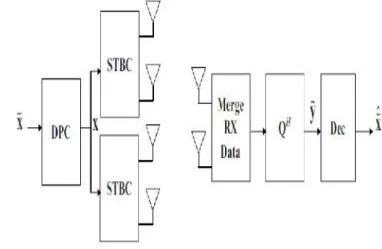
Fig. 2. STBC-DPC system transceiver block diagram
Due to the benefits of STBC and DPC systems, we try to propose a precoding STBC system to attain better BER
performance.
III.NEW DOUBBLE STBC DPC PRECODING
IV.PROPOSED METHOD
Motivated by the linear theoretical spectral efficiency improvement using multiple antenna at the both ends from the radio link, enormous efforts were made to design for the transmission schemes for MIMO systems. Two major techniques emerged: spatial multiplexing an space-time coding. While spatial to transmit multiple independent data streams from different antennas simultaneously, space-time coding achieves full diversity gain without the knowledge of fading channel at the transmitter. The use of multiple antennas has been a recent significant breakthrough in wireless technologies. It creates a MIMO channel in which each path.
Fig.3.STBC Encoder
The important feature of the Alamouti scheme is shown in equation antennas , since the inner product of the sequences x1 and x2 is zero, i.e.
the code matrix has the following property:
whereI2 is a 2 X 2 identity matrix At the receive antenna, the received signals over two consecutive symbol periods, denoted by r1 andr2 for time t and t + T , respectively, can be expressed as
wheren1 and n2 are independent complex variables with zero mean and power spectral density N0/2 per dimension, representing additive white Gaussian noise samples at time t and t + T respectively.
Fig.4.STBC Decoder
Tomlinson-Harashima Precoding (THP)
It is well known that the precoding technique will induce the high PAPR problem. In this section, we want to study the TH precoding technique to reduce PAPR. In [9], the THP was invented for reducing the peak-to-average power ratio in the DFE processing. Next, due to DPC scheme conducting transmit signal variation, the modulus operation, i.e., THP, is proposed to use for the DPC signal and retain the transmitted signal power. Fig. 3 is shown the block diagram of STBC-DPC/THP system.
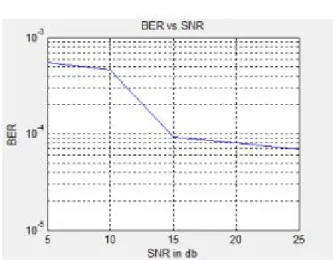
Fig.5.SNR vsBER for MIMO OFDM Using V BLAST
Fig.6.SNR vsBER for MIMO OFDM Using STBC
Fig.7.Comparison of SNR vs BER for Both MIMO
therefore time required is less to transmit the data the only disadvantage of this system is BER because at receiver side the data is weak due to fading effect. Therefore the choice of this system is depend on user. In STBC based system as shown in fig 5. the BER is 10 for 4 channel.
We can conclude that BER is improve because in this system we have send multiple copies of data through different antenna at receiver side using MLD decoding we will get our data with less error. But in this system at same time we are sending same copies of data therefore the data transfer rate of this system is not so good.
Now we can conclude from fig 6. that by considering BER as parameter that STBC system is good for error less transmission but if we require high speed transmisssion we will consider V-BLAST for that. require high speed transmisssion we will consider V-BLAST for that.
Table 1. V-BLAST V/S STBC
VI.CONCLUSION
BER at given SNR as compared to lower order Antenna configurations. By doing so, even higher data capacity at any given SNR can be achieve
REFERENCES
[1] L. J. Cimini, “Analysis and simulation of a digital mobile channel using orthogonal frequency division
multiplexing”, IEEE Transaction on Communications,
Vol. 33, Issue 7, pp. 665–675, July 1985.
[2]Part 11: Wireless LAN Medium Access Control (MAC)
and Physical Layer (PHY) Specifications: High-Speed
Physical Layer in the 5 GHz Band, IEEE Standard
802.11a- 1999.
[3] P. W. Wolniansky, G. J. Foschini, G. D. Golden and R.
A. Valenzuela, “V-Blast: An architecture for realizing very
high data rates over the rich-scattering channel”, International Symposium on Signals, Systems and
Electronics, pp. 295–300, 1998.
[4]W. A. C. Fernando, R.M.A.P. Rajatheva and K. M.
Ahmed, “Performance of Coded OFDM with Higher
Modulation Schemes”, International Conference on
Communication Technology, Vol. 2, pp 1-5, 1998.
[5]PAULRAJ A , NABAR R , GORE D . Introduction
tospace-timewireless communication [M]. Cambridge:
Cambridge University Press, 2003.