Original Research Article
A study on correlation between screen time duration and school
performance among primary school children at Tamil Nadu, India
S. Santha Kumar
1, S. Alph Shirley
2*
INTRODUCTION
School performance in early childhood is an important factor which lays foundation for future academic excellence and professional development. In recent times, one of the factors implied in poor school performance in children is increasing screen time. In addition to poor school performance, increasing screen time in children has been associated with several physical, psychological
and social adverse effects. Several health organizations like AAP, WHO, Canada Pediatric Society, Royal College of Pediatrics and Child Health and Australian Government has issued guidelines on screen time in children.1-5
The objective of this study was to find the association of screen time duration with school performance among primary school children in the state of Tamil Nadu, India.
1Department of Paediatrics, Government Thiruvannamalai Medical College, Thiruvannamalai, India
2Department of Paediatrics, Kanyakumari Government Medical College, Asaripallam, Nagercoil, Tamil Nadu, India
Received: 07 October 2019
Revised: 08 November 2019
Accepted: 14 November 2019
*Correspondence:
Dr. S. Alph Shirley,
E-mail: [email protected]
Copyright: © the author(s), publisher and licensee Medip Academy. This is an open-access article distributed under the terms of the Creative Commons Attribution Non-Commercial License, which permits unrestricted non-commercial use, distribution, and reproduction in any medium, provided the original work is properly cited.
DOI: http://dx.doi.org/10.18203/2349-3291.ijcp20195738
ABSTRACT
Background: In recent times, one of the factors implied in poor school performance in children is increasing screen time. Objective of the study was to find the association of screen time duration with school performance among primary school children in the state of Tamil Nadu, India.
Methods: This cross-sectional observational study was conducted among 134 primary school students at the state of Tamil Nadu, India from June 2019 to August 2019. Data regarding screen time were collected from the parents and school performance from teachers using a predesigned questionnaire. The data collected were analyzed with suitable statistical methods using SPSS 25 software.
Results: Of the 134 children, 72(53.7%) were male and 62(46.3%) female children. 52(38.8%) were in the age group of 6 to 7 years, 47(35.1%) in the age group of 8 to 9 years and 35(26.1%) in the age group of 10 to 11 years. Majority of the children (56.7%) had an average daily screen time of >120 minutes followed by 61 to 120 minutes (29.1%) and ≤60 minutes (14.2%). Based on composite academic performance, 23(17.2%) children were categorized as having poor academic performance, 71(52.9%) as average and 40(29.9%) as good academic performance. There was no statistically significant correlation of screen time duration with composite academic performance and academic performance in mathematics, science and language. (p Value >0.05).
Conclusions: There was no significant correlation between screen time duration and school performance in primary school children in this study. Further studies are required to find the influence of screen time on various domains of learning and on long term cognition and educational achievement.
METHODS
This was a cross sectional observational study conducted at the state of Tamil Nadu, India among 134 primary school children. The study was conducted over 3 months from June 2019 to August 2019. The inclusion criteria included primary school children whose parent were willing to participate in the study. The exclusion criteria for the study were children with physical disability, developmental delay, intellectual disability, learning disabilities, behavioral problems, visual impairment, hearing impairment, on long term medications, chronic illness and acute illness. After obtaining informed consent, data regarding screen time use were collected from the parents and details regarding school performance were collected from teachers using a predesigned questionnaire. The demographic details of the children were collected. Modified Kuppusamy’s socioeconomic status scale was used to find the socioeconomic status. The duration of screen time on a typical school day and typical holiday were collected from the parents and the average screen time over one week was calculated as average screen time per day. Teachers were asked to categorize the children as poor, average or good school performance based on the overall academic performance of the last three tests. This was taken as the composite academic performance. Teachers were also asked to score each child’s academic performance in Mathematics, Science and Language as poor, average and good based on the academic performance in the last three tests.
The data collected were analyzed with suitable statistical methods using SPSS 25 software. Statistical significance was assessed at 5% level of significance (p value <0.05).
RESULTS
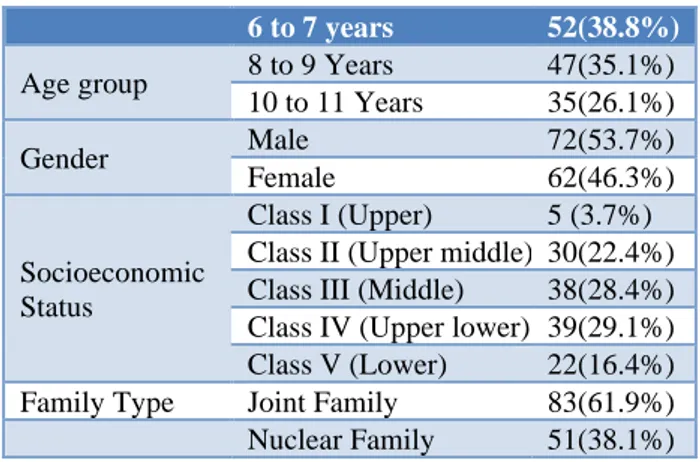
The study group included 72 (53.7%) male and 62 (46.3%) female children. 52(38.8%) were in the age group of 6 to 7 years, 47(35.1%) in the age group of 8 to 9 years and 35(26.1%) in the age group of 10 to 11 years. Demographic distribution as per Modified Kuppusamy Socio economic status scale and family type is shown in Table 1.
The demographic profile of the studied population as per parent’s education and occupation is shown in Table 2.
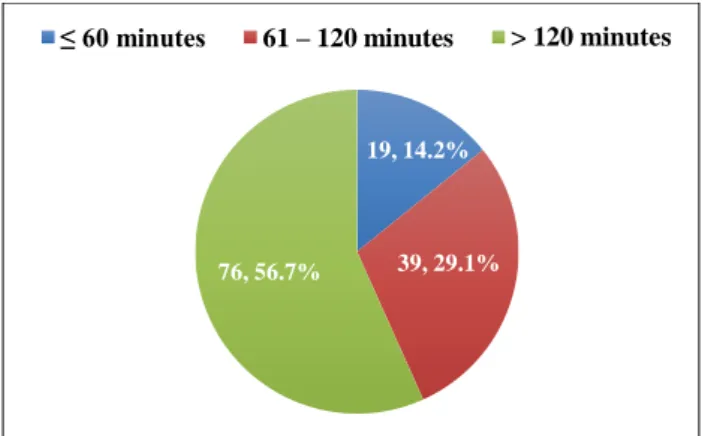
Majority of the children (56.7%) had an average daily screen time of >120 minutes followed by 61 to 120 minutes (29.1%) and ≤60 minutes (14.2%) (Figure 1). The distribution of screen time duration in various age groups is shown in Table 3.
Based on composite academic performance, 23(17.2%) were categorized as having poor academic performance, 71(52.9%) as average and 40(29.9%) as good academic performance. The distribution of composite academic performance and gender is shown in Figure 2.
Table 1: Demographic profile of the study population (based on age, gender, socioeconomic status and
family type).
6 to 7 years 52(38.8%)
Age group 8 to 9 Years 47(35.1%) 10 to 11 Years 35(26.1%) Gender Male 72(53.7%) Female 62(46.3%)
Socioeconomic Status
Class I (Upper) 5 (3.7%) Class II (Upper middle) 30(22.4%) Class III (Middle) 38(28.4%) Class IV (Upper lower) 39(29.1%) Class V (Lower) 22(16.4%) Family Type Joint Family 83(61.9%) Nuclear Family 51(38.1%)
Table 2: Demographic profile of the study population (based on parent’s occupation and education).
Parent’s Occupation Father Mother Home maker 0 (0%) 64(47.8%) Unskilled/ semiskilled 21 (15.7%) 8(5.9%) Skilled 35 (26.1%) 5(3.7%) Clerical/shop owner/farm 10 (7.5%) 8(5.9%) Semi professional 33 (24.6%) 21(15.8%) Professional 35 (26.1%) 28(20.9%) Parent’s Education
Illiterate 0(0%) 0(0%) Primary 13(9.7%) 21(15.7%) Middle/High School 29(21.6%) 27(20.2%) Higher Secondary 25(18.7%) 31(23.1%) Graduate 32(23.9%) 28 (20.9%) Professional 35(26.1%) 27(20.1%)
Table 3: Screen time duration and age.
Age
Average screen time per day
≤60 minutes
61-120 minutes
>120
minutes Total
6 to7 years 11(21.2%) 14(26.9%) 27(51.9%) 52 8 to 9 years 4(8.5%) 13(27.7%) 30(63.8%) 47 10 to 11
years 4(11.4%) 12(34.3%) 19(54.3%) 35 Total 19(14.2%) 39(29.1%) 76(56.7%) 134 Chi
Square 4.1439 p
value 0.38688 Not significant
The distribution of composite academic performance based on the student’s age is as shown in Figure 3.
Figure 1: Distribution based on Screen time duration.
Figure 2: Distribution of composite academic performance and gender
Figure 3: Distribution of composite academic performance in age groups.
The distribution based on screen time duration and academic performance in mathematics is shown in Table 4. There was no statistically significant correlation between screen time duration and academic performance in mathematics (Chi Square - 0.8681, p value - 0.929088 (>0.05) Not Significant).
The distribution based on screen time duration and academic performance in science is shown in Table 5.
There was no statistically significant correlation between screen time duration and academic performance in science (Chi Square - 3.8325, p value - 0.42915 (>0.05) Not Significant).
Figure 4: Screen time duration and Composite Academic Performance.
Table 4: Screen time duration and Academic Performance (Mathematics).
Screen time duration
Academic Performance (Mathematics)
Poor Average Good Total
≤60
minutes 5 8 6 19 61-120
minutes 8 21 10 39 >120
minutes 15 40 21 76 Total 28 69 37 134 Chi
Square 0.8681 p Value 0.929088 Not significant
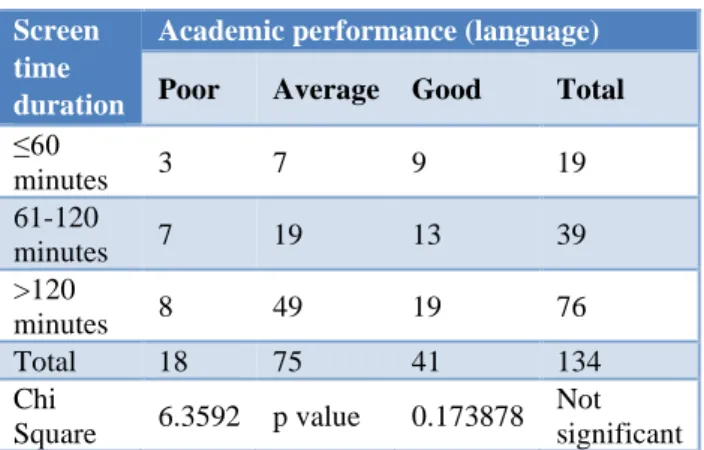
The distribution based on screen time duration and academic performance in Language is shown in Table 6. There was no statistically significant correlation between screen time duration and academic performance in Language (Chi Square - 6.3592, p value - 0.173878 (>0.05) Not Significant).
Table 5: Screen time duration and academic performance (science).
Screen time duration
Academic Performance (Science)
Poor Average Good Total
≤60 minutes 5 8 6 19 61-120
minutes 5 20 14 39 >120 minutes 11 46 19 76 Total 21 74 39 134 Chi Square 3.8325 p value 0.42915 Not
significant
19, 14.2%
39, 29.1% 76, 56.7%
≤ 60 minutes 61 – 120 minutes > 120 minutes
13 10
37 34
22
18
0 5 10 15 20 25 30 35 40
Male Female
Poor Average Good
10 9
4 21
27
23 21
11
8
0 5 10 15 20 25 30
6 to 7 Years 8 to 9 Years 10 to 11 Years
Poor Average Good
5 7
11 10
23
38
4
9
27
0 5 10 15 20 25 30 35 40
≤ 60 minutes 61 – 120 minutes > 120 minutes
Table 6: Screen time duration and academic performance (language).
Screen time duration
Academic performance (language)
Poor Average Good Total
≤60
minutes 3 7 9 19 61-120
minutes 7 19 13 39 >120
minutes 8 49 19 76 Total 18 75 41 134 Chi
Square 6.3592 p value 0.173878 Not significant
DISCUSSION
Increased screen time has been implicated as a reason for poor school performance by parents, teachers as well as health care providers. Several studies are being done to learn the influence of screen time on various domains of learning and school performance. In this study, we have investigated the association of screen time with school performance in primary school children at Tamil Nadu, India.
AAP guidelines (2016) recommends that in children aged 6 and older, consistent limits must be placed on the time spent using media, and the types of media, and to make sure media does not take the place of adequate sleep, physical activity and other behaviors essential to health.1
Royal College of Pediatrics and Child Health recommends that families should negotiate screen time limits with their children based upon the needs of an individual child, the ways in which screens are used and the degree to which use of screens appears to displace (or not) physical and social activities and sleep.4
In this study, 56.7% of the children had an average daily screen time of >120 minutes. Prolonged screen time of ≥ 2 hours was observed in 14.7% of boys and 8.9% of girls in a study among 1063 Chinese students aged 8-19 years.6 45.7% of the children had screen time of 1-2.9
hr/day and 8.9% had 3 or more hr/day in a study on screen time among school age children in Korea by Ham OK et al.7 In a study on screen time viewing among
elementary school aged children in the United States by Fakhouri TH et al, only around 54% of the children met screen time viewing recommendations.8
We found no statistically significant correlation between screen time duration and composite academic performance as well as academic performance in mathematics, science and language among primary school children in this study. This is similar to the study by Regondola EN and Barbado LN, among elementary pupils of the Camarines Norte State College Laboratory School in which the media habits of the respondents did
not in any way affect their academic performance except for that of the male grade two respondents.9
In a meta-analysis of 101 studies regarding video game influences on children's and adolescent’s academic performance by Ferguson CJ, it was noted that video game influences on reduced academic performance was minimal.10
In this systematic review and meta-analysis of 58 cross-sectional studies by Adelantado-Renau M et al, television viewing and video game playing were inversely associated with the academic performance of children.11 Bhattacharya S et al, in the study among children between 5 and 18 years of age found strong evidence of negative correlations between hours of television watched and cognitive test scores.12 Borzekowski DL et al, in a
study among third grade students observed that having a bedroom television set was significantly and negatively associated with students’ test scores, while home computer access and use were positively associated with the scores.13
In addition to short term cognitive adverse effects, screen time has also been implicated in negatively affecting long term cognitive development and educational achievement of children. Television viewing during childhood and adolescence were found to have adverse associations with educational achievement by 26 years of age in a study by Hancox RJ et al.14 In a study by Zimmerman FJ et al,
modest adverse effects of television viewing before age 3 years on the subsequent cognitive development of children was observed.15
In a systematic review of seventy-six studies on the relationship between television exposure and children’s cognition and behavior by Kostyrka-Allchorne K et al, it was observed that watching high quality educational content during preschool years improves children’s basic academic skills and predicts subsequent positive academic performance. But television viewing in infancy was associated with inattentive/hyperactive behaviors, lower executive functions and language delay, at least in the short term.16
In this study the author have not investigated the influence of screen time duration in childhood on long term cognition and education achievement. Also, effects of screen time on various domains of learning such as memory, concentration, comprehension, reasoning creativity and abstract thinking has not been analyzed.
CONCLUSION
Funding: No funding sources Conflict of interest: None declared
Ethical approval: The study was approved by the Institutional Ethics Committee
REFERENCES
1. Council OC. Media and Young Minds. Pediatr. 2016;138(5).
2. World Health Organization. Guidelines on physical activity, sedentary behaviour and sleep for children under 5 years of age. World Health Organization. 2019. Available at: http://www.who.int/iris/handle/10665/311664. Accessed on October 6, 2019
3. Screen time and young children: promoting health and development in a digital world. Paediatr Child Health. 2017;22(8):461-77.
4. Royal College of Paediatrics and Child Health.The health impacts of screen time: a guide for clinicians and parents. 2019. Available at: https://www.rcpch.ac.uk/sites/default/files/2018-12/rcpch_screen_time_guide_-_final.pdf. Accessed on October 6, 2019.
5. Australian Government Department of Health. Australia's Physical Activity and Sedentary Behaviour Guidelines and the Australian 24-Hour Movement Guidelines. 2019. Available at: https://www1.health.gov.au/internet/main/publishin g.nsf/Content/health-pubhlth-strateg-phys-act-guidelines. Accessed on October 6, 2019.
6. Ye S, Chen L, Wang Q, Li Q. Correlates of screen time among 8-19-year-old students in China. BMC public health. 2018;18(1):467.
7. Ham OK, Sung KM, Kim HK. Factors associated with screen time among school-age children in Korea. J School Nursing. 2013;29(6):425-34. 8. Fakhouri TH, Hughes JP, Brody DJ, Kit BK, Ogden
CL. Physical activity and screen-time viewing among elementary school- aged children in the United States from 2009 to 2010. JAMA Pediatr. 2013;167(3):223-9.
9. Regondola EN, Barbado LN. Media habits and academic performance of elementary pupils of the
Camarines Norte State College Laboratory School. IJIR. 2017;3(11):216-24.
10. Ferguson CJ. Do angry birds make for angry children? A meta-analysis of video game influences on children’s and adolescents’ aggression, mental health, prosocial behavior, and academic performance. Perspectives on Psycholog Science. 2015 Sep;10(5):646-66.
11. Adelantado-Renau M, Moliner-Urdiales D, Cavero-Redondo I, Beltran-Valls MR, Martínez-Vizcaíno V, Álvarez-Bueno C. Association between screen media use and academic performance among children and adolescents: a systematic review and meta-analysis. JAMA Pediatr. 2019;173(11):1058-67.
12. Bhattacharya S, Munasib A. Effect of Television on Child Cognitive Outcome. Oklahoma State University, Department of Economics and Legal Studies in Business; 2008.
13. Borzekowski DL, Robinson TN. The remote, the mouse, and the no. 2 pencil: the household media environment and academic achievement among third grade students. Archives of Pediatrics & Adolescent Medicine. 2005;159(7):607-13.
14. Hancox RJ, Milne BJ, Poulton R. Association of television viewing during childhood with poor educational achievement. Archives Pediatr Adolescent Med. 2005;159(7):614-8.
15. Zimmerman FJ, Christakis DA. Children’s television viewing and cognitive outcomes: a longitudinal analysis of national data. Archives Pediatr Adolescent Med. 2005;159(7):619-25. 16. Kostyrka-Allchorne K, Cooper NR, Simpson A. The
relationship between television exposure and children’s cognition and behaviour: A systematic review. Developmental Review. 2017;44:19-58.