THE INTERGENERATIONAL TRANSMISSION OF A STRESS-COPING MODEL OF ALCOHOL USE AND DISORDER
Jessica M. Solis
A dissertation submitted to the faculty at the University of North Carolina at Chapel Hill in partial fulfillment of the requirements for the degree of Doctor of Philosophy in the Department of Psychology and Neuroscience (Clinical Psychology) in the College of Arts &
Sciences.
Chapel Hill 2016
ABSTRACT
Jessica M. Solis: The Intergenerational Transmission of a Stress-Coping Model of Alcohol Use and Disorder
(Under the direction of Andrea Hussong)
Substance use disorders are one of the most common psychiatric disorders diagnosed in young adulthood, and previous literature supports the intergenerational transmission of substance use. In order to explain this transmission, the current study focused on the stress-coping model as a potential mechanism. Using data from a multigenerational longitudinal study, it tested whether an individual stress-coping model recurs within alcoholic families over a generation or whether other factors that co-occur with AUDs are responsible for this intergenerational pattern of alcohol use and disorder. Results supported the individual transmission of stress, avoidant coping, and maladaptive coping patterns (e.g., high levels of stress coupled with high levels of avoidant coping) across familial generations. Additionally, these individual pathways negatively predicted adolescent G3 alcohol use and binge drinking. Potential explanations and implications of these findings are considered.
ACKNOWLEDGEMENTS
First and foremost, I would like to thank Dr. Andrea Hussong for her unparalleled mentorship over the course of my graduate career at the University of North Carolina at Chapel Hill. Her tremendous guidance, compassion, patience, and brilliance have helped mold me into the researcher and woman I am today. Words can never express the extent of my gratitude.
Additionally, I would like to extend my appreciation to the past and present members of the Developmental Risk and Resilience Lab. Your continued friendship and unwavering support contributed to the completion of this project.
Similarly, this project would not be in its current form without the amazing guidance of my dissertation committee members, Dr. Don Baucom, Dr. Patrick Curran, Dr. Deborah Jones, and Dr. Lilly Shanahan. Thank you for sharing this journey with me.
Also, my most sincere thanks go to Dr. Laurie Chassin of Arizona State University for graciously allowing me to examine her incredibly rich data from the Adolescent/Adult Family Development Project (Grant AA016213 from the National Institute of Alcohol Abuse and Alcoholism). This project would have been impossible without you. Moreover, this research was also supported by a National Institute of Drug Abuse predoctoral fellowship 1F31DA034439-01A1.
Finally, to my family (Solis, Pina, and Sloan), I am absolutely humbled by your steadfast and unyielding love, support, and encouragement over the last few years. I share this
TABLE OF CONTENTS
LIST OF TABLES ... viii
LIST OF FIGURES ... ix
LIST OF ABBREVIATIONS AND SYMBOLS ... x
CHAPTER 1: INTRODUCTION ... 1
A Stress-Coping Model of Alcohol Use and Disorder ... 2
A Recurring Stress-Coping Model of Alcohol Use and Disorder ... 7
The Stressful Environment Selection Model of Alcohol Use and Disorder ... 8
The Socialization of Poor Coping Model of Alcohol Use and Disorder ... 10
The Current Study ... 11
CHAPTER 2: METHODS ... 13
Procedure ... 13
Participants ... 13
Measures ... 15
CHAPTER 3: RESULTS ... 20
Hypothesis 1... 20
Hypothesis 2... 22
Hypothesis 3... 24
Hypothesis 4... 26
CHAPTER 4: DISCUSSION ... 32
Intergenerational Pathways Towards Alcohol Use and Disorder ... 33
Implications... 38
Limitations and Future Directions ... 40
Conclusion ... 41
TABLES ... 42
FIGURES ... 51
LIST OF TABLES
Table 1 – Descriptive statistics for key predictor and outcome variables ... 42 Table 2 – Sensitivity analysis of hypothesis 1 predicting adolescent alcohol use
from a recurring stress-coping model ... 43 Table 3 – Hypothesis 1 predicting adolescent binge drinking from a recurring
stress-coping model ... 44 Table 4 – Hypothesis 2 predicting adolescent alcohol use from a selection into
stressful environments model ... 45 Table 5 – Hypothesis 2 predicting adolescent binge drinking from a selection
into stressful environments model ... 46 Table 6 – Hypothesis 3 predicting adolescent alcohol use from a socialization
of poor coping model ... 47 Table 7 – Hypothesis 3 predicting adolescent binge drinking from a socialization
of poor coping model ... 48 Table 8 – Unique effects of each hypothesized model predicting adolescent
alcohol use ... 49 Table 9 – Unique effects of each hypothesized model predicting adolescent
LIST OF FIGURES
Figure 1 – Hypothesis 1 testing a recurring stress-coping model of alcohol use
and disorder ... 51 Figure 2 – Sensitivity analysis of hypothesis 1 predicting adolescent alcohol use
from a recurring stress-coping model ... 52 Figure 3 – Hypothesis 1 predicting adolescent binge drinking from a recurring
stress-coping model ... 53 Figure 4 – Hypothesis 2 predicting adolescent alcohol use from a selection into
stressful environments model ... 54 Figure 5 – Hypothesis 2 predicting adolescent binge drinking from a selection
into stressful environments model ... 55 Figure 6 – Hypothesis 3 predicting adolescent alcohol use from a socialization
of poor coping model ... 56 Figure 7 – Hypothesis 3 predicting adolescent binge drinking from a socialization
LIST OF ABBREVIATIONS AND SYMBOLS AFDP Adolescent/Adult and Family Development Project AUD Alcohol use disorder
α Cronbach’s alpha
β Standardized regression coefficient
CCSC-R Children’s Coping Strategies Checklist-Reduced COAs Children of alcoholics
CFI Comparative Fit Index
DIS Diagnostic Interview Schedule
DSM-III Diagnostic and Statistical Manual for Mental Disorders—Third Edition FH-RDC Family History Research Diagnostic Criteria
G1 Generation 1; Parents
G2 Generation 2; Target adolescents (Waves 1-3); Target adults (Waves 4-5) G3 Generation 3; Targets’ offspring (Waves 5-6)
M Mean
MI Modification indices
p P-value
R2 Proportion of variance in dependent variable explained by independent variable RMSEA Root Mean Squared Error of Approximation
SD Standard deviation
SE Standard error
SRMR Standardized Root Mean Square Residual TLI Tucker Lewis Index
W4 Wave 4
W5 Wave 5
W6 Wave 6
CHAPTER 1: INTRODUCTION
Substance use disorders are one of the most common psychiatric disorders diagnosed in young adulthood (Kessler, Berglund, Demler, Jin, Merikangas, & Walters, 2005). These disorders can be highly impairing, often co-occur with other mental health problems, and demonstrate a strong pattern of intergenerational transmission (Kessler, Chiu, Demler, &
Walters, 2005; Sher, Grekin, & Williams, 2005). Intergenerational transmission has been defined as the cross-generational pattern or “cycle” of family dysfunctions, such as substance abuse and disorder (Zuravin et al., 1996). Previous literature supports the intergenerational transmission of substance use, in that having a parent who drinks is positively associated with offspring alcohol use (Yu, 2003) and substance abuse, and having at least one alcoholic parent is typically highly associated with the later development of alcohol dependence (McGue & Iacono, 2004; Sher, 1997); as these findings suggest, alcohol use disorder (AUD) is highly heritable (Chen et al., 2011).
Sher (1991) proffered three potential mechanisms to explain COAs’ vulnerability to developing AUDs as captured by a deviance-proneness model, a stress and negative affect or stress-coping model1, and a substance use effects model. Given its continued empirical support, much of the work investigating the development of AUDs is grounded within the deviance-proneness model. However, Masten and colleagues (2008) argued that there are likely to be multiple risks and roads towards the use of alcohol and the development of AUDs. To disregard these other mechanisms is to ignore the possibility of equifinality towards problematic alcohol use (Hussong et al., 2011). Knowing that, the second of these models, the stress-coping model, depicts an interaction of both genetic and environmental risks such that adolescents with a family history of alcoholism are more likely to experience life stress and ensuing negative affect that leads to the use of alcohol and other drugs as a means to cope with this emotional distress. In turn, the likelihood of developing an AUD increases. Thus, the current study focused on the stress-coping model as a potential explanation for adolescent problematic alcohol use. A Stress-Coping Model of Alcohol Use and Disorder
Growing out of the Tension Reduction hypothesis (Conger, 1956), the self-medication hypothesis suggests that people turn to alcohol as a means of reducing negative affect resulting from stress. People who consistently drink as a means to regulate negative emotions are thought to be at increased risk for problem-drinking behavior because they are likely to drink more and more often than their peers (Cooper et al., 1995). Even though self-medication may be
accelerated by alcohol’s stress-dampening effects (Armeli et al., 2003), other research has demonstrated that stress-related drinking does not always lead to problematic alcohol use (Catanzaro & Laurent, 2004; Greeley & Oei, 1999; Young, Oei, & Knight, 1990). Therefore,
despite the intuitive appeal of a self-medication mechanism, there is inconsistent evidence (Baker et al., 2004) for the strength (Chassin & Barrera, 1993; Cooper et al., 1995) and longitudinal nature (Hussong et al., 1998; Hussong et al., 2001) of the relationship between negative affect and alcohol use. In response, attempts have been made to reformulate the self-medication model. One such reformulation posits that youth who experience greater life stress and resulting emotional distress are more likely to suffer from emotional dysregulation. In turn, they are less likely to utilize adaptive coping strategies in the face of this distress, which leads to a higher likelihood of engaging in problematic behavior, such as alcohol use (Colder et al., 2002; Cooper et al., 2003; Wills et al., 2001).
Researchers have speculated that this increased external life stress forces COAs to access already taxed coping resources (Hussong & Chassin, 2004). Since its infancy, the coping
literature has sought to understand the myriad of stressors that challenge individuals across their lifespans, how they do or do not react and/or adapt to the presenting situation, and if and how these responses impact future growth or maladaptation. Beginning with perhaps the most widely cited definition (Compas et al., 2001) of coping, Lazarus and Folkman (1984) defined coping as “constantly changing cognitive and behavioral efforts to manage specific external and/or internal demands that are appraised as taxing or exceeding the resources of the person” (p.141).
According to this definition, coping is a continuous, purposeful, and dynamic process that can be divided into problem-focused and emotion-focused strategies. Problem-focused coping is defined as those purposeful actions that are meant to address the stressors arising between a person and his or her environment. Emotion-focused coping entails the alleviation of the resulting negative emotions from that stress. Any of these problem- or emotion-focused actions can be adjusted in response to the continuously evolving demands of the stressful event. As such, Lazarus and Folkman viewed coping as a goal-directed process that has the individual attempting to both resolve the source of the stressor and to manage resulting reactions to the event.
Deeming this and other two-factor characterizations of coping to be too simplistic, Ayers, Sandler, West, and Roosa (1996) generated a four-factor model of child and adolescent coping from a confirmatory factor analysis of 11 theoretically- and empirically-defined coping
repression of thoughts or emotions. Pursuing support for one’s actions and/or feelings would qualify as support-seeking behavior, and distraction incorporates the utilization of diverting actions or the physical release of emotions. Several studies have claimed and replicated the finding within different samples of youth that this four-factor model of coping actually fits the data better than the more common two-factor models of coping (Ayers et al., 1996; Sandler, Tein, & West, 1994).
From a review of the limited empirical literature that attempts to answer whether COAs cope with stressors differently than their non-COA counterparts, Solis (2013) found that COAs appear to employ a wide range of coping strategies in response to stress. Furthermore, COAs utilize specific coping strategies in response to these stressful situations at significantly different rates than those endorsed by their non-COA peers. In particular, COAs are more likely to use less effective coping strategies across the lifespan, including greater avoidance, denial, and behavioral disengagement (Amodeo et al., 2007; Hussong & Chassin, 2004; Smith et al., 2006; Klostermann et al., 2011). That being said, around adolescence and into young adulthood, COAs are also more likely to use cognitive strategies, such as positive reappraisal, than their peers (Hussong & Chassin, 2004), perhaps as a function of emerging cognitive development. Taken together, COAs appear to have several coping deficits, including a penchant for more avoidant coping strategies. In turn, the use of these more avoidant coping strategies are often seen in adolescents who report the highest levels of alcohol consumption and frequency (Ohannessian et al., 2010).
coping strategies in response to said stress, is predictive of alcohol use and alcohol-related problems in adolescents (Laurent, Catanzaro, & Callan, 1997; Wills et al., 2001). As such, for COAs, the stress-coping model of alcohol use may be particularly relevant for explaining alcohol use with particular attention paid to the interaction between family stress and avoidant coping.
The stress-coping model has received comparatively more empirical attention as an individual risk process within cross-sectional data (Sher et al., 1997) rather than as an intergenerational process within multigenerational, longitudinal data. For example, Sher and colleagues (1997) found that childhood stressors, such as verbal, physical, emotional, and verbal abuse, only partially mediated the relationship between paternal and adolescent and young adult offspring AUDs. However, this mediating relationship was evaluated for parents with a lifetime AUD diagnosis and for stressors that occurred before age 18. Therefore, it was unclear whether the timing of the paternal AUD overlapped with the experience of the childhood stressor, making it difficult to clearly establish the temporal relationship between parental AUD and adolescent AUD via a stressor mechanism. Moreover, even if the stress-coping model does play an
explanatory role in the relationship between parental AUD and offspring AUD, research has yet to establish whether this stress-coping mechanism itself recurs over generations and becomes an epidemiological pattern within families over time.
families or whether other factors that co-occur with AUDs are responsible for this intergenerational pattern of alcohol use and disorder.
A Recurring Stress-Coping Model of Alcohol Use and Disorder
Longitudinal studies of high-risk populations, such as COAs, that span developmental periods and generations provide invaluable opportunities to further investigate the developmental processes that underlie the intergenerational transmission of alcohol use disorders within
families. Fortunately, the “coming of age” of several of the research community’s esteemed multi-generational longitudinal studies allows for these opportunities to be realized. Seizing this opportunity, the current study combined an intergenerational perspective on alcohol use and disorder with an individual risk perspective focused on the stress-coping model.
have more coping deficits as compared to their peers (Amodeo et al., 2007; Hussong & Chassin, 2004; Smith et al., 2006). Moreover, parents and siblings are also more likely to model alcohol use as a means of coping with stress (Barrera et al., 1993; Hansen, 1997). The culmination of these correlated constraints increases risk for a stress-coping pattern of alcohol use in COAs and for eventually developing an AUD themselves. As such, I hypothesized that parents will follow an individual stress-coping pattern of alcohol use in young adulthood leading to the development of an AUD; subsequently, children will model their parents’ stress-coping behavior leading to the offspring’s own problematic alcohol use. Therefore, my first hypothesis tested whether the intergenerational transmission of alcohol use and disorder reflects the transmission of a single underlying stress-coping model that is passed across generations.
The Stressful Environment Selection Model of Alcohol Use and Disorder
A recurring stress-coping model may not be the only mechanism explaining the intergenerational transmission of stress, coping, and alcohol use and disorder. Therefore,
colleagues (2012) found that mothers’ reports of higher levels of family stressors during the first five years of their children’s lives predicted their adolescents’ total acute stress at age 15.
Moreover, mothers’ higher endorsement of family stress during their children’s first five years of life also predicted their offspring’s total chronic stress at ages 15 and 20. Similarly,
youth-reported chronic stress at age 15 predicted their own later stress at age 20. Turner and Butler (2003) presented similar findings in that higher levels of early adversity in childhood predicted significantly greater levels of stress in adulthood. Therefore, there appears to be stability in individuals’ reports of stress over time.
One potential explanation for this continuity in stress exposure comes from the idea that experiences of early stress tend to stem from relatively stable, structural and familial
circumstances, such as family conflict or economic uncertainty, which in turn, also increase the child’s risk for additional stressors later in life (Pearlin, 1989). Furthermore, early stress
exposure is also related to deleterious effects on children’s coping, cognitive abilities, and
interpersonal styles (Bifulco et al., 2002; Hankin, 2005; Turner & Lloyd, 1995). In turn, previous work has found that the resulting deleterious effects of early exposure to stress are also likely to affect children’s selection into different environments later in life and to heighten the likelihood that they will respond to future stressors in ways that intensify and multiply this stress
exposure increases the probability of chronic stress exposure over the life course and across familial generations, which in turn, increases the likelihood that problematic alcohol use will occur in response to these stressors over time and across generations. Following this model, my second hypothesis predicted that the relation between parents’ family stress in young adulthood and their offspring’s alcohol use in adolescence was mediated by their offspring’s family stress in childhood.
The Socialization of Poor Coping Model of Alcohol Use and Disorder
Switching the focus of intergenerational transmission risk from selection to poor
and psychological control. While this is a growing body of empirical research, the results lend themselves to the premise that parents are socialization agents for their children’s coping.
Poor coping strategies are more likely to result in alcohol use. Adolescents who learn ineffective coping strategies for dealing with stress may also be at risk for engaging in alcohol use associated with the stress-coping model. Adolescent heavy drinking (Britton, 2004; Veenstra et al., 2007; Wills et al., 2001) and alcohol-related problems (Laurent, Catanzaro, & Callan, 1997) are typically associated with adolescents’ use of more avoidant coping strategies in response to stress. In contrast, the use of more active styles of coping are negatively associated with alcohol use and alcohol-related problems (Wills et al., 2001; Windle & Windle, 1996). The socialization of poor coping model posits that ineffective coping transmitted across generations impacts adolescents’ risk for alcohol use as associated with a stress-coping model. Following this model, my third hypothesis predicted that children’s avoidant coping would mediate the pathway from parents’ avoidant coping in young adulthood to their offspring’s alcohol use in adolescence.
The Current Study
The current study drew on each of the individual causal pathways in the overarching conceptual model of the recurring stress-coping model of alcohol use. It tested four specific hypotheses that align with the aforementioned pathways.
Hypothesis 2: According to a selection into stressful environments model, the relation between parents’ family stress in young adulthood and their offspring’s alcohol use in
adolescence is mediated by their offspring’s family stress in childhood.
Hypothesis 3: According to a socialization of poor coping model, children’s avoidant coping will mediate the pathway from parents’ avoidant coping in young adulthood to their offspring’s alcohol use in adolescence.
CHAPTER 2: METHODS
Study hypotheses were examined with data from the Adolescent/Adult and Family Development Project (AFDP; Chassin, Lee, Cho, Wang, Agrawal, Sher, & Lynskey, 2012; Chassin, Rogosch, & Barrera, 1991) The AFDP is a community sample that assessed three generations of family members over time including parents (G1s), target adolescents (G2s), and later, these targets’ children (G3s).
Procedure
Data were collected with computer-assisted interviews administered to each participant separately either at families’ homes or on campus, or by telephone for out-of-state, young adult participants during the later waves of data. Mail-in surveys augmenting the primary battery were added in later waves. Interviews required 1-3 hours, and participants were paid up to $70 at each wave. To protect the confidentiality of the participants, a Certificate of Confidentiality was obtained from the Department of Health and Human Services.
Participants
G1 alcoholic parents were identified through court records, HMO wellness
questionnaires, and community telephone screenings (Chassin, Barrera, Bech, & Kossak-Fuller, 1992). To participate, at least one G1 parent must have met criteria for lifetime alcohol abuse or dependence according to the Diagnostic and Statistical Manual for Mental Disorders—Third Edition (DSM-III; American Psychiatric Association, 1980). To confirm eligibility, diagnostic interviews were conducted during the first wave of data collection with G1 parents using the Diagnostic Interview Schedule (DIS; Robins, Helzer, Croughan & Ratcliff, 1981; Robins, Helzer, Ratcliff, & Seyefried, 1982) or with spousal report, if the alcoholic parent was not interviewed, using the Family History Research Diagnostic Criteria (FH-RDC; Andreasen, Endicott, Spitzer, & Winokur, 1977). Additionally, COA families had to meet the following inclusionary criteria: G1s were either Hispanic or non-Hispanic Caucasian, English-speaking, an Arizona resident and the biological and custodial parent of a residential child between 10.5-15.5 years old at Wave 1; G1s and G2s could not have any cognitive limitations that would preclude the interview process. Control families were recruited via telephone interviews identified from reverse directory searches and were matched to COA families based on ethnicity, family structure, SES and the adolescent’s age and sex.
Retention in young adulthood was excellent, with 407 (90%) of the original G2 sample interviewed at wave 4, 411 (91%) interviewed at wave 5, and 409 (90%) interviewed at wave 6. In the G2 young adult follow-up (wave 4), full biological siblings aged 18-26 were included and all of these G2 siblings were again invited to participate at waves 5 and 6, five years later. A total of 327 G2 siblings (78% of eligible participants) were interviewed at wave 4, and 365 G2
(G3s). A total of 433 G3 participants were interviewed at wave 5, and 522 G3 participants (33% Hispanic) were interviewed at wave 6.
Analyses were based on three time points: (1) at Wave 4, when G2 targets and siblings were young adults; (2) at Wave 5, when these G2s’ children (G3s) are in late childhood (ages 8-12); and (3) at Wave 6 when G3s are in adolescence (ages 13-17). For G2s to be included in the current study, they must have: (1) participated in Waves 4-6, (2) had a G3 child aged 8-12 during Wave 5, and (3) had a G3 child aged 13-17 in Wave 6. The sample of 203 G2s and their eligible siblings from 140 G1-G2 families was 62% female, 48% COA, 64% Caucasian and 34%
Hispanic, ranging in age from 18-26 at Wave 4 (M=22 years, SD=1.38 years), 22-33 at Wave 5 (M=28 years, SD=2.99 years), and 25-40 at Wave 6 (M=34 years, SD=2.79 years). For G3s to be included in the current study, they must have been an eligible family’s oldest participating child within the appropriate age ranges at both Waves 5 (ages 8-12) and 6 (ages 13-17). Of those G2s and G2 siblings with children of the appropriate ages, there were 83 G3s at Wave 5 in late childhood (54% female, mean age=9 years, SD=1.33 years) and 112 G3s at Wave 6 in
adolescence (70% female, 70% Caucasian and 25% Hispanic, 66% COA, mean age=15 years, SD=1.06 years). The highest education level obtained by G2 parents in this sample at Wave 6 included 26% who had a high school diploma or GED, 34% had some college or
vocational/technical school, 16% had completed vocational/technical school or received their AA degree, 11% had received their bachelor’s degree, 1% had some graduate/professional school, and 4% had completed graduate/professional school.
Measures
and socioeconomic status as indexed by the highest level of education obtained by G2s. Highest education status was measured on a 10-point scale ranging from (1) 8th grade or less to (11) completed graduate/professional school. Ethnicity was also coded by self-identification as either non-Hispanic Caucasian (0) or Hispanic (1).
Alcoholism. G1 alcohol use was assessed via G1 parent-report. In order to assess lifetime G1 AUD at Wave 1, G1 parents were directly interviewed at baseline using a computerized version of the substance use disorder modules of the DIS (Robins, Helzer, Croughan & Ratcliff, 1981; Robins, Helzer, Ratcliff, & Seyefried, 1982) to assess diagnostic status. G1 AUD status was dichotomized to indicate whether G1s had ever received a diagnosis of AUD. G1 AUD was included as a covariate in subsequent analyses.
All young adult G2 subjects were assessed for alcohol abuse and dependence at Wave 4. Diagnosis was obtained from a computerized version of the Diagnostic Interview Schedule III-R (Robins, L.N., & Helzer, J.E., 1991). A dichotomous variable was created to indiciate whether young adults G2s met criteria for an AUD at Wave 4.
Binge drinking. Wave 6 G3 adolescents’ binge drinking was measured by G3s’ self-report of one item assessing how often they had consumed 5 or more drinks of any alcholic beverage at one time within the past year. Given the low endorsement rates, this item was then dichotomized to indicate engagement in binge drinking or not.
Family stress. Life stressors were assessed using an adapted version of the General Life Events Schedule for Children (Sandler, Ramirez, & Reynolds, 1986) and Children of Alcoholics Life Events Schedule (Roosa, Sandler, Gehring, Beals, & Cappo, 1988). All items were
previously rated in the literature as negative events and were assessed in a past year time-frame. For purposes of the current study, only stressors related to the family were included. G2s
reported on their G1-G2 family stress at Wave 4 and on their G2-G3 family stress at Wave 5. G2 respondents indicated whether the same 14 family stressors occurred within the past year at Waves 4 and 5, respectively, and a summary score was created. Given G3s’ young age during Wave 5 (aged 8-12) and the likelihood that they may not have been aware of all occurring family stressors, the decision was made to only use G2s’ report of G2-G3 family stress items to measure G3s’ stress during Wave 5.
took additional steps to create a more reliable avoidant coping scale. I presented five independent raters with all 24 original coping items and the current study’s definition of avoidant coping (i.e., “attempts to reduce stress by distancing oneself mentally and/or physically from the problem at hand”). I instructed each to rate whether the items could be considered avoidant coping. If a rater deemed an item to be an avoidant coping strategy, they then reported, using a 3-point scale, how well it met that definition. Any item that received at least two votes for being an avoidant coping strategy was included in subsequent exploratory factor analysis using promax rotation. A total of 16 G2 coping items were identified by the panel. Analysis of the scree plot and eigenvalues indicated that a one-factor solution of 12 items best represented the avoidant coping data. Internal reliability for these final 12 G2 avoidant coping items was α=.75. In order to determine how many avoidant coping strategies were used, use of a coping strategy was dichotomized to indicate no use at all or any use (no matter the frequency). The number of avoidant coping strategies endorsed was then summed to create an avoidant coping score. This type of summary score has been used previously in the literature to demonstrate the importance of the number of different coping strategies employed (Bernzweig, Eisenberg, & Fabes, 1993; Seiffge-Krenke, Aunola, & Nurmi, 2009; Waters & Thompson, 2014). Examples of items included, “refusing to believe that it has happened,” “turning to work or other substitute activities to take one’s mind off things,” and “holding off on doing anything about it until the situation permits.”
thinking (utilizing wishful thinking or wishing that the problem was better). However, in order to create a similar avoidant coping item set for G3s in Wave 5 that was used for G2s in Wave 4, the external panel once again rated each of the original 20 G3 coping items. The same rating process yielded 22 items. Analysis of the scree plot and eigenvalues of the exploratory factor analysis indicated that a one-factor solution of 8 items best represented the avoidant coping data for G3s. Internal reliability for these final G3 items was α=.70. In order to determine how many avoidant coping strategies were used, use of a coping strategy was dichotomized to indicate no use at all or any use (no matter the frequency). The number of avoidant coping strategies endorsed was then summed to create an avoidant coping score. Example items included “you didn’t think about it,” “you avoided it by going to your room,” and “you just forgot about it.”
Maladaptive Stress/Coping Pattern. In order to determine whether G2s and G3s
independently demonstrated a maladaptive pattern of high levels of family stress combined with avoidant coping, a dichotomous (e.g., 0 or 1) maladaptive stress/coping pattern variable was created. This maladaptive stress/coping pattern variable indexed whether a G2 participant reported above average levels of stressful family events and avoidant coping in Wave 4 or whether a G3 participant reported above average levels of stressful family events and avoidant coping in Wave 5. As such, a participant was assigned a score of 1 if (s)he endorsed higher than average levels of both family stress and avoidant coping. 15% of G2s and 29% of G3s
CHAPTER 3: RESULTS
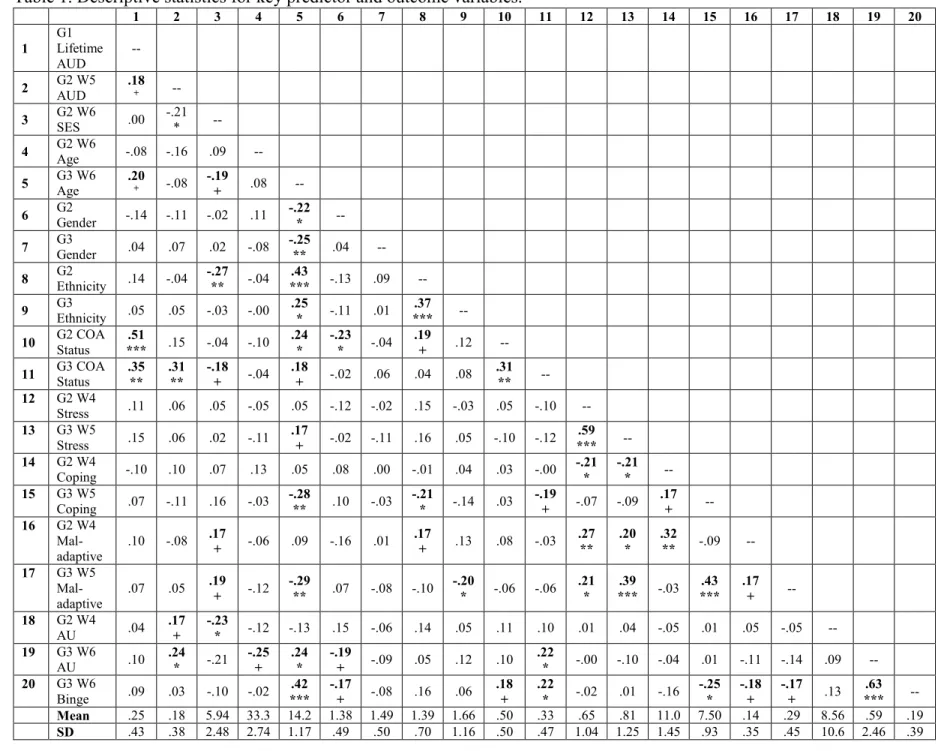
Table 1 presents zero-order correlations between the key observed predictor and
outcomes variables included in the study models. All analyses were conducted in Mplus Version 6.12. The fit of all models was determined by the examination of multiple indices (e.g., chi-square, Comparative Fit Index (CFI), Tucker Lewis Index (TLI), Root Mean Squared Error of Approximation (RMSEA), and Standardized Root Mean Square Residual (SRMR)). These model fit indices were used for all analyses. In order to address the non-normal distribution of the G3 alcohol use outcome, the MLR estimator was used to produce robust standard errors. A Satorra-Bentler chi-square test was used to perform a Likelihood Ratio Test of model fit. Additionally, in order to account for a nested data structure that included G2 siblings within families, the complex analysis option was used to correct for the standard error biases created by the grouped nature of the data. Similarly, due to the dichotomous nature of the adolescent binge drinking outcome variable, a logit link function was used with the ML estimator.
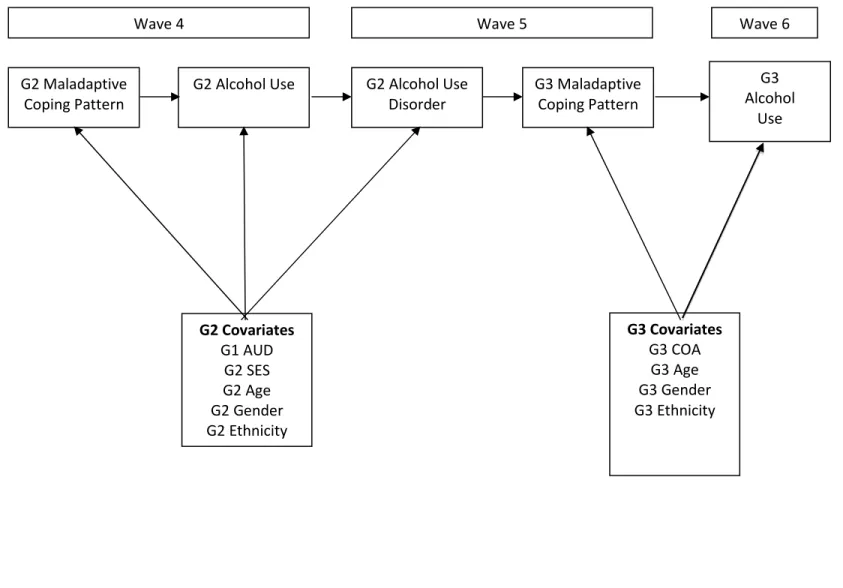
For the following path models, all G2 predictors were regressed on the following
covariates: G1 AUD, G2 SES, G2 age, G2 gender, and G2 ethnicity. Similarly, all G3 predictors and outcomes were regressed on the following covariates: G3 COA status (whether any parent had an AUD), G3 age, G3 gender, and G3 ethnicity.
Hypothesis 1
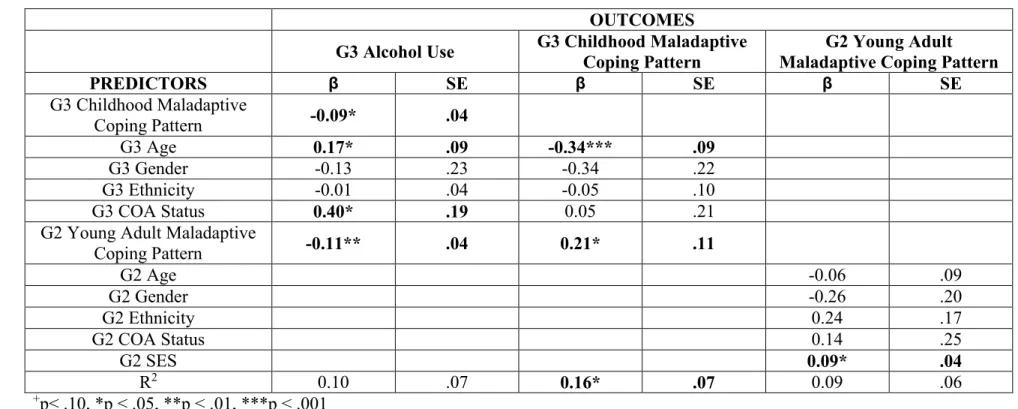
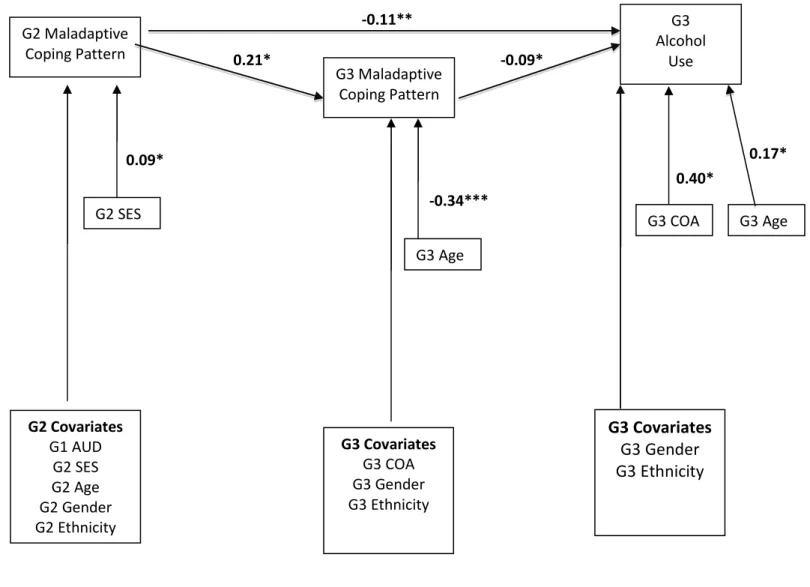
transmission patterns of alcohol use (see Figure 1). The resulting model did not fit the data well (χ2 (28) = 32.06, p=.27, CFI = .87, TLI = .73, RMSEA = .04, SRMR = .05). Given that the only theoretically viable modification indices related to the transmission of a maladaptive coping pattern (i.e., high family stress coupled with high avoidant coping), sensitivity analyses were conducted to determine the relative contributions of this pattern to adolescents’ alcohol use. This sensitivity analysis had G3 alcohol use regressed on G3 childhood maladaptive coping patterns which was in turn regressed on G2 young adult maladaptive coping patterns. The resulting model (see Figure 2; Table 2) fit the data exceptionally well (χ2 (15) = 14.41, p= .50, CFI = 1.00, TLI = 1.00, RMSEA = 0.00, SRMR = 0.04) but did not explain a significant amount of variance in G3 alcohol use (R2 = 0.10, p > .05). According to this model, all of the paths were significant such that G2s who exhibited a maladaptive coping pattern during young adulthood were more likely to later have offspring that exhibited this same maladaptive coping pattern in childhood
(standardized β = 0.21, p < .05). Moreover, a G3 childhood maladaptive coping pattern
negatively predicted later alcohol use in adolescence (standardized β = -0.09, p < .05). Several covariates also significantly predicted adolescent alcohol use. More specifically, older G3s were less likely to exhibit a maladaptive coping pattern in childhood (standardized β = -0.34, p < .001) and to drink more in adolescence (standardized β = 0.17, p < .05). Similarly, G3 COAs were also significantly more likely to use alcohol in adolescence (standardized β = 0.40, p < .05).
Additionally, G2s from a higher SES bracket were more likely to exhibit a maladaptive coping pattern in young adulthood (standardized β = 0.22, p < .05).
coping pattern. In doing so, results indicated that G2s who exhibited a maladaptive coping pattern during young adulthood were less likely to have adolescent offspring who drank (standardized β = -0.11, p < .01). Moreover, the total effect of a G2 young adult maladaptive coping pattern on G3 alcohol use was significant (standardized β = -0.12, p = .001), indicating an indirect effect equaling -0.01 (p > .05). Overall, according to these sensitivity analyses, there is evidence for transmission of a maladaptive coping pattern from G2s to G3s that significantly predicted G3 alcohol use.
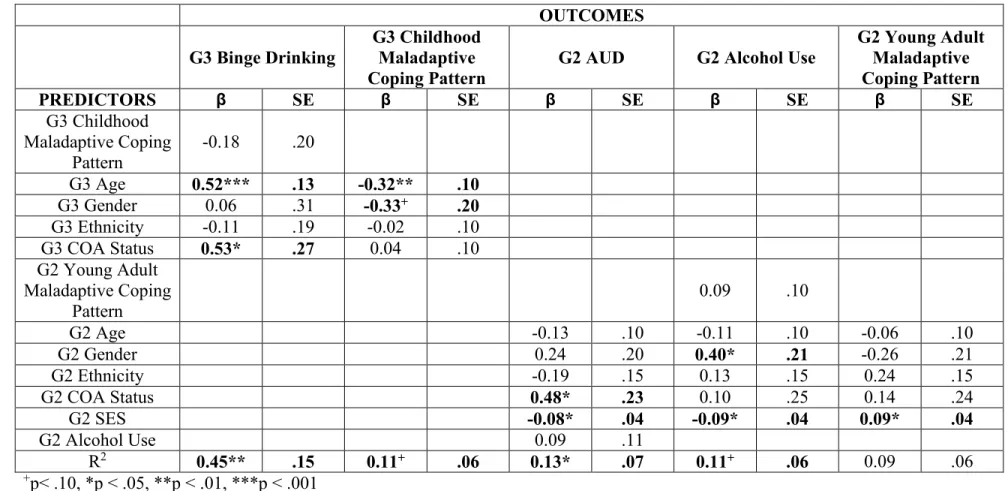
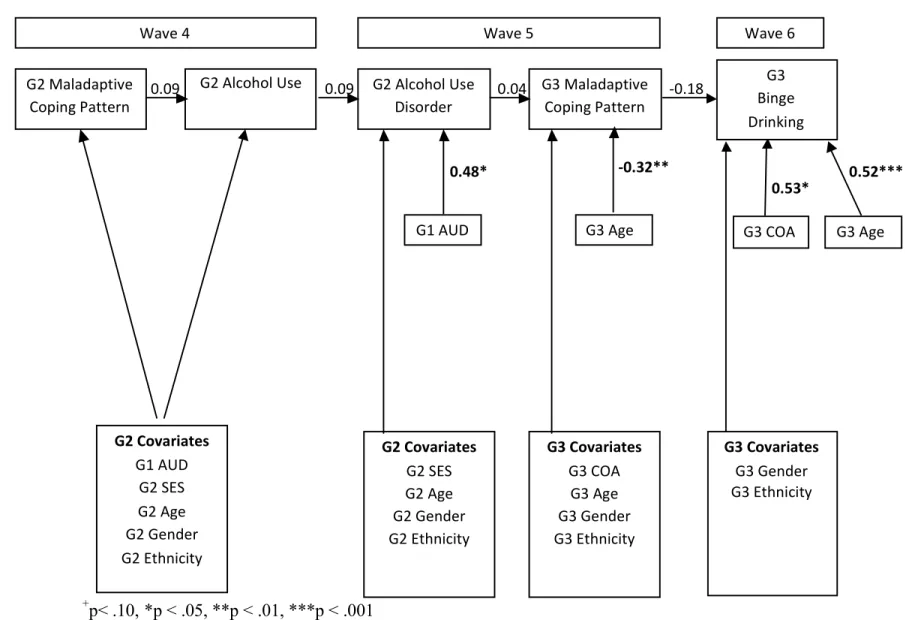
A path analysis also investigated Hypothesis 1 with regards to adolescent binge drinking (see Figure 3; Table 3). According to this model, even though only covariates were significant predictors, a significant amount of variance in G3 alcohol use was explained (R2 = 0.45, p < .01). For instance, older G3s were less likely to exhibit a maladaptive coping pattern in childhood (standardized β = -0.32, p < .01) and more likely to binge drink in adolescence (standardized β = 0.52, p < .001). Additionally, G2 COA status was a significant predictor in that G2s with an alcoholic parent (G1s) in childhood were more likely to develop an AUD themselves in
adulthood (standardized β = 0.48, p < .05). Similarly, being a G3 COA increased the log odds of G3s binge drinking in adolescence by 0.53 (p < .05). Also, G2s from a higher SES bracket were more likely to exhibit a maladaptive coping pattern in young adulthood (standardized β = 0.22, p < .05).
Hypothesis 2
Wave 4 family stress (i.e., “young adult stress”). The resulting model fit the data moderately well (χ2 (15) = 17.08, p = .31, CFI = .96, TLI = .92, RMSEA = 0.04, SRMR = 0.04). Consequently, modification indices were consulted to re-specify the model. Modification indices indicated that G3 alcohol use should be regressed on G2 age (MI=4.40). Previous research has found that younger maternal age is associated with greater frequency of offspring alcohol use (Shaw, Lawlor, & Najman, 2006). Therefore, given the theoretical plausibility of this suggestion, the model was re-specified to include this pathway.
The resulting model (see Figure 4; Table 4) fit the data exceptionally well (χ2 (14) = 12.05, p= .60, CFI = 1.00, TLI = 1.00, RMSEA = 0.00, SRMR = 0.03) and explained a
significant amount of variance in G3 alcohol use (R2 = 0.15, p < .05). Moreover, according to a likelihood ratio test, it significantly improved upon the model fit of the original model (χ2 (1) = 9.69, p < .01). Additionally, all of the paths were significant such that G2’s stress in young adulthood significantly predicted their offspring’s stress in childhood (standardized β = 0.57, p < .001), and G3 childhood stress negatively predicted their later alcohol use in adolescence
adolescent alcohol use remained significant (standardized β = -0.11, p < .05). Overall, these results support the stressful environment selection model of Hypothesis 2; however, the effect of family stress on adolescent alcohol use was in the opposite direction originally predicted.
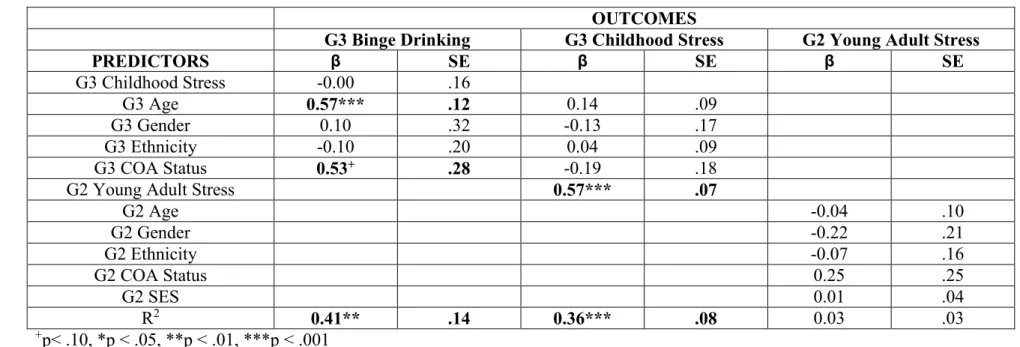
A path analysis also investigated Hypothesis 2 with regards to adolescent binge drinking (see Figure 5; Table 5). G3 binge drinking at Wave 6 was regressed on G3 childhood stress. In turn, G3 childhood stress was regressed on G2 young adult stress. The resulting model explained a significant amount of variance in G3 binge drinking (R2 = 0.41, p < .01) and indicated that the more family stress experienced by G2s as young adults, the more family stress G3s experienced in childhood. More specifically, with each family stressor G2s experienced in young adulthood, the log odds of G3s experiencing family stress during childhood increased by 0.57 (p < .001). G3 family stress during childhood did not predict G3 heavy alcohol use during adolescence.
Additionally, older G3s (standardized β = 0.57, p < .001) and G3 COAs (standardized β = 0.53, p < .10) were each significantly more likely to binge drink in adolescence. Therefore, Hypothesis 2 was only partially supported in that family stress continued from one generation to the next, but this transmission did not predict adolescents’ heavy alcohol use.
Hypothesis 3
A path analysis estimated whether the relation between parents’ avoidant coping in young adulthood and their offspring’s alcohol use in adolescence was mediated by their offspring’s avoidant coping in childhood. To test this model, G3 alcohol use was regressed on G3 Wave 5 avoidant coping (i.e., “childhood coping”). In turn, G3 Wave 5 avoidant coping was regressed on G2 Wave 4 avoidant coping (i.e., “young adult coping”). The resulting model did not fit the data well (χ2 (12) = 13.39, p = .34, CFI = .90, TLI = .75, RMSEA = 0.04, SRMR = 0.04).
indicated that G3 childhood coping should also be regressed on G1 AUD status (MI = 5.51). The resulting model (see Figure 6; Table 6) fit the data very well (χ2 (11) = 7.81, p=.73, CFI = 1.00, TLI = 1.00, RMSEA = 0.00, SRMR = 0.03) but did not explain a significant amount of variance in G3 alcohol use (R2 = 0.11, p >.05). According to a likelihood ratio test, however, it
significantly improved upon the model fit of the original model (χ2 (1) = 4.99, p < .05). Even though G3 childhood coping did not predict G3 alcohol use, G2’s coping in young adulthood did predict their offspring’s coping in childhood (standardized β = 0.21, p < .05) such that G2s who endorsed avoidant coping as young adults were more likely to have G3 children who also reported using greater numbers of avoidant coping strategies. Several covariates also
significantly predicted both G3 childhood coping and adolescent alcohol use. For example, older G3s (standardized β = -0.29, p < .05) were less likely to use avoidant coping strategies during childhood and more likely to drink during adolescence (standardized β = 0.23, p < .05).
Additionally, parent and grandparent AUD status were also significant predictors such that G3s were more likely to drink (standardized β = 0.43, p < .05) if their parent(s) had an AUD.
Moreover, they were also more likely to use avoidant coping in childhood if their grandparents (G1s) had an AUD (standardized β = 0.56, p < .05). In contrast, the total and specific indirect effects from G2 young adult coping did not significantly predict G3 alcohol use (standardized β = 0.02, p > .05). Further analysis revealed that the total effect (standardized β = -0.04, p > .05) of G2 young adult coping on G3 alcohol use, a combination of the direct effect (standardized β = -0.07, p > .05) and the indirect effect (standardized β = 0.03, p > .05), was not statistically significant. Therefore, Hypothesis 3 was only partially supported in that parents were
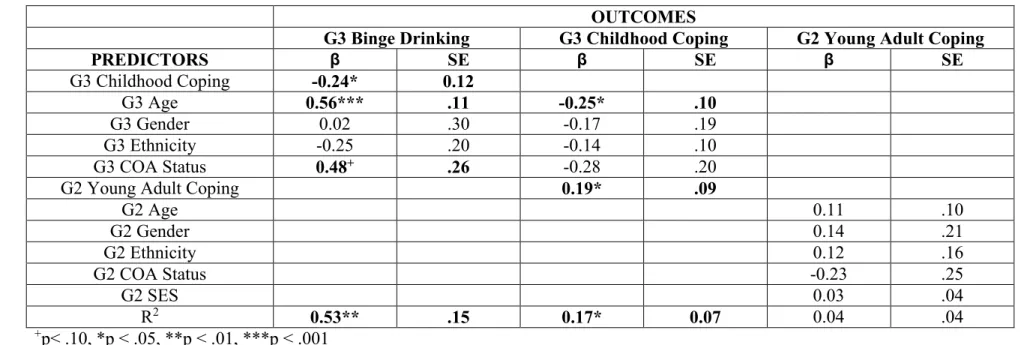
A path analysis also investigated Hypothesis 3 with regards to adolescent binge drinking (see Figure 7; Table 7). G3 binge drinking at Wave 6 was regressed on G3 childhood coping. In turn, G3 childhood coping was regressed on G2 young adult coping. The resulting model explained a significant amount of variance in G3 binge drinking (R2 = 0.53, p = .001) and
indicated that G3 childhood coping significantly predicted G3 binge drinking such that with each endorsement of an avoidant coping strategy during childhood, the log odds of drinking 5 or more drinks in one sitting during adolescence decreased by 0.24 (p < .05). Moreover, G2s’ young adult coping predicted their children’s coping such that with each G2 endorsement of an avoidant coping strategy during young adulthood, the log odds of their children also endorsing avoidant coping increased by 0.19 (p < .05). Several covariates also significantly predicted both G3 childhood coping and adolescent binge drinking. More specifically, older G3s were more likely to binge drink in adolescence (standardized β = 0.56, p < .001) and less likely to use avoidant coping strategies in childhood (standardized β = -0.25, p < .01). Also, having a parent with an AUD increased a G3’s log odds of binge drinking by 0.48 (p < .10). Therefore, Hypothesis 3 was again only partially supported in that parents were socialization agents of their children’s coping; however, this transmission of maladaptive coping led to decreased adolescent binge drinking. Hypothesis 4
A SEM framework was used to test the final hypothesis that determines whether there are unique effects of the three models, the recurring stress-coping, selection into stressful
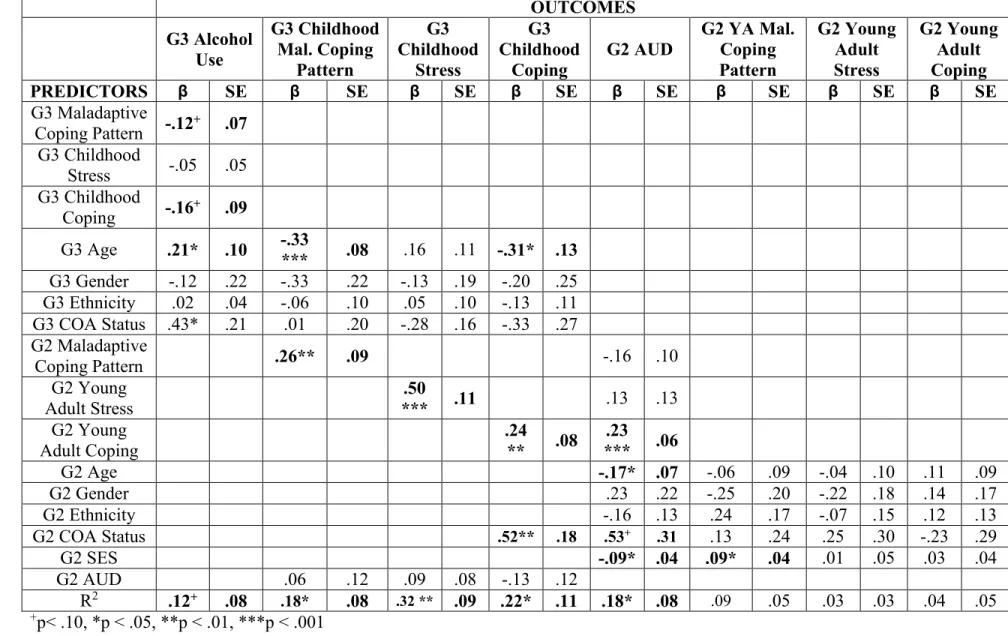
maladaptive coping pattern. The resulting model did not fit the data well (χ2 (48) = 57.10, p=.17, CFI = .94, TLI = .87, RMSEA = 0.04, SRMR = 0.06). Consequently, modification indices were consulted to re-specify the model. Modification indices indicated that G3 childhood coping should be regressed on G1 AUD status (M=5.49). The resulting model (see Figure 8; Table 8) fit the data well (χ2 (47) = 51.08, p=.32, CFI = .97, TLI = .95, RMSEA = 0.03, SRMR = 0.05) but only explained a moderately significant amount of variance in G3 alcohol use (R2 = 0.12, p
=.10). Moreover, according to a likelihood ratio test, it significantly improved upon the model fit of the original model (χ2 (1) = 8.27, p < .01). Overall, age and COA status were significant covariates in this overarching model. For example, older G2s were less likely to develop an AUD (standardized β = -0.17, p < .05). Moreover, older G3s were more likely to drink alcohol as adolescents (standardized β = 0.21, p < .05) and less likely to utilize avoidant coping strategies (standardized β = -0.31, p < .05) and demonstrate a maladaptive coping pattern (standardized β = -0.33, p < .001) in childhood. Similarly, having an alcoholic parent was associated with G2s being more likely to develop their own AUD (standardized β = 0.53, p < .10) and for G3s to drink more in adolescence (standardized β = 0.43, p < .05). Additionally, G3s were also more likely to use avoidant coping in childhood if their grandparents (G1s) had an AUD (standardized β = 0.52, p < .01).
(standardized β = -0.12, p < .10). Even though a significant amount of variance in the G3 maladaptive coping pattern was explained (R2 = 0.18, p < .05), the total and specific indirect effects from G2 maladaptive coping pattern did not significantly predict G3 alcohol use
(standardized β = -0.03, p > .05), regardless of the specific meditational path explored. In sum, there does appear to be some evidence for a recurring maladaptive stress-coping pattern that has a relatively unique effect on G3 adolescent alcohol use. However, this effect is in the opposite direction hypothesized.
With regards to the stressful environment selection pathway, G2 young adult stress once again significantly predicted G3 childhood stress (standardized β = 0.50, p < .001). However, childhood stress did not significantly predict adolescent drinking (standardized β = -0.05, p > .05). Additionally, even though a significant amount of variance in G3 childhood stress was explained (R2 = 0.32, p < .01), the total and specific indirect effects from G2 young adult stress did not significantly predict G3 alcohol use (standardized β = -0.03, p > .05), regardless of the specific meditational path explored. As such, despite the evidence for the transmission of stressful environments, the unique effect of the relation between parents’ family stress in young adulthood and their offspring’s alcohol use was limited.
In contrast, the socialization of coping pathway demonstrated that G2s who utilized more avoidant coping strategies in young adulthood were more likely to have offspring who also used avoidant coping in childhood (standardized β = 0.24, p < .01) and who later drank less in
adolescence (standardized β = -0.16, p < .10). Moreover, a significant amount of variance in G3 childhood coping was explained (R2 = .22, p < .05); however, once again, the total and specific indirect effects from G2 young adult stress did not significantly predict G3 alcohol use
relative evidence exists for a socialization of poor coping model, in which there is a unique effect of the relationship between parents’ avoidant coping in young adulthood to their offspring’s alcohol use in adolescence via their offspring’s childhood avoidant coping. However, again, the effect on adolescent alcohol use was in the opposite direction predicted. Overall, given the greater evidence for both the recurring stress-coping and socialization of poor coping models, it appears that avoidant coping is an important and unique predictor of adolescent alcohol use in both of these pathways.
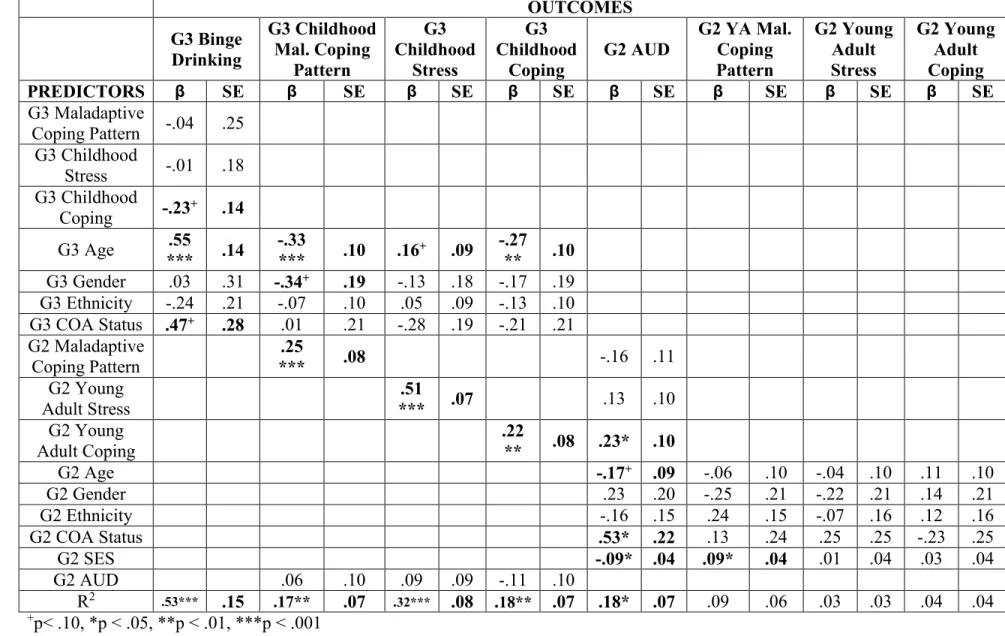
A SEM framework was also used to test the final unique effects hypothesis to predict adolescents’ binge drinking at Wave 6. To avoid model misspecification, G2 young adult stress and coping were covaried with the G2 young adult maladaptive coping pattern. Similarly, G3 childhood stress and coping were also covaried with the G3 childhood maladaptive coping pattern. The resulting model (see Figure 9; Table 9) explained a significant amount of variance in G3 binge drinking (R2 = 0.53, p = .001). Overall, age and COA status were significant covariates in this overarching model. For example, older G2s were less likely to develop an AUD
(standardized β = -0.17, p < .10). Moreover, older G3s were more likely to binge drink as adolescents (standardized β = 0.55, p < .001), more likely to experience childhood stress
(standardized β = 0.16, p < .10), and less likely to utilize avoidant coping strategies (standardized β = -0.27, p < .01) and demonstrate a maladaptive coping pattern (standardized β = -0.33, p < .001) in childhood. Similarly, having an alcoholic parent was associated with G2s being more likely to develop their own AUD (standardized β = 0.53, p < .05) and for G3s to binge drink more in adolescence (standardized β = 0.47, p < .10).
developing an AUD increased by 0.23 (p < .05). Furthermore, evidence was attained for the transmission of G2’s maladaptive coping pattern in young adulthood to their G3 offspring in childhood (standardized β = 0.25, p < .001) with a significant amount of the variance in G3 childhood maladaptive coping pattern being explained (R2 = .17, p < .01). However, the presence of a maladaptive coping pattern in childhood did not predict later adolescent binge drinking (standardized β = -0.04, p > .05). Therefore, it appears that there is only evidence for a recurrent maladaptive coping pattern across familial generations and not for this recurrent pattern’s unique effect on adolescent binge drinking.
With regards to the stressful environment selection pathway, G2 young adult stress once again significantly predicted G3 childhood stress (standardized β = 0.50, p < .001), such that with every increase in family stressor experienced by G2s in young adulthood, the log odds of their children also experiencing a family stressor increased by .51 (p < .001). Additionally, a significant amount of variance in G3 childhood stress was explained (R2 = 0.32, p < .001). However, once again, childhood stress did not significantly predict adolescent binge drinking (standardized β = -0.01, p > .05). As such, despite the evidence for the transmission of stressful environments, the unique effect of the relation between parents’ family stress in young adulthood and their offspring’s alcohol use is limited.
CHAPTER 4: DISCUSSION
By drawing on several theoretical perspectives, the current study tested whether an individual stress-coping model of alcohol use may recur in an intergenerational context to explain the transmission of problematic use within families or whether other factors that co-occur with AUDs are responsible for this intergenerational pattern of alcohol use and disorder. Findings provided moderate support for the study hypotheses and supported a more multifaceted approach to the understanding of the intergenerational transmission of stress, coping, and alcohol use across familial generations. Implications of these findings are discussed in turn below. Intergenerational Transmission of Stress and Coping
Given the transmission of stress, coping, and maladaptive coping patterns across familial generations, support was partially attained for the stressful environment selection, socialization of poor coping, and recurring stress-coping models. More specifically, G2s who experienced higher levels of family stress and used more avoidant coping strategies, respectively, were more likely to have offspring that reported more family stress and use of avoidant coping strategies, respectively, during childhood. Additionally, sensitivity analyses of the recurring stress-coping model revealed that young adults who experienced high levels of family stress coupled with high levels of avoidant coping were more likely to have children who also experienced this same high stress-avoidant coping pattern. This result represents what is likely the first study to investigate the intergenerational transmission of this maladaptive coping pattern.
impact their children’s health and well-being (Thoits, 2010; Turney, 2014). Moreover, this transmission of avoidant coping adds to the small body of literature investigating parents as socialization agents for their children’s coping. In fact, to my knowledge, it is the first study to use parents’ coping as young adults to predict their offspring’s coping in childhood. This positive relationship between parental and child coping is also in response to general stressful situations and not to previously studied more specific contexts such as sickle cell disease (Kliewer & Lewis, 1995) and community violence (Kliewer et al., 2006). Therefore, the current study extends the understanding of the individual intergenerational transmission of stress, coping, and maladaptive stress-coping patterns, within families.
Intergenerational Pathways towards Alcohol Use and Disorder
Interestingly, even though support was attained for the individual intergenerational transmission of family stress and avoidant coping, these individual pathways negatively predicted adolescent G3 alcohol use and binge drinking in Wave 6. Moreover, G3s who
transmission of a stressful environment pathway across familial generations, G2 parents were able to help their G3 children anticipate these stressors, making them less taxing, and leading adolescents to drink less. Unfortunately, little research has studied this area of parent-child relationships (Power, 2004); however, it could be relevant in the current context and future research should further investigate this possible connection.
Alternatively, given the enduring nature of this familial stress, children and adolescents may find this experience to be expected and simultaneously, out of their control. Meaning, perceiving this greater and continued family stress to be uncontrollable may in fact lead to less emotional distress and resulting emotional dysregulation and problematic outcomes. In fact, previous research has suggested that avoidant coping is actually associated with better outcomes when the triggering stressor is considered to be uncontrollable (Creasey et al., 1995; Valentiner et al., 1994). Additionally, avoidant coping has previously been linked to children’s more adaptive functioning at higher levels of stress (Gonzales, Tein, Sandler, & Friedman, 2001). As such, this could explain the recurring stress-coping model finding in which G3s who
demonstrated a maladaptive coping pattern (e.g., simultaneously experienced high family stress and utilized high avoidant coping) were less likely to drink alcohol. Prior research has also found that childhood stressors only predicted about one-quarter of developing but not the persistence of substance use disorders (Green et al. 2010; McLaughlin et al. 2010). Thus, while important, the experience of childhood stress is not the only factor contributing to the development of AUDs.
avoidant coping and adjustment outcomes, such as alcohol use, has been mixed (Compas et al., 2001). In fact, literature discrepancies may stem from differences in the operational definition of avoidant coping as either negative (e.g., self-medicating with substances) or as distracting (e.g., going shopping or visiting a friend) (Windle & Windle, 1996). For instance, previous researchers (Cooper et al., 1988; Windle & Windle, 1996) have found a positive relationship between
“negative” avoidant coping and alcohol use. In contrast, Gonzales and colleagues (2001) demonstrated that early adolescent girls’ use of distraction coping strategies buffered the relationship between family stress and conduct problems. Given that the majority of the items comprising the present investigation’s avoidant coping construct could be described as
distracting, perhaps the socialization pathway’s unexpected inverse relationship with adolescent alcohol use and binge drinking can be attributed to this particular operationalization of avoidant coping. According to this premise, my original hypotheses predicting a positive association between avoidant coping and problematic alcohol use within the socialization and recurring stress-coping models were correct and only fell victim to an incompatible measurement of avoidant coping.
mixed results have been presented (Blumenthal, Leen-Feldner, Badour, & Babson, 2011 2011). For example, in early adolescence, anxiety may in fact protect youth from initiating alcohol use. Conversely, once an adolescent has begun drinking, anxiety will promote the escalation of alcohol use (Colder, Chassin, Lee, & Villalta, 2010). Given that the G3s in the current sample were, on average, still in early adolescence (mean age=14.2 years) and that most had yet to initiate alcohol use, perhaps the increased stress experienced by these G3s caused protective anxiety against initiating alcohol use. Likewise, it could be that as these adolescents age and consequently are more developmentally likely to begin drinking, the original stress-coping hypothesis may emerge as this increased stress and resulting anxiety intensifies their drinking. Overall, this idea aligns quite nicely with the intergenerational transmission models of affective disorder that suggest that living with a parent with an affective disorder not only entails a genetic risk but may also increase exposure to potential environmental risk factors, such as an increase in perceived stress and the parental modeling of anxious behaviors (Eley et al., 2015). Therefore, the intergenerational transmission of psychopathology may be another possible mechanism in the transmission of problematic alcohol use and disorder.
positive and negative outcomes (Rafnsson, Jonsson, & Windle, 2006).
In addition to the aforementioned counterintuitive results with regards to problematic alcohol use and disorder, several findings concerning COA status aligned with previous literature. For example, G3 COAs were especially likely to face high levels of family stress coupled with high levels of avoidant coping—a prime depiction, especially for COAs, of the necessary precursors to a stress-coping model of alcohol use (Wills et al., 2001). Moreover, parent and grandparent AUD status also served as important predictors of problematic G3 alcohol use over time. For instance, having an alcoholic parent was associated with G3s being more likely to not only drink, but to binge drink as adolescents. Additionally, those G2s who had alcoholic parents were also more likely to develop an AUD themselves. Overall, these results are unsurprising given COAs’ well documented increased risk for developing problematic alcohol use (Chassin, Pitts, DeLucia, & Todd, 1999).
Knowing that there were several positive associations with increased alcohol use and disorder, a return to the overarching question of how alcohol use and disorder is
intergenerationally transmitted is necessary. The current investigation originally proposed that an individual stress-coping model of alcohol use recurs in an intergenerational context to explain this transmission. Complementary hypotheses asserting that selection of stressful environments and socialization of poor coping were also offered as alternative mechanisms. Hypothesis 4 allowed for the investigation of the unique effects of each of these proposed models. According to these analyses, evidence of the intergenerational transmission of stress, coping, and
individual pathways of the recurrent stress-coping model, one notable result is the positive association between G2 avoidant coping in young adulthood and G2s’ later development of an AUD. This finding speaks to the significant impact of avoidant coping on alcohol use and
disorder. Perhaps, the negative association found between avoidant coping and alcohol use in the socialization and recurrent stress-coping models is a reflection of the timing of the relationship. It could be that the use of avoidant coping is protective in early to mid-adolescence with regards to problematic alcohol use. However, according to this individual pathway, the continued use of avoidant coping strategies into young adulthood increases the likelihood of developing an AUD later in life. As such, one could speculate that the proposed recurring stress-coping, stressful environment, and/or socialization mechanisms do not fully emerge until young adulthood.
Moreover, given the evidence supporting the intergenerational transmission of stress, coping, and maladaptive stress-coping patterns, one could argue that each of the three proposed models are not competing with each other. Instead, they could comprise a broader type of developmental cascade that sees the negative correlated constraints of each of the three mechanisms interact with each other to increase the likelihood of developing and transmitting alcohol use and
disorder. Therefore, future research should consider investigating the timing of the emergence of these mechanisms in an intergenerational context.
Implications
though it was in the opposite direction hypothesized, the current study did demonstrate a buffering relationship between familial stress, avoidant coping, and adolescent alcohol use. Meaning, the use of what could be considered more distraction-based coping strategies may reduce the likelihood of using alcohol even in the face of higher stress levels. In terms of treatment, there are currently several programs intended to reduce adolescent alcohol use by working from a stress and coping model (Kaminer, Burleson, & Goldberger, 2002;
McGillicuddy, Rychtarik, & Papandonatos, 2015). However, many of the coping skills taught in these programs typically involve more problem-solving and cognitive restructuring techniques. While undoubtedly beneficial, being able to offer adolescents, especially those whose cognitive capabilities may not yet have completely matured, a more behaviorally-oriented coping strategy may be an equally appropriate option. As such, the current findings indicate that more
distraction-based coping strategies may offer a protective buffer between stress and adolescent alcohol use. In fact, when studying adolescents in residential treatment for substance use
school, and/or social environments. Limitations and Future Directions
Even though the current study represents several examples of previously unstudied intergenerational processes, several limitations should also be noted. First, as already stated, though great pains were taken to create the avoidant coping item set, there are many ways in which to define and measure avoidant coping. This lack of unanimity regarding the core
categories of coping leads to a number of negative outcomes, including confusion regarding the overabundance of coping measures; the difficulty in comparing, contrasting and synthesizing results across studies; and struggles with accounting for fundamental individual differences, such as age and family history of alcoholism, in coping processes (Compas et al., 2001). As such, it stands to reason that future researchers should at least attempt to consolidate previous
conceptualizations into an overarching developmental framework of coping as “coping needs more detailed specification...because of the bewildering richness of behavior relevant to it” (Pearlin & Schooler, 1978, p. 4). Of course, this is by no means an easy feat. This framework must integrate the unique, related, and dynamic dispositional and situational coping responses individuals employ with the idea that coping is an adaptive process that is integral to individuals’ mental health, physical health, and overall, global functioning (Skinner et al., 2003).
escalating alcohol use had yet to emerge in these younger G3s. As such, replication of the current study findings is needed to confirm the directionality of the relationships between stress, coping, and alcohol use.
Finally, similar to the necessity of establishing a more universal definition and
measurement of coping, the same requirement can be applied to the stress construct. Even though there is relatively less confusion surrounding the operationalization of stress, there is one
particular issue that is especially important to consider: does a researcher’s chosen measure of stress operate under a dispositional or situational approach to coping? In other words, is a particular measure more attuned to the way a person typically copes in response to general stressful events or is it attempting to measure the use of different coping strategies in the face of a particular stressor? The current study independently measured dispositional avoidant coping and a specific type of stress (e.g., familial). As such, future studies that are investigating the interaction between avoidant coping and familial stress should perhaps utilize a more situational approach in order to more accurately describe the relationship between these constructs.
Conclusion
In conclusion, the current study is a crucial first step in investigating how stress, coping, and alcohol use is transmitted across familial generations. Evidence for the individual
4
2
Table 1. Descriptive statistics for key predictor and outcome variables.
1 2 3 4 5 6 7 8 9 10 11 12 13 14 15 16 17 18 19 20
1 G1 Lifetime AUD
--
2 G2 W5 AUD
.18
+ --
3 G2 W6 SES .00
-.21 * --
4 G2 W6
Age -.08 -.16 .09 --
5 G3 W6 Age .20 + -.08
-.19
+ .08 --
6 G2
Gender -.14 -.11 -.02 .11 -.22
* --
7 G3
Gender .04 .07 .02 -.08 -.25
** .04 --
8 G2
Ethnicity .14 -.04 -.27
** -.04 .43
*** -.13 .09 --
9 G3
Ethnicity .05 .05 -.03 -.00 .25
* -.11 .01 .37
*** --
10 G2 COA Status
.51
*** .15 -.04 -.10 .24
* -.23
* -.04 .19
+ .12 --
11 G3 COA Status .35 ** .31 ** -.18 + -.04
.18
+ -.02 .06 .04 .08 .31
** --
12 G2 W4
Stress .11 .06 .05 -.05 .05 -.12 -.02 .15 -.03 .05 -.10 -- 13 G3 W5
Stress .15 .06 .02 -.11 .17
+ -.02 -.11 .16 .05 -.10 -.12 .59
*** --
14 G2 W4
Coping -.10 .10 .07 .13 .05 .08 .00 -.01 .04 .03 -.00 -.21
* -.21
* --
15 G3 W5
Coping .07 -.11 .16 -.03 -.28
** .10 -.03 -.21
* -.14 .03 -.19
+ -.07 -.09 .17
+ --
16 G2 W4 Mal-adaptive
.10 -.08 .17
+ -.06 .09 -.16 .01 .17
+ .13 .08 -.03 .27 **
.20 *
.32
** -.09 --
17 G3 W5 Mal-adaptive
.07 .05 .19 + -.12
-.29
** .07 -.08 -.10 -.20
* -.06 -.06 .21
* .39 *** -.03
.43 ***
.17
+ --
18 G2 W4
AU .04
.17 +
-.23
* -.12 -.13 .15 -.06 .14 .05 .11 .10 .01 .04 -.05 .01 .05 -.05 -- 19 G3 W6
AU .10
.24 * -.21
-.25 +
.24 *
-.19
+ -.09 .05 .12 .10 .22
* -.00 -.10 -.04 .01 -.11 -.14 .09 -- 20 G3 W6
Binge .09 .03 -.10 -.02 .42 ***
-.17
+ -.08 .16 .06 .18
+ .22
* -.02 .01 -.16 -.25
* -.18
+ -.17
+ .13
.63
*** --
Mean .25 .18 5.94 33.3 14.2 1.38 1.49 1.39 1.66 .50 .33 .65 .81 11.0 7.50 .14 .29 8.56 .59 .19
4
3
Table 2. Sensitivity analysis of hypothesis 1 predicting adolescent alcohol use from a recurring stress-coping model.
OUTCOMES
G3 Alcohol Use G3 Childhood Maladaptive Coping Pattern
G2 Young Adult Maladaptive Coping Pattern
PREDICTORS β SE β SE β SE
G3 Childhood Maladaptive
Coping Pattern -0.09* .04
G3 Age 0.17* .09 -0.34*** .09
G3 Gender -0.13 .23 -0.34 .22
G3 Ethnicity -0.01 .04 -0.05 .10
G3 COA Status 0.40* .19 0.05 .21
G2 Young Adult Maladaptive
Coping Pattern -0.11** .04 0.21* .11
G2 Age -0.06 .09
G2 Gender -0.26 .20
G2 Ethnicity 0.24 .17
G2 COA Status 0.14 .25
G2 SES 0.09* .04
R2 0.10 .07 0.16* .07 0.09 .06