S
IMULATING
C
OSMIC
R
EIONISATION
Proefschrift
ter verkrijging van
de graad van Doctor aan de Universiteit Leiden,
op gezag van de Rector Magnificus prof. mr. P. F. van der Heijden, volgens besluit van het College voor Promoties
te verdedigen op woensdag 30 september 2009 klokke 13.45 uur
door
Andreas Heinz Pawlik
Promotor: Prof. Dr. H. R ¨ottgering
Co-promotor: Dr. J. Schaye
Overige leden: Prof. Dr. V. Icke Prof. Dr. K. Kuijken
Dr. V. Springel (MPA Garching)
Contents
1 Introduction 1
1.1 The epoch of reionisation . . . 1
1.2 The first stars and the reionisation of the Universe . . . 2
1.2.1 The expanding Universe . . . 2
1.2.2 The formation of galaxies . . . 4
1.2.3 The first stars . . . 7
1.2.4 The transition to the ionised Universe . . . 8
1.2.5 Feedback from star formation . . . 9
1.3 Observing the epoch of reionisation . . . 11
1.4 Simulating the epoch of reionisation . . . 12
1.5 Thesis outline . . . 16
2 Keeping the Universe ionised 23 2.1 Introduction . . . 24
2.2 Simulations . . . 26
2.3 Results . . . 28
2.3.1 The gas density distribution . . . 30
2.3.2 The clumping factor . . . 31
2.4 Discussion . . . 38
2.A Fitting formulas . . . 45
2.A.1 Clumping factor . . . 45
2.A.2 Probability density function . . . 46
3 Photo-heating and supernova feedback amplify each other’s effect 49 3.1 Introduction . . . 50
3.2 Simulations . . . 51
3.3 Results . . . 52
3.4 Discussion . . . 54
4 TRAPHIC- radiative transfer for smoothed particle hydrodynamics simulations 59 4.1 Introduction . . . 60
4.2 Smoothed Particle Hydrodynamics . . . 62
4.3 Radiative Transfer in SPH - Previous Work . . . 63
4.4 TRAPHIC - TRAnsport of PHotons In Cones . . . 64
4.4.1 Overview . . . 65
4.4.2 Transport of photons . . . 67
4.4.4 Solving the radiative transfer equation . . . 75
4.4.5 Reduction of particle noise . . . 79
4.5 Summary . . . 80
4.A The Anisotropy of Particle-to-Neighbor Transport . . . 82
5 TRAPHICinGADGET- implementation and tests 87 5.1 Introduction . . . 88
5.2 Photo-ionisation rate equation . . . 89
5.3 Numerical implementation . . . 90
5.3.1 Transport of ionising photons and computation of the photo-ionisation rate 90 5.3.2 Solving the rate equation . . . 91
5.3.3 The time step∆tr . . . 95
5.3.4 Resampling . . . 96
5.3.5 Effective multi-frequency description - grey approximation . . . 96
5.4 Tests . . . 97
5.4.1 Test 0: Sub-cycling the photo-ionisation rate equation . . . 99
5.4.2 Test 1: HII region expansion in a uniform medium . . . 101
5.4.3 Test 2: Ionisation front shadowing by an opaque obstacle . . . 110
5.4.4 Test 3: HII region expansion in a centrally peaked density field . . . 114
5.4.5 Test 4: Expansion of multiple HII regions in a cosmological density field . 118 5.5 Conclusions . . . 123
5.A Constraints on the integration step size in the Euler discretization . . . 126
5.B Cones . . . 128
5.B.1 Cone tessellation . . . 128
5.B.2 Random rotations . . . 129
5.C A new treatment of absorptions by virtual particles . . . 130
5.D Power-law initial conditions for smoothed particle hydrodynamics simulations . 131 6 Radiative transfer simulations of cosmic reionisation 135 6.1 Introduction . . . 136
6.2 Simulations . . . 138
6.2.1 Cosmological N-body/SPH simulations . . . 138
6.2.2 Radiative transfer . . . 139
6.2.3 Density field comparison . . . 141
6.3 Results . . . 142
6.3.1 Mean ionised fraction . . . 143
6.3.2 The morphology and the topology of ionised regions . . . 146
6.3.3 Statistical analysis - 21 cm power spectrum . . . 151
6.4 Conclusions . . . 155
6.A Choice of radiative transfer parameters . . . 159
7 TRAPHIC- thermal coupling 163 7.1 Introduction . . . 164
7.2 Ionisation and recombination . . . 165
7.2.1 Photo-ionisation . . . 167
7.2.2 Collisional ionisation . . . 168
7.2.3 Recombination . . . 169
Contents ix
7.3.1 Cooling . . . 174
7.3.2 Heating . . . 179
7.4 Equilibrium solution . . . 181
7.4.1 Collisional ionisation equilibrium . . . 181
7.4.2 Photo-ionisation equilibrium . . . 182
7.4.3 General ionisation equilibrium . . . 182
7.5 Non-equilibrium solution . . . 183
7.5.1 Method and implementation . . . 185
7.5.2 Test 5: Sub-cycling . . . 187
7.6 Thermal coupling . . . 190
7.6.1 Test 6: HII region expansion in the grey approximation . . . 191
7.6.2 HII-region expansion: multi-frequency simulation . . . 196
7.6.3 Test 7: Expansion of multiple HII regions in a cosmological density field . 200 7.7 Conclusion . . . 206
Nederlandse samenvatting 211
Colour figures 217
Curriculum vitae 223
Publication list 225
Zwei Dinge erf ¨ullen das Gem ¨ut mit Bewunderung und Ehrfucht, der bestirnte Himmel ¨uber mir und das moralische Gesetz in mir.
Kant, Kritik der praktischen Vernunft
CHAPTER 1
Introduction
1.1
T
HE EPOCH OF REIONISATIONThe first stars and galaxies formed a few hundred million years after the Big Bang, when the Universe was only a small fraction of its present age. Their radiation is thought to have trans-formed the previously cold and neutral hydrogen that filled intergalactic space into the hot and ionised cosmic plasma that is observed today. This milestone in the history of the Universe is called the epoch of reionisation.
When did reionisation occur? Was it a simple instantaneous event, or a complex transition of extended duration? Were the first stars in the first galaxies sufficiently powerful to reionise the Universe, or was an additional source of ionising radiation at play? Much about the cosmic reionisation transition is still unknown.
Theoretical studies of the epoch of reionisation are currently particularly timely because of the wealth of observational data of unparallelled quality that will soon be provided by a new generation of observatories. Radio interferometers like LOFAR1, MWA2and SKA3will open a previously unexplored observational window by surveying the Universe at very low frequen-cies with unprecedented high resolution and sensitivity. The infrared space-based observatory JWST4and the optical ground-based adaptive optics telescope ELT5will even enable the direct imaging of the sources responsible for the reionisation process.
Radiative transfer simulations coupled to hydrodynamical simulations of the early Uni-verse are one of the most promising techniques to study reionisation. Simulating reionisation is a challenging task that requires the radiation-hydrodynamical modelling of large representa-tive volumes of the Universe at very high resolution. The main goal of this thesis is to present a radiative transfer method for use in this computationally demanding regime. To accomplish this goal, we will analyse the challenges posed by the desire to include the transfer of radiation in cosmological simulations of reionisation and show how they can be overcome.
The organisation of this chapter is as follows. In Sec. 1.2 we give a brief overview of the history of our Universe, sketch the physics behind the formation and evolution of the first stars and discuss some of the key aspects of the transition from the neutral to the ionised Universe they trigger. In Sec. 1.3 we review current observational constraints on the epoch of reionisation
1
http://www.lofar.org
2http://www.haystack.mit.edu/ast/arrays/mwa/ 3http://www.skatelescope.org
4http://www.jwst.nasa.gov/ 5
http://www.eso.org/sci/facilities/eelt/
and in Sec. 1.4 we discuss the main challenges encountered in simulating this important epoch. In Sec. 1.5 we present an outline of this thesis by summarising the content of its chapters, which concludes this chapter.
1.2
T
HE FIRST STARS AND THE REIONISATION OF THEU
NIVERSEThe theory of hierarchical structure formation constitutes one of the pillars of modern Big Bang cosmology. According to this theory, matter assembles to form increasingly larger structures, orhalos, through the gravitational amplification of tiny primordial density fluctuations. The dilute cosmic gas accreted by these halos soon condensed to form the first generation of stars and galaxies. Their radiation photo-ionised and photo-heated the previously predominantly neutral intergalactic gas, causing a global phase transition that is referred to as reionisation.
In this section we give a brief overview of some of the most important physical processes behind reionisation. This overview is not intended to be exhaustive. Rather, we focus our discussion on a few key issues that are of direct relevance to the work presented in this thesis. The reader is referred to the excellent reviews by, e.g., Barkana & Loeb (2001), Ciardi & Ferrara (2005), Furlanetto, Oh, & Briggs (2006), and Fan, Carilli,& Keating (2006) and to the textbooks by, e.g., Peacock (1999), Kolb & Turner (1990), Peebles (1993) and Padmanabhan (1993) for more information.
1.2.1 The expanding Universe
The history of the expanding Universe (see, e.g., Kolb & Turner 1990) starts with its birth in the Big Bang about 13.7 billion years ago. Back then it was so dense and so hot that frequent collisions, for instance between protons, electrons and photons, prevented elements from being formed. It was only about380000yr after the Big Bang, corresponding to a redshiftz ≈1100, that the adiabatic expansion of space had cooled the hot primordial plasma down to tempera-turesT ≈3000K that allowed the formation of neutral atoms. This key event in the history of the Universe is known as cosmological recombination.
Cosmological recombination (see Sunyaev & Chluba 2008 for a recent review) freed most of the photons that were previously trapped by Thompson scattering off free electrons. Today, these photons - witnesses of the infancy of the Universe - constitute the Cosmic Microwave Background (CMB) radiation and offer a direct view on the conditions in the Universe at the time of their last scattering (for a review see, e.g., Hu & Dodelson 2002). Together with obser-vations of redshiftz ∼0.5Type Ia supernova explosions that indicate a late-time acceleration in the expansion of space (Riess et al. 1998; Perlmutter et al. 1999) and observations of the large-scale structure of the Universe (e.g., Percival et al. 2007), the CMB observations (e.g., Komatsu et al. 2009) support a concordance cosmological model that specifies the composition of the expanding Universe and provides the current framework for investigations into its evolution.
Introduction 3
observations of its gravitational interaction with ordinary (baryonic and leptonic) matter (e.g., Clowe et al. 2006; for a review see, e.g., Trimble 1987).
Ordinary matter, which may be detected through its emission/absorption of radiation across the electromagnetic spectrum, accounts for only about17% of the total matter mass. Most of this matter is in the form of gas (e.g., Fukugita, Hogan, & Peebles 1998). Its initial (primor-dial) composition is well-constrained by Big Bang nucleosynthesis (e.g., Tytler et al. 2000; Kolb & Turner 1990). Just after recombination, about75% of its mass consisted of neutral hydro-gen and about25% consisted of neutral helium. It contained trace amounts of free electrons, hydrogen and helium ions, deuterium and molecular hydrogen (as well as trace amounts of other light elements, like lithium and beryllium). The last component of the Universe, radi-ation (CMB photons, neutrinos and other light relativistic relics), presently contributes only an insignificant amount of less than0.1%to the total energy budget (e.g., Fukugita & Peebles 2004).
The expansion of the Universe, i.e. the observation that the physical separation between idealised observers at rest increases with timet in proportion to the expansion factora(t) = [1+z(t)]−1, is characterised by the Hubble parameterH ≡a/a˙ , where the dot indicates the time derivative. From dimensional analysis one may expect that the Hubble parameter is closely related to age of the Universe,t ∼ H−1. With this notation, the composition of the Universe is conveniently specified in terms of the set of cosmological parametersΩΛ ≡ ρ¯Λ,0/ρc,Ωm ≡
¯
ρm,0/ρcandΩr ≡ρr¯,0/ρc, whereρΛ¯ ,0,ρm¯ ,0 andρr¯,0are, respectively, the present mean densities of dark energy, total (dark + ordinary) matter and radiation, ρc ≡ 3H02/(8πG) is the critical density,Gis the gravitational constant,cis the speed of light andH0 = 100hkm s−1Mpc−1is the Hubble constant, i.e. the present value of the Hubble parameter. The value ofhis confirmed to be about0.7by several independent measurements (e.g., Riess et al. 2009; for a review see, e.g., Jackson 2007).
Dilution due to the expansion of space implies that the density of matter evolves according toρ¯m(a) = mn¯m(a) = a−3ρ¯m,0, wheren¯mis the mean number density of particles of massm. The energy density of radiation evolves both because of dilution and because of the stretching of the wavelength λ0 with the expanding space, yielding ρ¯r(a) = ¯nr(a)hPc/(aλ0) = a−4ρ¯r,0, wheren¯r,0is the mean number density of the massless relativistic particles andhPis Planck’s constant. The energy density of the vacuum simply remains constant,ρ¯Λ(a) = ¯ρΛ,0.
The mathematical description of the expansion of the concordance Universe is provided by Einstein’s theory of General Relativity and (curved) space-time (e.g., Wald 1984; Nabler 1989). A central role in this theory is played by Einstein’s field equation, which relates the geometry and energy content of the Universe. Employing the postulated (and observationally supported) homogeneity and isotropy of space as well as the scalings of the (energy) densities of dark energy, matter and radiation that we have derived above, Einstein’s field equation transforms intoH2(a) = H02(Ωra−4 + Ωma−3+ ΩΛ), a relation known as the Friedmann equation. Note that we assumed that space is flat, which is, both on theoretical and observational grounds, the preferred geometry of the Universe in the concordance model, and which manifests itself in the relationΩr+ Ωm+ ΩΛ= 1. Hence,ΩΛ ≈0.74,Ωm≈0.26andΩr ∼10−4 are, respectively, identical to the fractional contributions of dark energy, matter and radiation to the total energy content of the Universe given above.
of space was dominated by the radiation density for redshiftsz&zeq, wherezeq = (Ωm/Ωr)−
1 ∼ 5×10³ marks the redshift at which the radiation density becomes equal to the matter density. The expansion was dominated by the matter density for redshiftszΛ< z < zeq, where zΛ = (ΩΛ/Ωm)1/3−1 ≈ 0.3 marks the redshift at which matter density becomes equal to the dark energy density. The history of the expanding Universe may thus be divided into an early radiation-dominated epoch, an intermediate matter-dominated epoch and the current epoch of dark energy domination.
1.2.2 The formation of galaxies
The galaxies observed today evolved from tiny fluctuations in the matter distribution through gravitational amplification. The characteristic time-scale associated with galaxy formation is therefore given by the free-fall time∼(Gρm)−1/2, whereρmis the local density of matter (dark + ordinary).
Linear theory
The initial growth of matter fluctuations due to gravitational instability in the expanding Uni-verse is well described by linear theory (for reviews see, e.g., Peebles 1980; Peacock 1999; Pad-manabhan 1993; Loeb 2006). It crucially depends on the size of the fluctuation wavelengthλ with respect to the size of the causally connected Universe, whose boundaries are marked by the (particle) horizon (e.g., Kolb & Turner 1990). The (proper) radiusλHof the horizon is given by the physical distance light could have travelled since the Big Bang, i.e.λH(t)∼ct∼cH−1.
Linear theory describes the growth of fluctuations in terms of the density contrastδ(r) ≡ ρm(r)/ρ¯m −1, wherer is the spatial coordinate. Fluctuations grow at different rates during different epochs of the expansion history of the Universe. We will briefly review the growth of fluctuations in the different regimes to facilitate the understanding of the fluctuation power spectrum that we present further below.
Linear fluctuations on super-horizon scales grow in proportion to the square of the expan-sion factor, δ ∝ a2, during radiation-domination and in proportion to the expansion factor, δ ∝ a, during matter-domination. A super-horizon fluctuation will eventually enter the hori-zon (atλH ∼ λ) and become a sub-horizon fluctuation. If the fluctuation enters the horizon during the radiation-dominated era, then its gravitational growth is suppressed by the rapid expansion of space caused by the high (with respect to the matter density) radiation density (Meszaros 1974).
Sub-horizon fluctuations in the weakly interacting dark matter may continue to grow, in proportion to the expansion factor,δ ∝a, once the Universe enters the matter-dominated era. On the other hand, sub-horizon fluctuations in ordinary matter may only continue to grow (in proportion to the expansion factor) after recombination. Before recombination, frequent scatterings of photons off free electrons smooth the fluctuations in the free electron density and, through electromagnetic coupling of electrons and protons, in the proton density.
Introduction 5
that enter the horizon after recombination are not affected by radiation pressure and continue to grow in proportion to the expansion factor,δ∝a.
Jeans mass
Thermal gas pressure prevents the growth of sub-horizon fluctuations in ordinary matter if the sound-crossing timeλ/csbecomes smaller than the gravitational free-fall time, i.e. ifλ≤λJ≡ csπ1/2(Gρm)−1/2, where cs is the sound speed (and the additional factor π1/2 results from a detailed linear theory analysis of the fluctuation growth). The sound speedc2s =γkBT /(µmH), whereµis the mean gas particle mass in units of the hydrogen massmHandγ is the ratio of specific heats, which for an ideal, mono-atomic gas is5/3. The Jeans scaleλJdefines the Jeans massMJ≡(4π/3)ρm(λJ/2)3. Introducing the overdensity∆≡ρm/ρ¯m, the total (dark matter + gas) Jeans mass reads
MJ≈6×10⁷M⊙∆−1/2
T
103K
3/2
1 +z
10
−3/2 µ
1.22
−3/2Ω
mh2
0.13
−1/2
. (1.1)
In fluctuations with masses greater than the Jeans mass, gravity cannot be supported by the gas pressure gradient, enabling the fluctuation to grow.
The temperature of the cosmic gas remains coupled to the temperature of the cosmic mi-crowave background due to scattering off residual free electrons down to redshifts1 +zdec ≈
160(Ωbh2/0.022)2/5 (e.g., Peebles 1993; Barkana & Loeb 2001), i.e. down to redshifts well after recombination. At present (z = 0), the distribution of energies of CMB photons is observed to be very close to that of photons emitted by a black body of temperatureTCMB,0 = 2.73K (Fixsen et al. 1996). The temperatureTbb of a black body is related to the energy densityc2ρbb of the black-body radiation it emits throughaT4
bb=c2ρbb, wherea= 4σSB/cis the radiation constant andσSBis the Stefan-Boltzmann constant. Forz > zdec, the gas temperature therefore evolves according toT =TCMB=TCMB,0(1 +z)and as a result, the Jeans mass becomes independent of redshift. At the mean density (∆ = 1),MJ≈2.4×10⁵(µ/1.22)−3/2(Ωmh2/0.2)−1/2.
For redshiftsz < zdec, the fraction of residual free electrons becomes so small that photon-electron scattering becomes improbable and the gas thermally decouples from the CMB. In the absence of other heating or cooling mechanisms, the gas then cools adiabatically,T ∝(1 +z)2. The cosmological Jeans mass, i.e. the Jeans mass at densityρm= ¯ρm, then becomes
MJ≈4×10³M⊙
1 +z
10
3/2 µ
1.22
−3/2Ωmh2
0.13
−1/2
Ωbh2
0.022
−3/5
. (1.2)
Nonlinear collapse
Onceδ ∼1, linear theory breaks down. An analytical approximation to the nonlinear growth of top-hat (i.e. spherical and homogeneous) sub-horizon fluctuations is provided by the spherical collapse model (Gunn & Gott 1972; for a textbook treatment see, e.g., Padmanabhan 1993). Near the linear regime, a fluctuation still grows approximately linearly with the expansion factor (δ∝a, assuming that the fluctuation becomes nonlinear well after recombination) while expanding with the Universe. Due to the pull-back from its self-gravity, the fluctuation then turns around, decoupling its dynamics from that of the expanding background. The fluctuation eventually becomes highly nonlinear and collapses to form a halo of densityρcoll.
The halo properties follow from the virial theorem, which relates the halo potential and kinetic energies. Accordingly, v2
Mvir is the halo mass and rvir is the halo radius. The latter two are related through Mvir =
4π/3¯ρm∆collr3vir, where∆coll ≡ρcoll/ρm¯ is the halo overdensity. Spherical collapse theory pre-dicts a halo overdensity ∆coll ≈ 180 independent of halo mass and nearly independent of redshift. The collapse shock-heats the gas in the halo to temperaturesTvir ≡ µmHv2vir/(3kB). The virial mass is related to the viral temperature through
Mvir ≈2×10⁶ M⊙
Tvir
103 K
3/2
1 +z
10
−3/2 µ
1.22
−3/2∆coll
180
−1/2
Ωmh2
0.13
−1/2
(1.3)
The fact that this is of the same order as the Jeans mass (Eq. 1.1), evaluated at the collapse overdensity, is not surprising, since both the virial and the Jeans mass are derived assuming similar balances between gravitational and thermal energy.
Hierarchical formation of galaxies in the concordance cosmology
The density fluctuations are thought to be seeded by the blow-up of quantum fluctuations during inflation, a theoretized brief (10−43 s . t . 10−30 s) phase of accelerated expansion shortly after the Big-Bang (Guth 1981; for textbook treatments see, e.g., Linde 1990; Liddle & Lyth 2000). While our description so far considered fluctuations in real spacer, a description of fluctuations in Fourier spacek is often more convenient mathematically (e.g., Barkana & Loeb 2001). Accordingly, a real space fluctuationδ(r)of wavelengthλis replaced by the corre-sponding Fourier space fluctuationδ(k)of wave numberk =|k|= 2π/λ. Standard models of inflation predict a Gaussian field of isotropic, scale-dependent random fluctuations, which are independent (in Fourier space) of each other. Their statistical properties are fully characterised by the scale-dependent variance, or powerP(k)at wave numberk.
Standard inflationary theory predicts a primordial power spectrumP(k) = kns with ns ≈
1. The scale-dependence of the (linearly evolving) fluctuation spectrum is modified due to the subsequent linear growth of fluctuations. The suppression of fluctuation growth during radiation-domination leads to a turn-over in the power spectrum at a comoving6 scale of the order of the horizon at matter-radiation equality,λH,com(zeq) ∼ aeq−1cH−1(zeq) ∼ 100Mpc co-moving, and implies a small-scale asymptotic scalingP(k)∝kns−4. At comoving scales larger
thanλH,com(zeq), the power spectrum preserves its primordial shape.
The overall amplitude of the (linearly evolved) power spectrum, which is commonly ex-pressed in terms of the rms density variationσ8 (extrapolated to redshift z = 0 using linear theory and averaged using a top-hat filter of radius8 h−1 Mpc), is not predicted by inflation and needs to be observationally determined. According to recent observational estimates, e.g. based on the analysis of CMB fluctuations (Komatsu et al. 2009),σ8 ≈0.8. Note that the shape of the power spectrum is also modified due to the nonlinear growth of fluctuations (e.g., Pea-cock & Dodds 1996).
The primordial shape of the power spectrum, together with its subsequent linear evolution, implies a fluctuation variance that increases with decreasing mass of the fluctuation. This mass-dependence is at the basis of the current paradigm of structure formation, the hierarchical formation of galaxies (White & Rees 1978; Blumenthal et al. 1984; White & Frenk 1991; for a review see, e.g., Baugh 2006). The lower the mass of a fluctuation, the larger its variance and the earlier (on average) it collapses. This bottom-up growth successfully explains for instance
6Comoving scalesλ
comare related (by definition) to physical scalesλthroughλ=aλcom, whereais the
Introduction 7
why galaxy-size halos are already observed at redshiftsz . 10, while cluster-size halos, i.e. halos hosting hundreds of galaxies, do not assemble until much later,z.1.
The mass-function of halos, i.e. the abundance of halos of a given mass, generally must be obtained using numerical simulations of the nonlinear structure formation process (see Sec. 1.4). Analytical approximate models help, however, to gain insight into the physical pro-cess at work. An excellent approximation to the mass function in numerical simulations is ob-tained from excursion set theory (Press & Schechter 1974; Bond et al. 1991; Sheth, Mo, & Tormen 2001; Maggiore & Riotto 2009), which combines the statistical description of the growth of fluc-tuations with the spherical (or its variant, the ellipsoidal) collapse model. The mass-function may be compared with observations by modelling the observed stellar luminosity distribution of (clusters of) galaxies as a function of halo mass. The stellar luminosities of galaxies depend on their star formation histories. The physics of star formation will be the subject of the next section.
1.2.3 The first stars
Stars form due to the gravitational collapse of gas in dark matter halos. The ability of a halo to contain gas is determined by the balance between the attractive gravitational forces and the repulsive pressure forces exerted on the gas. Only halos whose gravitational binding energy ∼kBTvirper particle exceeds the gas thermal energy∼kBT may therefore retain accreted gas (e.g., Barkana & Loeb 1999). To form stars, the halo gas must efficiently cool (i.e. on cooling time scales smaller than the free-fall time; Rees & Ostriker 1977; Silk 1977) and reduce its thermal pressure to collapse to higher densities.
The ability of gas to cool efficiently depends on its density, temperature and composition. At temperatures T < 104 K, primordial gas cools mostly through radiative de-excitation of collisionally excited molecular hydrogen (e.g., Bromm, Coppi, & Larson 2002; Abel, Bryan, & Norman 2002). Cooling times smaller than the free fall time require gas temperaturesT &103K and molecular hydrogen fractions ofnH2/nH &10−4 (e.g., Bromm & Larson 2004). Both these
criteria are satisfied in halos with virial temperaturesTvir ∼ 103 K (Haiman, Thoul, & Loeb 1996; Tegmark et al. 1997; Yoshida et al. 2003). Thesemini-halos, which are expected to form as early as z & 10 (see, e.g., the review by Barkana & Loeb 2001) and hence have masses Mvir ∼106M⊙(Eq. 1.3), constitute the first sites of star formation in the hierarchically evolving
concordance Universe. Note that their mass is significantly larger than the cosmological Jeans mass (Eq. 1.2), which determines the ability of fluctuations to grow.
The details of stellar formation and evolution are not very relevant for the work presented in this thesis. We will therefore content ourselves with a brief presentation of (some) key aspects. Our discussions will be largely based on the recent reviews by Bromm & Larson (2004) and Ciardi & Ferrara 2005, to which the reader is referred for further details.
The birth of the first stars
nH & 104 cm−3, collisional excitations and de-excitations become so frequent that the popu-lation of the energy states of molecular hydrogen reaches its thermal equilibrium value, ren-dering radiative cooling inefficient. The gas only continues to collapse once the accumulated gas mass becomes larger than the Jeans mass,MJ ∼ 700 M⊙(T /200 K)3/2(nH/104 cm−3)−1/2 (Bromm & Larson 2004). The collapse then proceeds to densitiesnH∼1022cm−3at which the gas becomes optically thick to its cooling radiation and forms a hydrostatical proto-stellar core of mass∼5×10⁻³M
⊙(e.g., Omukai & Nishi 1998).
The final stellar mass will be determined by the physics of accretion. Dimensional analysis (Bromm & Larson 2004) suggests that the accretion rate is given by the ratio of Jeans mass and free-fall time,M˙acc ∼c3s/G ∝T3/2. While the initial mass of the accreting proto-stellar core is comparable to the mass of proto-stellar cores in present-day star formation, a comparison of the temperatures of present-day star-forming regions (T ∼10K) and those in primordial ones (T ∼ 200 K) indicates that primordial proto-stellar clumps may accrete gas at rates that are about two orders of magnitude higher than the rates at which present-day proto-stellar clumps accrete their gas. Although dimensional arguments certainly oversimplify the description of the accretion problem, it is thus generally expected that the first stars are typically much more massive (∼100M⊙) than their present-day analogues (∼1M⊙).
Life and death of the first stars
Being formed out of primordial gas, the first stars are metal-free. The nuclear fusion that pow-ers the luminosities of stars must then proceed via proton-proton burning. Consequently, the first stars are much hotter than their present-day counterparts whose finite metallicity enables nuclear fusion to proceed via the more efficient CNO cycle. In fact, the first stars are found to resemble black-body emitters with black-body temperaturesTbb ≈105 K. As a result, the rate of emission of hydrogen (and helium) ionising photons by primordial stars may exceed that by present-day metal-enriched stars by more than an order of magnitude (e.g., Bromm, Kudritzki, & Loeb 2001; Schaerer 2002). The large masses of the first stars imply short stellar life-times. The final fates of the first stars depend on the precise values of their masses (e.g., Heger & Woosley 2002; for a review see Woosley, Heger, & Weaver 2002).
Stars with masses10M⊙ . M . 30 M⊙built up iron cores with masses in excess of the
Chandrasekhar mass and hence collapse and explode as supernovae (SNe), enriching their surroundings with the products of their stellar nucleosynthesis. Stars with masses30 M⊙ .
M .140M⊙and massesM >260M⊙, on the other hand, collapse into black holes that lock up
most of the stellar material. The stellar black holes may provide the seeds for the massive (105−
109M⊙) black holes observed as high-redshift quasars and at the centres of todays galaxies (e.g.,
Madau & Rees 2001; Volonteri & Rees 2005; Booth & Schaye 2009; Milosavljevi´c et al. 2009). The death of stars in the mass-range40 M⊙ . M . 100 M⊙ is expected to be accompanied
by a burst of gamma-rays. High-redshift gamma-ray burst are indeed observed and provide important observational probes of the epoch of reionisation (e.g., Ciardi & Loeb 2000; Salvaterra et al. 2009). For stars in the mass range140M⊙ . M . 260 M⊙ no black hole is expected to
form. These stars are instead disrupted in pair-instability SNe which leave no stellar remnants behind.
1.2.4 The transition to the ionised Universe
Introduction 9
2001). It is straightforward to see why the mere conversion of only trace amounts of gas into stars or black holes could have caused such a dramatic effect (Loeb & Barkana 2001): nuclear fusion releases∼ 7×10⁶ eV per hydrogen atom, and thin-disc accretion onto Schwarzschild black holes releases 10 times more energy. The ionisation of hydrogen requires, however, only 13.6 eV. It is therefore sufficient to convert a small fraction, i.e.∼ 10−5, of the total baryonic mass into stars or black holes in order to reionise the Universe, at least if recombinations are unimportant.
Because of the spatially clustered distribution of stars and galaxies, the reionisation process is expected to have occurred in a highly inhomogeneous manner. The neutral gas in and around the overdense regions that host the first star-forming halos is generally ionised first. The low-density gas far away from the these first sites of star formation, on the other hand, only becomes reionised once the stellar ionising radiation is channelled into the large-scale underdense voids (Ciardi, Stoehr, & White 2003). Consequently, reionisation starts from the inside-out (e.g., Lee et al. 2008). The ionised regions powered by individual star-forming halos would then grow until they overlap. Thereafter, the reionisation process would reverse to proceed from the outside in, with ionising radiation slowly carving its way from the highly ionised voids into remaining dense pockets of neutral gas (Miralda-Escud´e, Haehnelt, & Rees 2000).
Reionisation is therefore a (geometrically) highly complex process whose detailed under-standing requires the use of radiative transfer simulations (Sec. 1.4). These simulations are, however, computationally extremely demanding. As an alternative, (semi-) analytical models (e.g., Madau, Haardt, & Rees 1999; Valageas & Silk 1999; Chiu & Ostriker 2000; Furlanetto, Zaldarriaga, & Hernquist 2004; Benson et al. 2006; Choudhury, Haehnelt, & Regan 2009; for a review on the semi-analytical treatment of galaxy formation see Baugh 2006) that go beyond the type of order of magnitude estimates presented in the beginning of this section may be employed. Two parameters crucially determine the predictions of such models: the average fraction fesc of ionising photons that escape star-forming galaxies to ionise the intergalactic medium and the average recombination rate of the intergalactic gas, hαrec(T)nenHIIi, where αrecis the recombination rate coefficient (e.g., Osterbrock 1989),neis the electron number den-sity andnHIIis the number density of ionised hydrogen. Note that the average recombination rate is proportional to the average of the square of the gas density if the gas is highly ionised and hence is highly sensitive to density fluctuations (Sec. 1.2.5). The fact that the values of both the escape fraction (e.g., Wise & Cen 2009; Gnedin, Kravtsov, & Chen 2008; Inoue, Iwata, & Deharveng 2006; Razoumov & Sommer-Larsen 2006) and the average recombination rate (e.g., Madau, Haardt, & Rees 1999; Pawlik, Schaye, & van Scherpenzeel 2009) are highly un-certain, currently presents one of the most severe obstacles for a quantitative modelling of the reionisation epoch.
1.2.5 Feedback from star formation
Barkana & Loeb 2001, Ciardi & Ferrara (2005) and Ciardi (2008).
The ionising radiation emitted by the first stars (and quasars) photo-heats the intergalactic gas to temperaturesT ∼104K (e.g., Miralda-Escud´e & Rees 1994; Hui & Haiman 2003; Tittley & Meiksin 2007), raising the cosmological Jeans mass (Eq. 1.1 with∆ = 1) to values∼109 M⊙
(Eq. 1.1 with∆ = 1). ThisJeans filtering(Shapiro, Giroux, & Babul 1994; Gnedin & Hui 1998; Okamoto, Gao, & Theuns 2008) prevents the further assembly of gas in halos with virial tem-peraturesTvir .104 K, corresponding to virial massesMvir .108 M⊙(Eq. 1.3). Photo-heating
furthermore evaporates gas that already assembled in halos of such low masses, significantly reducing the halo gas fractions (e.g., Thoul & Weinberg 1996; Barkana & Loeb 1999; Kitayama & Ikeuchi 2000; Shapiro, Iliev, & Raga 2004; Dijkstra et al. 2004; Susa & Umemura 2004; Iliev, Shapiro, & Raga 2005; Pawlik & Schaye 2009). Both effects lead to a strong suppression of star formation and hence provide a negative feedback on reionisation.
Photo-ionisation heating provides, however, also a positive feedback on reionisation, be-cause the suppression of small-scale gas density fluctuations due to Jeans filtering reduces the average recombination rate of the intergalactic gas (e.g, Haiman, Abel, & Madau 2001; Wise & Abel 2005; Pawlik, Schaye, & van Scherpenzeel 2009). Less photons are then required to keep the intergalactic gas ionised, which facilitates the reionisation of the Universe. In Chap-ter 2 we will demonstrate that this positive feedback is, in fact, very strong. The evaluation of the net thermal feedback from photo-heating will require the use of radiation-hydrodynamical simulations.
In addition to copious amounts of ionising radiation, the first stars emit radiation in the Lyman-Werner absorption band of molecular hydrogen, characterised by frequencies11.2eV.
hPν .13.6eV. This soft ultra-violet (UV), non-ionising radiation may propagate un-absorbed by neutral hydrogen and dissociate the molecular hydrogen in nearby star-forming regions. Because molecular hydrogen is the main coolant in halos with virial temperaturesTvir∼103K, which present the first sites of star formation in the hierarchical Universe, the presence of a photo-dissociating background is expected to substantially suppress early star formation (Haiman, Rees, & Loeb 1997). The efficient formation of stars may only continue with the (hierarchical) build-up of halos with virial temperaturesTvir & 104 K, in which the gas cools through the emission of de-excitation radiation from collisionally excited atomic hydrogen (e.g., Barkana & Loeb 2001).
Ionising radiation may, on the other hand, increase the ability of primordial gas of temper-aturesT ∼ 103 K to cool. This is because the formation of molecular hydrogen is catalyzed by free electrons, whose abundance is increased by the presence of an ionising background. If the ionising spectrum is sufficiently hard (e.g. X-rays), then ionising photons may penetrate into the dense star-forming regions and counteract the photo-dissociations by soft UV pho-tons. Stellar photons may therefore provide a positive feedback on star formation in halos with virial temperaturesTvir ∼ 103 K (e.g., Haiman, Rees, & Loeb 1996; Ricotti, Gnedin, & Shull 2002; Glover & Brand 2003; Machacek, Bryan, & Abel 2003). Note, however, that photo-ionisation reduces the ability of primordial gas to cool radiatively in halos with virial temper-aturesTvir & 104 K (Efstathiou 1992; Wiersma, Schaye, & Smith 2009), because it reduces the abundance of neutral hydrogen, their main coolant.
SN explosions of massive stars typically inject a few solar masses of gas with velocity of ∼104 km s−1
Introduction 11
leads to a suppression of the star formation rate, the mechanical feedback from SN explosions, like photo-evaporation, provides a negative feedback on reionisation. As shown in Pawlik & Schaye (2009) and in Chapter 3 of this thesis, the negative feedback from SN explosions may, moreover, be amplified by the presence of a photo-evaporating UV background.
SN explosions (in particular, pair-instability SN explosions) also provide a chemical feed-back on the subsequent star formation process by enriching the intergalactic gas with the met-als synthesised in the first stars. It is well-known that gravitationally collapsing metal-enriched gas clouds may cool more efficiently than their metal-free counterparts and hence become more easily unstable to fragmentation into low-mass proto-stellar clumps (e.g., Bromm et al. 2001). In fact, enrichment to metalicities as low asZ ∼10−4Z⊙, where Z⊙is the solar metalicity, may
be sufficient to trigger the transition from the high-redshift (z ∼ 10) massive (∼ 100 M⊙, see
Sec. 1.2.3) star formation mode to the more standard low-mass (∼1M⊙) star formation mode
observed today (e.g., Bromm et al. 2001; Schneider et al. 2002).
Thermal, radiative, mechanical and chemical stellar feedbacks will likely occur simulta-neously and give rise to complicated non-linear interactions between very different physical processes (we already mentioned the interplay between SN mechanical feedback and photo-heating). Different feedback processes are, moreover, expected to affect the properties of the cosmic gas over very different scales. Radiative transfer effects like self-shielding will play a critical role in determining the efficiencies of the radiative/thermal feedbacks. Because of these complexities, investigations of stellar feedback generally require the use of numerical simula-tions (Sec. 1.4).
1.3
O
BSERVING THE EPOCH OF REIONISATIONThe epoch of reionisation is one of the last missing links in the story of the formation and evolution of galaxies. Evidence for reionisation is circumstantial - reionisation has, to date, not been directly observed. The detection and analysis of reionisation signatures in the highly ionised, post-reionisation Universe already provide, however, many interesting constraints on the duration and character of this important epoch. We summarise some of these constraints here and briefly discuss the prospective of direct observations of reionisation. The reader is referred to the recent reviews by Fan, Carilli,& Keating (2006) and Furlanetto, Oh, & Briggs (2006) for more information.
Observations of the absorption of light from quasars by intervening gas put strong con-straints on the ionisation state of the Universe. Residual neutral hydrogen imprints a forest of Ly-αabsorption lines in the spectra of background quasars (see Rauch 1998 for a review). The fraction of light transmitted by the intergalactic gas rapidly decreases with increasing redshift until, at redshift z & 6, complete absorption troughs appear. The first clear-cut detection of such Gunn-Peterson troughs (Gunn & Peterson 1965) was reported by Becker et al. (2001). The strong evolution in the transmissivity of the high-redshift gas indicates a qualitative change in the ionisation state of the Universe and is consistent with results of models and simulations in which reionisation ends at redshiftsz&6(e.g., Fan, Carilli,& Keating 2006).
CMB photons scatter off free electrons produced during reionisation. This smooths fluctu-ations in the CMB temperature anisotropies and, if the CMB temperature shows a quadrupole anisotropy, generates a polarisation signal on angular scales.10◦ corresponding to the scale
1980), the Ostriker-Vishniac effect (Ostriker & Vishniac 1986; Vishniac 1987) and patchy reion-isation (e.g., Santos et al. 2003). Observations of the CMB and its polarreion-isation may therefore provide important constraints on the reionisation process. Indeed, the most recent analysis of CMB temperature fluctuations (using the observed fluctuations in the polarisation signal to break the degeneracy between the damping of CMB fluctuations due to reionisation and the amplitude of the primordial fluctuation power) that have been measured with the WMAP7 satellite implies a best-fit reionisation redshiftz = 11.0±1.4 (Komatsu et al. 2009; assuming complete instantaneous reionisation).
Observational estimates of the ultra-violet (UV) luminosity density at redshiftsz &6(e.g., Stanway, Bunker, & McMahon 2003; Bouwens et al. 2004; Sawicki & Thompson 2006; Bouwens et al. 2008) provide a potential probe of the types of sources that reionised the Universe. At present, it is controversial whether the observed population of galaxies is capable of keeping the Universe at redshiftsz . 6 in a highly ionised state (e.g., Gnedin 2008; Bouwens et al. 2008; Y ¨uksel et al. 2008; Pawlik, Schaye, & van Scherpenzeel 2009 and Chapter 2 of this thesis). The ability of galaxies to keep the intergalactic gas ionised depends on the rate at which these galaxies produce ionising photons (which is inferred from their UV luminosity), the fraction of ionising photons that escape into the intergalactic medium and the average recombination rate in the intergalactic gas (Madau, Haardt, & Rees 1999). All these quantities are currently highly uncertain, both from an observer’s and from a theorist’s perspective. A contribution from quasars and other ionising sources (e.g., Rees 1986; Tegmark, Silk, & Evrard 1993; Mapelli, Ferrara, & Pierpaoli 2006; Dijkstra 2006; Srbinovsky & Wyithe 2007; Loeb 2009), though likely sub-dominant (e.g., Faucher-Gigu`ere et al. 2008; but see Volonteri & Gnedin 2009), can therefore not yet be excluded.
In the (near) future, the detection of the redshifted21cm signal from neutral hydrogen will provide a direct view on reionisation (Scott & Rees 1990; Madau, Meiksin, & Rees 1997; Furlan-etto, Oh, & Briggs 2006 for a review). Ly-αabsorption studies only probe the very last stages of reionisation (when the gas is highly ionised), because the Ly-αoptical depth saturates already for trace amounts (nHI/nH&10−4) of neutral hydrogen. The analysis of CMB fluctuations pro-vides, on the other hand, mostly integral constraints on the reionisation process, because the electron scattering optical depth towards reionisation is insensitive to the details of the reion-isation history. The detection of emission in 21 cm allows, at least in principle, to map out the neutral hydrogen density as a function of redshift in spheres around the observer. Several low-frequency radio arrays (LOFAR, MWA, 21CMA) are now being constructed to measure the statistical properties of the redshifted21cm signal. Eventually (∼2020), SKA will provide high-resolution tomographic images of the spatial distribution of the neutral hydrogen during reionisation.
1.4
S
IMULATING THE EPOCH OF REIONISATIONCosmological simulations of reionisation are amongst the most promising techniques to study the epoch of reionisation. These simulations combine prescriptions for the gravitational growth of density fluctuations in the expanding Universe and prescriptions for the hydrodynamical evolution of the cosmic gas with recipes for star formation and associated feedback and also follow the propagation of ionising radiation emitted by the first ionising sources (see, e.g., the reviews by Yepes et al. 1997; Bertschinger 1998; Dolag et al. 2008). Unlike analytical or
7
Introduction 13
semi-analytical models, which often rely on the presence of symmetries and which are mostly designed for application with specific scenarios or certain limiting regimes, cosmological sim-ulations enable the investigation of three-dimensional problems in all their complexity. Cos-mological simulations therefore constitute the prime choice for investigations into the epoch of reionisation, promising the modelling of the formation and evolution of stars and galaxies and the reionisation of the intergalactic hydrogen from first principles.
It is, however, important to realise that our current ignorance of many of (the details of) the physical processes that determine the formation and evolution of galaxies and their in-teractions with the surrounding intergalactic gas implies that cosmological simulations often suffer from some of the same systematic limitations as (semi-) analytical models (e.g., Furlan-etto, Oh, & Briggs 2006). In fact, most reionisation simulations employsub-resolution models that encode complex physics in an often simplified, sometimes heuristic, manner (e.g., Dolag et al. 2008). This introduces free parameters that require careful calibrations with results from other simulations and/or observations, just as is the case for (semi-) analytical models. Numer-ical simulations are, moreover, often compromised because of the lack of sufficiently powerful computational algorithms and resources. Simulating reionisation remains a computationally demanding task. In the following we will discuss some of the main challenges posed by the desire to incorporate the transport of ionising radiation into cosmological simulations of struc-ture formation and reionisation.
Representative models of the Universe during reionisation require simulation boxes with sizes of several tens to hundreds of comoving Mpc (e.g., Barkana & Loeb 2004; Iliev et al. 2006). In simulations with smaller boxes, cosmic variance may give rise to results that are not representative of the cosmic mean. For example, the mass of the most massive halo clearly cannot exceed the total mass of the simulated volume. Large simulation boxes are also needed to capture statistically significant samples of ionised regions, which have typical sizes of up to tens of comoving Mpc (e.g., Furlanetto, Zaldarriaga, & Hernquist 2004; Furlanetto, McQuinn, & Hernquist 2006). Simulation boxes must, moreover, be sufficiently large to account for the modulation of density fluctuations by long wavelength modes. This means that the box size must be chosen such that density fluctuations averaged at the scale of the box remain negligible. Large simulation boxes are also important for predictions of the performance of future epoch-of-reionisation observatories, whose field of view will comprise large parts of the sky (e.g., Mellema et al. 2006a).
The hierarchical character of structure formation (Sec. 1.2.2) makes simulating reionisation in large boxes a very computationally demanding task. If cooling by molecular hydrogen is important, the first stars form in halos with masses as small as∼ 106 M⊙ (Sec. 1.2.3). Even
if one assumes that most of the molecular hydrogen is quickly destroyed by Lyman-Werner photons from the very first stars, the mass of the first star-forming halos is only increased to ∼108 M⊙(Sec. 1.2.5), which is still very small. Simulations that aim to resolve the first sites of
star formation in large simulations consequently require a large number of resolution elements, which is computationally expensive. The only way to perform such simulations is then to employ simulation methods that are parallelised for use with distributed memory machines.
use of spatially adaptive simulation techniques. Fortunately, such techniques, which comprise Adaptive Mesh Refinement (AMR; Berger & Colella 1989) and Smoothed Particle Hydrody-namics (SPH; Gingold & Monaghan 1977; Lucy 1977), are now routinely employed in state-of-the-art cosmological hydrodynamical simulations. We note in passing that SPH currently is arguably the most widely employed technique for large-scale structure formation simula-tions (see, e.g., Monaghan 2005 and Agertz et al. 2007 for discussions of the advantages and disadvantages of SPH and AMR).
The most severe challenge for simulating reionisation is probably the need to incorporate the transport of ionising radiation into the large spatially adaptive cosmological simulations described above. Computing the ionising intensity throughout the simulation box requires solving the seven-dimensional (three space coordinates, two directional coordinate, frequency and time) radiative transfer equation. This is a formidable task, not only because of the high di-mensionality of the problem, but also because of the large number of ionising sources contained in typical cosmological volumes. To accomplish it, existing approaches (e.g., Gnedin & Abel 2001; Ciardi et al. 2001; Nakamoto, Umemura, & Susa 2001; Maselli, Ferrara, & Ciardi 2003; Razoumov & Cardall 2005; Mellema et al. 2006b; Susa 2006; Ritzerveld & Icke 2006; McQuinn et al. 2007; Semelin, Combes, & Baek 2007; Trac & Cen 2007; Pawlik & Schaye 2008; Aubert & Teyssier 2008; Altay, Croft, & Pelupessy 2008; Petkova & Springel 2009; Finlator, ¨Ozel, & Dav´e 2009) to solve the radiative transfer equation in cosmological simulations of reionisation often resort to a number of approximations.
Recently, the accuracy of several existing radiative transfer codes has been assessed in test simulations performed as part of a series of comparison projects (Iliev et al. 2006; Iliev et al. 2009). The results of the comparisons are encouraging, indicating that the participating codes have reached a certain level of maturity and reliability (Iliev et al. 2009). It should, however, be kept in mind that the design of most of the test simulations was kept rather simple in or-der to facilitate comparisons between different radiative transfer codes. Whether or not the approximations employed by current radiative transfer codes allow the accurate treatment of the radiative transfer problem in the complex setting of large-scale simulations of reionisation thus remains to be seen.
Radiative transfer codes that are both spatially adaptive and parallel on distributed memory are still rare (see Table 1 in Iliev et al. 2006 and Table 1 in Iliev et al. 2009). Most of even the most advanced reionisation simulations are therefore performed on uniform grids that contain relatively few grid points. Combined with the fact that large simulation boxes are necessary to model representative volumes of the Universe, this means that the spatial resolution of state-of-the-art radiative transfer simulations of reionisation is typically far below that of the underlying spatially adaptive hydrodynamical simulations. In fact, many radiative transfer simulations of reionisation ignore hydrodynamical effects altogether and assume the gas traces the dark matter. Small-scale structure in the cosmic gas is therefore often hardly accounted for.
Introduction 15
self-consistently and hence constitutes an additional free parameter. The fact that the escape fractions of star-forming galaxies are degenerate with their ionising luminosities renders esti-mates of, for instance, the number of photons required to reionise the Universe difficult, if not impossible, and prevents tight constraints on the nature of the ionising sources.
Cosmological simulations typically contain millions of stellar ionising sources (e.g., Iliev et al. 2006). Large numbers of ionising sources pose a challenge to simulations of reionisation because most of the existing radiative transfer methods require computation times that scale linearly with the source number. The usual practice of reducing the number of ionising sources by combining sources that fall into the same cells of a superimposed mesh renders reionisation simulations feasible, but also reduces the spatial resolution at which the radiative transfer is performed. Note that the inclusion of diffuse radiation emitted by recombining ions further in-creases the number of ionising sources. It is then common to treat this recombination radiation using the on-the-spot approximation (e.g., Osterbrock 1989), assuming it is re-absorbed in the immediate vicinity of the recombining ion. The validity of this approximation in the context of large-scale reionisation simulations remains to be assessed (e.g., Ritzerveld 2005).
Radiative transfer simulations of reionisation are typically performed by post-processing pre-computed static density fields. This static approximation is appropriate for simulating the initial phase of rapid growth of ionised regions, which often proceeds at speeds close to the speed of light, or the propagation of ionisation fronts on cosmological scales (see, e.g., the dis-cussion in Iliev et al. 2006). Once the speed of ionisation fronts becomes comparable to the sound speed of the ionised gas, the static approximation becomes, however, inapplicable and a full radiation-hydrodynamical treatment is required. In any case, the static approximation breaks down after about a sound-crossing time, as the Jeans filtering of the gas can then no longer be ignored. Although thermal feedback from reionisation is known to play a key role (see Sec. 1.2.5), its effects are ignored in almost all of the current large-scale reionisation sim-ulations. Some simulations try to include the effects of reionisation heating at the expense of a detailed treatment of the radiative transfer problem by employing photo-heating rates com-puted in the optically thin limit (e.g., Gnedin & Abel 2001; Pawlik, Schaye, & van Scherpenzeel 2009 and Chapter 2 of this thesis). The main drawback of such an approach is that it ignores the ability of gas to shadow and self-shield (e.g., Kitayama & Ikeuchi 2000; Susa & Umemura 2004; Dijkstra et al. 2004).
1.5
T
HESIS OUTLINEIn this section we give brief summaries of the contents of Chapters 2-7 of this thesis. The main scientific contribution of this thesis is the development of a novel method to solve the ra-diative transfer problem in large cosmological smoothed particle hydrodynamics simulations (Chapters 4 and 5). This scheme -TRAPHIC (TRAnsport of PHotons In Cones) - is designed to address and overcome the main challenges posed by simulations of reionisation: the huge dynamic range they exhibit, requiring the simultaneous simulation of the physics on both very small and very large scales, and the large number of ionising sources they contain. It is one of the first of a new generation of radiative transfer schemes that are developed to incorpo-rate the spatially adaptive transport of ionising radiation into large-scale structure formation simulations of our Universe in an efficient and accurate manner.
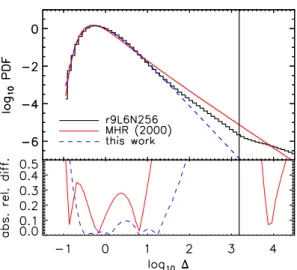
Chapter 2. The critical star formation rate density required to keep the intergalactic hy-drogen ionised depends crucially on the average rate of recombinations in the intergalactic medium (IGM). This rate is proportional to the clumping factorC ≡ hρ2
biIGM/hρbi2, whereρb andhρbi are the local and cosmic mean baryon density, respectively and the brackets hiIGM indicate spatial averaging over the recombining gas in the IGM. We perform a suite of cos-mological smoothed particle hydrodynamics simulations that include radiative cooling to cal-culate the volume-weighted clumping factor of the IGM at redshiftsz ≥ 6. We focus on the effect of ionisation heating by a uniform ultra-violet background and find that photo-heating strongly reduces the clumping factor because the increased pressure support smoothes out small-scale density fluctuations. Because the reduction of the clumping factor makes it eas-ier to keep the IGM ionised, photo-heating provides a positive feedback on reionisation. We demonstrate that this positive feedback is in fact very strong: even our most conservative es-timate for the clumping factor (C ≈ 6) is five times smaller than the clumping factor that is usually employed to determine the capacity of star-forming galaxies to keep thez = 6IGM ionised. Our results imply that the observed population of star-forming galaxies atz ≈6may be sufficient to keep the IGM ionised, provided that the IGM was reheated atz &9 and that the fraction of ionising photons that escape the star-forming regions to ionise the IGM is larger than≈0.2.
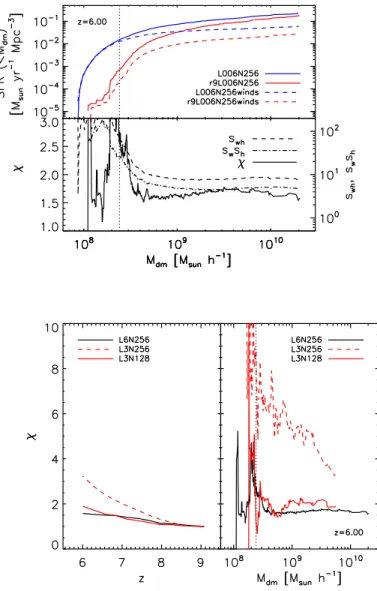
Chapter 3. Photo-heating associated with reionisation and kinetic feedback from core-collapse supernovae (SNe) have previously been shown to suppress the high-redshift cosmic star formation rate. Here we investigate the interplay between photo-heating and SN feed-back using a set of cosmological, smoothed particle hydrodynamics simulations. We show that photo-heating and SN feedback mutually amplify each other’s ability to suppress the star formation rate. Our results demonstrate the importance of the simultaneous, non-independent inclusion of these two processes in models of galaxy formation to estimate the strength of the to-tal negative feedback they exert. They may therefore be of particular relevance to semi-analytic models in which the effects of photo-heating and SN feedback are implicitly assumed to act independently of each other.
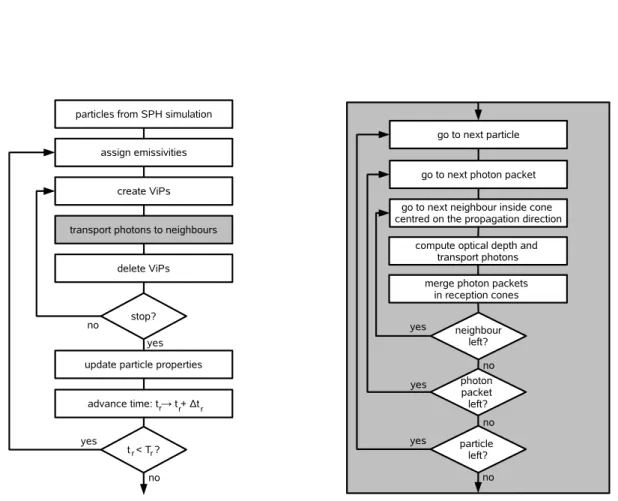
Chapter 4. We presentTRAPHIC, a novel radiative transfer scheme for Smoothed Particle
References 17
inside cones. The expensive scaling of the computation time with the number of light sources that is encountered in conventional radiative transfer schemes is avoided by introducing a source merging procedure.
Chapter 5. We present and test a parallel numerical implementation of our radiative trans-fer schemeTRAPHIC, specified for the transport of mono-chromatic hydrogen-ionising radi-ation, in the smoothed particle hydrodynamics codeGADGET-2. The tests comprise several
radiative transfer problems of increasing complexity. Some of these tests have been specifi-cally designed to investigateTRAPHIC’s ability to solve the radiative transfer problem in the large cosmological reionisation simulations that it was developed for, while others have been designed to demonstrate thatTRAPHICcan also be employed in more general contexts. The re-sults of all tests are in excellent agreement with both analytic solutions and numerical reference results obtained with state-of-the-art radiative transfer codes.
Chapter 6. Radiative transfer (RT) simulations coupled to cosmological hydrodynamical simulations are one of the most promising numerical tools to study reionisation, a key epoch in the high-redshift Universe. Current generations of RT schemes are, however, often limited for use with uniform and relatively coarse grids that imply a spatial resolution far below that of state-of-the-art spatially adaptive hydrodynamical simulations. Small-scale structure in the cosmic gas is then, at best, only statistically accounted for. Here we use the spatially adaptive RT schemeTRAPHIC(Chapter 4) to investigate the implications of this approximate approach.
We contrast RT simulations performed on spatially adaptive smoothed particle hydrodynam-ics density fields with RT simulations performed on density fields that are defined on a uni-form grid. Comparisons of the evolution of the mean ionised fraction, of the dependence of the ionised fraction on the local gas density and of power spectra of the 21 cm signal from neutral hydrogen reveal substantial differences caused by the difference in the dynamic range employed by the two types of RT simulations. Our results underpin earlier suggestions that ignoring the inhomogeneous distribution of gas on small scales, as is typically done in current RT simulations of reionisation, can give rise to misleading conclusions about the spatial distri-bution of the ionised gas and hence affect the interpretation of current and the predictions of future observations of reionisation.
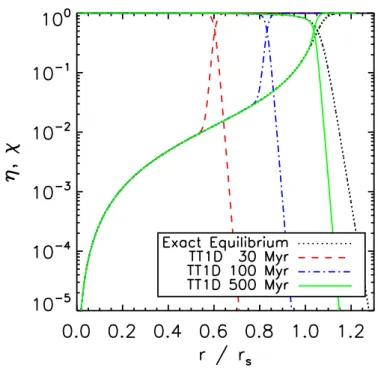
Chapter 7. The temperature of the cosmic gas is a key astrophysical observable. The detailed modelling of its evolution with cosmological hydrodynamical simulations requires the use of radiative transfer methods to accurately compute the effects of photo-ionisation and photo-heating on the relevant cooling and heating rates. We extend our implementation of TRAPHIC to compute the non-equilibrium evolution of the temperature of gas exposed to
hydrogen-ionising radiation. We verify this extension by comparingTRAPHIC’s performance in thermally coupled radiative transfer test simulations with reference solutions obtained with other radiative transfer codes.
REFERENCES
Abel T., Bryan G. L., Norman M. L., 2002, Sci, 295, 93 Agertz O., et al., 2007, MNRAS, 380, 963
Altay G., Croft R. A. C., Pelupessy I., 2008, MNRAS, 386, 1931 Aubert D., Teyssier R., 2008, MNRAS, 387, 295
Baugh C. M., 2006, RPPh, 69, 3101 Becker R. H., et al., 2001, AJ, 122, 2850
Benson A. J., Sugiyama N., Nusser A., Lacey C. G., 2006, MNRAS, 369, 1055 Berger M. J., Colella P., 1989, JCoPh, 82, 64
Bergstr ¨om L., 2000, RPPh, 63, 793
Bertone G., Hooper D., Silk J., 2004, PhR, 405, 279 Bertschinger E., 1998, ARA&A, 36, 599
Blumenthal G. R., Faber S. M., Primack J. R., Rees M. J., 1984, Natur, 311, 517 Bond J. R., Cole S., Efstathiou G., Kaiser N., 1991, ApJ, 379, 440
Booth C. M., Schaye J., 2009, arXiv, arXiv:0904.2572 Bouwens R. J., et al., 2004, ApJ, 606, L25
Bouwens R. J., Illingworth G. D., Franx M., Ford H., 2008, ApJ, 686, 230 Bromm V., Ferrara A., Coppi P. S., Larson R. B., 2001, MNRAS, 328, 969 Bromm V., Kudritzki R. P., Loeb A., 2001, ApJ, 552, 464
Bromm V., Coppi P. S., Larson R. B., 2002, ApJ, 564, 23 Bromm V., Larson R. B., 2004, ARA&A, 42, 79
Carroll S. M., Press W. H., Turner E. L., 1992, ARA&A, 30, 499 Cen R., 2002, ApJS, 141, 211
Chiu W. A., Ostriker J. P., 2000, ApJ, 534, 507
Choudhury T. R., Haehnelt M. G., Regan J., 2009, MNRAS, 394, 960 Ciardi B., Loeb A., 2000, ApJ, 540, 687
Ciardi B., Ferrara A., Marri S., Raimondo G., 2001, MNRAS, 324, 381 Ciardi B., Stoehr F., White S. D. M., 2003, MNRAS, 343, 1101
Ciardi B., Ferrara A., 2005, SSRv, 116, 625 Ciardi B., 2008, AIPC, 990, 353
Clowe D., Bradaˇc M., Gonzalez A. H., Markevitch M., Randall S. W., Jones C., Zaritsky D., 2006, ApJ, 648, L109
Dalla Vecchia C., Schaye J., 2008, MNRAS, 387, 1431
Dijkstra M., Haiman Z., Rees M. J., Weinberg D. H., 2004, ApJ, 601, 666 Dijkstra M., 2006, NewAR, 50, 204
Dolag K., Borgani S., Schindler S., Diaferio A., Bykov A. M., 2008, SSRv, 134, 229 Efstathiou G., 1992, MNRAS, 256, 43P
Fan X., Carilli C. L., Keating B., 2006, ARA&A, 44, 415
Faucher-Gigu`ere C.-A., Lidz A., Hernquist L., Zaldarriaga M., 2008, ApJ, 682, L9 Ferrara A., Salvaterra R., 2004, astro, arXiv:astro-ph/0406554
Finlator K., ¨Ozel F., Dav´e R., 2009, MNRAS, 393, 1090
Fixsen D. J., Cheng E. S., Gales J. M., Mather J. C., Shafer R. A., Wright E. L., 1996, ApJ, 473, 576 Frieman J. A., Turner M. S., Huterer D., 2008, ARA&A, 46, 385
Fukugita M., Hogan C. J., Peebles P. J. E., 1998, ApJ, 503, 518 Fukugita M., Peebles P. J. E., 2004, ApJ, 616, 643
Furlanetto S. R., Zaldarriaga M., Hernquist L., 2004, ApJ, 613, 1 Furlanetto S. R., McQuinn M., Hernquist L., 2006, MNRAS, 365, 115 Furlanetto S. R., Oh S. P., Briggs F. H., 2006, PhR, 433, 181
References 19
Glover S. C. O., Brand P. W. J. L., 2003, MNRAS, 340, 210 Gnedin N. Y., Hui L., 1998, MNRAS, 296, 44
Gnedin N. Y., Abel T., 2001, NewA, 6, 437 Gnedin N. Y., 2008, ApJ, 673, L1
Gnedin N. Y., Kravtsov A. V., Chen H.-W., 2008, ApJ, 672, 765 Gunn J. E., Peterson B. A., 1965, ApJ, 142, 1633
Gunn J. E., Gott J. R. I., 1972, ApJ, 176, 1 Guth A. H., 1981, PhRvD, 23, 347
Haiman Z., Thoul A. A., Loeb A., 1996, ApJ, 464, 523 Haiman Z., Rees M. J., Loeb A., 1996, ApJ, 467, 522 Haiman Z., Rees M. J., Loeb A., 1997, ApJ, 476, 458 Haiman Z., Abel T., Madau P., 2001, ApJ, 551, 599 Heger A., Woosley S. E., 2002, ApJ, 567, 532 Hu W., White M., 1997, NewA, 2, 323 Hu W., Dodelson S., 2002, ARA&A, 40, 171 Hui L., Haiman Z., 2003, ApJ, 596, 9
Iliev I. T., Shapiro P. R., Ferrara A., Martel H., 2002, ApJ, 572, L123 Iliev I. T., Shapiro P. R., Raga A. C., 2005b, MNRAS, 361, 405 Iliev I. T., et al., 2006, MNRAS, 371, 1057
Iliev I. T., Mellema G., Pen U.-L., Merz H., Shapiro P. R., Alvarez M. A., 2006, MNRAS, 369, 1625 Iliev I. T., Mellema G., Shapiro P. R., Pen U.-L., 2007, MNRAS, 376, 534
Iliev I. T., et al., 2009, arXiv, arXiv:0905.2920
Inoue A. K., Iwata I., Deharveng J.-M., 2006, MNRAS, 371, L1 Jackson N., 2007, LRR, 10, 4
Kaplinghat M., Chu M., Haiman Z., Holder G. P., Knox L., Skordis C., 2003, ApJ, 583, 24 Kitayama T., Ikeuchi S., 2000, ApJ, 529, 615
Kohler K., Gnedin N. Y., Hamilton A. J. S., 2007, ApJ, 657, 15
Kolb, E. W., Turner, M. S., The Early Universe, Westview Press (1990) Komatsu E., et al., 2009, ApJS, 180, 330
Lee K.-G., Cen R., Gott J. R. I., Trac H., 2008, ApJ, 675, 8
Liddle, A.;, Lyth, D., Cosmological Inflation and Large-Scale Structure. Cambridge (2000). Linde A. D., Particle Physics and Inflationary Cosmology, Harwood Academic Publishers (1990) Loeb A., Barkana R., 2001, ARA&A, 39, 19
Loeb A., 2006, astro, arXiv:astro-ph/0603360 Loeb A., 2009, JCAP, 3, 22
Lucy L. B., 1977, AJ, 82, 1013
Machacek M. E., Bryan G. L., Abel T., 2003, MNRAS, 338, 273 Madau P., Meiksin A., Rees M. J., 1997, ApJ, 475, 429
Madau P., Haardt F., Rees M. J., 1999, ApJ, 514, 648 Madau P., Rees M. J., 2001, ApJ, 551, L27
Maggiore M., Riotto A., 2009, arXiv, arXiv:0903.1249
Mapelli M., Ferrara A., Pierpaoli E., 2006, MNRAS, 369, 1719 Maselli A., Ferrara A., Ciardi B., 2003, MNRAS, 345, 379
Mellema G., Iliev I. T., Alvarez M. A., Shapiro P. R., 2006, NewA, 11, 374 Mellema G., Iliev I. T., Pen U.-L., Shapiro P. R., 2006, MNRAS, 372, 679 Meszaros P., 1974, A&A, 37, 225
Milosavljevi´c M., Bromm V., Couch S. M., Oh S. P., 2009, ApJ, 698, 766 Miralda-Escud´e J., Rees M. J., 1994, MNRAS, 266, 343
Miralda-Escud´e J., Haehnelt M., Rees M. J., 2000, ApJ, 530, 1 Monaghan J. J, 2005, Rep. Prog. Phys. 68 1703-1759
Nabler, G. L., Spacetime and Singularities: An Introduction, Cambridge University Press (1989) Nakamoto T., Umemura M., Susa H., 2001, MNRAS, 321, 593
Okamoto T., Gao L., Theuns T., 2008, MNRAS, 390, 920 Omukai K., Nishi R., 1998, ApJ, 508, 141
Osterbrock D. E., 1989, Astrophysics of gaseous nebulae and active galactic nuclei, Palgrave Macmillan Ostriker J. P., Vishniac E. T., 1986, ApJ, 306, L51
Padmanabhan T., Structure Formation in the Universe, Cambridge University Press (1993) Pawlik A. H., Schaye J., 2008, MNRAS, 389, 651
Pawlik A. H., Schaye J., van Scherpenzeel E., 2009, MNRAS, 394, 1812 Pawlik A. H., Schaye J., 2009, MNRAS, 396, L46
Peacock J. A., Dodds S. J., 1996, MNRAS, 280, L19
Peacock, J. A., Cosmological Physics, Cambridge University Press (1999)
Peebles, P. J. E., The Large-Scale Structure of the Universe, Princeton Series in Physics (1980) Peebles, P. J. E., Principles of Physical Cosmology, Princeton Series in Physics (1993)
Percival W. J., Cole S., Eisenstein D. J., Nichol R. C., Peacock J. A., Pope A. C., Szalay A. S., 2007, MNRAS, 381, 1053
Perlmutter S., et al., 1999, ApJ, 517, 565
Petkova M., Springel V., 2009, MNRAS, 396, 1383 Press W. H., Schechter P., 1974, ApJ, 187, 425 Rauch M., 1998, ARA&A, 36, 267
Razoumov A. O., Cardall C. Y., 2005, MNRAS, 362, 1413 Razoumov A. O., Sommer-Larsen J., 2006, ApJ, 651, L89 Rees M. J., Ostriker J. P., 1977,MNRAS, 179, 541
Rees M. J., 1986, MNRAS, 222, 27P
Ricotti M., Gnedin N. Y., Shull J. M., 2002, ApJ, 575, 49 Riess A. G., et al., 1998, AJ, 116, 1009
Riess A. G., et al., 2009, arXiv, arXiv:0905.0697 Ritzerveld J., 2005, A&A, 439, L23
Ritzerveld J., Icke V., 2006, PhRvE, 74, 026704 Salvaterra R., et al., 2009, arXiv, arXiv:0906.1578
Santos M. G., Cooray A., Haiman Z., Knox L., Ma C.-P., 2003, ApJ, 598, 756 Sawicki M., Thompson D., 2006, ApJ, 648, 299
Scannapieco C., Tissera P. B., White S. D. M., Springel V., 2006, MNRAS, 371, 1125 Schaerer D., 2002, A&A, 382, 28
Schneider R., Ferrara A., Natarajan P., Omukai K., 2002, ApJ, 571, 30 Scott D., Rees M. J., 1990, MNRAS, 247, 510
References 21
Shapiro P. R., Giroux M. L., Babul A., 1994, ApJ, 427, 25 Shapiro P. R., Iliev I. T., Raga A. C., 2004, MNRAS, 348, 753 Sheth R. K., Mo H. J., Tormen G., 2001, MNRAS, 323, 1 Silk J., 1977, ApJ, 211, 638
Srbinovsky J. A., Wyithe J. S. B., 2007, MNRAS, 374, 627
Stanway E. R., Bunker A. J., McMahon R. G., 2003, MNRAS, 342, 439 Sunyaev R. A., Chluba J., 2008, ASPC, 395, 35
Sunyaev R. A., Zeldovich I. B., 1980, MNRAS, 190, 413 Susa H., Umemura M., 2004, ApJ, 600, 1
Susa H., 2006, PASJ, 58, 445
Tassis K., Abel T., Bryan G. L., Norman M. L., 2003, ApJ, 587, 13 Tegmark M., Silk J., Evrard A., 1993, ApJ, 417, 54
Tegmark M., Silk J., Rees M. J., Blanchard A., Abel T., Palla F., 1997, ApJ, 474, 1 Thoul A. A., Weinberg D. H., 1996, ApJ, 465, 608
Tittley E. R., Meiksin A., 2007, MNRAS, 380, 1369 Trac H., Cen R., 2007, ApJ, 671, 1
Trimble V., 1987, ARA&A, 25, 425
Tytler D., O’Meara J. M., Suzuki N., Lubin D., 2000, PhST, 85, 12 Valageas P., Silk J., 1999, A&A, 347, 1
Vishniac E. T., 1987, ApJ, 322, 597
Volonteri M., Rees M. J., 2005, ApJ, 633, 624
Volonteri M., Gnedin N., 2009, arXiv, arXiv:0905.0144
Wald, R. M., General Relativity, The University of Chicago Press (1984) Whalen D., van Veelen B., O’Shea B. W., Norman M. L., 2008, ApJ, 682, 49 White S. D. M., Rees M. J., 1978, MNRAS, 183, 341
White S. D. M., Frenk C. S., 1991, ApJ, 379, 52
Wiersma R. P. C., Schaye J., Smith B. D., 2009, MNRAS, 393, 99 Wise J. H., Abel T., 2005, ApJ, 629, 615
Wise J. H., Cen R., 2009, ApJ, 693, 984
Woosley S. E., Heger A., Weaver T. A., 2002, RvMP, 74, 1015 Yepes G., 1997, ASPC, 126, 279
![Table 2.5: Parameter values ζ z r and τ z r to be used in Eq. 2.8 in order to fit the evolution of the clumping factors C 1000 , C 500 , C 200 , C 100 and C 50 obtained from the simulations r[z r ]L6N256 (see also Fig](https://thumb-us.123doks.com/thumbv2/123dok_us/8304093.2199344/57.892.172.767.958.1103/table-parameter-values-evolution-clumping-factors-obtained-simulations.webp)