Autism Spectrum Disorder Among US Children
(2002
–
2010): Socioeconomic, Racial, and Ethnic
Disparities
Maureen S. Durkin, PhD, DrPH, MPH, Matthew J. Maenner, PhD, Jon Baio, EdS, Deborah Christensen, PhD, Julie Daniels, PhD, Robert Fitzgerald, PhD, Pamela Imm, MS, Li-Ching Lee, PhD, Laura A. Schieve, PhD, Kim Van Naarden Braun, PhD, Martha S. Wingate, DrPH, and Marshalyn Yeargin-Allsopp, MD
Objectives.To describe the association between indicators of socioeconomic status (SES) and the prevalence of autism spectrum disorder (ASD) in the United States during the period 2002 to 2010, when overall ASD prevalence among children more than doubled, and to determine whether SES disparities account for ongoing racial and ethnic disparities in ASD prevalence.
Methods. We computed ASD prevalence and 95% confidence intervals (CIs) from population-based surveillance, census, and survey data. We defined SES categories by using area-level education, income, and poverty indicators. We ascertained ASD in 13 396 of 1 308 641 8-year-old children under surveillance.
Results.The prevalence of ASD increased with increasing SES during each surveillance year among White, Black, and Hispanic children. The prevalence difference between high-and low-SES groups was relatively constant over time (3.9/1000 [95% CI = 3.3, 4.5] in 2002 and 4.1/1000 [95% CI = 3.6, 4.6] in the period 2006–2010). Significant racial/ethnic differences in ASD prevalence remained after stratification by SES.
Conclusions.A positive SES gradient in ASD prevalence according to US surveillance data prevailed between 2002 and 2010, and racial and ethnic disparities in prevalence persisted during this time among low-SES children. (Am J Public Health.2017;107:1818– 1826. doi:10.2105/AJPH.2017.304032)
See also Newschaffer, p. 1698.
P
opulation-based studies of thepreva-lence of autism spectrum disorder (ASD) in the United States have reported notable differences among selected racial and ethnic groups, with prevalence generally found to be higher among non-Hispanic White children relative to both non-Hispanic Black and Hispanic children.1–7Studies in the United States8–10and in some,11,12but not other,13,14 countries have also found a positive socio-economic status (SES) gradient in ASD prevalence, with prevalence increasing with indicators of increasing socioeconomic ad-vantage. For example, in a previous analysis of public health surveillance data for children in communities included in the Centers for Disease Control and Prevention’s Autism and Developmental Disabilities Monitoring (ADDM) Network in 2002 and 2004, we
found a dose–response association between SES and ASD prevalence, and a prevalence nearly 70% higher among children in the highest relative to the lowest SES tertile of the population (prevalence ratio = 1.69; 95% confidence interval [CI] = 1.55, 1.83).10
The SESfindings for ASD stand in sharp contrast to those for intellectual disability and childhood disabilities generally, which con-sistently show an excess prevalence among children of low SES.15Taken together, the US
findings of racial/ethnic and socioeconomic variation in prevalence suggest potential underascertainment of ASD in economically disadvantaged groups, and raise the question of whether the ongoing racial and ethnic dispar-ities in ASD prevalence are confounded by SES. Since our earlier analysis of SES disparities in ASD prevalence based on ADDM Net-workfindings,10the estimated prevalence of ASD overall has more than doubled, from 6.6 per 1000 8-year-old children in 200216 to 14.7 in 2010.1Whether the increase in prevalence occurred across all SES strata is not known. If the increase occurred dispropor-tionally among children of low SES, perhaps because of expanded screening and improved access to ASD diagnostic and treatment ser-vices over time, we would expect to see a diminution of the SES gradient in ASD prevalence. The present study analyzed ADDM Network data for the period 2002 to 2010 to address 2 main questions: (1) Did the SES gradient in ASD prevalence persist in each surveillance year from 2002 through
ABOUT THE AUTHORS
Maureen S. Durkin is with the Department of Population Health Sciences of the University of Wisconsin School of Medicine and Public Health and the Waisman Center of the University of Wisconsin–Madison. Matthew J. Maenner, Jon Baio, Deborah Christensen, Laura A. Schieve, Kim Van Naarden Braun, and Marshalyn Yeargin-Allsopp are with the National Center on Birth Defects and Developmental Disabilities, Centers for Disease Control and Prevention, Atlanta, GA. Julie Daniels is with the Department of Epidemiology, University of North Carolina Gillings School of Global Public Health, Chapel Hill. Robert Fitzgerald is with the Department of Psychiatry, Washington University, St Louis, MO. Pamela Imm is with the Waisman Center of the University of Wisconsin–Madison. Li-Ching Lee is with the Department of Epidemiology, Johns Hopkins Bloomberg School of Public Health, Baltimore, MD. Martha S. Wingate is with the Department of Health Care Organization and Policy, University of Alabama at Birmingham School of Public Health.
Correspondence should be sent to Maureen S. Durkin, PhD, DrPH, Department of Population Health Sciences, University of Wisconsin School of Medicine and Public Health, 789 WARF, 610 Walnut St, Madison, WI 53726 (e-mail: maureen.durkin@ wisc.edu). Reprints can be ordered at http://www.ajph.org by clicking the“Reprints”link.
2010? and (2) Were the racial and ethnic differences in ASD prevalence that have been previously documented present within SES strata throughout the period? An affirmative answer to the second question would sug-gest that racial and ethnic disparities in ASD prevalence are not readily explained by racial/ethnic disparities in available indicators of SES.
Additional questions we sought to answer were whether a positive SES gradient was present over time among subgroups defined by race, ethnicity, sex, and co-occurrence of intellectual disability, and among ASD cases ascertained from different sources (health care, school, and both health care and school). In our previous study,10we had hypothesized that a positive SES gradient would not be found among cases ascertained from school sources because special education services for autism should be accessible to all school-aged children with ASD in the United States, whereas specialized health and autism therapeutic services are not universally available and accessible. However, in our previous study, based on sur-veillance years 2002 and 2004, we found the SES gradient to be similar for cases identified through health care and school sources.10
METHODS
We performed stratified analyses of population-based, cross-sectional surveillance data from the ADDM Network and the US Census and American Community Survey (ACS) to determine the prevalence of ASD among 8-year-old children by SES strata in 4 surveillance years: 2002, 2006, 2008, and 2010, the latest year for which geocoded surveillance data were available.
Autism and Developmental
Disabilities Monitoring Network
The ADDM Network was established by the Centers for Disease Control and Pre-vention in 2000 as a population-based sur-veillance program at diverse geographic locations in the United States. It incorporates abstracted data from records of multiple ed-ucational and health care sources to determine the number of 8-year-old children who are determined to meet the ASD case definition, regardless of preexisting diagnoses. The
ADDM Network clinician reviewers de-termine whether the ASD case definition is met by reviewing a composite record of all relevant abstracted data for a given child.
Autism spectrum disorder refers to a group of neurodevelopmental disorders involving impairments in social communication and interaction, as well as the presence of re-petitive or stereotyped behaviors.17,18In the ADDM Network surveillance database for 2002 to 2010, which preceded the publica-tion ofDiagnostic and Statistical Manual of Mental Disorders, Fifth Edition,18children with ASD included those who were 8 years of age, resided in the surveillance areas during sur-veillance years, and metDiagnostic and Statistical Manual of Mental Disorders, Fourth Edition–Text Revision(DSM-IV-TR)17diagnostic criteria for autistic disorder, Asperger’s syndrome, or a pervasive developmental disorder not otherwise specified. Trained abstractors systematically reviewed health and educational records of children with a documented developmental delay or concern, regardless of the presence of a documented ASD classification. Children’s records were reviewed by experienced clinicians who appliedDSM-IV-TRcriteria to classify ASD. Further details regarding the ADDM Network methodology have been reported previously.1,16,19,20
Study Sample
This study was restricted to sites partici-pating in the ADDM Network for surveil-lance years 2002, 2006, 2008, and 2010 that contributed geocoded data allowing classifi -cation of ASD cases by census indicators of SES. The included sites were located in 11 states: Alabama, Arizona, Arkansas, Colorado, Georgia, Maryland, Missouri, New Jersey, North Carolina, Utah, and Wisconsin.1,16Of the 11 sites, 8 participated in all 4 surveillance years and all participated in at least 3 of the surveillance years included in this report. A total of 13 396 8-year-old children with ASD were ascertained at the participating sites across the 4 surveillance years. Of the 13 396 children with ASD, 10 172 (75.9%) had a previous ASD diagnosis. Information from standardized intelligence tests was available for 77.7% of the children with ASD. On the basis of this information, children with ASD were classified as having co-occurring in-tellectual disability if their IQ was 70 or less.
The population denominator comprised all 8-year-old children residing in census tracts within the respective study areas and sur-veillance years according to US Census and National Center for Health Statistics bridged-race decennial and intercensal pop-ulation estimates for 2002 to 2010. Across the 4 surveillance years, a total of 1 308 641 8-year-old children were under surveillance. Characteristics of this population are shown in Table 1.
Socioeconomic Status Indicators
and Computation of Prevalence
Although intercensal and 2010 US Census data provide population counts, they do not include socioeconomic information at the census tract level. To obtain census tract– level SES indicators, for surveillance year 2002, we used 2000 Census data, and for surveillance years 2006, 2008, and 2010, we used 2006–2010 ACS data. To allow as-sessment of the comparability of SES in-dicators based on 2000 Census data and 2006–2010 ACS data, for the 2006 sur-veillance year we computed SES indicators based on 2000 Census data in addition to 2006–2010 ACS data.
To confirm the robustness of thefindings across SES indicators, we computed separate SES tertiles on the basis of median household income. The results of analyses using these tertiles were similar to those based on edu-cational attainment and are not included in this report. We also created a dichotomous variable indicating census tracts that meet
the US Census definition of“poverty area,” defined as those in which at least 20% of children lived in households with incomes below the federal poverty line.21Although by design, with the use of tertile cut-offs, the proportion of children in the surveillance areas who were classified as low, middle, and high SES was approximately equal within
each surveillance year, the proportion clas-sified as living in poverty areas increased over time, from 22.4% in 2002 for which 2000 Census data were used to 36.0% in the later 3 surveillance years based on data from the 2006–2010 ACS (Table 1). This increase is indicative of the population impact of the 2008–2009 economic recession.28
TABLE 1—Distribution of the Population of 8-Year-Old Children in the Surveillance Areas, by Period and Percentage Living in Poverty Areas: United States, 2002–2010
Surveillance Year 2002 Surveillance Years 2006, 2008, and 2010 Total
Population Strata No. (%) % in Poverty Area No. (%) % in Poverty Area No. (%) % in Poverty Area
Total 379 459 (100) 22.4 929 182 (100) 36.0 1 308 641 (100) 32.0
Sex
Male 194 407 (51.2) 23.7 474 168 (51.0) 36.0 668 575 (51.1) 32.4
Female 185 052 (48.8) 24.1 455 014 (49.0) 36.0 640 066 (48.9) 32.6
Race/ethnicity
Non-Hispanic White 226 134 (59.6) 9.6 503 812 (54.2) 20.8 729 946 (55.8) 17.3 Non-Hispanic Black 81 402 (21.5) 50.3 185 648 (19.9) 60.2 267 050 (20.4) 57.2 Hispanic 49 696 (13.1) 36.1 166 898 (18.0) 57.5 216 594 (16.6) 48.8
Other 22 227 (5.8) 19.4 72 824 (7.9) 30.8 95 051 (7.2) 28.1
Site
Alabama 37 495 (9.9) 28.8 93 778 (10.1) 46.5 131 274 (10.0) 41.7
Arizona 42 618 (11.2) 23.4 106 768 (11.5) 41.1 149 386 (11.4) 36.1
Arkansas 39 157 (10.3) 37.9 44 136 (4.7) 59.4 83 293 (6.4) 49.3
Colorado 35 848 (9.4) 11.6 114 375 (12.3) 33.2 150 223 (11.5) 28.1
Georgia 45 501 (12.0) 16.2 140 906 (15.2) 40.3 186 407 (14.3) 36.3
Maryland 31 830 (8.4) 21.6 81 923 (8.8) 11.6 113 753 (8.7) 14.4
Missouri 29 186 (7.7) 20.3 78 981 (8.5) 29.3 108 167 (8.3) 26.9
New Jersey 30 807 (8.1) 32.4 38 806 (4.2) 37.6 69 613 (5.3) 35.3
North Carolina 21 691 (5.7) 20.6 96 293 (10.4) 38.3 117 984 (9.0) 35.1
Utah 27 921 (7.4) 6.9 26 092 (2.8) 21.3 54 012 (4.1) 13.9
Wisconsin 37 405 (9.9) 22.1 107 124 (11.5) 34.0 144 529 (11.0) 30.9
Low EA, totala 125 937 (100) 50.1 308 572 (100) 69.7 434 509 (100) 64.0
Non-Hispanic White 56 037 (44.5) 26.5 121 503 (39.4) 51.3 177 540 (40.9) 43.5 Non-Hispanic Black 48 492 (32.2) 77.1 85 247 (27.6) 86.0 125 739 (28.9) 83.1
Hispanic 23 318 (18.5) 59.3 84 337 (27.3) 79.3 107 655 (24.9) 75.0
Middle EA, totala 126 997 (100) 14.4 311 721 (100) 29.7 438 718 (100) 25.3 Non-Hispanic White 75 889 (59.8) 7.2 167 442 (53.7) 18.0 243 331 (55.5) 14.6 Non-Hispanic Black 27 202 (21.4) 30.7 67 997 (21.8) 46.6 68 269 (15.6) 40.3
Hispanic 16 614 (13.1) 20.0 53 824 (17.3) 44.3 70 438 (16.1) 38.6
High EA, totala 126 402 (100) 2.8 308 455 (100) 8.7 434 857 (100) 7.0
Non-Hispanic White 94 126 (74.5) 1.5 214 530 (69.6) 5.7 308 656 (71.0) 4.4 Non-Hispanic Black 13 241 (10.5) 7.6 32 352 (10.5) 20.6 45 593 (10.5) 16.8
Hispanic 9 729 (7.7) 8.2 28 706 (9.3) 17.9 38 435 (8.8) 15.5
Note.EA = educational attainment. Poverty areas include census tracts where at least 20% of people have incomes below the poverty level, US Census Bureau.21,22
Source. Population data sources: US Census Bureau,23Centers for Disease Control and Prevention,24US Census Bureau.25, 26
aEducational attainment socioeconomic status tertiles based on percentage of adults aged 25 years or older with a bachelor’s degree or higher per census tract,
For children with ASD, we assigned values for SES indicator tertiles and poverty area residence based on their census tract of residence at age 8 years, similar to the approach described by Krieger et al.29
Statistical Analysis
We computed the SES-specific prevalence of ASD per 1000 by dividing the number of children with ASD in each SES category and study year by the general population of 8-year-old children in the same category and study year. We computed 95% confidence intervals (CIs) based on the B distribution, by using SPSS version 22 (IBM, Somers, NY). We examined associations between SES in-dicators and ASD prevalence after stratifying by site, and found the results were generally in the same direction each study year in all sites. The results presented here are pooled across sites within surveillance years or sets of sur-veillance years. To evaluate the association between ASD prevalence and both SES in-dicators and race/ethnicity, we computed prevalence ratios with 95% CIs. To evaluate
whether the associations between educational attainment tertiles and ASD varied by race or ethnicity, sex, and other characteristics, we evaluated the educational attainment– ASD association after stratifying by these characteristics. We also computed preva-lence differences with 95% CIs to estimate the differences in ASD prevalence between high and low educational attainment tertiles.
RESULTS
Among children overall, ASD prevalence rose over time in each educational attainment tertile of the population. In each surveillance year, prevalence was lowest in the low edu-cational attainment tertile and highest in the high educational attainment tertile, consistent with a dose–response association between census tract educational attainment and ASD prevalence (Figure 1). A positive gradient in ASD prevalence by educational attainment categories was also seen in each surveillance
year within each racial/ethnic group exam-ined (Table 2).
Among children overall and among non-Hispanic children (both White and Black), the ratio of ASD prevalence in high versus low educational attainment tertiles appeared to decrease over time as the prev-alence increased. For example, in 2002, when the overall ASD prevalence was 6.2 per 1000, the high to low educational attainment prevalence ratio was 1.99 (95% CI = 1.78, 2.21). In the 2006-to-2010 period, when the prevalence had increased to 11.9 per 1000, the high-to low-prevalence ratio was 1.44 (95% CI = 1.37, 1.51). Among Hispanic children, ASD prevalence increased over time, from 3.9 per 1000 in 2002 to 8.0 in the later period, while the high to low educational attainment prevalence ratios did not decrease (1.28 [95% CI = 0.87, 1.88] in 2002 and 1.35 [95% CI = 1.17, 1.56] in 2006–2010; Table 2).
In contrast to the prevalence ratios, ASD prevalence differences between high and low educational attainment tertiles showed no decrease over time among children overall (Figure 1 and Table 2) or among non-Hispanic Black children or non-Hispanic children (Table 2). Among non-Hispanic White children, the prevalence differences between high and low educational attainment tertiles narrowed from 3.7 per 1000 (95% CI = 2.9, 4.5) in 2002 to 2.4 per 1000 (95% CI = 1.7, 3.2) in 2006 to 2010 (Table 2).
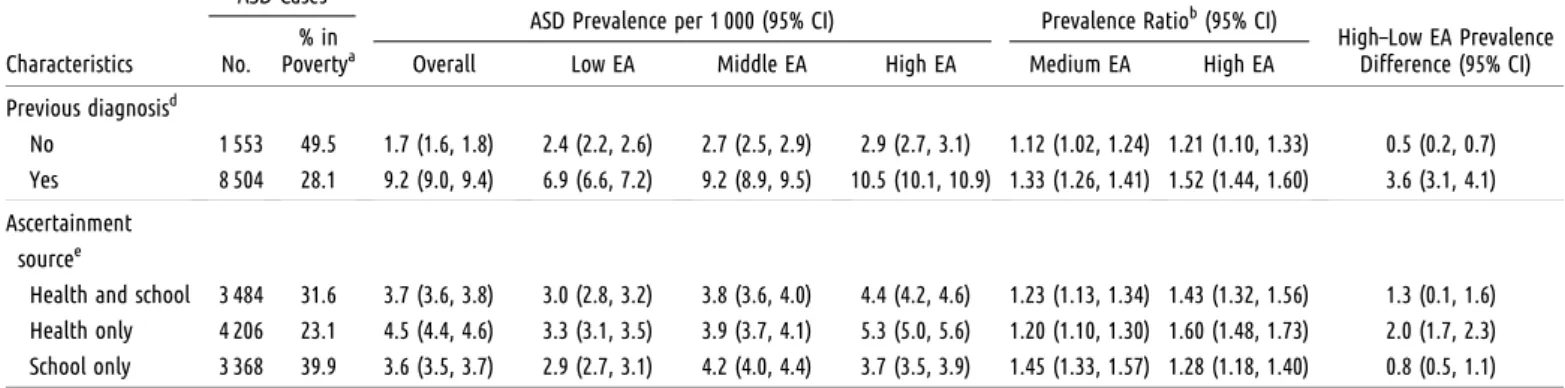
Additional stratified results in Table 2 show that the educational attainment gradient in ASD prevalence was present among both boys and girls, among children without co-occurring intellectual disability, and among ASD cases ascertained from health care or both school and health care records. Among cases ascertained only from school records, ASD prevalence was lowest among children in the lowest educational attainment tertile during both periods, but the educa-tional attainment gradient was present only in the earlier period (Table 2).
Evidence of the educational attainment gradient was present among children meeting surveillance criteria for ASD who had a pre-vious ASD diagnosis or determination in their records, and among those with no previous ASD diagnosis, though in both periods the gradient was steeper for children with a pre-vious ASD diagnosis (Table 2).
15
10
5
0
5
0
2004
2002 2006 2008 2010
2004
2002 2006 2008 2010
EA level High Medium Low
ACS SF3 Census data source
P
revalenc
e/1000
P
revalenc
e/1000
a
b
Year
Year
Note.95% confidence intervals provided around the point estimates. Educational attainment tertiles based on percentage of adults aged‡25 years with a bachelor’s degree or higher per census tract, based on 2000 Census data for surveillance year 2002, and on 2006–2010 ACS data for surveillance years 2006, 2008, and 2010.
Source.Based on 2000 US Census data (SF3) for surveillance years 2002 and 2006, and on 2006–2010 American Community Survey (ACS) data for surveillance years 2006, 2008, and 2010.
TABLE 2—Autism Spectrum Disorder Prevalence and Prevalence Ratios and Differences by Educational Attainment Tertiles and Surveillance Period, Overall and Stratified by Sociodemographic Characteristics: United States, 2002–2010
ASD Cases
ASD Prevalence per 1 000 (95% CI) Prevalence Ratiob(95% CI)
Characteristics No. % in
Povertya Overall Low EA Middle EA High EA Medium EA High EA HighDifference (95% CI)–Low EA Prevalence
2002 surveillance year
Overall 2 338 19.0 6.2 (6.0, 6.5) 3.9 (3.6, 4.3) 6.2 (5.8, 6.7) 7.9 (7.4, 8.4) 1.58 (1.41, 1.77) 1.99 (1.78, 2.21) 3.9 (3.3, 4.5)
Race/ethnicity Non-Hispanic
White
1 522 10.0 6.7 (6.4, 7.0) 4.3 (3.8, 4.9) 6.5 (5.9, 7.1) 8.0 (7.4, 8.6) 1.51 (1.30, 1.76) 1.86 (1.61, 2.15) 3.7 (2.9, 4.5)
Non-Hispanic Black
476 42.6 5.9 (5.4, 6.5) 4.2 (3.6, 4.9) 6.7 (5.8, 7.8) 8.9 (7.4, 10.7) 1.59 (1.29, 1.96) 2.11 (1.67, 2.66) 4.6 (3.0, 6.5)
Hispanic 192 36.5 3.9 (3.4, 4.5) 3.2 (2.5, 4.0) 4.0 (3.1, 5.1) 4.1 (3.0, 5.6) 1.25 (0.90, 1.74) 1.28 (0.87, 1.88) 0.9 (–0.5, 2.5)
Sex
Boys 1 910 18.4 9.8 (9.4, 10.3) 6.2 (5.6, 6.8) 10.0 (9.3, 10.8) 12.5 (11.7, 13.4) 1.62 (1.43, 1.86) 2.03 (1.80, 2.29) 6.3 (5.3, 7.4) Girls 428 21.7 2.3 (2.1, 2.5) 1.6 (1.3, 2.0) 2.3 (1.8, 2.7) 2.9 (2.5, 3.4) 1.41 (1.09, 1.82) 1.79 (1.41, 2.29) 1.3 (0.8, 1.8)
Co-occurring intellectual disabilityc
Present 749 25.4 2.0 (1.9, 2.1) 1.6 (1.4, 1.8) 2.2 (2.0, 2.5) 2.1 (1.9, 2.3) 1.42 (1.19, 1.71) 1.25 (1.03, 1.51) 0.4 (0.1, 0.7) Absent 1 031 13.9 2.7 (2.5, 2.9) 1.4 (1.2, 1.6) 2.6 (2.3, 2.9) 4.1 (3.8, 4.5) 1.87 (1.55, 2.24) 2.90 (2.44, 3.44) 2.6 (2.2, 3.0) Unknown 558 20.1 1.5 (1.4, 1.6) 1.0 (0.8, 1.2) 1.4 (1.2, 1.6) 1.9 (1.7, 2.2) 1.45 (1.15, 1.82) 1.89 (1.52, 2.34) 0.9 (0.6, 1.2)
Previous diagnosisd
No 671 22.8 1.8 (1.7, 1.9) 1.4 (1.2, 1.6) 1.7 (1.5, 1.9) 2.0 (1.8, 2.3) 1.21 (0.99, 1.47) 1.42 (1.18, 1.72) 0.6 (0.3, 0.9) Yes 1 667 17.5 4.4 (4.2, 4.6) 2.5 (2.2, 2.8) 4.5 (4.1, 4.9) 5.9 (5.5, 6.3) 1.79 (1.56, 2.06) 2.30 (2.02, 2.63) 3.3 (2.8, 4.8)
Ascertainment sourcee
Health and school 763 18.1 2.0 (1.9, 2.1) 1.4 (1.2, 1.6) 1.9 (1.7, 2.2) 2.7 (2.4, 3.0) 1.40 (1.16, 1.71) 2.00 (1.66, 2.40) 1.3 (0.9, 1.6) Health only 793 19.0 2.1 (2.0, 2.3) 1.4 (1.2, 1.6) 2.0 (1.8, 2.3) 2.6 (2.3, 2.9) 1.42 (1.17, 1.73) 1.85 (1.54, 2.22) 1.2 (0.8, 1.5) School only 782 20.0 2.21(2.0, 2.3) 1.2 (1.0, 1.4) 2.4 (2.1, 2.7) 2.6 (2.3, 2.9) 1.97 (1.62, 2.40) 2.14 (1.77, 2.60) 1.4 (1.0, 1.7)
2006, 2008, and 2010 surveillance years combined
Overall 11 058 28.6 11.9 (11.7, 12.1) 9.3 (9.0, 9.8) 11.6 (11.2, 12.0) 13.4 (13.0, 13.8) 1.25 (1.19, 1.31) 1.44 (1.37, 1.51) 4.1 (3.6, 4.6)
Race/ethnicity Non-Hispanic
White
6 660 18.8 13.2 (12.9, 13.5) 11.1 (10.5, 11.7) 12.9 (12.4, 13.5) 13.5 (13.0, 14.0) 1.17 (1.09, 1.25) 1.22 (1.15, 1.30) 2.4 (1.7, 3.2)
Non-Hispanic Black
2 055 49.6 11.1 (10.6, 11.6) 9.0 (8.4, 9.7) 11.8 (11.0, 12.6) 14.3 (13.0, 15.7) 1.30 (1.18, 1.44) 1.58 (1.41, 1.77) 5.3 (3.8, 6.8)
Hispanic 1 341 49.6 8.0 (7.6, 8.4) 6.9 (6.4, 7.5) 7.9 (7.2, 8.7) 9.3 (8.2, 10.5) 1.15 (1.02, 1.30) 1.35 (1.17, 1.56) 2.4 (1.2, 3.9)
Sex
Boys 9 123 28.4 19.2 (18.8, 19.6) 14.8 (14.2, 15.4) 19.2 (18.5, 19.9) 21.8 (21.1, 22.5) 1.30 (1.24, 1.37) 1.48 (1.40, 1.56) 7.0 (6.1, 8.0) Girls 1 935 29.9 4.3 (4.1, 4.5) 3.5 (3.2, 3.8) 4.3 (4.0, 4.6) 4.7 (4.4, 5.1) 1.22 (1.09, 1.37) 1.33 (1.19, 1.49) 1.2 (0.7, 1.6)
Co-occurring intellectual disabilityc
Present 2 923 38.1 3.1 (3.0, 3.2) 3.1 (2.9, 3.3) 3.3 (3.1, 3.5) 2.8 (2.6, 3.0) 1.06 (0.97, 1.15) 0.88 (0.81, 0.97) –0.4 (–0.6,–0.2) Absent 5 711 25.2 6.1 (5.9, 6.3) 4.1 (3.9, 4.3) 6.0 (5.7, 6.3) 7.7 (7.4, 8.0) 1.46 (1.36, 1.57) 1.87 (1.74, 2.00) 3.6 (3.2, 4.0) Unknown 2 424 25.2 2.6 (2.5, 2.7) 2.0 (1.8, 2.2) 2.5 (2.3, 2.7) 2.9 (2.7, 3.1) 1.25 (1.12, 1.38) 1.42 (1.28, 1.57) 0.8 (0.6, 1.1)
The educational attainment–ASD preva-lence gradient was absent in both periods in 1 subgroup of children with ASD—namely, those with co-occurring intellectual disability. In the earlier period, the prevalence of co-occurring ASD and intellectual disability was lowest among children in low educational attainment tertile and highest among those in the middle educational attainment tertile. In the later period, the prevalence of co-occurring ASD and intellectual disability was lowest in the high educational attainment tertile (Table 2).
The results in Table 2 also show that in both periods, children with ASD and co-occurring intellectual disability and those with no previous ASD diagnosis were more likely to live in poverty areas than were those without intellectual disability and those with a previous ASD diagnosis, respectively. In addition, the percentage of children with ASD living in poverty areas varied sub-stantially by race and ethnicity (Table 2). Overall, in both periods, children with ASD were less likely to live in poverty areas than were all 8-year-old children in the surveil-lance areas. In 2002, 19.0% of ASD cases (Table 2) and 22.4% of the children in the surveillance areas overall lived in poverty areas (Table 1). For the 2006 to 2010 surveillance years combined, 28.6% of ASD cases (Table 2) and 36.0% of the children in the surveillance areas overall lived in poverty areas (Table 1).
The prevalence ratios in Table 3 are pre-sented to allow evaluation of the extent to which racial and ethnic disparities in ASD prevalence are explained by the association between SES and ASD prevalence, by using 2 indicators of SES–educational attainment and residence in poverty areas. The prevalence ratios for non-Hispanic White relative to non-Hispanic Black children were elevated in both periods before stratification by SES in-dicators, but not consistently so after
strati-fication. In the low educational attainment tertile, the White–Black prevalence ratio was elevated only in the latter period whereas in poverty areas this ratio was elevated in both periods. In contrast, in the high educational attainment tertile and among children not residing in poverty areas, there was no racial disparity in ASD prevalence in either period (Table 3). The prevalence ratios comparing ASD prevalence in non-Hispanic White to Hispanic children were significantly elevated during both periods, both overall and within each SES stratum.
DISCUSSION
These results confirm, on the basis of ADDM Network data and using educational attainment or poverty as indicators of SES, that a positive SES gradient in ASD
prevalence was present over time between 2002 and 2010. Although the ratio indicating the relative prevalence in high- compared with low-SES children decreased over this time as overall prevalence more than doubled, the ASD prevalence difference between high and low SES was relatively constant, showing no evidence of convergence over time.
The results also show that the rise in ASD prevalence between 2002 and 2010 was similar in absolute terms in all 3 SES groups—low, middle, and high educational attainment—with an absolute change in prevalence between 2002 and 2010 of approximately 8 per 1000 children in each group (Figure 1). Thisfinding along with the persistent SES disparity in prevalence is consistent with a recent National Academies of Science, Engineering, and Medicine study that found steady increases in ASD prevalence among children in poverty and receiving Supplemental Security Income and Medicaid between 2000 and 2012, but also found that even after the increase, the proportion of children in poverty receiving services or sup-plementary income because of ASD was lower than the proportion expected on the basis of estimates of the prevalence of ASD in the general population.30
The persistence of SES disparities in ASD prevalence in the United States has important public health implications. Early clinical TABLE 2—Continued
ASD Cases
ASD Prevalence per 1 000 (95% CI) Prevalence Ratiob(95% CI)
Characteristics No. % in
Povertya Overall Low EA Middle EA High EA Medium EA High EA HighDifference (95% CI)–Low EA Prevalence
Previous diagnosisd
No 1 553 49.5 1.7 (1.6, 1.8) 2.4 (2.2, 2.6) 2.7 (2.5, 2.9) 2.9 (2.7, 3.1) 1.12 (1.02, 1.24) 1.21 (1.10, 1.33) 0.5 (0.2, 0.7) Yes 8 504 28.1 9.2 (9.0, 9.4) 6.9 (6.6, 7.2) 9.2 (8.9, 9.5) 10.5 (10.1, 10.9) 1.33 (1.26, 1.41) 1.52 (1.44, 1.60) 3.6 (3.1, 4.1)
Ascertainment sourcee
Health and school 3 484 31.6 3.7 (3.6, 3.8) 3.0 (2.8, 3.2) 3.8 (3.6, 4.0) 4.4 (4.2, 4.6) 1.23 (1.13, 1.34) 1.43 (1.32, 1.56) 1.3 (0.1, 1.6) Health only 4 206 23.1 4.5 (4.4, 4.6) 3.3 (3.1, 3.5) 3.9 (3.7, 4.1) 5.3 (5.0, 5.6) 1.20 (1.10, 1.30) 1.60 (1.48, 1.73) 2.0 (1.7, 2.3) School only 3 368 39.9 3.6 (3.5, 3.7) 2.9 (2.7, 3.1) 4.2 (4.0, 4.4) 3.7 (3.5, 3.9) 1.45 (1.33, 1.57) 1.28 (1.18, 1.40) 0.8 (0.5, 1.1)
Note.ASD = autism spectrum disorder; CI = confidence interval; EA = educational attainment (indicator of socioeconomic status [SES], tertiles based on percentage of adults aged 25 or older with a bachelor’s degree or higher per census tract, based on 2000 Census data for surveillance year 2002, and on 2006–2010 American Community Survey data for surveillance years 2006, 2008 and 2010).
a% in poverty refers to residence in census tracts where at least 20% of people have incomes below the poverty level: US Census Bureau.21,22
bReference = low EA.
cCo-occurring intellectual disability considered present if IQ£70.
dPrevious autism diagnosis documented in health or educational records.
descriptions of autism suggested that it was a disorder seen primarily among children of highly educated and accomplished parents,31 and a number of epidemiological studies have found positive associations between SES and autism prevalence.8–12,32,33However, as early as 1980, Lorna Wing argued that studies based on data for children receiving clinical diag-noses and services for autism were affected by biased case ascertainment, and that even in the United Kingdom, where access to health and educational services was universal, relatively high levels of parental education and re-sources were necessary to ensure that a child with autism was able to get an accurate di-agnosis.34Recent large, epidemiological studies in Sweden13and France14that were designed to evaluate the association between SES and ASD found no evidence of a positive SES gradient in ASD prevalence. Both studies concluded that in countries with universal access and no economic barriers to obtaining
autism diagnoses and services, ASD is not found to be associated with socioeconomic advantage and may be associated with so-cioeconomic disadvantage.13
Limitations and Other
Considerations
A limitation of the present study is that the surveillance data were available only for children receiving comprehensive develop-mental assessments or special education ser-vices. For this reason, we cannot confirm that ASD was underidentified in children of low SES, contributing to the positive SES gradient observed. It is possible that even if compre-hensive assessments were available for all children, ASD would be found to be less frequent in some groups. If, however, the SES gradient in ASD prevalence found in this study is attributable to persisting disparities in access to or use of autism services in the
United States, one implication of thefindings is that the prevalence of ASD based on sur-veillance is underestimated and that the actual overall prevalence is similar to that observed for children of high SES. In 2010, ASD prevalence in the high educational attainment tertile was 16.9 per 1000, compared with 14.7 overall.
Another limitation of this study was our reliance on aggregate Census data for the denominator and comparison group data. Because of this, we were unable to perform multivariable analyses to evaluate and control for confounding effects of a broad set of variables. We were, however, able to perform stratified analyses to evaluate potential con-founding of demographic variables.
Ourfinding that racial and ethnic disparities in ASD prevalence persisted over time, espe-cially among children in low-SES communities, suggests that the relatively low ASD prevalence among Black and Hispanic children is not fully explained by racial and ethnic disparities in SES. Moreover, if low prevalence is indicative of underascertainment of ASD, thisfinding sug-gests that the negative impacts of poverty and being Black or Hispanic on ASD ascertainment are additive rather than confounded.
One potential strategy to enhance the completeness and equity of case ascertain-ment, though perhaps requiring more evi-dence,35is universal screening for ASD, as recommended by the American Academy of Pediatrics.36If all children received periodic screening for ASD during routine pediatric care and follow-up services as needed, we could be more confident in the use of ad-ministrative data to estimate ASD prevalence for low- and middle-SES children. In addi-tion to potentially improving surveillance and prevalence estimation, universal routine screening for ASD could help ensure equi-table access to and use of autism services.
Diagnostic and treatment services for ASD are among the most expensive of all forms of neurodevelopmental and behavioral ser-vices.37If the disparities found in this study are a result of services being preferentially accessed by socioeconomically advantaged children, these disparities would point to the need for strategies to help ensure that ASD services are reaching those in greatest need. As the proportion of resources for develop-mental disabilities that are dedicated to ASD grows, it is important that these resources TABLE 3—Autism Spectrum Disorder Prevalence in Non-Hispanic White to Non-Hispanic
Black and Non-Hispanic White to Hispanic Children, by Surveillance Period and Socioeconomic Strata: United States, 2002–2010
Surveillance Period, PR (95% CI),
Population Strata 2002 2006, 2008, and 2010
Overall
Non-Hispanic White/Non-Hispanic Black 1.15 (1.04, 1.38) 1.19 (1.14, 1.25) Non-Hispanic White/Hispanic 1.74 (1.50, 2.02) 1.65 (1.56, 1.74)
Low EAa
Non-Hispanic White/Non-Hispanic Black 1.02 (0.84, 1.25) 1.23 (1.12, 1.34) Non-Hispanic White/Hispanic 1.34 (1.03, 1.73) 1.61 (1.46, 1.77)
Middle EAa
Non-Hispanic White/Non-Hispanic Black 0.97 (0.82, 1.15) 1.11 (1.03, 1.21) Non-Hispanic White/Hispanic 1.61 (1.25, 2.08) 1.65 (1.49, 1.83)
High EAa
Non-Hispanic White/Non-Hispanic Black 0.91 (0.75, 1.10) 0.95 (0.86, 1.04) Non-Hispanic White/Hispanic 1.95 (1.42, 2.67) 1.46 (1.29, 1.65)
Poverty areab
Non-Hispanic White/Non-Hispanic Black 1.41 (1.15, 1.74) 1.31 (1.21, 1.42) Non-Hispanic White/Hispanic 1.80 (1.35, 2.38) 1.72 (1.57, 1.89)
Non-poverty areab
Non-Hispanic White/Non-Hispanic Black 0.93 (0.82, 1.00) 0.95 (0.89, 1.00) Non-Hispanic White/Hispanic 1.85 (1.53, 2.24) 1.51 (1.39, 1.64)
Note.CI = confidence interval; EA = educational attainment; PR = prevalence ratio.
aEA socioeconomic tertiles based on percentage of adults aged 25 years or older with a bachelor’s
degree or higher per census tract, based on 2000 Census data for surveillance year 2002, and on 2006– 2010 American Community Survey data for surveillance years 2006, 2008, and 2010.
b
are distributed equitably. In addition to low income and education, some of the barriers to equitable access to ASD services identified in previous studies include language and transportation barriers, cultural differences, and scheduling difficulties.38,39
The SES gradient and racial disparities in ASD prevalence found in this study contrast with those for cerebral palsy identified in a previous analysis of ADDM Network data40; for cerebral palsy, a negative SES gradient and higher prevalence among Black relative to White children were found. These contrasting patterns for cerebral palsy and ASD do not suggest the coverage of the ADDM Network surveillance system is dif-ferential by SES, but may instead point to disparities in referral for or access to autism diagnostic and treatment services.
Consistent with our earlier analysis of data for surveillance years 2002 and 2004,10the positive SES gradient in ASD prevalence persisted in the latter half of the decade in each demographic group examined, with the ex-ception of children with co-occurring ASD and intellectual disability. The lack of an as-sociation during both periods between ASD and SES in the subgroup with co-occurring intellectual disability might result from the existence of competing associations, as the prevalence of intellectual disability is consis-tently found to be elevated among children of low SES.10The absence of an SES gradient in ASD prevalence among children with co-occurring intellectual disability could also result from these children being more likely than those with ASD alone to be referred and evaluated for developmental disorders in-cluding autism and thus less subject to as-certainment bias.
Conclusions
In conclusion, the SES disparity in ASD prevalence based on US surveillance data persisted between 2002 and 2010, and this disparity, according to SES measures available for this study, does not appear to fully explain the observed racial and ethnic disparities in ASD prevalence in the United States.
CONTRIBUTORS
M. S. Durkin and M. J. Maenner conceptualized and designed the study. All of the authors acquired the data. M. S. Durkin and M. J. Maenner analyzed and interpreted the data. M. S. Durkin drafted the article.
M. J. Maenner, J. Daniels, R. Fitzgerald, P. Imm, and M. Yeargin-Allsopp made critical revisions. ACKNOWLEDGMENTS
Funding for this work was provided by Centers for Disease Control and Prevention Cooperative Agreements UR3/ CCU523235, UR3/DD000078, and UR3/DD000677, and by the University of Wisconsin–Madison and the National Institute of Child Health and Human Devel-opment grants P30HD03352 and U54 HD090256.
We are grateful to the many staff, scientists, and clini-cians who have contributed to the Autism and De-velopmental Disabilities Monitoring Network project.
Note.Thefindings and conclusions in this report are those of the authors and do not necessarily represent the official position of the Centers for Disease Control and Prevention.
HUMAN PARTICIPANT PROTECTION This project was approved by the University of Wisconsin Health Sciences institutional review board. All partici-pating sites met applicable institutional review board and privacy/confidentiality requirements under 45 CFR 46. REFERENCES
1. Autism and Developmental Disabilities Monitoring Network Surveillance Year 2010 Principal Investigators; Centers for Disease Control and Prevention. Prevalence of autism spectrum disorder among children aged 8 years—Autism and Developmental Disabilities Moni-toring Network, 11 sites, United States, 2010.MMWR Surveill Summ. 2014;63(SS-2):1–21.
2. Kogan MD, Blumberg SJ, Schieve LA, et al. Prevalence of parent-reported diagnosis of autism spectrum disorder among children in the US, 2007.Pediatrics. 2009;124(5): 1395–1403.
3. Mandell DS, Wiggins LD, Carpenter LA, et al. Racial/ ethnic disparities in the identification of children with autism spectrum disorders.Am J Public Health. 2009;99(3): 493–498.
4. Boyle CA, Boulet S, Schieve LA, et al. Trends in the prevalence of developmental disabilities in US children, 1997–2008.Pediatrics. 2011;127(6):1034–1042. 5. Van Naarden Braun K, Christensen D, Doernberg N, et al. Trends in the prevalence of autism spectrum dis-order, cerebral palsy, hearing loss, intellectual disability, and vision impairment, Metropolitan Atlanta, 1991– 2010.PLoS One. 2015;10(4):e0124120.
6. Jarquin VG, Wiggins LD, Schieve LA, Van Naarden-Braun K. Racial disparities in community identification of autism spectrum disorders over time; Metropolitan Atlanta, Georgia, 2000–2006.J Dev Behav Pediatr. 2011; 32(3):179–187.
7. Zablotsky B, Black LI, Maenner MJ, Schieve LA, Blumberg SJ. Estimated prevalence of autism and other developmental disabilities following questionnaire changes in the 2014 National Health Interview Study.
Natl Health Stat Report. 2015;(87):1–20.
8. Croen LA, Grether JK, Selvin S. Descriptive epide-miology of autism in a California population: who is at risk?J Autism Dev Disord. 2002;32(3):217–224. 9. Bhasin TK, Schendel D. Sociodemographic risk factors for autism in a US metropolitan area.J Autism Dev Disord. 2007;37(4):667–677.
10. Durkin MS, Maenner MJ, Meaney FJ, et al. Socio-economic inequality in the prevalence of autism spectrum disorder: evidence from a US cross-sectional study.PLoS One. 2010;5(7):e11551.
11. Williams E, Thomas K, Sidebotham H, Emond A. Prevalence and characteristics of autistic spectrum dis-orders in the ALSPAC cohort.Dev Med Child Neurol. 2008;50(9):672–677.
12. Leonard H, Glasson E, Nassar N, et al. Autism and in-tellectual disability are differentially related to sociodemo-graphic background at birth.PLoS One. 2011;6(3):e17875. 13. Rai D, Lewis G, Lundberg M, et al. Parental socio-economic status and risk of offspring autism spectrum disorders in a Swedish population-based study.J Am Acad Child Adolesc Psychiatry. 2012;51(5):467–476.e6. 14. Delobel-Ayoub M, Ehlinger V, Klapouszczak D, et al. Socioeconomic disparities and prevalence of autism spectrum disorders and intellectual disability.PLoS One. 2015;10(11):e0141964.
15. Spencer NJ, Blackburn CM, Read JM. Disabling chronic conditions in childhood and socioeconomic disadvantage: a systematic review and meta-analyses of observational studies.BMJ Open. 2015;5(9):e007062. 16. Autism and Developmental Disabilities Monitoring Network Surveillance Year 2002 Principal Investigators; Centers for Disease Control and Prevention. Prevalence of autism spectrum disorders—Autism and Developmental Disabilities Monitoring Network, 14 sites, United States, 2002.MMWR Surveill Summ. 2007;56(SS-1):12–28. 17.Diagnostic and Statistical Manual of Mental Disorders, Fourth Edition, Text Revision.Arlington, VA: American Psychiatric Association; 2000.
18.Diagnostic and Statistical Manual of Mental Disorders, Fifth Edition. Washington, DC: American Psychiatric Associ-ation; 2013.
19. Van Naarden Braun K, Pettygrove S, Daniels J, et al. Evaluation of a methodology for a collaborative multiple source surveillance network for autism spectrum disorders—Autism and Developmental Disabilities Monitoring Network, 14 Sites, United States, 2002.
MMWR Surveill Summ. 2007;56(SS-1):29–40. 20. Rice CE, Baio JL, Van Naarden Braun K, et al. for the ADDM Network. A public health collaboration for the surveillance of autism spectrum disorders.Paediatr Perinat Epidemiol. 2007;21(2):179–190.
21. US Census Bureau. Statistical brief, poverty areas. Available at: http://www.census.gov/population/ socdemo/statbriefs/povarea.html. Accessed April 10, 2017. 22. US Census Bureau. Number of people living in
“poverty areas”up, Census Bureau reports. 2014. Available at: http://census.gov/newsroom/press-releases/2014/cb14-123.html. Accessed April 10, 2017. 23. US Census Bureau. US Census 2000. Available at: http://www.census.gov/main/www/cen2000.html. Accessed April 10, 2017.
24. Centers for Disease Control and Prevention. Estimates of the July 1, 2000–July 1, 2009, revised bridged-race intercensal population estimates by year, county, age, sex, race, and Hispanic origin. Available at: http://www.cdc. gov/nchs/nvss/bridged_race/data_documentation.htm. Accessed April 10, 2017.
25. US Census Bureau. US Census 2010. Available at: http:// www.census.gov/2010census. Accessed April 10, 2017. 26. US Census Bureau. American Community Survey. Available at: http://www.census.gov/programs-surveys/ acs. Accessed April 10, 2017.
28. DeNavas-Walt C, Proctor BD.US Census Bureau, Current Population Reports, P60-249, Income and Poverty in the United States: 2013.Washington, DC: US Census Bureau; 2014.
29. Krieger N, Chen JT, Waterman PD, Rehkopf DH, Subramanian SV. Painting a truer picture of US socio-economic and racial/ethnic health inequalities: the Public Health Disparities Geocoding Project.Am J Public Health. 2005;95(2):312–323.
30. National Academies of Science, Engineering, and Medicine.Mental Disorders and Disabilities Among Low-Income Children. Washington, DC: National Academies Press; 2015. Available at: https://www.nap.edu/catalog/ 21780/mental-disorders-and-disabilities-among-low-income-children. Accessed April 10, 2017.
31. Kanner L. Autistic disturbances of affective contact.
Nerv Child. 1943;2:217–250.
32. Lotter V. Epidemiology of autistic conditions in young children. II. Some characteristics of the parents and children.Soc Psychiatry. 1967;1(4):163–173.
33. Fombonne E, Simmons H, Ford T, Meltzer H, Goodman R. Prevalence of pervasive developmental disorders in the British Nationwide Survey of Child Mental Health.J Am Acad Child Adolesc Psychiatry. 2001; 40(7):820–827.
34. Wing L. Childhood autism and social class.Br J Psychiatry. 1980;137:410–417.
35. Siu AL; US Preventive Services Task Force. Screening for autism spectrum disorder in young children: US Preventive Services Task Force recommendation state-ment.JAMA. 2016;315(7):691–696.
36. Zwaigenbaum L, Bauman ML, Fein D, et al. Early screening of autism spectrum disorder: recommendations for practice and research.Pediatrics. 2015;136(suppl 1): S41–S59.
37. Buescher AV, Cidav Z, Knapp M, Mandell DS. Costs of autism spectrum disorders in the United Kingdom and the United States.JAMA Pediatr. 2014;168(8):721–728. 38. Magaña S, Lopez K, Aguinaga A, Morton H. Access to diagnosis and treatment services among Latino children with autism spectrum disorders.Intellect Dev Disabil. 2013; 51(3):141–153.
39. Kalkbrenner AE, Daniels JL, Emch M, Morrissey J, Poole C, Chen JC. Geographic access to health services and diagnosis with an autism spectrum disorder.Ann Epidemiol. 2011;21(4):304–310.