1 “Viability of 4 Wild Strains L. paraplantarum, L. plantarum, W. paramesenteroides, and E. 1
faecalis in Fermented Probiotic Grape Marmalade during Storage at both 5oC and 25oC” 2
Lesly Samedia, Albert Linton Charlesa, *
3
4
aDepartment of Tropical Agriculture and International Cooperation, National Pingtung
5
University of Science and Technology, 1 Shuefu Road, Neipu, Pingtung 912 01, Taiwan 6
7
*Corresponding authorE-mail: [email protected]. (Albert Linton Charles)
8
ORCID: https://orcid.org/0000-0002-1093-1701
9
10
11
12
13
14
15
16
17
18
19
20
21
22
2 Abstract
23
Grape foods fermented with probiotics are sources of beneficial bacteria for the GI tract and also 24
have a high antioxidant capacity. The addition of probiotics to ferment food has always been a 25
traditional process; therefore, probiotic dairy and non-dairy products might contribute to a daily 26
antioxidant diet to improve consumers’ life quality and health. This research was undertaken to 27
determine the viability of 4 wild isolates of Lactobacillus for storage at 5 and 25ºC within 90 days 28
in simulated synthetic grape media and a standard grape marmalade formulation. Changes in active 29
culture numbers, pH level, glucose concentration, and antioxidant properties were evaluated. Most 30
of the isolates demonstrated higher growth in the grape marmalade than the synthetic grape 31
marmalade, which was greater than 7 Log cfu/g within 90 days of storage at 5ºC. In addition, most 32
of the wild isolates grew beyond the critical count of 106 cfu/g in sampling between 60 and 90
33
days of storage. Moreover, fermented grape marmalade with probiotics showed a strong 34
antioxidant capacity that failed to differ significantly with the synthetic medium. The study 35
confirmed L. paraplantarum, L. plantarum, W. paramesenteroides, and E. feacalis were ideal 36
probiotics for fermentation process of grape marmalade. 37
Keywords: Anti-oxidative properties; DPPH; Grape Marmalade; Lactobacillus; Probiotics. 38
39
40
41
42
43
44
3 1. Introduction
46
Probiotics represent constituents of bacterial cells or compounds of microbial cells with 47
beneficial aspects on human health and well-being,naturally present in fermented products such 48
as milk, yogurt, and sauerkraut (Ouwehand and Salminen, 1998; Salminen et al., 1999). They can 49
also be carefully selected and added to the diet according to their health benefits. However, not all 50
microorganisms are probiotics. To earn this label, they must have proven their health benefits that 51
they are in sufficient concentration and that they survive the acidity of the stomach to be able to 52
act in the intestines. Most probiotics used nowadays are Lactobacillus and Bifidobacterium 53
(Vancanneyt et al., 2006). Lately, new specific strains and species to the Genus Lactobacillus have 54
been screened as “Pro-biotic” due to the fact that health benefits conferred by bacteria seem 55
specific to the strains. Metchnikoff, the Nobel Prize winner in 1908, discovered that the nutritional 56
value of yoghurt was largely due to the presence of lactic acid bacteria, which does not mean that 57
they are present in milk, but that they synthesize lactic. Since its discovery, some previous reports 58
indicated innumerable virtues to certain strains of these bacteria: improving the digestibility of 59
proteins, lactose, and bioavailability of minerals, and participating in the synthesis of certain 60
vitamins, especially vitamins B and K (Parvez et al., 2006). 61
Certain strains of probiotics have a regulating action on the intestinal transit and can therefore be 62
useful, both in cases of diarrhea and constipation. Some are effective against allergies or work 63
against gastroenteritis, and others reduce inflammatory recurrence in Crohn's disease, chronic 64
inflammation of the terminal part of the small intestine, and often of the colon (Prantera et al., 65
2002). Moreover, studies attribute the oral absorption of probiotics to increases in the resistance 66
to immune diseases. Nowadays, other benefits are currently under study, including those of 67
4 Today, there is a growing demand for both non-dairy and dairy probiotic products in the 69
market, as well as bacteria added to beverages and marketed as supplements, tablets, and freeze-70
dried preparations (Luckow and Delahunty, 2004). Probiotics added to a new food or beverage 71
lead to many substantial variables to be examined to ensure survivability, which is important for 72
safety. It should be noted that the physiological condition of the bacteria incorporated into products 73
is of great significance, and therefore relies greatly on these 3 basic parameters; such as the time 74
of harvest of the bacteria, whether in the midst of the log phase or stationary growth phrase; the 75
condition resulting in static period on the handling of bacteria while and after harvesting; and the 76
structure of the growth environment in regards to product constitution to which they may be 77
incorporated (Ouwehand et al., 2002). Furthermore, fermented dairy and non-dairy products could 78
include a shelf life so that they have a high viable bacteria count of at consumption, averaging a 79
lower limit of 106 cfu.g-1 of products (De La Cruz et al., 2010). Therefore, this research aimed to
80
investigate the viability of the probiotics added to fermented grape marmalade during storage until 81
90 days at room and refrigerated temperatures. 82
2. Materials and methods 83
2.1 Grape Control Media (GCM)
84
For the preparation of the control, a grape medium was prepared to determine the growth 85
and survival of 4 wild strains of W. paramesenteroides, L. paraplantarum, E. faecalis, and L. 86
plantarum. The media was formulated as followed: 55 g of sugar, 1.5 g of agar-agar, and 500 mL 87
of condensed grape extract. Food quality Lactic Acid was added to adjust the medium to pH 4.5 88
as described by (Randazzo et al., 2010). The marmalade was distributed in sterile containers and 89
5
2.2 Grape Marmalade Samples (GM)
91
The grapes used in this study were provided by a local farm in Pingtung (Taiwan) 92
producing organic grapes (Vitis vinifera). The formulation of the jam followed a regular industrial 93
recipe; 83% of grapes, 15% of sucrose, and 2% of lemon juice were mixed then heated to 40-45ºC 94
to obtain a degree Brix (°Bx) value of 40. Then, the marmalade was stored (180 g portion) in glass 95
jars with no addition of additives (Restuccia et al., 2006). 96
2.3 Bacterial strains
97
The 5 wild strains used in this study belong to the microbial collection of the laboratory. 98
The isolates from local plant leaves were screened for their phenotypic, genotypic, biochemical 99
and technological attributes. The strains have been studied previously for bacterial properties such 100
as resistance to acid, bile, the capability to adapt to the cell line of the intestinal epithelium, 101
antimicrobial activity, lysozyme resistance, CaCO-2 cells, and antibiotic sensitivity (Caggia et al., 102
2009; Scialdone et al., 2009). Thus, the L. plantarum strain was used as a control. All isolates were 103
cultured in MRS and kept within 20% Glycerin at -80oC for further use. 104
2.4 Preparation and inoculation of probiotic cultures into grape control media and grape
105
marmalade
106
Four different isolates of probiotics isolated from 5 different plant leaves were sub-cultured in 107
MRS medium to 1% (v / v) inoculum. Bacteria isolates were collected at 10000 rpm for 10 minutes, 108
and maintained in a 0.9% NaCl solution, and diluted 10-fold in the same condensed solution. Then, 109
100 g of the grape marmalade product was aseptically dispensed into sterilized tubes (Champagne 110
6 above, to a final density of 109 cfu/g marmalade. The bacterial solution was then mixed into the
112
marmalade and kept at 5ºC and 25ºC. Grape marmalade saturated in salt solution (0.9% w/v NaCl) 113
was used as control. 114
2.6Physical and chemical tests of the marmalades
115
A pH meter was used to evaluate the pH values at regular intervals. The samples were 116
investigated on production day and after 90 days of storage at 5 and 25ºC. To determine the sugar 117
content of marmalade, the D-glucose Enzyme Assay Kit (K-SUFRG) (Megazyme International 118
Ireland Ltd., Wiclkow) was used according to the manufacturer's protocols (Randazzo et al., 2013). 119
2.6.1- Anti-oxidative properties of probiotic grape marmalade 120
The anti-oxidative capability of the probiotic grape marmalade was evaluated following NO 121
Radical, ABTS, and DPPH radical scavenging activity assays described below. The probiotic 122
product was centrifuged at 8000 x g for 5 min at 5oC, and the supernatants were analyzed after 123
intervals of 0, 24, 48, and 72 h incubation to evaluate their antioxidant properties (Ruberto et al., 124
2007). 125
2.6.2- Nitric Oxide Radical (NO) 126
The activity of trapping plant extracts against the NO radical was assessed by the method of 127
(Ebrahimzadeh et al., 2008). The generation of nitric oxide was measured from sodium 128
nitroprusside by the Greiss reaction. The amount of nitrite formed was reduced between oxygen 129
and nitric oxide generated by sodium nitroprusside. The percentage of antioxidant activity was 130
7 AA% = [100–((A596 sample ―A596 blank) × 100)] / A596 control, where A596 is absorbance at 132
596 nm. 133
2.6.3- ABTS Assay 134
ABTS radical scavenging activity of grape marmalade extracts was evaluated by the ABTS 135
cation decolorization assay as described by Ruberto et al. (2001) with some modifications (Ruberto 136
et al., 2007). The ABTS radical cation was produced by reaction of 7 mM stock solution of ABTS 137
with 2.45 mM potassium persulfate and the mixture was allowed to stand in the dark at room 138
temperature for 12 h before use. The ABTS solution was diluted with methanol to give an 139
absorbance of 0.7 ± 0.01 at 734 nm. Grape marmalade extracts were allowed to react with 2 mL 140
of the ABTS solution and the absorbance was measured at 734 nm after 1 minute. Trolox was used 141
as a reference compound. The results were expressed as Trolox equivalent antioxidant capacity 142
values and calculated as mean value ± standard deviation (SD) (n = 3). 143
2.6.4. Tests of DPPH 144
The procedures of Tagliazucchi were adopted to determine DPPH (Sigma-Aldrich) scavenging 145
activity; therefore, 1 mL of grape marmalade supernatant and 5 mL newly prepared 0.1 mM DPPH 146
methanol solution were combined and maintained in the dark for 1 hour (Tagliazucchi et al., 2010). 147
A spectrophotometer was used to measure the absorbance at A517. Thus, the grape marmalade
148
supernatant with methanol (1 mL) was replaced by a blank to calculate the proportion of DPPH as 149
follows: 150
DPPH (%) = [1 - (A517 nm sample/A517 nm blank)] x 100%, where A517 is absorbance at 517 nm.
151
2.7 Enumeration of probiotic bacteria
8 Aliquots of both control and GM samples, inoculated and non-inoculated from the original isolates, 153
were evaluated at regular intervals of 0, 15, 30, 45 and 90 days at 5 and 25ºC of storage, for 154
enumeration of viable bacteria according to the procedure of (Randazzo et al., 2013). 155
2.8 Statistical analysis
156
All data were submitted to ANOVA for statistical analysis. Then, the data were compared via 157
the statistical procedure of SPSS and the Tukey test (p < 0.05). 158
3. Results 159
3.1. Physicochemical parameters of grape Control media and marmalade samples
160
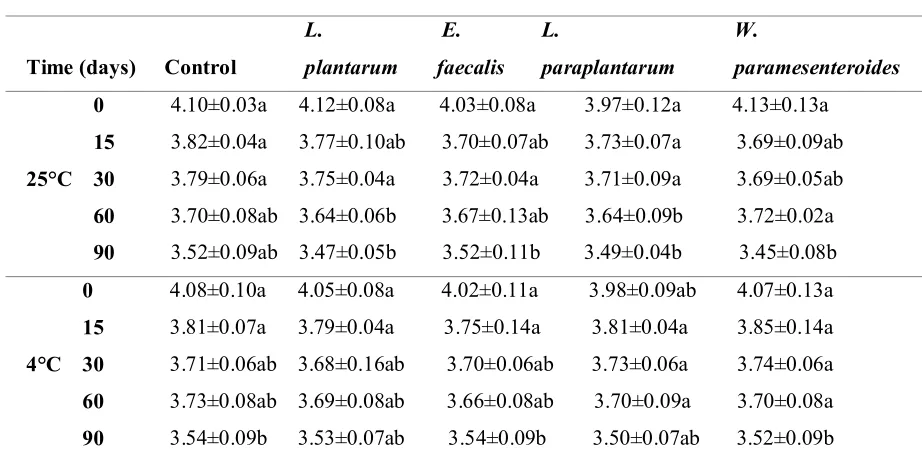
In Table 1, the pH values in GCM of inoculated and non-inoculated samples are shown with 161
the 4 isolates at both room and refrigerated storages. Overall, reduction in pH of all samples 162
persisted at 5oC of storage. Interestingly, the inoculated GCM samples with wild-type strains 163
exhibited identical pH values at 25°C to other reports. The synthetic medium inoculated with 164
selected isolates indicated particularly a substantial reduction at 25°C of storage attaining pH 3 to 165
3.4 within 60 days. Thus, a distinct trend of pH was noticed in the synthetic medium to wild-type 166
isolates at refrigerated conditions. The grape synthetic medium samplings inoculated with isolates 167
W. paramesenteroides, E. faecalis, and L. plantarum exhibited significant pH values during 168
storage; however, the synthetic medium inoculated with the strain L. paraplantarum had fairly 169
regular pH levels. 170
171
172
9 Table 1.pH valuesabout LAB counts for the non-inoculated and inoculated GCM and GM kept 174
at room and refrigerated temperatures. 175
pH values in Grape Control Media (GCM) 176
Time (days)
Control
L.
plantarum
E.
faecalis L.
paraplantarum
W.
paramesenteroides
0 4.10±0.03a 4.12±0.08a 4.03±0.08a 3.97±0.12a 4.13±0.13a
15 3.82±0.04a 3.77±0.10ab 3.70±0.07ab 3.73±0.07a 3.69±0.09ab
25°C 30 3.79±0.06a 3.75±0.04a 3.72±0.04a 3.71±0.09a 3.69±0.05ab
60 3.70±0.08ab 3.64±0.06b 3.67±0.13ab 3.64±0.09b 3.72±0.02a
90 3.52±0.09ab 3.47±0.05b 3.52±0.11b 3.49±0.04b 3.45±0.08b
0 4.08±0.10a 4.05±0.08a 4.02±0.11a 3.98±0.09ab 4.07±0.13a
15 3.81±0.07a 3.79±0.04a 3.75±0.14a 3.81±0.04a 3.85±0.14a
4°C 30 3.71±0.06ab 3.68±0.16ab 3.70±0.06ab 3.73±0.06a 3.74±0.06a
60 3.73±0.08ab 3.69±0.08ab 3.66±0.08ab 3.70±0.09a 3.70±0.08a
90 3.54±0.09b 3.53±0.07ab 3.54±0.09b 3.50±0.07ab 3.52±0.09b
Formulation of values as the average ±S.D. in triplicate runs. Same columns by different letters indicated significant differences with a p-value greater than 0.05.
177 178
pH values in Grape Marmalade (GM) 179
Time (days)
Control
L.
plantarum
E.
faecalis L.
paraplantarum W.
paramesenteroides
0 4.08±0.12a 4.05±0.10a 3.91±0.14a 3.85±0.10a 3.78±0.17a
15 3.83±0.07ab 3.76±0.04a 3.77±0.24ab 3.71±0.17a 3.68±0.16ab
25°C 30 3.79±0.16a 3.75±0.16a 3.72±0.16ab 3.70±0.06a 3.69±0.16ab
60 3.75±0.08ab 3.68±0.18ab 3.67±0.08ab 3.70±0.14a 3.67±0.18ab
90 3.53±0.12ab 3.49±0.09b 3.51±0.12b 3.49±0.09ab 3.58±0.09b
0 4.07±0.09a 4.02±0.18a 3.97±0.13a 3.95±0.08a 3.90±0.11a
15 3.85±0.34a 3.80±0.24a 3.77±0.31a 3.81±0.17a 3.81±0.23a
4°C 30 3.71±0.25a 3.71±0.16ab 3.69±0.21ab 3.71±0.18a 3.70±0.21a
60 3.68±0.17ab 3.65±0.17a 3.63±0.14ab 3.69±0.41a 3.69±0.18a
90 3.55±0.29b 3.52±0.15b 3.52±0.18ab 3.51±0.12ab 3.52±0.13ab
Formulation of values as the average ±S.D. in triplicate runs. Same columns by different letters indicated significant differences with a p-value greater than 0.05.
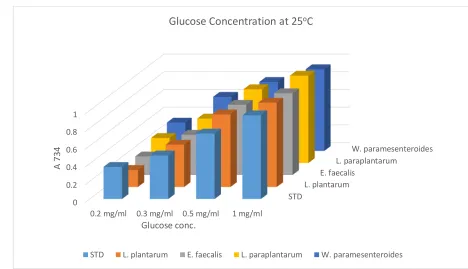
10 The sugar concentration in grape marmalade was evaluated to 100 mg/g of Glucose until the end 181
of preservation. The results of non-inoculated and inoculated grape marmalades were shown in 182
Fig. 1 and sugar composition was 0.339 g of Glucose at A534 for the freshly prepared samples.
183
Jams and marmalades are basically constituted of fruit peel, sugar, and water; in addition, the more 184
bitter the peel the better the flavor of the marmalade. It represents a beneficial origin of dietary 185
fibers, vitamins, and minerals. These nutrients possess healthy benefits in several ways considering 186
when they are incorporated with probiotic bacteria and antioxidants. 187
188
STD
L. plantarum E. faecalis
L. paraplantarum
W. paramesenteroides
0 0.2 0.4 0.6 0.8 1
0.2 mg/ml 0.3 mg/ml 0.5 mg/ml 1 mg/ml
A
7
34
Glucose conc.
Glucose Concentration at 25oC
11 189
Figure 1: Glucose Concentration of the Marmalade at different Temperatures of Storage 5oC and
190
25oC
191
3.2.Viabilityof probiotic Bacteria in GCM and GM at storage
192
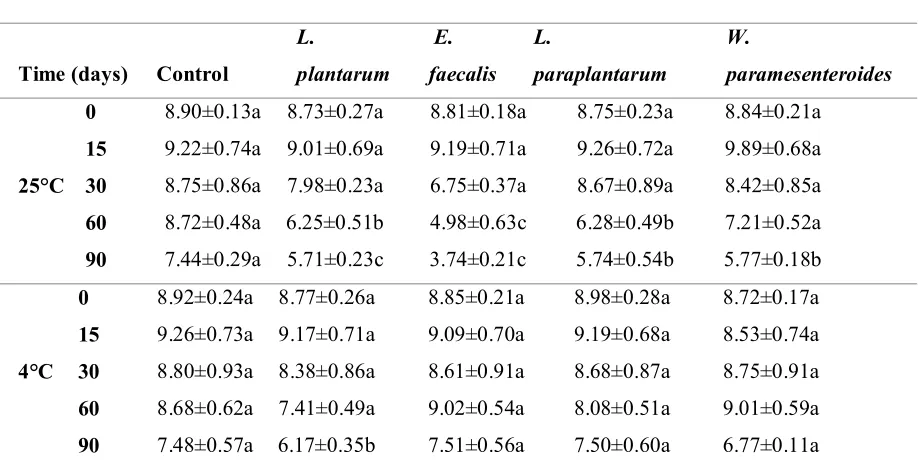
The viability of probiotic strains at storage was investigated in the synthetic medium and 193
marmalade of grapes at refrigerated and room temperatures (Table 2). Samples of non-inoculated 194
grape synthetic medium and marmalade exhibited slight numbers in the media during preservation 195
at room and refrigerated conditions. Generally, synthetic medium samples inoculated with the 196
wild-type W. paramesenteroides, E. faecalis, and L. plantarum indicated strong growth within 30 197
days of storage at room temperature, whereas specimens inoculated to L. paraplantarum showed 198
seemingly constant values (Table 2). All synthetic medium samples indicated a substantial 199
reduction in survival over the crucial range of 106 cfu/g for more than 45 days. Nevertheless, a
200
distinct tendency was noticed at 5°C: most initial isolates showed a reduction after 30 days (log 8 201
STD
L. plantarum E. faecalis
L. paraplantarum
W. paramesenteroides
0 0.2 0.4 0.6 0.8 1
0.2 mg/ml 0.3 mg/ml 0.5 mg/ml 1 mg/ml
A
7
34
Glucose conc.
Glucose Concentration at 5oC
12 cfu/mL) of preservation and growth within 45 days. Strains of W. paramesenteroides, E. faecalis, 202
and L. plantarum remained viable in the grape synthetic medium during 90 days of storage, yet 203
subsisting beyond the crucial counts of 106 cfu/g. Most of the initial isolates exhibited strong 204
survival with considerable growth in 30 days at room temperature, according to cells density 205
ranging from 1010 to 1012 cfu/g. Most isolates excluding E. faecalis had counts over the crucial
206
standard of 106 cfu/g for more than 60 days at 25oC (Table 2). Thus, most of the isolates stayed 207
active above 107 cfu/g in the grape marmalade samplings kept at refrigerated condition. Under 208
those terms, all initial isolates indicated significant counts (proximate to 1010 cfu/g) from 15 to 45
209
days of storage, excluding W. paramesenteroides and E. faecalis, which maintained the greatest 210
values after 60 days of storage. 211
Table 2.LAB counts (Log cfu/g) for the non-inoculated and inoculated GCM and GM kept at 212
room and refrigerated temperatures. 213
Mean counts (Log cfu/g) Grape Control Media (GCM) 214
Time (days)
Control
L.
plantarum
E.
faecalis L.
paraplantarum
W.
paramesenteroides
0 8.90±0.13a 8.73±0.27a 8.81±0.18a 8.75±0.23a 8.84±0.21a
15 9.22±0.74a 9.01±0.69a 9.19±0.71a 9.26±0.72a 9.89±0.68a
25°C 30 8.75±0.86a 7.98±0.23a 6.75±0.37a 8.67±0.89a 8.42±0.85a
60 8.72±0.48a 6.25±0.51b 4.98±0.63c 6.28±0.49b 7.21±0.52a
90 7.44±0.29a 5.71±0.23c 3.74±0.21c 5.74±0.54b 5.77±0.18b
0 8.92±0.24a 8.77±0.26a 8.85±0.21a 8.98±0.28a 8.72±0.17a
15 9.26±0.73a 9.17±0.71a 9.09±0.70a 9.19±0.68a 8.53±0.74a
4°C 30 8.80±0.93a 8.38±0.86a 8.61±0.91a 8.68±0.87a 8.75±0.91a
60 8.68±0.62a 7.41±0.49a 9.02±0.54a 8.08±0.51a 9.01±0.59a
90 7.48±0.57a 6.17±0.35b 7.51±0.56a 7.50±0.60a 6.77±0.11a
Formulation of values as the average ±S.D. in triplicate runs. Same columns by different letters indicated significant differences with a p-value greater than 0.05.
215
216
13 Mean counts (Log cfu/g) Grape Marmalade (GM)
218
Time (days)
Control
L.
plantarum
E.
faecalis L.
paraplantarum W.
paramesenteroides
0 8.92±014a 8.70±0.24a 8.79±0.21a 9.02±0.69a 8.81±0.45a
15 9.13±0.82a 9.07±0.75a 9.04±0.77a 8.86±0.67a 9.06±0.71a
25°C 30 8.78±0.50a 8.75±0.59a 7.80±0.53a 8.71±0.82a 8.71±0.46a
60 9.08±0.61a 8.98±0.56a 8.88±0.59a 8.75±0.67a 8.95±0.89a
90 6.84±0.53a 7.17±0.48a 6.84±0.52a 6.77±0.12a 7.73±0.36a
0 8.93±0.38a 8.77±0.66a 8.78±0.37a 9.10±0.84a 8.86±0.3a
15 9.16±0.85a 9.29±0.92a 9.19±0.89a 9.26±0.98a 9.14±0.81a
4°C 30 8.78±0.34a 8.83±0.78a 8.75±0.41a 8.85±0.79a 8.85±0.33a
60 8.75±0.28a 9.11±0.96a 8.95±0.19a 9.15±0.96a 9.11±0.93a
90 7.46±0.19a 8.74±0.58a 7.84±0.30a 8.86±0.87a 7.81±0.13a
Formulation of values as the average ±S.D. in triplicate runs. Same columns by different letters indicated significant differences with a p-value greater than 0.05.
219
3.3.Correlation and Properties of the fermentation
220
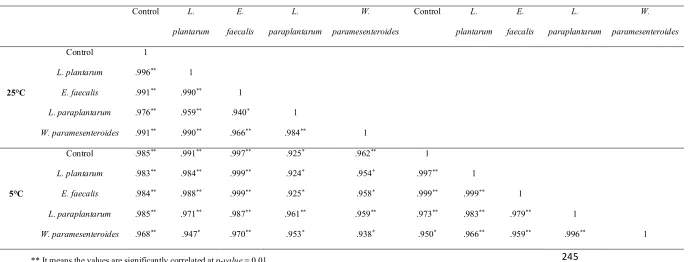
The isolates of L. paraplantarum, W. paramesenteroides, E. faecalis, and L. plantarum performed 221
well in sterile grape marmalade with no addition of nutrients. Tables 1 and 2 summarizes the 222
evolution of lactic fermentation time of grape marmalade by L. paraplantarum, W. 223
paramesenteroides, E. faecalis, and also L. plantarum, respectively. The counts of L. plantarum, 224
W. paramesenteroides, and E. faecalis attained 109 cfu/mL in grape marmalade after 3 days of 225
fermentation at 30°C (Table 2). The extension of the development time beyond 15 days showed 226
no significant decrease in the cell counts of all the tested LAB. Under fermentation of grape 227
marmalade, sugar metabolism was described by glucose absorption, but fermented grape 228
marmalade maintained sugars at the acidification outset. Both L. plantarum and W. 229
paramesenteroides generated more lactic acid than L. paraplantarum. In reference, L. plantarum 230
and W. paramesenteroides generated about 1% of lactic acid after 3 days at 30°C. In identical 231
development terms, L. paraplantarum generated a titratable acidity of 0.79% acid lactic. Thus, 232
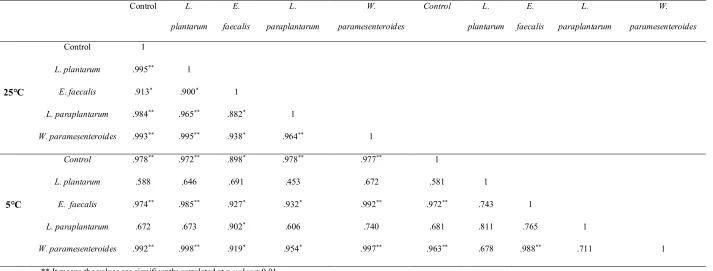
14 the grape marmalade (Table 3); but most isolates showed a certain positive correlation at some 234
points with a p-value = 0.01 or p-value = 0.05. Nonetheless, a different case is observed for the 235
acidity of the strains at room and refrigerated conditions. At p-values 0.01 and 0.05, none of the 236
isolates showed significant differences (Table 4), since E. faecalis and L. plantarum exhibited 237
15
Control L.
plantarum E.
faecalis
L.
paraplantarum
W.
paramesenteroides
Control L.
plantarum E.
faecalis
L.
paraplantarum
W.
paramesenteroides
Control 1
L. plantarum .995** 1
25°C E. faecalis .913* .900* 1
L. paraplantarum .984** .965** .882* 1
W. paramesenteroides .993** .995** .938* .964** 1
Control .978** .972** .898* .978** .977** 1
L. plantarum .588 .646 .691 .453 .672 .581 1
5°C E. faecalis .974** .985** .927* .932* .992** .972** .743 1
L. paraplantarum .672 .673 .902* .606 .740 .681 .811 .765 1
W. paramesenteroides .992** .998** .919* .954* .997** .963** .678 .988** .711 1
** It means the values are significantly correlated at p-value = 0.01
* It means the values are significantly correlated at p-value = 0.05
240
241
242
16
Control L.
plantarum
E.
faecalis
L.
paraplantarum
W.
paramesenteroides
Control L.
plantarum E.
faecalis
L.
paraplantarum
W.
paramesenteroides
Control 1
L. plantarum .996** 1
25°C E. faecalis .991** .990** 1
L. paraplantarum .976** .959** .940* 1
W. paramesenteroides .991** .990** .966** .984** 1
Control .985** .991** .997** .925* .962** 1
L. plantarum .983** .984** .999** .924* .954* .997** 1
5°C E. faecalis .984** .988** .999** .925* .958* .999** .999** 1
L. paraplantarum .985** .971** .987** .961** .959** .973** .983** .979** 1
W. paramesenteroides .968** .947* .970** .953* .938* .950* .966** .959** .996** 1
245
246
247
248
249
250
251
** It means the values are significantly correlated at p-value = 0.01
17
3.4. Antioxidant characteristics of probiotic grape marmalade
252
The antioxidant influence of LAB, in terms of the antioxidant capability of cells and the 253
intracellular cell-free extract of LAB, has been investigated based on several anti-oxidative tests. 254
In this research, the anti-oxidative activity of grape marmalade is shown with various cultures of 255
L. plantarum, E. faecalis, W. paramesenteroides, and L. paraplantarum (Table 5). In particular, 256
according to the cultures applied, the fermented grape marmalade exhibited a strong antioxidant 257
capability, estimated as total anti-oxidative activity, ABTS, and DPPH. Nonetheless, the probiotic 258
grape marmalade that contained W. paramesenteroides indicated an anti-oxidative activity of 77% 259
that varied insignificantly from that of probiotic grape marmalade with L. paraplantarum and L. 260
plantarum (72% and 71%, respectively) within 3 days of fermentation. 261
Anti-oxidative activity decreased with E. faecalis after fermentation (15.3% versus 8.7%), 262
regarding a decrease of 7% over 90 days. An apparent decrease in antioxidative activity was 263
observed in the grape marmalade using L. paraplantarum (decreased about 5%). The ABTS in the 264
probiotic grape marmalade with LAB exhibited no significant differences during storage at room 265
and refrigerated conditions. GM fermented with E. faecalis and W. paramesenteroides exhibited 266
higher ABTS (69%) than those of L. plantarum and L. paraplantarum, which inhibiting powers 267
were 67.2 and 64.7 respectively. Similar findings were obtained for DPPH, where the probiotic 268
grape marmalade with W. paramesenteroides exhibited the highest scavenging activity (73%). 269
DPPH capacity of grape marmalade was decreased, notably of the probiotic L. paraplantarum, 270
18
Formulation of values as the average ±S.D. in triplicate runs. Values with similar letters showed non-significant differences with a p-value greater than 0.05.
273
274
NO Radical (%-A=534 nm) ABTS (%-A=700 nm) DPPH (%-A=340 nm)
19 4. Discussion
275
The cholesterol content and lactose non-tolerance reside in two substantial challenges combined 276
with milk-based products. In addition, there is an increase for vegetarianism in some developed 277
countries and the demand for non-dairy probiotic products (Kumar et al., 2015). Numerous studies 278
have recently shown that certain raw materials are capable of introducing new non-dairy probiotic 279
products into the market (Abu-Ghannam and Rajauria, 2015; Rivera-Espinoza and Gallardo-280
Navarro, 2010). Thus, a proper study of non-dairy probiotic products is emphasized on the 281
numerous fundamental and external properties of foods, such as pH, nutrient accessibility, glucose 282
content, O2 level, water, and temperature, affect the survival of probiotic cells (Mårtensson et al.,
283
2002; Mattila-Sandholm et al., 2002; Vasudha and Mishra, 2013). In this research, the survival of 284
four different wild strains was studied in grape marmalade at room and refrigerated conditions of 285
storage. All the isolates were investigated for their characteristics, viability to pH 2, strong 286
tolerance to bile salts, resistance to different “Anti-biotics”, such as vancomycin, chloramphenicol, 287
tetracycline, ampicillin, and penicillin, and their antibacterial trend against S. aureus, L. 288
monocytogenes, and E. coli. This study was able to show that the alleged wild probiotic strains 289
survived in the grape marmalade during storage, thus indicating that this vehicle might be a 290
potential candidate as a probiotic medium. Thus, the isolates exhibited significant viability more 291
in grape marmalade than in the synthetic medium grape, which confirmed that food preparations 292
could affect probiotics survival at storage. Some authors have argued that a strong matrix can 293
preserve the strains during storage; thus in this research, the grape marmalade preparation with its 294
innate constituents, apparently promoted the survival of the probiotics (Lacroix and Yildirim, 295
2007; Ranadheera et al., 2010; Saarela et al., 2000). Previous researches have demonstrated the 296
20 increase and survival of cells in some fruits and vegetables may be subject to the strains applied 298
(Chen and Chen, 2007; Tuomola et al., 2001). In this research, the survival of the strains confirmed 299
the results shown by previous studies, which showed the probiotic strain cells had a comparative 300
stability in milk compared to non-dairy products. 301
The changes in the stability of isolates were attributed to pH and Temperatures during storage. 302
Champagne reported that in several fermented milk byproducts, the deficit of probiotic strains 303
survival was assigned to a reduction of pH (pH 4-5) and to the production of organic acids as a 304
result of fermentation (Champagne et al., 2005). Sheehan indicated that the isolates demonstrated 305
strong survival at pH 4, and indicated that the control strain might survive during 12 weeks at 5°C 306
in orange juice (pH 3.65) and in pineapple juice at pH 3.4 (Sheehan et al., 2007). This research 307
reported that most of the isolates stayed active beyond the crucial count in grape marmalade at 308
room temperature within 45 days. The correlation in bacteria numbers as well as pH levels 309
confirmed the survival of isolates, related to previous statistics, while the survival of the wild 310
strains was to a lesser degree. In addition, the results indicated an insignificant increase in glucose 311
concentrations at 25°C of storage. The increase in glucose might be due to two factors that occurred 312
concurrently: intracellular bacterial growth and sucrose inversion, which was precipitated at low 313
pH levels and at high storage temperatures. Essentially, marmalades and jams are considered as 314
high stable products referring to their low pH, glucose concentration, and their Aw; they constitute
315
suitable media to sucrose inversion (Agte et al., 2010; Simanjuntak et al., 2013). 316
This study also highlighted the anti-oxidative effect of Lactic Acid Bacteria as a great interest for 317
researchers (Chu et al., 2000; Wang et al., 2008). The anti-oxidative effect of grape marmalade is 318
21 L. paraplantarum. Based on the strains applied, the grape marmalade demonstrated strong 320
antioxidant capacity, evaluated as DPPH scavenging activity, and total antioxidant activity. 321
Similar findings were exhibited for DPPH: grape marmalade fermented with L. plantarum and W. 322
parameseneroides showed the highest scavenging activity at 70%; whereas L. paraplantarum 323
reduced the DPPH of grape marmalade within 30 days at room temperature. In a study conducted 324
by Wang et al. (2008), it was observed that the fermentation of carbohydrates by innate intestinal 325
LAB exhibited strong antioxidant effects. Table 2 indicated that the glucose concentration of the 326
grape marmalade was probably a sufficient and essential carbon source for Lactobacilli strains 327
(Chen et al., 2008). 328
The metabolism of the bacteria apparently affected the capacity of the antioxidant activity in the 329
marmalade according to the strains used. Some researchers have reported the effect of fermentation 330
on the food anti-oxidative properties. For instance, Espinoza et al. (2010) reported the anti-331
oxidative characteristics of fermented probiotic carrot juice (Rivera-Espinoza and Gallardo-332
Navarro, 2010); and it’s reported that sugar apple as substrate indicated no significant difference 333
between fresh and fermented juices for the strains of L. delbrueckii, L. paracasei, and L. casei. 334
Fermented sugar apple juice showed 65%-75% antioxidant activity and DPPH scavenging free 335
radicals scavenging of 72% (Prado et al., 2008). The fermented grape marmalade showed anti-336
oxidative activities, which changed with the strains applied, but L. plantarum and L. 337
paraplantarum had no effect on the anti-oxidative activity of fermented grape marmalade 338
compared to non-fermented synthetic medium. In this study, the fermentation of grape marmalade 339
with W. paramesenteroides showed better anti-oxidative activity than the non-fermented synthetic 340
medium (Table 5). As a result, the anti-oxidative activity changed with the starters used. 341
22 the reduction of sucrose; however, this assumption needs to be studied in more detail (Randazzo 343
et al., 2013). The findings of this study showed that L. plantarum and W. paramesenteroides were 344
the best probiotic bacteria to produce non-dairy probiotic products. Moreover, antioxidant ability 345
exhibited for 72 hours of fermentation period by E. faecalis showed no significant difference 346
comparing to L. paraplantarum, L. plantarum, and W. paramesenteroides. Grape marmalade 347
might be a good candidate for the production of new functional probiotic, which might efficiently 348
subsist probiotic strains of Lactobacillus both under refrigerated conditions and at room 349
temperature. A quotidian absorption of approximately 10 grams of probiotic marmalade might 350
provide from 108 to 109 viable probiotic bacteria, with stored preparations for 40 - 90 days at both
351
25oC and 5oC, respectively (Ouwehand et al., 2002). Similarly, the results of this study are 352
assimilated to those in fermented dairy products, with over to 106 cfu/mL within 30 days of storage
353
at 5oC.
354
5. Conclusions
355
The capability of L. paraplantarum, L. plantarum, W. paramesenteroides, and E. faecalis was 356
investigated in the suitability of grape as a raw material for the production of probiotic grape 357
marmalade during storage. All wild strains of Lactobacillus showed better viability at different 358
temperatures of storage compared to the control isolates, with a greater count by log 7 cfu/g up to 359
90 days and stored at 5°C. Grape marmalade isolates, stored at room temperature, maintained 360
sustainable counts beyond the crucial level for 90 days. The metabolism of lactobacilli caused pH 361
changes that accelerated the rate of hydrolysis of sucrose to constituent glucose. Based on a 362
commercial aspect, the viability might be considered as an important criterion for the selection of 363
isolates at different temperatures for use in probiotic marmalades during storage. 364
23 Acknowledgements
366
The authors are grateful to the International Cooperation Development Fund, Taiwan (Taiwan 367
ICDF) for research funding. 368
Conflict of Interest 369
The authors declare no conflict of interest. 370
References 371
Abu-Ghannam N., Rajauria G. (2015) Non-Dairy Probiotic Products. FOERST, P. 372
SANTIVARANGKNA, C. Advances probiotic technology 1:356-374. 373
http://78.39.227.9/handle/Hannan/83610. 374
Agte V., Khetmalis N., Nilegaonkar S., Karkamkar S., Yadav S. (2010) Prebiotic potential of ‘juice 375
grape’varieties and some hybrids. http://hdl.handle.net/123456789/10498. 376
Caggia C., Scifò G.O., Restuccia C., Randazzo C.L. (2009) Growth of acid-adapted Listeria 377
monocytogenes in orange juice and in minimally processed orange slices. Food Control 378
20:59-66. https://doi.org/10.1016/j.foodcont.2008.02.003. 379
Champagne C.P., Gardner N.J., Roy D. (2005) Challenges in the addition of probiotic cultures to 380
foods. Critical reviews in food science and nutrition 45:61-84. 381
https://doi.org/10.1080/10408690590900144. 382
Chen M.J., Chen K.N. (2007) Applications of probiotic encapsulation in dairy products. 383
Encapsulation and controlled release technologies in food systems:83-112. 384
https://doi.org/10.1002/9780470277881.ch4. 385
Chen Y., Xie M.-Y., Nie S.-P., Li C., Wang Y.-X. (2008) Purification, composition analysis and 386
antioxidant activity of a polysaccharide from the fruiting bodies of Ganoderma atrum. Food 387
Chemistry 107:231-241. https://doi.org/10.1016/j.foodchem.2007.08.021. 388
Chu Y.H., Chang C.L., Hsu H.F. (2000) Flavonoid content of several vegetables and their 389
antioxidant activity. Journal of the Science of Food and Agriculture 80:561-566. 390
https://doi.org/10.1002/(SICI)1097-0010(200004)80:5<561::AID-JSFA574>3.0.CO;2-%23. 391
De La Cruz F., Frost L.S., Meyer R.J., Zechner E.L. (2010) Conjugative DNA metabolism in 392
Gram-negative bacteria. FEMS microbiology reviews 34:18-40. 393
24 Ebrahimzadeh M.A., Pourmorad F., Hafezi S. (2008) Antioxidant activities of Iranian corn silk. 395
Turkish Journal of biology 32:43-49.
396
http://dergipark.gov.tr/tbtkbiology/issue/11718/139934. 397
Kumar B.V., Vijayendra S.V.N., Reddy O.V.S. (2015) Trends in dairy and non-dairy probiotic 398
products-a review. Journal of food science and technology 52:6112-6124. 399
https://doi.org/10.1007/s13197-015-1795-2. 400
Lacroix C., Yildirim S. (2007) Fermentation technologies for the production of probiotics with 401
high viability and functionality. Current Opinion in Biotechnology 18:176-183. 402
https://doi.org/10.1016/j.copbio.2007.02.002. 403
Luckow T., Delahunty C. (2004) Which juice is ‘healthier’? A consumer study of probiotic non-404
dairy juice drinks. Food Quality and Preference 15:751-759. 405
https://doi.org/10.1016/j.foodqual.2003.12.007. 406
Mårtensson O., Öste R., Holst O. (2002) The effect of yoghurt culture on the survival of probiotic 407
bacteria in oat-based, non-dairy products. Food Research International 35:775-784. 408
https://doi.org/10.1016/S0963-9969(02)00074-1. 409
Mattila-Sandholm T., Myllärinen P., Crittenden R., Mogensen G., Fondén R., Saarela M. (2002) 410
Technological challenges for future probiotic foods. International Dairy Journal 12:173-411
182. https://doi.org/10.1016/S0958-6946(01)00099-1. 412
Ouwehand A.C., Salminen S., Isolauri E. (2002) Probiotics: an overview of beneficial effects, 413
Lactic Acid Bacteria: Genetics, Metabolism and Applications, Springer. pp. 279-289. 414
https://doi.org/10.1007/978-94-017-2029-8_18. 415
Ouwehand A.C., Salminen S.J. (1998) The health effects of cultured milk products with viable and 416
non-viable bacteria. International Dairy Journal 8:749-758. https://doi.org/10.1016/S0958-417
6946(98)00114-9. 418
Parvez S., Malik K.A., Ah Kang S., Kim H.Y. (2006) Probiotics and their fermented food products 419
are beneficial for health. Journal of applied microbiology 100:1171-1185. 420
https://doi.org/10.1111/j.1365-2672.2006.02963.x. 421
Phillips M., Kailasapathy K., Tran L. (2006) Viability of commercial probiotic cultures (L. 422
acidophilus, Bifidobacterium sp., L. casei, L. paracasei and L. rhamnosus) in cheddar 423
cheese. International journal of food microbiology 108:276-280. 424
25 Prado F.C., Parada J.L., Pandey A., Soccol C.R. (2008) Trends in non-dairy probiotic beverages. 426
Food Research International 41:111-123. https://doi.org/10.1007/s12010-009-8738-1. 427
Prantera C., Scribano M., Falasco G., Andreoli A., Luzi C. (2002) Ineffectiveness of probiotics in 428
preventing recurrence after curative resection for Crohn's disease: a randomised controlled 429
trial with Lactobacillus GG. Gut 51:405-409. http://dx.doi.org/10.1136/gut.51.3.405 430
Ranadheera R., Baines S., Adams M. (2010) Importance of food in probiotic efficacy. Food 431
research international 43:1-7. https://doi.org/10.1016/j.foodres.2009.09.009. 432
Randazzo C., Pitino I., Ribbera A., Caggia C. (2010) Pecorino Crotonese cheese: study of bacterial 433
population and flavour compounds. Food Microbiology 27:363-374. 434
https://doi.org/10.1016/j.fm.2009.11.010 435
Randazzo C.L., Pitino I., Licciardello F., Muratore G., Caggia C. (2013) Survival of Lactobacillus 436
rhamnosus probiotic strains in peach jam during storage at different temperatures. Food 437
Science and Technology 33:652-659. http://dx.doi.org/10.1590/S0101-438
20612013000400009. 439
Restuccia C., Giusino F., Licciardello F., Randazzo C., Caggia C., Muratore G. (2006) Biological 440
control of peach fungal pathogens by commercial products and indigenous yeasts. Journal 441
of food protection 69:2465-2470. https://doi.org/10.4315/0362-028X-69.10.2465. 442
Rivera-Espinoza Y., Gallardo-Navarro Y. (2010) Non-dairy probiotic products. Food 443
microbiology 27:1-11. https://doi.org/10.1016/j.fm.2008.06.008 444
Ruberto G., Renda A., Daquino C., Amico V., Spatafora C., Tringali C., De Tommasi N. (2007) 445
Polyphenol constituents and antioxidant activity of grape pomace extracts from five 446
Sicilian red grape cultivars. Food Chemistry 100:203-210. 447
https://doi.org/10.1016/j.foodchem.2005.09.041. 448
Saarela M., Mogensen G., Fonden R., Mättö J., Mattila-Sandholm T. (2000) Probiotic bacteria: 449
safety, functional and technological properties. Journal of biotechnology 84:197-215. 450
https://doi.org/10.1016/S0168-1656(00)00375-8. 451
Salminen S., Ouwehand A., Benno Y., Lee Y. (1999) Probiotics: how should they be defined? 452
Trends in food science & technology 10:107-110.
https://doi.org/10.1016/S0924-453
26 Scialdone O., Randazzo S., Galia A., Silvestri G. (2009) Electrochemical oxidation of organics in 455
water: role of operative parameters in the absence and in the presence of NaCl. Water 456
research 43:2260-2272. https://doi.org/10.1016/j.watres.2009.02.014. 457
Sheehan V.M., Ross P., Fitzgerald G.F. (2007) Assessing the acid tolerance and the technological 458
robustness of probiotic cultures for fortification in fruit juices. Innovative Food Science & 459
Emerging Technologies 8:279-284. https://doi.org/10.1016/j.ifset.2007.01.007. 460
Tagliazucchi D., Verzelloni E., Bertolini D., Conte A. (2010) In vitro bio-accessibility and 461
antioxidant activity of grape polyphenols. Food Chemistry 120:599-606. 462
https://doi.org/10.1016/j.foodchem.2009.10.030. 463
Thaipong K., Boonprakob U., Crosby K., Cisneros-Zevallos L., Byrne D.H. (2006) Comparison 464
of ABTS, DPPH, FRAP, and ORAC assays for estimating antioxidant activity from guava 465
fruit extracts. Journal of food composition and analysis 19:669-675. 466
https://doi.org/10.1016/j.jfca.2006.01.003. 467
Tuomola E., Crittenden R., Playne M., Isolauri E., Salminen S. (2001) Quality assurance criteria 468
for probiotic bacteria–. The American journal of clinical nutrition 73:393s-398s. 469
https://doi.org/10.1093/ajcn/73.2.393s 470
Vancanneyt M., Huys G., Lefebvre K., Vankerckhoven V., Goossens H., Swings J. (2006) 471
Intraspecific genotypic characterization of Lactobacillus rhamnosus strains intended for 472
probiotic use and isolates of human origin. Applied and environmental microbiology 473
72:5376-5383. DOI: 10.1128/AEM.00091-06. 474
Vasudha S., Mishra H. (2013) Non dairy probiotic beverages. International Food Research Journal 475
20. https://search.proquest.com/docview/1425252500?accountid=13204.
476
Wang Y.-B., Li J.-R., Lin J. (2008) Probiotics in aquaculture: challenges and outlook. Aquaculture 477