CHARACTERIZING BEHAVIORAL PHENOTYPES OF FRAGILE X SYNDROME IN MICE
Caroline Rauffenbart
A thesis submitted to the faculty at the University of North Carolina at Chapel Hill in partial fulfillment of the requirements for graduating with Honors in the Department of Biology in the
College of Arts and Sciences
ABSTRACT
Fragile X Syndrome (FXS) is the most prevalent inherited form of autism. This condition is due to inappropriate silencing of the Fmr1 gene on the X-chromosome and subsequent loss of Fragile X Mental Retardation Protein (FMRP), a RNA-binding protein that represses dendritic protein translation. Clinical features of FXS include cognitive impairments, increased seizure susceptibility, and altered social behaviors. In these studies, I used the marble burying, open-field, acoustic startle/prepulse inhibition, social exploration and nose poke behavioral assays to characterize phenotypic differences between male Fmr1-KO and wildtype mice that are
comparable to known FXS behavioral defects. Results indicate that Fmr1-KO mice display increased perseverance and general hyperactivity, but are otherwise behaviorally similar to the control subjects. These findings provide a basis for future pre-clinical mouse studies that will attempt to correct behavioral and cellular abnormalities associated with FXS using
pharmacological interventions during different stages of development.
INTRODUCTION
characteristics of FXS are achieved by knocking out the Fmr1 gene to simulate the FMRP deficiency found in FXS. FMRP is a RNA-binding protein that acts on numerous mRNA cargos to regulate local synaptic protein synthesis in dendritic spines of several brain areas. When bound, FMRP often represses translation of these mRNA’s, many of which are thought to promote synaptic plasticity and synapse formation (Garber et al., 2006). Absence of FMRP in FXS results in an excess of dendritic proteins that promote synaptic growth through pathways initiated by the Gqα-subunit of various G Protein-Coupled Receptors (GPCRs) and subsequent phospholipase C (PLC) and/or phosphoinositide 3-kinase cascades (Berry-Kravis et al., 2011).
Specific GPCRs affected by a lack of FMRP include those of the dopaminergic,
glutamatergic and cholinergic subtypes. FMRP deficiency enhances long-term depression (LTD) of hippocampal synapses by means of the Gq-coupled metabotropic glutamate receptor
(mGluR1/5) (Volk et al., 2007). Proposed pharmacological treatments for FXS have included mGluR antagonists such as 6-methyl-2-(phenylethynyl)pyridine (MPEP), which has successfully normalized some phenotypes of FXS in mice (Yan et al., 2005), but studies have yielded mixed results. Differences in results are likely due to the variety of roles that mGluR5 plays in brain reward circuitry. Unlike hippocampal consequences of Fmr1-KO, mice lacking FMRP display decreased mGluR5-LTD in medium spiny neurons (MSNs) of the nucleus accumbens (NAc) (Jung et al., 2012). Dolen et al. (2007) were able to successfully rescue many behavioral and physiological phenotypes of Fmr1-KO mice by genetically reducing mGluR5 expression during development, which implies that pharmacological manipulation of mGluR expression during development may be a more promising treatment strategy for reduction of FXS abnormalities.
change DA receptor activity and activation of subsequent pathways. Like mGluR, D1/D2 heterodimeric DA receptors activate pathways that induce synaptic plasticity by means of PLC, and D2 receptors play a role in activating striatal LTD. Because DA plays an especially
important role in behavioral initiation and repetition, altered levels of the neurotransmitter have been associated with stereotypies characteristic of FXS (Fulks et al., 2010). Aripiprazole (ARI), a D2 receptor partial agonist, is used as a treatment for FXS symptoms like anxiety and
aggression investigated and continues to be investigated as a treatment for FXS (Hagerman et al., 2009). Fish et al. (2013) used intracranial self stimulation (ICSS) to show that ARI elevates brain stimulation reward in mice but its anhedonic effect is less pronounced in Fmr1-KO mice than in the control. These findings suggest that ARI may be effective at reducing genotype DA reward function difference and decreasing abnormal stereotypies commonly observed in FXS subjects.
Like the effect of FMRP deficiency on glutamate GPCRs, hippocampal LTD by M1 muscarinic acetylcholine receptors (mAChR1) is enhanced in Fmr1-KO mice. M1 and M4 antagonists, dicyclomine and tropicamide, respectively, partially improve behavioral abnormalities and seizure susceptibility associated with Fmr1-KO mice (Volk et al., 2007). Additionally, mAChR1-dependent LTD in MSNs of the NAc is enhanced by a FMRP
mAChR LTD, improve motor function, and decrease stereotypies characteristic of Fmr1-KO mice. This pharmacological approach will be tested as a follow-up to the current preliminary data.
Human males with FXS often exhibit heightened sensitivity to sensory stimuli (Miller et
al., 1999). These individuals display low sensorimotor gating abilities, which can be measured in
both mice and humans by means of a prepulse inhibition (PPI) assay, during which a weak
acoustic stimulus is sounded prior to a loud, startling sound and is expected to lower the
subject’s startle amplitude. The difference between acoustic startle reactions with and without a
preceding weak sound acts as a measure of PPI, or sensorimotor gating. Male Fmr1-KO mice
have been found to exhibit increased PPI, which may be indicative of physiological
compensation for Fmr1 deletion in mice that do not occur in humans. Fmr1-KO mice have also
exhibited lower startle thresholds to sound amplitude than Fmr1-wildtype (WT) mice. Low PPI
has been associated with cognitive abnormalities of FXS and may indicate a mechanism of the
disorder that is directly related to sensorimotor gating abnormalities (Frankland et al., 2004).
Other studies have shown that Fmr1-KO mice display low PPI; results are mixed and it is
therefore difficult to predict a phenotype for the Fmr1-KO mice used in the present study (de
Vrij et al., 2008). Changes in acoustic startle behavior in Fmr1-KO subjects throughout
pharmacological treatment may exhibit useful indications of therapeutic progress, as abnormal
PPI levels are correlated with cognitive changes in FXS.
Social anxiety is a distinct characteristic of human FXS and is modeled in the current
study using a stranger-mouse paradigm in a three-chambered apparatus. Fmr1-KO mice have
previously displayed preference for being in the same chamber as a stranger mouse over being in
with the stranger mouse. This may indicate greater social anxiety or arousal in Fmr1-KO mice
(McNaughton et al., 2008). While mouse models that display a more accurate simulation of FXS
social behaviors would be ideal for animal studies of FXS therapies, correction of present
indications of social inhibition is a primary goal for current treatment studies.
Marble burying is reflective of a basic perseverant digging behavior seen in various types
of mice (Thomas et al., 2009). Repetitive motor behavior is characteristic of individuals on the
autism spectrum (Carcani-Rathwell et al., 2006). Previous studies have shown that Fmr1-KO
mice on certain genetic backgrounds display increased marble burying behavior, suggesting heightened perseverant behavior that coincides with the known human FXS phenotype (Spencer et al., 2011). The open field behavioral assay further tests for hyperactivity, anxiety, exploratory
behavior and stereotypy by measuring distance travelled, motion repetition and areas occupied by the subject mouse in a one-hour trial. A previous study showed that Fmr1-KO mice display increased open field activity in all facets of behavioral assessment across different mouse backgrounds (Spencer et al., 2011).
There is not yet sufficient background information for phenotypic designations of Fmr1-KO mice in hole-board task performance, but this test has been designed as an indicator of repetitive behavior (Moy et al., 2008). It is expected that, as with the open field and marble burying tasks, the Fmr1-KO mice used in the current study will display increased repetitive behavior during the hole-board task by restricting nose pokes to specific holes in a sequential, perseverant manner relative to their Fmr1-WT counterparts.
This study attempts to characterize behaviors of Fmr1-KO mice including social
exploration, open-field exploration, acoustic startle/PPI, marble burying and hole-board
to mice across different developmental stages in order to predict the efficacy of therapeutic
interventions during childhood and/or adolescence. Long-term management of FXS behavioral
abnormalities may be achieved when pharmacological manipulation occurs at a stage of critical
development. This would be an improvement to the life-long treatments currently administered
to individuals with FXS that provide only temporary and partial improvement to phenotypic
abnormalities. Drugs tested will include the aforementioned trihexyphenidyl, MPEP and
aripiprazole.
MATERIALS AND METHODS
Subjects. C57BL/6J Fmr1-KO and WT mice were tested starting at P50-62 over a course of five
weeks. 11 Fmr1-WT and 10 Fmr1-KO mice served as subjects. There were no weight
differences between the two genotypes: WT, 30.2 g ± 1.4; KO, 30.8 g ± 0.5 (mean ± SEM). One WT mouse was injured; data from this subject were removed from the study. Experimenter was blind to mouse genotype throughout the duration of the study (Fmr1-WT or KO).
Marble Burying. Mice were tested in a standard cage containing 3 liters of corncob bedding with
20 glass marbles arranged in an orderly array of 5 equidistant rows atop the bedding. The cage containing bedding and marbles was placed in a sound-attenuating box with a light and fan. Mice were placed in the cage for 30 minutes. After the trial, the mice were returned to their home cages and the number of marbles buried (2/3 of marble beneath bedding) was recorded. Open-Field Exploration / Hole-Board Exploration. The subjects were allowed to explore an
region (VersaMax System, AccuScan Instruments). This same apparatus was modified for the nose poke assay by installation of a floorboard containing 16 equidistant holes. Photobeams within the chamber tracked mouse locomotion and number of nose pokes in each hole within a one-hour testing period (Pokemon system, AccuScan Instruments).
Social Exploration. A clear, three-chambered rectangular Plexiglas testing apparatus was used.
The two dividing walls contained closeable doorways and a video tracking system was used to track the subjects’ movements (Noldus Ethovision). The test was composed of two parts: a ten-minute habituation period and a ten-ten-minute social testing period. During habituation, the doorways were open and the mouse was placed in the center chamber. The mouse was allowed to freely roam the apparatus while the tracking system noted the number of entrances to and amount of time spent in each side.
After ten minutes of habituation, the mouse was contained within the center of the apparatus with the doorways closed. One clear, holed Plexiglas cage was placed on each side of the apparatus. The cage on one side was left empty while the cage on the other side contained an unfamiliar adult C57BL/6J male. The mouse was then free to explore all areas of the apparatus (the doors were opened) for ten minutes. The tracking system noted the number of entrances into each side of the apparatus, amount of time spent in each side and amount of time spent within a 5 cm vicinity of each cage.
Acoustic Startle / Prepulse Inhibition (PPI). Mice were placed in a Plexiglas cylinder within a
trials with a prepulse stimulus (PPS, 20 ms; either 74, 78, 82, 86, or 90 dB) 100 ms prior to a SS. Measurements of startle amplitude were recorded by a computer system and PPI yields at each sound amplitude were calculated as (100 - [(response amplitude for PPS + SS together/response amplitude for SS alone) x 100]).
Data Analysis. All statistical analyses were performed with SPSS (IBM). A one-way Analysis of
Variance (ANOVA) was used to evaluate effect of genotype, and, when a significant F was observed, post hoc Fisher’s Protected Least Significant Difference (PLSD) tests were conducted. For the sociability test, a repeated measures ANOVA was conducted to determine side
preference within genotype. For all analyses, p < 0.05 was considered significant.
RESULTS
Marble-burying assay. No significant effects of genotype in were found: WT, 16.8 marbles ±
0.5; KO, 17.3 marbles ± 0.4 (mean ± SEM).
Open field test. The Fmr1-KO mice demonstrated significant increases in rearing movements at
Figure 1. Rearing movements and distance traveled in a novel open field. Data shown are means (± SEM) for each group for a one-hour test. *p<0.05.
Social Exploration. Loss of Fmr1 did not lead to changes in the three-chamber task. During
habituation, both groups demonstrated similar exploration of the three-chamber box, without any side preference (Figure 2A). In the test for sociability, the Fmr1-KO mice spent significantly more time in the side of the box with the stranger mouse, in comparison to the empty cage side (Figure 2B) [within-genotype comparison following repeated measures ANOVA, main effect of side, F (1,17)=12.09, p=0.0029]. Both WT and KO mice had significant preference for spending more time in direct proximity to the stranger cage (Figure 2C) [within-genotype comparisons following repeated measures ANOVA, main effect of side, F (1,17)=19.72, p=0.0004]. There were no genotype differences between numbers of entries during either the habituation or sociability phases (data not shown).
5 10 15 20 25 30 35 40 45 50 55 60
0 20 40 60 80 100 Fmr1 Fmr1
A) Rearing Movements
Time (min) Rears KO WT * * * * * * * * * *
5 10 15 20 25 30 35 40 45 50 55 60 0 400 800 1200 1600 2000 2400 Fmr1 Fmr1
B) Total Distance Traveled
Time (min)
Distance
(cm)
Figure 2. Significant social preference in Fmr1-KO mice. Data shown are mean (+ SEM) for each group (n=9 WT and 10 KO mice) for a 10-min test. * p < 0.05, within-genotype
comparison between stranger side and empty cage side.
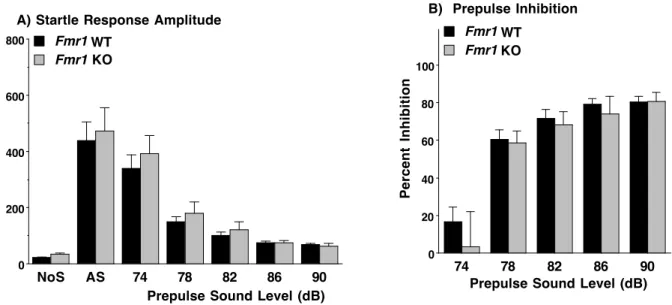
Acoustic Startle / Prepulse Inhibition (PPI). As shown in Figure 3, the Fmr1-WT and KO mice had similar performance in the acoustic startle test.
Figure 3. No genotype differences in acoustic startle responses or prepulse inhibition. Data shown are means (+ SEM) for each group. Trials included no stimulus (No S) trials and acoustic startle stimulus (AS) alone trials.
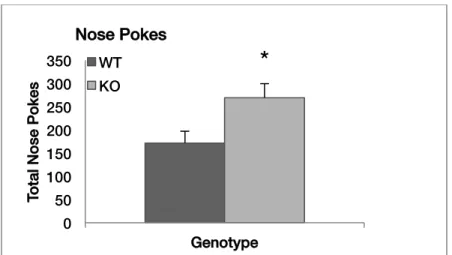
Nose Poke. As shown in Figure 4, the Fmr1-KO mice made significantly more nose pokes than the wild type mice [F(1,19)=6.11, p=0.023], suggesting that loss of Fmr1 led to abnormal repetitive behavior. WT KO 0 100 200 300 400
500 Left Side
Right Side
A) Habituation, Time in Side
Time (sec) WT KO 0 100 200 300 400
500 Stranger Side
Empty Cage Side B) Sociability, Time in Side
Time (sec) * p=0.0688 WT KO 0 100 200 300 400
500 Stranger Cage Zone Empty Cage Zone C) Sociability, Time in Proximity
Time
(sec) *
*
NoS AS 74 78 82 86 90
0 200 400 600 800 Fmr1 Fmr1
A) Startle Response Amplitude
Prepulse Sound Level (dB)
Amplitude
KO WT
74 78 82 86 90
0 20 40 60 80 100 Fmr1 Fmr1
B) Prepulse Inhibition
Prepulse Sound Level (dB)
Percent
Inhibition
Figure 4.Genotype difference in total nose pokes for a one-hour test. Data shown are means (+ SEM) for each group. * p < 0.05.
DISCUSSION
The current study of C57BL/6J Fmr1-KO mice found no genotype effect on marble burying, social exploration, PPI, acoustic startle response, repetitive fine movement behavior, time spent in the center region of a locomotor chamber or hyperactivity in an open field assay. The experimental group displayed significantly more rearing movements in the open field test, more nose pokes in the hole-board assay and greater hyperactivity in the hole-board assay. These findings indicate that the present mouse model is not ideal for pharmacological testing of novel treatments for FXS because the mice tested did not exhibit certain core aspects of the FXS behavioral phenotype. These findings also present the novel hole-board assay as a practical test for perseverance in mouse models of autism with fewer confounding factors than other tests of perseverance such as marble burying.
While the Fmr1-KO mouse model consistently displays functional and structural abnormalities that are comparable to those of human FXS, the translation of this genetic simulation to FXS-like behaviors is not as reliable in animal models. Past behavioral studies of Fmr1-KO mice with seemingly comparable experimental procedures have yielded conflicting
*
!
0!
50!
100!
150!
200!
250!
300!
350!
Genotype!
Total Nose Pokes
!
Nose Pokes!
WT!
results. Acoustic startle/PPI is a historically controversial test for Fragile X-like reactivity and sensorimotor gating abilities in mice. While human males with FXS exhibit greater startle reactions to acoustic stimuli, decreased PPI, and compromised cognitive performance, Fmr1-KO mouse models have displayed similar acoustic startle increases but also PPI and cognitive
capability increases (Frankland et al., 2004). While the correlation between PPI and cognitive task performance is maintained in the mouse model for FXS, FMRP deficiency has an opposite effect on these traits in mice than in humans. Other studies have shown PPI in Fmr1-KO mice to be lower than the control subjects (de Vrij et al., 2008) or, in strains other than C57BL/6J, no different from the Fmr1-WT group (Nielsen et al., 2002).
The current study asserts that there is no genotype difference in acoustic startle response or PPI in C57 mice. Although other studies have promoted the idea that this lack of difference is strain-specific to mice on hybrid genetic backgrounds, the current findings contradict this. Equivalent startle response levels were observed between Fmr1-KO and WT mice. A learning task was not performed in this study, but would have contributed to our findings by testing the hypothesis put forth by Frankland et al., (2004) that changes in cognitive ability are directly correlated with PPI alterations in models of FXS.
of the open field test, but did not publish data on rearing movements. The present study observed a greater number of rearing movements in Fmr1-KO mice throughout the hour of testing.
Increased rearing activity is correlated with heightened anxiety, especially in novel social situations (Mines et al., 2010), but because anxiety was not displayed by increased time spent in the center region, it is more likely that more rearing movements signify general hyperactivity (Moy et al., 2014). This indication of hyperactivity is supported by greater distance travelled by Fmr1-KO subjects over the course of the nose poke assay.
The experimental subjects performed more nose pokes during the hole-board test than the controls, indicating expected perseverant behavior commonly seen among humans with FXS. Increased hyperactivity during this assay could reflect urgency to perform this repetitive task in different areas of the chamber, which may explain why distance travelled during the open field assay had no genotype effect. Patients with FXS often exhibit repetitive behaviors including preference for routine, hand flapping and echolalia. Such behaviors are also found in other forms of autism, but have been observed as being especially prominent in FXS (Moss et al., 2009). Past studies have not been successful in simulating this characteristic phenotype of FXS in mouse models through other assays such as marble burying. Thus, the current observations of repetition in the hole-board test introduce this novel assay as a more accurate means of observing
perseverance.
Like the present data, Spencer et al. (2011) found no difference in marble burying
high level of digging. Although not an issue in the current study, hyperactivity could confound this task because general movement within the cage tends to set the marbles more deeply within the corncob bedding. As mentioned by Spencer et al. (2011), the nose poke assay is a seemingly more practical test of perseverance, and they were also able to confirm findings of repetitive behavior in C57 mice with the nose poke assay (unpublished).
Social anxiety, shyness and emotional withdrawal are common characteristics of individuals with FXS (Moss and Howlin, 2009). An accurate model of FXS would be expected to display decreased social tendencies, yet the Fmr1-KO mice in the current study showed a preference for being near a stranger mouse (both direct vicinity and in the same chamber) over being in an empty chamber. This is consistent with findings in some other studies, including Spencer et al. (2011), who studied Fmr1-KO mouse performance over a variety of tasks and genetic backgrounds. While most strains showed no genotype difference in preference for social interaction, it was suggested that this may have been confounded by increased hyperactivity in KO mice over several strains (including C57BL/6J) but was not confounded by hyperactivity in the B6D2 (C57BL/6JxDBA/2J) hybrid strain. This hybrid strain also showed other core
characteristics of autism including repetitive behavior and impaired social communication, and was determined a more accurate model for FXS than C57BL/6J and other tested mouse strains (Spencer et al., 2011).
There has been evidence that environmental stimuli, especially during development, can rescue long-term behavioral and neuronal phenotypes of FXS (Restivo et al., 2005).
a confounding factor. Assuring that all pups are fostered with WT mothers would control for the maternal behavior confound, as social aversion associated with FXS would likely translate to decreased maternal care in the case of Fmr1-KO mothers. Additionally, a greater sample size would reduce the chance of this factor effecting overall results, and more mice are currently being raised to undergo the same testing and contribute to the sample size of the current study.
As displayed in the current study with review of literature, it is evident that behavioral studies of mouse models for human neurological conditions yield variable results. Certain variation could be strain-dependent, but variability across studies is often seen within a strain as well. Crabbe et al. (1999) controlled behavioral experiments across different laboratories and found that behavioral data are often idiosyncratic to the location of the studies or the scientists involved. Thus, consensus regarding characteristic behaviors of mouse models for a specific human neurological condition can rarely be reached unless a behavioral phenotype is repeatedly displayed over numerous studies in different labs. Endophenotyping has been proposed as a means of improving the credibility and practicality of behavioral phenotyping to increase the specificity for behavioral expectations according to the condition being studied. This would include an assessment of traits that are directly related to and can be used as markers for a specific biological dysfunction (Hunsaker, 2012). This strategy would improve studies that employ animal models of syndromic causes of autism; direct correlation of a biological marker with a specific behavioral abnormality would limit the ambiguity associated with an otherwise phenotypically heterogeneous disorder.
REFERENCES
Carcani-Rathwell, I., Rabe-Hasketh, S., & Santosh, P.J. (2006). Repetitive and stereotyped behaviours in pervasive developmental disorders. J Child Psychol Psychiatry, 47(6), 573-81.
Crabbe, J. C., Wahlsten, D., & Dudek, B. C. (1999). Genetics of mouse behavior: interactions with laboratory environment. Science,284, 1670–1672.
Crawford, D.C., Acuna, J.M., & Sherman, S.L. (2001). FMR1 and the fragile X syndrome: human genome epidemiology review. Genet Med, 3, 359–371.
D'Amato, F.R., Scalera, E., Sarli, C., Moles, A. (2005). Pups call, mothers rush: does maternal responsiveness affect the amount of ultrasonic vocalizations in mouse pups? Behav Genet,35, 103–112.
de Vrij, F.M., Levenga, J., van der Linde, H.C., Koekkoek, S.K., De Zeeuw, C.I., Nelson, D.L., Oostra, B.A., & Willemsen, R. (2008). Rescue of behavioral phenotype and neuronal protrusion morphology in Fmr1 KO mice. Neurobiol Dis, 31(1), 127-32.
Dolen, G., Osterweil, E., Rao, B.S., Smith, G.B., Auerbach, B.D., Chattarji, S., & Bear, M.F. (2007). Correction of fragile X syndrome in mice. Neuron, 56(6), 955-62.
Erickson, C.A., Stigler, K.A., Wink, L.K., Mullett, J.E., Kohn, A., Posey, D.J., & McDougle, C.J. (2011). A prospective open-label study of aripiprazole in fragile X syndrome.
Psychopharmacology (Berl), 216(1), 85-90.
Fish, E.W., Krouse, M.C., Stringfield, S.J., DiBerto, J.F., Robinson, J.E., Malanga, C.J. (2013). Changes in Sensitivity of Reward and Motor Behavior to Dopaminergic, Glutamatergic, and Cholinergic Drugs in a Mouse Model of Fragile X Syndrome. PLoS One. 8(10), e77896.
Frankland, P.W., Wang, Y., Rosner, B., Shimizu, T., Balleine, B.W., Dykens, E.M., Ornitz, E.M., & Silva, A.J. (2004). Sensorimotor gating abnormalities in young males with fragile X syndrome and Fmr1-knockout mice. Mol. Psychiatry,9, 417–425.
Fulks, J.L., O'Bryhim, B.E., Wenzel, S.K., Fowler, S.C., Vorontsova, E., Pinkston, J.W., Ortiz, A.N., & Johnson, M.A. (2010). Dopamine release and uptake impairments and behavioral alterations observed in mice that model Fragile X Mental Retardation Syndrome. ACS Chem Neurosci, 1(10), 679-690.
Garber, K., Smith, K.T., Reines, D., & Warren, S.T. (2006). Transcription, translation and fragile X syndrome. Curr Opin Genet Dev, 16(3), 270-5.
Hagerman, R.J., Berry-Kravis, E., Kaufmann, W.E., Ono, M.Y., Tartaglia, N., Lachiewicz, A., Kronk, R., Delahunty, C., Hessl, D., Visootsak, J., Picker, J., Gane, L., & Tranfaglia, M. (2009). Advances in the treatment of fragile X syndrome. Pediatrics, 123(1), 378-90. Hasbi, A., Fan, T., Alijaniaram, M., Nguyen, T., Perreault, M.L., O'Dowd, B.F., & George, S.R.
(2009). Calcium signaling cascade links dopamine D1-D2 receptor heteromer to striatal BDNF production and neuronal growth. Proc Natl Acad Sci USA, 106(50), 21377-82. Hunsaker, M.R. (2012). Comprehensive neurocognitive endophenotyping strategies for mouse
models of genetic disorders. Prog Neurobiol,96(2), 220–241.
Jung, K.M., Sepers, M., Henstridge, C.M., Lassalle, O., Neuhofer, D., Martin, H., Ginger, M., Frick, A., DiPatrizio, N.V., Mackie, K., Katona, I., Piomelli, D., & Manzoni, O.J. (2012). Uncoupling of the endocannabinoid signalling complex in a mouse model of fragile X syndrome. Nat Commun, 3:1080.
Krueger, D.D., Osterweil, E.K., Chen, S.P., Tye, L.D., & Bear, M.F. (2011). Cognitive dysfunction and prefrontal synaptic abnormalities in a mouse model of fragile X syndrome. Proc Natl Acad Sci U S A, 108(6), 2587-92.
McNaughton, C. H., Moon, J., Strawderman, M. S., Maclean, K. N., Evans, J., & Strupp, B. J. (2008). Evidence for social anxiety and impaired social cognition in a mouse model of fragile X syndrome. Behav. Neurosci,122, 293–300.
Miller, L.J., McIntosh, D.N., McGrath, J., Shyu, V., Lampe, M., Taylor, A.K., Tassone, F., Neitzel, K., Stackhouse, T., & Hagerman, R.J. (1999). Electrodermal responses to sensory stimuli in individuals with fragile X syndrome: a preliminary report. Am J Med Genet, 83, 268–279.
Mines, M.A., Yuskaitis, C.J., King, M.K., Beurel, E., & Jope, R.S. (2010). GSK3 influences social preference and anxiety-related behaviors during social interaction in a mouse model of fragile X syndrome and autism. PLoS One, 5, e9706.
Moss, J. & Howlin, P. (2009). Autism spectrum disorders in genetic syndromes: implications for diagnosis, intervention and understanding the wider autism spectrum disorder population.
Journal of Intellectual Disability Research,53(10), 852–873.
Moss, J., Oliver, C., Arron, K., Burbidge, C., & Berg, K. (2009). The prevalence and
phenomenology of repetitive behavior in genetic syndromes. J Autism Dev Disord, 39, 572–588.
Moy, S.S., Nadler, J.J., Young, N.B., et al. (2009). Social approach in genetically engineered mouse lines relevant to autism. Genes, Brain and Behavior, 8(2), 129–142.
Moy, S.S., Riddick, N.V., Nikolova, V.D., Teng, B.L., Agster, K.L., Nonneman, R.J., Young, N.B., Baker, L.K., Nadler, J.J., & Bodfish, J.W. (2014). Modifying behavioral phenotypes in Fmr1KO mice: genetic background differences reveal autistic-like responses. Autism Res, 4(1), 40-56.
Nielsen, D.M., Derber, W.J., McClellan, D.A. & Crnic, L.S. (2002). Alterations in the auditory startle response in Fmr1 targeted mutant mouse models of fragile X syndrome. Brain Res, 927, 8–17.
Restivo, L., Ferrari, F., Passino, E., Sgobio, C., Bock, J., Oostra, B.A. et al. (2005). Enriched environment promotes behavioral and morphological recovery in a mouse model for the fragile X syndrome. Proc Natl Acad Sci USA,102, 11557–11562.
Spencer, C.M., Alekseyenko, O., Hamilton, S.M., Thomas, A.M., Serysheva, E., Yuva-Paylor, L.A., Paylor, R. (2011). Modifying behavioral phenotypes in Fmr1KO mice: genetic background differences reveal autistic-like responses. Autism Res.4, 40–56.
Thomas, A., Burant, A., Bui, N., Graham, D., Yuva-Paylor, L.A., & Paylor, R. (2009). Marble burying reflects a repetitive and perseverative behavior more than novelty-induced anxiety. Psychopharmacology, 204(2), 361–73.
Verkerk, A.J., Pieretti, M., et al. (1991). Identification of a gene (FMR-1) containing a CGG repeat coincident with a breakpoint cluster region exhibiting length variation in fragile X syndrome. Cell,65(5), 905–914.
Volk, L.J., Pfeiffer, B.E., Gibson, J.R., & Huber, K.M. (2007). Multiple Gq-coupled receptors converge on a common protein synthesis-dependent long-term depression that is affected in fragile X syndrome mental retardation. J Neurosci, 27(43): 11624-34.
Yan, Q.J., Rammal, M., Tranfaglia, M., & Bauchwitz, R.P. (2005). Suppression of two major Fragile X Syndrome mouse model phenotypes by the mGluR5 antagonist MPEP.