Process Governance: Definitions and Framework, Part 1
Rafael Paim & Raquel Flexa
This Article if the first of a two-part series discussing governance frameworks. In Part `, four existing frameworks are examined and a new proposal is described. The proposed framework was gernerated based on experience in working with organizations in the public and private sectors. Part 2 will present further details regarding the proposed framework.
Introduction
Certainly, what is most challenging for organizations about process management is how to encourage performance improvement and then to ensure that these improvements are workable and maintained over the short, medium and long term. Even more difficult, however, is the task of assuring that such actions are fully aligned with business objectives. Given that need, it can be seen how important it is for a Process Governance Model to exist within the organization. Governance, when well defined, well managed and fully aligned with organizational strategy, acts to orient and facilitate Process Management, in that it defines goals, roles, responsibilities and instruments. As a result, efforts to improve process management are directed to a common goal, avoiding the usual duplication of effort and converging to achieve the goals.
Process Governance: Some Conceptual Definitions
To begin the discussion, it is important to know how Process Governance is understood by authors who have studied the subject.
Paim (2007, 2010) and Paim et. al. (2009) state that process governance comprises the “definition of overall guidelines of the process management model, the process control model and the activities of the various organizational units, and involves mainly the distribution of Process Management-related responsibilities within the organization. Briefly, it involves fostering the definition of overall guidelines to orient what should be done in Process Management and how it should be done”.
Jeston & Nelis (2008) summarize Governance as an instrument to guarantee that processes, process designs and strategy perform well, and to ensure alignment among all three.
Spanyi & Dwyer (2008) define it as the structure, metrics, roles and responsibilities necessary to measure and improve performance and to manage an organization’s processes, and regard it as fundamental to optimal, workable process improvement in the organization.
Korhonen (2007) sees Governance as necessary to ensure coordination among process initiatives by different functional units and to eliminate misalignment between organizational strategy and process endeavors.
Lastly, Richardson (2006) characterizes Governance as “used to define the set of rules that dictate or govern how an organization must conduct a specific business function. Thus, process governance consists of the set of guidelines and resources that an organization uses to facilitate collaboration and communication when it undertakes enterprise process initiatives”. To summarize, despite certain distinctions, all the definitions agree on some common points: Governance acts to guide Process Management, in which it is aided by an overarching goal and by roles and instruments aligned with that goal. It becomes an important tool supporting business management.
Background to the Proposed Process Governance Framework
From the conceptual analyses offered by the above authors, from benchmarking visits to firms in various sectors, from the results of international research into Process Management and Governance in Organizations and from participation in international congresses and visits,
proposal, Process Governance consists in “the definition, spread and control of Process Management, as regards its: goals; principles, orientations and decision-making limits; form of organization/structure; roles and responsibilities; form of evaluation and control, which are designed to protect the interests of shareholders and stakeholders, partners or the corporation in a systemic and integrated way, and assure that the organization does not fail to solve problems and take opportunities to improve and innovate in how its work is done.
Process Governance may include the activities of formulating, introducing, controlling and reviewing policies, guidelines, rules, procedures, instruments and technologies that guide process management practices within the organization. It also includes the forms of organization, integration, collaboration and communication among the various different process management initiatives within the firm. The objects of Process Governance are the organization’s value chain, the process management methodology and the rules, roles and responsibilities that structure and organize how process management functions. To sumarize, Process Governance can be said to enable and steer the execution of Process Management, involving the whole organization and clarifying what should be done, who should do it and how.
Process Governance vs. Process Management: Clarifying the Concepts
It is very common for managers and other members of organizations to confuse the terms “process governance” and “process management”, sometimes in the belief that they refer to the same object. Ultimately, this causes difficulties for efforts to introduce a by-process approach in organizations.
Firstly it has to be understood what “process management” means. This concept should be understood as a coordinated set of permanent tasks required to design processes and assure they function properly, and to foster process-related learning. These tasks can be represented as the design, monitoring, control and correction of processes, and the promotion of process-related learning in organizations. The role of Process Governance, meanwhile, is to guide Process Management, i.e., to fill the gap between strategy and execution, to help align the two and consequently to increase productivity and generate value.
Figure 1 - Relation between Process Governance, Process Management and Strategy in the Organization. Source: Enjourney, 2010
Building a Governance Model: Impacting Factors
In order to build a sound Model of Governance it is necessary not only to understand the definition of Governance, but also to understand what major impacting factors must be reflected in the model. Only then will it be possible to generate a result that not only contains those factors, but uses them most efficiently. These factors are:
• The Sector where the firm operates and information on its portfolio of products and/or services: these factors steer and guide construction of the Governance Model;
• Business Strategy: impacts how the model will be constructed;
• Value Chain / Macro-process: this factor is the foundation for process management because it brings together the major cross-processes in the firm;
• Process or By-Process Management Status: this factor is explanatory as regards realities in the organization and the degree of maturity of its processes;
• Institutional Policies and Guidelines: these factors may be restrictive or driving, but they always steer organizational actions;
• Organizational Design and Power Structures: these factors are constraints on certain functions of the Governance Model, given the characteristics (functional, matrix, geographic etc.) of the organizational structure;
• Existing process-oriented instruments: are a facilitating and enabling factor for construction of a Process Governance Model;
• Process Maturity in the Organization: impacts how processes are structured, standardized, documented, managed and improved.
Some Process Governance Frameworks in the Literature
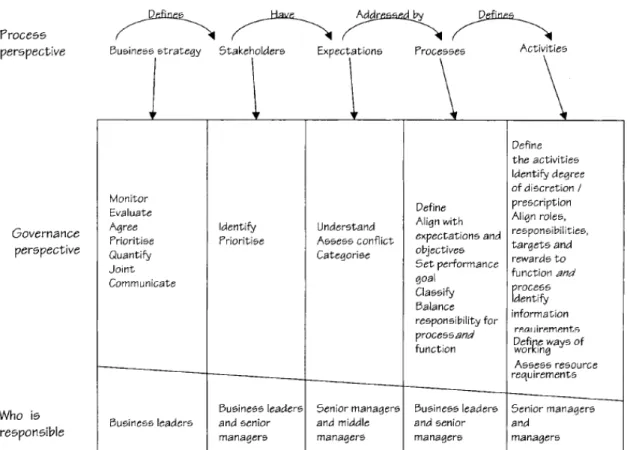
A Framework is a conceptual structure that enables different business objects to be framed and treated homogeneously. It can be defined as a set of concepts used to solve a problem in a specific domain. In our case, it provides a view of how Process Governance should be structured in the organization by bringing out explicitly some of its key elements, their forms and the levels at which they act. At present, various model Frameworks have been developed by a number of authors writing on this subject. Four of these are examined in this Article and will be discussed below to support construction of the model proposed by Enjourney. The first Framework to be examined is proposed by Braganza & Lambert (2000). In this model, Governance acts mainly in improving processes tied to the organization’s day-to-day activities, seeking to balance and minimize conflicts between the two.
Roles and their respective tasks and responsibilities are stated explicitly in the Governance Model in order to assist in fostering improvements. In addition, the model defines and legitamizes various other important elements, such as reward models that fluctuate between improvements and day-to-day activities.
Figure 2 - Process Governance Framework. Source: Braganza & Lambert, 2000.
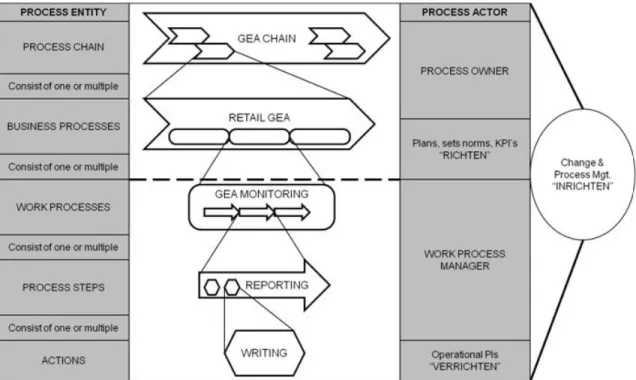
The second Framework is taken from Peeters (2008). In this model, Governance also acts in day-to-day activities, but it acts at the operations level, and this action is not directly connected with endeavors to achieve improvements. Definition of roles and responsibilities is related to each operational level, but not very clearly. Other important elements and the interrelations among them are mentioned, but not explored in much depth.
Figure 3 – Process Governance Framework. Source: Adapted from Peeters, 2008.
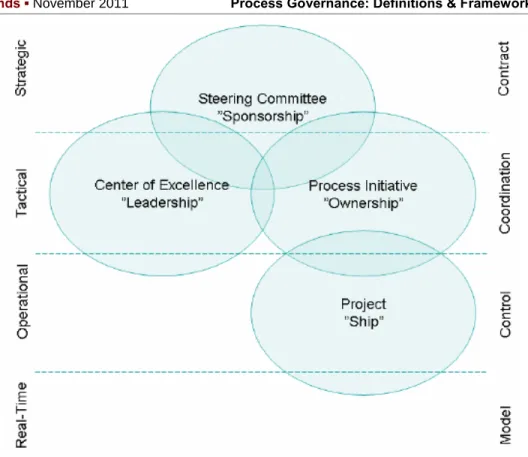
The following model is drawn from Korhonen (2007). Here Process Governance focuses on improvement by process re-design, but without acting on day-to-day activities. Governance tasks and roles, and their interrelations, are well defined and the author stresses the importance of there being a Process Office.
Figure 4 - Process Governance Framework. Source: Korhonen, 2007.
Lastly, the Framework proposed by Barros (2009) proposes a model in which it is possible for Governance to act both in day-to-day activities and in process improvement, balancing the conflict that exists between them. Roles are defined, although the related tasks and responsibilities are not set out clearly enough for implementation purposes.
Process Governance Framework: Enjourney Consulting and Education
From analysis of the frameworks demonstrated above and its experience on the subject in projects in business and government in a wide range of industries sectors, Enjourney has developed a Framework using the elements it considers most important in defining an effective Process Governance Model which can meet organizational needs. Knowing that the object on which the governance model focuses are organizational processes, the key elements to be incorporated are:
• Decision-Making Models;
• Management Models;
• Introduction and Implementation;
• Sponsorship;
• Organization Goals;
• Monitoring and Control;
• Performance Evaluation.
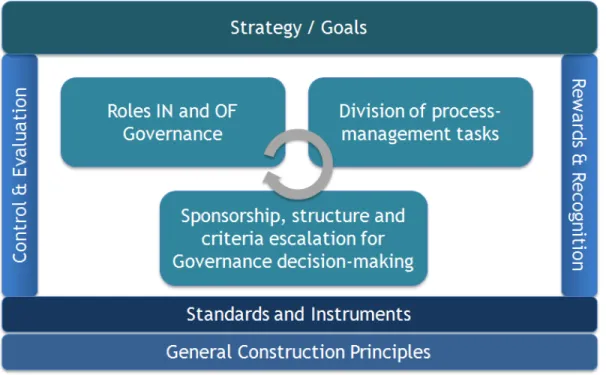
From a combination of all these elements, Enjourney developed the model Framework shown in Figure 5 below:
Figure 5 - Process Governance Framework. Source: Enjourney, 2010.
The framework is made up of 7 (seven) elements and rests on general construction principles. The model is oriented by strategies and goals, which then disaggregate into the other elements. Execution centers on roles, division of tasks and the structure and criteria escalation for decision-making. All the elements of this model are supported by predefined standards and instruments and use control, evaluation and reward mechanisms. The elements present in the framework are detailed below:
• Strategies/Goals: express the organization’s expectations, represent what it intends to accomplish with its actions in processes. It is extremely important for these goals to be clearly defined and effectively circulated, because they orient the actions of collaborators and the firm as a whole.
• Roles OF and IN Governance: the Roles OF Governance are representations held of such Governance in view of the stated goal. Roles IN Governance are the units or positions (or roles proper) created to give explicit, practical form to the model of action structured with a view to managing processes.
• Division of Process Management Tasks: represents the pre-defined attributes, responsibilities and roles. The tasks and responsibilities of process management enable it to exist in the organization in structured form.
• Sponsorship, Structure and Criteria Escalation for Governance Decision-making: determines the set of relationships among the roles and may take into consideration determinants pertaining to hierarchy, interaction and collaboration. This structure comprises the definition of decision-making entitlements in Governance, as well as the prioritization of process designs and sponsorship structure.
• Standards and Instruments: represent the set of factors intended to give uniformity to process initiatives. This element embraces tools, methods, methodology, process architecture, metrics, documentation and so on.
• Control and Evaluation: represent the set of control and evaluation metrics necessary to ascertain the consistency and effectiveness of the process governance operating in the organization on the basis of the model designed previously.
•
Recognition and Rewards: represents systems of rewards relating to performance of the roles involved in governance. In turn, a progress mechanism is defined that encourages and induces improvement and development in how such roles are performed. These vary with the stated goal and the set of roles (OF and IN governance) in place.Final Remarks
The results produced by process management initiatives and the maturing of Process Management techniques over recent years have attracted the interest of organizations. The need to direct and organize process management itself has grown accordingly. Efforts to achieve change and improvement have to be conducted in keeping with clear definitions of the various related elements; otherwise, introduction of initiatives and actions to restructure processes may not produce the expected results, and success will not be guaranteed. It is thus vital that the organization is supported by a well-defined Process Governance Model aligned with the business strategy. This will permit coordination and communication among process initiatives through roles, responsibilities, structures and metrics by which processes in organizations can be measured and improved.
In order to further understand the elements in the framework, please see (Paim & Flexa, 2011b)
_____ Authors
Prof. Rafael Paim is a senior professional in Process Management. Over the last 15 years he has worked on over 120 consulting and research projects related to processes management and governance,
information technology, services, and organizational design. Prof. Paim has trained over 2500 professionals, in more than 100 in-company courses and public process management courses in Brazil. In 2002, Prof. Paim lead a spin-off from COPPE/UFRJ and created a process management consulting and training firm, called Enjourney Consulting and Education. He is Founder Partner at Enjourney. In 2009, Prof. Paim published the book "Process Management: think, execute and learn". Since 2007 he has been an editorial board member of the Business Process Management Journal and has published more than 30 papers and articles on the topic. Since 2010, he has leaded an International Benchmarking Mission. Eight
teaching. GEOS is a Group of Operations and Systems Management and Engineering at Cefet-RJ, Brazil. Rafael Paim is Production/Industrial Engineer, Master in Science, Doctor in Science, at Poli/COPPE/UFRJ.
Prof. Raquel Flexa is a senior professional in Process Management. Over the last 12 years she has worked on over 50 consulting andresearch projects related to processes management and governance, industrial engineering, public management, health services, and organizational design. Prof. Flexa has trained over 1000 professionals, in more than 30 in-company courses and public process management courses in Brazil. In 2002, Prof. Flexa leaded a spin-off from COPPE/UFRJ and created a process management consulting and training firm, called Enjourney Consulting and Education. She is Founder Partner at
Enjourney. Raquel was also supply chain manager at Biomanguinhos (the biggest vaccine producer in Latin America), at Fiocruz for two years.
Production Engineering Professor at Cefet-RJ, Brazil. Prof. Raquel and her main focus - in education, research and consulting - is public management and health services. Nowadays, Raquel Flexa is
Professor at the Department of Production Engineering inFederal Center for Technological Education Celso Suckow da Fonseca (Cefet-RJ) and collaborative professor and PhD candidate at Poli / COPPE/
UFRJ. Prof. Flexa is a GEOS Member, focusing on research and professional teaching. GEOS is a Group of Operations and Systems Management and Engineering at Cefet-RJ, Brazil. Raquel Flexa is
Production/Industrial Engineer, Master in Science at Poli/COPPE/UFRJ.
BPTrends Linkedin Discussion Group
We recently created a BPTrends Discussion Group on Linkedin to allow our members, readers and friends to freely exchange ideas on a wide variety of BPM related topics. We encourage you to initiate a new discussion on this publication or on other BPM related topics of interest to you, or to contribute to existing discussions. Go to Linkedin and join the BPTrends Discussion Group.