Context Sensitive Web Service Engineering Environment for Product Extensions in
Manufacturing Industry
Dragan Stokic, Ana Teresa Correia
Institute for Applied System Technology, ATB-Bremen, Bremen, Germany
e-mail: [email protected], [email protected]
Abstract— Modern industrial companies aim to extend their products with services as fundamental value-added activities and reduce the product to be just a part of the offering. Web based services offer excellent opportunities for such product extensions. To build such services and to meet requirements of mass customization, the manufacturers of machines and equipment for production of mass customized products need powerful service engineering environments to allow for multi-directional exchange of knowledge between product design, service design and manufacturing, as well as customers and other relevant organizations across the value chain, distributed all over the globe. Specifically, they need feedback from their business customers to whom they sell their equipment, as well as from the final-product customers. The objective of this research is to create a new context sensitive, product-(web)service engineering environment based on a combination of Cloud Manufacturing, Product Data Management system and social software solutions, as well as a set of tools to support real time sharing of knowledge among various actors, from the designer up to the customer, aimed at companies producing machines for mass product manufacturers. The application of the environment in a shoe machine producer is presented.
Keywords-product extension services; web services; service engineering; context sensitivity; cloud manufacturing.
I. INTRODUCTION
To support dynamic building of new web based services around products, i.e., to build Product Extension Services, there is a need for strong collaboration among various actors across the value chain [1][2]. In today’s rapidly changing and globalizing markets, with new emerging technologies to support the mass production for manufacturing and service industries, the new paradigm, called “Mass Customization”, represents the trend towards the production of highly customized products/services. Providing customers with the ability to co-design products/services based on their own preferences has been considered one of the most distinctive features of mass customization. However, to meet requirements of building Product Service Systems (PSS) for mass customization, the manufacturers of machines and equipment for production of mass customized products need feedback from their business customers to whom they sell their equipment and services, as well as from the final-product users/customers. Real time exchange of knowledge between the web service designers, product manufacturers, maintenance experts, as well product-service users, is unavoidable for the modern PSS design. This includes
automatic data gathering and exchange along the value chain (e.g. data on energy consumption), but also tacit knowledge from various actors (e.g., experience of the maintenance staff), relevant for building services.
The classical product engineering systems do not meet their requirements concerning neither effective support of concurrent web service design, nor facilitating acquisition and re-use of the tacit knowledge. The industrial companies require a structured approach offered by such classical Information and Communication Technology (ICT) solutions, but, on the other hand, they need high flexibility from tools to allow capturing of dynamically changing requirements and experience of various actors [3]. Cloud Manufacturing (CMfg) provides new possibilities for collaborative design of PSS within such distributed enterprise, easily adaptable to highly dynamically changing conditions under which enterprises are developing and manufacturing their product-services [4]. On the other hand, tremendous experiences in social SoftWare (SW) solutions offer new opportunities for enterprises to capture and share experienced based knowledge among all actors across the value chain, highly relevant for design of web services for product extension. Such social SW solutions include social networks allowing for mass customers’ feedback (through opinion mining) on a global market and wiki-like solutions allowing for flexible organization of knowledge/experience capturing/documenting by non-IT experts in companies [5], but such solutions have not been systematically used in a combination to classical engineering for PSS engineering.
The objective of the research presented, is to build a new web Service engineering environment for Product Extensions as a combination of classical product engineering tools, CMfg and social SW solutions, as such combination is likely to meet the requirements of distributed enterprises to allow for utilizing manufacturing intelligence and experience of all actors in the value chain, including both business customers / companies and product / service consumers.
The structure of the paper is as follows: In Section II a brief analysis of the state-of-the-art is provided. In Section III, the basic proposed concept is described, while in Section IV the application in industry is indicated. Section V describes the expected innovations and benefits, as well as future work.
II. STATE OF THE ART
Product Service Systems (PSS). Based on the analysis of the research dealing with PSS, it can be concluded that there
are no tools to develop SW for designing and managing PSS appropriate for machine vendors acting at the global market faced with mass customization requirements, even though some academic SW has been making breakthroughs, potentially in relation to collaborative engineering of PSS, in e.g. the capability to address integration of SW and hardware [6], or dynamic simulation [7]. Existing commercial SW mostly addresses the designing of physical products. Some SW solutions do support some single phases in development of PSS, but no engineering environment for PSS is provided. In other words, interchangeability between product and service has yet to be realized in commercial SW. However, this is exactly where a new type of SW is required in order to provide more opportunity to create an offering with higher value or an innovative solution.
Context sensitivity. With the recent advance of context-aware computing, an increasing need arises for developing formal context modelling and reasoning techniques. The basis for context-aware applications is a well-designed Context Model (CM). A CM enables applications to understand the user’s activities in relation to situational conditions. Typical context modelling techniques include key-value models, object-oriented models, and ontological methods [8]. By context modelling, the problem of how to represent the context information is solved. However, how to extract context from the knowledge process and how to manipulate the in-formation to meet the requirement of knowledge enrichment remains to be solved. Since it is planned to model context with ontology, context extraction mainly is issue of context reasoning and context provisioning: how to inference high level context information from low level raw context data [9]. The application of context sensitivity for web service engineering in manufacturing industry has not been explored.
Analysis of big data volumes as customer feedback. The rise of social media has enabled citizens to express their opinions online about everything. Companies want to tap this source of information to understand reviews, ratings, recommendations, in order to identify new marketing opportunities, and manage their reputations. As businesses look to automate the process of filtering out the noise, understanding the conversations, and identifying the relevant content, many are now looking to the field of sentiment analysis (also known as opinion mining). Sentiment analysis can be separated in two categories: manual or human sentiment analysis and automated sentiment analysis. Many companies will need a combination of these methods to combine the capabilities of human interpretation witch computational capability of automatic search and analysis. Automated sentiment analysis of digital texts can be performed combining elements from machine learning, e.g. support vector machines, and semantic orientation, e.g. ontology. This research is interested in understanding the polarity of a given text or document, i.e. if the author has a positive, negative or neutral opinion [10]. The use of such technique for web service engineering in manufacturing industry has not been sufficiently examined.
III. OBJECTIVE AND BASIC CONCEPT The objectives of the research are to develop:
• New Service Oriented Architecture (SOA) - based engineering environment for design of web services around products based on real time sharing of knowledge among product design, service design and manufacturing within distributed enterprises based on a combination of CMfg and Social SW solutions, allowing for involvement of customers on the global market, both business and final-product, where a novel PSS ontology is a key bonding element.
• Set of SW services to support context sensitive capturing and searching of knowledge for service design functionality and reusability, as well as for context sensitive analysis of big volumes of data gathered over the globally distributed customers, design, manufacturing and suppliers.
Concretely, the envisioned developments include: a) an open and extensible environment built on the foundations of Product Data Management/Product Lifecycle Management (PDM/PLM), and b) a methodology and accompanying tools to support the collaborative product-service design. The environment is specifically focusing on conceptual product-service design, but, to a large extent, it will be applicable for detailed web services design.
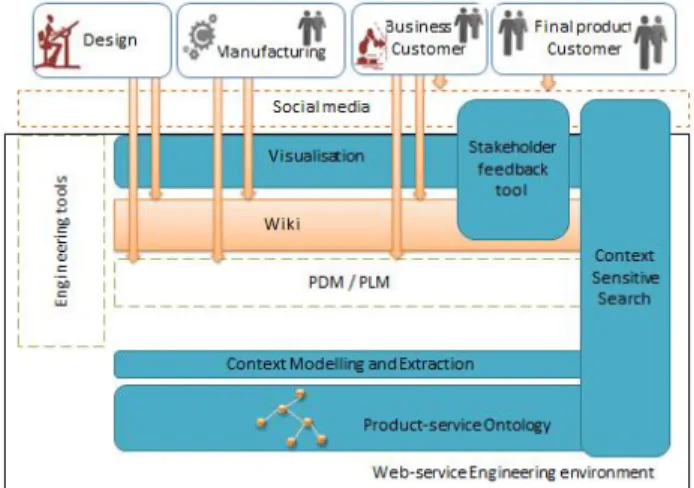
A new engineering environment for real time sharing of knowledge among various actors involved in service design within distributed enterprises is under development. The conceptual architecture of the environment is presented in Fig. 1. For many manufacturing companies services development starts to be or will be in a near future a core, value-generating process. To satisfy the need to differentiate them in the market place, nearly every company’s development processes have unique properties. The diversity and spectrum of methods and skills required to perform web service development processes is huge. Engineers from different disciplines and specialists with various backgrounds have to address a part or an aspect of PSS by having a partial model and collaborating with other experts. It is necessary to define common concepts and language used to interface between these models. However, it is not reasonable to totally integrate those models into a complete, holistic view of PSS, covering each and every aspect of all the methods used to define PSS. Furthermore, it is sensible that every discipline uses the best available tools to perform their tasks.
The new engineering environment is therefore built as an open solution with loose coupling of different tools. The requirements of several industrial companies in different sectors (all proving equipment for the manufacturing of mass customized products) concerning PSS development have been analyzed and serve as a basis for the definition of new engineering environments and set of tools. The aim is to provide an environment for supporting web services development with ICT solution that embraces the diversity of users, methods, tools in use. The backbone of the environ-ment are (PDM/PLM) solutions (e.g. open enterprise ARAS [11]) and social SW solutions. The advantages of the PDM/PLM systems are well defined structures of data corresponding to the well-organized industrial processes [12]. However, such systems, due to their often “rigid”
structures, may restrict possibilities to collect experience from various actors in the value chain, especially in dynamically changing conditions in highly flexible manufacturing. Especially experience from shop-floor (e.g., in adding sensors), and customers, is very difficult to be captured using classical PDM/PLM systems. Social SW allows for flexible capturing and presentation of experience of different actors, but often suffers from missing structures limiting reuse of these experiences.
Fig.1. Concept of web service engineering environment These solutions allow non-IT experts to provide their experiences in any form it fits them, e.g. problems in manufacturing of parts or assembly can be documented by the shop floor in a form which best suits specific manufacturing line/machine (each group can define its own ‘form’). The feedback from customers on the PSS use can be also provided in any form which suits specific customer
and/or service experts (maintenance staff, etc.). On the other hand, social media networks such as LinkedIn, Facebook, Twitter, Pinterest, Instagram, etc. allow gathering experiences of mass customers in very “free” forms.
The environment is a SOA-based open environment which combines open PDM/PLM and engineering systems and social SW, both wiki based solution for knowledge capturing of knowledge/experience of experts from manufacturing area, maintenance / service providers and business customers, and social networks/multimedia. The experience - based knowledge capturing via social SW is directly interrelated with the structured knowledge, collected within classical tools and by automatic monitoring of manufacturing processes, the product itself (e.g., sensors at machines) and usage (e.g., manufacturing processes where machines are used). The environment includes powerful visualization of knowledge, as well as a middleware to interface to various systems for automatic data gathering (e.g. Manufacturing Execution Systems - MES, Supervisory Control and Data Acquisition - SCADA, equipment, etc.) and Security, Trust & Privacy framework (for the sake of simplicity, middleware and security framework are not depicted in Fig. 1).
The objective is to allow engineers/designers, when using various engineering tools and/or PDM/PLM solutions to re-design/document/reconfigure product parts and service components, to have direct access to the experience from manufacturing area and business customers related to the corresponding part/service, but also to opinion/feedback of customers of final-product (e.g., features of shoes produced by the machine /component); see Fig. 2. The collaborative features allowing for real time sharing of knowledge between design teams and other actors are included.
The whole environment is made in CMfg, i.e., in order to allow for product–service co-design, the manufacturing environment (both manufacturing of machines/equipment and use of machines/equipment at the business customers) is virtually represented [4][13]. This PDM/PLM system is embedded in a cloud where all the actors in the value chain plus the machines and processes are able to provide data/knowledge and access the knowledge that is both saved in the PDM/PLM systems, as well as in the social SW solutions in the cloud. By this, dynamic feedback among various actors can be established, as well as life cycle aspects can be efficiently taken into account. The social SW is extended with a number of plugs-ins and additional function-ality to allow for effective capturing of the unstructured knowledge. Security aspects, especially critical for CMfg, are analyzed, and appropriate mechanisms will be integrated.
As explained above, the bonding element between the classical engineering tools, PDM/PLM and social SW is a common ontology for service. Research on product-service has been carried out for many years and in various disciplines; however, even a consolidated set of terminologies has not been established [14]. A common ontology has not been released in industrial practice. Thus, one of the goals of the research lies in developing flexible, open engineering environment and ontology to realize the environment and interconnect various SW approaches and tools. An overall ontology will be built starting from [14].
In order to support designers to easily obtain information/knowledge relevant for her/his current task within the enormous amount of data gathered by automatic data collection, knowledge within PDM/PLM and different engineering tools, knowledge /experience collected within social SW from manufacturing end customers, etc., a context sensitive search functionality is developed to support all other tools in the environment. Therefore, the whole solution is context sensitive. The context sensitivity includes four key elements: CM, context monitoring services, context extraction services and search [9]. CM represents an abstract description of collaborative work relevant for PSS design activities in general. To enable its direct use by context-sensitive services, CM is formally expressed as ontology. Its concepts, attributes and relations are directly derived from the collaborative situations in building web services in dynamic industrial settings. CM is based on the collaboration patterns, i.e., typically occurring forms of collaborative work relevant for PSS and extended with scenario specific concepts (processes, products, technology).
A set of generic context monitoring services provide basic monitoring functionalities to monitor processes in which data/knowledge is acquired (e.g. design, manufacturing area both were machines are produced and where they are used), needed to identify/extract context. The Context Extraction Services observe activities within the new environment using Monitoring services. Context Extraction Services analyze structured and unstructured data to determine the context of the current situation and to identify what activity the users are currently involved in. The Context Extractor uses Context Association Network and Context Hierarchy Tree approaches. By using an appropriate
CM and unstructured information provided by users or devices, the context extraction services process this unstructured information, to automatically annotate it.
Tools for analysis of stakeholder feedback enable context sensitive analysis of the knowledge gathered in wiki, social media networks and classical engineering tools. Specifically, the feedback from final-product customers, where mass customization plays central role, needs to be analyzed and provided to machine/equipment vendors in order that they can improve design of their services to accommodate mass customization requirements. Information sources on social networks are continuously mined to identify opinions about products, services and specific features. Using opinion mining, keywords identify products and features and associate the opinion expressed by customers.
IV. APPLICATION
The new environment is aimed at manufacturing companies producing equipment and delivering them at the global market in various mass production sectors (shoe, food packaging, etc.), which require new solutions for effective collaboration among various actors, as a most critical aspect of the PSS design process.
The environment is currently tested and applied at a German company producing machines for the shoe industry, which needs to combine feedback from their business partner (shoe manufacturers) and feedback from the shoe buyers in order to improve their machines and various services around these machines and allow for mass customization of shoes, which is one of the key requirement in today’s global shoe market. They intend to improve the design of their machines and web services around their products (e.g. maintenance and monitoring of their machines/systems). They also intend to use these web services (e.g., service for remote diagnostics) to automatically collect, in real time, data/knowledge on performance of their machines at their business customers, aiming to further enhance design of the machines and services. In order to allow for effective building of services by adding sensors at their machines, they need to establish feedback from their manufacturing area of their machines to design processes. Besides data which can be collected by automatic measuring in processes and over services, it is important to gather experience of people involved in these processes. Of special importance is to collect knowledge/experience of their service teams and business customers (shoe manufacturers) distributed all over the world. Therefore, they need to allow different actors to easily document their experience using web services, taking into account cultural differences in different world regions and highly variable conditions under which the machines are used (e.g., low education levels of the machine operators, etc.). The social SW solution proposed will allow collecting experience from maintenance, while the stakeholder feedback tool will analyze feedback from shoe buyers. Both types of knowledge will be correlated with the PDM/PLM solution and support building of various web services, i.e. the proposed combination of CMfg and social SW allows collecting of the experience of actors in an easy and less formalized way but structured enough to be re-usable for
improved web services around machines (e.g., for improved diagnostics). By this, they will build a unique system where knowledge from both machine manufacturers and customers are collected to be re-used for optimization of service design.
V. CONCLUSION AND FUTURE WORK
The main innovation lies in solving the crucial problem of how to support PSS design process at machine/equipment vendors, faced with the challenge of mass customization of final-products produced by their machines/equipment, by provision of appropriate knowledge, both formalized and experience based knowledge, based on combination of classical engineering tools, PDM/PLM systems and social SW solutions. This includes data mining of high volume of data provided by the shop-floor experts (manufacturers of the machines), business customers and final-product customers, as well as the context extraction from the content created/used within dynamic collaborative work and manufacturing processes and/or the data provided by different services. In order to achieve such a solution, the research provides several innovations: (a) It brings a step towards development of an engineering environment supporting development of PSS. As indicated in Section II, to date, there have been insufficient attempts to provide such an environment. However, the research in recent years has created a number of methods and SW useful for the development of such PSS engineering environment [15]. The research will focus on the development of ontology for PSS [12]. (b) This is one of the first attempts to combine classical engineering tools, PDM/PLM solutions with CMfg and social SW to efficiently provide experience and knowledge from shop-floor and user feedback from the global market to the web service designers’ desks. (c) The new solutions are context sensitive, in order to support the user to cope with enormous amount of knowledge to be managed and allow for higher re-usability of components and services [16]. (d) The research contributes to bringing data mining algorithms to higher maturity level applicable in (manufacturing) industry by enhancing existing and developing novel ones to meet the application requirements. The proposed combination of advanced technological solutions will bring considerable benefits to the manufacturing companies in terms of re-ducing time to market in building new and/or upgrading existing machines with web services as different manufactur-ability, environmental and final-product mass customization aspects will be effectively taken into account already in conceptual service design. The approach will allow for improvements in knowledge sharing across product-service lifecycle, as well as better product-service offerings addressing customer needs. It will also allow for better addressing sustainability across the entire service lifecycle.
The new environment and tools are currently under development and first testing trials by the users are going on.
ACKNOWLEDGMENT
This work is partly supported by the DIVERSITY (Cloud Manufacturing and Social Software Based Context Sensitive
Product-Service Engineering Environment for Globally Distributed Enterprise) project of EU’s H2020 framework, under the grant agreement no. 636692. This document does not represent the opinion of the European Community, and the Community is not responsible for any use that might be made of its content.
REFERENCES
[1] F. H. Beuren, M. G. Gomes Ferreira, and P. A. Cauchick Miguel, “Product-service systems: a literature review on integrated products and services,” J. Clean. Prod., vol. 47, May 2013, pp. 222–231.
[2] M. Boehm and O. Thomas, “Looking beyond the rim of one’s teacup: a multidisciplinary literature review of Product-Service Systems in Information Systems, Business Manage-ment, and Engineering & Design,” J. Clean. Prod., vol. 51, , Jul. 2013, pp. 245–260.
[3] M.P. Sorli, and D. M. Stokic, Innovating in Product/Process Development, Springer-Verlag, Heidelberg, 2009.
[4] X. V. Wang and X. W. Xu, “ICMS: A Cloud-Based Manufacturing System,” in Cloud Manufacturing, W. Li and J. Mehnen, Eds. Springer London, 2013, pp. 1–22.
[5] D. Ortiz-arroyo, “Chapter 2: Discovering Sets of Key Players in Social Networks,” in Computational Social Network Analysis, A. Abraham, A.-E. Hassanien, and V. Snágel, Eds. London: Springer London, 2010.
[6] H. Meier, R. Roy, G. Seliger , Industrial Product-Service Systems - IPS2. In: CIRP Annals - Manufacturing Technology 59 (2), 2010, pp. 607–627.
[7] L. Pesonen, S. J. Salminen, J-P Ylén, P. Riihimäki, Dynamic simulation of product process, in Journal Simulation Model-ling Practice and Theory Vol. 16 No. 8., 2008, pp. 1091-1102. [8] Strang, T. and C. Linnhoff-Popien. A Context Modeling Survey. in Workshop on Advanced Context Modelling, Rea-soning and Management as part of the Conference on Ubiquitous Computing - The Sixth International Conference on Ubiquitous Computing. 2004. Nottingham, England. [9] D. M. Stokic, S. Scholze, and O. Kotte, “Generic
Self-Learn-ing Context Sensitive Solution for Adaptive ManufacturSelf-Learn-ing and Decision Making Systems”, ICONS 2014, Nice, 2014. [10] B. Snyder, R. Barzilay. "Multiple Aspect Ranking using the
Good Grief Algorithm". Proceedings of the Joint Human Language Technology/North American Chapter of the ACL Conference (HLT-NAACL), 2007, pp. 300–307.
[11] ARAS PDM Software [Online], Available from:
http://www.aras.com/standards/standard.aspx?name=PDM-Software, last accessed on 19.02.2015
[12] A. Saaksvuori, and A. Immonen, Product Lifecycle Management, 2nd ed., Springer, Berlin, 2008.
[13] A. Weiss, Computing in the clouds, Networker, vol. 11, 2007, pp. 16-25.
[14] G. Annamalai, et.al. An Ontoloogy for PSS, Chapter in Functional Thinking for Value Creation, Springer-Verlag, 2010, pp. 231-236.
[15] J. Lee, and M. AbuAli, “Innovative Product Advanced Service Systems (I-PASS): meth-odology, tools, and applications for dominant service design,” Int. J. Adv. Manuf. Technol., vol. 52, no. 9–12, , Feb. 2011, pp. 1161–1173 . [16] Y. Geum and Y. Park, “Development of technology roadmap
for Product-Service System (TRPSS),” in 2010 IEEE International Conference on Industrial Engineering and Engineering Management (IEEM), 2010, pp. 410–414.