K. Rustan M. Leino
Microsoft Research, Redmond, WA, USA [email protected]
Manuscript KRML 178, working draft 24 June 2008.
Abstract. Boogie is an intermediate verification language, designed to make the prescription of verification conditions natural and convenient. It serves as a com-mon intermediate representation for static program verifiers of various source languages, and it abstracts over the interfaces to various theorem provers. Boogie can also be used as a shared input and output format for techniques like abstract interpretation and predicate abstraction. As a language, Boogie has both mathe-matical and imperative components. The imperative components of Boogie spec-ify sets of execution traces, the states of which are described and constrained by the mathematical components. The language includes features like paramet-ric polymorphism, partial orders, logical quantifications, nondeterminism, total expressions, partial statements, and flexible control flow. The Boogie language was previously known as BoogiePL. This paper is a reference manual for Boogie version 2.
Hello, my name is Rustan Leino. I’m a computer scientist. I write a lot of papers. That little IPL article on subscripts in technical presentations? That was mine. In 1992, I went up to Palo Alto, California to a research lab called the Systems Research Center. Don’t look for it; it’s not there anymore. But that summer, I saw a tool that for me redefined the word “light-weight formal methods”. I remember being knocked out by its. . . its potential, its raw power– and its automation. That tool was Modula-3’s now-legendary Extended Static Checker. Sixteen years and several verification tools later, theorem-prover based software verification is still trying to reach that potential. And it’s earned a dis-tinguished place in computer science history as one the trade’s most expertise-demanding tools. So in the late fall of 2006, when I heard that the intermediate verification language Boogie was releasing a new version called “Smell the Polymorphism”, and was planning its first major publications in almost three years to promote that version, well needless to say I jumped at the chance to write the documentation—the, if you will, “rockumentation”—that you’re about to read. I wanted to capture the. . . the uses, the sounds. . . the smells of a hard-working verification language, on the road. And I got that; I got more. . . a lot more. But hey, enough of my yakkin’. Whaddaya say? Let’s Boogie!
0
Introduction
A standard technique in program verification is to transform a given program into a set ofverification conditions, logical formulas whose validity implies that the program
satisfies the correctness properties under consideration. The verification conditions are then processed with the help of a theorem prover, where a successful proof attempt shows the correctness of the program, and a failed proof attempt may give an indication of a possible error in the program.
Experience with some automatic program verifiers [6, 4, 1] suggests that the com-plex task of generating verification conditions for modern programming languages can be managed by separating the task into two steps: a transformation of the program and its proof obligations into an intermediate language (an intermediate representation that is structured more like a program than a formula), and then a transformation of that intermediate-language program into logical formulas. The first of these steps encodes the semantics of the source program’s constructs in terms of primitive program con-structs, records as assumptions properties that are guaranteed in any execution of the source program, and prescribes what correctness means (that is, what conditions need to hold where in order for the program to be considered correct).
This paper is a reference manual for Boogie, an intermediate language designed to accommodate the encoding of verification conditions for imperative, object-oriented programs. Previously known as BoogiePL, the Boogie language is currently used and checked by the program verifier also called Boogie [1]. At the time of this writing, translations into Boogie exist or are under way for several languages: Spec# [1], C [2, 10], Dafny, Java bytecode with BML, and Eiffel. The paper describes the syntax, type checking, and semantics of Boogie, as well as a rationale for its design and examples of how to encode proof obligations and assumptions in the language.
The next section gives an overview of Boogie 2. The bulk of the remaining sections detail the language constructs, types, expressions, and statements. The last sections give additional examples and related work.
1
Overview
At the top level, Boogie features seven kinds of declarations. The mathematical con-structs introduce types, constants, functions, and axioms. The imperative concon-structs introduce global variables, procedure declarations, and procedure implementations.
Type declarationsintroduce type constructors. For example, typeWicket;
declares a type (more precisely, a nullary type constructor) intended to represent wick-ets. Symbolic constants are introduced byconstant declarations, like
constw:Wicket;
which says that w is some fixed (but unspecified) value of type Wicket. Function declarationsintroduce mathematical functions. For example,
functionage(Wicket)returns(int);
declares a function intended to return the age of wickets. Properties of constants and functions are postulated byaxiom declarations. For example,
says thatage returns 7 forw.
The program state is made up of mutable variables. Globalvariable declarations introduce the state on which all procedure operate. For example,
varfavorite:Wicket;
introduces a variable for holding the current favorite wicket. Aprocedure declaration gives a name to a set of execution traces, which are specified by pre- and postconditions. For example,
procedureNewFavorite(n:Wicket); modifiesfavorite;
ensuresfavorite==n;
Finally, animplementation declarationspells out a set of execution traces by giving a body of code. The implementation is correct if and only if its set of traces is a subset of the traces specified by the corresponding procedure. For example,
implementationNewFavorite(n:Wicket) {
favorite:=n; }
gives a (correct) implementation of procedureNewFavorite.
The grammars shown in this paper use| to separate alternatives. The superscript ? indicates that the preceding component is optional, the superscripts ∗ and + indicate a repetition of 0-or-more and 1-or-more, respectively, components juxtaposed, and
,
∗ and,
+ indicate 0-or-more and 1-or-more components separated by commas. Boldface words indicate keywords, and non-| non-superscript symbols (like semi-colons and parentheses) stand for themselves.A Boogie program has the following form: Program ::= Decl∗
Decl ::= TypeDecl|ConstantDecl|FunctionDecl|AxiomDecl | VarDecl |ProcedureDecl |ImplementationDecl The order of the declarations in a program is immaterial.
Identifiers, indicated by the grammar component Id, consist of characters drawn from a large set. This set consists of letters (including non-English letters from the Unicode alphabet), digits (but an identifier may not being with a digit), and
underscore
. dot
$ dollar sign # hash sign
0 single quote (prime) ` back quote
∼ tilde ˆ caret
\ backslash ? question mark
The identifiers declared in a Boogie program fall into five independent name spaces: types, functions, constants plus variables, procedures, and attributes. The name space for types contains global type names (type constructors and type synonyms) and scoped type variables (appearing in map types and in quantification expressions). The global type names must be distinct from each other and the type variables in any scope must be distinct from each other, but scoped type variables are allowed to shadow global type names. Similarly, the name space for constants plus variables contains global names (constants and global variables) and scoped names (formal parameters, local variables, and quantified variables). The global names must be distinct from each other and the scoped names in any scope must be distinct from each other, but scoped variables are allowed to shadow global names.
2
Types
In addition to built-in types, Boogie allows user-defined type declarations:
TypeDecl ::= TypeConstructor|TypeSynonym
This section describes type constructors, then built-in types, and finally type synonyms.
2.0 Type constructors
Type constructors are declared according to the following grammar:
TypeConstructor ::= typeAttribute∗finite?Id Id∗;
Type declarations, along with all other top-level declarations and some other constructs, can be decorated with a set ofattributes; these are described in Section 11.
The declaration above defines atype constructornamed by the first Id. The type constructors in a program must have distinct names, and these names must also be distinct from any type synonym. The number of remainingId’s specify the number of type arguments that the type constructor takes, but the particular Id’s used to indicate the number of these arguments is not relevant. In particular, the type-argumentId’s can contain duplicates; for example, they may all be the identifier .
As an example,
typeBarrelα;
declares a unary type constructor intended to represent barrels for some contents. For example, Barrel int and Barrel Wicket are two instantiations of the Barrel type constructor, representing barrels of integers and barrels of wickets, respectively.
Each instantiation of a type constructor gives rise to a type. The cardinality of each type is non-zero; that is, each type represents a nonempty set of individuals. Unless
the type constructor is declared with finite, the type has an infinite number of indi-viduals. A type constructed by a finite type constructor may have a finite number of individuals. For example, a closed enumeration can be declared as a finite type:
type finiteRGBColor; const uniquered:RGBColor; const uniquegreen:RGBColor; const uniqueblue:RGBColor;
axiom(∀ce:RGBColor • ce==red ∨ce==green ∨ce==blue);
(0)
A subtle, but important, point in this example is that without the finite keyword, RGBColor would have an infinite number of values, in which case the axiom would be tantamount to false. Note that it is the declaration of the type constructor, not its type arguments, that determines whether or not it yieldsfinite types.
2.1 Built-in types
Atypeis either aprimitive type, an instantiated type constructor or type synonym, or a possibly polymorphicmap type. In addition, universally quantified type identifiers can denote types.
Type ::= TypeAtom|MapType
| Id TypeCtorArgs? type identifier, or type
constructor with type arguments TypeAtom ::= bool|int primitive types
| bv0|bv1|bv2| · · · bit-vector types | (Type)
MapType ::= TypeArgs?[Type
,
+]Type TypeArgs ::= hId,
+i| < Id
,
+ > ASCII syntax for the same TypeCtorArgs ::= TypeAtom TypeCtorArgs?| Id TypeCtorArgs? | MapType
The primitive typebool denotes the booleans and intdenotes the mathematical inte-gers. The variousbv types represent bit vectors consisting of the indicated number of bits. The semantics of types is that no individual belongs to more than one type; that is, different types represent disjoint sets of individuals.
A (possibly polymorphic) map type denotesmaps, aka update-able maps, aka non-rigid functions, aka heterogeneous arrays. Syntactically, the domain types are listed within square brackets, followed by the range type. For example, each individual of [RGBColor]int maps RGB-color individuals to integers, and each individual of the type [int,int]bool is a two-dimensional array of booleans. Domain types need not be finite; for example,[Wicket]bool represents maps from all wickets to booleans and [int]Wicket represents maps from all mathematical integers to wickets.
A map type also indicates a number of universally quantified type identifiers, syn-tactically listed first within angle brackets. The order of the bound type identifiers is
not important, but they must all be distinct from each other and from all bound type identifiers in enclosing types. If this list is empty, it is omitted and the map type is said to bemonomorphic. If the list is nonempty, the map type is said to bepolymorphic. For example, in the following,m maps wicket barrels to wickets whereasn maps any kind of barrel to individuals of that barrel’s contents type:
constm: [Barrel Wicket]Wicket; constn:hαi[Barrelα]α;
So, if bi has type Barrel int, then the map-selection expression n[bi] denotes an integer, and if bw has type Barrel Wicket, then n[bw] denotes a wicket. Boogie supports Unicode input and allows ASCII synonyms, like<for hand>for i.
There is a restriction on polymorphic map types. Each bound type variable must be mentioned somewhere in the map type’s domain types. For example, hαi[int]α is not allowed, because the domain typeintdoes not mention α. Although it is not actually necessary for defining type checking for expressions per se—one could let the enclosing context further constrain the bound type variables, in the usual way—this restriction means that every map-selection expression has a unique type, regardless of the context where the map selection appears.
Modulo this restriction, Boogie’s type system thus supports higher-rank types, in the sense that a map can take another map as a domain argument. In some languages, universal types hαi. . . are considered for any types, but in Boogie they are only used with map types, which is therefore reflected in the Boogie syntax.
Note that the parsing of type-constructor arguments and type-synonym arguments is right associative (see grammar production TypeCtorArgs). Stated differently, the arguments of a type constructor (or type synonym) are parsed as long as possible or until a map type is encountered. Parentheses can be used to override the precedence levels, as usual. Here are several examples:
typeC α β;
consta:C Wicket Wicket;
constb:Barrel Barrel Wicket; // error (here, the firstBarrelis given // two arguments instead of one) constc:Barrel(Barrel Wicket);
constd:Barrel[int]Barrel Wicket; // same asBarrel([int] (Barrel Wicket)) conste:C Wicket Barrelint; // error (C expects 2 arguments, not 3) constf:C Wicket(Barrelint);
constg:C Wicket[int]Barrelint; // same asC Wicket([int] (Barrelint)) consth:C [int]intWicket; // parse error (extraneousWicket) consti:C [int]Wicket Wicket; // error (firstWicket expects 0 arguments) constj:C([int]Wicket)Wicket;
2.2 Type synonyms
Type synonyms are declared as follows:
This declaration introduces atype synonymwhose name is the first Id, whose formal type arguments are given by the remainingId’s, and whose definition is given byType. The type synonyms in a program must must have distinct names, and these names must also be distinct from any type constructor. The type arguments must all be distinct. The right-hand side Type can mention the type arguments (and other type synonyms and type constructors) and must resolve to a properly formed type. For example, in:
typeMySynonym α=int;
typeComplicatedInt =MySynonym(MySynonymbool); typeBogus =MySynonym MySynonym; // error
the declaration of the unary type synonymMySynonym is legal (it is allowed to ignore its argument,α, in the definition) and so is the declaration ofComplicatedInt, but the declaration of Bogus is not legal, because the second occurrence of MySynonym is used without an argument type.
A type synonym is simply an abbreviation for the given type; any use of it, which syntactically looks like the use of a type constructor, is simply replaced by the right-hand sideType in which:
– all bound type arguments are renamed to avoid name capture, and
– the type arguments to the type synonym are replaced by the types provided in the use.
For example,
typeMultiSet α= [α]int;
defines, for any type α, MultiSet α as a synonym for the type [α]int that repre-sents maps from α to integers. Semantically, there is no difference between the use of a type synonym (like MultiSet Wicket) and the type to which it expands (here, [Wicket]int).
As another example, given: typeS α β=hγi[β, γ]int;
(where the right-hand side is a polymorphic map type with bound type variable γ, as introduced below), the use:
Sbool(S Wicket hγi[γ]γ) is semantically equivalent to:
hi[ hδi[hγi[γ]γ , δ]int , ] int
Note that the formal type argumentα is not used, so bool andWicket do not occur in the expansion. Note also that the bound type variable γ in the definition of the type synonym is renamed in order to avoid name capture.
Type synonyms are expanded before any restriction on the enclosing context is ap-plied. For example, given the declaration of MySynonym above,
is not a legal type:MySynonymβ is itself legal and is thus expanded tointaccording to its definition above. After expansion, the enclosing context becomes hβi[int]int, which is not legal, because β is not used in the domain type of the map type.
Definitions of type synonyms are not allowed to be recursive (or mutually recur-sive). More precisely, consider the directed graph whose vertices are the type synonyms in a program, and in which there is an edge from a type synonym S to each type syn-onym mentioned in its definition. Then, this graph must be acyclic.
3
Constants and functions
Constant declarations have the following syntactic form:
ConstantDecl ::= constAttribute∗unique?IdsType OrderSpec; IdsType ::= Id
,
+:TypeFor each Id in the IdsType, the declaration introduces Id as a symbolic constant of type Type. The constants in a program must have names that are distinct from other constants and global variables. The attributes, unique designation, and OrderSpec clause apply to each of theId’s introduced, as if eachId were introduced in a separate const declaration.
Declaring a constant with unique makes manifest that the constant has a value that is different from the values of other unique constants of the same type. By using unique, one can avoid declaring axioms for the quadratically many distinctions. For example, the use ofuniquein the declaration (0) ofRGBColor constants implies the condition expressed by the following axiom:
axiomred 6=green ∧green6=blue ∧blue6=red;
The OrderSpec clause optionally specifies the relative position of the constant in the partial order <: for typeType. Section 10 gives the details.
A function declaration has one of the following syntactic forms: FunctionDecl ::= functionAttribute∗Id FSig ;
| functionAttribute∗Id FSig{Expr }
It introduces a function named Id. The functions in a program must have distinct names. The function’s type signature has the form:
FSig ::= TypeArgs? (FArg
,
∗)returns(FArg ) FArg ::= FArgName?TypeFArgName ::= Id:
The signature includes any number of arguments and one result type.
A function can be polymorphic. Universally quantified type identifiers are intro-duced inTypeArgs. They can then be used as types in the declaration of the function’s arguments and result, as well as in the optional Expr. The identifiers introduced in TypeArgs must not contain any duplicates. For example,
declares a function intended to return the volume of any kind of barrel.
There is a restriction that every type identifier introduced inTypeArgsmust be used (after the expansion of type synonyms) somewhere among the types of the function’s arguments.
Optionally, the function arguments and result value can be named, for example to document the purpose of each argument. For example, the use of argument names in
functioncylinderVolume(radius:int,height:int)returns(int);
serves as a human aid in remember the order of the arguments. Among the argument and result names supplied, no duplicates are allowed.
The second form of function defines a value for the function. TheExpr is allowed to refer to theId’s supplied as argument names. A declaration
functionattrs F(args)returns(res){E } is equivalent to
functionattrs F(args)returns(res); axiom(∀args0 • F(argIds)==E );
whereargs0 is args with any omitted argument names filled in by fresh identifiers and argIds is the list of argument names in args0.
4
Expressions
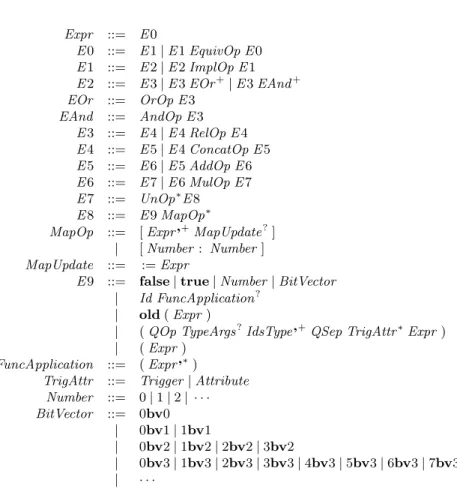
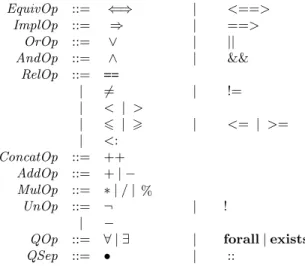
Boogie expressions include constants, variables, equality and arithmetic relations, boolean connectives, simple arithmetic operators, logical quantifiers, and an ordering operator. They follow the grammar in Fig. 0. The operators come in both Unicode form and ASCII form, as shown in Fig. 1.
Most of the expressions are standard and self-explanatory. Note that ∨ and ∧ have equal binding power but do not associate with each other; thus, an expression that mentions both must necessarily use parentheses somewhere to disambiguate.
4.0 Division and modulo
Because division and modulo are defined differently in different source languages, Boo-gie provides syntax for the operators/ and%but gives them no meaning. Instead, the meaning of these operators can be axiomatized according to their desired meaning. For Modula-3 or Java, the following axioms can be used:
axiom(∀x:int,y:int• {x%y} {x/y} x%y ==x−x/y∗y ); axiom(∀x:int,y:int• {x%y}
(0<y ⇒ 06x%y ∧ x%y<y)∧ (y <0 ⇒ y <x%y ∧ x%y60) );
Expr ::= E0
E0 ::= E1|E1EquivOp E0 E1 ::= E2|E2ImplOp E1 E2 ::= E3|E3EOr+|E3EAnd+ EOr ::= OrOp E3
EAnd ::= AndOp E3 E3 ::= E4|E4RelOp E4 E4 ::= E5|E4ConcatOp E5 E5 ::= E6|E5AddOp E6 E6 ::= E7|E6MulOp E7 E7 ::= UnOp∗E8
E8 ::= E9MapOp∗
MapOp ::= [Expr
,
+MapUpdate?] | [Number: Number] MapUpdate ::= :=ExprE9 ::= false|true|Number|BitVector
| Id FuncApplication?
| old(Expr)
| (QOp TypeArgs?IdsType
,
+QSep TrigAttr∗Expr)| (Expr) FuncApplication ::= (Expr
,
∗)TrigAttr ::= Trigger|Attribute Number ::= 0|1|2| · · ·
BitVector ::= 0bv0
| 0bv1|1bv1
| 0bv2|1bv2|2bv2|3bv2
| 0bv3|1bv3|2bv3|3bv3|4bv3|5bv3|6bv3|7bv3
| · · ·
EquivOp ::= ⇐⇒ | <==>
ImplOp ::= ⇒ | ==>
OrOp ::= ∨ | ||
AndOp ::= ∧ | &&
RelOp ::= ==
| 6= | !=
| < | >
| 6 | > | <= | >=
| <: ConcatOp ::= ++
AddOp ::= +| −
MulOp ::= ∗ |/| %
UnOp ::= ¬ | !
| −
QOp ::= ∀ | ∃ | forall|exists
QSep ::= • | ::
Fig. 1.Expression operators, shown in both their Unicode (left column) and ASCII (right column) forms.
whereas for C, C#, and Spec#, the following axioms can be used:
axiom(∀x:int,y:int• {x%y} {x/y} x%y ==x−x/y∗y ); axiom(∀x:int,y:int• {x%y}
(06x ∧ 0<y ⇒ 06x%y ∧ x%y <y)∧ (06x ∧ y <0 ⇒ 06x%y ∧ x%y <−y)∧ (x 60 ∧ 0<y ⇒ −y <x%y ∧ x%y60)∧ (x 60 ∧ y <0 ⇒ y <x%y ∧ x%y 60) );
These axioms are not complete and may in some applications of Boogie need to be extended with further axioms. For example, the following axioms may sometimes be useful:
axiom(∀x:int,y:int• {(x+y) %y}
06x ∧ 0<y ⇒ (x+y) %y ==x%y ); axiom(∀x:int,y:int• {(y+x) %y}
06x ∧ 0<y ⇒ (y+x) %y ==x%y ); axiom(∀x:int,y:int• {(x−y) %y}
06x−y ∧ 0<y ⇒ (x−y) %y ==x%y ); axiom(∀a:int,b:int,d:int• {a%d,b%d}
26d ∧ a%d ==b%d ∧ a<b ⇒ a+d6b);
4.1 Map selection and update
A map range value is selected by supplying values in the map’s domain, given in the same order as the domain types are declared. For example, given the map
the expressiona[5,red]denotes the wicket at5,red. The map update expressiona[5,red:=w] returns a map, namely the map that is like a except possibly at 5,red, where it has valuew. Note that the map update expression does not change the value of the mapa; it simply returns a map whose value is very much like that ofa.
Maps do not necessarily satisfyextensionality—the property that maps are equal if all their elements are equal. For example, extensionality would imply:
b[j:=b[j]]==b
but this property does not necessarily hold in Boogie.
4.2 Bit vectors
Bit-vector literals specify their own type. A literal XbvKis legal when X (which is a number represented in decimal) is 0 or is expressible within Kbits. Other than equality and disequality (6=), only two operations are defined on bit vectors: extraction and concatenation.
For a bit vector b of type bvK and literals M and N, theextractionexpression b[N:M] denotes the bit vector obtained by first dropping the M least significant bits of band then returning the nextN−M least significant bits. In other words,b[N:M] denotes the N −M bits of b starting at bit M. The result has type bv(N−M). The extraction expression requires K>N >M >0.
For bit vectors b and c of types bvK and bvN, respectively, theconcatenation expressionb++cdenotes the bit vector of typebv(K+N)consisting of the bits from b concatenated by the bits of c.
For example,(13bv6 ++ 4bv3)[5: 2]is3bv3, since (showing literals in non-Boogie binary notation):
(0011012++ 1002)[5: 2] = { concatenation }
0011011002[5: 2]
= { drop the 2 low-order bits } 00110112[3: 0]
= { select the 3 low-order bits } 0112
Note that an extraction expression b[N:M] indicates a half-open interval of bits, going from bitM to, but not including, bitN. The advantages of half-open intervals are the familiar ones: subtracting the two bounds yields the number of bits in the result— for example, b[24: 18] is a vector of 24−18 = 6 bits—and concatenation fuses its arguments if the “middle” bound is repeated—for example,
b[24: 18] ++b[18: 7] == b[24: 7]
since the “middle” bound 18 is repeated. The advantage of reversing the order of the argumentsM andN (that is, listing them in reverse numerical order) is that this gives the familar representation of bit vectors as binary numbers, with the least-significant bit
to the right. For example,0bv10 ++b[24: 18]zero-extends the 6-bit quantityb[24: 18] to a 16-bit word. Pictorially, a familiar representation like:
b:
32 30 24 18 7 6 5 0
has the following subdivisions:
b[32: 30] ++b[30: 24] ++b[24: 18] ++b[18: 7] ++b[7: 6] ++b[6: 5] ++b[5: 0] whereb is of typebv32.
A Boogie program can declare additional bit-vector operations as functions. The properties of these functions can be defined by axioms. Alternatively, as explained in Section 11, prover-specific attributes can be used to identify such functions with the prover’s native support of bit vectors.
4.3 Old expressions
Postconditions and procedure implementations aretwo-state contexts. This means that it is possible to refer to two different values of each variable. In a postcondition, the two states are the pre- and post-states of the procedure’s invocations, and in a procedure implementation, the two states are the pre-state of the procedure and the current state. In both cases, the pre-state value of an expression is denoted by enclosing it as the argument to old. For example, in the postcondition of a procedure, if x and y are global variables, thenold(x+y)refers to the value of x+y on entry to the procedure, whereas x+y not enclosed inside anyold expression denotes the value ofx+y on exit from the procedure.
Only global variables are affected byoldexpressions. For example, ifais a global variable,b is a local variable, andcis an out-parameter, then the use ofold(a+b+c) in a procedure implementation is equivalent toold(a) +b+c. Stated differently,old distributes to the leaves of expressions and is the identity for every leaf expression that is not a global variable. Nested occurrences of olddo not further change the meaning of the expression; old(old(E)) is equivalent to just old(E). In other words, old is idempotent.
4.4 Logical quantifiers
Boogie supports both universal and existential quantifiers. For example, the expression (∀t:Wicket • age(t)620 )
says that no wicket is older than 20.
The bound variables among the IdsType’s must be distinct and must be different from local variables, parameters, and other bound variables in scope (but they may have the same names as constants and global variables). The bound variables are in scope in the body of the quantifier expression and in itsTrigAttr components.
In addition to theIdsType bound variables, the quantifier can declare bound type variables in TypeArgs. Such type variables must be distinct and must be different from other type variables in scope. The type variables may be used in the types of the IdsType bound variables, in the TrigAttr components, and in the body of the quan-tifier. In fact, each type variable introduced must be mentioned somewhere within the types of theIdsType’s. For example,
(∀ hαix:int, y:Barrelα• Q(x,y) ) and
(∀x:int• (∀ hαiy:Barrelα• Q(x,y) )) are legal whereas
(∀ hαix:int• (∀y:Barrelα• Q(x,y) )) // error
is not (because the type of the bound variable in the outer quantifier does not depend on
α).
The bound type variables are universally or existentially quantified as indicated by QOp. For example,
(∀ hαib:Barrelα• P(b) )
says thatP(b)holds for all typesαand all valuesb:Barrelα. And: (∀ hαib:Barrelα• P(b) )
says that there exists a typeαand a valueb:Barrelαsuch thatP(b)holds.
Note, an expression that quantifies over types is not the same as a universal (or extential) type. Also, a quantified expression always has type bool, never a universal (or existential) type. If this is a point of confusion, it may help to consider the higher-order function ∀, which takes a function, say f, as argument and returnstrue if and only if f returnstrue on all off’s inputs. Then, a quantification(∀x:T • E )over a bound variable x can be viewed as the higher-order function ∀ applied to the value abstraction(λx:T • E ). And a quantification(∀ hαix:· · · • E )can be viewed as the higher-order function∀ applied to the type abstraction(Λ α• (∀x:· · · • E )).
Like top-level declarations, quantifiers can be decorated with attributes. In addition, quantifiers can include trigger expressions. Such attributes and triggers are described in Section 11.
5
Type checking of expressions
On the whole, type checking in Boogie is humdrum. Only map operations and equality are noteworthy. Map selection and update operate on polymorphic maps, which means that the corresponding type rules consider the instantiation of generic types. Equality is type checked rather liberally, allowing two expressions to be compared if there is some instantiation of type parameters that makes the two operands have the same type. The
semantic meaning ofa==b is that the evaluation of expressionsa andb lead not only to the same value but also to values of the same type.
Well-typing is expressed by the judgmentT,V a:T, which says that in a
con-text with type parametersT and identifier type bindingsV (likex:T andfhαi(T)returns(U)), expressiona has type T.
T,Va:bool T,Vb:bool ⊕ ∈ { ⇐⇒, ⇒ , ∨, ∧ } T,V a⊕b:bool
T,Va:bool T,V¬a:bool
T,Va:int T,Vb:int ⊕ ∈ {<,6,>, >} T,Va⊕b:bool
T,Va:int T,Vb:int ⊕ ∈ {+,−,∗, /,%} T,V a⊕b:int
T,Va:int T,V−a:int
T,Va:bvK T,Vb:bvN T,V a++b:bv(K+N) T,Va:bvK K>N>M>0
T,Va[N:M] :bv(N−M) T,Va:T
T,V(a) :T
T,V a:T T,Vold(a) :T T,V
T,Vfalse:bool
T,V T,V true:bool T,V N >0
T,VN :int
T,V K >0 (N = 0)or(06N <2K)
T,V NbvK:bvK T,Va:T T,Vb:U Tσ==Uσ
T,V a==b:bool T,V¬(a==b) :bool
T,V a6=b:bool
T,V a:T T,Vb:T T,Va<:b:bool
(T, α),(V,x:T)a:bool (T, α),(V,x:T)attr t for allt∈t Æ∈ {∀,∃}
T,V (Æhαix:T • t a) :bool
T,V a:hαi[U]V T,V b:Uσ for all(b,U)∈(b,U) dom(σ) ={α} T,Va[b] :Vσ
T,V a:hαi[U]V dom(σ) ={α}
T,V e :Vσ T,V b:Uσ for all(b,U)∈(b,U) T,V a[b:=e] :hαi[U]V
T,V x:T ∈ V T,V x :T
T,V fhαi(U)returns(V)∈ V dom(σ) ={α} T,V a:Uσ for all(a,U)∈(a,U)
T,Vf(a) :Vσ
We have now seen enough of Boogie’s type system and expressions to consider some examples.
5.0 Example: Modeling memory
One of the first and most important decisions one makes when designing a translation of a source language into Boogie is the representation of memory. In a type-safe source language with object references and fields, one option is to split the memory (the heap) up into one part corresponding to each field. For example, a program containing the following class:
class C{ i n t data ; C n e x t ; }
would give rise to a Boogie program that includes the following declarations: typeRef;
varC.data: [Ref]int; varC.next: [Ref]Ref;
whereRef is a type intended to represent object references. Here, each field is a map from object references to values. A field selection expressiono.datain the source lan-guage is then translated into the Boogie expressionC.data[o], which has type int(see type rules above). In addition to the fields declared in the source program, it is typical that a Boogie encoding would model a number of ghost fields. For example,
varalloc: [Ref]bool;
keeps track of which object references have been allocated in the current state. However, it is also possible to define the heap as one variable, mapping object ref-erences and field names to values. Since the values are of different types, depending on which field name is used, it is convenient to use a polymorphic map, here defined via a type synonym:
typeFieldα;
typeHeapType =hαi[Ref,Fieldα]α; varHeap:HeapType;
The fields in the source-program snippet above, and a ghost field for allocation, are now translated into distinct constants:
const uniqueC.data:Fieldint; const uniqueC.next:Field Ref; const uniquealloc:Fieldbool;
The field selection expression o.data is now translated into the Boogie expression Heap[o,C.data], which has typeint(in the type rule for map selection above, useσ
as the substitution of intfor α).
There are several advantages to encoding the heap in this way, instead of as one individual variable per field. One advantage is conciseness, because functions that op-erate on the heap need only take one argument. For example, a boolean model field m in a classC can be modeled by a function:
functionC.m(heap:hαi[Ref,Fieldα]α, this:Ref)returns(bool); Another important advantage is the ability to quantify over fields. For example, the quantification can easily range over fields that are not in scope in the source-language module translated into Boogie, which enables modular verification in a nice way.
Yet another option to model the heap as mapping each object reference to a map from field names to values, in other words a currying of the heap representation we just considered:
varObjStore: [Ref]hαi[Fieldα]α;
This representation may be advantageous if changes to entire objects (likeObjStore[o] :=r) occur more frequently than changes to individual fields (ObjStore[o][data] := 5), or if it often is necessary to copy all fields of one object into the fields of another (ObjStore[o] :=ObjStore[template]). It also gives a clean way to define a model-field function that depends only on the field of the object itself:
functionC.m(this:Ref, dataRecord:hαi[Fieldα]α)returns(bool); Unlike the C.m function we considered earlier, this function takes as arguments only those parts of the heap that make up the fields of the object. For a model-field selec-tion expression o.m, the translation using this function is C.m(ObjStore[o]). Note, however, that a model field is commonly defined over the fields of more than object, in which case it is necessary to pass in larger parts of the heap, possibly the entire heap as in the earlier definition ofC.m.
5.1 Example: Frame conditions
In program verification, it is important to curb the effects that a procedure can have. In Boogie, this is done by a combination of modifies and ensures clauses. Since Boogie’s modifies clauses are coarse-grained, one uses a postcondition that gives more detail. This particular postcondition is often referred to as theframe conditionof the procedure. Suppose a source-language method is allowed to modify thedata field of a parameter
p, and that it is also allowed to allocate new objects and modify their fields. The Boogie modifies clause and frame condition for this can be written:
modifiesHeap;
ensures(∀ hαio:Ref, f:Fieldα•
Heap[o,f] =old(Heap)[o,f]∨ (o=p ∧f =C.data)∨ ¬old(Heap)[o,alloc] );
There are several interesting things to note about this frame condition. First, it contains a quantification over all fields,f. Second, the type off is supposed to be any field, which is writtenFieldα, where αdenotes any type. Since αneeds to be bound somewhere, the universal quantification over type α is used. Third, it is necessary to be able to compare f against the particular field name C.data, which is done by the equality f =C.data. But f (of type Field α) and C.data (of type Field int) do not have the same type; nevertheless, Boogie allows the equality comparison (see the type rules), because there is some overlap in their types, given the fact thatαis a type variable.
6
Axioms
An axiom declaration has the form
AxiomDecl ::= axiomAttribute∗Expr ;
The given expression must be of type boolean. Global variables and old expressions are not allowed in Expr. The axiom expresses some properties about the program’s constants and functions. The effect of this is to restrict execution traces, as described later.
Note that just like first-order logic makes it possible to write an antecedent that is equivalent to false, trivially rendering the formula valid, it is possible to write incon-sistent axioms in Boogie. For example, the inconincon-sistent axiom
axiom false;
has the effect of eliminating all execution traces, which means that all implementations in the Boogie program are trivially correct.
7
Mutable variables, states, and execution traces
The imperative parts of a Boogie program operate on astate space. The program state space is the Cartesian product of variables, including a fictitious variablegold for every
global variable g. A state thus assigns a value to each variable. In the body of a pro-cedure implementation, local variables, out-parameters, and those global variables ap-pearing in any of the procedure’s modifies clauses aremutable variables, which means they can changed by statements in the procedure’s implementation.
Global variables are in scope for all procedures and are declared as follows: VarDecl ::= varAttribute∗IdsTypeWhere
,
+;For each IdsTypeWhere, the declaration introduces each Id as a global variable of type Type. At times in an execution trace when the value of the variable is chosen ar-bitrarily, the value is chosen to satisfyWhereClause, as explained in Sections 8 and 9. The global variables in a program must have names that are distinct from constants and other global variables. The Type and WhereClause of an IdsTypeWhere apply to each of the Id’s declared, as if eachId were introduced in a separatevardeclaration. The attributes of the declaration apply to each of the Id’s introduced.
The expression given by a WhereClause appearing among the global variables must be of type boolean and can refer to any constant, function, and global variable. Here and throughout, if an optionalWhereClauseis omitted, it defaults to “where true”.
Anexecution traceis a nonempty, possibly infinite sequence of states, optionally followed by the special value , where every state satisfies all axioms and order speci-fications declared in the program.
A finite execution trace not ending with is said toterminate, and it corresponds to a well-behaved program execution that terminates after a finite number of steps. An execution trace that ends with is said togo wrong, and it corresponds to an ill-behaved program exeuction, that is, a program execution that after a finite number of steps crashes. So, afinite execution traceeither terminates or goes wrong. An infinite execution trace is said to diverge, and it corresponds to a well-behaved never-ending program execution.
8
Procedures and implementations
Aproceduredefines two sets of execution traces, thecaller tracesand thecallee traces. These traces are determined by the procedure’s signature and specification. A procedure implementationalso defines a set of execution traces, theimplementation traces. These traces are determined by the implementation’s body, which is a statement. A procedure can be invoked by the call statement, which gives rise to the traces defined by the pro-cedure’s caller traces. An implementation is correct if and only if the implementation traces form a subset of the procedure’s callee traces.
8.0 Syntax
A procedure declaration has one of two forms:
ProcedureDecl ::= procedureAttribute∗Id PSig; Spec∗ | procedureAttribute∗Id PSig Spec∗Body PSig ::= TypeArgs?(IdsTypeWhere
,
∗)OutParameters? OutParameters ::= returns(IdsTypeWhere,
∗)It introducesId as the name of a procedure. The procedure is parameterized according to the signature PSig, and it stands for the execution traces defined by the signature and theSpec clauses. IfOutParameters is omitted, it defaults to “returns( )”. The procedures in a program must have distinct names.
A procedure can be polymorphic. Universally quantified type identifiers are intro-duced inTypeArgs. They can then be used as types in the declaration of the procedure’s
in- and out-parameters, as well as in the specification and optional Body. The identi-fiers introduced inTypeArgs must not contain any duplicates. There is a restriction that every type identifier introduced in TypeArgs must be used (after the expansion of type synonyms) somewhere among the types of the procedure’s in-parameters.
A signature declares some number of type arguments, in-parameters, and out-pa-rameters. The Id’s declared as type arguments must be distinct (from each other), and the Id’s declared as in- or out-parameters must also be distinct (from each other). The type arguments may be used in types appearing in the procedure signature, specification, and body. The expression given by a WhereClause appearing among the parameters must be of type boolean and can refer to any constant, function, global variable, and in- and out-parameter. The Type and WhereClause of an IdsTypeWhere apply to each of the Id’s declared, as if each Id were introduced in its own IdsTypeWhere declaration.
A procedure specification consists of three kinds of clauses. Aprecondition (re-quires clause) specifies a boolean condition that holds in the initial state of each ex-ecution trace of the procedure. Generally, it is the caller’s responsibility to establish the precondition at a call site, and the implementation gets to assume the precondition to hold on entry. Apostcondition(ensures clause) specifies a boolean condition that re-lates the initial and final states of each finite execution trace of the procedure. Generally, it is the implementation’s responsibility to establish the postcondition on exit, and the caller gets to assume the postcondition to hold upon return. Themodifies clausesof a procedure specification list those global variables that are allowed to change during the course of the procedure’s execution traces.
Syntactically, the specification consists of any number of preconditions (requires clauses), modifies clauses, and postconditions (ensures clauses):
Spec ::= free?requiresAttribute∗ Expr ; | free?modifiesAttribute∗ Id
,
∗; | free?ensuresAttribute∗ Expr;A precondition can refer to global variables and in-parameters, but not to out-parameters. A precondition is not allowed to useoldexpressions. A modifies clause is only allowed to list global variables. A postcondition can refer to global variables and to in- and out-parameters. It uses old expressions to refer to the values of global variables in the initial state. A specification clause that uses thefreekeyword is calledfree; otherwise, it is calledchecked.
A procedure implementation is declared as follows:
ImplementationDecl ::= implementationAttribute∗Id ISig Body∗ ISig ::= TypeArgs?(IdsType
,
∗)OutParameters? OutParameters ::= returns(IdsType,
∗)For every implementation P, the program must also contain a procedure declaration forP. The implementation declaration must repeat the signature of the procedure, with a few exceptions. First, the names and order of type arguments are not significant, so the implementation is allowed to rename these, provided the rest of the signature still uses the type arguments in the same way. More precisely, it must be possible in the implementation to
– reorder the type arguments and
– consistently rename the type arguments in the entire signature of the implementa-tion declaraimplementa-tion
such that the resulting type arguments and the types of in- and out-parameters are the same as in the procedure declaration. Second, the names of the in- and out-parameters are not significant, so the implementation is allowed to rename these parameters, pro-vided the names propro-vided are distinct (from each other in the implementation declara-tion). The collection of multiple variables into a singleIdsType declaration is also not significant; for example,
x,y:int
and
x:int, y:int
are treated in the same way. Third, the implementation signature does not contain where clauses; these are simply acquired from the procedure declaration (like the procedure specification).
A program can contain any number (zero or more) of implementations per proce-dure. The correctness of an implementation is considered separately from any other implementations given. For convenience, one implementation can be declared as part of the procedure declaration, as shown above in the second form of the procedure declaration. That is,
procedurePhαi(ins)returns(outs)spec{body} is a shorthand for
procedurePhαi(ins)returns(outs); spec
implementationPhαi(ins0)returns(outs0){body}
whereins0 andouts0 areins andouts but with anywhereclauses dropped.
8.1 Caller and callee traces: Motivation
Recall, caller traces are used to define procedure calls, whereas callee traces are used to constrain implementations. It is well-known that one achieves sound modular verifi-cation by verifying every assumption. For procedures, this means verifying that callers establish every precondition assumed by the implementation, and verifying that the implementation establishes every postcondition assumed by the callers [8]. This sound-ness criterion suggests that caller traces and callee traces ought to be the same. Perhaps unexpectedly, this is not the case in Boogie.
Boogie is a language for expressing verification conditions. When designing what verification conditions to prescribe, the user of Boogie has the choice of relegating some proof obligations to meta proofs that are carried out by other means. For example, in a source-language that avoids dangling pointers, the heap maintains the property that
allocated objects can only reach other allocated objects. This can be modeled in Boogie by declaring a predicate like:
functionWellFormed(heap:HeapType)returns(bool);
and giving a number of axioms that define WellFormed’s properties of interest. The correctness of these axioms—which, to establish, requires a detailed semantics of the source-language operations and type system—can be argued once and for all, along with the rest of the proof that the translation from the source language into Boogie is correct. There is no need to include such a meta-level proof obligation in the ver-ification conditions expressed in Boogie. Rather, one would simply like to assume WellFormed(Heap) to hold during various points of the program execution. To pre-scribe the property to hold on entry and exit of every procedure, it is possible to place an assumestatement (see Section 9.2) immediately inside every implementation and im-mediately after each call. However, Boogie offers the cleaner and less unwieldy solution of declaring WellFormed(Heap) as a free pre- and postcondition of every procedure. A free precondition is assumed by the implementation, but not checked at call sites, and a free postcondition is assumed upon return from calls, but is not checked on exit from implementations, creating a distinction between caller traces and callee traces.
When parameters or pre/post-states are involved, the flexibility of caller/callee trace sets becomes even more pronounced. For example, when modeling a source language without explicit deallocation of storage, every procedure invocation satisfies a postcon-dition like:
(∀o:Ref • old(Heap)[o,alloc] ⇒ Heap[o,alloc] )
An effective use of Boogie would declare this postcondition to be free. The alterna-tive of checking this postcondition of every implementation is unnecessary, because the source language offers no way for a source-language program to violate the property. And the alternative of using assume statements after each call is unwieldly, because then one has to save the value of the heap before the call and then expression the as-sumption after the call in terms of the saved heap and the current heap.
8.2 Caller and callee traces: Definitions
Consider any procedure P in a program. In the following, let σ and τ range over states whose domains consist of the global variables of the program, the oldversions of those variables, and the in- and out-parameters of P. Let X range over any finite and possibly empty sequence of states, and let Y range over any infinite sequence of states. Furthermore, we restrict the ranges of σ,τ,X, andY so that every state:
V0 maps variables to values that are consistent with the declared types of these vari-ables, and
V1 is consistent with the declared axioms in the program.
Note, if the program’s axioms are inconsistent—for example, if they containaxiom false;— then σ, τ, X, and Y have empty ranges, so the trace sets defined below will all be empty.
– All tracesσX,σX , andσY where
A0 for somerequiresR in the specification ofP,R(σ)is false, or
A1 for somewhereAamong the in-parameters ofP,A(σ)is false, or
A2 for somewhereB among the out-parameters ofP,B(σ)is false, or
A3 for some whereG among the global variables of the program,G(σ)is false.
– All tracesσXτ where
B0 for every global variable g,g(σ) =gold(σ), and
B1 for everyrequiresR in the specification ofP,R(σ)is true, and
B2 for everywhereAamong the in-parameters ofP,A(σ)is true, and
B3 for everywhereB among the out-parameters of P,B(σ)is true, and
B4 for everywhereG among the global variables,G(σ)is true, and
B5 for every ensures Q in the specification of P, Q(τ) is true, where, here and throughout, any global variable g (whether or not it occurs in a modifies clause) occurring in an old expression in Q has the value of the fictitious variablegold inτ, and
B6 for every global variable g,gold(σ) =gold(τ), and B7 for every in-parameter a ofP,a(σ) =a(τ), and
B8 for every global variable g, either g appears in a modifies clause ofP or g(σ) =g(τ), and
B9 for everywhereB among the out-parameters of P,B(τ)is true, and
B10 for everywhereGamong those global variables that appear in themodifies clause,G(τ)is true.
– All tracesσY where
C0 for every global variable g,g(σ) =gold(σ), and
C1 for everyrequiresR in the specification ofP,R(σ)is true, and
C2 for everywhereAamong the in-parameters ofP,A(σ)is true, and
C3 for everywhereB among the out-parameters of P,B(σ)is true, and
C4 for everywhereG among the global variables,G(σ)is true.
From this general recipe, we know the caller traces and callee traces of P. Thecaller tracesofP are those traces prescribed by the following alteration of the general recipe:
– whereclauses of in-parameters are ignored; that is, A1, B2, and C2 are dropped, and
– where clauses of out-parameters are applied only in the post-state; that is, A2, B3, and C3 are dropped (but B9 remains), and
– where clauses of global variables are applied only in the post-state; that is, A3, B4, and C4 are dropped (but B10 remains), and
– free preconditions are ignored; that is, A0, B1, and C1 consider only checked pre-conditions, and
– free modifies clauses are ignored; that is, B8 considers only checked modifies clauses.
Thecallee traces of P are those traces prescribed by the following alteration of the general recipe:
– where clauses are applied only in the pre-state; that is, B9 and B10 are ignored, and
– free postconditions are ignored; that is, B5 considers only checked postconditions. Intuitively, these alterations say that callers are responsible only for establishing checked (not free) preconditions and only need to be prepared to handle changes pre-scribed by checked (not free) modifies claues. Dually, implementations do not need to establish free postconditions. Similarly,whereclauses are like free preconditions and (for out-parameters and modified global variables only) free postconditions.
Note that if the Boogie program contains no where clauses and no free specifi-cation clauses, then the caller traces of a procedure are trivially the same as its callee traces.
8.3 Implementation traces
Each implementation of a procedure defines a set ofimplementation traces. These traces stem from the execution traces defined by the implementation’s body, after an initial renaming of the parameters.
Consider an implementation
implementationPhα0i(ins0)returns(outs0)body whereP is defined as follows:
procedurePhαi(ins)returns(outs); spec
The implementation traces of this implementation are all the tracesσ τZ, where
– the domain ofσconsists of the global variables of the program, a fictitious variable gold for every global variableg, and the in- and out-parameters of thedeclaration
ofP, and
– the domain ofτ consists of the global variables, a fictitious variablegold for every
global variableg, the in- and out-parameters of theimplementationof P, and the local variables of the body of the implementation, and
– σ and τ agree on the values of global variables, agree on the values of the old variables, and agree on the values of corresponding parameters, and
– Z denotes any (empty, finite, infinite) state sequence optionally followed by , and
– τZ is an execution trace ofbody.
As we will see in the next section, the traces of the body are defined so that each of their states satisfies V0 and V1 (see Section 8.2); consequently, because of the likeness of σ
andτ, stateσalso satisfies V0 and V1.
As stated above, an implementation is correct if its implementation traces form a subset of the procedure’s callee traces. Note that the definition of implementation traces does not mention the procedure’s pre- and postconditions, for example. However, callee traces that begin in a state where a precondition does not hold are subsequently uncon-strained; thus, a correct implementation is allowed to proceed in any which way from such pre-states. Also, finite callee traces that start in states satisfying all preconditions have the property that their initial and final states are related by the postconditions; thus, the terminating traces of a correct implementation are constrained similarly.
Modifies clauses are enforced syntactically: in the body of an implementation, only those global variables appearing in the procedure’s (free and checked) modifies clauses are allowed to be modified.
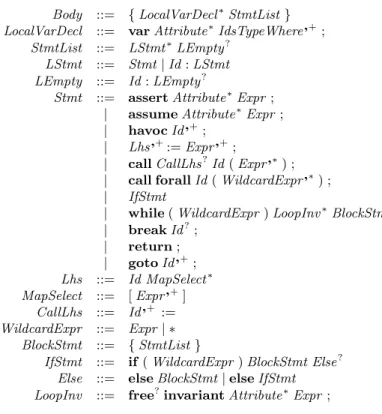
Body ::= {LocalVarDecl∗StmtList}
LocalVarDecl ::= varAttribute∗IdsTypeWhere
,
+;StmtList ::= LStmt∗LEmpty?
LStmt ::= Stmt|Id :LStmt LEmpty ::= Id :LEmpty?
Stmt ::= assertAttribute∗Expr;
| assumeAttribute∗Expr;
| havocId
,
+;| Lhs
,
+:=Expr,
+; | callCallLhs?Id(Expr,
∗) ;
| call forallId(WildcardExpr
,
∗) ;| IfStmt
| while(WildcardExpr)LoopInv∗BlockStmt
| breakId?; | return;
| gotoId
,
+;Lhs ::= Id MapSelect∗ MapSelect ::= [Expr
,
+]CallLhs ::= Id
,
+ := WildcardExpr ::= Expr| ∗BlockStmt ::= {StmtList}
IfStmt ::= if (WildcardExpr)BlockStmt Else?
Else ::= elseBlockStmt|elseIfStmt LoopInv ::= free?invariantAttribute∗Expr;
Fig. 2.Boogie’s statement grammar.
9
Statements
Boogie statements are used in procedure implementations and provide a way to pre-scribe execution traces. A procedure implementation is correct if and only if its finite traces form a subset of the procedure’s callee traces. The statements include state muta-tions, check and assume operamuta-tions, conditional and blind (demonic) nondeterministic control flow (possibly irreducible), iteration, and procedural abstraction. The statements follow the grammar in Fig. 2.
Throughout this section, states implicitly range over those that satisfy V0 and V1 (see Section 8.2).
9.0 Implementation body
A body starts with a number of local-variable declarations. The names of the variables declared must be distinct from each other and distinct from the implementation’s in-and out-parameters. The expression given by a WhereClause appearing among the local variables must be of type boolean and can refer to any constant, function, global variable, in- and out-parameter, and local variable. The TypeandWhereClause of an IdsTypeWhere apply to each of the Id’s declared, as if each Id were introduced in
a separate vardeclaration. The attributes of the declaration apply to each of theId’s introduced.
The execution traces of a body{locals stmts}consists of all tracesσZ such that:
– the domain ofσconsists of the global variables of the program, a fictitious variable gold for every global variable g, the in- and out-parameters of the implementation
declaration, and the local variables declared inlocals, and
– for everywhereL among the local variables,L(σ)is true, and
– Z denotes any (empty, finite, infinite) state sequence optionally followed by , and
– σZ is an execution trace of thestart label of start: transform(∅)JstmtsKreturn;
wherestart is a fresh label symbol, ∅ denotes the empty map (see Section 9.5), andtransformis a function defined below; more precisely, σZ ∈Traces(start), whereTraces is defined in Section 9.1 below.
The semantics of an implementation body’s statements is given by trace sets via a basic-block transformation of the statement. The transform function rewrites state-ments to form a sequence ofbasic blocks, each of which has the form
label:SimpleStmt∗Goto
where SimpleStmt is a subset of the statements in Fig. 2 and Goto is either agoto statement or areturnstatement. TheSimpleStmt statements include assert, assume, havoc, and call statements, as well as assignment statements whose left-hand side is a list of simple variables.
Function transform is applied only in contexts where there is a preceding label (without an interveningGoto) and a succeedingGoto (without an intervening label); from this condition and the definition of transform below, it follows that the result of start: transform(∅)JstmtsKreturn;is indeed a sequence of basic blocks.
By the way, note that a sequence of basic blocks is a special case ofStmtList in the Boogie statement grammar.
9.1 Basic blocks
The definition of the semantics of basic blocks rests on the definition of several other operators and functions.
The concatenation of two trace setsAandB, writtenA#B, is defined as follows: A#B = {X
X ∈ A } ∪
{Y
Y ∈ A } ∪
{XσZ
Xσ∈ AandσZ ∈ B }
where X ranges over possibly empty, finite state sequences, Y ranges over infinite state sequences, andZ ranges over any (empty, finite, infinite) state sequence optionally followed by . Note that concatenation of traces fuses, as opposed to repeats, the last state of one trace with the first state of the next.
Function stmt concatenates the trace sets of a sequence of statements. For any statement S and possibly empty sequence of statementsstmts:
stmtJ K = {σσ
σis any state satisfying V0 and V1}
stmtJstmts SK = stmtJstmtsK #tracesJSK
wheretracesJSKdenotes the trace set ofS. Note that all traces returned by stmthave length at least 2. This is important below, because it ensures that the execution traces of infinite loops (like `:goto`;) are infinite.
For any label ` among the basic blocks of a procedure’s transformed implemen-tation, Traces(`)denotes the execution traces that result from basic block ` forward. Function Traces is defined as the least fixpoint to the system of equations obtained as follows for each label`:
Traces(`) =
stmtJstmtsK for`:stmtsreturn; stmtJstmtsK #
S
£∈succsTraces(£) for`:stmtsgotosuccs;
The remaining subsections consider the various statements, defining trace sets for the simple statements and decomposing the other statements using the transform func-tion.
9.2 Assertions and assumptions
The assert statement gives an expression that holds in every correct trace. The assume statement gives an expression that holds in every feasible trace. The expressions given by these statements must be boolean.
The assert statement is used to prescribe a check. For example, a source-language assignmentx = y / z;may be translated into the Boogie statements:
assertz 6= 0; x:=y/z;
As another example, the array assignmenta[i] :=e;in a language with co-variant array types (like in Java or C#) is modeled by prefixing the actual state update with assertions like:
asserta6=null; // check receiver to be non-null assert06i; // check lower bound of index asserti<ArrayLength(a); // check upper bound of index asserttype(e)<:elementType(type(a)); // check co-variance
where the source-languagenullis modeled by: constnull:Ref;
In order to report a meaningful error message to the user of the source language, the source-language verification tool needs to remember why each of these assertions was generated in the translation to Boogie and then simply maps the failure of any of asserts to a message reflecting that reason.
An assume statement is used to introduce an assumption in the program to be veri-fied, with the effect of rendering infeasible those execution traces where the assumption
would not hold. For example, the function WellFormed in Section 8.1 that expresses the well-formedness of the heap in a program can be assumed after each update of the heap. For example,
Heap[this,C.data] := 5; assumeWellFormed(Heap);
Such use of WellFormed affords the possibility of axiomatizing only some of the properties ofWellFormed; that is, using an implication in
axiom(∀heap:HeapType • WellFormed(heap) ⇒ . . .);
instead of an if-and-only-if (since there would never be a need to prove WellFormed in the program).
In important special case of the assume statement is assume false;, which has the effect of not doing any further checking along that program path. This is useful, for example, when debugging a Boogie program: to prevent the program verifier from spending time trying to prove proof obligations beyond some particular program point, simply insert an assume false; at that point, which has the effect of rendering infea-sible those execution paths that would go through that point.
Other important uses of assume statements are explained in the subsections dealing withif statements (Section 9.7) and the havoc statement (Section 9.4).
Formally, the trace sets of these statements are: tracesJassertE;K =
{σ
E(σ)is true} ∪ {σ
E(σ)is false}
tracesJassumeE;K = {σ
E(σ)is true}
To understand how trace sets are built up, it is instructive to consider the effect of composing the assert and assume statements with other statements. For example, the trace set stmtJassert0 6 x;assume0 6 y;K consists of the traces σσ , where x(σ)<0 and the tracesσσ where both06x(σ)and06y(σ). However, the traces
σσ where0 6x(σ)and y(σ)<0 are not included at all. Attempting an operational description of a “run” of these two statements, one could say:
0. Evaluate06x. If it holds, continue the run; otherwise, go wrong.
1. Evaluate 0 6y. If it holds, continue the run, which in the case of just these two statements means terminate. If 0 6 y does not hold, then shrivel up the entire execution trace, as if the run never happened.
From this step-by-step run point of view, this “shriveling up” business removes the steps “already taken” if it arrives at an assume statement whose condition does not hold. This may seem magical, but all it means is that this trace is not feasible; it’s just that the infeasibility of it is discovered only after some other statements have already happened. Note, however, that an assume statement cannot undo going wrong. For example, stmtJassertx < 100;assumex == 0;K contains the execution traces σσ where x(σ) = 0, which correspond to those feasible traces where the assertion holds. But it also contains the execution traces σσ where100 6x(σ), which correspond to the runs that go wrong and do not even make it to the assume statement.
9.3 Assignments
An assignment changes the value of one or more mutable variables in parallel. The number of Lhs’s on the left-hand side must equal the number of Expr’s on the right-hand side. The type of anLhs and the type of the corresponding Expr must be equal. The Id in anLhs must denote a mutable variable, and these Id’s must all be distinct. Note that in-parameters are not mutable variables, so they cannot be assigned to.
For example, the simple assignment statement: x:=x+ 1;
increments the value of variablex by1. The assignment statement: a[i] := 12;
changes what map a maps i to, making the new value map i to 12. The parallel assignment statement:
x,y:=y,x;
swaps the values of variables x andy. The statement: x,a[i] :=x + 1,x;
incrementsx and setsa[i]to the old value of x. The statement: a[i],a[j] :=a[j],a[i];
is not allowed, because the Id’s in the left-hand side are not distinct.
The trace set of a simple assignment statement where all left-hand sides areId’s is defined as follows:
tracesJx:=E;K = {στ
σandτhave the same domains and agree on the values
of all variables except possible those inx, and for each xinxand correspondingEinE,x(τ) =E(σ) }
If the left-hand side is not just Id’s, then the semantics is defined in terms of the se-mantics of simpler assignment statements. For any list x of Id’s; any map variable or map-selection expression A; any lists J, X, and F of expressions; any list L of Rhs’s; and any expressionE:
tracesJx,A[J],L := X,E,F;K = tracesJx,A,L := X,A[J:=E],F;K For example, the semantics of the statements:
a[j] :=E; b[i][m,n] :=F;
is defined as having the same semantics as: a:=a[j:=E];
Note thatwhereclauses do not play a role for assignment statements. In particular, an assignment statement can set a variable to a value that does not satisfy its where clause. For example,
varvolume:int where06volume ∧volume610; x:= 11;
setsvolume to11, despite the fact that thewhereclause suggestsvolume is intended to be between 0 and 10. where clauses apply only in places where a variable gets an arbitrary value; by not applying them at assignment statements, Boogie provides the ability to use a sequence of statements that (perhaps temporarily) violates where conditions.
To explicitly say that a condition holds after an assignment, use an assume state-ment, as in:
Heap[this,C.data] :=Heap[this,C.data] + 1; assumeWellFormed(Heap);
9.4 Havoc
The havoc statement assigns arbitrary (blindly chosen) values to a set of variables. Each Id listed in the statement must denote a mutable variable. The values assigned are arbi-trary, but within limits: the values are drawn from the types of the respective variables (in accordance with V0), the values satisfy the program’s axioms (in accordance with V1), and the values satisfy thewhereclauses of the variables.
For example, for variablesx andy declared as: varx:int where06x;
vary:int where06y ∧y<x;
the statement havocx,y; sets x and y to non-negative integers where x is strictly larger thany. Note how, in this example, one gets the same result with the sequence of statements:
havocx; havocy;
Although the havocx; by itself may set x to 0, there is no feasible trace that passes the havocy;with such a value forx. The sequence:
havocy; havocx;
is different, because it first sets y to a value between 0 and less than x, and then sets x to a non-negative integer without further regard for the value of y.
An important and frequently occuring idiom is to follow ahavocwith anassume, which has the effect of taming the nondeterminism offered by thehavoc. For example,
havoca,b; assume3∗a+b==25;
will have the effect of setting a and b to an arbitrary solution of the given equation. Another example is: