W O R D - S E N S E D I S A M B I G U A T I O N U S I N G S T A T I S T I C A L
M E T H O D S
Peter F. Brown, Stephen A. Della Pietra, Vincent J. Della Pietra,
and Robert L. Mercer
IBM Thomas J. Watson Research Center
P.O. Box 704
Yorktown Heights, NY 10598
A B S T R A C T
We describe a statistical technique for assign- ing senses to words. An instance of a word is as- signed a sense by asking a question about the con- text in which the word appears. The question is constructed to have high mutual information with the translation of that instance in another lan- guage. When we incorporated this method of as- signing senses into our statistical machine transla- tion system, the error rate of the system decreased by thirteen percent.
I N T R O D U C T I O N
An alluring aspect of the statistical ~p- proach to machine translation rejuvenated by Brown et al. [Brown et al., 1988, Brown et al., 1990] is the systematic framework it provides for attacking the problem of lexical disam- biguation. For example, the system they de- scribe translates the French sentence Je vais prendre la ddcision as I will make the decision, correctly interpreting prendre as make. The statistical translation model, which supplies English translations of French words, prefers the more common translation take, bnt the trigram language model recognizes that the three-word sequence make the decision, is much more probable than take the decision..
The system is not always so successfifl. It incorrectly renders Je vais prendre ma propre ddcision as 1 will take my own decision. The
language model does not realize that take my own decision is improbable because take and decision no longer fall within a single trigram.
Errors such as this are common because the statistical models only capture local phe- nomena; if the context necessary to determine a translation falls outside the scope of the models, the word is likely to be translated in- correctly, t[owever, if the relevant context is encoded locally, the word should be translated correctly. We can achieve this within the tra- ditional paradigm of analysis, transfer, and synthesis by incorporating into the analysis phase a sense-disambiguation component that assigns sense labels to French words. If pren- dre is labeled with one sense in the context of ddcision but with a different sense in other contexts, then the translation model will learn front trMning d a t a that the first sense usually translates to make, whereas the other sense usuMly translates to take.
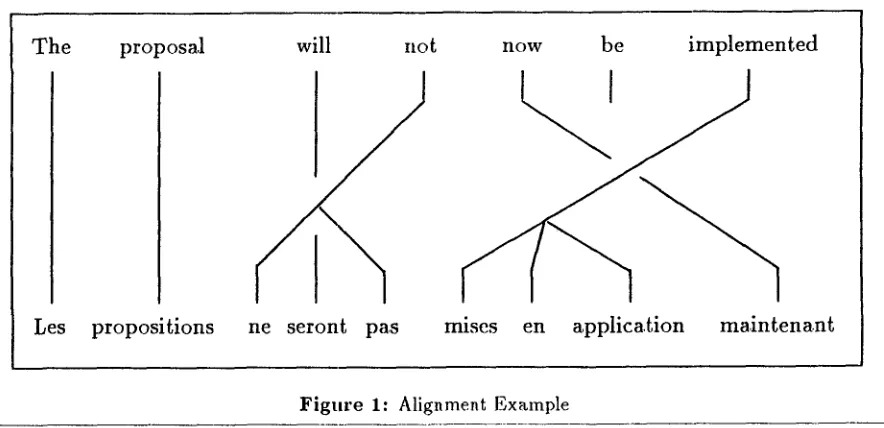
T h e p r o p o s a l
Les p r o p o s i t i o n s
will n o t
/
ne s e r o n t p a s
n o w b e i m p l e m e n t e d
mises en a p p l i c a t i o n m a i n t e n a n t
F i g u r e 1: Alignment Example
cerned about senses as they occur in a dic- tionary only to the extent that those senses are translated differently. The French noun
intdr~t, for example, is translated into Ger- man as either Zins or [nteresse according to its sense, but both of these senses are trans- lated into English as interest, and so we make no a t t e m p t to distinguish them.
S T A T I S T I C A L T R A N S L A T I O N Following Brown et al. [Brown et al., 1990], we choose as the translation of a French sen- tence F that sentence E for which Pr ( E [ F )
is greatest. By Bayes' rule,
Pr (ELF) = Pr (E) Pr
Pr(F)
(1)
Since the denominator does not depend on E, the sentence for which Pr (El/7') is great- est is also the sentence for which the product Pr ( E ) Pr ( F I E ) is greatest. The first factor in this product is a statistical characteriza- tion of the English language and the second factor is a statistical characterization of the process by which English sentences are trans- lated into French. We can compute neither factors precisely. Rather, in statistical trans- lation, we employ models from which we can obtain estimates of these values. We cM1 the model from which we compute Pr ( E ) the lan- guage model and that from which we compute
P r ( F I E ) the translation model.
The translation model used by Brown et al.
[Brown et al., 1990] incorporates the concept of an alignment in which each word in E acts independently to produce some of the words in F. If we denote a typical alignment by A, then we can write the probability of F given E as a sum over all possible alignments:
Pr (FIE) = ~ Pr (F, AlE ) . (2)
A
Although the number of possible alignments is a very rapidly growing function of the lengths of the French and English sentences, only a tiny fraction of the alignments contributes sub- stantiMly to the sum, and of these few, one makes the grea.test contribution. We ca.ll this most probable alignment the Viterbi align- m e n t between E a.nd F.
Tile identity of tile Viterbi alignment for a pair of sentences depends on the details of the translation model, but once the model is known, probable alignments can be discovered algoritlunically [Brown et al., 1991]. Brown
et al. [Brown et al., 1990], show an example of such an automatically derived alignment in their Figure 3. (For the reader's convenience, we ha.re reproduced that figure here as Figure
[image:2.612.86.528.70.284.2]In a Viterbi alignment, a French word that is connected by a line to an English word is said to be aligned with t h a t English word. Thus, in Figure 1, Les is aligned with The, propositions with proposal, and so on. We call a p~ir of aligned words obtained in this way a
connection.
From the Viterbi alignments for 1,002,165 pairs of short French and English sentences from the Canadian Hansard d a t a [Brown et al.,
1990], we have extracted a set of 12,028,485 connections. Let p(e, f ) be the probability that a connection chosen at random fi:om this set will connect the English word e to the French word f . Because each French word gives rise to exactly one connection, the right marginM of this distribution is identical to the distribution of French words in these sen- tences. The left marginal, however, is not the same as the distribution of English words: English words t h a t tend to produce several French words at a time are overrepresented while those t h a t tend to produce no French words are underrepresented.
S E N S E S B A S E D O N B I N A R Y
Q U E S T I O N S
Using p(e, f ) we can compute the mutuM information between a French word and its English mate in a connection. In this section, we discuss a method for labelling a word with a sense t h a t depends on the context in which it appears in such a way as to increase the mutual information between the members of a connection.
In the sentence Je vats prendre .ma pro- pre ddeision, the French verb prendre should be translated as make because the obiect of
prendre is ddcision. If we replace ddcision by
voiture, then prendre should be translated as
take to yield [ will take my own ear. In these examples, one can imagine assigning a sense to prendre by asking whether the first noun to the right of prendre is ddeision or voiture. We say t h a t the noun to the right is the informant
for prendre.
In I1 doute que les ndtres gagnent, which
means He doubts that we will win, the French word il should be translated as he. On the other hand, in II faut que les n6tres gagnent,
which means It is necessary that we win, il
should be translated as it. Here, we can de- termine which sense to assign to il by asking about the identity of the first verb to its right. Even though we cannot hope to determine the translation of il from this informant unam- biguously, we can hope to obtain a significant amount of information about the translation.
As a final example, consider the English word is. In the sentence I think it is a prob- lem, it is best to translate is as est as in Je pense que c'est un probl~me. However, this is certainly not true in the sentence [ think there is a problem, which translates as Je pense qu'il y a u n probl~me. Here we can reduce the en- tropy of the distribution of the translation of is by asking if the word to the left is there. If so, then is is less likely to be translated as est
than if not.
Motivated by examples like these, we in- vestigated a simple m e t h o d of assigning two senses to a word w by asking a single binary question about one word of the context in which w appears. One does not know before- hand whether the informant will be the first noun to the right, the first verb to the right, or some other word in the context of w. How- ever, one can construct a question for each of a number of candidate informant sites, and then choose the most informative question.
are 2 v possible questions, tlowever, using the splitting theorem of Breiman, Friedman, O1- shen, and Stone [Breiman
et al.,
1984], it is possible to find the most informative of these 2 v questions in time which is linear in V.The flip-flop Mgorithm begins by making an initiM assignment of the English transla- tions into two classes, and then uses the split- ting theorem to find the best question about the potential informant. This question divides the French vocabulary into two sets. One can then use the splitting theorem to find a di- vision of the English translations of w into two sets which has maximal mutual informa- tion with the French sets. In the flip-flop al- gorithm, one alternates between splitting the French vocabulary into two sets and the En- glish translations of w into two sets. After each such split, the mutual information be- tween the French and English sets is at least as great as before the split. Since the mutual information is bounded by one bit, the process converges to a partition of the French vocab- ulary that has high mutual information with the translation of w.
A P I L O T E X P E R I M E N T
We used the flip-flop algorithm in a pilot experiment in which we assigned two senses to each of the 500 most common English words and two senses to each of the 200 most com- mon French words.
For a French word, we considered ques- tions about seven informants: the word to the left, the word to the right, the first noun to the left, the first noun to the right, the first verb to the left, the first verb to the right, and the tense of either the current word, if it is a verb, or of the first verb to the left of the current word. For an English word, we only considered questions about the the word to the left and the word two to tim left. We re- stricted the English questions to the l)revious two words so that we could easily use them in our translation system which produces an English sentence from left to right. When a potential informant did not exist, because, say there was no noun to the left of some
Word: Informant: Information:
prendre Right noun .381 bits
Sense 1 T E R M _ W O R D mesure
note exemple temps initiative part
Sense 2 d~cision parole connaissance engagement fin
retr~ite
Common informant values for each sense
Pr(English [ Sense 1) Pr(English
[ Sense 2)
to_take .433
to_make .061
to_do .051
to_be .045
to_make .186
to-speak .105
to_rise .066
to_take .066
to_be .058
decision .036
to-get .025
to_have .021
Probabilities of English translations
F i g u r e 2: Senses for the French word
prendre
word in a particular sentence, we used the spe- cial word,
TERM_WORD.
To find the nouns and verbs in our French sentences, we used the tagging Mgorithm described by MeriMdo [Merialdo, 1990].Figure 2 shows the question that was con- s t r , c t e d for tile verb
prendre.
The noun tothe right yielded the most information, .381 bits, about the English translation of
prendre.
The box in the top of the figure shows the words which most frequently occupy that site, that is, tile nouns which appear to the right
of
prendre
with a probability greater than one [image:4.612.324.543.270.398.2]Word: Informant: Information:
vouloir Verb tense .349 bits
Word: Informant: Information:
del)uis
Word to the right .738 bits
Sense 1 Sense 2
3rd p sing present 1st p sing present 3rd p plur present 1st p pint present 2nd p pint present 3rd p sing imperfect 1st p sing imperfect 3rd p sing future
1st p sing conditional 3rd p sing conditional 3rd p plur conditional 3 r d p plur subjunctive
1st p plur conditional
Common informant values for each sense
Sense 1 longtemps de
UR quelques denx 1 plus trois
Sense 2 l e la
l' c e les
1968
Comnmn informant values for each sense
P r ( E n g l i s h [ S e n s e 1) Pr(English [ Sense 2)
to_want .484
to_mean .056
to_be .056
to_wish .033
to_rear .022
to_like .020
toJike .391
to_want .169
to_have .083
to_wish .066
me .029
Probabilities of English translations
F i g u r e 3: Senses for the French word vouloir
ample, if the noun to the right of prendre is
ddeision, parole, or eonnaissance, then pren- dre is assigned the second sense. The box at the b o t t o m of the figure shows the most prob- able translations of each of the two senses. Notice that the English verb to_make is three times as likely when prendre has the second sense as when it has the first sense. People
make decisions, speeches, and acquaintances, they do not take them.
Figure 3 shows our results for the verb
vouloir. Here, the best informant is the tense of vouloir. The first sense is three times more likely than the second sense to translate as
to_want, but twelve times less likely to trans- late as to_like. In polite English, one says I
would like so and so more commonly than [
would want so and so.
Pr (English I Sense 1) Pr (English I Sense 2)
for .432
last .123
long .102
past .078
over .027
in .022
overdue .021
since .772
from .040
Probabilities of English translations
F i g u r e 4: Senses for the French word depuis
Tile question in Figure 4 reduces the en- tropy of the translation of the French prepo- sition depuis by .738 bits. When depuis is fol- lowed by an article, it translates with proba- bility .772 to .since, and otherwise only with probability .016.
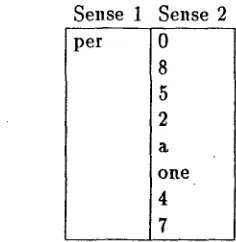
Finally, consider the English word cent. In our text, it is either a denomination of cur- rency, in which case it is usually preceded by a number and translated as c., or it is the second half of per cent, in which case it is pre- ceded by per and transla,ted along with per as ~0. The results in Figure 5 show that the al- gorithm has discovered this, and in so doing has reduced the entropy of the translation of
[image:5.612.63.284.56.413.2] [image:5.612.371.472.120.242.2] [image:5.612.312.532.285.412.2]Word: cent
Informant: Word to the left Information: .378 bits
Sense 1 Sense 2
per 0
8 5 2 a
o n e 4 7
Common informant values for each sense
Pr(French I Sense 1) Pr(French [Sense 2)
% .891 c. .592
cent .239
sou .046
% .022
Probabilities of French translations
Figure 5: Senses for the English word cent
Pleased with these results, we incorporated sense-assignment questions for the 500 most common English words and 200 most com- mon French words into our translation sys- tem. This system is an enhanced version of the one described by Brown et al. [Brown
et al., 1990] in that it uses a trigram lan- guage model, and has a French vocabulary of 57,802 words, and an English vocabulary of 40,809 words. We t r a n s l a t e d 100 randomly selected Hansard sentences each of which is 10 words or less in length. We judged 45 of the resultant translations as acceptable as compared with 37 acceptable translations pro- duced by the same system running without sense-disambiguation questions.
F U T U R E W O R K
Although our results are promising, this particular method of assigning senses to words is quite limited. It assigns at most two senses
to a word, and thus can extract no more than one bit of information about the translation of that word. Since the entropy of the transla- tion of a common word can be as high as five bits, there is reason to hope that using more senses will fitrther improve the performance of our system. Our method asks a single ques- tion about a single word of context. We can think of tlfis as the first question in a deci- sion tree which can be extended to additional levels [Lucassen, 1983, Lucassen and Mercer, 1984, Breiman et al., 1984, Bahl et al., 1989]. We are working on these and other improve- ments and hope to report better results in the future.
R E F E R E N C E S
[Bahl et aL, 1989] BMd, L., Brown, P., de Souza, P., and Mercer, R. (1989). A tree-based statistical language model for natural language speech recognition. I E E E Transactions on Acoustics, Speech and Sig- nal Processing, 37:1001-1008.
[Breiman et ai., 1984] Breiman, L., Fried- man, J. tI., Olshen, R. A., and Stone, C. J. (1984). Classification and Regres- sion Trees. Wadsworth & Brooks/Cole Ad- vanced Books & Software, Monterey, Cali- fornia.
[Brown et aL, 1990] Brown, P. F., Cocke, J., DellaPietra, S. A., DellaPietra, V. J., Je- linek, F., Lafferty, J. D., Mercer, R. L., and Roossin, P. S. (1990). A statistical ap- l)roach to machine translation. Computa- tional Linguistics, 16(2):79--85.
[Brown et al., 1988] Brown, P. F., Cocke, J., DellaPietra, S. A., DellaPietra, V. J., Je- linek, F., Mercer, R. L., and Roossin, P. S. (1988). A statistical approach to language translation. I!1 Proceedings of the 12th In- ternational Conference on Computational Linguistics, Budapest, Hungary.
[Brown et aL, 1991] Brown, P. F., DellaPi- etra, S. A., DellaPietta, V. J., and Mercer, R. L. (1991). Parameter estimation for ma- chine translation. In preparation.
[image:6.612.104.222.117.238.2]ing activation approach. I:! Proccedil~!ls of the Sixth Annual Conferen~:e of the UII' Centre for the New Oxford English Dictio- nary and Text Research, pages 52-6,t, Wa- terloo, Canada.
[Lesk, 1986] Lesk, M. E. (1986). Auto- mated sense disambiguation using machine- readable dictionaries: How to tell a pine cone from an ice cream cone. In Proceed- ings of the SIGDOC Conference.
[Lncassen, 1983] Lucassen, J. M. (1983). Dis- covering phonemic baseforms automati- cally: an information theoretic approach. Technical Report RC 9833, IBM Research Division.
[Lucassen and Mercer, 1984] Lucassen, J. M. and Mercer, R. L. (1984). An information theoretic approach to automatic determi- nation of phonemic baseforms. In Proceed- ings of the IEEE International Conference on Acoustics, Speech and Signal Processing, pages 42.5.1-42.5.4, San Diego, California.
[Meria]do, 1990] Merialdo, B. (1990). Tag- ging text with a probabilistic model. In Proceedii~gs of the IBM Natural Language ITL, pages 161-172, Paris, France.
[Nadas et