The Effects of Syntactic Features in Automatic Prediction of Morphology
Wolfgang Seeker and Jonas Kuhn
Institute for Natural Language Processing University of Stuttgart
{seeker,jonas}@ims.uni-stuttgart.de
Abstract
Morphology and syntax interact considerably in many languages and language processing should pay attention to these interdependen-cies. We analyze the effect of syntactic fea-tures when used in automatic morphology pre-diction on four typologically different lan-guages. We show that predicting morphology for languages with highly ambiguous word forms profits from taking the syntactic context of words into account and results in state-of-the-art models.
1 Introduction
In this paper, we investigate the interplay between syntax and morphology with respect to the task of assigning morphological descriptions (or tags) to each token of a sentence. Specifically, we examine the effect of syntactic information when it is inte-grated into the feature model of a morphological tag-ger. We test the effect of syntactic features on four languages – Czech, German, Hungarian, and Span-ish – and find that syntactic features improve our tag-ger considerably for Czech and German, but not for Hungarian and Spanish. Our analysis of construc-tions that show morpho-syntactic agreement sug-gests that syntactic features are important if the
lan-guage shows frequent word form syncretisms1 that
can be disambiguated by the syntactic context. The meaning of a sentence is structurally encoded
1Syncretism describes the situation where a word form is
ambiguous between several different morphological descrip-tions within its inflection paradigm.
by morphological and syntactic means.2 Different
languages, however, use them to a different extent. Languages like English encode grammatical infor-mation (like the subject vs object status of an argu-ment) via word order, whereas languages like Czech or Hungarian use different word forms. Automatic analysis of languages with rich morphology needs to pay attention to the interaction between morphol-ogy and syntax in order to arrive at suitable com-putational models. Linguistic theory (e. g., Bresnan (2001), Melˇcuk (2009)) suggests many interactions between morphology and syntax. For example, lan-guages with a case system use different forms of the same word to mark different syntactic (or seman-tic) relations (Blake, 2001). In many languages, two words that participate in a syntactic relation show covariance in some or all of their morphological
fea-tures (so-called agreement, Corbett (2006)).3
Automatic annotation of morphology assigns
morphological descriptions (e. g.,
nominative-singular-masculine) to word forms. It is usually
modeled as a sequence model, often in combination with part-of-speech tagging and lemmatization (Collins, 2002; Hajiˇc, 2004; Smith et al., 2005; Chrupała et al., 2008, and others). Sequence models achieve high accuracy and coverage but since they only use linear context they only approximate some
of the underlying hierarchical relationships. As
an example for these hierarchical relationships,
2
And also by prosodic means, which we will not discuss since text-based tools rarely have access to this information.
3For example, in English, the subject of a sentence and the
finite verb agree with respect to their number and person fea-ture.
die wirtschaftlich am weitesten entwickelten , modernen und zum Teil katholisch gepr¨agten Regionen
nom/acc.pl.fem nom/acc.pl.fem
the economic - most developed , modern and to part catholic influenced regions
NK
MO
PM MO
NK
CJ
CD
MO
NK MO
CJ
[image:2.612.76.535.67.152.2]’the regions that are economically most developed, modern, and partly catholic’
Figure 1: Example of a German noun phrase. First and last word agree in number, gender, and case value.
Figure 1 shows a German noun phrase taken from the German TiGer corpus (Brants et al., 2002). The two bold-faced words are the determiner and the head noun of the phrase, and they agree in their gender, number, and case values. The word
Regionen (regions) is four-way ambiguous for its
case value, which is reduced to a two-way
ambi-guity between nominative and accusative by the
determiner. Further disambiguation would require information about the syntactic role of the noun phrase in a sentence. There are 11 tokens between these two words, which would require a context window of at least 13 to capture the agreement
relation within a sequence model. Syntactically,
however, as indicated by the dependency tree, the determiner and the head are linked directly. The interdependency between morphology and syntax in the example thus manifests itself in the morphological disambiguation of a highly syncretic word form because of its government or agreement relation to its respective syntactic head/dependents.
Of course, the sequence model is most of the time a reasonable approximation, because the ma-jority of noun phrases in the TiGer corpus are not
as long as the example in Figure 1.4 Furthermore,
not all languages show this kind of relationship be-tween morphological forms and syntactic relation as demonstrated for German. But taking advantage of the morphosyntactic dependencies in a language can give us better models that may even be capable of handling the more difficult or rare cases. We there-fore advocate that models for predicting morphology should be designed with the typological characteris-tics of a language and its morphosyntactic properties in mind, and should, where appropriate, integrate
4
We find 57,551 noun phrases with less than three tokens between determiner and noun and 4,670 with three or more.
syntactic information in order to better model the morphosyntactic interdependencies of the language. In the remainder of the paper, we show empiri-cally that taking syntactic information into account produces state-of-the-art models for languages with a high interdependency between morphology and syntax. We use a simple setup, where we combine a morphological tagger and a dependency parser in a bootstrapping architecture in order to analyze the effect of syntactic information on the performance of the morphological tagger (Section 2). Using syn-tactic features in morphology prediction requires a syntactically annotated corpus for training a statisti-cal parser, which may not be available for languages with few resources. We show in Section 3 that only very little syntactically annotated data is required to achieve the improvements. We furthermore expect that the improved morphological information also improves parsing performance and present a prelim-inary experiment in Section 4.
2 Experiments
In this section, we present a series of experiments that investigate the effect of syntactic information on the prediction of morphological features. We start by describing our data sets and the system that we used for the experiments.
2.1 Languages and Data Sets
We test our hypotheses on four different languages: Czech, German, Hungarian, and Spanish.
predict the morphological information annotated in the Spanish data set.
Czech and Hungarian represent languages with very rich morphological systems both in verbal and nominal morphological paradigms. They differ sig-nificantly in the way in which morphological infor-mation is encoded in word forms. Czech, a Slavic language, is an inflecting language, where one suf-fix may signal several different morphological cate-gories simultaneously (e. g., number, gender, case). In contrast, Hungarian, a Finno-Ugric language, is of the agglutinating type, where each morphological category is marked by its own morpheme.
Both German and Czech show various form cretisms in their inflection paradigms. Form syn-cretisms emerge when the same word form is am-biguous between several different morphological de-scriptions, and they are a major challenge to auto-matic morphological analysis. Spanish shows syn-cretism in the verbal inflection paradigms. In Hun-garian, form syncretisms are much less frequent. The case paradigm of Hungarian only shows one form syncretism between dative and genitive case (out of about 18 case suffixes).
All languages show agreement between subject and verb, and within the noun phrase. The word or-der in Czech and Hungarian is very variable whereas it is more restrictive in Spanish and German.
As our data, we use the CoNLL 2009 Shared Task data sets (Hajiˇc et al., 2009) for Czech and
Spanish. For German, we use the dependency
conversion of the TiGer treebank by Seeker and Kuhn (2012), splitting it into 40k/5k/5k sentences for training/development/test. For Hungarian, we use the Szeged Dependency Treebank (Vincze et al., 2010), with the split of Farkas et al. (2012).
2.2 System Description
To test our hypotheses, we implemented a tagger that assigns full morphological descriptions to each token in a sentence. The system was inspired by the
morphological tagger included in mate-tools.5 Like
the tagger provided with mate-tools, it is a classifier that tags each token using the surrounding tokens in
5A collection of language independent, data-driven analysis
tools for lemmatization, pos-tagging, morphological analysis, and dependency parsing: http://code.google.com/p/mate-tools
its feature model. Models are trained using passive-aggressive online training (Crammer et al., 2003). The system makes two passes over each sentence: The first pass provides predicted tags that are used as features during the second pass. We also adopted the idea of a tag filter, which deterministically as-signs tags for words that always occur with the same tag in the training data.
For all matters of syntactic annotation in this pa-per, we use the graph-based dependency parser by Bohnet (2010), also included in mate-tools. All data sets are annotated with gold syntactic information, which is used to train the parsing models.
For our experiments, we use a bootstrapping ap-proach: the parser uses the output of the morphology in its feature set, and the morphological tagger we want to analyze uses the output of the parser as syn-tactic features. Since it is best to keep the training setting as similar as possible to the test setting, we use 10-fold jackknifing to annotate our training data with predicted morphology or syntax respectively.
Jackknifing differs from cross-validation only in its purpose. Cross-validation is used for evaluating data, jackknifing is used to annotate data. The data set is split into n parts, and n-1 parts are used to train
a model for annotating the nth part. This is then
rotated n times such that each part is annotated by the automatic tool without training it on its own test data. Jackknifing is important for creating a realis-tic training scenario that provides automarealis-tic prepro-cessing. For annotating development and test sets, models are trained on the jackknifed training set.
2.3 The Effects of Syntactic Features
In the first experiment, we use the system described in Section 2.2 to predict morphological information on all four languages. We start with describing the general setup and the feature set, and continue with a discussion of the results.
The experimental setup is as follows: the German and Spanish data sets are annotated with lemma and part-of-speech information using 10-fold jackknif-ing. The annotation is done with mate-tools’ lem-matizer and pos-tagger. For Czech and Hungarian, we keep the annotation provided with the data sets.
pre-processing step. It is not necessary to separate part-of-speech and lemma from the prediction of mor-phology and, in fact, many systems perform these steps simultaneously (e. g. Spoustov´a et al. (2009)). Doing morphology prediction as a separate step al-lows us to use lemma and part-of-speech informa-tion in the feature set.6
static features
form form1b form2b
form3b form1a lemma2a
pos1b pos2b pos1a
form+pos pos+s1 pos+s2
pos+s3 pos+s4 lemma+p2
lemma+p3 pos+number form+form1b pos+pos1a pos+pos1b+pos2b s1+s1 1b s1+s1 1a s2+s2 1a last-verb-lemma last-verb-pos next-verb-lemma next-verb-pos
dynamic features
tag1b+tag2b tag2b+tag3b tag1a tag1a+tag1b tag1a+tag2a tag2a+tag3a pos1b+case1b last-verb-tag next-verb-tag pos1b+case1b+pos2b+case2b
Hungarian only features
pos+uppercase
Czech only features
pos+p2
Spanish only features
s5 p1 p4
p5 s2 1a s3 1a
[image:4.612.72.301.167.450.2]s4 1a
Table 1: Baseline feature set. formmeans word form,
lemmais lemma, posis part-of-speech, s1/p1stand for suffix and prefix of length 1 (characters),tagis the mor-phological tag predicted by the system, 1b/1a means 1 token before/after the current token, and + marks feature conjunctions.numbermarks if the form contains a digit.
After preprocessing the data, our baseline system is trained using the feature set shown in Table 1. The baseline system does not make use of any syntactic information but predicts morphological information based solely on tokens and their linear context. The features are divided into static features, which can be computed on the input, and dynamic features, which are computed also on previous output of the system (cf. two passes in Section 2.2).
6Lemma and part-of-speech prediction may also profit from
syntactic information, see e.g. Prins (2004) or Bohnet and Nivre (2012).
The feature sets in Table 1 were developed specif-ically for our experiments and are the result of an automatic forward/backward feature selection pro-cess. The purpose of the feature selection was to ar-rive at a baseline system that performs well without any syntactic information. With such an optimized baseline system, we can measure the contribution of syntactic features more reliably.
Thelast-verb/next-verbandpos+casefeatures are
variants of the features proposed in Votrubec (2006). They extract information about the first verb within the last 10/the next 30 tokens in the sentence. The
casefeature extracts the case value from previously
assigned morphological tags. Note that the verb
features are approximating syntactic information by making the assumption that the closest verbs are likely to be syntactic heads for many words.
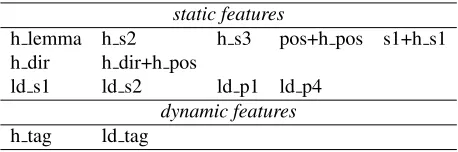
static features
h lemma h s2 h s3 pos+h pos s1+h s1 h dir h dir+h pos
ld s1 ld s2 ld p1 ld p4
dynamic features
[image:4.612.313.542.307.383.2]h tag ld tag
Table 2: Syntactic features.h andld mark features from the head and the left-most daughter,diris a binary fea-ture marking the direction of the head with respect to the current token.
After training the baseline models, we use them to annotate the whole data set with morphological in-formation (using 10-fold jackknifing for the training portions). We then use 10-fold jackknifing again to annotate the data sets with the dependency parser.
At this point, all our data sets are annotated with predicted morphology from our baseline system and with syntactic information from the parser, which uses the morphological information from our base-line system in its feature set. We can now retrain our morphological tagger using features that are derived from the dependency trees provided by the parser. Note that this is not a stacking architecture, since the second system does not use the predicted mor-phology output from the baseline system. The loop simply ensures that we get the best possible syntac-tic features.
dev set test set
all oov all oov
Czech
morfette 90.37 68.66 90.01 67.25 our baseline 92.51 73.12 92.29 72.58 pred syntax *93.18 74.04 *92.82 73.11 gold syntax *93.64 75.20 *93.30 74.96
German
morfette 86.78 66.37 84.58 61.05 our baseline 90.92 72.52 89.11 69.67 pred syntax *92.07 75.06 *90.10 71.18 gold syntax *92.70 *76.29 *90.87 *73.20
Hungarian
morfette *96.19 *85.82 95.99 *85.43 our baseline 96.08 84.49 95.94 83.76 pred syntax 96.18 84.70 96.11 83.85 gold syntax *96.46 85.30 *96.35 84.50
Spanish
[image:5.612.325.527.64.330.2]morfette 97.83 89.67 97.76 91.00 our baseline 97.83 89.05 97.59 90.88 pred syntax 97.84 89.08 97.67 90.91 gold syntax 98.11 90.34 97.88 91.61
Table 3: The effect of syntactic features when predicting morphological information. * mark statistically signifi-cantly better models compared to our baseline (sentence-based t-test withα= 0.05).
features of the left-most daughter of the current to-ken. We also experimented with other types, e. g. the right-most daughter, but these features did not improve the model. This is likely due to the way these languages encode morphological information and may be different for other languages. From the head and the left-most daughter, we construct fea-tures about form, lemma, affixes, and tags. Table 2 lists the syntactic features that we use in the model.
With the syntactic features available due to the parsing step, we train new models with the full sys-tem. For each language, we run four experiments. The first two are baseline experiments, where we use the off-the-shelf morphological tagger morfette (Chrupała et al., 2008) and our own baseline sys-tem, both of which do not use any syntactic features. In the third experiment, we evaluate our full system using the syntactic features provided by the depen-dency parser. As an oracle experiment, we also re-port results on the full system when using the gold standard syntax from the treebank. Table 3 presents all results in terms of accuracy on all tokens (all)
dev set test set
all oov all oov
Czech
featurama 94.75 84.12 94.78 84.23 our baseline 93.80 80.47 93.57 80.53 pred syntax *94.40 81.51 *94.24 81.61 gold syntax *94.80 82.45 *94.64 82.80
German
RFTagger 90.63 72.11 89.04 70.80 our baseline 92.59 80.73 91.48 78.83 pred syntax *93.70 82.71 *92.51 80.20 gold syntax *94.28 *84.12 *93.32 *82.35
Hungarian
our baseline 97.27 92.61 97.03 91.28 pred syntax 97.38 92.39 97.19 91.50 gold syntax *97.63 92.79 *97.45 91.92
Spanish
our baseline 98.23 92.46 98.02 93.15 pred syntax 98.24 92.30 98.07 93.03 gold syntax 98.40 92.82 *98.22 93.64
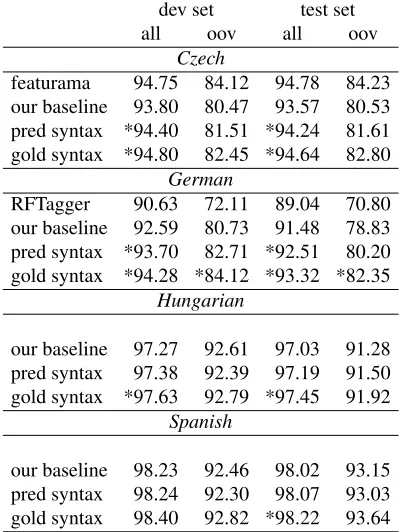
Table 4: The effect of syntactic features when predicting morphologyusing lexicons. * mark statistically signifi-cantly better models compared to our baseline (sentence-based t-test withα= 0.05).
and out-of-vocabulary tokens only (oov). Out-of-vocabulary tokens do not occur in the training data.
We find trends along several axes: Generally, the syntactic features work well for Czech and Ger-man, whereas for Hungarian and Spanish, they do
not yield any significant improvement. The
im-provements for German and Czech are between 0.5 (Czech) and 1.0 (German) percentage points abso-lute in token accuracy, and between 0.2 (Czech test set) and 2.5 (German dev set) percentage points ab-solute in accuracy of unknown words. There are no obvious differences between the development and the test set in any of the languages.
Compared to the morfette baseline, we find our systems to be either superior or equal to morfette in terms of token accuracy. Regarding accuracy on un-known words, morfette outperforms our systems for Hungarian, but is outperformed on Czech and Ger-man. For Spanish, all systems yield similar results.
[image:5.612.75.294.64.329.2]case, for Hungarian and Spanish, the differences are small but visible. There are pronounced differences between the predicted and the gold syntax experi-ments in Czech and German. Clearly, the parser makes mistakes that propagate through to the pre-diction of the morphology.
2.4 Syntax vs Lexicon
The current state-of-the-art in predicting morpho-logical features makes use of morphomorpho-logical lexi-cons (e.g. Hajiˇc (2000), Hakkani-T¨ur et al. (2002), Hajiˇc (2004)). Lexicons define the possible morpho-logical descriptions of a word and a statistical model selects the most probable one among them. In the following experiment, we test whether the contribu-tion of syntactic features is similar or different to the contribution of morphological lexicons.
Lexicons encode important knowledge that is dif-ficult to pick up in a purely statistical system, e. g. the gender of nouns, which often cannot be deduced
from the word form (Corbett, 1991).7
We extend our system from the previous experi-ment to include information from a morphological dictionaries. For Czech, we use the morphologi-cal analyzer distributed with the Prague Dependency Treebank 2 (Hajiˇc et al., 2006). For German, we use DMor (Schiller, 1994). For Hungarian, we use (Tr´on et al., 2006), and for Spanish, we use the mor-phological analyzer included in Freeling (Carreras et al., 2004). The output of the analyzers is given to the system as features that simply record the presence of a particular morphological analysis for the current word. The system can thus use the output of any tool regardless of its annotation scheme, especially if the annotation scheme of the treebank is different from the one of the morphological analyzer.
Table 4 presents the results of experiments where we add the output of the morphological analyzers to our system. Again, we run experiments with and without syntactic features. For Czech, we also show
results from featurama8 with the feature set
devel-oped by Votrubec (2006). For German, we show re-sults for RFTagger (Schmid and Laws, 2008).
As expected, the information from the morpho-logical lexicon improves the overall performance
7
Lexicons are also often used to speed up processing con-siderably by restricting the search space of the statistical model.
8
http://sourceforge.net/projects/featurama/
considerably compared to the results in Table 3, es-pecially on unknown tokens. This shows that even with the considerable amounts of training data avail-able nowadays, rule-based morphological analyzers are important resources for morphological descrip-tion (cf. Hajiˇc (2000)). The contribudescrip-tion of syn-tactic features in German and Czech is almost the same as in the previous experiment, indicating that the syntactic features contribute information that is orthogonal to that of the morphological lexicon. The lexicon provides lexical knowledge about a word form, while the syntactic features provide the syn-tactic context that is needed in German and Czech to decide on the right morphological tag.
2.5 Language Differences
From the previous experiments, we conclude that syntactic features help in the prediction of morphol-ogy for Czech and German, but not for Hungarian and Spanish. To further investigate the difference between Czech and German on the one hand, and Hungarian and Spanish on the other, we take a closer look at the output of the tagger.
We find an interesting difference between the two pairs of languages, namely the performance
with respect to agreement. Agreement is a
phe-nomenon where morphology and syntax strongly in-teract. Morphological features co-vary between two items in the sentence, but the relation between these items can occur at various linguistic levels (Corbett, 2006). If the syntactic information helps with pre-dicting morphological information, we expect this to be particularly helpful with getting agreement right. All languages show agreement to some ex-tent. Specifically, all languages show agreement in number (and person) between the subject and the verb of a clause. Czech, German, and Spanish show agreement in number, gender, and case (not Span-ish) within a noun phrase. Hungarian shows case agreement within the noun phrase only rarely, e.g. for attributively used demonstrative pronouns.
devel-opment sets of each language. We compare the base-line system that does not use any syntactic informa-tion with the output of the morphological tagger that uses the gold syntax. We use the gold syntax rather than the predicted one in order to eliminate any in-fluence from parsing errors. As can be seen from the results, the level of agreement relations in Czech and German improves when using syntactic information, whereas in Spanish and Hungarian, only very tiny changes occur.
agreement baseline gold syntax Czech
sbj-verb 3199/4044 = 79.10 3264/4044 = 80.71 NP case 8719/9132 = 95.48 8821/9132 = 96.59 NP num 8933/9132 = 97.82 9016/9132 = 98.73 NP gen 8493/9132 = 93.00 8768/9132 = 96.01
German
sbj-verb 4412/4696 = 93.95 4562/4696 = 97.15 NP case 13340/13951 = 95.62 13510/13951 = 96.84 NP num 13631/13951 = 97.71 13788/13951 = 98.83 NP gen 13253/13951 = 95.00 13528/13951 = 96.97
Hungarian
sbj-verb 8653/10219 = 84.68 8655/10219 = 84.70 NP case 402/891 = 45.12 412/891 = 46.24
Spanish
[image:7.612.79.290.212.413.2]sbj-verb 1930/2004 = 96.31 1932/2004 = 96.41 NP num 8810/8849 = 99.56 8816/8849 = 99.63 NP gen 8810/8849 = 99.56 8821/8849 = 99.68 Table 5: Agreement counts in morphological annotation compared between the baseline system and the oracle system using gold syntax.
For Czech and German, these results sugguest that syntactic information helps with agreement. We believe that the reasons why it does not help for Hungarian and Spanish are the following: for Span-ish, we see that also the baseline model achieves very high accuracies (cf. Table 3) and also high rates of correct agreement. It seems that for Spanish, syn-tactic context is simply not necessary to make the correct prediction. For Hungarian, the reason lies within the inflectional paradigms of the language, which do not show any form syncretism, mean-ing that word forms in Hungarian are usually not ambiguous within one morphological category (e.g. case). Making a morphological tag prediction, how-ever, is difficult only if the word form itself is am-biguous between several morphological tags. In this case, using the agreement relation between the word and its syntactic head can help the system making
the proper prediction. This is the situation that we find in Czech and German, where form syncretism is pervasive in the inflectional paradigms.
2.6 Syntactic Features in Czech
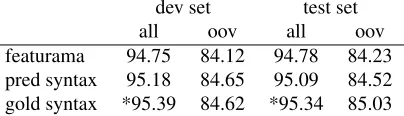
In Section 2.4 we compared the performance of our system on Czech to another system, featurama (see Table 4). Featurama outperforms our baseline sys-tem by a percentage point in token accuracy (and even more for unknown tokens). Syntactic informa-tion closes that gap to a large extent but only using gold syntax gets our system on a par with featurama. The question then arises whether the syntactic features actually contribute something new to the task, or whether the same effect could also be achieved with linear context features alone as in fea-turama. In order to test this we run an additional experiment, where we add some of the syntax fea-tures to the feature set of featurama. Specifically, we add the static features from Table 2 that do not use lemma or part-of-speech information. Due to the way featurama works, we cannot use features from the morphological tags (the dynamic features).
The results in Table 6 show that also featurama profits from syntactic features, which corroborates the findings from the previous experiments. We also note again that better syntax would improve results even more.
dev set test set
all oov all oov
featurama 94.75 84.12 94.78 84.23 pred syntax 95.18 84.65 95.09 84.52 gold syntax *95.39 84.62 *95.34 85.03
Table 6: Syntactic features for featurama (Czech). * mark statistically significantly better models compared to feat-urama (sentence-based t-test withα= 0.05).
3 How Much Syntax is Needed?
Syntactic features require syntactically annotated corpora. Without a treebank to train the parser, the
morphology cannot profit from syntactic features.9
This may be problematic for languages for which there is no treebank, because creating a treebank is expensive. Fortunately, it turns out that very small amounts of syntactically annotated data are enough
9
[image:7.612.326.528.453.511.2]German Czech
88 89 90 91 92 93 94
0 5000 10000 15000 20000 25000 30000 35000 40000
accuracy of morphology
# of sentences in training data of syntactic parser dev test
88 89 90 91 92 93 94
0 5000 10000 15000 20000 25000 30000 35000 40000
accuracy of morphology
[image:8.612.93.527.62.203.2]# of sentences in training data of syntactic parser dev test
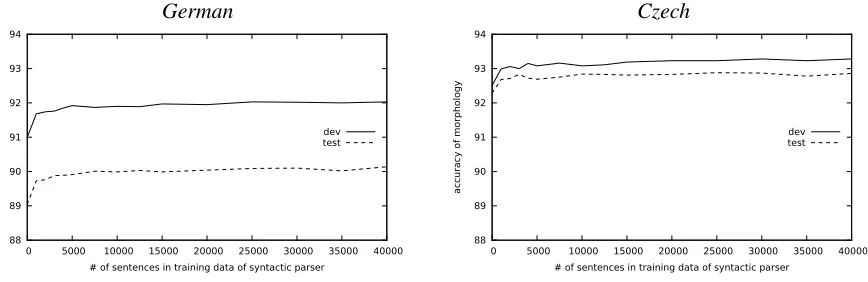
Figure 2: Dependency between amount of training data for syntactic parser and quality of morphological prediction.
to provide a parsing quality that is sufficient for the morphological tagger.
In order to test what amount of training data is needed, we train several parsing models on increas-ing amounts of syntactically annotated data. For ex-ample, the first experiment uses the first 1,000 sen-tences of the treebank. We perform 5-fold jackknif-ing with the parser on these sentences to annotate them with syntax. Then we train one parsing model on these 1,000 sentences and use it to annotate the rest of the training data as well as the development and the test set. This gives us the full data set an-notated with syntax that was learned from the first 1,000 sentences of the treebank. The morphologi-cal tagger is then trained on the full training set and applied to development and test set.
Figure 2 shows the dependency between the amount of training data given to the parser and the quality of the morphological tagger using syntac-tic features provided by this parser. The left-most point corresponds to a model that does not use
syn-tactic information. For both languages, German
and Czech, we find that already 1,000 sentences are enough training data for the parser to provide useful syntactic information to the morphological tagger. After 5,000 sentences, both curves flatten out and stay on the same level. We conclude that using syn-tactic features for morphological prediction is viable even if there is only small amounts of syntactic data available to train the parser.
As a related experiment, we also test if we can get the same effect with a very simple and thus much faster parser. We use the brute-force algorithm de-scribed in Covington (2001), which selects for each
token in the sentence another token as the head. It does not have any tree requirements, so it is not even guaranteed to yield a cycle-free tree structure. In Ta-ble 7, we compare the simple parser with the mate-parser, both trained on the first 5,000 sentences of the treebank. Evaluation is done in terms of labeled
(LAS) and unlabeled attachment score (UAS).10
dev set test set
LAS UAS LAS UAS
Czech
simple parser (5k) 71.57 78.96 69.09 77.23 full parser (5k) 76.77 84.38 74.70 83.00
German
[image:8.612.321.531.358.446.2]simple parser (5k) 83.06 85.23 78.56 81.18 full parser (5k) 87.56 90.08 83.69 86.58 Table 7: Simple parser vs full parser – syntactic quality. Trained on first 5,000 sentences of the training set.
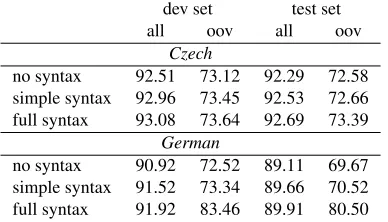
As expected, the simple parser performs much worse in terms of syntactic quality. Table 8 shows the performance of the morphological tagger when using the output of both parsers as syntactic fea-tures. For Czech, both parsers seem to supply sim-ilar information to the morphological tagger, while for German, using the full parser is clearly better. In both cases, the morphological tagger outperforms the models that do not use syntactic information (cf. Table 3). The performance on unknown words is however much worse for both languages. We con-clude that even with a simple parser and little train-ing data, the morphology can make use of syntactic information to some extent.
10
dev set test set
all oov all oov
Czech
no syntax 92.51 73.12 92.29 72.58 simple syntax 92.96 73.45 92.53 72.66 full syntax 93.08 73.64 92.69 73.39
German
[image:9.612.318.536.63.160.2]no syntax 90.92 72.52 89.11 69.67 simple syntax 91.52 73.34 89.66 70.52 full syntax 91.92 83.46 89.91 80.50 Table 8: Simple parser vs full parser – morphological quality. The parsing models were trained on the first 5,000 sentences of the training data, the morphological tagger was trained on the full training set.
4 Does Better Morphology lead to Better
Parses?
In the previous sections, we show that syntactic in-formation improves a model for predicting morphol-ogy for Czech and German, where syntax and mor-phology interact considerably. A natural question then is whether the improvement also occurs in the other direction, namely whether the improved mor-phology also leads to better parsing models.
In the previous experiments, we run a 10-fold jackknifing process to annotate the training data with morphological information using no syntactic fea-tures and afterwards use jackknifing with the parser to annotate syntax. The syntax is subsequently used as features for our predicted-syntax experiments. We can apply the same process once more with the morphology prediction in order to annotate the train-ing data with morphological information that is pre-dicted using the syntactic features. A parser trained on this data will then use the improved morphology as features. If the improved morphology has an im-pact on the parser, the quality of the second parsing model should then be superior to the first parsing model, which uses the morphology predicted with-out syntactic information. Note that for the follow-ing experiments, neither morphology model uses the morphological lexicon.
Table 9 presents the evaluation of the two pars-ing models (one uspars-ing morphology without syntactic features, the other one using the improved morphol-ogy). The results show no improvement in parsing performance when using the improved morphology. Looking closer at the output, we find differences
be-dev set test set
LAS UAS LAS UAS
Czech
baseline morph 81.73 88.45 81.02 87.77 morph w/ syntax 81.63 88.37 80.83 87.61
German
[image:9.612.89.283.64.175.2]baseline morph 91.16 92.97 88.06 90.24 morph w/ syntax 91.20 92.97 88.15 90.34
Table 9: Impact of the improved morphology on the qual-ity of the dependency parser for Czech and German.
tween the two parsing models with respect to gram-matical functions that are morphologically marked. For example, in German, performance on subjects and accusative objects improves while performance for dative objects and genitives decreases. This sug-gests different strengths in the two parsing models. However, the question how to make use of the im-proved morphology in parsing clearly needs more research in the future. A promising avenue may be the approach by Hohensee and Bender (2012).
5 Related Work
Morphological taggers have been developed for many languages. The most common approach is the combination of a morphological lexicon with a sta-tistical disambiguation model (Hakkani-T¨ur et al., 2002; Hajiˇc, 2004; Smith et al., 2005; Spoustov´a et al., 2009; Zsibrita et al., 2013).
Our work has been inspired by Versley et al. (2010), who annotate a treebank with morphologi-cal information after the syntax had been annotated already. The system used a finite-state morphology to propose a set of candidate tags for each word, which is then further restricted using hand-crafted rules over the already available syntax tree.
Lee et al. (2011) pursue the idea of jointly predict-ing syntax and morphology, out of the motivation that joint models should model the problem more faithfully. They demonstrate that both sides can use information from each other. However, their model is computationally quite demanding and its overall performance falls far behind the standard pipeline approach where both tasks are done in sequence.
2010). Modeling morphosyntactic relations explic-itly has been shown to improve statistical parsing models (Tsarfaty and Sima’an, 2010; Goldberg and Elhadad, 2010; Seeker and Kuhn, 2013), but the co-dependency between morphology and syntax makes it a difficult problem, and linguistic intuition is often contradicted by the empirical findings. For example, Marton et al. (2013) show that case information is the most helpful morphological feature for parsing Arabic, but only if it is given as gold information, whereas using case information from an automatic system may even harm the performance.
Morphologically rich languages pose different challenges for automatic systems. In this paper, we work with European languages, where the problem of predicting morphology can be reduced to a tag-ging problem. In languages like Arabic, Hebrew, or Turkish, widespread ambiguity in segmentation of single words into meaningful morphemes adds an additional complexity. Given a good segmentation tool that takes care of this, our approach is appli-cable to these languages as well. For Hebrew, this problem has also been addressed by jointly mod-eling segmentation, morphological prediction, and syntax (Cohen and Smith, 2007; Goldberg and Tsar-faty, 2008; Goldberg and Elhadad, 2013).
6 Conclusion
In this paper, we have demonstrated that using syn-tactic information for predicting morphological in-formation is helpful if the language shows form syn-cretism in combination with morphosyntactic phe-nomena like agreement. A model that uses syntactic information is superior to a sequence model because it leverages the syntactic dependencies that may hold between morphologically dependent words as sug-gested by linguistic theory. We also showed that only small amounts of training data for a statistical parser would be needed to improve the morphologi-cal tagger. Making use of the improved morphology in the dependency parser is not straight-forward and requires more investigation in the future.
Modeling the interaction between morphology and syntax is important for building successful pars-ing pipelines for languages with free word order and rich morphology. Moreover, our experiments show that paying attention to the individual properties of a
language can help us explain and predict the behav-ior of automatic tools. Thus, the term ”morpholog-ically rich language” should be viewed as a broad term that covers many different languages, whose differences among each other may be as important as the difference with languages with a less rich mor-phology.
Acknowledgments
We would like to thank Jan Hajiˇc and Jan ˇStˇep´anek for their kind help with the Czech morphology and featurama. We would also like to thank Thomas M¨uller for sharing resources and thoughts with us, and Anders Bj¨orkelund for commenting on earlier versions of this paper. This work was funded by the Deutsche Forschungsgemeinschaft (DFG) via SFB 732 ”Incremental Specification in Context”, project D8.
References
Barry J. Blake. 2001. Case. Cambridge University Press, Cambridge, New York, 2nd edition.
Bernd Bohnet and Joakim Nivre. 2012. A Transition-Based System for Joint Part-of-Speech Tagging and Labeled Non-Projective Dependency Parsing. In Pro-ceedings of the 2012 Joint Conference on Empirical Methods in Natural Language Processing and Com-putational Natural Language Learning, pages 1455– 1465, Jeju, South Korea. Association for Computa-tional Linguistics.
Bernd Bohnet. 2010. Very high accuracy and fast depen-dency parsing is not a contradiction. InProceedings of the 23rd International Conference on Computational Linguistics, pages 89–97, Beijing, China. International Committee on Computational Linguistics.
Sabine Brants, Stefanie Dipper, Silvia Hansen-Shirra, Wolfgang Lezius, and George Smith. 2002. The TIGER treebank. InProceedings of the 1st Workshop on Treebanks and Linguistic Theories, pages 24–41, Sozopol, Bulgaria.
Joan Bresnan. 2001. Lexical-Functional Syntax. Black-well Publishers.
Grzegorz Chrupała, Georgiana Dinu, and Josef van Genabith. 2008. Learning morphology with mor-fette. In Proceedings of the Sixth International Conference on Language Resources and Evaluation (LREC’08), pages 2362–2367, Marrakech, Morocco. European Language Resources Association (ELRA). http://www.lrec-conf.org/proceedings/lrec2008/. Shay B. Cohen and Noah A. Smith. 2007. Joint
morpho-logical and syntactic disambiguation. InProceedings of the 2007 Joint Conference on Empirical Methods in Natural Language Processing and Computational Natural Language Learning, pages 208–217, Prague, Czech Republic. Association for Computational Lin-guistics.
Michael Collins. 2002. Discriminative training meth-ods for hidden markov models: Theory and experi-ments with perceptron algorithms. InProceedings of the 2002 Conference on Empirical Methods in Natu-ral Language Processing, pages 1–8. Association for Computational Linguistics, July.
Greville G. Corbett. 1991. Gender. Cambridge Text-books in Linguistics. Cambridge University Press. Greville G. Corbett. 2006. Agreement. Cambridge
Text-books in Linguistics. Cambridge University Press. Michael A. Covington. 2001. A fundamental algorithm
for dependency parsing (with corrections). In Pro-ceedings of the 39th Annual ACM Southeast Confer-ence, Athens, Gorgia. ACM.
Koby Crammer, Ofer Dekel, Shai Shalev-Shwartz, and Yoram Singer. 2003. Online passive-aggressive algo-rithms. InProceedings of the 16th Annual Conference on Neural Information Processing Systems, volume 7, pages 1217–1224, Cambridge, Massachusetts, USA. MIT Press.
Rich´ard Farkas, Veronika Vincze, and Helmut Schmid. 2012. Dependency parsing of hungarian: Baseline re-sults and challenges. InProceedings of the 13th Con-ference of the European Chapter of the Association for Computational Linguistics, pages 55–65, Avignon, France. Association for Computational Linguistics. Yoav Goldberg and Michael Elhadad. 2010. Easy first
dependency parsing of modern Hebrew. In Proceed-ings of the NAACL HLT 2010 First Workshop on Sta-tistical Parsing of Morphologically-Rich Languages, pages 103–107, Los Angeles, California, USA. Asso-ciation for Computational Linguistics.
Yoav Goldberg and Michael Elhadad. 2013. Word seg-mentation, unknown-word resolution, and morpholog-ical agreement in a hebrew parsing system. Computa-tional Linguistics, 39(1):121–160.
Yoav Goldberg and Reut Tsarfaty. 2008. A single gener-ative model for joint morphological segmentation and syntactic parsing. InProceedings of the 46th Annual
Meeting of the Association for Computational Linguis-tics, pages 371–379, Columbus, Ohio. Association for Computational Linguistics.
Jan Hajiˇc. 2000. Morphological Tagging: Data vs. Dic-tionaries. InProceedings of the 6th ANLP Conference / 1st NAACL Meeting, pages 94—101, Seattle, Wash-ington. Association for Computational Linguistics. Jan Hajiˇc. 2004. Disambiguation of Rich Inflection
(Computational Morphology of Czech). Nakladatel-stv´ı Karolinum, Prague, Czech Republic.
Jan Hajiˇc, Jarmila Panevov´a, Eva Hajiˇcov´a, Petr Sgall, Petr Pajas, Jan ˇStˇep´anek, Ji´ı Havelka, and Marie Mikulov´a. 2006. Prague Dependency Treebank 2.0. Jan Hajiˇc, Massimiliano Ciaramita, Richard
Johans-son, Daisuke Kawahara, Maria Ant`onia Mart´ı, Llu´ıs M`arquez, Adam Meyers, Joakim Nivre, Sebastian Pad´o, Jan Step´anek, Pavel Stran´ak, Mihai Surdeanu, Nianwen Xue, and Yi Zhang. 2009. The CoNLL-2009 shared task: Syntactic and Semantic dependen-cies in multiple languages. In Proceedings of the 13th Conference on Computational Natural Language Learning: Shared Task, pages 1–18, Boulder, Col-orado, USA. Association for Computational Linguis-tics.
Dilek Z. Hakkani-T¨ur, Kemal Oflazer, and G¨okhan T¨ur. 2002. Statistical morphological disambiguation for agglutinative languages. Computers and the Humani-ties, 36(4):381–410.
Matt Hohensee and Emily M. Bender. 2012. Getting more from morphology in multilingual dependency parsing. InProceedings of the 2012 Conference of the North American Chapter of the Association for Com-putational Linguistics: Human Language Technolo-gies, pages 315–326, Montr´eal, Canada. Association for Computational Linguistics.
John Lee, Jason Naradowsky, and David A. Smith. 2011. A discriminative model for joint morphological disam-biguation and dependency parsing. InProceedings of the 49th annual meeting of the Association for Compu-tational Linguistics, pages 885–894, Portland, USA. Association for Computational Linguistics.
Yuval Marton, Nizar Habash, and Owen Rambow. 2013. Dependency parsing of modern standard arabic with lexical and inflectional features. Computational Lin-guistics, 39(1):161–194.
Igor Melˇcuk. 2009. Dependency in linguistic descrip-tion.
Robbert Prins. 2004. Beyond N in N-gram tagging. In Leonoor Van Der Beek, Dmitriy Genzel, and Daniel Midgley, editors,Proceedings of the ACL 2004 Student Research Workshop, pages 61–66, Barcelona, Spain. Association for Computational Linguistics.
Helmut Schmid and Florian Laws. 2008. Estimation of conditional probabilities with decision trees and an application to fine-grained POS tagging. In Proceed-ings of the 22nd International Conference on Compu-tational Linguistics, pages 777–784, Morristown, NJ, USA. Association for Computational Linguistics. Wolfgang Seeker and Jonas Kuhn. 2012. Making
El-lipses Explicit in Dependency Conversion for a Ger-man Treebank. In Proceedings of the 8th Interna-tional Conference on Language Resources and Eval-uation, pages 3132–3139, Istanbul, Turkey. European Language Resources Association (ELRA).
Wolfgang Seeker and Jonas Kuhn. 2013. Morphologi-cal and syntactic case in statistiMorphologi-cal dependency pars-ing. Computational Linguistics, 39(1):23–55.
Noah A. Smith, David A. Smith, and Roy W. Tromble. 2005. Context-based morphological disambiguation with random fields. In Proceedings of Human Lan-guage Technology Conference and Conference on Empirical Methods in Natural Language Processing, pages 475–482, Vancouver, British Columbia, Canada, October. Association for Computational Linguistics. Drahom´ıra ”Johanka” Spoustov´a, Jan Hajiˇc, Jan Raab,
and Miroslav Spousta. 2009. Semi-supervised train-ing for the averaged perceptron POS tagger. In Pro-ceedings of the 12th Conference of the European Chapter of the Association for Computational Linguis-tics, pages 763–771, Athens, Greece. Association for Computational Linguistics.
Viktor Tr´on, P´eter Hal´acsy, P´eter Rebrus, Andr´as Rung, P´eter Vajda, and Eszter Simon. 2006. Morphdb.hu: Hungarian lexical database and morphological gram-mar. InProceedings of the 5th International Confer-ence on Language Resources and Evaluation, pages 1670–1673, Genoa, Italy.
Reut Tsarfaty and Khalil Sima’an. 2010. Modeling mor-phosyntactic agreement in constituency-based parsing of Modern Hebrew. In Proceedings of the NAACL HLT 2010 First Workshop on Statistical Parsing of Morphologically-Rich Languages, pages 40–48, Los Angeles, California, USA. Association for Computa-tional Linguistics.
Reut Tsarfaty, Djam´e Seddah, Yoav Goldberg, Sandra K¨ubler, Marie Candito, Jennifer Foster, Yannick Vers-ley, Ines Rehbein, and Lamia Tounsi. 2010. Statistical parsing of morphologically rich languages (SPMRL): what, how and whither. InProceedings of the NAACL HLT 2010 First Workshop on Statistical Parsing of Morphologically-Rich Languages, pages 1–12, Los Angeles, California, USA. Association for Computa-tional Linguistics.
Yannick Versley, Kathrin Beck, Erhard Hinrichs, and Heike Telljohann. 2010. A syntax-first approach to
high-quality morphological analysis and lemma dis-ambiguation for the tba-d/z treebank. In9th Confer-ence on Treebanks and Linguistic Theories (TLT9), pages 233–244.
Veronika Vincze, D´ora Szauter, Attila Alm´asi, Gy¨orgy M´ora, Zolt´an Alexin, and J´anos Csirik. 2010. Hungar-ian Dependency Treebank. InProceedings of the 7th Conference on International Language Resources and Evaluation, pages 1855–1862, Valletta, Malta. Euro-pean Language Resources Association (ELRA). Jan Votrubec. 2006. Morphological tagging based on
averaged perceptron. InWDS’06 Proceedings of Con-tributed Papers, pages 191–195, Praha, Czechia. Mat-fyzpress, Charles University.