115
Learning Representations for Detecting Abusive Language
Magnus Sahlgren RISE AI and FOI Box 1263, 164 29 Kista
Sweden
Tim Isbister FOI
164 90 Stockholm Sweden [email protected]
Fredrik Olsson FOI
164 90 Stockholm Sweden
Abstract
This paper discusses the question whether it is possible to learn a generic representation that is useful for detecting various types of abusive language. The approach is inspired by recent advances in transfer learning and word embed-dings, and we learn representations from two different datasets containing various degrees of abusive language. We compare the learned representation with two standard approaches; one based on lexica, and one based on data-specificn-grams. Our experiments show that learned representations do contain useful in-formation that can be used to improve detec-tion performance when training data is limited.
1 Introduction
Abusive language is prevalent on the Internet of today. Many users of social media can attest to the frequent occurrence of negative slurs, racist and sexist comments, hate speech, cyberbullying, and outright threats. Commentary fields of news out-lets, discussion forums, blogs, and normal web-sites are overflooded by abusive language, forcing administrators to restrict the possibility to com-ment on content, and in many cases removing this possibility altogether. As unfortunate as this de-velopment may be, it is hardly surprising. Our current information landscape has been designed to maximize theeffectivenessof human communi-cation, and factors such as transparency, trust and credibility have remained of peripheral concern for service providers. The combination of accessi-bility and anonymity of many online services pro-vides the perfect conditions for “dark triad” behav-ior (Paulhus and Williams, 2002) to flourish. Even traditional news media, which have been seen as the last bastion for credibility and trust, are nowa-days driven by the need for fast updates, sensation-alism, and the hunt for clicks. It should serve as a
cautionary observation that even fringe phenom-ena such astrolling fit comfortably in the current media landscape on the Internet (Phillips, 2015).
Our research focus in this paper is the question whether an inherently abusive environment such as a discussion forum or a white supremacist web-site can be used to learn a generic representation of abusive language, and whether such a represen-tation can be used in supervised methods for de-tecting abusive language. Our work is inspired on the one hand by recent advances in transfer learn-ing and pre-trainlearn-ing of deep neural networks (Pan and Yang, 2010; Erhan et al., 2010; Peters et al., 2018), and on the other hand the use of embed-dings as representation layer in text classification (Sahlgren and Cöster, 2004; Jin et al., 2016). We use two different data sources for learning rep-resentations (Stormfront and Reddit, further de-tailed in Section 4.1) and three different represen-tation learning mechanisms (character-enhanced word embeddings, document-enhanced word em-beddings, and a character-level language model, all further detailed in Section 3.3). We compare the proposed approaches with standard lexicon-based classification as well as supervised classi-fication using Bag-of-Words n-gram representa-tions.
2 Previous Work
been a fair amount of previous work on detecting various forms of abusive language. In particular the general concept of hate speech, which may in-clude anything from negative remarks and racist comments to threats, has enjoyed a considerable amount of previous research (see e.g. Warner and Hirschberg (2012); Wester et al. (2016); Ross et al. (2016); Waseem and Hovy (2016); Davidson et al. (2017); Isbister et al. (2018)), demonstrating both the complexity of such a general problem as man-ifested by low inter-annotator agreement scores, but also the viability of using machine learning for detecting specific instances of hate speech in online conversations. Several researchers have fo-cused on more specific types of abusive language, such as cyberbullying (see e.g. Reynolds et al. (2011); Nandhini and Sheeba (2015); Murnion et al. (2018)) and threats (e.g. Hammer (2014); Wester et al. (2016)), demonstrating the applica-bility of machine learning for detection purposes. The somewhat related, but more general, tasks of sentiment analysis and stance detection have a long history in Natural Language Processing (NLP), with a large body of literature on both theo-retical and practical issues related to detection and monitoring (see e.g. Turney (2002); Pang and Lee (2008); Liu (2012); Pozzi et al. (2016); Kucher et al. (2017)).
3 Text Representations
Our primary interest in this study is the effect of text representations for the task of detecting abu-sive language. We consider three inherently dif-ferent approaches: predefined sets of keywords (i.e. lexica), data-specific n-grams (i.e. Bag-of-Words), and pretrained embeddings. The follow-ing sections provide more details regardfollow-ing the different approaches.
3.1 Lexica
The arguably most simplistic representation for detecting abusive language is to use a set of key-words (i.e. a lexicon) of abusive terms, possibly augmented by weights that quantify the relative importance of lexicon items. As an example, a lexicon with negative slurs may list terms such as “idiot”, “redneck” and “white trash”, and weights may be assigned that give higher importance to currences of “idiot” and “white trash” than to oc-currences of “redneck”. It is obvious that the cov-erage of the lexicon will be dependent on the
in-ventiveness of the lexicographer. Coming up with an exhaustive list of all possible negative slurs is a daunting task, and (the almost certain) failure to do so will affect the coverage of the method. One way to alleviate this synonymyproblem is to use unsupervised (or semi-supervised) machine learn-ing to augment the compiled lexicon (Gyllensten and Sahlgren, 2018). Another obvious problem with keyword matching is polysemy, or the fact that words can have several different meanings. As an example, consider a statement such as “you should use the white trash can”, which contains the abusive keyword “white trash”, but does not signal negativity. Accounting for such context-sensitivity is a challenging problem (referred to asword-sense disambiguationin NLP) that affects the precision of the classification.
Despite these apparent drawbacks, lexicon-based classification is common in both sentiment analysis (see e.g. Taboada et al. (2011); Jurek et al. (2015)), and in hate speech detection (e.g. Njagi et al. (2015); Schmidt and Wiegand (2017); Isbis-ter et al. (2018)). The two main reasons for this is simplicity and transparency. Simply defining a set of keywords and counting their occurrences in text is a quick and easy way to get an impression of the prevalence of some phenomenon. Further-more, being able to precisely identify the matching keywords in text is a transparent and simple way to explain a classification decision to a user. Such explainability can be a very important considera-tion in practical applicaconsidera-tions.
In the following experiments, we use four pre-viously published lexica relating to abusive lan-guage. We use the baseLexicon containing 537 tokens, and the expandedLexicon con-taining 2,680 tokens from (Wiegand et al.)1, and the hatebaseLexicon containing 1,018 to-kens, and the refined_ngramLexicon con-taining 178 tokens from (Davidson et al., 2017)2. We refer to these lexica simply as Lexicon #1, Lexicon #2, Lexicon #3, and Lexicon #4 in the remainder of this article. The original lexica are modified such that only terms that are certain to convey abusiveness, according to the lexicon cre-ators, are retained and word class information is discarded. That is, in Lexicon #1, all terms la-beled FALSE by the annotators are removed, and in Lexicon #2 all terms with a positive score
(in-1
https://github.com/uds-lsv/lexicon-of-abusive-words
2
dicating abusiveness) are kept. Lexicon #3 and #4 are used as-is. For the classification tasks using the lexica, a text is considered as abusive if it contains at least one term from a lexicon. Examples of abu-sive lexical entries include: “linthead”, “alligator bait”, and “you fuck wit”.
3.2 Bag-of-Words
In contrast to a priori defining a set of represen-tative terms, a Bag-of-Words (BoW) representa-tion identifies informative terms directly from the training data. A BoW representation is an un-ordered collection of terms, in which each text is represented as ann-dimensional vector, where n
is the size of the vocabulary, and each dimension encodes the weight (orinformativeness) of a spe-cific word in the current text. The standard term weight is some variant of TF-IDF (Sparck Jones, 1988), which combines a measure of the represen-tativeness of a word for a text (often simply the fre-quency of the word in the text, TF) with a measure of how discriminative words are (often the inverse document frequency of a word, IDF). This “simple and proven” (Robertson and Jones, 1994) method for representing text is often employed in practi-cal document processing applications, such as text categorization, document clustering, and informa-tion retrieval.
The main benefit of using BoW representations is that does not require any a priori knowledge, and that it operates completely on the given data. As such, a BoW representation may learn to use features that are not obvious for a lexicographer, and it may learn to use certain features in combi-nation (e.g. that the occurrence of “can” in con-junction with “white trash” signals absence rather than presence of abusiveness). On the other hand, a BoW representation will be sensitive to out-of-vocabulary items, and it may learn to use fea-tures that do not make sense for a human ana-lyst, which obviously decreases the explainability of the method.
In the following experiments, we augment stan-dard BoW unigram features with character n -grams. This is normally done in order to account for morphological variation; if a training exam-ple contains the word “abuse” but a test examexam-ple contains the word “abusive”, a standard BoW rep-resentation will allocate different vector dimen-sions for these two words, and consequently there will be no similarity between the BoW
representa-tions for these texts. Using charactern-grams, we would instead represent these words by their com-ponent charactern-grams (up to some size ofn), which would allocate the same vector dimensions to shared n-grams such as “abus”, thus inducing similarity between their representations.
We use up to 4-grams for the character se-quences, and we also allow for word bigrams in the representations. Word bigrams can be helpful to distinguish the use of collocations from use of the component terms. As an example, we would assign very different abusive scores to the two statements “you can use the trash can that is white” and “you are white trash”; it is not the individ-ual occurrences of the words “white” and “trash” that is significant here, but the collocation “white trash”. We weight the dimensions of the result-ing representations usresult-ing standard TF-IDF. For the classification tasks, the weighted n-gram repre-sentations are fed into a Logistic Regression clas-sifier with L2 penalization.
3.3 Embeddings
While a lexicon relies completely on prior knowl-edge about the task and the domain, a BoW repre-sentation relies exclusively on task-dependent fea-tures. The idea of using pre-trained embeddings is a way to combine these two perspectives; we use bag-of representations to encode task-specific fea-tures, but take prior knowledge about the domain into account by learning a representation from rep-resentative data, which (in the best case) encodes latent variables that may be useful for relevant classification tasks.
This approach is inspired by recent advances in transfer learning and pre-training of deep neural networks (Pan and Yang, 2010; Erhan et al., 2010; Peters et al., 2018), in which a model that has been learned on some data is used as the foundation for learning a new model on new data. By doing so, the new model can take advantage of the previ-ous knowledge already encoded in the representa-tions of the pre-trained model. This is conceptu-ally the same idea as using pre-trained word em-beddings as representation layer in text classifica-tion (Sahlgren and Cöster, 2004; Jin et al., 2016), where the hope is that the embeddings can provide useful generalizations in comparison with only us-ing standard BoW.
em-beddings trained using the FastText model (Bo-janowski et al., 2017), which uses the character
n-grams of a set of context words to predict a target word. For those who are familiar with the word2vec model (Mikolov et al., 2013), this is es-sentially the same idea as the CBOW architecture, but using charactern-grams instead of only word tokens. The resulting embeddings are used to pro-duce text representations by simply averaging the TF-IDF-weighted vectors for all words in a text. For the embeddings, we use 300-dimensional vec-tors using the CBOW architecture with character
n-grams, where nranges between 3 to 6 charac-ters. We use a window size of 5 tokens, and dis-card tokens that occur less than 100 times in the training data. These parameter settings are stan-dard in the literature on embeddings, and are based on experience and trial and error.
The second flavor uses document-enhanced word embeddings trained using the Doc2Vec model (Le and Mikolov, 2014), which also re-lies on the architectures from word2vec, but adds a document id as input signal in addition to the word tokens. In this case, we use the distributed bag-of-words architecture, which predicts a set of word vectors based on a document vector (i.e. a document-based version of the SkipGram archi-tecture). We use 300 dimensions for the embed-dings, and the distributed bag-of-words architec-ture with a window size of 5, including only tokens that occur more than 100 times in the training data.
The third flavor uses a character-level language model that is trained to predict the next charac-ter given an input sequence of characcharac-ters. We use a simple architecture consisting of one recur-rent layer with Gated Recurrecur-rent Units (GRU) (Cho et al., 2014) using recurrent dropout, followed by a dense output layer using softmax activation. For training the network, we use adam optimization with learning rate decay, and a context size of 32 characters. For producing input vectors for train-ing examples in the supervised classification ex-periments, we split the examples into consecutive chunks of 32 characters, and average the activa-tions of the GRU layer over all chunks.
Despite being conceptually similar, there is an important difference between these three ap-proaches that concerns the compositionality of the text representations. In the case of character-enhanced and document-character-enhanced word embed-dings, we are essentially using bag-of
represen-tations that disregard the sequential nature of the data. That is, the average embedding for the se-quences “Bob hates Mary” and “Mary hates Bob” will be exactly the same. This is not the case for the language model, which operates on the char-acter sequences, and therefore will produce differ-ent compositional represdiffer-entations for these two se-quences. It is an empirical question whether this difference is of practical importance when using the resulting representations as input to a super-vised classifier.
4 Experiments
In order to compare the viability for detecting abusive language of the representations described in the previous sections, we use two different datasets for building embeddings, and four differ-ent datasets for validating classifiers based on the representations. Since our main focus in this paper is to study the effect of the representations rather than pursuing state of the art results, we use the same supervised classifier in all cases; a Logis-tic Regression classifier with L2 penalization. Be-fore turning to the results, we describe the various datasets used in the experiments.
4.1 Data for Pre-Training
The three types of embeddings are trained on two different data sets; a collection of roughly 5 million posts from the white supremacist web-site Stormfront, and a random sample of approx-imately 54 million comments from the discussion forum Reddit. Both datasets were crawled specif-ically for these experiments.
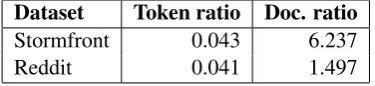
Dataset Token ratio Doc. ratio
Stormfront 0.043 6.237
[image:5.595.88.276.63.106.2]Reddit 0.041 1.497
Table 1: Ratios of occurrences of lexicon items in Stormfront vs. Reddit.
of abusive language, due to the fact that subjects who are active in white-supremacist environments tend to exhibit not only racial prejudice but gener-alized prejudice, which means we can also expect to find a substantial amount of sexism, homopho-bia, islamophohomopho-bia, and so on.
As a simple demonstration of this, Table 1 shows the proportion of occurrences of terms from the various lexica introduced in Section 3.1 in Stormfront vs. Reddit. We count ratios of the occurrence of lexical items over both tokens and documents to account for differences in docu-ment length (comdocu-ments on Stormfront are on av-erage 143 words long, but only 36 words long on Reddit). The ratios in Table 1 demonstrate a slightly higher concentration of abusive terminol-ogy (especially when considering document ratio) in Stormfront compared to Reddit.
[image:5.595.83.513.666.739.2]4.2 Data for Classification
Table 2 shows the four different datasets used to evaluate the viability of the different representa-tions for detecting various forms of abusive lan-guage. The columns Pos. used and Neg. used
specify the number of examples included in our experiments; we delimit all datasets to 10,000 data points (by random sampling) for efficiency rea-sons, and in order to use an equal amount of data in all experiments. Note that all datasets are highly imbalanced between the classes. This means that one could achieve high accuracy by simply guess-ing the majority class (i.e. the negative examples). To address this, we use weighted F1 score, which calculates F1 for each label and then their aver-age is weighted by support – i.e. the number of true instances for each label. Note that the use of
weighted F1 can result in an F-score that does not lie in between precision and recall. We also pro-vide a baseline method similar to random guess-ing by usguess-ing a stratified dummy classifier that gen-erates predictions by respecting the training set’s class distribution.
4.3 Results
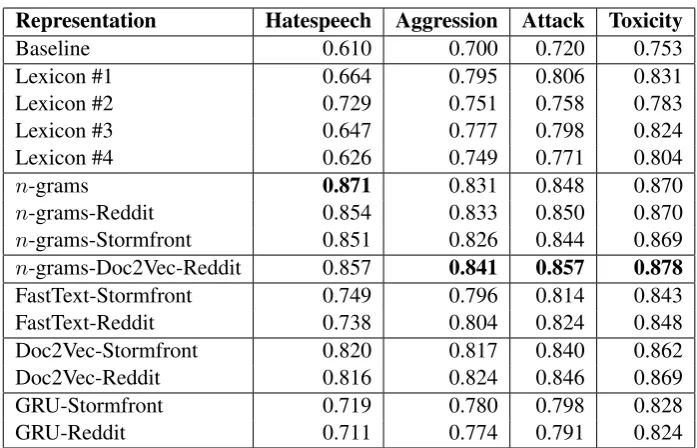
The results for the various representations on the various datasets are shown in Table 3 (next side). It is obvious that all representations beat the baseline, which demonstrates that they all provide useful information. Starting with the lexica, it is interesting to note that Lexi-con #1 (the baseLexicon containing 537 to-kens) outperforms the other lexica in all Wikipedia datasets, despite Lexicon #2 and #3 being sig-nificantly bigger. Lexicon #4, which is the
refined_ngramLexicon containing merely 178 tokens, performs only slightly worse than the other lexica. The biggest lexicon, the
expandedLexicon with 2,680 tokens, per-forms best on the Twitter Hatespeech data. These differences demonstrate that lexica in general do not generalize well.
The best-performing lexicon for each dataset outperforms the character-level language model representations. However, none of the lexica beat the GRU representations on all datasets, which in-dicates that pretrained representations have better generalization capabilities than simple keyword matching approaches. This is further corroborated by the fact that the FastText representations con-sistently outperform the lexica (and the language model). The best performing embeddings are the Doc2Vec representations, which produce competi-tive results in particular for the Wikipedia datasets (aggression, attack, and toxicity).
However, the standard BoW n-gram represen-tations outperform all other represenrepresen-tations on all datasets. We include three variants of the BoW vectors. The row labeled “n-grams” con-tain results from data-specific BoW
representa-Dataset Reference Pos. available Pos. used Neg. available Neg. used
Twitter Hatespeech Waseem and Hovy (2016) 2,989∗ 2,989 8,270∗ 7,011
Wikipedia Aggression Wulczyn et al. (2017) 21,496 1,647 94,368 8,353
Wikipedia Attack Wulczyn et al. (2017) 19,627 1,492 96,237 8,508
Wikipedia Toxicity Wulczyn et al. (2017) 23,023 1,205 136,663 8,795
∗
Note that since the publishing of Waseem and Hovy (2016), more than 5,000 tweets in the original corpus have become unavailable, and are thus not included in our experiment.
Representation Hatespeech Aggression Attack Toxicity
Baseline 0.610 0.700 0.720 0.753
Lexicon #1 0.664 0.795 0.806 0.831
Lexicon #2 0.729 0.751 0.758 0.783
Lexicon #3 0.647 0.777 0.798 0.824
Lexicon #4 0.626 0.749 0.771 0.804
n-grams 0.871 0.831 0.848 0.870
n-grams-Reddit 0.854 0.833 0.850 0.870
n-grams-Stormfront 0.851 0.826 0.844 0.869
n-grams-Doc2Vec-Reddit 0.857 0.841 0.857 0.878
FastText-Stormfront 0.749 0.796 0.814 0.843
FastText-Reddit 0.738 0.804 0.824 0.848
Doc2Vec-Stormfront 0.820 0.817 0.840 0.862
Doc2Vec-Reddit 0.816 0.824 0.846 0.869
GRU-Stormfront 0.719 0.780 0.798 0.828
[image:6.595.124.473.59.283.2]GRU-Reddit 0.711 0.774 0.791 0.824
Table 3: Results for the various representations on the datasets used in these experiments. The baseline is based on random guessing in proportion to the class distributions, and the lexica use simple Boolean matching (i.e. presence or absence of lexicon terms). All other results are produced by feeding the representations to a Logistic Regression classifer with L2 penalization.
tions (i.e. n-grams collected from the training data), while the “n-grams-Reddit” and the “n -grams-Stormfront” use vocabulary collected from the Reddit and Stormfront data, respectively. The point of including all three variants is to study the effect of data-specific vocabulary, which only seems to have a clear positive effect on the Twitter Hatespeech data. This is hardly surprising, since the Twitter data features a lot of domain-specific terminology such as hashtags and @-mentions.
In order to investigate whether the best-performing embeddings (Doc2Vec) contribute ad-ditional information in comparison with the data-specific BoW n-grams, we also include results with a model that concatenates the data-specific BoW n-grams with the Doc2Vec-Reddit model. These augmented representations produce the best results on all the Wikipedia datasets, but low-ers the score for the Twitter Hatespeech data. This demonstrates that the document-based em-beddingsdocontribute useful information in addi-tion to the BoWn-grams, but that domain-specific vocabulary is important to include. It could be in-teresting in future research to investigate whether Doc2Vec representations that have been trained on Twitter data would improve the results for the Twitter Hatespeech dataset.
Note that the FastText and Doc2Vec embed-dings trained on Stormfront produce slightly
bet-ter results for the Twitbet-ter Hatespeech data than the ones trained on Reddit, but the opposite is true for the Wikipedia data. One interpretation of this is that the Wikipedia data is more similar in na-ture to Reddit than to Stormfront; both Wikipedia discussions and Reddit are essentially conversa-tional in nature, and typically do not contain ex-plicit hatespeech to the extent present in the Twit-ter Hatespeech data and in the white supremacist website Stormfront. This analysis does not hold for the GRU language model, however, where the model trained on Stormfront produces slightly bet-ter results on all datasets. Although the differ-ences in the results produced with the representa-tions learned from Stormfront and Reddit are very small, they indicate that the choice of background data can have an influence on the suitability of the learned representations for specific classification tasks.
Figure 1: Learning curves for the Twitter Hatespeech data using different representations with a Logistic Re-gression classifier.
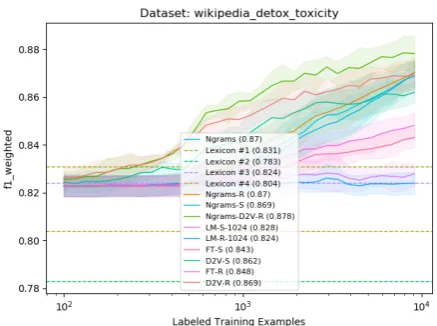
straight lines for the Baseline and Lexicon repre-sentations, which do not rely on training data.
The arguably most interesting aspect of the learning curves is the fact that the Doc2Vec rep-resentations lead to the best performance for all datasets when the amount of training data is lim-ited. Up to a couple of hundred training examples, the Doc2Vec representation outperforms the BoW
n-grams by a large margin. This does not apply for the other types of embeddings, however, which seem to require substantial amounts of training data in order to produce useful results. This sug-gests that when there is limited training data avail-able, it is beneficial to utilize pretrained document-based embeddings as representation layer.
Note also that very few labelled examples are needed to beat the best-performing lexicon when using Doc2Vec embeddings. In the case of the Twitter Hatespeech data, only a hundred labelled examples are needed to beat the best lexicon. For the Wikipedia datasets, a couple of hundred ex-amples are needed. This observation seems incon-sistent with claims that lexica are more efficient to compile than collecting training data. Compiling a suitable lexicon with a couple of hundred relevant terms is hardly an easier, or more efficient, task than collecting a couple of hundred data samples. It could be an interesting future study to quantify the relative efforts involved in lexicon construction vs. data annotation.
5 Conclusions
This paper has investigated the question whether an inherently abusive environment such as a
[image:7.595.312.530.69.231.2]dis-Figure 2: Learning curves for the Wikipedia Aggres-sion data using different representations with a Logistic Regression classifier.
Figure 3: Learning curves for the Wikipedia Attack data using different representations with a Logistic Re-gression classifier.
[image:7.595.312.530.305.468.2] [image:7.595.311.530.541.704.2]cussion forum or a white supremacist website can be used to learn a generic representation of abu-sive language, and whether such a representation can be used in supervised methods for detecting abusive language. The answer seems to be yes.
Our main result is the fact that pretrained em-beddings, in particular Doc2Vec representations, trained on some relevant background data produce better results than standard BoW n-grams when training data is limited. We hypothesize that the results produced with the Doc2Vec representations will be very difficult to beat even when using state of the art methods if the classifier can only use a couple of hundred training examples. The fact that Doc2Vec representations produce more useful results than the other embeddings suggests that it could be interesting to investigate the use of more traditional document-based embedding techniques such as Latent Semantic Analysis (LSA) or La-tent Dirichlet Allocation (LDA). We leave this as a suggestion for future research.
We acknowledge the fact that other machine learning methods may be more suitable to use for the input representations included in these experi-ments. We use Logistic Regression mainly for its simplicity and its well-known effectiveness. There have been many successful results using (deep) neural networks with pretrained embeddings, but these models learn complex internal representa-tions that are difficult to interpret, which means that such models are less suitable to use when studying the effect of the input representations on the classification performance. Even so, it could be interesting to investigate whether the Doc2Vec embeddings produce the best results also when us-ing other (deep) machine learnus-ing models.
Our results also show that lexica do not gen-eralize well across tasks, and that only a couple of hundred training examples are needed for a su-pervised classifier based on pretrained document-based embeddings to beat the best-performing lex-icon.
References
Piotr Bojanowski, Edouard Grave, Armand Joulin, and Tomas Mikolov. 2017. Enriching word vectors with subword information. Transactions of the Associa-tion for ComputaAssocia-tional Linguistics, 5:135–146.
Kyunghyun Cho, Bart van Merrienboer, Caglar Gul-cehre, Dzmitry Bahdanau, Fethi Bougares, Holger Schwenk, and Yoshua Bengio. 2014. Learning
phrase representations using rnn encoder–decoder for statistical machine translation. In Proceedings of EMNLP 2014, pages 1724–1734. Association for Computational Linguistics.
Thomas Davidson, Dana Warmsley, Michael W. Macy, and Ingmar Weber. 2017. Automated hate speech detection and the problem of offensive language. In Proceedings of the Eleventh International Confer-ence on Web and Social Media, pages 512–515.
Dumitru Erhan, Yoshua Bengio, Aaron Courville, Pierre-Antoine Manzagol, Pascal Vincent, and Samy Bengio. 2010. Why does unsupervised pre-training help deep learning? Journal of Machine Learning Research, 11:625–660.
Amaru Cuba Gyllensten and Magnus Sahlgren. 2018. Distributional term set expansion. InProceedings of LREC 2018.
H. L. Hammer. 2014. Detecting threats of violence in online discussions using bigrams of important words. In 2014 IEEE Joint Intelligence and Secu-rity Informatics Conference, pages 319–319.
Tim Isbister, Magnus Sahlgren, Lisa Kaati, Milan Obaidi, and Nazar Akrami. 2018. Monitoring tar-geted hate in online environments. InSecond Work-shop on Text Analytics for Cybersecurity and Online Safety (TA-COS 2018).
Peng Jin, Yue Zhang, Xingyuan Chen, and Yunqing Xia. 2016. Bag-of-embeddings for text classifica-tion. In Proceedings of IJCAI 2016, pages 2824– 2830. AAAI Press.
Anna Jurek, Maurice D. Mulvenna, and Yaxin Bi. 2015. Improved lexicon-based sentiment analysis for social media analytics. Security Informatics, 4(1):9.
Kostiantyn Kucher, Carita Paradis, Magnus Sahlgren, and Andreas Kerren. 2017. Active learning and visual analytics for stance classification with alva. ACM Transactions on Interactive Intelligent Sys-tems, 7(3):14:1–14:31.
Quoc Le and Tomas Mikolov. 2014. Distributed rep-resentations of sentences and documents. In Pro-ceedings of ICML 2014, ICML’14, pages II–1188– II–1196. JMLR.org.
Brian Levin. 2002. Cyberhate: A legal and historical analysis of extremists’ use of computer networks in america. American Behavioral Scientist, 45(6):958– 988.
Bing Liu. 2012. Sentiment Analysis and Opinion Min-ing. Morgan & Claypool Publishers.
Shane Murnion, William J. Buchanan, Adrian Smales, and Gordon Russell. 2018. Machine learning and semantic analysis of in-game chat for cyberbullying. Computers & Security, 76:197 – 213.
B. Sri Nandhini and J.I. Sheeba. 2015. Online social network bullying detection using intelligence tech-niques. Procedia Computer Science, 45:485 – 492. International Conference on Advanced Computing Technologies and Applications (ICACTA).
Dennis Njagi, Z Zuping, Damien Hanyurwimfura, and Jun Long. 2015. A lexicon-based approach for hate speech detection. 10:215–230.
Sinno Jialin Pan and Qiang Yang. 2010. A survey on transfer learning. IEEE Transactions on Knowledge and Data Engineering, 22(10):1345–1359.
Bo Pang and Lillian Lee. 2008. Opinion mining and sentiment analysis. Foundations and Trends in In-formation Retrieval, 2(1-2):1–135.
Delroy L Paulhus and Kevin M Williams. 2002. The dark triad of personality: Narcissism, machiavel-lianism, and psychopathy. Journal of Research in Personality, 36(6):556 – 563.
Matthew Peters, Mark Neumann, Mohit Iyyer, Matt Gardner, Christopher Clark, Kenton Lee, and Luke Zettlemoyer. 2018. Deep contextualized word rep-resentations. InProceedings of NAACL: HLT, pages 2227–2237. Association for Computational Linguis-tics.
Whitney Phillips. 2015. This Is Why We Can’T Have Nice Things: Mapping the Relationship Between Online Trolling and Mainstream Culture. The MIT Press.
Federico Alberto Pozzi, Elisabetta Fersini, Enza Messina, and Bing Liu. 2016. Sentiment Analysis in Social Networks, 1st edition. Morgan Kaufmann Publishers Inc., San Francisco, CA, USA.
K. Reynolds, A. Kontostathis, and L. Edwards. 2011. Using machine learning to detect cyberbullying. In 2011 10th International Conference on Machine Learning and Applications and Workshops, vol-ume 2, pages 241–244.
Stephen Robertson and K. Sparck Jones. 1994. Sim-ple, proven approaches to text retrieval. Technical report.
Björn Ross, Michael Rist, Guillermo Carbonell, Ben-jamin Cabrera, Nils Kurowsky, and Michael Wo-jatzki. 2016. Measuring the reliability of hate speech annotations: The case of the european refugee crisis. In Proceedings of NLP4CMC III. Bochumer Linguistische Arbeitsberichte.
Magnus Sahlgren and Rickard Cöster. 2004. Using bag-of-concepts to improve the performance of sup-port vector machines in text categorization. In Pro-ceedings of COLING 2004, Stroudsburg, PA, USA. Association for Computational Linguistics.
Anna Schmidt and Michael Wiegand. 2017. A survey on hate speech detection using natural language pro-cessing. In Proceedings of the Fifth International Workshop on Natural Language Processing for So-cial Media, pages 1–10. Association for Computa-tional Linguistics.
Karen Sparck Jones. 1988. Document retrieval sys-tems. chapter A Statistical Interpretation of Term Specificity and Its Application in Retrieval, pages 132–142. Taylor Graham Publishing, London, UK, UK.
Maite Taboada, Julian Brooke, Milan Tofiloski, Kim-berly Voll, and Manfred Stede. 2011. Lexicon-based methods for sentiment analysis.Computational Lin-guistics, 37(2):267–307.
Peter D. Turney. 2002. Thumbs up or thumbs down?: Semantic orientation applied to unsupervised clas-sification of reviews. InProceedings of ACL 2002, ACL ’02, pages 417–424, Stroudsburg, PA, USA. Association for Computational Linguistics.
William Warner and Julia Hirschberg. 2012. Detecting hate speech on the world wide web. InProceedings of the Second Workshop on Language in Social Me-dia, LSM ’12, pages 19–26, Stroudsburg, PA, USA. Association for Computational Linguistics.
Zeerak Waseem and Dirk Hovy. 2016. Hateful sym-bols or hateful people? predictive features for hate speech detection on twitter. In Proceedings of the Student Research Workshop, SRW@HLT-NAACL 2016, pages 88–93.
Aksel Wester, Lilja Øvrelid, Erik Velldal, and Hugo Lewi Hammer. 2016. Threat detection in on-line discussions. In Proceedings of the 7th Work-shop on Computational Approaches to Subjectivity, Sentiment & Social Media Analysis, pages 66–71, San Diego, USA.
Michael Wiegand, Josef Ruppenhofer, Anna Schmidt, and Clayton Greenberg. Inducing a lexicon of abu-sive words – a feature-based approach. In Proceed-ings of NAACL: HTL, pages 1046–1056. Association for Computational Linguistics.