Online Large-Margin Training for Statistical Machine Translation
Taro Watanabe Jun Suzuki Hajime Tsukada Hideki Isozaki
NTT Communication Science Laboratories
2-4 Hikaridai, Seika-cho, Soraku-gun, Kyoto 619-0237 Japan
{taro,jun,tsukada,isozaki}@cslab.kecl.ntt.co.jp
Abstract
We achieved a state of the art performance in statistical machine translation by using a large number of features with an online large-margin training algorithm. The mil-lions of parameters were tuned only on a small development set consisting of less than 1K sentences. Experiments on Arabic-to-English translation indicated that a model trained with sparse binary features outper-formed a conventional SMT system with a small number of features.
1 Introduction
The recent advances in statistical machine transla-tion have been achieved by discriminatively train-ing a small number of real-valued features based ei-ther on (hierarchical) phrase-based translation (Och and Ney, 2004; Koehn et al., 2003; Chiang, 2005) or syntax-based translation (Galley et al., 2006). How-ever, it does not scale well with a large number of features of the order of millions.
Tillmann and Zhang (2006), Liang et al. (2006) and Bangalore et al. (2006) introduced sparse binary features for statistical machine translation trained on a large training corpus. In this framework, the prob-lem of translation is regarded as a sequential labeling problem, in the same way as part-of-speech tagging, chunking or shallow parsing. However, the use of a large number of features did not provide any signifi-cant improvements over a conventional small feature set.
Bangalore et al. (2006) trained the lexical choice model by using Conditional Random Fields (CRF)
realized on a WFST. Their modeling was reduced to Maximum Entropy Markov Model (MEMM) to han-dle a large number of features which, in turn, faced
the labeling bias problem (Lafferty et al., 2001).
Tillmann and Zhang (2006) trained their feature set using an online discriminative algorithm. Since the decoding is still expensive, their online training ap-proach is approximated by enlarging a merged
k-best list one-by-one with a 1-k-best output. Liang
et al. (2006) introduced an averaged perceptron al-gorithm, but employed only 1-best translation. In Watanabe et al. (2006a), binary features were trained only on a small development set using a variant of voted perceptron for reranking k-best translations. Thus, the improvement is merely relative to the baseline translation system, namely whether or not there is a good translation in their k-best.
We present a method to estimate a large num-ber of parameters — of the order of millions —
using an online training algorithm. Although it
was intuitively considered to be prone to overfit-ting, training on a small development set — less
than 1K sentences — was sufficient to achieve
im-proved performance. In this method, each
train-ing sentence is decoded and weights are updated at every iteration (Liang et al., 2006). When updat-ing model parameters, we employ a memorization-variant of a local updating strategy (Liang et al., 2006) in which parameters are optimized toward a set of good translations found in the k-best list across iterations. The objective function is an ap-proximated BLEU (Watanabe et al., 2006a) that scales the loss of a sentence BLEU to a
document-wise loss. The parameters are trained using the
Margin Infused Relaxed Algorithm (MIRA) (Cram-mer et al., 2006). MIRA is successfully employed in dependency parsing (McDonald et al., 2005) or
the joint-labeling/chunking task (Shimizu and Haas,
2006). Experiments were carried out on an Arabic-to-English translation task, and we achieved signif-icant improvements over conventional minimum er-ror training with a small number of features.
This paper is organized as follows: First, Sec-tion 2 introduces the framework of statistical ma-chine translation. As a baseline SMT system, we use the hierarchical phrase-based translation with
an efficient left-to-right generation (Watanabe et al.,
2006b) originally proposed by Chiang (2005). In Section 3, a set of binary sparse features are defined including numeric features for our baseline system. Section 4 introduces an online large-margin training algorithm using MIRA with our key components. The experiments are presented in Section 5 followed by discussion in Section 6.
2 Statistical Machine Translation
We use a log-linear approach (Och, 2003) in which a foreign language sentence f is translated into an-other language, for example English, e, by seeking a maximum solution:
ˆe=argmax
e
wT·h( f,e) (1)
where h( f,e) is a large-dimension feature vector. w
is a weight vector that scales the contribution from each feature. Each feature can take any real value, such as the log of the n-gram language model to represent fluency, or a lexicon model to capture the word or phrase-wise correspondence.
2.1 Hierarchical Phrase-based SMT
Chiang (2005) introduced the hierarchical phrase-based translation approach, in which non-terminals are embedded in each phrase. A translation is gener-ated by hierarchically combining phrases using the non-terminals. Such a quasi-syntactic structure can naturally capture the reordering of phrases that is not directly modeled by a conventional phrase-based ap-proach (Koehn et al., 2003). The non-terminal em-bedded phrases are learned from a bilingual corpus without a linguistically motivated syntactic struc-ture.
Based on hierarchical phrase-based modeling, we adopted the left-to-right target generation method (Watanabe et al., 2006b). This method is able to
generate translations efficiently, first, by simplifying
the grammar so that the target side takes a phrase-prefixed form, namely a target normalized form. Second, a translation is generated in a left-to-right manner, similar to the phrase-based approach using Earley-style top-down parsing on the source side. Coupled with the target normalized form, n-gram
language models are efficiently integrated during the
search even with a higher order of n.
2.2 Target Normalized Form
In Chiang (2005), each production rule is restricted to a rank-2 or binarized form in which each rule con-tains at most two non-terminals. The target normal-ized form (Watanabe et al., 2006b) further imposes a constraint whereby the target side of the aligned right-hand side is restricted to a Greibach Normal Form like structure:
X→Dγ,¯bβ,∼E (2)
where X is a non-terminal,γis a source side string of
arbitrary terminals and/or non-terminals. ¯bβis a
cor-responding target side where ¯b is a string of
termi-nals, or a phrase, andβis a (possibly empty) string
of non-terminals. ∼defines one-to-one mapping
be-tween non-terminals inγ and β. The use of phrase
¯b as a prefix maintains the strength of the phrase-base framework. A contiguous English side with a (possibly) discontiguous foreign language side pre-serves phrase-bounded local word reordering. At the same time, the target normalized framework still combines phrases hierarchically in a restricted man-ner.
2.3 Left-to-Right Target Generation
Decoding is performed by parsing on the source side
and by combining the projected target side. We
applied an Earley-style top-down parsing approach (Wu and Wong, 1998; Watanabe et al., 2006b;
Zoll-mann and Venugopal, 2006). The basic idea is
word positions. Combined with the rest-cost esti-mation aggregated in a bottom-up way, our decoder
efficiently searches for the most likely translation.
The use of a target normalized form further sim-plifies the decoding procedure. Since the rule form does not allow any holes for the target side, the inte-gration with an n-gram language model is straight-forward: the prefixed phrases are simply concate-nated and intersected with n-gram.
3 Features
3.1 Baseline Features
The hierarchical phrase-based translation system employs standard numeric value features:
• n-gram language model to capture the fluency
of the target side.
• Hierarchical phrase translation probabilities in
both directions, h(γ|¯bβ) and h(¯bβ|γ), estimated by relative counts, count(γ,¯bβ).
• Word-based lexically weighted models of
hlex(γ|¯bβ) and hlex(¯bβ|γ) using lexical
transla-tion models.
• Word-based insertion/deletion penalties that
penalize through the low probabilities of the lexical translation models (Bender et al., 2004).
• Word/hierarchical-phrase length penalties.
• Backtrack-based penalties inspired by the
dis-tortion penalties in phrase-based modeling (Watanabe et al., 2006b).
3.2 Sparse Features
In addition to the baseline features, a large number of binary features are integrated in our MT system. We may use any binary features, such as
h( f,e)=
1 English word “violate” and Arabic
word “tnthk” appeared in e and f .
0 otherwise.
The features are designed by considering the
decod-ing efficiency and are based on the word alignment
structure preserved in hierarchical phrase transla-tion pairs (Zens and Ney, 2006). When hierarchi-cal phrases are extracted, the word alignment is pre-served. If multiple word alignments are observed
e
i−1
e
ie
i+1e
i+2e
i+3e
i+4 [image:3.612.336.516.58.141.2]f
j−1f
jf
j+1f
j+2f
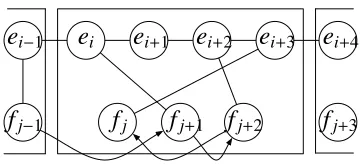
j+3Figure 1: An example of sparse features for a phrase translation.
with the same source and target sides, only the fre-quently observed word alignment is kept to reduce the grammar size.
3.2.1 Word Pair Features
Word pair features reflect the word correspon-dence in a hierarchical phrase. Figure 1 illustrates an example of sparse features for a phrase trans-lation pair fj, ..., fj+2 and ei, ...,ei+3 1. From the word alignment encoded in this phrase, we can ex-tract word pair features of (ei,fj+1), (ei+2,fj+2) and (ei+3, fj).
The bigrams of word pairs are also used to
capture the contextual dependency. We assume
that the word pairs follow the target side order-ing. For instance, we define ((ei−1, fj−1),(ei,fj+1)), ((ei,fj+1),(ei+2,fj+2)) and ((ei+2,fj+2),(ei+3,fj))
in-dicated by the arrows in Figure 1.
Extracting bigram word pair features following the target side ordering implies that the correspond-ing source side is reordered accordcorrespond-ing to the tar-get side. The reordering of hierarchical phrases is represented by using contextually dependent word pairs across their boundaries, as with the feature ((ei−1,fj−1),(ei,fj+1)) in Figure 1.
3.2.2 Insertion Features
The above features are insufficient to capture the
translation because spurious words are sometimes inserted in the target side. Therefore, insertion fea-tures are integrated in which no word alignment is associated in the target. The inserted words are asso-ciated with all the words in the source sentence, such as (ei+1,f1), ...,(ei+1, fJ) for the non-aligned word
ei+1 with the source sentence f1J in Figure 1. In the
f
j−1f
jf
j+1f
j+2f
j+3X
1X
2 [image:4.612.314.546.62.248.2]X
3Figure 2: Example hierarchical features.
same way, we will be able to include deletion fea-tures where a non-aligned source word is associated with the target sentence. However, this would lead to complex decoding in which all the translated words are memorized for each hypothesis, and thus not in-tegrated in our feature set.
3.2.3 Target Bigram Features
Target side bigram features are also included to directly capture the fluency as in the n-gram lan-guage model (Roark et al., 2004). For instance, bi-gram features of (ei−1,ei),(ei,ei+1),(ei+1,ei+2)...are observed in Figure 1.
3.2.4 Hierarchical Features
In addition to the phrase motivated features, we included features inspired by the hierarchical struc-ture. Figure 2 shows an example of hierarchical
phrases in the source side, consisting of X1 →
D
fj−1X2fj+3
E
, X2 →Dfjfj+1X3
E
and X3 →Dfj+2
E
. Hierarchical features capture the dependency of the source words in a parent phrase to the source words in child phrases, such as ( fj−1,fj), ( fj−1, fj+1), ( fj+3,fj), ( fj+3,fj+1), ( fj, fj+2) and ( fj+1,fj+2) as in-dicated by the arrows in Figure 2. The hierarchical features are extracted only for those source words that are aligned with the target side to limit the fea-ture size.
3.3 Normalization
In order to achieve the generalization capability, the following normalized tokens are introduced for each surface form:
• Word class or POS.
• 4-letter prefix and suffix. For instance, the word
Algorithm 1 Online Training Algorithm
Training data:T =
( ft,et) Tt=1
m-best oracles:O={}Tt=1
i=0
1: for n=1, ...,N do
2: for t=1, ...,T do
3: Ct ←bestk( ft; wi)
4: Ot ←oraclem(Ot∪ Ct; et)
5: wi+1=update wi usingCtw.r.t.Ot
6: i=i+1
7: end for
8: end for
9: return
PNT
i=1wi
NT
“violate” is normalized to “viol+” and “+late”
by taking the prefix and suffix, respectively.
• Digits replaced by a sequence of “@”. For
ex-ample, the word “2007/6/27” is represented as
“@@@@/@/@@”.
We consider all possible combination of those to-ken types. For example, the word pair feature
(vi-olate, tnthk) is normalized and expanded to (viol+,
tnthk), (viol+, tnth+), (violate, tnth+), etc. using the 4-letter prefix token type.
4 Online Large-Margin Training
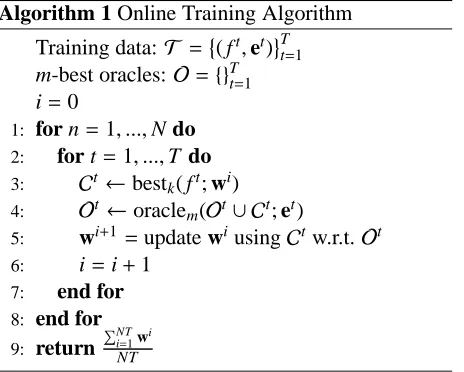
Algorithm 1 is our generic online training
algo-rithm. The algorithm is slightly different from other
online training algorithms (Tillmann and Zhang, 2006; Liang et al., 2006) in that we keep and up-date oracle translations, which is a set of good trans-lations reachable by a decoder according to a met-ric, i.e. BLEU (Papineni et al., 2002). In line 3,
a k-best list is generated by bestk(·) using the
cur-rent weight vector wi for the training instance of
( ft,et). Each training instance has multiple (or,
pos-sibly one) reference translations et for the source
sentence ft. Using the k-best list, m-best oracle
translationsOt is updated by oracle
m(·) for every
i.e. BLEU. Tillmann and Zhang (2006) avoided the problem by precomputing the oracle translations in advance. Liang et al. (2006) presented a similar up-dating strategy in which parameters were updated
toward an oracle translation found inCt, but ignored
potentially better translations discovered in the past iterations.
New wi+1is computed using the k-best listCtwith
respect to the oracle translationsOt(line 5). After N
iterations, the algorithm returns an averaged weight vector to avoid overfitting (line 9). The key to this online training algorithm is the selection of the up-dating scheme in line 5.
4.1 Margin Infused Relaxed Algorithm
The Margin Infused Relaxed Algorithm (MIRA) (Crammer et al., 2006) is an online version of the large-margin training algorithm for structured clas-sification (Taskar et al., 2004) that has been suc-cessfully used for dependency parsing (McDonald et
al., 2005) and joint-labeling/chunking (Shimizu and
Haas, 2006). The basic idea is to keep the norm of the updates to the weight vector as small as possible, considering a margin at least as large as the loss of the incorrect classification.
Line 5 of the weight vector update procedure in Algorithm 1 is replaced by the solution of:
ˆ
wi+1 =argmin
wi+1
||wi+1−wi||+CX
ˆe,e′
ξ(ˆe,e′)
subject to
si+1( ft,ˆe)−si+1( ft,e′)+ξ(ˆe,e′)≥L(ˆe,e′; et)
ξ(ˆe,e′)≥0
∀ˆe∈ Ot,∀e′∈ Ct (3)
where si( ft,e) = n
wioT
· h( ft,e). ξ(·) is a
non-negative slack variable and C ≥ 0 is a constant to
control the influence to the objective function. A larger C implies larger updates to the weight
vec-tor. L(·) is a loss function, for instance difference of
BLEU, that measures the difference between ˆe and
e′ according to the reference translations et. In this
update, a margin is created for each correct and in-correct translation at least as large as the loss of the incorrect translation. A larger error means a larger distance between the scores of the correct and incor-rect translations. Following McDonald et al. (2005), only k-best translations are used to form the margins
in order to reduce the number of constraints in Eq. 3. In the translation task, multiple translations are ac-ceptable. Thus, margins for m-oracle translation are
created, which amount to m×k large-margin
con-straints. In this online training, only active features constrained by Eq. 3 are kept and updated, unlike
offline training in which all possible features have to
be extracted and selected in advance. The Lagrange dual form of Eq. 3 is:
maxα(·)≥0 − 1 2||
X
ˆe,e′
α(ˆe,e′)h( ft,ˆe)−h( ft,e′)||2
+X
ˆe,e′
α(ˆe,e′)L(ˆe,e′; et)
−X
ˆe,e′
α(ˆe,e′)si( ft,ˆe)−si( ft,e′)
subject to X
ˆe,e′
α(ˆe,e′)≤C (4)
with the weight vector update:
wi+1=wi+X ˆe,e′
α(ˆe,e′)h( ft,ˆe)−h( ft,e′) (5)
Equation 4 is solved using a QP-solver, such as a co-ordinate ascent algorithm, by heuristically selecting (ˆe,e′) and by updatingα(·) iteratively:
α(ˆe,e′) = max 0, α(ˆe,e′)+δ(ˆe,e′)
(6)
δ(ˆe,e′) =
L(ˆe,e′; et)−
si( ft,ˆe)−si( ft,e′)
||h( ft,ˆe)−h( ft,e′)||2
C is used to clip the amount of updates.
A single oracle with 1-best translation is analyti-cally solved without a QP-solver and is represented as the following perceptron-like update (Shimizu and Haas, 2006):
α=max
0,min
C,L(ˆe,e
′; et)−
si( ft,ˆe)−si( ft,e′) ||h( ft,ˆe)−h( ft,e′)||2
Intuitively, the update amount is controlled by the margin and the loss between the correct and incor-rect translations and by the closeness of two transla-tions in terms of feature vectors. Indeed, Liang et al. (2006) employed an averaged perceptron algorithm
in which αvalue was always set to one. Tillmann
and Zhang (2006) used a different update style based
on a convex loss function:
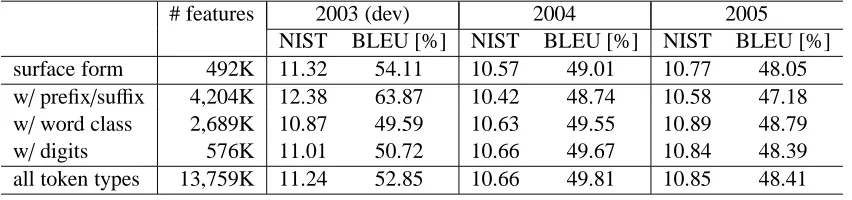
Table 1: Experimental results obtained by varying normalized tokens used with surface form.
# features 2003 (dev) 2004 2005
NIST BLEU [%] NIST BLEU [%] NIST BLEU [%]
surface form 492K 11.32 54.11 10.57 49.01 10.77 48.05
w/prefix/suffix 4,204K 12.38 63.87 10.42 48.74 10.58 47.18
w/word class 2,689K 10.87 49.59 10.63 49.55 10.89 48.79
w/digits 576K 11.01 50.72 10.66 49.67 10.84 48.39
all token types 13,759K 11.24 52.85 10.66 49.81 10.85 48.41
where η > 0 is a learning rate for controlling the
convergence.
4.2 Approximated BLEU
We used the BLEU score (Papineni et al., 2002) as the loss function computed by:
BLEU(E; E)=exp
1
N N
X
n=1
log pn(E,E)
·BP(E,E)
(7)
where pn(·) is the n-gram precision of hypothesized
translations E = {et}Tt=1 given reference translations
E={et}Tt=1and BP(·)≤1 is a brevity penalty. BLEU is computed for a set of sentences, not for a sin-gle sentence. Our algorithm requires frequent up-dates on the weight vector, which implies higher cost in computing the document-wise BLEU. Tillmann and Zhang (2006) and Liang et al. (2006) solved the problem by introducing a sentence-wise BLEU. However, the use of the sentence-wise scoring does not translate directly into the document-wise score because of the n-gram precision statistics and the brevity penalty statistics aggregated for a sentence set. Thus, we use an approximated BLEU score that basically computes BLEU for a sentence set, but
accumulates the difference for a particular sentence
(Watanabe et al., 2006a).
The approximated BLEU is computed as follows:
Given oracle translations Ofor T, we maintain the
best oracle translations OT1 = nˆe1, ...,ˆeTo. The
ap-proximated BLEU for a hypothesized translation e′
for the training instance ( ft,et) is computed over OT1 except for ˆet, which is replaced by e′:
BLEU({ˆe1, ...,ˆet−1,e′,ˆet+1, ...,ˆeT}; E)
The loss computed by the approximated BLEU mea-sures the document-wise loss of substituting the
cor-rect translation ˆet into an incorrect translation e′.
The score can be regarded as a normalization which scales a sentence-wise score into a document-wise score.
5 Experiments
We employed our online large-margin training pro-cedure for an Arabic-to-English translation task. The training data were extracted from the
Ara-bic/English news/UN bilingual corpora supplied by
LDC. The data amount to nearly 3.8M sentences. The Arabic part of the bilingual data is tokenized by isolating Arabic scripts and punctuation marks. The development set comes from the MT2003 Arabic-English NIST evaluation test set consisting of 663 sentences in the news domain with four reference translations. The performance is evaluated by the
news domain MT2004/MT2005 test set consisting
of 707 and 1,056 sentences, respectively.
The hierarchical phrase translation pairs are ex-tracted in a standard way (Chiang, 2005): First, the bilingual data are word alignment annotated by
running GIZA++ (Och and Ney, 2003) in two
di-rections. Second, the word alignment is refined
by a grow-diag-final heuristic (Koehn et al., 2003). Third, phrase translation pairs are extracted together with hierarchical phrases by considering holes. In the last step, the hierarchical phrases are constrained so that they follow the target normalized form con-straint. A 5-gram language model is trained on the English side of the bilingual data combined with the English Gigaword from LDC.
First, the use of normalized token types in Sec-tion 3.3 is evaluated in Table 1. In this setting, all the structural features in Section 3.2 are used, but
differentiated by the normalized tokens combined
Table 2: Experimental results obtained by incrementally adding structural features.
# features 2003 (dev) 2004 2005
NIST BLEU [%] NIST BLEU [%] NIST BLEU [%]
word pairs 11,042K 11.05 51.63 10.43 48.69 10.73 47.72
+target bigram 11,230K 11.19 53.49 10.40 48.60 10.66 47.47
+insertion 13,489K 11.21 52.20 10.77 50.33 10.93 48.08
+hierarchical 13,759K 11.24 52.85 10.66 49.81 10.85 48.41
Table 3: Experimental results for varying k-best and m-oracle translations.
# features 2003 (dev) 2004 2005
NIST BLEU [%] NIST BLEU [%] NIST BLEU [%]
baseline 10.64 46.47 10.83 49.33 10.90 47.03
1-oracle 1-best 8,735K 11.25 52.63 10.82 50.77 10.93 48.11
1-oracle 10-best 10,480K 11.24 53.45 10.55 49.10 10.82 48.49
10-oracle 1-best 8,416K 10.70 47.63 10.83 48.88 10.76 46.00
10-oracle 10-best 13,759K 11.24 52.85 10.66 49.81 10.85 48.41
sentence-BLEU 14,587K 11.10 51.17 10.82 49.97 10.86 47.04
by 10-oracle and 10-best list. When decoding, a 1000-best list is generated to achieve better oracle translations. The training took nearly 1 day using 8 cores of Opteron. The translation quality is eval-uated by case-sensitive NIST (Doddington, 2002)
and BLEU (Papineni et al., 2002)2. The table also
shows the number of active features in which non-zero values were assigned as weights. The addition
of prefix/suffix tokens greatly increased the number
of active features. The setting severely overfit to the development data, and therefore resulted in worse
results in open tests. The word class3 with surface
form avoided the overfitting problem. The digit se-quence normalization provides a similar generaliza-tion capability despite of the moderate increase in the active feature size. By including all token types,
we achieved better NIST/BLEU scores for the 2004
and 2005 test sets. This set of experiments indi-cates that a token normalization is useful especially trained on a small data.
Second, we used all the normalized token types, but incrementally added structural features in Ta-ble 2. Target bigram features account for only the fluency of the target side without considering the
source/target correspondence. Therefore, the
in-2We used the tool available at http://www.nist.gov/
speech/tests/mt/
3We induced 50 classes each for English and Arabic.
clusion of target bigram features clearly overfit to the development data. The problem is resolved by adding insertion features which can take into ac-count an agreement with the source side that is not directly captured by word pair features.
Hierarchi-cal features are somewhat effective in the 2005 test
set by considering the dependency structure of the source side.
Finally, we compared our online training algo-rithm with sparse features with a baseline system in Table 3. The baseline hierarchical phrase-based system is trained using standard max-BLEU training (MERT) without sparse features (Och, 2003). Table 3 shows the results obtained by varying the m-oracle
and k-best size (k,m = 1,10) using all structural
[image:7.612.85.531.196.310.2]Table 4: Two-fold cross validation experiments.
closed test open test
NIST BLEU NIST BLEU
[%] [%]
baseline 10.71 44.79 10.68 44.44
online 11.58 53.42 10.90 47.64
when the k-best list size was also increased. The use of sentence-wise BLEU as an objective provides almost no improvement in the 2005 test set, but is comparable for the 2004 test set.
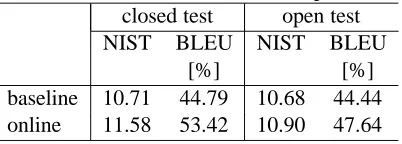
As observed in three experiments, the 2004/2005
test sets behaved differently, probably because of
the domain mismatch. Thus, we conducted a
two-fold cross validation using the 2003/2004/2005 test
sets to observe the effect of optimization as shown
in Table 44. The MERT baseline system performed
similarly both in closed and open tests. Our on-line large-margin training with oracle and 10-best constraints and the approximated BLEU loss function significantly outperformed the baseline sys-tem in the open test. The development data is almost doubled in this setting. The MERT approach seems to be confused with the slightly larger data and with
the mixed domains from different epochs.
6 Discussion
In this work, the translation model consisting of mil-lions of features are successfully integrated. In or-der to avoid poor overfitting, features are limited to word-based features, but are designed to reflect the structures inside hierarchical phrases. One of the benefit of MIRA is its flexibility. We may include as many constraints as possible, like m-oracle con-straints in our experiments. Although we described experiments on the hierarchical phrase-based trans-lation, the online training algorithm is applicable to any translation systems, such as phrase-based trans-lations and syntax-based transtrans-lations.
Online discriminative training has already been studied by Tillmann and Zhang (2006) and Liang et al. (2006). In their approach, training was per-formed on a large corpus using the sparse features of
phrase translation pairs, target n-grams and/or
bag-of-word pairs inside phrases. In Tillmann and Zhang
4We split data by document, not by sentence.
(2006), k-best list generation is approximated by a step-by-step one-best merging method that separates the decoding and training steps. The weight vector update scheme is very similar to MIRA but based on a convex loss function. Our method directly em-ploys the k-best list generated by the fast decoding method (Watanabe et al., 2006b) at every iteration. One of the benefits is that we avoid the rather expen-sive cost of merging the k-best list especially when handling millions of features.
Liang et al. (2006) employed an averaged percep-tron algorithm. They decoded each training instance and performed a perceptron update to the weight vector. An incorrect translation was updated toward an oracle translation found in a k-best list, but dis-carded potentially better translations in the past iter-ations.
An experiment has been undertaken using a small development set together with sparse features for the reranking of a k-best translation (Watanabe et al., 2006a). They relied on a variant of a voted percep-tron, and achieved significant improvements. How-ever, their work was limited to reranking, thus the improvement was relative to the performance of the baseline system, whether or not there was a good translation in a list. In our work, the sparse features are directly integrated into the DP-based search.
The design of the sparse features was inspired
by Zens and Ney (2006). They exploited the
word alignment structure inside the phrase trans-lation pairs for discriminatively training a reorder-ing model in their phrase-based translation. The re-ordering model simply classifies whether to perform monotone decoding or not. The trained model is treated as a single feature function integrated in Eq.
1. Our approach differs in that each sparse feature is
individually integrated in Eq. 1.
7 Conclusion
millions of features achieved very significant im-provements over a conventional method with a small number of features. This result indicates that we can easily experiment many alternative features even with a small data set, but we believe that our ap-proach can scale well to a larger data set for further improved performance. Future work involves scal-ing up to larger data and more features.
Acknowledgements
We would like to thank reviewers and our colleagues for useful comment and discussion.
References
Srinivas Bangalore, Patrick Haffner, and Stephan Kan-thak. 2006. Sequence classification for machine trans-lation. In Proc. of Interspeech 2006, pages 1157– 1160, Pittsburgh.
Oliver Bender, Richard Zens, Evgeny Matusov, and Her-mann Ney. 2004. Alignment templates: the RWTH SMT system”. In Proc. of IWSLT 2004, pages 79–84, Kyoto, Japan.
David Chiang. 2005. A hierarchical phrase-based model for statistical machine translation. In Proc. of ACL 2005, pages 263–270, Ann Arbor, Michigan, June.
Koby Crammer, Ofer Dekel, Joseph Keshet, Shai Shalev-Shwartz, and Yoram Singer. 2006. Online passive-aggressive algorithms. Journal of Machine Learning Research, 7:551–585, March.
George Doddington. 2002. Automatic evaluation of ma-chine translation quality using n-gram co-occurrence statistics. In In Proc. ARPA Workshop on Human Lan-guage Technology.
Michel Galley, Jonathan Graehl, Kevin Knight, Daniel Marcu, Steve DeNeefe, Wei Wang, and Ignacio Thayer. 2006. Scalable inference and training of context-rich syntactic translation models. In Proc. of COLING/ACL 2006, pages 961–968, Sydney, Aus-tralia, July.
Philipp Koehn, Franz Josef Och, and Daniel Marcu. 2003. Statistical phrase-based translation. In Proc. of NAACL 2003, pages 48–54, Edmonton, Canada.
John Lafferty, Andrew McCallum, and Fernando Pereira. 2001. Conditional random fields: Probabilistic models for segmenting and labeling sequence data. In Proc. 18th International Conf. on Machine Learning, pages 282–289. Morgan Kaufmann, San Francisco, CA.
Percy Liang, Alexandre Bouchard-Cˆot´e, Dan Klein, and Ben Taskar. 2006. An end-to-end discriminative approach to machine translation. In Proc. of COL-ING/ACL 2006, pages 761–768, Sydney, Australia, July.
Ryan McDonald, Koby Crammer, and Fernando Pereira. 2005. Online large-margin training of dependency parsers. In Proc. of ACL 2005, pages 91–98, Ann Ar-bor, Michigan, June.
Franz Josef Och and Hermann Ney. 2003. A system-atic comparison of various statistical alignment mod-els. Computational Linguistics, 29(1):19–51.
Franz Josef Och and Hermann Ney. 2004. The align-ment template approach to statistical machine transla-tion. Computational Linguistics, 30(4):417–449.
Franz Josef Och. 2003. Minimum error rate training in statistical machine translation. In Proc. of ACL 2003, pages 160–167, Sapporo, Japan, July.
Kishore Papineni, Salim Roukos, Todd Ward, and Wei-Jing Zhu. 2002. BLEU: a method for automatic eval-uation of machine translation. In Proc. of ACL 2002, pages 311–318, Philadelphia, Pennsylvania.
Brian Roark, Murat Saraclar, Michael Collins, and Mark Johnson. 2004. Discriminative language model-ing with conditional random fields and the percep-tron algorithm. In Proc. of ACL 2004, pages 47–54, Barcelona, Spain, July.
Nobuyuki Shimizu and Andrew Haas. 2006. Exact de-coding for jointly labeling and chunking sequences. In Proc. of the COLING/ACL 2006 Main Conference Poster Sessions, pages 763–770, Sydney, Australia, July.
Ben Taskar, Dan Klein, Mike Collins, Daphne Koller, and Christopher Manning. 2004. Max-margin parsing. In Proc. of EMNLP 2004, pages 1–8, Barcelona, Spain, July.
Christoph Tillmann and Tong Zhang. 2006. A discrimi-native global training algorithm for statistical MT. In Proc. of COLING/ACL 2006, pages 721–728, Sydney, Australia, July.
Taro Watanabe, Jun Suzuki, Hajime Tsukada, and Hideki Isozaki. 2006a. NTT Statistical Machine Translation for IWSLT 2006. In Proc. of IWSLT 2006, pages 95– 102, Kyoto, Japan.
Dekai Wu and Hongsing Wong. 1998. Machine transla-tion with a stochastic grammatical channel. In Proc. of COLING 98, pages 1408–1415, Montreal, Quebec, Canada.
Richard Zens and Hermann Ney. 2006. Discriminative reordering models for statistical machine translation. In Proc. of WSMT 2006, pages 55–63, New York City, June.