Unsupervised PCFG Induction for Grounded Language Learning
with Highly Ambiguous Supervision
Joohyun Kim Raymond J. Mooney
Department of Computer Science The University of Texas at Austin
1616 Guadalupe, Suite 2.408 Austin, TX 78701, USA
{scimitar,mooney}@cs.utexas.edu
Abstract
“Grounded” language learning employs train-ing data in the form of sentences paired with relevant but ambiguous perceptual contexts. B¨orschinger et al. (2011) introduced an ap-proach to grounded language learning based on unsupervised PCFG induction. Their ap-proach works well when each sentence po-tentially refers to one of a small set of pos-sible meanings, such as in the sportscasting task. However, it does not scale to prob-lems with a large set of potential meanings for each sentence, such as the navigation in-struction following task studied by Chen and Mooney (2011). This paper presents an en-hancement of the PCFG approach that scales to such problems with highly-ambiguous su-pervision. Experimental results on the naviga-tion task demonstrates the effectiveness of our approach.
1 Introduction
The ultimate goal of “grounded” language learning is to develop computational systems that can acquire language more like a human child. Given only su-pervision in the form of sentences paired with rel-evant but ambiguous perceptual contexts, a system should learn to interpret and/or generate language describing situations and events in the world. For example, systems have learned to commentate sim-ulated robot soccer games by learning from sample sportscasts (Chen and Mooney, 2008; Liang et al., 2009; B¨orschinger et al., 2011), or understand nav-igation instructions by learning from action traces
produced when following the directions (Chen and Mooney, 2011; Tellex et al., 2011).
B¨orschinger et al. (2011) recently introduced an approach to grounded language learning using un-supervised induction of probabilistic context free grammars (PCFGs) to learn from ambiguous con-textual supervision. Their approach first constructs a large set of production rules from sentences paired with descriptions of their ambiguous context, and then trains the parameters of this grammar using EM. Parsing a novel sentence with this grammar gives a parse tree which contains the formal mean-ing representation(MR) for this sentence. This ap-proach works quite well on the sportscasting task originally introduced by Chen and Mooney (2008). In this task, each sentence in a natural-language commentary describing activity in a simulated robot soccer game is paired with the small set of actions observed within the past 5 seconds, one of which is usually described by the sentence. Even with this low level of ambiguity in a constrained domain, their method constructs a PCFG with about 33,000 pro-ductions. More fundamentally, their approach is re-stricted to a finite set of potential meaning represen-tations, and the grammar size grows at least linearly with the number of possible MRs, which in turn is inevitably exponential in the number of objects and actions in the domain.
The navigation task studied by Chen and Mooney (2011) provides much more ambiguous supervision. In this task, each instructional sentence is paired with a formal landmarks plan (represented as a large graph) that includes a full description of the observed actions and world-states that result when
someone follows this instruction. An instruction generally refers to a subgraph of this large graph. Therefore, there are a combinatorial number of pos-sible meanings to which a given sentence can refer.
Chen and Mooney (2011) circumvent this combi-natorial problem by never explicitly enumerating the exponential number of potential meanings for each sentence. Their system first induces a semantic lex-icon that maps words and short phrases to formal representations of actions and objects in the world. This lexicon is learned by finding words and phrases whose occurrence highly correlates with specific ob-served actions and objects in the simulated environ-ment when executing the corresponding instruction. This learned lexicon is then used to directly infer a formal MR for observed instructional sentences using a greedy covering algorithm. These inferred MRs are then used to train a supervised semantic parser capable of mapping novel sentences to their formal meanings.
We present a novel enhancement of B¨orschinger et al.’s PCFG approach that uses Chen and Mooney’s lexicon learner to avoid a combinatorial explosion in the number of productions. The learned lexicon is first used to build a hierarchy of semantic lexemes
(i.e. lexicon entries) called the Lexeme Hierarchy Graph (LHG) for each ambiguous landmarks plan in the training data. The intuition behind utilizing an LHG is that the MR for each lexeme constitutes a semantic concept that corresponds to some natural-language (NL) word or phrase. Therefore, the LHG represents how complex semantic concepts are com-posed of simpler semantic concepts and ultimately connected to NL words and phrases. B¨orschinger et al.’s approach instead produces NL groundings at the level of atomic MR constituents, which causes an explosion in the number of PCFG productions for complex MR languages. We estimated that B¨orschinger et al.’s approach would require more than 20! (> 1018) productions for our navigation problem.1 On the other hand, our method, which uses correspondences from the LHG at the seman-tic concept level, constructs a more focused PCFG of tractable size. It then extracts the MR for a novel
1The corpus contains quite a few examples with landmarks plans containing more than 20 actions. This results in at least 20! permutations representing possible alignments between ac-tions and NL words.
sentence from the most-probable parse tree for the resulting PCFG. Our approach can produce a large, combinatorial number of different MRs for a wide range of novel sentences by composing relevant MR components from the resulting parse tree, whereas B¨orschinger et al.’s approach is only able to output MRs that are explicitly included as a nonterminals in the original learned PCFG.
The remainder of the paper is organized as fol-lows. Section 2 reviews B¨orschinger et al.’s PCFG approach as well as the navigation task and data. Section 3 describes our enhanced PCFG approach and Section 4 presents an experimental evaluation of it. Then, Section 5 discusses the unique aspects of our approach and Section 6 describes additional related work. Finally, Section 7 presents future re-search directions and Section 8 gives our conclu-sions.
2 Background
2.1 Existing PCFG Approach
Our approach extends that of B¨orschinger et al. (2011), which in turn was inspired by a series of previous techniques (Lu et al., 2008; Liang et al., 2009; Kim and Mooney, 2010) following the idea of constructing correspondences between NL and MR in a single probabilistic generative framework. Particularly, their approach automatically constructs a PCFG that generates NL sentences from MRs, which indicates how atomic MR constituents are probabilistically related to NL words. The nonter-minals in the grammar correspond to complete MRs, MR constituents, and NL phrases. The nontermi-nal for a composite MR generates each of its MR constituents, and each atomic MR,x, generates an NL phrase, P hrasex. EachP hrasex then
gener-ates a sequence of W ordx’s for describing x, and
eachW ordxcan generate each possible word in the
Figure 1: Derivation tree for the NL/MR pair: THE PINK GOALIE PASSES THE BALL TO PINK11 / pass(pink1, pink11). Left side shows PCFG rules that are added for each stage (full MR to atomic MRs, and atomic MRs to NL words ).
preferred MR interpretation in the topmost nonter-minal.
Unfortunately, as discussed earlier, this approach only works for finite MR languages, and the gram-mar becomes intractably large even for finite but complex MRs. It effectively assumes that MRs are fairly small and includes every possible MR con-stituent as a nonterminal in the PCFG. This is not tractable for more complex MRs. Therefore, our ex-tension incorporates a learned lexicon to constrain the space of productions, thereby making the size of the PCFG tractable for complex MRs, and even giving it the ability to handle infinite MR languages. Moreover, when processing novel sentences, our ap-proach can produce a large space of novel MRs that were not anticipated during training, which is not the case for B¨orschinger et al.’s approach.
2.2 Navigation Task and Dataset
We employ the task and data introduced by Chen and Mooney (2011) whose goal is to interpret and follow NL navigation instructions in a virtual world. Fig-ure 2 shows a sample execution path in a particular virtual world. The challenge is learning to perform this task by simply observing humans following in-structions. Formally, given training data of the form {(e1, a1, w1), . . . ,(en, an, wn)}, whereei is an NL
instruction, ai is an observed action sequence, and
wi is the current world state (patterns of floors and
walls, positions of any objects, etc.), we want to pro-duce the correct actionsajfor a novel(ej, wj).
Figure 2: Sample virtual world from Chen and Mooney (2011) of interconnecting hallways with different floor and wall patterns and objects indi-cated by letters (e.g. “H” for hatrack).
Figure 3: Sample instruction with its constructed landmarks plan, components in bold compose the correct plan.
In order to learn, their system infers the intended formal planpi (the MR for a sentence) which
pro-duced the action sequenceaifrom the instructionei.
However, there is a large space of possible plans for any given action sequence. Chen and Mooney first construct a formallandmarks plan, ci, for each ai,
which is a graph representing the context of every action and the world-state encountered during the execution of the sequence. The correct plan MR, pi, is assumed to be a subgraph ofci, and this causes
a combinatorial matching problem between ei and
ciin order to learn the correct meaning ofeiamong
all the possible subgraphs ofci. The landmarks and
correct plans for a sample instruction are shown in Figure 3, illustrating the complexity of the MRs.
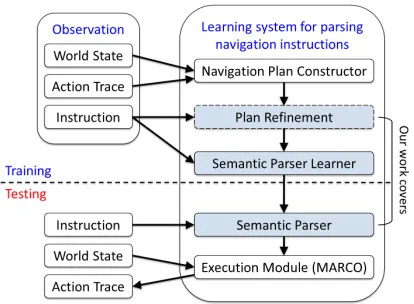
[image:3.612.73.306.59.197.2]lex-Figure 4: An overview of Chen and Mooney (2011)’s system. Our method replaces the plan re-finement and semantic parser parts.
icon that maps words and short phrases to small sub-graphs representing their inferred meanings from the
(ei, ci) pairs. The lexicon is learned by evaluating
pairs ofn-grams,wj, and MR graphs,mj, and
scor-ing them based on how much more likely mj is a
subgraph of the context ci when w occurs in the
corresponding instruction ei. This process is
simi-lar to other “cross-situational” approaches to learn-ing word meanlearn-ings (Siskind, 1996; Thompson and Mooney, 2003). Then, aplan refinement step esti-matespi fromci by greedily selecting high-scoring
lexemes of the form (wj, mj) whose words and
phrases (wj) cover the instructionei and introduce
components (mj) from the landmarks planci. The
refined plans are used to construct supervised train-ing data (ei, pi) for a supervised semantic-parser
learner. The trained semantic parser can parse a novel instruction into a formal plan, which is finally executed for end-to-end evaluation. Figure 4 illus-trates the overall system.
As this figure indicates, our new PCFG method replaces the plan refinement and semantic parser components in their system with a unified model that both disambiguates the training data and learns a semantic parser. We use the landmarks plans and the learned lexicon produced by Chen and Mooney (2011) as inputs to our system.2
2In our experiments, we used the top 1,000 lexemes learned by Chen and Mooney (2011).
3 Our PCFG Approach
Like B¨orschinger et al. (2011), our approach learns a semantic parser directly from ambiguous su-pervision, specifically NL instructions paired with their complete landmarks plans as context. Our method incorporates the semantic lexemes as build-ing blocks to find correspondences between NL words and semantic concepts represented by the lex-eme MRs, instead of building connections between NL words and every possible MR constituent as in B¨orschinger et al.’s approach. Particularly, we uti-lize the hierarchical subgraph relationships between the MRs in the learned semantic lexicon to produce a smaller, more focused set of PCFG rules.3 The intuition behind our approach is analogous to the hi-erarchical relations between nonterminals in syntac-tic parsing, where higher-level categories such as S, VP, or NP are further divided into smaller categories such as V, N, or Det, thereby forming a hierarchi-cal structure. Inspired by this idea, we introduce a directed acyclic graph called the Lexeme Hierarchy Graph (LHG) which represents the hierarchical rela-tionships between lexeme MRs. Since complex lex-eme MRs represent complicated semantic concepts while simple MRs represent simple concepts, it is natural to construct a hierarchy amongst them. The LHGs for all of the training examples are used to construct production rules for the PCFG, which are then parametrized using EM. Finally, a novel sen-tence is semantically parsed by computing its most-probable parse using the trained PCFG, and then its MR is extracted from the resulting parse tree.
3.1 Constructing a Lexeme Hierarchy Graph
An LHG represents the hierarchy of lexical mean-ings relevant to a particular training instance by en-coding the subgraph relations between the MRs of relevant lexemes. Algorithm 1 describes how an LHG is constructed for an ambiguous training pair of a sentence and its corresponding context,(ei, ci).
First, we obtain all relevant lexemes(wij, mij)in the lexicon L, where the MR mij is a subgraph of the contextci (denoted asmij ⊂ci). These lexemes are
[image:4.612.82.289.56.208.2]Algorithm 1LEXEMEHIERARCHYGRAPH(LHG)
Input:Training instance(ei, ci), LexiconL Output: Lexeme hierarchy graph for(ei, ci)
Find relevant lexemes(wi1, mi1), . . . ,(wni, min)
s.t.mij ⊂ci
Create a starting nodeT;MR(T)←ci for allmijin the descending order of sizedo
Create a nodeTi
j;MR(Tji)←mij
PLACELEXEME(Tji,T)
end for
procedurePLACELEXEME(T0,T)
for allchildrenTj ofTdo ifMR(T0)⊂MR(Tj)then
PLACELEXEME(T0,Tj) end if
end for
ifT0was not placed under any childTj then
AddT0as child ofT
end if end procedure
sorted in descending order based on the number of nodes in their MRsmij. Then, after setting the con-textci as the MR of the root node (MR(T) ← ci),
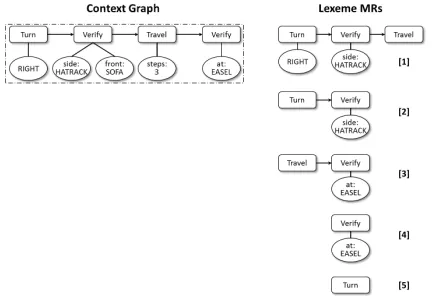
lexemes are inserted, in order, into the graph to cre-ate a hierarchy of MRs, where each child’s MR is a subgraph of the MR of each of its parents. Figure 5 illustrates a sample construction of an LHG for the following landmarks plan (ci):
Turn(RIGHT),
Verify(side:HATRACK, front:SOFA), Travel(steps:3),
Verify(at:EASEL)
The initial LHG may contain nodes with too many children. This is a problem, because when we sub-sequently extract PCFG rules, we need to add a pro-duction for every k-permutation of the children of each node (see Section 3.2). To reduce the branch-ing factor in the LHG, we introducepseudo-lexeme
nodes by repeatedly combining the two most similar children of each node. Pseudocode for the process is shown in Algorithm 2. The MR for a pseudo-lexeme is the minimal graph,m0, that is a supergraph of both of the lexeme MRs that it combines. The pair of
(a) All relevant lexemes are obtained for the training exam-ple and ordered by the number of nodes in their MR.
(b) Lexeme MR [1] is added as a child of the top node. MR [2] is a subgraph of [1], so it is added as its child.
[image:5.612.320.536.93.241.2](c) MR [3] is not a subgraph of [1] or [2], so it is added as a child of the root. MR [4] is added under [3], and MR [5] is recursively filtered down and added under [2].
Algorithm 2ADDINGPSEUDOLEXEMES TOLHG
Input:LHG with rootT
Output: LHG with pseudo lexemes added
procedureRECONSTRUCTLHG(T)
repeat
((Ti, Tj), m0) ← pick the most similar
pair(Ti, Tj)of children ofTand the minimal
ex-tension m0 s.t. MR(Ti) ⊂ m0, MR(Tj) ⊂ m0,
m0⊂MR(T)
Add childT0 ofT;MR(T0)←m0 MoveTiandTj to be children ofT0 untilThere are no more pairs to combine
for allnon-leaf childrenTkofT do
RECONSTRUCTLHG(Tk) end for
end procedure
most similar children, (mi, mj), is determined by
measuring the fraction of the nodes in mi andmj
that overlap with their minimum extensionm0 and is calculated as follows:
Sim(mi, mj, m0) =
|mi|+|mj|
2|m0|
where |m| is the number of nodes in the MR m. Adding pseudo-lexemes also has another advan-tage. They can be considered to be higher-level semantic concepts composed of two or more sub-concepts. These higher-level concepts will likely occur in other training examples as well, which al-lows for more flexible interpretations. For example, assuming the ruleA → BCDis constructed from an LHG, we will introduce a pseudo lexemeE and build two rulesA→BE andE→CD. It is likely thatE also occurs in another rule constructed from other training examples such as E → F G. This increases the model’s expressive power by support-ing additional derivations such asA→∗ BF G,
pro-viding more flexibility when parsing novel NL sen-tences.
3.2 Composing PCFG Rules
The next step composes PCFG rules from the LHGs and is summarized in Figure 6. We basically fol-low the scheme of B¨orschinger et al. (2011), but instead of generating NL words from each atomic MR, words are generated from each lexeme MR,
Figure 6: Summary of the rule generation process.
NLsrefer to the set of NL words in the corpus. Lex-eme rules come from the schemata of B¨orschinger et al. (2011), and allow every lexeme MR to gener-ate one or more NL words. Note that pseudo-lexeme nodes do not produce NL words.
and smaller lexeme MRs are generated from more complex ones as given by the LHGs. A nonterminal Smis generated for the MR,m, of each LHG node.
Then, for every LHG node,T, with MR,m, we add rules of the formSm → Smi...Smj, where the RHS
is some k-permutation of the nonterminals for the MRs of the children of node T. B¨orschinger et al. assume that every atomic MR generates at least one NL word. However, since we do not know which subgraph of the overall context (i.e.ci, the MR of the
root node) conveys the intended plan and is therefore expressed in the NL instruction, we must allow each ordered subset of the children of a node (i.e. each k-permutation) to be a possible generation.
The rest of the process more closely follows B¨orschinger et al.’s. Every MR, m, of a lexeme node4 generates a rule Sm → P hrasem, and
ev-eryP hrasemgenerates a sequence of NL words,
in-cluding one or more “content words” (W ordm) for
expressingmand zero or more “extraneous” words (W ord∅). While B¨orschinger et al. have W ordm
generate all possible NL words (each of which are
subsequently weighted by EM training), in our ap-proach, eachW ordm only produces the NL phrase
associated withmin the lexicon, or individual words that appear in this phrase. The words not covered byW ordmalso can be generated byW ord∅which
has rules for every word. P hm andP hXm ensure
thatP hrasemproduces at least oneW ordm, where
P hXm indicates that one or more W ordm’s have
already been generated, andP hm indicates that no
W ordmhas yet been generated.
3.3 Parsing Novel NL Sentences
To learn the parameters of the resulting PCFG, we use the Inside-Outside algorithm.5 Then, the
stan-dard probabilistic CKY algorithm is used to produce the most probable parse for novel NL sentences (Ju-rafsky and Martin, 2000).
B¨orschinger et al. (2011) simply read the MR,m, for a sentence off the top Sm nonterminal of the
most probable parse tree. However, in our approach, the correct MR is constructed by properly compos-ing the appropriate subset of lexeme MRs from the most-probable parse tree. This allows the system to produce a wide variety of novel MRs for novel sen-tences, as long as the correct MR is a subgraph of the complete context (ci) for at least one of the training
sentences.
First, the parse tree is pruned to remove all sub-trees starting with P hrasex nodes. This leaves a
tree consisting of theRoot and a set ofSm nodes.
The pruned subtrees only concern generating NL words and phrases from the selected MRs. The re-maining tree shows which MR constituents were se-lected from the available context, from which the sentence is then generated. Each leaf in the pruned tree represents an MR constituent that was used to generate a phrase in the sentence. These are the con-stituents we want to assemble and compose into a final MR for the sentence.
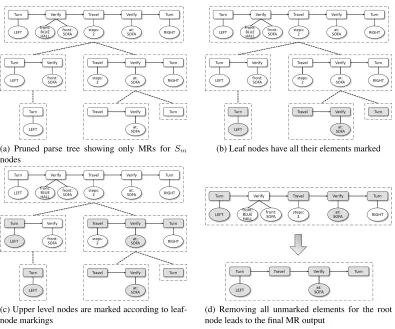
Algorithm 3 describes the procedure for extract-ing the final MR from the pruned parse tree. Fig-ure 7 graphically depicts a sample trace of this algo-rithm. The algorithm recursively traverses the parse tree. When a leaf-node is reached, it marks all of the nodes in its MR. After traversing all of its children,
5
We used the implementation available athttp://web. science.mq.edu.au/˜mjohnson/Software.htm
which was also used by B¨orschinger et al. (2011).
Algorithm 3CONSTRUCT PARSEDMRRESULT Input: Parse tree T for input NL, e, with all P hrasexsubtrees removed.
Output: Semantic parse MR,m, fore
procedureOBTAINPARSEDOUTPUT(T) ifT is a leafthen
returnMR(T)with all its nodes marked
end if
for allchildrenTiofT do
mi←OBTAINPARSEDOUTPUT(Ti)
Mark the nodes inMR(T)corresponding to the marked nodes inmi
end for
ifT is not the rootthen returnMR(T)
end if
returnMR(T)with unmarked nodes removed
end procedure
a node in the MR for the current parse-tree node is marked iff its corresponding node in any of the chil-dren’s MRs were marked. The final output is the MR constructed by removing all of the unmarked nodes from the MR for the root node.
4 Experimental Evaluation
For evaluation, we used the same data and method-ology as Chen and Mooney (2011). Please see their paper for more details.
4.1 Data
We used the English instructions and follower data collected by MacMahon et al. (2006).6 This data contains 706 route instructions for three virtual worlds. The instructions were produced by six in-structors for 126 unique starting and ending loca-tion pairs spread evenly across the three worlds, and there were 1 to 15 human followers for each instruc-tion who executed an average of 10.4 acinstruc-tions per in-struction. Each instruction is a paragraph consist-ing of an average of 5.0 sentences, each contain-ing an average of 7.8 words. Chen and Mooney constructed the additional single-sentence corpus by matching each sentence with the majority of human
(a) Pruned parse tree showing only MRs for Sm
nodes
(b) Leaf nodes have all their elements marked
(c) Upper level nodes are marked according to leaf-node markings
[image:8.612.110.505.52.381.2](d) Removing all unmarked elements for the root node leads to the final MR output
Figure 7: Sample construction of MR output from pruned parse tree.
followers’ actions. We use this single-sentence ver-sion for training, but use both the single-sentence and the original paragraph version for testing. Each sentence was manually annotated with a “gold stan-dard” execution plan, which is used for evaluation but not for training.
4.2 Methodology and Results
Experiments were conducted using “leave one ronment out” cross-validation, training on two envi-ronments and testing on the third, averaging over all three test environments. We perform direct compar-ison to the best results of Chen and Mooney (2011) (referred to as CM). A Wilcoxon signed-rank test is performed for statistical significance, and ‘∗’ de-notes significant differences (p < .01) in the tables.
Semantic Parsing Results
We first evaluated how well our system learns to map novel NL sentences for new test environments into their correct MRs. Partial semantic-parsing ac-curacy (Chen and Mooney, 2011) is calculated by
Precision Recall F1
Our system 87.58 ∗65.41 ∗74.81
CM ∗90.22 55.10 68.37
Table 1: Test accuracy for semantic parsing. ‘∗’ denotes difference is statistically significant.
[image:8.612.316.504.55.191.2]comparing the system’s MR output to the hand-annotated gold standard. Accuracy is measured in terms of precision, recall, and F1 for individual MR constituents (thereby awarding partial credit for ap-proximately correct MRs).
[image:8.612.322.527.417.459.2]Single-sentence Paragraph
Our system ∗57.22% ∗20.17%
[image:9.612.79.288.57.100.2]CM 54.40% 16.18%
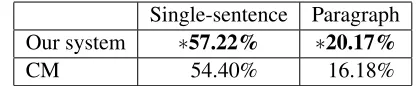
Table 2: Successful plan execution rates for novel test data. ‘∗’ means statistical significance.
Navigation Plan Execution Results
Next, we test the end-to-end system by execut-ing the parsed navigation plans for test instructions in novel environments to see if they reach the ex-act desired destinations in the environment. Table 2 shows the successful end-to-end navigation-task completion rate for both single-sentences and com-plete paragraph instructions.
Again, our system outperforms CM’s best results since more accurate semantic parsing produces more successful plans. However, the difference in per-formance is smaller than that observed for semantic parsing. This is because the redundancy in the hu-man generated instructions allows an incorrect se-mantic parse to be successful, as long as the errors do not affect its ability to guide the system to the correct destination.
5 Discussion
Our approach improves on B¨orschinger et al. (2011)’s method in the following ways:
• The building blocks for associating NL and MR are semantic lexemes instead of atomic MR con-stituents. This prevents the number of constructed PCFG rules from becoming intractably large as hap-pens with B¨orschinger et al.’s approach. As previ-ously mentioned, lexeme MRs are intuitively anal-ogous to syntactic categories in that complex lex-eme MRs represent complicated semantic concepts whereas higher-level syntactic categories such as S, VP, or NP represent complex syntactic structures.
• Our approach has the ability to produce previ-ously unseen MRs, whereas B¨orschinger et al. can only generate an MR if it is explicitly included in the PCFG rules constructed from the training data. Even though our MR parse is restricted to be a sub-graph of some training context,ci, our model allows
for exponentially many combinations.
In addition, our approach can produce a wider range of MR outputs than Chen and Mooney
(2011)’s even though we use their semantic lexi-con as input. Their system deterministically builds a supervised training set by greedily selecting high-scoring lexemes, thus implicitly including only high-scoring lexemes during training. On the other hand, our probabilistic approach also considers rela-tively low-scoring but useful lexemes, thereby utiliz-ing more semantic concepts in the lexicon. In partic-ular, this explains why our approach obtains higher
recallin the evaluation of semantic parsing.
Even though we have demonstrated our approach on the specific task of following navigation in-structions, it is straightforward to apply it to other language-grounding tasks where NL sentences po-tentially refer to some subset of states, events, or ac-tions in the world, as long as this overall context can be represented as a semantic graph or logical form. Since the semantic lexicon is an input to our system, other approaches to lexicon learning are also easily incorporated.
6 Related Work
this model on ambiguous data using EM. As pre-viously discussed, B¨orschinger et al. (2011) use a PCFG generative model and also train it on ambigu-ous data using EM. Liang et al. (2009) assume each sentence maps to oneor moresemanticrecords(i.e. MRs) and trains a hierarchical semi-Markov genera-tive model using EM, and then finds a Viterbi align-ment between NL words and records and their con-stituents. Several recent projects (Branavan et al., 2009; Vogel and Jurafsky, 2010) use NL instructions to guide reinforcement learning from independent exploration with delayed rewards. These systems do not even need the ambiguous supervision obtained from observing humans follow instructions; how-ever, they do not learn semantic parsers that map sentences to complex, structural representations of their meaning.
Interpreting and executing NL navigation instruc-tions is our primary task, and several other recent projects have studied related problems. Shimizu and Haas (2009) present a system that parses natural lan-guage instructions into actions. However, they limit the number of possible actions to only 15 and treat the problem as a sequence labeling problem that is solved using a CRF with supervised training. Ma-tuszek et al. (2010) developed a system that learns to map NL instructions to executable commands for a robot navigating in an environment constructed by a laser range finder. However, their approach has limi-tations of ignoring any objects or other landmarks in the environment to which the instructions can refer. There are several recent projects (Vogel and Juraf-sky, 2010; Kollar et al., 2010; Tellex et al., 2011) which learn to follow instructions in more linguisti-cally complex environments. However, they assume predefined spatial words, direct matching between NL words and the names of objects and other land-marks in the MR, and/or an existing syntactic parser. By contrast, our work does not assume any prior lin-guistic knowledge, syntactic, lexical, or semantic, and mustlearnthe mapping between NL words and phrases and the MR terms describing landmarks.
7 Future Work
In the future, we would like to develop a better lex-icon learner since our PCFG approach critically re-lies on the quality of the learned lexicon.
Particu-larly, we would like to investigate how syntactic in-formation (such as part-of-speech tags induced us-ing unsupervised learnus-ing) could be used to improve semantic-lexicon learning. For example, some of the current lexicon entries violate the general constraint that nouns usually refer to objects and verbs to ac-tions. Ideally, the lexicon learner would be able to induce and then utilize this sort of relationship be-tween syntax and semantics.
In addition, we want to investigate the use of dis-criminative reranking (Collins, 2000), which has proven effective in various other NLP tasks. We would expect the final MR output to improve if a discriminative model, which uses additional global features, is used to rerank the top-kparses produced by our generative PCFG model.
8 Conclusions
We have presented a novel method for learning a semantic parser given only highly ambiguous su-pervision. Our model enhances B¨orschinger et al. (2011)’s approach to reducing the problem of grounded learning of semantic parsers to PCFG in-duction. We use a learned semantic lexicon to aid the construction of a smaller and more focused set of PCFG productions. This allows the approach to scale to complex MR languages that define a large (potentially infinite) space of representations for capturing the meaning of sentences. By contrast, the previous PCFG approach requires a finite MR language and its grammar grows intractably large for even moderately complex MR languages. In ad-dition, our algorithm for composing MRs from the final parse tree provides the flexibility to produce a wide range of novel MRs that were not seen during training. Evaluations on a previous corpus of nav-igational instructions for virtual environments has demonstrated the effectiveness of our method com-pared to a recent competing system.
Acknowledgments
References
Benjamin B¨orschinger, Bevan K. Jones, and Mark John-son. 2011. Reducing grounded learning tasks to gram-matical inference. InProceedings of the Conference on Empirical Methods in Natural Language Process-ing (EMNLP-11), pages 1416–1425, Stroudsburg, PA, USA. Association for Computational Linguistics. S.R.K. Branavan, Harr Chen, Luke S. Zettlemoyer, and
Regina Barzilay. 2009. Reinforcement learning for mapping instructions to actions. InJoint Conference of the 47th Annual Meeting of the Association for Computational Linguistics and the 4th International Joint Conference on Natural Language Processing of the Asian Federation of Natural Language Processing (ACL-IJCNLP), Singapore.
David L. Chen and Raymond J. Mooney. 2008. Learn-ing to sportscast: A test of grounded language ac-quisition. InProceedings of 25th International Con-ference on Machine Learning (ICML-2008), Helsinki, Finland, July.
David L. Chen and Raymond J. Mooney. 2011. Learn-ing to interpret natural language navigation instruc-tions from observainstruc-tions. In Proceedings of the 25th AAAI Conference on Artificial Intelligence (AAAI-11), San Francisco, CA, USA, August.
David L. Chen, Joohyun Kim, and Raymond J. Mooney. 2010. Training a multilingual sportscaster: Using per-ceptual context to learn language. Journal of Artificial Intelligence Research, 37:397–435.
Michael Collins. 2000. Discriminative reranking for nat-ural language parsing. In Proceedings of the Seven-teenth International Conference on Machine Learning (ICML-2000), pages 175–182, Stanford, CA, June. Daniel Jurafsky and James H. Martin. 2000. Speech
and Language Processing: An Introduction to Natu-ral Language Processing, Computational Linguistics, and Speech Recognition. Prentice Hall, Upper Saddle River, NJ.
R. J. Kate and R. J. Mooney. 2006. Using string-kernels for learning semantic parsers. InProceedings of the 21st International Conference on Computational Linguistics and 44th Annual Meeting of the Associ-ation for ComputAssoci-ational Linguistics (COLING/ACL-06), pages 913–920, Sydney, Australia, July.
Rohit J. Kate and Raymond J. Mooney. 2007. Learn-ing language semantics from ambiguous supervision. In Proceedings of the Twenty-Second Conference on Artificial Intelligence (AAAI-07), pages 895–900, Van-couver, Canada, July.
Joohyun Kim and Raymond. J. Mooney. 2010. Genera-tive alignment and semantic parsing for learning from ambiguous supervision. InProceedings of the 23rd In-ternational Conference on Computational Linguistics
(COLING-10), pages 543–551. Association for Com-putational Linguistics.
Thomas Kollar, Stefanie Tellex, Deb Roy, and Nicholas Roy. 2010. Toward understanding natural language directions. InProceedings of Human Robot Interac-tion Conference (HRI-2010).
P. Liang, M. I. Jordan, and D. Klein. 2009. Learning se-mantic correspondences with less supervision. InJoint Conference of the 47th Annual Meeting of the Associ-ation for ComputAssoci-ational Linguistics and the 4th Inter-national Joint Conference on Natural Language Pro-cessing of the Asian Federation of Natural Language Processing (ACL-IJCNLP), Singapore.
Wei Lu, Hwee Tou Ng, Wee Sun Lee, and Luke S. Zettle-moyer. 2008. A generative model for parsing natural language to meaning representations. InProceedings of the Conference on Empirical Methods in Natural Language Processing (EMNLP-08), pages 783–792, Morristown, NJ, USA. Association for Computational Linguistics.
M. MacMahon, B. Stankiewicz, and B. Kuipers. 2006. Walk the talk: Connecting language, knowledge, and action in route instructions. In Proceedings of the Twenty-First National Conference on Artificial Intel-ligence (AAAI-06), Boston, MA, July.
Cynthia Matuszek, Dieter Fox, and Karl Koscher. 2010. Following directions using statistical machine transla-tion. In Proceedings of the 5th ACM/IEEE interna-tional conference on Human-robot interaction (HRI-10), pages 251–258, New York, NY, USA. ACM. Nobuyuki Shimizu and Andrew Haas. 2009. Learning to
follow navigational route instructions. InProceedings of the Twenty First International Joint Conference on Artificial Intelligence (IJCAI-2009).
Jeffrey M. Siskind. 1996. A computational study of cross-situational techniques for learning word-to-meaning mappings. Cognition, 61(1):39–91, October. Stefanie Tellex, Thomas Kolla, Steven Dickerson, Matthew R. Walter, Ashis G. Banerjee, Seth Teller, and Nicholas Roy. 2011. Understanding natural language commands for robotic navigation and mobile manipu-lation. InProceedings of the National Conference on Artificial Intelligence (AAAI-11), August.
Cynthia A. Thompson and Raymond J. Mooney. 2003. Acquiring word-meaning mappings for natural lan-guage interfaces. Journal of Artificial Intelligence Re-search, 18:1–44.
Adam Vogel and Dan Jurafsky. 2010. Learning to fol-low navigational directions. InProceedings of the 48th Annual Meeting of the Association for Computational Linguistics (ACL-10).
lambda calculus. In Proceedings of the 45th Annual Meeting of the Association for Computational Linguis-tics (ACL-07), pages 960–967, Prague, Czech Repub-lic, June.
John M. Zelle and Raymond J. Mooney. 1996. Learn-ing to parse database queries usLearn-ing inductive logic pro-gramming. InProceedings of the Thirteenth National Conference on Artificial Intelligence (AAAI-96), pages 1050–1055, Portland, OR, August.
Luke S. Zettlemoyer and Michael Collins. 2005. Learn-ing to map sentences to logical form: Structured clas-sification with probabilistic categorial grammars. In Proceedings of 21st Conference on Uncertainty in Ar-tificial Intelligence (UAI-2005), Edinburgh, Scotland, July.
Luke S. Zettlemoyer and Michael Collins. 2007. Online learning of relaxed CCG grammars for parsing to logi-cal form. InProceedings of the 2007 Joint Conference on Empirical Methods in Natural Language Process-ing and Computational Natural Language LearnProcess-ing (EMNLP-CoNLL-07), pages 678–687, Prague, Czech Republic, June.