A Tree Transducer Model for Grammatical Error Correction
Jan Buys and Brink van der Merwe MIH Media Lab and Computer Science Division
Stellenbosch University, South Africa
[email protected], [email protected]
Abstract
We present an approach to grammatical er-ror correction for the CoNLL 2013 shared task based on a weighted tree-to-string transducer. Rules for the transducer are extracted from the NUCLE training data. An n-gram language model is used to rerank k-best sentence lists generated by the transducer. Our system obtains a pre-cision, recall and F1 score of0.27,0.1333
and 0.1785, respectively, on the official test set. On the revised annotations, the F1 score increases to0.2505. Our system ranked 6th out of the participating teams on both the original and revised test set an-notations.
1 Introduction
There has recently been an increase in research on automated grammatical error detection and correc-tion for writing by English language learners (Lea-cock et al., 2010). In the most prominent line of research, statistical classifiers are trained to de-tect or correct specific error types. Features for these classifiers are based on word context and lo-cal syntactic information. The classifiers are com-bined, and a language model is often used to filter corrections. Research on this approach focusses especially on preposition and determiner errors. Most of the systems in the HOO 2011 and 2012 shared tasks (Dale and Kilgarriff, 2011; Dale et al., 2012) fall under this broad approach.
In a second class of models, a model for gen-erating corrected sentences is formulated in the noisy-channel framework, relying strongly on a language model to distinguish between grammati-cal and ungrammatigrammati-cal candidate corrections (Lee and Seneff, 2006; Turner and Charniak, 2007; Park and Levy, 2011). Such models are often in-spired by techniques developed for statistical ma-chine translation (Brockett et al., 2006). Finally,
rule-based methods are often used in commercial language processing systems such as word pro-cessors. Here large hand-crafted linguistically ex-pressive, error-tolerant grammars are used to anal-yse sentences and identify where constraints have been broken.
In this paper we present our system for the CoNLL 2013 shared task in grammatical error cor-rection (Ng et al., 2013). Our grammar corcor-rection model is based on a tree-to-string transducer that is specified by a set of rules that each rewrite a tree fragment to a string of words and variables. These rules are extracted automatically from a set of training examples. Each training example con-sists of an incorrect sentence, a corresponding cor-rect sentence with its parse tree, and a word align-ment between the incorrect and correct sentences. During decoding the model searches for parsed well-formed sentences that could be transformed into a given incorrect sentence with high probabil-ity. Sentences are split into linguistically plausible clauses to decrease the average sentence length, in order to improve decoding runtime. In order to discriminate more accurately between candidate sentence corrections an n-gram language model trained on a large corpus of well-formed text is used to rerank thek-best hypotheses that the trans-ducer model generates. The tree transtrans-ducer and language model scores are weighted to maximize the model F1 score on a validation set. After de-coding the clauses are recombined into the original sentence structure.
The next section describes preprocessing and the resources used by our system. Section 3 defines weighted tree-to-string transducers. We present the formulation of our error correction model in section 4, and discuss decoding with it in section 5. Section 6 describes language model reranking. System results are given in section 7. Finally, section 8 draws some conclusions and dis-cuss future work.
2 Data Pre-processing
2.1 NUCLE
We use the pre-processed version of the NUCLE corpus (Dahlmeier et al., 2013) released as train-ing data for this shared task. The data con-sist of essays, subdivided into paragraphs. Us-ing NLTK (Bird et al., 2009), paragraphs were split into sentences with NLTK punkt and sen-tences were tokenized with NLTKword tokenize. Though this sentence-splitting and tokenization is not error-free (for example, quotation marks are handled incorrectly in some contexts), we use it to maintain consistency in our model. An error anno-tation in the data consists of the start and end token offsets in a sentence, as well as the correction that should replace the text between the offsets.
We divide the corpus into 80% training data,
10% validation data and 10% development data. Splitting is performed by random selection at es-say level. For each sentence with corrections, we refer to the original as the incorrect sentence, and to the version with the corrections applied to it as the correct sentence. For the purpose of train-ing our models, all words are lowercased. As de-scribed below, we also construct an alignment be-tween the words of each of these sentence pairs.
The 2013 shared task focusses on five error types: Article or determiner, preposition, noun number, verb form, and subject-verb agreement errors. In the training data we only apply correc-tions of these types to obtain the correct version of the sentences, though other error types are also included in the error annotations. An alternative would be to apply the corrections of other error types to the correct and incorrect versions of the sentences. However, we decided against that in or-der to keep the training data realistically close to the test data, which will also contain these other er-rors. We do, however, correct some of the mechan-ical errors, especially spelling errors, in the incor-rect and corincor-rect versions of the training data, to reduce noise that these errors may introduce into the model.
In order to train a syntax-based model for gram-mar correction, the correct version of the sen-tences are parsed with the Berkeley parser (Petrov and Klein, 2007). The Berkeley parser is a state-of-the-art unlexicalized parser. Given that the cor-rect side of our training data will still contain er-rors, it is unlikely that lexicalized parsing will be more accurate. Parser options are set to obtain
left-binarized parse trees under Viterbi decoding.
2.2 Wikipedia language model
We train then-gram language model used in our system on a large corpus of text extracted from the English Wikipedia. The April 2013 Wikipedia XML dump1 is used. This is parsed with the gwtwiki2Wikipedia parser, and all sentences con-sisting of 6 or more words are extracted. These sentences are tokenized with NLTK and lower-cased. The corpus has about 1 500 millions words. As vocabulary we use the 64 000 words with the highest frequency occurrence in the corpus. A
3-gram language model is trained from the cor-pus on this restricted vocabulary, to keep the size of the language model reasonable. The language model is trained and applied with the SRILM toolkit (Stolcke, 2002). Kneser-Ney smoothing is used to estimate the model weights.
2.3 Vocabulary
We set the vocabulary of the transducer model as the union of the vocabulary of our language model and the vocabulary of the words of the correct sen-tences in the NUCLE training data. In the trans-ducer construction we ensure that all words in this vocabulary can be accepted. A large number of URLs occur in the training data, as citations are included in some of the essays. We replace these with a<url> symbol to reduce noise in the vo-cabulary.
In the validation, development and test data, words that do not appear in the vocabulary are re-placed with an<unk>symbol. We record the re-placed words, so that after decoding they can be replaced back to their original positions. We do not perform automatic spelling correction on the test data as a preprocessing step: The occurrence of out of vocabulary words is small enough that performing spelling correction will not have a sig-nificant impact on the performance of our system. We use the NLTK interface to WordNet (Miller, 1995) to find pairs of singular and plural nouns and groups of verbs that have the same base form. All verbs and non-proper nouns that occur in the language model vocabulary are grouped like this. The groups are used to construct additional rules for noun number and verb form errors.
1
http://download.wikimedia.org/enwiki/ latest/enwiki-latest-pages-articles.xml. bz2
3 Weighted Tree-to-string Transducers
Tree transducers are a class of automata-theoretic models that perform transformations on tree struc-tures. There is a rich theory concerning these mod-els, and tree transducers with different restrictions can compute different classes of transformations. Algorithms for weighted variants of these trans-ducers have recently been developed (Graehl et al., 2008; May, 2010) and applied to syntax-based sta-tistical machine translation.
Tree-to-string transducers are a class of tree transducers that generalizes synchronous context-free grammars. These transducers can be used to transform strings into trees: For a given output string, the decoding problem is to find the input tree that could be transformed into the given string with the highest probability. This decoding pro-cess is referred to as backward application. The formulation is due to the noisy-channel model of-ten followed in statistical machine translation.
3.1 Definitions
We need a few preliminary definitions (the no-tation of May (2010) is generally followed): A ranked alphabetΣis a finite set of symbols, each which can take a finite set of ranks. A tree t ∈ TΣ is denoted by σ(t1, . . . , tk), where k ∈ N,
t1, . . . , tk ∈ TΣ andσ is a node of rank k. Σk denotes the subset of Σof all symbols withrank
k. TΣ(S) is the set of all trees in TΣ∪S where symbols fromS occur only at the leaves. We do-nate byX = {x1, x2, . . .}a set ofvariables, and Xk = {x1, . . . , xk}. With respect toXk, a tree
u∈TΣ(Xk)or a sequenceu∈(∆∪(Q×X))∗is linearif each element ofXkoccurs at most once inu, andnondeletingif each element ofXkoccurs at least once inu.
Formally, a weighted extended top-down tree-to-string transducer M is a 5-tuple
(Q,Σ,∆, R, Qd) (May, 2010, chap. 2). Q is an alphabet of states that all have rank one. Σ
and∆are the ranked input and output alphabets, respectively. Qd is the set of initial states. R is a finite set of rules with an associated weight function π : R → W. Each rule r ∈ R is of the form q.t → g for q ∈ Q, t ∈ TΣ(X) and
g ∈(∆∪(Q×X))∗. The treetshould be linear inX, and each variable ingshould also be int.
We refer toq.tas the left hand side of a rule, and togas the right hand side. M islinearif the right hand side of each rule is linear, andnondeletingif
the right hand side of each rule is nondeleting with respect toXk, the set of variables on the left hand side.
For a ruler : q.t → g ande, f ∈ (∆∪(Q× TΣ))∗, a derivation step e ⇒r f is obtained by replacing the left-most element of e of the form
q(s), where s matches t, by a transformation of
g, where each instance of a variable is replaced with the corresponding subtree ofs. The sequence
d= (r1, . . . , rm) is aderivationof the pair(t, s) if t ⇒r1 t
1 ⇒r2 . . . ⇒rm s, where ti ∈ (∆∪
(Q×TΣ))∗ for1 ≤ i < m. The weight of dis wt(d) =π(r1)·. . .·π(rm).
The tree transducer that we use is a weighted linear, nondeleting top-down tree-to-string trans-ducer. The expressive power of this transducer class is sufficient for the transformations that we need our model to perform. Relaxing these re-strictions will increase the decoding complexity of the transducer model significantly. Since we work with binarized trees, no node will have a rank greater than2. Our transducer only has one state,
q. Look-ahead restrictions are added to restrict the variables on the left hand side to match specific constituents.
3.2 Probability model
A tree-to-string transducer can represent a condi-tional probability model for the output sentences given the input trees, or a joint probability model over the input trees and output strings. We will use a joint probability distribution for our model. Note that there is spurious ambiguity in the model at two levels: Firstly, it is possible that there can be different derivations for the same tree-string pair. However, during the application of the model this ambiguity occurs infrequently. Secondly, the model can generate different trees with the same yield.
Suppose cis a correct sentence in the setC of all possible correct sentences, and i is the given (possibly) incorrect sentence. Let τ(c) represent the set of all possible parse trees ofc. Then we want to find sentence
ˆ
c= arg max
c∈C
P(c, i) (1)
= arg max
c∈C
Σπ∈τ(c)P(π, i) (2)
be the case for a conditional model). The model is trained from a set of derivations constructed from the training data, as will be described below. Let
f(r)be the number of times that ruler occurs in all the training derivations. Then the probability estimate of a rule is
p(r|root(r)) = f(r)
Σr0:root(r0)=root(r)f(r0)
(3)
In the construction of the transducer, some rules that do not occur in the training derivations are added. In order to give non-zero weights to these added rules, we apply Good-Turing smooth-ing (Katz, 1987). This method has the advantage of decreasing the counts of low-frequency rules whose rule counts may provide unreliable prob-ability estimates. For the rules of each of the root nonterminals, the counts of rules with frequencies between0and5are re-estimated.
4 Transducer Model Formulation
4.1 Word alignment
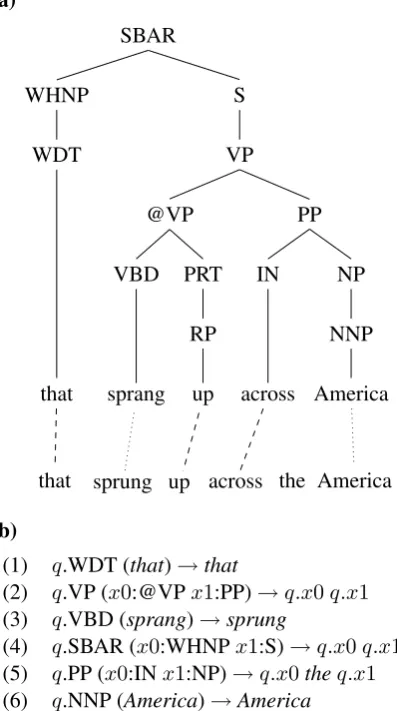
In order to extract rules from the training data to perform transformations between incorrect and correct sentences, we need to construct an align-ment between words in each pair of correct and incorrect sentences. This approach is similar to aligning words in source and target language sen-tences for statistical machine translation. We con-struct the alignments from given sequences of edit operations in the training data. Figure 1(a) gives an example of a parse tree for a correct phrase, aligned with a corresponding incorrect phrase.
Firstly, all words in a sentence that do not oc-cur in any edits are aligned one-to-one between the correct and incorrect sentence. In the example, “that”, “up” and “across” are aligned in this way. Then, for each edit annotation, we consider the in-correct and in-correct phrases of that edit. Note that in the NUCLE annotations the incorrect phrase will always be non-empty, but the correct phrase may be empty.
Words that occur in both the correct and incor-rect edit phrases are aligned one-to-one. We re-strict such alignments to prevent overlapping. In the example in Figure 1(a), there is an edit to re-place “the America” with “America”, so the word “America” is aligned. Adding these alignments may split a phrase into unaligned subphrases. If such a subphrase is empty on either side, then the word(s) on the other side have to be left unaligned.
(a)
SBAR
S
VP
PP
NP
NNP
America IN
across @VP
PRT
RP
up VBD
sprang WHNP
WDT
that
that sprung up across the America
(b)
(1) q.WDT (that)→that
(2) q.VP (x0:@VPx1:PP)→q.x0q.x1
(3) q.VBD (sprang)→sprung
(4) q.SBAR (x0:WHNPx1:S)→q.x0q.x1
(5) q.PP (x0:INx1:NP)→q.x0theq.x1
(6) q.NNP (America)→America
Figure 1: (a) Example alignment between a cor-rect parse tree and an incorcor-rect clause. (b) Some rules extracted from the example.
In the example, “the” will be unaligned. But if the subphrases are non-empty on both sides, then all the words on the incorrect side are aligned to all the words on the correct side of the subphrase. In many instances, this will occur for single word re-placements. In the example, “sprung” is aligned with “sprang” in this manner.
4.2 Rule extraction
We follow the GHKM transducer rule extraction algorithm described in (Galley et al., 2004) and (Galley et al., 2006). Given a training example
[image:4.595.312.511.67.423.2]going downward.
For each of the nodes inπ, we compute aspan and acomplement spanwith respect to the nodes ini. The span of a nodenis defined by the indexes of the first and last words in f that are reachable from n. The spans of the leaves in the tree (the words of the correct sentence) are defined by a, and the spans of the other nodes can be computed bottom-up for each node from the spans of its child nodes. The complement span ofnis the union of the spans of all nodes that are neither ancestors nor descendants ofn. The complement spans can be computed top-down for each node by taking the union of the complement span of its parent and the spans of its siblings. Nodes whose spans and complement spans do not overlap, are called fron-tiernodes. From each frontier node, a rule can be extracted: The left hand side of the rule is a subtree rooted atn. The subtree is extracted by traversing
π top-down from n, replacing all frontier nodes reached with variables (as more rules will be ex-tracted from there). The right hand side is formed by the words of the span ofnof the incorrect side, with the span of each left hand side frontier node replaced by the corresponding variable.
Figure 1(b) gives sample rules extracted from the training example in Figure 1(a). In the example tree, all the constituent nodes are frontier nodes, as there are no complex rewrites. For constituents under which no changes are made, CFG-like rules such as (1) and (2) are extracted. In the case where a single word is substituted (in the example, “sprang” with “sprung”), a rule for this substitu-tion will be extracted (3). If there were no align-ment between these words, the algorithm would have attached the word “sprung” to the rule headed bySBAR (4), which would clearly not have been linguistically sensible. In the case of the deletion of a word in the incorrect sentence, that word will left be unaligned (“the” in the example). The rule for this word (5) will have as head the lowest node that spans the words in i to the left and right of the unaligned word – in the example, thePPnode. Rewrite rules for aligned words in phrase edits are also extracted (6).
4.3 Additional rules
We add rules to the transducer that involve words in the vocabulary. Whichever of these rules have not already been extracted from the training data will be assigned a rule count of0, otherwise their
Non-lexicalized
q.S (x0:NPx1:VP)→q.x0q.x1 −0.596
q.S (x0:VPx1:VP)→q.x0q.x1 −5.781
q.VP (x0:VPx1:SBAR)→q.x0q.x1 −3.723
Word identity
q.NN (work)→work −2.614 q.VBP (work)→work −2.475 q.DT (the)→the −0.183
Single word substitution
q.NN (work)→works −4.343 q.VBP (work)→working −4.541 q.VBZ (works)→work −4.802 q.DT (the)→a −3.100 q.IN (of)→from −3.901
Phrase substitution
q.NP (DT (the) NN (right))→rights −5.109 q.VP (VBG (being) VP (VBN (researched)))
→under researching −6.272
Context-sensitive phrase substitution
q.VP (TO (to) VP (VB (work)x0:PP))
→workingq.x0 −6.272
q.PP (IN (in) S (VP (VBG (generating)x0:NP)))
→to generateq.x0 −5.480
Context-sensitive word insertion and deletion
[image:5.595.306.538.60.336.2]q.NP (DT (thex0:NN)→q.x0 −2.634 q.VP (VBZ (has)x0:VP)→q.x0 −5.202 q.VP (x0:VBx1:NP)→q.x0intoq.x1 −5.203
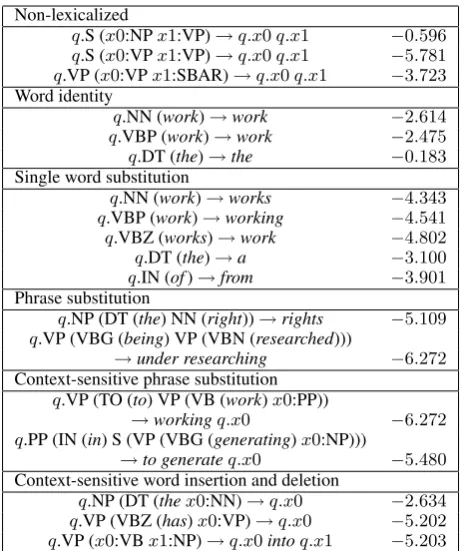
Table 1: Example transducer rules by type, with log probability weights.
rule counts will be left unchanged.
We need to ensure that there are lexical rewrite rules for all the words in our vocabulary. For each of the words in the vocabulary we find one or two possible part-of-speech tags, using the NLTK POS tagger. We add word identity rules in the form of the examples in Table 1. An identity rule is also added for the<unk>symbol.
Additional rules are added for noun number and verb form errors, using the word groups extracted from the vocabulary and WordNet. These rules perform substitutions between singular and plural nouns (in both directions) and between verbs with the same base forms. Subject-verb agreement er-rors are also concerned with the verb form in the sentence, so added verb form rules will also be ap-plicable to such errors. Examples of these single word substitutions are given in Table 1. Since de-terminer and preposition errors are restricted to a relatively small number of possible substitutions, we assume that all relevant rules involving these errors have already been extracted from the train-ing data.
given. Phrase substitution rules can be fully lexi-cal (without variables) or context-sensitive (when they have variables). Word insertions and dele-tions will always be context-sensitive.
5 Transducer Model Decoding
5.1 Sentence to clause splitting
A challenge to our transducer model on the NU-CLE dataset is the length of sentences. On the training data,46%of sentences have length greater than 20 and 13% have length greater that 30. The decoding time of our model increases sharply when the length of sentences becomes greater than
20. For lengths greater that 30 decoding is not practically feasible on our available computational resources. In order to address this problem, we perform linguistically motivated sentence splits to decrease the length of sentences passed to the de-coder. Clauses that are still longer than30 words are not decoded. Decoding was performed on a desktop computer with 8GB RAM. To keep the overall decoding time reasonable, we restrict de-coding to take no more than1minute per sentence on average.
Sentence splitting is based on constituency parses (obtained with the Berkeley parser) of the incorrect sentences under consideration. Sen-tences are split at clause level, using the heuristics described below. The goal is to extracted clauses that have a form similar to that of full sentences.
We distinguish betweenS-clauses, that are indi-cated byS,SINVandSQparse tree constituents, andSBAR-clauses, indicated bySBAR orSBARQ
parse tree constituents. An SBAR-clause usually consists of an introductory subordinating conjunc-tion orwh-word, followed by an S-clause.
We perform splits on S-clauses. A clausal split is performed between the phrase before the start position of the S-clause and the phrase after that position. If the parse tree node of the S-clause is the child of an SBAR-clause node, the split is performed between the phrase before the starting position of the SBAR-clause, and the phrase after the start of the S-clause. The introductory words in the SBAR-clause are excluded from the extracted clauses.
Splits are also performed between some phrases separated by a coordinating conjunction, which is indicated by aCCtag in the parse tree. Such a split is performed only if theCCnode is a child of an S-clause node. The phrase before the conjunction is
split from the phrase after the conjunction, while the conjunction itself is excluded.
After decoding and reranking has been per-formed, the clauses are recombined to reconstruct the original sentences. For each clause the highest-scoring correct clause is chosen. Finally, the origi-nal case of all the words in the sentence is restored, as all words were lowercased in the model.
5.2 k-Best decoding
When performing decoding with the transducer model, we need to find the highest-scoring candi-date correct sentences, so that we can in turn find the best sentence according to the overall model. We found that a good trade-off between speed and accuracy is to find a list of trees of the 1000 -best derivations for a given (incorrect) sentence. The weights of different derivations for which the parse trees have the same yields, are summed to find weights for each of the hypothesis sentences. Note that this is an approximation of the summa-tion in equasumma-tion (2), which is taken over all parse trees with the same yield.
In our implementation the weighted tree trans-ducer package Tiburon (May and Knight, 2006) is used. Tiburon implements generic operations on regular tree grammars, tree and tree-to-string transducers. We use Tiburon to perform de-coding in our model, using its implementation of backwards application andk-best decoding.
The decoding algorithm implemented by Tiburon is based on a weighted version of the Earley parsing algorithm (May, 2010, chap. 4). Empirically, large rules have a detrimental impact on the decoding speed of the algorithm. To address this problem, we extract rules from binarized parse trees, which results in smaller rules than using non-binarized parse trees. In Figure 1(a), the node @VP indicates that a bi-narization has been performed on the subtree
VP (VBD PRT PP). All remaining rules that have more that four variables are removed.
As the search space of the model is large, we need to apply some heuristic pruning. Following practices used in parsing models such as Huang and Chiang (2005), beam search is performed. The cell limitγ, the maximum number of hypothe-ses that can be kept at a state in the search process, is set to30. The beam widthβis set to10−4. This
means that if a hypothesis score is worse thanβ
up to a specific point in the model, the hypothesis is discarded. γ andβ were set to make decoding feasible on available computational resources.
The heuristic pruning may undermine some of the advantages our model might have in taking whole sentence analyses into account to generate error corrections. However, we find that despite this, the model is still able to generate hypothesis corrections that take non-local dependencies into consideration.
6 Language Model Reranking
Although the transducer model defines a joint probability distribution and is therefore sufficient to find corrections for given sentences, incorpo-rating an n-gram language model in our system significantly increases its performance. The main reason for this is that the generative transducer model alone does not have enough discriminative power to distinguish between well-formed and un-grammatical sentences.
6.1 Evaluation
The standard evaluation metric used for grammat-ical error correction is precision, recall and F1 score. Changes made to a given incorrect sentence are represented by edits. For a sample sentence, the sufficient statistics for this evaluation metric is the 3-tuple (#correct system edits, #system edits, #gold standard edits). This can be summed over all the examples being evaluated, and the preci-sion, recall and F1 scores can be computed from that.
The shared task uses the M2 scorer, as de-scribed by Dahlmeier and Ng (2012). Given the original and system sentences, possible system edit sequences are represented with a lattice. The edit sequence that is the best match with the gold standard edit sequence is chosen to compute the edit scores.
6.2 Reranking
During decoding we compute the language model score for each of the hypothesis sentences gener-ated by our transducer model for a given incor-rect sentence. The log probability scores of the transducer and language models are normalized by the length of the incorrect sentence. In order to weigh these two scores, the transducer score is kept fixed, and the language model score is multi-plied by a weightα. For a given incorrect sentence
Data set Precision Recall F1 score
Validation 0.065 0.153 0.092
Development 0.079 0.149 0.103
[image:7.595.309.528.62.132.2]Test (original) 0.2700 0.1333 0.1785 Test (revised) 0.3712 0.1891 0.2505
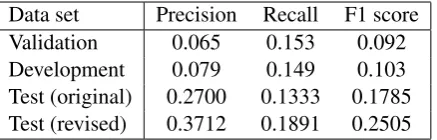
Table 2: Model results
i and a generated set of hypothesis correct sen-tencesH(i), we want to find
ˆ
c= arg max
c∈H(i)
[T T(c, i) +α·LM(c)] (4)
where T T(c, i) gives the tree transducer score andLM(c)gives the language model score. The parameterαis set to maximize the F1 score of the model on a validation set. LetI be the set of in-correct sentences in this set. Then we want to find
ˆ
α= arg max
α
F1[Σi∈Iedits(ˆc, i, g(i))] (5)
whereˆcis given by (4) andeditsis the sufficient statistics for the F1 score ofˆcfor the incorrect sen-tenceiand gold standard editsg(i).
7 Results
We now present results of the model on our val-idation and development sets, as well as on the official test set. A useful measure to analyze the performance of our model is to perform oracle reranking on the hypothesis sets generated by the transducer model. For each sentence, the oracle picks the hypothesis that will contribute to the best possible F1 score. We are especially interested in how frequently the correct sentence is among the hypothesis sentences – this is called thehypothesis coverage.
7.1 Development sets
On the development set, only21%of clauses are annotated with corrections. For clauses that have no annotations, the hypothesis coverage is 99%, while for clauses that have annotations the hypoth-esis coverage is49%. The oracle obtains a0.64F1 score.
We tune the value ofα on the validation set to maximize the F1 score. The best F1 score is ob-tained withα= 1.6949. The system results on the validation set and the development set with thisα
Error type Development Test recall recall
Noun number 0.2231 0.1818
Verb form 0.1839 0.1475
Article or determiner 0.1564 0.1261
Preposition 0.1655 0.0932
[image:8.595.73.302.61.159.2]Subject-verb agreement 0.0957 0.1048
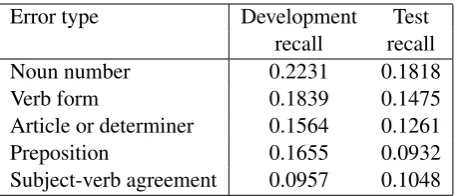
Table 3: Recall for each error type, on the devel-opment set and original test set.
weight on the language model (a relatively large
α) increases the recall of the model.
A breakdown of the recall for each error type is given in Table 3. On the development set, the best recall is obtained for noun number errors, and the worst for subject-verb agreement errors. A reason for the relatively low performance on agreement errors may be due to the constituency parse tree representation used. In a clause, the subject noun phrase and the predicate verb phrase, whose head verb must agree with the subject, are in different subtrees. This increases the difficulty in modelling the dependency between the subject and the verb.
7.2 Test set
The test set released for this shared task consists of 1381 sentences, which we split into 2247 clauses using the heuristic described above. The distribu-tion of sentence lengths is very similar to that of the training data. The number of out of vocabu-lary words is quite small at0.03%. The set does not include any URLs, and the general impression was that it is less noisy than the training data.
The system result on the test set is given in Ta-ble 2. Scores for both the original and revised test data annotations are given. We submitted plau-sible corrections suggested by our system for the gold standard revision. This contributed to a sig-nificant increase in our model score on the revised annotations. The model recall on the test set is similar to that of the development on most error types, though the preposition error recall is signifi-cantly lower and the subject-verb agreement recall is slightly higher. This may indicate that prepo-sition error correction rules in the model does not generalize well enough.
The precision of our model is significantly bet-ter on the test set than on the development set. This can be explained by differences in the character-istics of the test set. The relative occurrence of
annotated errors is much higher in the test set than in the development set: 46%of clauses have cor-rections. It has been found previously that a low frequency of errors increase the difficulty of the correction task (Dahlmeier and Ng, 2011). This is caused especially by an increase in the number of system edits suggested for sentences that should not be changed. Our oracle found that for sen-tences that should not be changed, 100% of the correct unchanged hypotheses were generated by the tree transducer, while for sentences that should be changed,50%of hypothesis sets contained the correct result. The oracle obtains a0.75F1 score. The precision of the oracle model increases sig-nificantly, from 0.65 to0.95. Varying the choice ofαcontrols the trade-off between precision and recall better on the test set than on the validation set. These results indicate that our model is more suited for data with the characteristics of the test set than for data similar to the development sets.
8 Conclusion
We presented a novel approach to grammatical er-ror correction based on tree transducers, obtaining promising results. One of the weaknesses of our model is handling insertions and deletions. The model performs too many unnecessary deletions, especially removing content words or non-article determiners. It also has difficulty in finding edits where insertions such as article insertions should be performed.
For future work, ways of constructing better rule sets for the transducer should be investigated to take more dependencies into consideration and to improve probability estimates. Techniques to improve the runtime of the decoding algorithm while minimizing the loss in accuracy caused by heuristic pruning should be considered. Alterna-tive approaches to reranking could also be investi-gated. Including additional features may increase the ability of the model to discriminate between grammatical and ungrammatical sentences.
Acknowledgement
References
Steven Bird, Ewan Klein, and Edward Loper. 2009. Natural Language Processing with Python. O’Reilly Media.
Chris Brockett, William B. Dolan, and Michael Ga-mon. 2006. Correcting ESL errors using phrasal SMT techniques. In Proceedings of ACL, pages 249–256.
Daniel Dahlmeier and Hwee Tou Ng. 2011. Grammat-ical error correction with alternating structure opti-mization. InProceedings of ACL, pages 915–923.
Daniel Dahlmeier and Hwee Tou Ng. 2012. Better evaluation for grammatical error correction. In Pro-ceedings of HTL-NAACL, pages 568–572.
Daniel Dahlmeier, Hwee Tou Ng, and Siew Mei Wu. 2013. Building a large annotated corpus of learner English: The NUS corpus of learner English. In
Proceedings of the 8th Workshop on Innovative Use of NLP for Building Educational Applications, At-lanta, Georgia, USA.
Robert Dale and Adam Kilgarriff. 2011. Helping our own: The HOO 2011 pilot shared task. In Proceed-ings of the 13th European Workshop on Natural Lan-guage Generation, pages 242–249, Nancy, France.
Robert Dale, Ilya Anisimoff, and George Narroway. 2012. HOO 2012: A report on the preposition and determiner error correction shared task. In Proceed-ings of the 7th Workshop on the Innovative Use of NLP for Building Educational Applications, pages 54–62, Montreal, Canada.
Michel Galley, Mark Hopkins, Kevin Knight, and Daniel Marcu. 2004. What’s in a translation rule? InProceedings of HLT-NAACL, pages 273–280.
Michel Galley, Jonathan Graehl, Kevin Knight, Daniel Marcu, Steve DeNeefe, Wei Wang, and Ignacio Thayer. 2006. Scalable inference and training of context-rich syntactic translation models. In Pro-ceedings of ACL, pages 961–968.
Jonathan Graehl, Kevin Knight, and Jonathan May. 2008. Training tree transducers. Computational Linguistics, 34(3):391–427.
Liang Huang and David Chiang. 2005. Better k-best parsing. InProceedings of the Ninth International Workshop on Parsing Technologies, pages 53–64.
Slava M. Katz. 1987. Estimation of probabilities from sparse data for the language model of a speech rec-ognizer. IEEE Transactions on Acoustics, Speech, and Signal Processing, 35(3):400–401.
Claudia Leacock, Martin Chodorow, Michael Gamon, and Joel R. Tetreault. 2010. Automated Grammat-ical Error Detection for Language Learners. Syn-thesis Lectures on Human Language Technologies. Morgan & Claypool Publishers.
John Lee and Stephanie Seneff. 2006. Automatic grammar correction for second-language learners. InProceedings of Interspeech, pages 1978–1981.
Jonathan May and Kevin Knight. 2006. Tiburon: A weighted tree automata toolkit. In CIAA, volume 4094 ofLecture Notes in Computer Science, pages 102–113. Springer.
Jonathan May. 2010. Weighted Tree Automata and Transducers for Syntactic Natural Language Pro-cessing. Ph.D. thesis, University of Southern Cal-ifornia.
George A. Miller. 1995. WordNet: A lexical database for English. Communications of the ACM, 38(11):39–41.
Hwee Tou Ng, Siew Mei Wu, Yuanbin Wu, Christian Hadiwinoto, and Joel Tetreault. 2013. The CoNLL-2013 shared task on grammatical error correction. InProceedings of CoNLL.
Y. Albert Park and Roger Levy. 2011. Automated whole sentence grammar correction using a noisy channel model. InProceedings of ACL, pages 934– 944.
Slav Petrov and Dan Klein. 2007. Improved inference for unlexicalized parsing. In Proceedings of HLT-NAACL, pages 404–411.
Andreas Stolcke. 2002. SRILM: An extensible lan-guage modeling toolkit. InProceedings of ICSLP, pages 901–904.