Improving Dependency Parsers using Combinatory Categorial Grammar
Bharat Ram Ambati Tejaswini Deoskar
Institute for Language, Cognition and Computation School of Informatics, University of Edinburgh
[email protected], {tdeoskar,steedman}@inf.ed.ac.uk
Mark Steedman
Abstract
Subcategorization information is a useful feature in dependency parsing. In this paper, we explore a method of incorpo-rating this information via Combinatory Categorial Grammar (CCG) categories from a supertagger. We experiment with two popular dependency parsers (Malt and MST) for two languages: English and Hindi. For both languages, CCG categories improve the overall accuracy of both parsers by around 0.3-0.5% in all experiments. For both parsers, we see larger improvements specifically on dependencies at which they are known to be weak: long distance dependencies for Malt, and verbal arguments for MST. The result is particularly interesting in the case of the fast greedy parser (Malt), since im-proving its accuracy without significantly compromising speed is relevant for large scale applications such as parsing the web.
1 Introduction
Dependency parsers can recover much of the predicate-argument structure of a sentence, while being relatively efficient to train and extremely fast at parsing. Dependency parsers have been gaining in popularity in recent times due to the availability of large dependency treebanks for several languages and parsing shared tasks (Buchholz and Marsi, 2006; Nivre et al., 2007a; Bharati et al., 2012).
Ambati et al. (2013) showed that the perfor-mance of Malt (Nivre et al., 2007b) on the free word order language, Hindi, is improved by using lexical categories from Combinatory Categorial Grammar (CCG) (Steedman, 2000). In this paper, we extend this work and show that CCG categories are useful even in the case of English, a typolog-ically different language, where parsing accuracy
of dependency parsers is already extremely high. In addition, we also demonstrate the utility of CCG categories to MST (McDonald et al., 2005)
for both languages. CCG lexical categories
contain subcategorization information regarding the dependencies of predicates, including long-distance dependencies. We show that providing this subcategorization information in the form of CCG categories can help both Malt and MST on precisely those dependencies for which they are known to have weak rates of recovery. The result is particularly interesting for Malt, the fast greedy parser, as the improvement in Malt comes without significantly compromising its speed, so that it can be practically applied in web scale parsing. Our results apply both to English, a fixed word order and morphologically simple language, and to Hindi, a free word order and morphologically rich language, indicating that CCG categories from a supertagger are an easy and robust way of introducing lexicalized subcategorization information into dependency parsers.
2 Related Work
Parsers using different grammar formalisms have different strengths and weaknesses, and prior work has shown that information from one formalism can improve the performance of a parser in another formalism. Sagae et al. (2007) achieved a 1.4% improvement in accuracy over a state-of-the-art HPSG parser by using dependen-cies from a dependency parser for constraining wide-coverage rules in the HPSG parser. Coppola and Steedman (2013) incorporated higher-order dependency features into a cube decoding phrase-structure parser and obtained significant gains on dependency recovery for both in-domain and out-of-domain test sets.
Kim et al. (2012) improved a CCG parser using dependency features. They extracted n-best parses from a CCG parser and provided dependency
Pierre Vinken will join the board as a nonexecutive director Nov. 29
N/N N (S[dcl]\NP)/(S[b]\NP) ((S[b]\NP)/PP)/NP NP/N N PP/NP NP/N N/N N ((S\NP)\(S\NP))/N N
> > > >
N NP N (S\NP)\(S\NP)
T >
NP NP
> >
(S[b]\NP)/PP PP
>
S[b]\NP
<
S[b]\NP
>
S[dcl]\NP
>
[image:2.595.109.494.62.195.2]S[dcl]
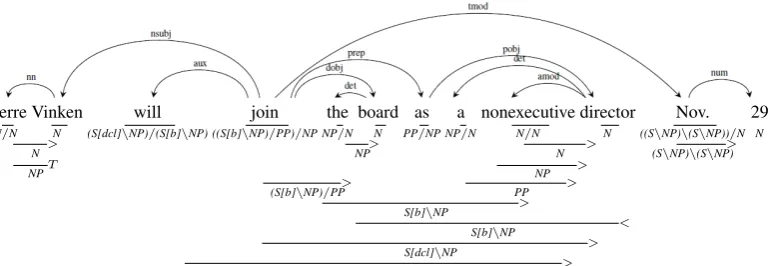
Figure 1: A CCG derivation and the Stanford scheme dependencies for an example sentence.
features from a dependency parser to a re-ranker with an improvement of 0.35% in labelled F-score of the CCGbank test set. Conversely, Ambati et al. (2013) showed that a Hindi dependency parser (Malt) could be improved by using CCG categories. Using an algorithm similar to Cakici (2005) and Uematsu et al. (2013), they first cre-ated a Hindi CCGbank from a Hindi dependency treebank and built a supertagger. They provided CCG categories from a supertagger as features to Malt and obtained overall improvements of 0.3% and 0.4% in unlabelled and labelled attachment scores respectively.
3 Data and Tools
Figure 1 shows a CCG derivation with CCG lexical categories for each word and Stanford scheme dependencies (De Marneffe et al., 2006) for an example English sentence. (Details of CCG and dependency parsing are given by Steedman (2000) and K¨ubler et al. (2009).)
3.1 Treebanks
In English dependency parsing literature, Stanford and CoNLL dependency schemes are widely popular. We used the Stanford parser’s built-in converter (with the basic projective option) to
generate Stanford dependencies and Penn2Malt1
to generate CoNLL dependencies from Penn Treebank (Marcus et al., 1993). We used standard splits, training (sections 02-21), development (section 22) and testing (section 23) for our experiments. For Hindi, we worked with the Hindi Dependency Treebank (HDT) released as part of Coling 2012 Shared Task (Bharati et al., 2012). HDT contains 12,041 training, 1,233 development and 1,828 testing sentences.
We used the English (Hockenmaier and Steed-man, 2007) and Hindi CCGbanks (Ambati et al.,
1http://w3.msi.vxu.se/ nivre/research/Penn2Malt.html
2013) for our experiments. For Hindi we used two lexicons: a fine-grained one (with morphological information) and a coarse-grained one (without morphological information).
3.2 Supertaggers
We used Clark and Curran (2004)’s supertagger for English, and Ambati et al. (2013)’s supertag-ger for Hindi. Both are Maximum Entropy based CCG supertaggers. The Clark and Curran (2004) supertagger uses different features like word, part-of-speech, and contextual and complex bi-gram features to obtain a 1-best accuracy of 91.5% on the development set. In addition to the above mentioned features, Ambati et al. (2013) em-ployed morphological features useful for Hindi. The 1-best accuracy of Hindi supertagger for fine-grained and coarse-fine-grained lexicon is 82.92% and 84.40% respectively.
3.3 Dependency Parsers
There has been a significant amount of work on parsing English and Hindi using the Malt and MST parsers in the recent past (Nivre et al., 2007a; Bharati et al., 2012). We first run these parsers with previous best settings (McDonald et al., 2005; Zhang and Nivre, 2012; Bharati et al., 2012) and treat them as our baseline. In the case of English, Malt uses arc-standard and stack-projective parsing algorithms for CoNLL and Stanford schemes respectively and LIBLIN-EAR learner (Fan et al., 2008) for both the schemes. MST uses 1st-order features, and a pro-jective parsing algorithm with 5-best MIRA train-ing for both the schemes. For Hindi, Malt uses the arc-standard parsing algorithm with a LIBLIN-EAR learner. MST uses 2nd-order features, non-projective algorithm with 5-best MIRA training.
Language Experiment UAS MaltLAS UAS MSTLAS
English
Stanford Baseline 90.32 87.87 90.36 87.18
Stanford + CCG 90.56** (2.5) 88.16** (2.5) 90.93** (5.9) 87.73** (4.3)
CoNLL Baseline 89.99 88.73 90.94 89.69
CoNLL + CCG 90.38** (4.0) 89.19** (4.1) 91.48** (5.9) 90.23** (5.3)
[image:3.595.107.489.61.178.2]Hindi BaselineFine CCG 88.6788.93** (2.2) 83.0483.23* (1.1) 90.5290.97** (4.8) 80.6780.94* (1.4) Coarse CCG 89.04** (3.3) 83.35* (1.9) 90.88** (3.8) 80.73* (0.4)
Table 1: Impact of CCG categories from a supertagger on dependency parsing. Numbers in brackets are percentage of errors reduced. McNemar’s test compared to baseline, * =p <0.05; ** =p <0.01 (Hindi Malt results (grey background) are from Ambati et al. (2013)).
(POS, chunk and morphological information) extracted using a Hindi shallow parser2.
4 CCG Categories as Features
Following Ambati et al. (2013), we used supertags which occurred at least K times in the training data, and backed off to coarse POS-tags otherwise. For English K=1, i.e., when we use CCG cate-gories for all words, gave the best results. K=15 gave the best results for Hindi due to sparsity is-sues, as the data for Hindi is small. We provided a supertag as an atomic symbol similar to a POS tag and didn’t split it into a list of argument and result categories. We explored both Stanford and CoNLL schemes for English and fine and coarse-grained CCG categories for Hindi. All feature and parser tuning was done on the development data. We assigned automatic POS-tags and supertags to the training data.
4.1 Experiments with Supertagger output We first used gold CCG categories extracted from each CCGbank as features to the Malt and MST, to get an upper bound on the utility of CCG cate-gories. As expected, gold CCG categories boosted the Unlabelled Attachment Score (UAS) and La-belled Attachment Score (LAS) by a large amount (4-7% in all the cases).
We then experimented with using automatic CCG categories from the English and Hindi su-pertaggers as a feature to Malt and MST. With au-tomatic categories from a supertagger, we got sta-tistically significant improvements (McNemar’s test,p <0.05for Hindi LAS andp <0.01for the rest) over the baseline parsers, for all cases (Table 1). Since the CCGbanks used to train the supertag-gers are automatically generated from the con-stituency or dependency treebanks used to train
2http://ltrc.iiit.ac.in/analyzer/hindi/
the dependency parsers, the improvements are indeed due to reparameterization of the model to include CCG categories and not due to additional hand annotations in the CCGbanks. This shows that the rich subcategorization information pro-vided by automatically assigned CCG categories can help Malt and MST in realistic applications.
For English, in case of Malt, we achieved 0.3% improvement in both UAS and LAS for Stanford scheme. For CoNLL scheme, these improvements were 0.4% and 0.5% in UAS and LAS respectively. For MST, we got around 0.5% improvements in all cases.
In case of Hindi, fine-grained supertags gave larger improvements for MST. We got final improvements of 0.5% and 0.3% in UAS and LAS respectively. In contrast, for Malt, Ambati et al. (2013) had shown that coarse-grained supertags gave larger improvements of 0.3% and 0.4% in UAS and LAS respectively. Due to better handling of error propagation in MST, the richer informa-tion in fine-grained categories may have surpassed the slightly lower supertagger performance, compared to coarse-grained categories.
4.2 Analysis: English
We analyze the impact of CCG categories on different labels (label-wise) and distance ranges (distance-wise) for CoNLL scheme dependencies (We observed a similar impact for the Stanford scheme dependencies as well). Figure 2a shows the F-score for three major dependency labels,
namely, ROOT (sentence root), SUBJ (subject),
OBJ(object). For Malt, providing CCG categories
gave an increment of 1.0%, 0.3% forROOT and
SUBJlabels respectively. For MST, the
improve-ments forROOT andSUBJwere 0.5% and 0.8%
87.7
92.5
88.7
92.8 93.4
92.5
88.2 93.9
93.3
88.5 89
90 91 92 93 94
95 Malt
Malt + CCG MST MST + CCG
87.7
86.5 86.5 88.2
86 87 88 89
ROOT SUBJ DOBJ
(a) Label-wise impact
98.2
78.6
80.8 98.3
79.2
81.7 98.4
80.8
84.5 98.5
81.8
85.5
78 83 88 93 98
1-5 6-10 >10
Malt Malt + CCG MST MST + CCG
(b) Distance-wise impact
[image:4.595.82.518.60.153.2]Figure 2: Label-wise and Distance-wise impact of supertag features on Malt and MST for English
Figure 2b shows the F-score of dependencies based on the distance ranges between words. The percentage of dependencies in the 1−5, 6−10 and
>10 distance ranges are 88.5%, 6.6% and 4.9% re-spectively out of the total of around 50,000 depen-dencies. For both Malt and MST, there was very slight improvement for short distance dependen-cies (1−5) but significant improvements for longer distances (6−10 and >10). For Malt, there was an improvement of 0.6% and 0.9% for distances 6−10, and >10 respectively. For MST, these improvements were 1.0% and 1.0% respectively. 4.3 Analysis: Hindi
In the case of Hindi, for MST, providing CCG categories gave an increment of 0.5%, 0.4% and
0.3% for ROOT, SUBJ and OBJ labels
respec-tively in F-score over the baseline. Ambati et al. (2013) showed that for Hindi, providing CCG categories as features improved Malt in better handling of long distance dependencies.
The percentage of dependencies in the 1−5,
6−10 and >10 distance ranges are 82.2%,
8.6% and 9.2% respectively out of the total of around 40,000 dependencies. Similar to English, there was very slight improvement for short
distance dependencies (1−5). But for longer
distances, 6−10, and >10, there was significant improvement of 1.3% and 1.3% respectively for MST. Ambati et al. (2013) reported similar improvements for Malt as well.
4.4 Discussion
Though valency is a useful feature in dependency parsing (Zhang and Nivre, 2011), Zhang and Nivre (2012) showed that providing valency information dynamically, in the form of the number of depen-dencies established in a particular state during parsing, did not help Malt. However, as we have shown above, providing this information as a static lexical feature in the form of CCG categories does help Malt. In addition to specifying the number of arguments, CCG categories also contain syntactic type and direction of those arguments. However,
providing CCG categories as features to zpar (Zhang and Nivre, 2011) didn’t have significant impact as it is already using similar information. 4.5 Impact on Web Scale Parsing
Greedy parsers such as Malt are very fast and are practically useful in large-scale applications such as parsing the web. Table 2, shows the speed of Malt, MST and zpar on parsing English test data in CoNLL scheme (including POS-tagging and supertagging time). Malt parses 310 sentences per second, compared to 35 and 11 of zpar and MST respectively. Clearly, Malt is orders of magnitude faster than MST and zpar. After using CCG categories from the supertagger, Malt parses 245 sentences per second, still much higher than other parsers. Thus we have shown a way to improve Malt without significantly compromising speed, potentially enhancing its usefulness for web scale parsing.
Parser Ave. Sents / Sec Total Time
MST 11 3m 36s
zpar 35 1m 11s
Malt 310 0m 7.7s
Malt + CCG 245 0m 10.2s
Table 2: Time taken to parse English test data.
5 Conclusion
[image:4.595.321.507.447.500.2]References
Bharat Ram Ambati, Tejaswini Deoskar, and Mark Steedman. 2013. Using CCG categories to improve
Hindi dependency parsing. In Proceedings of the
51st Annual Meeting of the Association for Compu-tational Linguistics (Volume 2: Short Papers), pages 604–609, Sofia, Bulgaria.
Akshar Bharati, Prashanth Mannem, and Dipti Misra
Sharma. 2012. Hindi Parsing Shared Task. In
Pro-ceedings of Coling Workshop on Machine Transla-tion and Parsing in Indian Languages, Kharagpur, India.
Sabine Buchholz and Erwin Marsi. 2006. CoNLL-X shared task on multilingual dependency parsing. In
Proceedings of the Tenth Conference on Computa-tional Natural Language Learning, pages 149–164, New York City, New York.
Ruken Cakici. 2005. Automatic induction of a CCG
grammar for Turkish. In Proceedings of the ACL
Student Research Workshop, pages 73–78, Ann Ar-bor, Michigan.
Stephen Clark and James R. Curran. 2004. The impor-tance of supertagging for wide-coverage CCG
pars-ing. InProceedings of COLING-04, pages 282–288.
Michael Collins. 2002. Discriminative training meth-ods for hidden markov models: theory and
experi-ments with perceptron algorithms. InProceedings
of the conference on Empirical methods in natural language processing, EMNLP ’02, pages 1–8. Greg Coppola and Mark Steedman. 2013. The effect
of higher-order dependency features in discrimina-tive phrase-structure parsing. InProceedings of the 51st Annual Meeting of the Association for Compu-tational Linguistics (Volume 2: Short Papers), pages 610–616, Sofia, Bulgaria.
Marie Catherine De Marneffe, Bill Maccartney, and Christopher D. Manning. 2006. Generating typed dependency parses from phrase structure parses. In
In LREC 2006.
Rong-En Fan, Kai-Wei Chang, Cho-Jui Hsieh, Xiang-Rui Wang, and Chih-Jen Lin. 2008. Liblinear: A li-brary for large linear classification. J. Mach. Learn. Res., 9:1871–1874, June.
Julia Hockenmaier and Mark Steedman. 2007. CCG-bank: A Corpus of CCG Derivations and Depen-dency Structures Extracted from the Penn Treebank.
Computational Linguistics, 33(3):355–396.
Sunghwan Mac Kim, Dominick Ng, Mark Johnson, and James Curran. 2012. Improving combina-tory categorial grammar parse reranking with
depen-dency grammar features. In Proceedings of
COL-ING 2012, pages 1441–1458, Mumbai, India. Sandra K¨ubler, Ryan McDonald, and Joakim Nivre.
2009. Dependency Parsing. Synthesis Lectures on
Human Language Technologies. Morgan & Clay-pool Publishers.
Mitchell P. Marcus, Beatrice Santorini, and Mary Ann Marcinkiewicz. 1993. Building a large annotated
corpus of English: The Penn Treebank.
Computa-tional Linguistics, 19(2):313–330.
Ryan McDonald, Koby Crammer, and Fernando Pereira. 2005. Online large-margin training of
de-pendency parsers. In Proceedings of the 43rd
An-nual Meeting on Association for Computational Lin-guistics, pages 91–98, Ann Arbor, Michigan. Joakim Nivre, Johan Hall, Sandra K¨ubler, Ryan
Mc-Donald, Jens Nilsson, Sebastian Riedel, and Deniz Yuret. 2007a. The CoNLL 2007 shared task on
dependency parsing. InProceedings of the CoNLL
Shared Task Session of EMNLP-CoNLL 2007, pages 915–932, Prague, Czech Republic.
Joakim Nivre, Johan Hall, Jens Nilsson, Atanas Chanev, G¨ulsen Eryigit, Sandra K¨ubler, Svetoslav Marinov, and Erwin Marsi. 2007b. Maltparser: A language-independent system for data-driven
de-pendency parsing. Natural Language Engineering,
13(2):95–135.
Kenji Sagae, Yusuke Miyao, and Jun’ichi Tsujii. 2007. HPSG parsing with shallow dependency constraints. InProceedings of the 45th Annual Meeting of the As-sociation of Computational Linguistics, pages 624– 631, Prague, Czech Republic.
Mark Steedman. 2000. The Syntactic Process. MIT
Press, Cambridge, MA, USA.
Sumire Uematsu, Takuya Matsuzaki, Hiroki Hanaoka, Yusuke Miyao, and Hideki Mima. 2013. Inte-grating multiple dependency corpora for inducing
wide-coverage Japanese CCG resources. In
Pro-ceedings of the 51st Annual Meeting of the Associa-tion for ComputaAssocia-tional Linguistics (Volume 1: Long Papers), pages 1042–1051, Sofia, Bulgaria.
Yue Zhang and Joakim Nivre. 2011. Transition-based dependency parsing with rich non-local features. In
Proceedings of the 49th Annual Meeting of the Asso-ciation for Computational Linguistics: Human Lan-guage Technologies, pages 188–193, Portland, Ore-gon, USA.
Yue Zhang and Joakim Nivre. 2012. Analyzing the effect of global learning and beam-search on
transition-based dependency parsing. In