J. Exp. Biol. (1968), 49, 107-116 With 6 text-figures
Printed in Great Britain
EFFECTS OF EYESTALK REMOVAL ON RHYTHMIC
LOCOMOTOR ACTIVITY IN CARCINUS
BY E. NAYLOR AND BARBARA G. WILLIAMS Department of Zoology, University College of Swansea
{Received 14 February 1968)
INTRODUCTION
In decapod Crustacea the focus of attention for studies on the control of rhythmicity has centred upon the neuro-endocrine system of the eyestalk. Kalmus (1938), Roberts (1941), Schallek (1942), Edwards (1950), Valente & Edwards (1955) and Powell (1965) have all recorded the disappearance of rhythmic locomotor activity after eyestalk ablation in various decapods. Bliss (1962) was also unable to detect the normal rhythm in several Gecarcinus after eyestalk ablation; in one case she found that a circadian rhythm persisted, but with ajdramatically changed periodicity. On the basis of this last observation Bliss (1962) and Roberts (1965) have suggested that reported losses of rhythmicity may, in fact, be illusory, unless adequate methods are employed to detect possible changes in frequency.
Another consideration to be borne in mind in eyestalk-ablation experiments, relates to the necessity of distinguishing between the effects of post-operative shock and effects upon a possible rhythmic control mechanism or mediator. This is perhaps particularly relevant in view of conflicting reports relating to the level of activity of decapods from which eyestalks have been removed. Whereas eyestalk-ablated Cambarus were shown to exhibit increased activity (Roberts, 1941; Schallek, 1942), total activity is reported to be decreased in ablated Potamobius and Cambarus (Kalmus, 1938),
Trichodactylus (Valente & Edwards, 1955), Uca (Edwards, 1950) and Cardnus (Powell,
1965). The present paper attempts to reconcile these conflicting reports by studying
Cardnus maenas L. at various times following eyestalk removal and after other
experi-mental procedures. An important treatment adopted relates to the observation that arrhythmic, but otherwise normal Cardnus, can be induced to show a rhythm by chilling (Naylor, 1963). Present work uses this observation as a test of the ability of crabs to show rhythmicity after they have been given time to recover from surgical operations. The procedure of frequency analysis is used to test for rhythmicity in the results.
MATERIALS AND METHODS
rhyth-micity can be re-initiated in aquarium crabs, the first peak occurring at the time of return to normal temperatures and subsequent peaks at approximately 12-4 hr. in-tervals thereafter (Naylor, 1963). Surgically operated crabs were tested by this pro-cedure after being given various periods of recovery.
Usually for removal of eyestalks the crabs were first anaesthetized for 5-10 min. in iced sea water and one eyestalk was removed with a sharp, fine-tipped scalpel. Crabs were then left in running sea water for 2 days before the second eyestalk was removed in a similar manner. The wounds were not cauterized but bleeding was not excessive in crabs anaesthetized in iced water, and specimens were left to recover for a further 6 days in running sea water before being used in the experiments. Retinae were removed with fine scissors after anaesthetizing the animal in iced sea water and again keeping the crab in running sea water for a subsequent recovery period of 6 days.
In eyestalk-chilling experiments the animals were immobilized between Perspex plates bound by rubber bands and suspended in a tank of fast running sea water in a vertical position. The eyestalks of the crab were arranged to project above the surface of the water, and pieces of narrow-gauge rubber tubing were fitted over the eyestalks and attached but not sealed to the orbits. Iced sea water at a temperature of i° C. was then dripped down the tubes for a period of 10-11 hr., at the end of which time the crabs were transferred to actographs at 150 C. Control animals for these experiments were clamped between Perspex plates and kept in running sea water for 10-11 hr., but were not chilled.
Extracts of eyestalks used for injection experiments were prepared with freshly removed eyes homogenized in a little boiled sea water and centrifuged. The super-natant fluid was diluted to a concentration equivalent to two eyestalks per 0-25 c.c. of solution. Experimental animals were injected through the membrane at the base of the last peraeopod with 0-25 c.c. of eyestalk extract, while controls received similar quanti-ties of muscle extract or boiled sea water.
Activity was recorded in continuous dim red light using tilting-box actographs (Naylor, 1958), most crabs being kept in moist air at 150 C. The procedure of frequency analysis, used to confirm the presence or absence of rhythmicity in the data, is described elsewhere (Williams & Naylor, 1967). In the periodograms so obtained, marked ex-cursions from the general trend of values for the coefficient of variability are indicative of rhythmicity of that frequency in the original data.
RESULTS
Eyestalk removal
Effects of eyestalk removal on rhythmic locomotor activity in Carcinus 109
0 10
H.T (a) Normal crabs i
HOUT8
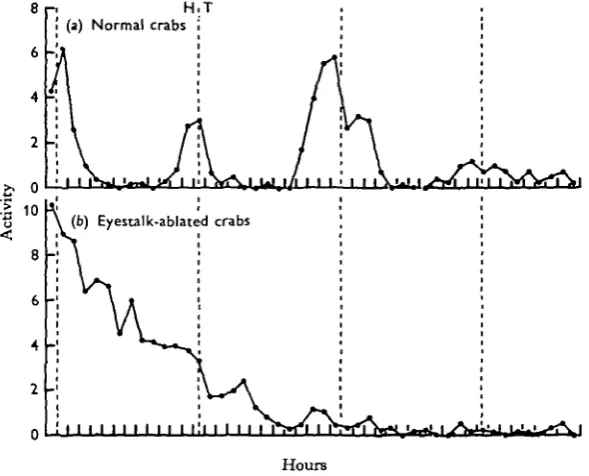
Fig. 1. Average hourly activity in constant conditions of (d) four freshly collected crabs and
(b) twenty crabs from which both eyestalks were removed immediately after collection.
[image:3.451.79.374.81.319.2](Vertical dotted lines indicate times of high tide.)
Table 1. Average hourly activity of eyestalkless (E~) and normal (E+) crabs on days 6, 9, 12 and 15 after the second eyestalk was removed from the experimental animals
Hourly activity values
Day 6 Day 9 Day 12 Day 15 Day 6 Day 9 Day 12 Day is E+ E" E+ E-E+ E" E+ E" E+ E~ E+ E" E+ E~ E+ E~ Numher
^ ^ U1UUV1
of crabs 9 IO 9 1 2 9 1 2 9 IO 1 2 1 2 IO 13 9 13 I I IO Mean o-8 4 8 o-8 3 ° o-8 3 3 o-7 3 o
i - 8 i - o 1 9 i'S
I - I
I -4 0 9 1-4 Standard deviation Summer OSS 3-28 0'4S 2*51
0 6 3 a-39 o-SS 3-O2 Range crabs O-2-22 0-0-7-4 0-3-1-7 0-0-9-0 O-O-2-O O-O-7-O O-1-2-0 0-1-6-3 Winter crabs
i i S
1-37 1-07
1 2 7
•71
1-08
•26 1 0 3
O3-44 0-0-3-9 0-7-3-8 0-0-4-4 0-2-2-7 0-2-3-2 0-6-1-4 0-4-3-7
Variances Comparison of mean
#= P < 0001 •
=# o-oi < P < o-oa*
=1= o-ooa < P < o-oi*
=# O-OO2 < P < OOI*
= P > 01
= P > 01
= P > 01
=t= P > 01
[image:3.451.46.410.404.631.2]in summer a highly significant increase in activity was evident in ablated crabs (Table i).
Carcinus is normally arrhythmic in winter and exhibits overt locomotor rhythmicity
only during the summer months.
•a
3. 0
4
10 20 30 40 50 60 70 Time from end of chilling (hr.)
80 90 100
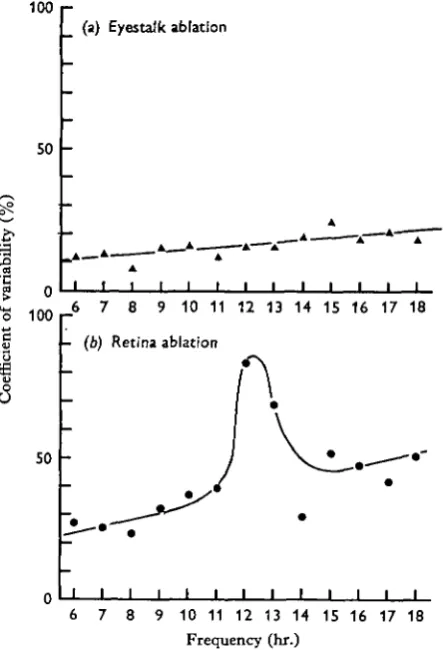
Fig. 2. Average hourly activity after chilling at 40 C. for 12 hr. of (a) twenty crabs from which eyestalks were removed and (6) five crabs from which retinae were removed. (Vertical dotted lines at i2-4 hr. intervals from end of chilling period.)
Effects of eyestalk removal on rhythmic locomotor activity in Carcinus 111
Injection experiments
In summer, eyestalkless crabs were injected with extract of eyestalks removed from donor crabs during the quiescent stage of their activity rhythm. Average hourly activity values fell gradually during the period of 12 hr. after injection, both in experi-mental animals and in controls, but crabs injected with eyestalk extract were generally less active than controls injected with muscle extract (Fig. 4a) or boiled sea water (Fig. 46). The fluctuation of mean hourly activity values of the controls of Fig. 4a probably relates to the smaller number of crabs used in those experiments (eight controls), compared with the sixteen controls in Fig. 4b. Using a method of paired comparisons of means, the differences between experimental animals and controls are significant at the 1 % level in Fig. 4a and at the o-i % level in Fig. 4b.
100
50
ID
o c
u •3 SE
0 100
(a) Eyestalk ablation
50
6 7 8 9 10 11 12 13 14 15 16 17 18
- (b) Retina ablation
A
1 I I
6 7 8 9 10 11 12 13 14
Frequency (hr.)
[image:5.451.117.339.232.557.2]15 16 17 18
Fig. 3. Periodogram analyses of data in Fig. 2, scanning for possible rhythms of 6-18 hr. frequency.
Eyestalk chilling
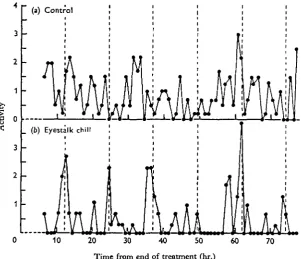
induced, approximately tidal, rhythmicity (Fig. 6b) being phased from the end of the chilling period. Control animals immobilized in a similar manner to the experimental animals, but not chilled, showed no rhythm (Figs. 5 a, 6a).
a <
3
2
1
0 \
i i
A
/\
/ \
/ \
V
• • • . .
-1—£••
A-•
•
A
/ \
A
••••••
t
\
Muscle extract
Eyestalk extract
A
3
—A Sea water
•-• Eyestalk extract
Hours
Fig. 4. Average hourly activity of eyestalkless crabs after injection of various extracts: (a) eight crabs injected with eye«talk extract and eight controls with muscle extract, (6) fourteen crabs injected with eyestalk extract and sixteen controls with boiled sea water.
DISCUSSION
Effects of eyestalk removal on rhythmic locomotor activity in Carcinus 113
cannot be induced in recuperated animals by chilling. All workers agree, therefore that normal rhythmicity is altered or lost following eyestalk ablation, which suggests that the eyestalk hormonal mechanism is at least a mediator, if not an autonomous clock, involved in the control of normal rhythmic locomotor activity. [image:7.451.80.382.129.388.2]Time from end of treatment (hr.)
Fig. 5. Average hourly activity of (b) three crabs subjected to chilling of the eyestalks and (a) three controls clamped in the same manner as experimental animals but not chilled (symbols as in Fig. 2).
In Gecarcinus (Bliss, 1962) eyestalk removal not only affects the locomotor rhythm but also precipitates moulting. The activity pattern of eyestalkless crabs is similar to that of unoperated crabs in premoult, all of which show a disturbance of their normal circadian rhythmicity. These findings have been used to suggest that activity changes following eyestalk removal are directly related to the loss of the neuroendocrine system which inhibits moulting (Bliss, 1962; Gabe, 1966). In contrast, Carcinus in present experiments showed no indication of precipitate moulting as a result of eyestalk ablation. This is supported by other work, for whereas eyestalk ablation induced moulting in juvenile Carcinus (Passano & Jyssum, 1963) and in old specimens in terminal anecdysis (Carlisle, 1957), the same operation did not induce moulting in crabs of intermediate age such as were used in present experiments (Carlisle, 1954). Moreover, unlike Gecarcinus, normal Carcinus which moult in acktographs maintain their tidal rhythmicity during proecdysis. They show increased total activity only during the 24 hr. or so immediately before the moult, and tidal rhythmicity is evident up to the time of ecdysis. This evidence precludes for Carcinus the close relationship between moulting and rhythmic locomotor activity which Bliss suggested for Gecarcinus.
Apart from differences relating to the possible initiation of moulting by eyestalk extirpation conflicting reports of the level of activity in eyestalkless decapods may also relate to differences in the lapse of time between ablation and activity recording. Thus the observations by Powell (1965) that activity was low in eyestalkless Cardnus would be explained if, as seems likely (Bliss, 1962, in discussion), only a short recovery period was given. Similarly, the reduced activity of eyestalkless Trichodactylus may be related to the fact that the animals were placed in actographs only ' several hours' after
100
50
I
_ (a) Control
100
I
50
6 7 8 9 10 11 12 13 14 15 16 17 18
- (b) Eyestalk chill
6 7 8 9 10 11 12 13 14 15 16 17 18
Frequency (hr.)
Fig. 6. Periodogram analyses of data in Fig. 5, scanning for possible rhythms of 6-18 hr. frequency.
Effects of eyestalk removal on rhythmic locomotor activity in Carcinus 115
source of rhythmic inhibition of locomotion. This suggestion is complemented by the results of experiments involving the injection of eyestalk extract, which inhibits loco-motor activity in recuperated, eyestalkless Cambarus (Roberts, 1941) and Carcinus (p. i n ) . The injection experiments are consistent with the view that the inhibitory principle is a blood-borne hormone. In addition, preliminary experiments suggest that eyestalk extract from active donors is less effective in suppressing activity in recipients than extract from quiescent donors (Williams, 1966), but difficulties arise in the interpretation of such experiments, since an inhibitory factor may be stored in the eyestalks of active animals without being released into the blood.
Such a mechanism may perhaps be compared with mediation of the locomotor rhythm in Periplaneta americana by the suboesophageal ganglion (Harker, 1955, 1956, i960; Roberts, 1965, 1966; Brady, 1967). Harker's (i960) view that the oesophageat ganglion functions as an endogenous hormonal clock in the cockroach has recently been questioned by Roberts (1965, 1966) and Brady (1967). The last author suggests that the neuro-endocrine rhythms of the nerve-cord ganglia are rather ephemeral and are perhaps controlled by an electrical pacemaker in the brain. In Carcinus the apparently rhythmic production of an inhibitory hormone by the neurosecretory cells of the eyestalk has not definitely been shown to be an autonomous process. The only evidence of there being a self-timed clock within the eyestalk comes from the observations thai rhythmicity is rephased by chilling the eyestalks, while the remainder of the crab is kept at room temperature. It should not be overlooked, however, that information concerning the chilling period may be passed from the eyestalk to a rhythmic centre elsewhere in the body, which in turn controls hormone production in the eyestalk. Evidence for nervous involvement in the control of rhythmicity in the crayfish
Cambarus is given by Schallek (1942), who found that the promotion of activity by
eyestalk removal could be duplicated by section of the optic nerves. It should be noted, however, that Schallek (1942) favoured a nervous mechanism as an alternative to endocrine factors, rather than as an additional mechanism involved in the control of rhythmicity.
Whether the eyestalk hormonal mechanism in Carcinus is self-timing or not, it is in all probability only part of a complex clock system. Previous work on temperature relationships of the rhythm (Naylor, 1963) has suggested that at least two mechanisms control locomotor rhythmicity in the crab. One of these, postulated on the basis of the short-term effects of temperature change upon the Carcinus rhythm, may equate with the eyestalk inhibitory mechanism discussed here. Thus a fall in temperature, which induces a transient advance and enhancement of the next peak of activity (Naylor, 1963), may do so by temporary inhibition of production or release of the eyestalk inhibitory hormone. Conversely, a rise in temperature, which delays and reduces the next activity peak, may temporarily enhance the production or release of the inhibitory hormone. The more deep-seated mechanism which maintains the rhythm despite the transient changes (Naylor, 1963) could be a nervous mechanism which in the light of present results, is expressed via the hormonal mechanism of the eyestalk. Bliss's single result of a crab showing rhythmicity after eyestalk ablation could be explained if in that animal some deep-seated clock expressed its rhythmicity via another neurohaemal centre outside the eyestalk, more or less along the lines of her own alternative explana-tion of the Gecarcinus results (Bliss, 1962).
SUMMARY
1. Male Car emus collected in summer and given several days to recover from eye-stalk ablation showed a continuously high level of activity. Injection of eyeeye-stalk extract inhibited activity. Unlike control animals from which retinae were removed, experi-mental animals did not show a rhythm after chilling. Chilling the eyestalks alone elicited a rhythm similar to that appearing when the whole animal was chilled.
2. The results are consistent with the view that locomotor rhythmicity is mediated via an inhibitory hormonal mechanism in the neurosecretory cell groups of the eye-stalk. There is no direct evidence that the neuroendocrine mechanism alone constitutes an autonomous clock, however, and it is in any case probably co-ordinated by one or more other rhythmic systems within the crab.
We are grateful to the Science Research Council which supported one of us (B. G.W.) in this work, and to Professor E. W. Knight-Jones for the provision of laboratory facilities.
REFERENCES
BLISS, D. E. (1962). Neuroendocrine control of locomotor activity in the land crab Geearcimu lateralis. In Mem. Soc. Endocrinol. No. 12, Neurosecretion, pp. 391-408. Ed. H. Heller and R. B. Clark. New York: Acad. Press.
BRADY, J. (1967). Control of the circadian rhythm of activity in the cockroach. II. The role of the sub-oesophageal ganglion and ventral nerve cord. J. exp. Biol. 47, 165-78.
CARLISLE, D. B. (1954). On the hormonal inhibition of moulting in decapod Crustacea. J. mar. biol. Ats.
U.K. 33, 61-3.
CARLISLE, D. B. (1957). On the hormonal inhibition of moulting in Decapod Crustacea. II. The terminal anecdysis in crabs. J. mar. biol. Ass. UJC. 36, 291—307.
EDWARDS, G. A. (1950). The influence of eyestalk removal on the metabolism of the fiddler crab.
Pkysiologia comp. Oecol. a, 34-50.
GABE, M. (1966). Neurosecretion, 872 pp. Oxford: Pergamon Press.
HARKER, J. E. (1955). Control of diurnal rhythms of activity in Periplaneta americana L. Nature, Lond. 175.
773-HARKER, J. E. (1956). Factors controlling the diurnal rhythm of activity of Periplaneta americana L.
J. exp. Biol. 33, 224-34.
HARKER, J. E. (i960). Endocrine and nervous factors in insect circadian rhythms. Cold Spring Harb.
Symp. quant. Biol. as, 279-087.
KALMUS, H. (1938). Das Aktogram des Flusskrebses. Z. Vergl. Phytiol. 35, 798-802.
NAYLOR, E. (1958). Tidal and diurnal rhythms of locomotory activity in Carcimu maenas L. J. exp. Biol.
35, 602-10.
NAYLOR, E. (1963). Temperature relationships of the locomotor rhythm of Carcimu. J. exp. Biol. 40, 669-79.
PASSANO, L. M. & JYSSUM, S. (1963). The role of the Y-organ in crab proecdysis and limb regeneration.
Comp. Biochem. Phytiol. 9, 195-213.
POWELL, B. L. (1965). The hormonal control of the tidal rhythm of locomotory activity in Carcimu
maenas. Gen. Comp. Endocrin. 5, 705.
ROBERTS, S. K. DE F. (1965). Photoreception and entrainment of cockroach activity rhythms. Science,
N. Y. 148,
958-9-ROBERTS, S. K. DE F. (1966). Circadian activity rhythms in cockroaches. III. The role of endocrine and neural factors. J. cell. Physiol. 67, 473-86.
ROBERTS, T. W. (1941). Evidences that hormonal inhibition of locomotion occurs for the crayfish,
Cambarus virilis Hagen. Anat. Rec. Suppl. 8, 46—7.
SCHALLEK, W. (1942). Some mechanisms controlling locomotor activity in the crayfish. J. exp. Zool. 91, 155-66.
VALENTE, D. & EDWARDS, G. A. (1955). The regulation of the activity rhythm of the crab Trichodactylus
petropolitamu. Fax. Filos Cien. Let., Univ. Sao Paulo Vfj, 5—12.
WILLIAMS, BARBARA G. (1966). Studies on the development and control of rhythmic activity of Carcimu
maenas (L.). Ph.D. Thesis: University College of Swansea, Wales.