2009 .
We recommend you cite the published version.
The publisher’s URL ishttp://eprints.uwe.ac.uk/16062/ Refereed: Yes
(no note)
Disclaimer
UWE has obtained warranties from all depositors as to their title in the material deposited and as to their right to deposit such material.
UWE makes no representation or warranties of commercial utility, title, or fit-ness for a particular purpose or any other warranty, express or implied in respect of any material deposited.
Jetendr Shamdasani, Tam´as Hauer, Peter Bloodsworth, Andrew Branson, Mohammed Odeh, and Richard McClatchey
CCCS Research Centre, CEMS Faculty, University of the West of England, Coldharbour Lane, Frenchay, Bristol BS16 1QY, UK
Abstract. Traditional ontology alignment techniques enable equivalence relationships to be established between concepts in two ontologies with some confidence value. With semantic matching, however, it is possible to identify not only equivalence (≡) relationships between concepts, but less general () and more general relationships (). This is beneficial since more expressive relationships can be discovered between ontologies thus helping us to resolve heterogeneity between differing semantic representa-tions at a finer level of granularity. This work concerns the application of semantic matching to the medical domain. We have extended the SMatch algorithm to function in the medical domain with the use of the UMLS metathesaurus as the background resource, hence removing its previous reliance on WordNet, which does not cover the medical domain in a sat-isfactory manner. We describe the steps required to extend the SMatch algorithm to the medical domain for use with UMLS. We test the accu-racy of our approach on subsets of the FMA1and MeSH2ontologies, with both precision and recall showing the accuracy and coverage of different versions of our algorithm on each dataset.
1
Introduction
Semantic Matching [1] is the process of discovering set theoretic based rela-tionships between differing concepts within two or more ontologies. It is richer than identifying equivalent concept pairs since finer relationships between con-cepts may be discovered, in particularless general () andmore general (). The framework is well understood, yet to our knowledge it has not yet been exploited in medical applications. Ontologies are commonly used in the medi-cal domain for creating widely agreed terminologies, taxonomies, for annotating medical data from publications to patient records and in reformulating clini-cians’ queries. The value of ontology matching lies in the fact that there are numerous, largely independent terminologies, taxonomies and ontologies cover-ing the various subdomains of medicine. In order for interoperability between these semantic models to be achieved they need to be matched. Alignment takes
Corresponding author.
1http://sig.biostr.washington.edu/projects/fm/AboutFM.html 2http://www.nlm.nih.gov/mesh/
L. Aroyo et al. (Eds.): ESWC 2009, LNCS 5554, pp. 203–217, 2009. c
this a step further and allows us to describe the overlap between subdomains. As an example if we consider the case of two clinicians trying to gain access to a clinical system, each clinician has their own ontology of a subset of a domain and the clinical system has a more general view of the clinical world. For these clini-cians to be able to access and share data they need to speak the same language. An alignment between these varying models is beneficial since it facilitates the sharing of information.
In this paper we present a semantic matching framework for use in the medical domain. The current work is an extension of the SMatch approach [2] and has been motivated by the requirements of the E.C. funded Health-e-Child project3. The SMatch framework is based on two cornerstones: firstly, it uses a predicate logic framework to unify node-wise string matching with structural matching (thus exploiting their interplay.) and secondly, it uses a background thesaurus as an anchor for tokenization, sense filtering and knowledge seeding. The direct application of the algorithm to medical ontologies is somewhat weak because of its reliance on the WordNet thesaurus [3]; this was shown in our previous work [4]. Previously we only used the UMLS Concept hierarchy for disambiguation. In this work we present results using different features of the UMLS for hierarchical disambiguation with our structural filtering implementation which differs from the original SMatch approach. We have formalised the original steps for semantic matching and created a framework built entirely on the logic behind the original algorithm.
We have chosen the UMLS metathesaurus [5] as our background resource be-cause of its wide coverage of clinical terms and its disambiguation of these terms. We have built a prototype matcher that has been evaluated on test ontologies with some initial results. We have formalised the steps to derive a semantic match between medical ontologies; these are shown with a worked example. Section 2 presents previous work conducted in the area of semantic matching and ontology alignment. Section 3 provides a brief introduction to the UMLS. Section 4 ex-plains the idea behind semantic matching. Section 5 describes the modifications to the original SMatch algorithm for use with the UMLS. Section 6 presents our evaluation methodology for our algorithm. Section 7 presents the results with different versions of our algorithm. Finally, conclusions and directions for further work are presented in section 8.
2
Previous Work
Previous work within the area of ontology alignment has mostly focused on discovering equivalence relationships between different concepts and roles in an ontology. Their output is normally in the form of an equivalence relationship with a confidence value between concepts within the range 0 to 1. There are many different approaches within the literature which rely on different features of an ontology (its schema, instances etc..). A diverse number of approaches have been attempted in the ontology alignment field [1] and significant progress has been
made. Much of this progress has been in the form of using differing background knowledge sources. Background knowledge has been used in the form of free text [6], previous alignments [7], search engines [8] and other ontologies. In our caseSemantic Matching uses other ontologies as background resources. There have been approaches using single or multiple resources. A standard semantic matching approach is composed of an anchoring step, deriving semantics by using background knowledge and a set of reasoning rules. Semantic matching differs from other approaches because the goal is not to look for equivalence but rather to discover other relationships.
Aleskovsi et al [9] use a single background resource to match two flat lists of medical terms using a single background ontology. Their process consists of an anchoring step where they firstly tokenize the string to be matched and then “anchor” these to concepts in the background ontology. This is done for all strings in both lists. Once this has been completed they are able to derive a semantic match between two terms using the background resource. They use a set of predefined reasoning rules to achieve this, for example, using transitive reasoning. They have shown the application of these rules in their follow-up work [10] where they matched the anatomy parts of the CRISP to MeSH and used the FMA as a background resource.
Sabou et al [11] have extended the approach by Alekovsi et al. to use multiple background ontologies using the Swoogle ontology search engine. They firstly search for the concepts they are going to match then search for ontologies which contain both of these terms. If a suitable resource cannot be found, then separate ontologies are searched for and are then matched against each other, this process is repeated until a match is found. They semi-formalise the steps involved in their framework. Their search approach has been improved in a later work [12] by using the senses available from WordNet, therefore allowing a better ontology selection process for their background knowledge. SMatch is another semantic matching approach. Instead of defining inference rules, Giunchiglia et al. cast the ontology alignment problem as a propositional satisfiability problem. Here labels of nodes in trees are tokenized and the lexical structure in addition to the tree structure are represented by logical formulae built from WordNet senses that are associated with the tokens. These formulae are fed into a standard SAT solver to check the validity of the matches based on predefined reasoning rules. One strength of this approach is that there does not necessarily have to be a complete lexical overlap between the ontologies to be matched and WordNet. SMatch and its modification to use the UMLS is explained further in section 5 with a worked example.
3
The UMLS
biomedical domain. A concept in the UMLS is identified by a CUI (Concept Unique Identifier) which is a unique value identifying a Concept. Every Concept has a set of Terms (or Lexical Groupings) identified by an LUI (Lexical Unique Identifier) and a set of Strings identified by a SUI (String Unique Identifier). Ev-ery concept has an Atom identified by an AUI (Atomic Unique Identifier) which are the original definitions of a concept from its source vocabulary. Figure 1 shows how these relate to each other via a UML diagram.
Fig. 1.A UML based representation of the UMLS
Every Concept in the UMLS is related to another concept in the UMLS hi-erarchy via Broader Than (RB), Narrower Than (RN), Parent (PAR), Child (CHD) and Sibling (SIB) relationships, this information being contained within the MRREL table of the UMLS. As well as relationships between concepts the UMLS also contains hierarchical information between Atoms in their original source vocabularies. Atoms are related to one another in simple taxonomic hier-archies with varying semantics for example “isa” or “part of”, this information is contained within the MRHIER table. Also for disambiguation purposes there is the MRCOC table which contains co-occurrences relationships between UMLS Concepts in text. Section 5 describes how the UMLS can be applied to semantic matching. The next section explains the idea behind semantic matching.
4
Semantic Matching Explained
Semantic Matching is the process of discovering≡,,relationships between concepts in two ontologies. We have chosen to use the propositional reasoning based approach of the SMatch algorithm. This section will explain what semantic matching is. At the highest level, the SMatch algorithm assigns a logical formula to each node of a tree, such that the meaning of the node that is inferred from both the lexical and the tree structures which are encoded by the predicate calculus. These formulae are in turn input into reasoning rules to derive a match.
Examination
(a)
Kidney Examination
(b)
Fig. 2. String Matching Example
[image:5.595.218.379.573.604.2]due to its logic based representation of strings which are converted into atomic formulae. The atomic formula for the node “Examination” would be the name of the node i.e.examinationand the atomic formula for the node “Kidney Exami-nation” would be the name of the node as well, however the white space character is converted to which means the meaning of the concept is the conjunction of the concepts of “Kidney”and “Examination” i.e.kidneyexamination. The shaded region in figure 3(a) shows the meaning of this concept and figure 3(b) shows the match result.
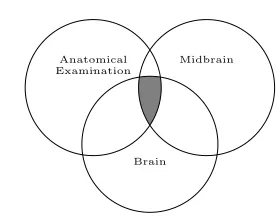
Figure 4 shows an example of matching two trees taking their structures into account, Tree 1 (on the left) has no structure with only one node with the label “Examination” whereas Tree 2 does have structure. If we were match-ing the nodes “Examination” and “Midbrain” the correct result would be that “Examination” “Midbrain” due to the fact that the meaning of the node “Midbrain” is influenced by its parent nodes. To achieve this SMatch takes two factors into account, firstly from our background knowledge we know that “Ex-amination” is equivalent to “Anatomical Ex“Ex-amination”; this is the background theory that is implicit and is used in the reasoning process. Also the node with structure (“Midbrain”) is given acontext, the manner in which this is achieved is that the logical formula of “Midbrain” is altered to take into account its re-lationship with its parents. This constraint is applied by an intersection with its logical formula to its path to the root, the new formula for this node is midbrainbrainanatomical examination. The shaded area in figure 5 shows the meaning of this concept visually.
Examination Kidney
(a)
Examination
Kidney Examination
[image:6.595.187.409.439.538.2](b)
Fig. 3.Venn diagrams showing the meaning of the concept “Kidney Examination” (a) and the result of the matching process (b)
Examination1
(a) Tree 1
AnatomicalExamination2
Brain2
M idbrain2
(b) Tree 2
[image:6.595.206.391.594.669.2]Midbrain Anatomical
Examination
[image:7.595.222.361.137.245.2]Brain
Fig. 5.The meaning of the concept Midbrain after constraining its mean via its rela-tionship to its parents
5
The Modified SMatch Algorithm
Our modified algorithm takes two trees as input and as an output it produces a matrix of relationships between them. Figure 6 shows our input trees for this pur-pose. The algorithm works on the same 4-step premise as the original algorithm. At the highest level in the first step the label of a node in a tree is converted into a logical formula using specific rules with some filtering performed and concepts being attached via a background resource. Step 2 consists of creating a node formula and applying context in the form of filtering out irrelevant concepts. The third step involves the matching of atomic formulae using a background resource and the fourth and final step is the reasoning process. These will now be discussed in full.
(a) Tree 1 (b) Tree 2
Fig. 6.The two input trees for our matching process
5.1 Step 1 – String to Formula Conversion
[image:7.595.126.465.455.613.2]node with the label “HeartAndKidneyDiseases” from Tree 1; its tokens would be{heart, and, kidney, disease}. Once this has been completed tokens are con-verted toatomic formulae and a look up in the UMLS is performed to attach Concepts to these. Words which denote preposition, conjunctions etc. . . are ig-nored i.e. are not annotated with concepts from the UMLS, however they are kept for logical formula conversion. For example if we query the UMLS for the termheart we find that heart has a total of 5 concepts from the UMLS. Hence the formula ofhearthas a total of 5 concepts attached to it. The notation for this isheart{cui#5}. For the node “HeartAndKidneyDiseases” we would have three atomic formulae for this node which would beheart{cui#5},kidney{cui#1}and disease{cui#5}. As a final step these atomic formulae are joined with boolean connectives (,and¬). The rules for this are that tokens denoting disjunction (e.g. or) are converted to logical disjunction, tokens denoting conjunctive terms (e.g. for) are converted to logical conjunction and terms denoting negation (e.g. not) are converted to negation. Hence the final formula for the node “HeartAnd-KidneyDiseases” would be ((heartrenal)disease). Notice how the term “and”, despite being a connective word in the English language has been con-verted to disjunction, this captures the meaning of the concept. A change to this step is that before the tokenization step we check to see if a concept exists “as is” within the UMLS i.e. there is an existing match in the background resource for the entire label. For example of we consider the node labelled “MyocardialIn-farction” from Tree 2, its atomic formula would bemyocardial inf arctionwith its corresponding Concepts attached from the UMLS. This would be the single atomic formula for the node.
5.2 Step 2 – Context Creation and Filtering
The purpose of this step is to capture themeaning of a concept according to its relationships with its parents. The manner in which this is achieved is that the conjunction of the current node to its parent is taken, since in essence the meaning of this node is the intersection with all of its parents. For example for the node named “HyperthrophicCardiomyopathy” in Tree 2 the conjunction of the formula of this node is taken to its parent node would be ((disease) ((heartkidney)diesease)(hypertrophic cardiomyopathy)). This is thecontext of the node with its UMLS concepts attached to each atomic formula. Once the contextual formula has been created we can then perform a filtering of the Concepts, a necessary step in removing unrelated Concepts attached to atomic formulae and hence improving the matching process.
Concept, Atom or Co-Occurrences relationships to c. We currently retain all related concepts i.e. with a score greater than zero and disregard all unrelated concepts. Only one table at a time is used i.e. they are not used in conjunction with each other. This step is beneficial since it is able to drop concepts attached to an atomic formula which have no relationships in its current tree context. It should be noted that if an atomic formula only has one concept we retain that.
5.3 Step 3 – Atomic Formula Matching with the UMLS
Once the above steps are completed, the concepts, related to atomic formulae, in the two trees, are matched against each other using the UMLS hierarchy. As stated previously there is more than one source of hierarchical information in the UMLS; these are the MRREL and MRHIER tables. MRREL describes the relationships between concepts, whereas and the MRHIER describes the relationships between atoms.
If we wish to use the Atom hierarchy, the mapping rules are as follows:
– ≡rule- If a Concept from A contains a Concept from B then a≡relationship is returned.
– rule- If an Atom from a Concept in A is a subclass of an Atom from a Concept B in a single source vocabulary then arelationship is returned. – rule- If an Atom from a Concept in A is a superclass of an Atom from a
Concept in B in a single source vocabulary then arelationship is returned.
where A and B are both atomic formulae. If we use the Concept hierarchy of the UMLS, the mapping rules are:
– =rule- If a Concept from A contains a Concept from B then a≡relationship is returned.
– rule - If a Concept from A is a subclass of a Concept from B i.e. it is related via a RN or CHD relationship then arelationship is returned. – rule- If a Concept from A is a superclass of a Concept from B i.e. it is
related via a PAR or RB relationship then arelationship is returned.
where A and B are both atomic formulae. As can be seen there is no ⊥ test because unlike WordNet the UMLS does not explicitly state antonymy between concepts. We select the first relationship discovered with equivalence taking the highest level of precedence.
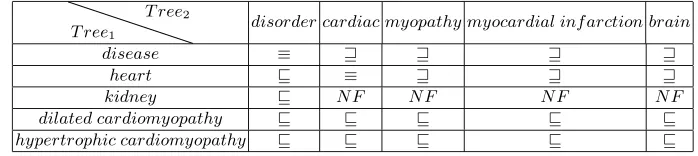
Table 1.This is the output of step three of the algorithm where the labels are matched using the UMLSAtomhierarchy
T ree1
T ree2 disorder cardiac myopathy myocardial inf arction brain
disease ≡ N F
heart ≡ N F N F N F
kidney N F N F N F N F
dilated cardiomyopathy N F N F N F hypertrophic cardiomyopathy N F N F N F
Table 2.This is the output of step three of the algorithm where the labels are matched using the UMLSConcepthierarchy
T ree1
T ree2
disorder cardiac myopathy myocardial inf arction brain
disease ≡
heart ≡
kidney N F N F N F N F
dilated cardiomyopathy
hypertrophic cardiomyopathy
5.4 Step 4 – Reasoning
[image:10.595.121.470.314.392.2]axioms→rel(contextA, contextB) (1)
axioms∧ ¬rel(contextA, contextB) (2)
((disease↔disorder)∧(heart↔
cardiac)∧(disease←myocardial inf arction)) →((disease)∧((heart∨kidney)∧disease)) ←((disorder)∧(cardiac)∧
(myocardial inf arction)) (3)
((disease↔disorder)∧(heart↔
cardiac)∧(disease←myocardial inf arction))∧ ¬(((disease)∧((heart∨kidney)∧ disease))←((disorder)∧(cardiac)∧
[image:11.595.125.471.434.535.2](myocardial inf arction))) (4)
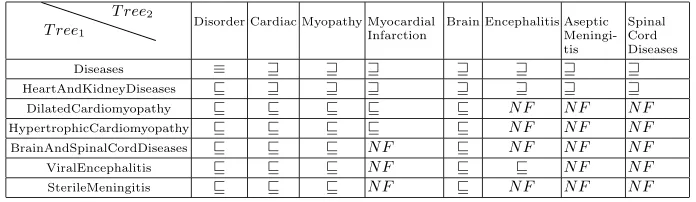
Table 3.This is the final output of the algorithm when the Atom hierarchies are used for both filtering and matching of the concepts
T ree1
T ree2
Disorder Cardiac Myopathy Myocardial Infarction
Brain Encephalitis Aseptic Meningi-tis
Spinal Cord Diseases
Diseases ≡
HeartAndKidneyDiseases N F N F N F N F
DilatedCardiomyopathy N F N F N F N F N F N F
HypertrophicCardiomyopathy N F N F N F N F N F N F
BrainAndSpinalCordDiseases N F N F N F N F N F N F N F
ViralEncephalitis N F N F N F N F N F
SterileMeningitis N F N F N F N F N F N F N F
Table 4.This is the output of the algorithm with filtering using the Atom Hierarchy of the UMLS and the Concept Matching of the third step
T ree1
T ree2
Disorder Cardiac Myopathy Myocardial Infarction
Brain Encephalitis Aseptic Meningi-tis
Spinal Cord Diseases
Diseases ≡
HeartAndKidneyDiseases
DilatedCardiomyopathy N F N F N F
HypertrophicCardiomyopathy N F N F N F
BrainAndSpinalCordDiseases N F N F N F N F
ViralEncephalitis N F N F N F
[image:11.595.124.472.591.692.2]Tables 3 and 4 show the results of matching the two trees in figure 6, using the Atom and Concept hierarchies for matching atomic formulae. As can be seen the results of using either the concept hierarchy or the atom hierarchy in the third step are different, hence the axioms, or information from a background resource can have a great influence on the final result. Our evaluation focuses on using differing features of the UMLS for the filtering in the second step and the matching of atomic formulae in the third step. This will be discussed further in the next section.
6
Evaluation Methodology
Our evaluation methodology focuses on the accuracy of the differing hierarchical matching and filtering schemes used by our algorithm. We have selected subsets of the FMA and MeSH ontologies for our matching process and have created a reference alignment for our matching task. The subset of the FMA we have chosen is rooted at the concept of Brain, and follows the “regional part of” rela-tionship to its leaf nodes, this contains 476 concepts in total. The subset of MeSH we have chosen is rooted at the concept of brain as well and traverses down to its leaf nodes, this contains 181 concepts in total. Both of these subsets cover the same domain, as they describe anatomical relationships with the organ “Brain” however, their level of coverage, naming of terms and models are different. All the matches are from the FMA to MeSH, i.e the FMA is the source ontology and MeSH is the target. We have used the 2008AA version of the UMLS in all of our experiments. The SMatch algorithm has been reimplemented from scratch with our modifications incorporated and we have used the SAT4J4 library as our SAT solver.
For the evaluation of our algorithm we have chosen to use different sources for the filtering of concepts (Concepts, Atoms or Co-Occurrences, none) and for the hierarchical matching as well (Concepts or Atoms). We created our reference alignment with the aid of a medical expert, our process for creating our standard has been to select 20 random concepts from our FMA subset and 40 random concepts from our MeSH subset and manually derive a match in the semantic matching range.
7
Results
The following versions of the algorithm were run:
1. Concept NoFilter: This uses the concept hierarchy for the matching of atomic formulae with no filtering of concepts.
2. Atom NoFilter:This uses the atom hierarchy for the matching of atomic formulae with no filtering of concepts.
3. Concept ConceptFilter: This uses the concept hierarchy of the UMLS for atomic formulae matching and the concept hierarchy for the filtering of concepts.
4. Atom AtomFilter:This uses the Atom hierarchy of the UMLS for match-ing atomic formulae and the Atom hierarchy for filtermatch-ing.
5. Concept AtomFilter: This uses the Concept hierarchy for the matching of atomic formulae and the Atom hierarchy for the filtering of concepts. 6. Atom ConceptFilter:This uses the Atom hierarchy of the UMLS for the
matching of atomic formulae and the Concept hierarchy for the filtering of Concepts.
7. Concept COCFilter: This uses the Concept hierarchy of the UMLS for the matching of atomic formulae and the Co-Occurrence relationships for filtering.
[image:13.595.128.467.341.434.2]8. Atom COCFilter: This uses the Atom hierarchy of the UMLS for the matching of atomic formulae and the Co-Occurrence relationships for filtering.
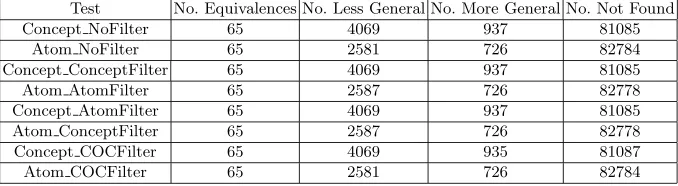
Table 5.The number of matches found for each version of our algorithm
Test No. Equivalences No. Less General No. More General No. Not Found
Concept NoFilter 65 4069 937 81085
Atom NoFilter 65 2581 726 82784
Concept ConceptFilter 65 4069 937 81085
Atom AtomFilter 65 2587 726 82778
Concept AtomFilter 65 4069 937 81085
Atom ConceptFilter 65 2587 726 82778
Concept COCFilter 65 4069 935 81087
Atom COCFilter 65 2581 726 82784
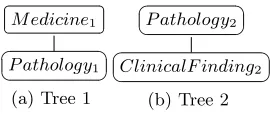
M edicine1
P athology1
(a) Tree 1
P athology2
ClinicalF inding2
[image:14.595.231.366.150.207.2](b) Tree 2
Fig. 7.Two trees to show where filtering can dramatically affect the results
The filtering however is useful although this is just a special case, if we con-sider the example in figure 7. If there was no filtering scheme involved at the hierarchical level we would have the following relationships discovered:
– M edicine1P athology2 – M edicine1ClinicalF inding2 – P athology1≡P athology2 – P athology1ClinicalF inding2
However, if we use Atom filtering we would have the following relationships discovered:
– M edicine1N F P athology2 – M edicine1N F ClinicalF inding2 – P athology1N F P athology2 – P athology1N F ClinicalF inding2
This is because when we query the UMLS for the terms in Tree 1 which are “Medicine” we get the following Concepts returned:
– C0013227:Pharmaceutical Preparations – C0025118:Medicine
For “Pathology” we have the following:
– C0677042:Pathology processes – C0334866:Medical pathologist – C0205469:Pathological aspects – C0919386:Pathology procedure – C0030664:Pathology
The filtering scheme retains the concept of 0025118:Medicine and drops C0013227:Pharmaceutical Preparations since this concept is not related to any of the concepts of Pathology. For the node labelled “Pathology” the concept of C0030664:Medical pathologistis kept since it is the only concept related to any of the concepts of “Medicine”. The meaning of this tree has now been constrained and given context since each node only has these concepts attached.
above, however, now the concept that is retained during the filtering process is C0677042:Pathology processes. Therefore the atomic formula for the node “Pathology” in tree 2 now has a different concept attached when compared to the node “Pathology” in tree 1. According to our rules in step 3 there is now no relationship discovered, hence the axioms are empty and no relationship can be deduced during the reasoning process. This is an ideal case where the filtering of concepts is useful, however when matching our subsets of FMA to MeSH they both cover the same domain hence the filtering (although dropping irrelevant concepts) has not been effective in the number of results discovered since iden-tical concepts were dropped in both trees. In our future work we will match two highly unrelated trees to gauge the effectiveness of our filtering scheme.
8
Conclusion
In this work we have shown how to apply the UMLS to a semantic matching task by modifying the SMatch algorithm to its use. For this we have detailed the steps involved and how the UMLS can be used. We have found by the number of results shown that the filtering has a minimal effect on the number of results discovered, however, in some situations this is not the case. Overall the accuracy is our method is high, this is evidenced by the high precision values of our algorithm and recall is high as well (both are perfect at 1), which is to be expected on such a small reference alignment. Currently our results are preliminary, our future work will consist of a further evaluation of our approach on a much larger dataset with a complete reference alignment. This however is difficult since there are no commonly agreed upon reference alignments or datasets for semantic matching in the medical domain. We intend to submit our matching system to the OAEI [13] medical track to aid our evaluation. We will also test our algorithm on different datasets with varying degrees of overlap.
The significance of this work is that it is possible to conduct semantic match-ing in the medical domain, we have shown this with the use of one background resource which is the UMLS. This is beneficial because the expressivity of seman-tic matching is able to increase the number of alignments discovered between elements, hence increasing the number of potential matches between concepts. We will later investigate how our approach can apply to differing sources of medical knowledge and outline the steps to achieve this.
References
1. Euzenat, J., Shvaiko, P.: Ontology Matching. Springer, Heidelberg (2007) 2. Giunchiglia, F., Yatskevich, M., Shvaiko, P.: Semantic Matching: Algorithms and
Implementation. Journal of Data Semantics, 1–38 (2007)
3. Fellbaum, C.: WordNet: An Electronic Lexical Database. MIT Press, Cambridge (1998)
5. Bodenreider, O.: The Unified Medical Language System (UMLS): Integrating Biomedical Terminology. Nucleic Acids Research 32 (2004)
6. Tan, H., Jakoniene, V., Lambrix, P., Aberg, J., Shahmehri, N.: Alignment of Biomedical Ontologies Using Life Science Literature. In: Bremer, E.G., Hakenberg, J., Han, E.-H.(S.), Berrar, D., Dubitzky, W. (eds.) KDLL 2006. LNCS (LNBI), vol. 3886, pp. 1–17. Springer, Heidelberg (2006)
7. Do, H., Rahm, E.: COMA a system for flexible combination of schema matching approaches. In: 28th International Conference of Very Large Databases (2002) 8. Risto, G., Aleksovski, Z., ten Kate, W., van Harmelen, F.: Using Google Distance
to Weight Approximate Ontology Matches. In: BNACI 2007 (2007)
9. Aleksovski, Z., Klein, M., ten Kate, W., van Harmelen, F.: Matching Unstructured Vocabularies using a Background Ontology. In: Staab, S., Sv´atek, V. (eds.) EKAW 2006. LNCS, vol. 4248, pp. 182–197. Springer, Heidelberg (2006)
10. Aleksovski, Z., ten Kate, W., van Harmelen, F.: Exploiting the structure of back-ground knowledge used in ontology matching. In: Ontology Matching Workshop (ISWC 2006) (2006)
11. Sabou, M., d’Aquin, M., Motta, E.: Exploring the Semantic Web as Background Knowledge for Ontology Matching. International Journal of Data Semantics (2008) 12. Garcia, J., Lopez, V., d’Aquin, M., Sabou, M., Motta, E., Mena, E.: Solving Se-mantic Ambiguity to Improve SeSe-mantic Web based Ontology Matching. In: Inter-national Workshop on Ontology Matching (OM 2007) (2007)