Proceedings of NAACL-HLT 2018
Learning Visually Grounded Sentence Representations
Douwe Kiela
Facebook AI Research [email protected]
Alexis Conneau
Facebook AI Research [email protected]
Allan Jabri1 UC Berkeley [email protected]
Maximilian Nickel
Facebook AI Research [email protected]
Abstract
We investigate grounded sentence representa-tions, where we train a sentence encoder to predict the image features of a given caption— i.e., we try to “imagine” how a sentence would be depicted visually—and use the resultant fea-tures as sentence representations. We examine the quality of the learned representations on a variety of standard sentence representation quality benchmarks, showing improved perfor-mance for grounded models over non-grounded ones. In addition, we thoroughly analyze the extent to which grounding contributes to im-proved performance, and show that the system also learns improved word embeddings.
1 Introduction
Following the word embedding upheaval of the past few years, one of NLP’s next big challenges has become the hunt for universal sentence rep-resentations: generic representations of sentence meaning that can be “plugged into” any kind of sys-tem or pipeline. Examples include Paragraph2Vec
(Le and Mikolov, 2014), C-Phrase (Pham et al.,
2015), SkipThought (Kiros et al.,2015) and Fast-Sent (Hill et al., 2016a). These representations tend to be learned from large corpora in an unsu-pervised setting, much like word embeddings, and effectively “transferred” to the task at hand.
Purely text-based semantic models, which rep-resent word meaning as a distribution over other words (Harris, 1954; Turney and Pantel, 2010;
Clark, 2015), suffer from the grounding problem
(Harnad, 1990). It has been shown that
ground-ing leads to improved performance on a variety of word-level tasks (Baroni, 2016; Kiela, 2017). Unsupervised sentence representation models are often doubly exposed to the grounding prob-lem, especially if they represent sentence
mean-1Work done while at Facebook AI Research.
ings as a distribution over other sentences, as in SkipThought (Kiros et al.,2015).
Here, we examine whether grounding also leads to improved sentence representations. In short, the grounding problem is characterized by the lack of an association between symbols and external infor-mation. We address this problem by aligning text with paired visual data and hypothesize that sen-tence representations can be enriched with external information—i.e., grounded—by forcing them to capture visual semantics. We investigate the per-formance of these representations and the effect of grounding on a variety of semantic benchmarks.
There has been much recent interest in gener-ating actual images from text (Goodfellow et al.,
2014;van den Oord et al.,2016;Mansimov et al.,
2016). Our method takes a slightly different ap-proach: instead of predicting actual images, we train a deep recurrent neural network to predict thelatent feature representationof images. That is, we are specifically interested in the semantic content of visual representations and how useful that information is for learning sentence represen-tations. One can think of this as trying to imag-ine, or form a “mental picture”, of a sentence’s meaning (Chrupała et al.,2015). Much like a sen-tence’s meaning in classical semantics is given by its model-theoretic ground truth (Tarski,1944), our ground truth is provided by images.
Grounding is likely to be more useful for con-crete words and sentences: a sentence such as “democracy is a political system” does not yield any coherent mental picture. In order to accommo-date the fact that much of language is abstract, we take sentence representations obtained using text-only data (which are better for representing abstract meaning) and combine them with the grounded representations that our system learns (which are good for representing concrete meaning), leading to multi-modal sentence representations.
In what follows, we introduce a system for grounding sentence representations by learning to predict visual content. Although it is not the pri-mary aim of this work, it is important to first exam-ine how well this system achieves what it is traexam-ined to do, by evaluating on the COCO5K image and caption retrieval task. We then analyze the per-formance of grounded representations on a variety of sentence-level semantic transfer tasks, showing that grounding increases performance over text-only representations. We then investigate an im-portant open question in multi-modal semantics: to what extent are improvements in semantic per-formance due to grounding, rather than to having more data or data from a different distribution? In the remainder, we analyze the role that concrete-ness plays in representation quality and show that our system learns grounded word embedding pro-jections that outperform non-grounded ones. To the best of our knowledge, this is the first work to comprehensively study grounding for distributed sentence representations on such a wide set of se-mantic benchmark tasks.
2 Related work
Sentence representations Although there ap-pears to be a consensus with regard to the method-ology for learning word representations, this is much more of an open problem for sentence rep-resentations. Recent work has ranged from try-ing to learn to compose word embeddtry-ings (Le and Mikolov,2014;Pham et al.,2015;Wieting et al.,
2016;Arora et al.,2017), to neural architectures for predicting the previous and next sentences (Kiros et al.,2015) or learning representations via large-scale supervised tasks (Conneau et al.,2017). In particular, SkipThought (Kiros et al.,2015) led to an increased interest in learning sentence repre-sentations. Hill et al.(2016a) compare a wide se-lection of unsupervised and supervised methods, including a basic caption prediction system that is similar to ours. That study finds that “differ-ent learning methods are preferable for differ“differ-ent intended applications”, i.e., that the matter of opti-mal universal sentence representations is as of yet far from decided.
InferSent (Conneau et al.,2017) recently showed that supervised sentence representations can be of very high quality. Here, we learn grounded sen-tence representations in a supervised setting, com-bine them with standard unsupervised sentence
representations, and show how grounding can help for a variety of sentence-level tasks.
Multi-modal semantics Language grounding in semantics has been motivated by evidence that human meaning representations are grounded in perceptual experience (Jones et al.,1991;Perfetti,
1998; Andrews et al., 2009; Riordan and Jones,
2011). That is, despite ample evidence of hu-mans representing meaning with respect to an ex-ternal environment and sensorimotor experience
(Barsalou, 2008; Louwerse, 2008), standard
se-mantic models rely solely on textual data. This gives rise to an infinite regress in text-only seman-tic representations, i.e., words are defined in terms of other words,ad infinitum.
The field of multi-modal semantics, which aims to address this issue by enriching textual repre-sentations with information from other modalities, has mostly been concerned with word representa-tions (Bruni et al.,2014;Baroni,2016;Kiela,2017, and references therein). Learning multi-modal rep-resentations that ground text-only reprep-resentations has been shown to improve performance on a va-riety of core NLP tasks. This work is most closely related to that ofChrupała et al.(2015), who also aim to ground language by relating images to cap-tions: here, we additionally address abstract sen-tence meaning; have a different architecture, loss function and fusion strategy; and explicitly focus on grounded universal sentence representations.
Bridging vision and language There is a large body of work that involves jointly embedding im-ages and text, at the word level (Frome et al.,2013;
Joulin et al., 2016), the phrase level (Karpathy
et al.,2014;Li et al.,2016), and the sentence level (Karpathy and Fei-Fei, 2015; Klein et al., 2015;
Kiros et al.,2015;Chen and Zitnick, 2015;Reed
et al., 2016). Our model similarly learns to map
sentence representations to be consistent with a visual semantic space, and we focus on studying how these grounded text representations transfer to NLP tasks.
(Elliott and Kádár, 2017; Gella et al., 2017; Lee et al., 2017). Recently,Das et al. (2017) trained dialogue agents to communicate about images, try-ing to predict image features as well.
3 Approach
In the following, letD ={(Ik,Ck)}kN=1be a dataset
where each imageIkis associated with one or more
captions Ck = {C1, . . . ,C| C |k}. A prominent
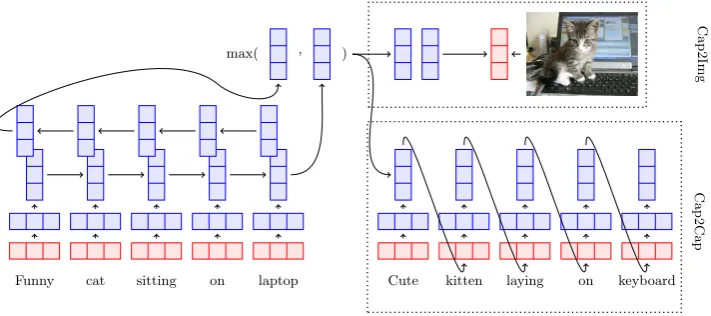
ex-ample of such a dataset is COCO (Lin et al.,2014), which consists of images with up to 5 correspond-ing captions for each image. The objective of our approach is to encode a given sentence, i.e., a cap-tionC, and learn to ground it in the corresponding imageI. To encode the sentence, we train a bidirec-tional LSTM (BiLSTM) on the caption, where the input is a sequence of projected word embeddings. We combine the final left-to-right and right-to-left hidden states of the LSTM and take the element-wise maximum to obtain a sentence encoding. We then examine three distinct methods for grounding the sentence encoding.
In the first method, we try to predict the image features (Cap2Img). That is, we learn to map the caption to the same space as the image features that represent the correct image. We call this strong perceptual grounding, where we take the visual input directly into account.
An alternative method is to exploit the fact that one image in COCO has multiple captions (Cap2Cap), and to learn to predict which other captions are valid descriptions of the same image. This approach is strictly speaking not perceptu-ally grounded, but exploits the fact that there is an implicit association between the captions and the shared underlying image, and so could be consid-ered a weaker version of grounding.
Finally, we experiment with a model that opti-mizes both these objectives jointly: that is, we pre-dict both images and alternative captions for the same image (Cap2Both). Thus, Cap2Both incor-porates both strong perceptual and weak implicit grounding. Please see Figure1for an illustration of the various models. In what follows, we discuss them in more technical detail.
3.1 Bidirectional LSTM
To learn sentence representations, we employ a bidirectional LSTM architecture. In particular, let
x=(x1, . . . ,xT)be an input sequence where each
word is represented via an embedding xt ∈Rn.
Using a standard LSTM (Hochreiter and
Schmid-huber, 1997), the hidden state at time t, denoted
ht ∈Rm, is computed via
ht+1,ct+1 =LSTM(xt,ht,ct |Θ)
wherect denotes the cell state of the LSTM and
whereΘdenotes its parameters.
To exploit contextual information in both input directions, we process input sentences using a bidi-rectional LSTM, that reads an input sequence in both normal and reverse order. In particular, for an input sequence x of lengthT, we compute the hidden state at timet,ht ∈R2mvia
hf
t+1 =LSTM(xt,h
f t,c
f t |Θf) hb
t+1 =LSTM(xT−t,hbt,cbt |Θb)
Here, the two LSTMs processxin a forward and a backward order, respectively. We subsequently use max :Rd×Rd →Rd to combine them into their
element-wise maximum, yielding the representa-tion of a caprepresenta-tion after it has been processed with the BiLSTM:
hT =max(htf,hbt)
We use GloVe vectors (Pennington et al.,2014) for our word embeddings. The embeddings are kept fixed during training, which allows a trained sentence encoder to transfer to tasks (and a vo-cabulary) that it has not yet seen, provided GloVe embeddings are available. Since GloVe represen-tations are not tuned to represent grounded infor-mation, we learn a global transformation of GloVe space to grounded word space. Specifically, let
x ∈ Rn be the original GloVe embeddings. We
then learn a linear mapU ∈Rn×nsuch thatx=Ux
and usexas input to the BiLSTM. The linear map
Uand the BiLSTM are trained jointly.
3.2 Cap2Img
Letv∈RIbe the latent representation of an image
(e.g.the final layer of a ResNet). To ground cap-tions in the images that they describe, we maphT
into the latent space of image representations such that their similarity is maximized. In other words, we aim to predict the latent features of an image from its caption. The mapping of caption to image space is performed via a series of projections
Funny cat sitting on laptop
max( , )
Cute kitten laying on keyboard
C
a
p
2
Im
g
C
a
p
2
C
a
[image:4.595.145.501.62.220.2]p
Figure 1: Model architecture: predicting either an image (Cap2Img), an alternative caption (Cap2Cap), or both at the same time (Cap2Both).
whereψdenotes a non-linearity such as ReLUs or tanh.
By jointly training the BiLSTM with these la-tent projections, we can then ground the language model in its visual counterpart. In particular, let Θ = ΘBiLSTM∪ {P`}`L=1 be the parameters of the
BiLSTM as well as the projection layers. We then minimize the following ranking loss:
LC2I(Θ)=Õ
(I,C)∈D
frank(I,C)+ frank(C,I) (1)
where
frank(a,b)= Õ
b0∈Na
[γ−sim(a,b)+sim(a,b0)]+
where [x]+ = max(0,x) denotes the threshold function at zero andγdefines the margin. Further-more,Na denotes the set of negative samples for
an image or caption and sim(·,·)denotes a
similar-ity measure between vectors. In the following, we employ the cosine similarity, i.e.,
sim(a,b)= ha,bi
kakkbk.
Although this loss is not smooth at zero, it can be trained end-to-end using subgradient methods. Compared to e.g. an l2 regression loss,
Equa-tion (1) is less susceptible to error incurred by subspaces of the visual representation that are ir-relevant to the high level visual semantics. Empir-ically, we found it to be more robust to overfitting.
3.3 Cap2Cap
Let x = (x1, . . . ,xT), y = (y1, . . . ,yS) be a
cap-tion pair that describes the same image. To learn
weakly grounded representations, we employ a standard sequence-to-sequence model (Sutskever
et al., 2014), whose task is to predict y from x.
As in the Cap2Cap model, lethT be the
represen-tation of the input sentence after it has been pro-cessed with a BiLSTM. We then model the joint probability ofygivenxas
p(y | x)=
S Ö
s=1
p(ys |hT,y1, . . . ,ys−1,Θ).
To model the conditional probability ofyswe use
the usual multiclass classification approach over the vocabulary of the corpusVsuch that
p(ys =k |hT,y1, . . . ,ys−1,Θ)= e
hvk,ysi Í|V |
j=1ehvj,ysi .
Here,ys = ψ(WVgs+b)andgs is hidden state of
the decoder LSTM at times.
To learn the model parameters, we minimize the negative log-likelihood over all caption pairs, i.e.,
LC2C(θ)=−Õ
x,y∈D |y| Õ
s=1
logp(ys|hT,y1, . . . ,ys−1,Θ).
3.4 Cap2Both
Finally, we also integrate both concepts of ground-ing into a joint model, where we optimize the fol-lowing loss function:
3.5 Grounded universal representations
On their own, features from this system are likely to suffer from the fact that training on COCO intro-duces biases: aside from the inherent dataset bias in COCO itself, the system will only have cover-age for concrete concepts. COCO is also a much smaller dataset than e.g. the Toronto Books Cor-pus often used in purely text-based methods (Kiros
et al., 2015). As such, grounded representations
are potentially less “universal” than text-based al-ternatives, which also cover abstract concepts.
There is evidence that meaning is dually coded in the human brain: while abstract concepts are processed in linguistic areas, concrete concepts are processed in both linguistic and visual areas
(Paivio, 1990). Anderson et al. (2017) recently
corroborated this hypothesis using semantic rep-resentations and fMRI studies. In our case, we want to be able to accommodate concrete sentence meanings, for which our vision-centric system is likely to help; as well as abstract sentence mean-ings, where trying to “imagine” what “democracy is a political system” might look like will probably only introduce noise.
Hence, we optionally complement our systems’ representations with more abstract universal sen-tence representations trained on language-only data (specifically, the Toronto Books Corpus). Al-though it would be interesting to examine multitask scenarios where these representations are jointly learned, we leave this for future work. Here, in-stead, we combine grounded and language-only representations using simple concatenation, i.e.,
rgs = rgr ounded || rling−only. Concatenation has
been proven to be a strong and straightforward mid-level multi-modal fusion method, previously explored in multi-modal semantics for word rep-resentations (Bruni et al., 2014; Kiela and Bot-tou,2014). We call the combined system Ground-Sent (GS), and distinguish between sentences per-ceptually grounded in images (GroundSent-Img), weakly grounded in captions (GroundSent-Cap) or grounded in both (GroundSent-Both).
3.6 Implementation details
We use 300-dimensional GloVe (Pennington et al.,
2014) embeddings, trained on WebCrawl, for the initial word representations and optimize using Adam (Kingma and Ba,2015). We use ELU ( Clev-ert et al.,2016) for the non-linearity in projection layers, set dropout to 0.5 and use a dimensionality
of 1024 for the LSTM. The network was initialized with orthogonal matrices for the recurrent layers (Saxe et al.,2014) and He initialization (He et al.,
2015) for all other layers. The learning rate and margin were tuned on the validation set using grid search.
4 Data, evaluation and comparison We use the same COCO splits as Karpathy and
Fei-Fei(2015) for training (113,287 images),
val-idation (5000 images) and testing (5000 images). Image features for COCO were obtained by trans-ferring the final layer from a ResNet-101 (He et al.,
2016) trained on ImageNet (ILSVRC 2015).
4.1 Transfer tasks
We are specifically interested in how well (grounded) universal sentence representations transfer to different tasks. To evaluate this, we perform experiments for a variety of tasks. In all cases, we compare against layer-normalized Skip-Thought vectors, a well-known high-performing sentence encoding method (Ba et al., 2016). To ensure that we use the exact same evaluations, with identical hyperparameters and settings, we evalu-ate all systems with the same evaluation pipeline, namely SentEval (Conneau and Kiela,2018)2.
Fol-lowing previous work in the field, the idea is to take universal sentence representations and to learn a simple classifier on top for each of the transfer tasks—the higher the quality of the sentence rep-resentation, the better the performance on these transfer tasks should be.
4.1.1 Semantic classification
We evaluate on the following well-known and widely used evaluations: movie review sentiment (MR) (Pang and Lee,2005), product reviews (CR)
(Hu and Liu, 2004), subjectivity classification
(SUBJ) (Pang and Lee, 2004), opinion polarity (MPQA) (Wiebe et al.,2005), paraphrase identifi-cation (MSRP) (Dolan et al.,2004) and sentiment classification (SST, binary version) (Socher et al.,
2013). Accuracy is measured in all cases, except for MRPC, which measures accuracy and the F1-score.
COCO5K
Caption Retrieval Image Retrieval
Model R@1 R@5 R@10 MEDR MR R@1 R@5 R@10 MEDR MR
DVSA 11.8 32.5 45.4 12.2 NA 8.9 24.9 36.3 19.5 NA
FV 17.3 39.0 50.2 10.0 46.4 10.8 28.3 40.1 17.0 49.3
OE 23.3 NA 65.0 5.0 24.4 18.0 NA 57.6 7.0 35.9
Cap2Both 19.4 45.0 59.4 7.0 26.5 11.7 32.6 46.4 12.0 41.7
[image:6.595.82.517.66.187.2]Cap2Img 27.1 55.6 70.0 4.0 19.2 17.1 43.0 57.3 8.0 36.6
Table 1: Retrieval (higher is better) results on COCO, plus median rank (MEDR) and mean rank (MR) (lower is better). Note that while this work underwent review, better methods have been published, most notably VSE++
(Faghri et al.,2017).
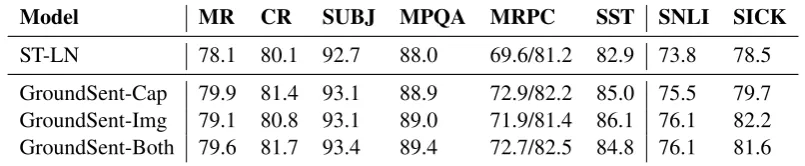
Model MR CR SUBJ MPQA MRPC SST SNLI SICK
ST-LN 78.1 80.1 92.7 88.0 69.6/81.2 82.9 73.8 78.5
GroundSent-Cap 79.9 81.4 93.1 88.9 72.9/82.2 85.0 75.5 79.7
GroundSent-Img 79.1 80.8 93.1 89.0 71.9/81.4 86.1 76.1 82.2
GroundSent-Both 79.6 81.7 93.4 89.4 72.7/82.5 84.8 76.1 81.6
Table 2: Accuracy results on sentence classification and entailment tasks.
4.1.2 Entailment
Recent years have seen an increased interest in entailment classification as an appropriate ation of sentence representation quality. We evalu-ate representations on two well-known entailment, or natural language inference, datasets: the large-scale SNLI dataset (Bowman et al.,2015) and the SICK dataset (Marelli et al.,2014).
4.2 Implementational details
We implement a simple logistic regression on top of the sentence representation. In the cases of SNLI and SICK, as is the standard for these datasets, the representations for the individual sen-tences u and v are combined by using hu,v,u∗ v,|u−v|ias the input features. We tune the seed and anl2 penalty on the validation sets for each,
and train using Adam (Kingma and Ba,2015), with a learning rate of 0.001 and a batch size of 32.
5 Results
Although it is not the primary aim of this work to learn a state-of-the-art image and caption re-trieval system, it is important to first establish the capability of our system to do what it is trained to do. Table 1 shows the results on the COCO5K caption and image retrieval tasks for the two models that predict image features.
We compare our system against several well-known approaches, namely Deep Visual-Semantic Alignments (DVSA) (Karpathy and Fei-Fei,2015), Fisher Vectors (FV) (Klein et al., 2015) and Or-der Embeddings (OE) (Vendrov et al.,2015). As the results show, Cap2Img performs very well on this task, outperforming the compared models on caption retrieval and being very close to order em-beddings on image retrieval3. The fact that the
system outperforms Order Embeddings on caption retrieval suggests that it has a better sentence en-coder. Cap2Both does not work as well on this task as the image-only case, probably because interfer-ence from the language signal makes the problem harder to optimize. The results indicate that the system has learned to predict image features from captions, and captions from images, at a level ex-ceeding or close to the state-of-the-art on this task.
5.1 Transfer task performance
Having established that we can learn high-quality grounded sentence encodings, the core question we now wish to examine is how well grounded sentence representations transfer. In this sec-tion, we combine our grounded features with the
[image:6.595.97.500.246.329.2]Model MR CR SUBJ MPQA MRPC SST SNLI SICK
STb-1024 70.3 68.0 87.5 85.5 69.7/80.6 78.3 67.3 76.6
STb-2048 73.1 75.7 88.3 86.5 71.6/81.7 79.0 71.0 78.8
2×STb-1024 71.4 74.7 88.2 86.6 71.3/80.7 75.8 69.4 78.3
Cap2Cap 71.4 74.7 86.7 86.7 70.3/79.8 76.1 68.5 78.2
Cap2Img 72.1 75.5 86.9 86.0 72.3/81.1 77.7 71.4 81.2
Cap2Both 71.6 74.4 86.5 85.5 71.4/79.5 78.5 71.3 81.7
GroundSent-Cap 73.1 73.0 88.6 86.6 70.8/81.2 79.4 70.7 79.1
GroundSent-Img 72.5 74.9 88.4 85.7 71.3/81.2 79.4 70.5 79.7
GroundSent-Both 73.3 75.2 87.5 86.6 69.9/79.9 80.3 72.0 78.1
Table 3: Thorough investigation of the contribution of grounding, ensuring equal number of components and identical architectures, on the variety of sentence-level semantic benchmark tasks. STb=SkipThought-like model with bidirectional LSTM+max. 2×STb-1024=ensemble of 2 different STb models with different initializations. GroundSent is STb-1024+Cap2Cap/Img/Both. We find that performance improvements are sometimes due to having more parameters, but in most cases due to grounding.
high-quality layer-normalized SkipThought repre-sentations of Ba et al. (2016), leading to multi-modal sentence representations as described in Section 3.5. That is, we concatenate Cap2Cap, Cap2Img or Cap2Both and Skip-Thought with Layer Normalization (ST-LN) representations, yielding GroundSent-Cap, GroundSent-Img and GroundSent-Both representations, respectively. We report performance of ST-LN using SentEval, which led to slightly different numbers than what is reported in their paper4.
Table2shows the results for the semantic clas-sification and entailment tasks. Note that all sys-tems use the exact same evaluation pipeline, which makes them directly comparable. We can see that in all cases, grounding increases the performance. The question of which type of grounding works best is more difficult: generally, grounding with Cap2Cap and Cap2Both appears to do slightly bet-ter on most tasks, but on e.g. SST, Cap2Img works better. The entailment task results (SNLI and SICK in Table 2) show a similar picture: in all cases grounding improves performance.
It is important to note that, in this work, we are not necessarily concerned with replacing the state-of-the-art on these tasks: there are systems that perform better. We are primarily interested in whether grounding helps relative to text-only baselines. We find that it does.
4This is probably due to different seeds, optimization methods and other minor implementational details that dif-fer between the original work and SentEval.
5.2 The contribution of grounding
An important open question is whether the increase in performance in multi-modal semantic models is due to qualitatively different information from
grounding, or simply due to the fact that we have
more parameters or data from a different distri-bution. In order to examine this, we implement a SkipThought-like model that also uses a bidi-rectional LSTM with element-wise max on the fi-nal hidden layer (henceforth referred to as STb). This model is architecturally identical to the sen-tence encoder used before: it can be thought of as Cap2Cap, but where the objective is not to predict an alternative caption, but to predict the previous and next sentence in the Toronto Books Corpus, just like SkipThought (Kiros et al.,2015).
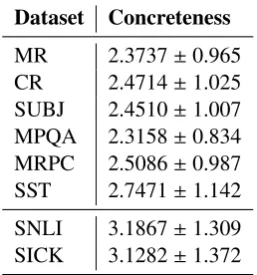
Dataset Concreteness
MR 2.3737±0.965
CR 2.4714±1.025
SUBJ 2.4510±1.007
MPQA 2.3158±0.834
MRPC 2.5086±0.987
SST 2.7471±1.142
SNLI 3.1867±1.309
[image:8.595.117.246.64.202.2]SICK 3.1282±1.372
Table 4: Mean and variance of dataset concreteness, over all words in the datasets.
As Table 3 shows, a more nuanced picture emerges in this comparison: grounding helps more for some datasets than for others. Grounded mod-els outperform the STb-1024 model (which uses much more data—the Toronto Books Corpus is much larger than COCO) in all cases, often al-ready without concatenating the textual modality. The ensemble of two STb-1024 models performs better than the individual one, and so does the higher-dimensional one. In the cases of CR and MRPC (F1), it appears that improved performance is due to having more data or ensemble effects. For the other datasets, grounding clearly yields better results. These results indicate that grounding does indeed capture qualitatively different information, yielding better universal sentence representations.
6 Discussion
There are a few other important questions to in-vestigate. The average abstractness or concrete-ness of the evaluation datasets may have a large impact on performance. In addition, word embed-dings from the learned projection from GloVe input embeddings, which now provides a generic word-embedding grounding method even for words that are not present in the image-caption training data, can be examined.
6.1 Concreteness
As we have seen, performance across datasets and models can vary substantially. A dataset’s con-creteness plays an important role in the relative merit of applying grounding: a dataset consisting mostly of abstract words is less likely to benefit from grounding than one that uses mostly con-crete words. In order to examine this effect, we calculate the average concreteness of the
evalua-Model MEN SimLex RW W353
GloVe 0.805 0.408 0.451 0.738
Cap2Both 0.819 0.467 0.487 0.712
Cap2Img 0.845 0.515 0.523 0.753
Table 5: Spearmanρscorrelation on four standard
se-mantic similarity evaluation benchmarks.
tion datasets used in this study. Table4shows the average human-annotated concreteness ratings for all words (where available) in each dataset. The ratings were obtained by Brysbaert et al. (2014) in a large-scale study, yielding scores for 40,000 English words.
We observe that the two entailment datasets are more concrete, which is due to the fact that the premises are derived from caption datasets (Flickr30K in the case of SNLI; Flickr8K and video captions in the case of SICK). This explains why grounding can clearly be seen to help in these cases. For the semantic classification tasks, the more con-crete datasets are MRPC and SST. The picture is less clear for the first, but in SST we see that the grounded representations definitely do work bet-ter. Concreteness values make it easier to analyze performance, but are apparently not always direct indicators of improvements with grounding.
6.2 Grounded word embeddings
Our models contain a projection layer that maps the GloVe word embeddings that they receive as inputs to a different embedding space. There has been a lot of interest in grounded word represen-tations in recent years, so it is interesting to exam-ine what kind of word representations our models learn. We omit Cap2Cap for reasons of space (it performs similarly to Cap2Both). As shown in Table 5, the grounded word projections that our network learns yield higher-quality word embed-dings on four standard lexical semantic similarity benchmarks: MEN (Bruni et al.,2014), SimLex-999 (Hill et al.,2016b), Rare Words (Luong et al.,
2013) and WordSim-353 (Finkelstein et al.,2001). 7 Conclusion
sys-tem learns can be transferred to various NLP tasks, and that grounded universal sentence representa-tions lead to improved performance. We analyzed the source of improvements from grounding, and showed that the increased performance appears to be due to the introduction of qualitatively differ-ent information (i.e., grounding), rather than sim-ply having more parameters or apsim-plying ensem-ble methods. Lastly, we showed that our systems learned high-quality grounded word embeddings that outperform non-grounded ones on standard semantic similarity benchmarks. It could well be that our methods are even more suited for more concrete tasks, such as visual question answering, visual storytelling, or image-grounded dialogue— an avenue worth exploring in future work. In addi-tion, it would be interesting to explore multi-task learning for sentence representations where one of the tasks involves grounding.
Acknowledgments
We thank the anonymous reviewers for their helpful comments and suggestions. Part of Fig. 1 is licensed from dougwoods/CC-BY-2.0/flickr.com/photos/deerwooduk/682390157.
References
Andrew J. Anderson, Douwe Kiela, Stephen Clark, and Massimo Poesio. 2017. Visually grounded and tex-tual semantic models differentially decode brain ac-tivity associated with concrete and abstract nouns. Transactions of the Association for Computational Linguistics5.
Mark Andrews, Gabriella Vigliocco, and David Vinson. 2009. Integrating experiential and distributional data to learn semantic representations. Psychological re-view116(3):463.
Sanjeev Arora, Yingyu Liang, and Tengyu Ma. 2017. A simple but tough-to-beat baseline for sentence em-beddings. InInternational Conference on Learning Representations (ICLR).
Jimmy Lei Ba, Jamie Ryan Kiros, and Geoffrey E Hin-ton. 2016. Layer normalization. arXiv preprint arXiv:1607.06450.
Marco Baroni. 2016. Grounding distributional seman-tics in the visual world. Language and Linguistics Compass10(1):3–13.
Lawrence W. Barsalou. 2008. Grounded cognition. An-nual Review of Psychology59(1):617–645.
Raffaella Bernardi, Ruket Cakici, Desmond Elliott, Aykut Erdem, Erkut Erdem, Nazli Ikizler-Cinbis,
Frank Keller, Adrian Muscat, and Barbara Plank. 2016. Automatic description generation from im-ages: A survey of models, datasets, and evaluation measures. Journal of Artificial Intelligence Research (JAIR)pages 409–442.
Samuel R. Bowman, Gabor Angeli, Christopher Potts, and Christopher D. Manning. 2015. A large anno-tated corpus for learning natural language inference. InProceedings of EMNLP.
Elia Bruni, Nam-Khanh Tran, and Marco Baroni. 2014. Multimodal distributional semantics.Journal of Ar-tifical Intelligence Research49:1–47.
Marc Brysbaert, Amy Beth Warriner, and Victor Ku-perman. 2014. Concreteness ratings for 40 thousand generally known english word lemmas. Behavior research methods46(3):904–911.
Xinlei Chen and Lawrence C Zitnick. 2015. Mind’s eye: A recurrent visual representation for image caption generation. InProceedings of the IEEE conference on computer vision and pattern recognition. pages 2422–2431.
Grzegorz Chrupała, Ákos Kádár, and Afra Alishahi. 2015. Learning language through pictures. In Pro-ceedings of ACL.
Stephen Clark. 2015. Vector Space Models of Lexical Meaning. In Shalom Lappin and Chris Fox, edi-tors,Handbook of Contemporary Semantic Theory, Wiley-Blackwell, Oxford, chapter 16.
Djork-Arné Clevert, Thomas Unterthiner, and Sepp Hochreiter. 2016. Fast and accurate deep network learning by exponential linear units (ELUs). In In-ternational Conference on Learning Representations (ICLR).
Alexis Conneau and Douwe Kiela. 2018. Senteval: An evaluation toolkit for universal sentence representa-tions. InProceedings of LREC.
Alexis Conneau, Douwe Kiela, Holger Schwenk, Loïc Barrault, and Antoine Bordes. 2017. Supervised learning of universal sentence representations from natural language inference data. InProceedings of EMNLP. Copenhagen, Denmark.
Abhishek Das, Satwik Kottur, José M. F. Moura, Stefan Lee, and Dhruv Batra. 2017. Learning cooperative visual dialog agents with deep reinforcement learn-ing. InProceedings of CVPR.
Bill Dolan, Chris Quirk, and Chris Brockett. 2004. Un-supervised construction of large paraphrase corpora: Exploiting massively parallel news sources. In Pro-ceedings of ACL. page 350.
Fartash Faghri, David J Fleet, Jamie Ryan Kiros, and Sanja Fidler. 2017. Vse++: Improved visual-semantic embeddings. arXiv preprint arXiv:1707.05612.
H. Fang, S. Gupta, F.N. Iandola, R. Srivastava, L. Deng, P. Dollar, J. Gao, X. He, M. Mitchell, J.C. Platt, C.L. Zitnick, and G. Zweig. 2015. From captions to visual concepts and back. InCVPR.
Lev Finkelstein, Evgeniy Gabrilovich, Yossi Matias, Ehud Rivlin, Zach Solan, Gadi Wolfman, and Ey-tan Ruppin. 2001. Placing search in context: The concept revisited. In Proceedings of the 10th in-ternational conference on World Wide Web (WWW). ACM, pages 406–414.
A. Frome, G. Corrado, J. Shlens, S. Bengio, J. Dean, and T. Mikolov. 2013. Devise: A deep visual-semantic embedding model. InNIPS.
Spandana Gella, Rico Sennrich, Frank Keller, and Mirella Lapata. 2017. Image pivoting for learning multilingual multimodal representations .
Ian Goodfellow, Jean Pouget-Abadie, Mehdi Mirza, Bing Xu, David Warde-Farley, Sherjil Ozair, Aaron Courville, and Yoshua Bengio. 2014. Generative adversarial nets. InProceedings of NIPS.
Stevan Harnad. 1990. The symbol grounding problem. Physica D42:335–346.
Z. Harris. 1954. Distributional Structure. Word 10(23):146—162.
Kaiming He, Xiangyu Zhang, Shaoqing Ren, and Jian Sun. 2015. Delving deep into rectifiers: Surpassing human-level performance on imagenet classification. InProceedings of the IEEE international conference on computer vision (CVPR). pages 1026–1034. Kaiming He, Xiangyu Zhang, Shaoqing Ren, and Jian
Sun. 2016. Deep residual learning for image recog-nition. In Proceedings of the IEEE Conference on Computer Vision and Pattern Recognition (CVPR). pages 770–778.
Felix Hill, Kyunghyun Cho, and Anna Korhonen. 2016a. Learning distributed representations of sen-tences from unlabelled data. In Proceedings of NAACL.
Felix Hill, Roi Reichart, and Anna Korhonen. 2016b. Simlex-999: Evaluating semantic models with (gen-uine) similarity estimation. Computational Linguis-tics.
Sepp Hochreiter and Jürgen Schmidhuber. 1997. Long short-term memory. Neural computation9(8):1735– 1780.
Minqing Hu and Bing Liu. 2004. Mining and sum-marizing customer reviews. In Proceedings of SIGKDD. pages 168–177.
Susan S Jones, Linda B Smith, and Barbara Landau. 1991. Object properties and knowledge in early lex-ical learning. Child development62(3):499–516. A. Joulin, L.J.P. van der Maaten, A. Jabri, and N.
Vasi-lache. 2016. Learning visual features from large weakly supervised data. InECCV.
A. Karpathy, A. Joulin, and L. Fei-Fei. 2014. Deep fragment embeddings for bidirectional image sen-tence mapping. InProceedings of NIPS.
Andrej Karpathy and Li Fei-Fei. 2015. Deep visual-semantic alignments for generating image descrip-tions. In Proceedings of the IEEE Conference on Computer Vision and Pattern Recognition (CVPR). pages 3128–3137.
Douwe Kiela. 2017. Deep embodiment: grounding semantics in perceptual modalities (PhD thesis). Technical Report UCAM-CL-TR-899, University of Cambridge, Computer Laboratory.
Douwe Kiela and Léon Bottou. 2014. Learning Image Embeddings using Convolutional Neural Networks for Improved Multi-Modal Semantics. In Proceed-ings of EMNLP.
Diederik Kingma and Jimmy Ba. 2015. Adam: A method for stochastic optimization. InInternational Conference on Learning Representations (ICLR). Ryan Kiros, Yukun Zhu, Ruslan Salakhutdinov,
Richard S. Zemel, Antonio Torralba, Raquel Urta-sun, and Sanja Fidler. 2015. Skip-thought vectors. InProceedings of NIPS.
Benjamin Klein, Guy Lev, Gil Sadeh, and Lior Wolf. 2015. Associating neural word embeddings with deep image representations using fisher vectors. In Proceedings of the IEEE Conference on Com-puter Vision and Pattern Recognition (CVPR). pages 4437–4446.
Quoc V. Le and Tomas Mikolov. 2014. Distributed representations of sentences and documents. In Pro-ceedings of ICML.
Jason Lee, Kyunghyun Cho, Jason Weston, and Douwe Kiela. 2017. Emergent translation in multi-agent communication.CoRRabs/1710.06922.
A. Li, A. Jabri, A. Joulin, and L.J.P. van der Maaten. 2016. Learning visual n-grams from web data. In arxiv.
Tsung-Yi Lin, Michael Maire, Serge Belongie, James Hays, Pietro Perona, Deva Ramanan, Piotr Dollár, and C Lawrence Zitnick. 2014. Microsoft COCO: Common objects in context. In European Confer-ence on Computer Vision (ECCV). Springer, pages 740–755.
Thang Luong, Richard Socher, and Christopher D Man-ning. 2013. Better word representations with recur-sive neural networks for morphology. InProceedings of CoNLL. pages 104–113.
Elman Mansimov, Emilio Parisotto, Jimmy Lei Ba, and Ruslan Salakhutdinov. 2016. Generating im-ages from captions with attention. In International Conference on Learning Representations (ICLR). J. Mao, W. Xu, Y. Yang, J. Wang, and A.L. Yuille.
2015. Deep captioning with multimodal recurrent neural networks. InProceedings of ICLR.
Marco Marelli, Stefano Menini, Marco Baroni, Luisa Bentivogli, Reffaella Bernardi, and Roberto Zampar-elli. 2014. A SICK cure for the evaluation of compo-sitional distributional semantic models. In Proceed-ings of LREC.
Allan Paivio. 1990. Mental representations: A dual coding approach. Oxford University Press.
Bo Pang and Lillian Lee. 2004. A sentimental educa-tion: Sentiment analysis using subjectivity summa-rization based on minimum cuts. InProceedings of ACL. page 271.
Bo Pang and Lillian Lee. 2005. Seeing stars: Exploit-ing class relationships for sentiment categorization with respect to rating scales. InProceedings of ACL. pages 115–124.
Jeffrey Pennington, Richard Socher, and Christopher D. Manning. 2014. GloVe: Global vectors for word representation. InProceedings of EMNLP.
Charles A Perfetti. 1998. The limits of co-occurrence: Tools and theories in language research. Discourse Processes25(2&3):363—377.
Nghia The Pham, German Kruszewski, Angeliki Lazaridou, and Marco Baroni. 2015. Jointly opti-mizing word representations for lexical and senten-tial tasks with the c-phrase model. InProceedings of ACL.
S. Reed, Z. Akata, H. Lee, and B. Schiele. 2016. Learn-ing deep representations of fine-grained visual de-scriptions. InProceedings of CVPR.
Brian Riordan and Michael N Jones. 2011. Redun-dancy in perceptual and linguistic experience: Com-paring feature-based and distributional models of se-mantic representation. Topics in Cognitive Science 3(2):303–345.
Andrew M. Saxe, James L. McClelland, and Surya Gan-guli. 2014. Exact solutions to the nonlinear dynam-ics of learning in deep linear neural networks. In International Conference on Learning Representa-tions (ICLR).
Richard Socher, Alex Perelygin, Jean Y Wu, Jason Chuang, Christopher D Manning, Andrew Y Ng,
Christopher Potts, et al. 2013. Recursive deep mod-els for semantic compositionality over a sentiment treebank. InProceedings of EMNLP. pages 1631— 1642.
I. Sutskever, O. Vinyals, and QV. Le. 2014. Sequence to sequence learning with neural networks. In Pro-ceedings of NIPS.
Alfred Tarski. 1944. The semantic conception of truth: and the foundations of semantics. Philosophy and phenomenological research4(3):341–376.
Peter D. Turney and Patrick Pantel. 2010. From Fre-quency to Meaning: vector space models of se-mantics. Journal of Artifical Intelligence Research 37(1):141–188.
Aaron van den Oord, Nal Kalchbrenner, Lasse Espeholt, koray kavukcuoglu, Oriol Vinyals, and Alex Graves. 2016. Conditional image generation with pixelcnn decoders. InProceedings of NIPS.
Ivan Vendrov, Ryan Kiros, Sanja Fidler, and Raquel Urtasun. 2015. Order-embeddings of images and language. InInternational Conference on Learning Representations (ICLR).
O. Vinyals, A. Toshev, S. Bengio, and D. Erhan. 2015. Show and tell: A neural image caption generator. In Proceedings of CVPR.
Janyce Wiebe, Theresa Wilson, and Claire Cardie. 2005. Annotating expressions of opinions and emo-tions in language. Language resources and evalua-tion39(2):165–210.