Original Article
Postoperative survival and functional outcome of
palliative decompression and stabilization for
thoracic metastatic spinal cord compression:
prognostic factor analysis
Weigang Jiang1,2*, Mingxing Lei2*, Yaosheng Liu1,2, Haifeng Qin3, Yuncen Cao2, Shiguo Zhou4, Shubin Liu1,2
1The People’s Liberation Army 307 Clinical College of Anhui Medical University, No. 81, Meishan Rd, Hefei, Anhui
Province, People’s Republic of China; 2Department of Orthopedic Surgery, 307th Hospital of The Chinese People’s
Liberation Army, No. 8 Fengtaidongda Rd, Beijing, People’s Republic of China; 3Department of Pulmonary
Neoplasms Internal Medicine, 307th Hospital of The Chinese People’s Liberation Army, No. 8 Fengtaidongda Rd, Beijing, People’s Republic of China; 4Statistics Room, Capital Medical University Affiliated Beijing Friendship
Hospital, No. 95, Xuanwu District Yongan Rd, Beijing, People’s Republic of China. *Equal contributors.
Received June 30, 2016; Accepted August 27, 2016; Epub October 1, 2016; Published October 15, 2016
Abstract: Objective: To analyze the survival time and functional outcome of patients with thoracic metastatic spinal cord compression (MSCC) after operation and to identify parameters influencing the postoperative survival time. Methods: Sixty-seven consecutive patients with thoracic MSCC who were performed with posterior decompression and spine stabilization from January 2010 to December 2014 were retrospectively in this study. Nine prognostic factors, namely, age, primary tumor, preoperative Eastern Cooperative Oncology Group (ECOG) performance sta-tus, interval from cancer diagnosis to spinal metastases, preoperative ambulatory stasta-tus, preoperative visceral metastases, number of extraspinal bone metastasis, number of involved vertebrae, and postoperative adjuvant radiotherapy, were investigated. All factors were analyzed by Kaplan-Meier method and Cox proportional hazards model. Results: Postoperative Frankel grade was improved in 52% patients, maintained in 43% and retrogressive in 5%. Postoperative ambulatory rate was significantly higher than the preoperative ambulatory rate (P < 0.001). VAS score decreased from preoperative 5.7 ± 1.7 to postoperative 2.1 ± 1.4 score (P < 0.01). Surgery-related complica -tions occurred in 13.4% (9/67) patients. In the multivariate Cox regression analysis, age, type of primary tumor, preoperative visceral metastases, preoperative ECOG-PS, and postoperative adjuvant radiotherapy were indepen-dent prognostic factors for survival in patients with MSCC after surgery. Conclusions: Posterior decompression and stabilization is a relatively safe and effective method for MSCC. Besides, our study showed that age, type of primary tumor, preoperative visceral metastases, preoperative ECOG-PS, and postoperative adjuvant radiotherapy were independent characteristics for postoperative survival.
Keywords: Spinal metastasis, metastatic spinal cord compression, surgery, prognostic factor
Introduction
Metastatic spinal cord compression (MSCC) is one of the most serious complications of spin- al metastases which occurs in approximately 10% to 20% patients with advanced cancer [1]. Seventy percent patients with MSCC occur in the thoracic vertebrae [2]. Local pain is usually the earliest symptom, and patients may suffer from neurological dysfunction as the disease progresses, which may lead to the interruption of combined treatments for those patients. Stu-
dies showed that once patients totally para-lyzed, neurological function would be difficult to recover as before [3-5].
appropriate treatment, such as supportive care, palliative radiotherapy, palliative surgery and excisional surgery. The treatment strategy of MSCC is multidisciplinary and individualiza-tion. Surgery should be performed in an appro-priate time so that the radiotherapy or chemo-therapy wouldn’t be delayed. Prognostic scor-ing system is used to help clinician timely and accurately formulate an effective therapeutic strategy and to avoid excessive treatment and inadequate treatment. This study retrospective- ly analyzed clinical and imaging data of 67 pa- tients with thoracic MSCC, our objective was to present the postoperative survival and func-tional outcome of patients with thoracic MSCC after operation and to identify parameters that might have influence the postoperative survi- val.
Materials and methods
Inclusion and exclusion criteria
Inclusion criteria: (1) Patients were diagnosed with thoracic MSCC. (2) Patients were treated with posterior decompression and stabilization. (3) Expected survival was over 3 months. Excl- usion criteria: (1) Primary spinal malignant tu- mor. (2) Intramedullary metastases. (3) Lesions were previously treated by surgery or radiother-apy. (4) Lost to follow-up.
Characteristics of patients
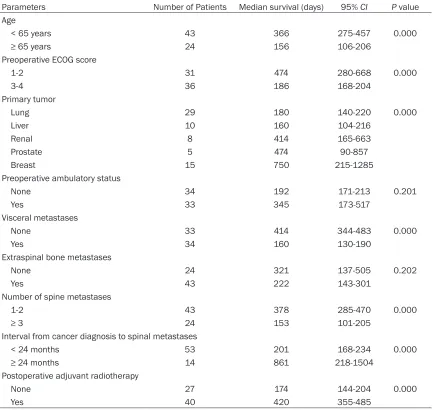
[image:2.612.91.525.85.495.2]The entire cohort of 67 consecutive patients (145 vertebrae) treated with posterior decom-pression and stabilization for thoracic MSCC
Table 1. Univariate analysis of survival
Parameters Number of Patients Median survival (days) 95% CI P value
Age
< 65 years 43 366 275-457 0.000
≥ 65 years 24 156 106-206
Preoperative ECOG score
1-2 31 474 280-668 0.000
3-4 36 186 168-204
Primary tumor
Lung 29 180 140-220 0.000
Liver 10 160 104-216
Renal 8 414 165-663
Prostate 5 474 90-857
Breast 15 750 215-1285
Preoperative ambulatory status
None 34 192 171-213 0.201
Yes 33 345 173-517
Visceral metastases
None 33 414 344-483 0.000
Yes 34 160 130-190
Extraspinal bone metastases
None 24 321 137-505 0.202
Yes 43 222 143-301
Number of spine metastases
1-2 43 378 285-470 0.000
≥ 3 24 153 101-205
Interval from cancer diagnosis to spinal metastases
< 24 months 53 201 168-234 0.000
≥ 24 months 14 861 218-1504
Postoperative adjuvant radiotherapy
None 27 174 144-204 0.000
Yes 40 420 355-485
were enrolled in our study. There were 31 fema- les and 36 males with a mean age of 57 ± 11 years (range, 32-76 years). The primary tumour was lung cancer in 29 (43%) patients, breast cancer in 15 (22%) patients, liver cancer in 10 (15%) patients, renal cancer in 8 (12%) patients, and prostate cancer in 5 (8%) patients. One th- oracic vertebra was invaded in 23 (34%) pati- ents, two were invaded in 20 (30%) patients, 3 or more were invaded in 24 (36%) patients (Table 1). Tokuhashi score was 0 to 8 points in 36 (54%) patients, 9 to 11 points in 20 (30%) patients, and 12 to 15 points in 11 (16%) pati- ents.
The ECOG-PS was used to evaluate patient’s general condition. Visual analog score (VAS) was used to evaluate pain intensity. Frankel grade, ranging from A to E, was used to evalu-ate neurological dysfunction. The following da- ta should be collected, such as gender, age, type of primary tumor, preoperative ECOG-PS, interval from cancer diagnosis to spinal metas-tases, preoperative ambulatory status (patien- ts with Frankel D to E are ambulatory), preop-erative visceral metastases, number of extra-spinal bone metastasis, number of involved vertebrae, postoperative adjuvant radiothera-py, preoperative and postoperative VAS score, and preoperative and postoperative Frankel grade. The Medical Research Ethics Board of the 307 th hospital of the Chinese People’s Liberation Army approved this retrospective
Statistical analysis
We used SPSS 18.0 software (SPSS Institute, Chicago, USA) for the statistical analyses. Con- tinuous quantitative variables were described as mean ± standard deviation. Kappa consis-tency test was used to evaluate the level of agreement between the survival time predicted by the Tokuhashi score and the observed sur-vival time. Prognostic factors were analyzed by Kaplan-Meier and Cox proportional hazards analysis. In all analyses, a value of P < 0.05 was considered to be statistically significant.
Results
Survival and functional outcome
The average follow-up time was 11.7 ± 10.7 months (range, 0.3-52.8 month). At the end of follow-up (May 31, 2015), ten (15%) patients were still alive, and the overall median survival time was 10.8 months (95% CI, 7.3-14.3 mon- ths). Two (3%) patients died within a month after surgery due to pulmonary embolism (1 patient) and severe pulmonary infection (1 patient). Forty-five (67%) patients died within one year. Sixty (82%) patients died within two years.
Twenty-nine patients were nonambulatory be- fore operation. Seventeen patients (59%) rega- ined the ability to walk after operation. However, two patients (5%) who were ambulatory before study and required neither pa- tient approval nor informed co- nsent for review of patients’ images and medical records.
Surgery
[image:3.612.91.375.71.258.2]Neurological deficit caused by MSCC (sensory and/or motor function impairment, sphinct- er dysfunction) was the major indication for posterior lami-nectomy decompression (with or without partial vertebrecto-my) and stabilization (Figure 1). Postoperative local radio-therapy was performed 2-3 weeks after the operation. All the treatments were decid- ed by oncologists, radiologists and orthopedic surgeons. Figure 1. 43-year-old female, T9 and T10 vertebral metastasis of breast
operation lost their ability to walk due to death within a month. Postoperative Frankel grade was improved in 52% (35/67) patients, main-tained in 43% (29/67) and retrogressive in 5% (3/67). Preoperative and postoperative ambu-latory status had statistical significance (P < 0.001, chi-square test). VAS score decreased from preoperative 5.7 ± 1.7 score to postopera-tive 2.1 ± 1.4 score (P < 0.01, Wilcoxon signed-rank test). Surgery-related complications occu- rred in 13.4% (9/67) patients.
Identification of prognostic factors of survival
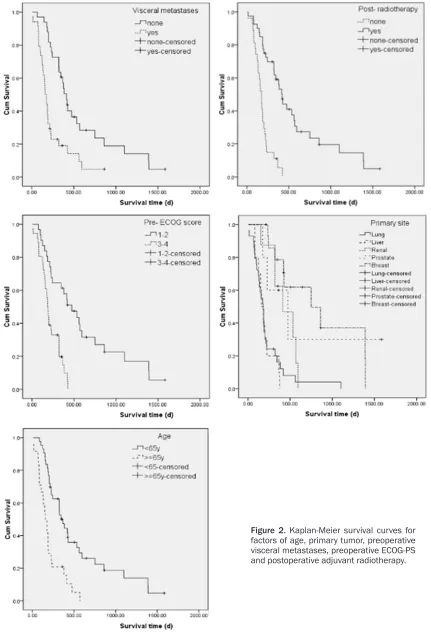
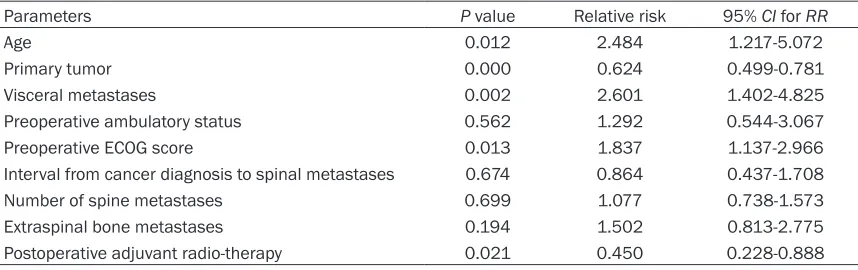
[image:5.612.91.520.84.219.2]In univariate analysis (Kaplan-Meier, log-rank test), age (P < 0.01), primary tumor (P < 0.05), preoperative ECOG-PS (P < 0.01), interval from cancer diagnosis to spinal me- tastases (P < 0.01), preoperative visceral metastases (P < 0.01), number of spine metas-tases (P < 0.01) and postoperative adjuvant radiotherapy (P < 0.01) significantly affected the postoperative survival. But in the multivari-ate analysis, age (P = 0.012), primary tumor (P = 0.000), preoperative visceral metastases (P = 0.002), preoperative ECOG-PS (P = 0.013) and postoperative adjuvant radiotherapy (P = 0.021) were important prognostic factors for survival in patients with MSCC (Figure 2 and
Table 2).
months (95% CI, 10.1-15.1 months), 25 months (95% CI, 14.1-41.8 months), respectively. Observed survival was consistent with the sur-vival predicted by Tokuhashi score via Kappa consistency test (Kappa = 0.626, P < 0.001).
Discussion
Patients with spinal metastasis, which often occurred in the patients with advanced cancer, usually have a short life expectancy, and the purpose of treatment is mainly to improve the neurological function, relieve pain, and improve the quality of life at last. In 1976, a prospective trial showed that patients managed with radio-therapy and laminectomy had no significant out- come differences compared with patients man-aged with radiotherapy alone [6]. After a period of time, the role of surgery for spinal metasta-ses was controversial. However, the controver-sy was stopped not until a prospective random-ized study performed by Patchell et al. in 2005 [7]. This study showed that outcomes of patients with surgery and radiotherapy were significantly better than radiotherapy alone. At present, surgery is essential for spinal metas-tases to relieve spinal cord compression and improve stability. In our study, postoperative Frankel grade was improved or maintained in 52% and 43% patients, respectively.
Table 2. Multivariate analysis of survival
Parameters P value Relative risk 95% CI for RR
Age 0.012 2.484 1.217-5.072
Primary tumor 0.000 0.624 0.499-0.781
Visceral metastases 0.002 2.601 1.402-4.825
Preoperative ambulatory status 0.562 1.292 0.544-3.067
Preoperative ECOG score 0.013 1.837 1.137-2.966
Interval from cancer diagnosis to spinal metastases 0.674 0.864 0.437-1.708
Number of spine metastases 0.699 1.077 0.738-1.573
Extraspinal bone metastases 0.194 1.502 0.813-2.775
Postoperative adjuvant radio-therapy 0.021 0.450 0.228-0.888
[image:5.612.91.329.277.357.2]Annotation: ECOG, Eastern Cooperative Oncology Group; 95% CI, 95% confidence interval; RR, Relative Risk.
Table 3. Observed survival and survival predicted by the Tokuhashi score of 57 dead patients at last follow-up
Survival predicted by the Tokuhashi score (months)
Observed survival (months) Total < 6 6-12 > 12
< 6 9 2 - 11
6-12 2 24 8 34
> 12 - 1 11 12
Total 11 31 15 57
Performance of Tokuhashi score
The commonly used surgical procedures inclu- de excisional surgery, palliative decompression and minimally invasive surgery. A study showed a long survival in patients with excisional sur-gery. But the incidence of complications was as high as 20% [8]. Nowadays, palliative decom-pression is still the standard surgical procedure for MSCC. Surgery strategy should be individu-alized and multidisciplinary. Individual treatme- nt strategy is often based on the patient’s sur-vival and functional prognosis. Generally speak-ing, excisional surgery was considered for pati- ents whose survival was greater than 12 mon- ths. Patients with very short survival time and poor functional outcome shouldn’t be the can-didates for decompressive surgery. So patients with difference prognosis had difference treat-ment strategy. An accurate prognostic scoring system can help clinicians to develop individu-alized treatment plan, avoiding excessive medi-cal treatment and insufficient treatment. In 1990, Tokuhashi et al. developed a prognos-tic scoring system, Tokuhashi score, then was revised in 2005 [9, 10]. Finally, six prognostic factors were included: primary tumor, Karnofsky performance status, metastases to major inter-nal organs, number of extraspiinter-nal bone metas-tases, number of spinal metastases and Frankel grade. Tomita score was developed by Tomita in 2001, and was revised by Kawahara et al. in 2009 [11, 12]. This score system con-tains three prognostic factors: primary tumor, metastases to major internal organs, bone metastases. Many Studies have confirmed the validity of revised Tokuhashi and Tomita score as a prognostic tool for patients with spinal metastases [13-16]. However, they are not impeccable. In 2012, Popovic et al. [17] reviewed previous scoring system, such as revised Bauer score, revised Tokuhashi score, revised Tomita score, van er Linde and Sioutos scoring system. They thought that none of these scoring system was applicable to all types of patients with spinal metastases. In our study, survival predicted by the Tokuhashi score had good consistency with the observed survival (P < 0.001). It also indirectly showed that palliative surgery has no improvement on survival. In the univariate analysis, age (< 65 years), breast and prostate cancer, preopera-tive ECOG (1-2), interval from cancer diagnosis to spinal metastases (< 24 months), visceral metastases (none), number of spine
metasta-ses (1-2) and postoperative adjuvant radiother-apy were associated with longer postoperative survival. But in the multivariate analysis, age (P = 0.012), primary tumor (P = 0.000), visceral metastases (P = 0.002), preoperative ECOG-PS (P = 0.013) and postoperative adjuvant radio-therapy (P = 0.021) were independent prognos-tic factors of survival of MSCC after thoracic posterior decompressive surgery. Thus, besides Tokuhashi score (primary tumor, Karnofsky per-formance status, metastases to major internal organs, number of extraspinal bone metasta-ses, number of spinal metastases and Frankel grade), age and postoperative adjuvant radio-therapy were also important prognostic factors of postoperative survival.
In conclusion, posterior decompression and st- abilization is an safe and effective means for MSCC. Our study supports the validity and re- producibility of the Tokuhashi score. Moreover, age and postoperative adjuvant radiotherapy were also significantly associated with postop-erative survival in our population.
Acknowledgements
The work is supported by the Beijing Municipal Science and Technology Commission (NO. Z13- 1107002213052 and NO. Z1611000005161- 01).
Disclosure of conflict of interest
None.
Address correspondence to: Yaosheng Liu and Shu- bin Liu, Department of Orthopedic Surgery, 307th Hospital of The Chinese People’s Liberation Army, No. 8 Fengtaidongda Rd, Beijing 100071, People’s Republic of China. E-mail: [email protected] (YSL); [email protected] (SBL)
References
[1] Zairi F, Marinho P, Bouras A, Allaoui M, Assaker R. Recent concepts in the management of tho-racolumbar spine metastasis. J Neurosurg Sci 2013; 57: 45-54.
[2] Moon KY, Chung CK, Jahng TA, Kim HJ, Kim CH. Postoperative survival and ambulatory out-come in metastatic spinal tumors: prognostic factor analysis. J Korean Neurosurg Soc 2011; 50: 216-23.
functional outcome after surgical decompres-sion in metastatic spinal cord compresdecompres-sion. Oncology 2014; 86: 177-84.
[4] Miscusi M, Polli FM, Forcato S, Ricciardi L, Frati A, Cimatti M, De Martino L, Ramieri A, Raco A. Comparison of minimally invasive surgery with standard open surgery for vertebral thoracic metastases causing acute myelopathy in pa-tients with short- or mid-term life expectancy: surgical technique and early clinical results. J Neurosurg Spine 2015; 22: 518-25.
[5] Park JH, Jeon SR. Pre- and postoperative lower extremity motor power and ambulatory status of patients with spinal cord compression due to a metastatic spinal tumor. Spine (Phila Pa 1976) 2013; 38: E798-802.
[6] Young RF, Feldman RA. Metastatic tumors of the spine. J Neurosurg 1979; 50: 536-7 [7] Patchell RA, Tibbs PA, Regine WF, Payne R,
Saris S, Kryscio RJ, Mohiuddin M, Young B. Direct decompressive surgical resection in the treatment of spinal cord compression caused by metastatic cancer: a randomised trial. Lancet 2005; 366: 643-8.
[8] Li H, Gasbarrini A, Cappuccio M, Terzi S, Pa- derni S, Mirabile L, Boriani S. Outcome of exci-sional surgeries for the patients with spinal metastases. Eur Spine J 2009; 18: 1423-30. [9] Tokuhashi Y, Matsuzaki H, Toriyama S, Kawano
H, Ohsaka S. Scoring system for the preopera-tive evaluation of metastatic spine tumor prog-nosis. Spine (Phila Pa 1976) 1990; 15: 1110-3.
[10] Tokuhashi Y, Matsuzaki H, Oda H, Oshima M, Ryu J. A revised scoring system for preopera-tive evaluation of metastatic spine tumor prog-nosis. Spine (Phila Pa 1976) 2005; 30: 2186-91.
[11] Tomita K, Kawahara N, Kobayashi T, Yoshida A, Murakami H, Akamaru T. Surgical strategy for spinal metastases. Spine (Phila Pa 1976) 20-01; 26: 298-306.
[12] Kawahara N, Tomita K, Murakami H, Demura S. Total en bloc spondylectomy for spinal tu-mors: surgical techniques and related basic background. Orthop Clin North Am 2009; 40: 47-63.
[13] Eap C, Tardieux E, Goasgen O, Bennis S, Mireau E, Delalande B, Cvitkovik F, Baussart B, Aldea S, Jovenin N, Gaillard S. Tokuhashi score and other prognostic factors in 260 patients with surgery for vertebral metastases. Orthop Traumatol Surg Res 2015; 101: 483-8. [14] Petteys RJ, Spitz SM, Rhee J, Goodwin CR,
Zadnik PL, Sarabia-Estrada R, Groves ML, Bydon A, Witham TF, Wolinsky JP, Gokaslan ZL, Sciubba DM. Tokuhashi score is predictive of survival in a cohort of patients undergoing sur-gery for renal cell carcinoma spinal metasta-ses. Eur Spine J 2015; 24: 2142-9.
[15] Papastefanou S, Alpantaki K, Akra G, Katonis P. Predictive value of Tokuhashi and Tomita scores in patients with metastatic spine dis-ease. Acta Orthop Traumatol Turc 2012; 46: 50-6.
[16] Lee CH, Chung CK, Jahng TA, Kim KJ, Kim CH, Hyun SJ, Kim HJ, Jeon SR, Chang UK, Lee SH, Moon SH, Majeed H, Zhang D, Gravis G, Wibmer C, Kumar N, Moon KY, Park JH, Tabouret E, Fuentes S. Which one is a valuable surrogate for predicting survival between Tomita and Tokuhashi scores in patients with spinal metastases? A meta-analysis for diag-nostic test accuracy and individual participant data analysis. J Neurooncol 2015; 123: 267-75.