The Shape of Elementary Trees and Scope Possibilities in STAG
Robert Frank Yale University Department of Linguistics
370 Temple Street New Haven, CT 06511
Dennis Ryan Storoshenko Yale University Department of Linguistics
370 Temple Street New Haven, CT 06511
Abstract
Work on the syntax-semantics interface in the TAG framework has grappled with the problem of identifying a system with suf-ficient power to capture semantic depen-dencies which also imposes formally and linguistically interesting constraint on the kinds of dependencies that can be ex-pressed. The consensus in recent years ap-pears to have shifted to the use of a system that is substantially more expressive than TAG. In this paper, we revisit some of the arguments in favor of more formal power, particularly those from Nesson and Shieber (2008). We show that these arguments can be defused once we adopt a different per-spective on predicate-headed semantic el-ementary trees, namely that they are di-vided into scope and variable components like their quantificational counterparts. We demonstrate as well that this proposal pro-vides an new perspective on scope rigidity.
1 TAG Semantics and Formal Power
Much of the interest in using Tree Adjoining Grammar as the structure-building component of syntactic theory stems from the combination of its formal and computational restrictiveness and its apparent sufficiency to express the kinds of pat-terns that are found in natural language. Over the past couple of decades, researchers have at-tempted to augment TAG models of syntax with mechanisms for assigning semantic interpreta-tions. One line of work in this regard is that of Kallmeyer and Joshi (2003) and Kallmeyer and Romero (2008). In this approach, elemen-tary trees are associated with underspecified se-mantic descriptions, which are combined using
a combinatory mechanism that operates in par-allel with TAG derivational steps, essentially a form of feature unification. Though this approach has had considerable empirical success, it does so by sacrificing the restrictiveness of the TAG for-mal system: unification over unbounded feature structures is Turing complete (Johnson, 1988).1 An alternative line exploits the TAG combinatory machinery itself to construct semantic interpreta-tions, through a synchronous derivation of syn-tactic representations and semantic terms (Shieber and Schabes, 1990). Though this Synchronous TAG (STAG) approach is appealing, because it maintains the constrained approach to grammat-ical combination embraced in TAG, it remains an open question whether it is sufficiently pow-erful to accomplish the task of assigning compo-sitional interpretations. Indeed, in comparison to the wealth of work on the grammatical complex-ity of patterns found in natural language syntax, there is precious little work studying the com-plexity of semantic patterns, or of the syntax-semantics mapping.2
Recently, Nesson and Shieber (2008) have ar-gued that there are empirical reasons to move
1
As far as we are aware, Kallmeyer and colleagues have not proposed restrictions on their system which constrains its expressiveness. One interesting avenue to pursue in this connection could follow the work of Feinstein and Wintner (2008) who prove that the class of one-reentrant unification grammars generate exactly the Tree Adjoining Languages. Of course, it remains an open empirical question whether im-posing this restriction on this approach would yield a system that is sufficiently expressive to assign meanings in a compo-sitional fashion. We briefly return to this issue in Section 5 below.
2
See Marsh and Partee (1984) for one notable exceptions, though questions remain about the empirical relevance of this result.
beyond the tree-local multicomponent version of STAG advocated by Shieber and Schabes (1990) and in Schabes and Shieber (1994), to a system which is greater in power than simple TAG. In this paper, we suggest that Nesson and Shieber were mistaken: the examples that they use to mo-tivate greater expressive power can in fact be dealt with using tree-local MCTAG, but only once we rethink the semantic representations of elemen-tary trees for lexical predicates. We then move beyond English, showing that this new concep-tion of semantic elementary tree set provides a natural way to characterize cross-linguistic vari-ability in scopal flexibility, a varivari-ability that is un-expected under the multiple adjunction approach to scope ambiguity. Finally, we briefly discuss a potential analogy between scope and scrambling and the implications that this analogy has for the complexity of the syntax-semantics interface.
2 Puzzles for a Restrictive Semantics
Nesson and Shieber (2008) present a number of sentence types whose semantic derivations they take to require power beyond that possible under tree-local MCTAG. One of these involves “inverse linking”, where a quantifier is syntactically em-bedded within another quantificational NP. Such a case is given in (1):
(1) Mitt courted every person at some
fundraiser. (∃>∀,∀>∃)
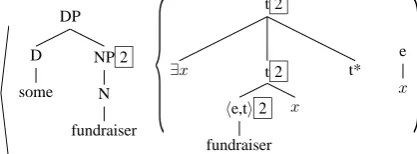
To derive an interpretation for this sentence, Nes-son and Shieber make use of what has become the standard TAG treatment of quantifiers, given in Figure 1, augmented with dominance links that are crucial only to the inverse linking case. A quantifier’s interpretation is assigned two pieces of structure, a scope tree and a variable tree. To derive (1), the quantifier, some fundraiser, is com-bined into the at-headed tree set, of which it is
DPD
some
NP 2
N
fundraiser
t 2∃x t 2
he,ti2 fundraiser
x t*
e
[image:2.595.302.517.73.132.2]x
Figure 1: Tree Set for some fundraiser
S* NPNP* PP
P
at NP↓1
t*
he,ti
and he,ti* he,ti
at e↓1
[image:2.595.75.284.658.735.2]Figure 2: Tree Set for at proposed in Nesson and Shieber (2008)
the complement, given in Figure 2: on the seman-tic side, the variable component of the quantifier substitutes into the he,ti-recursive auxiliary tree, following the link in the syntactic tree. However, there is no place in thehe,tirecursive auxiliary to host thet-recursive scope component of the quan-tifier, meaning that tree local combination is im-possible. It is only because of the presence of the degenerate t component of this tree set that the combination of the quantifier and preposition is even able to occur set locally. The derivation con-tinues by adjoining the derived tree set into an-other quantifier tree set, representing every
per-son, this time tree-locally, within the set’s scope
component.
Nesson and Shieber invoke a second kind of example to argue for the inadequacy of even set-local MCTAG. This case involves the interleaving of scopal elements from multiple clauses, of the sort seen in (2).
(2) Some professor remembered to review
every paper (that he promised to review). (∃>∀>remembered)
In the relevant reading of (2), the universal quan-tifier that is the object of the lower clause takes scope below the existential matrix subject, but above the matrix verbal predicate. This interpreta-tion cannot be derived even set-locally under stan-dard assumptions.3 If the tree set associated with
3
In fact, Shieber and Nesson’s assumptions about the se-mantic elementary tree for the control predicate remember do not match the ones we are currently making. Instead, they invoke a three-part tree set for the semantics of control pred-icates like remember, including a lambda abstraction over the subject, the lexical predicate and a variable to be inserted into the (controlled) embedded subject position. This move allows them to generate the desired scope for (2), though it does not generalize to slightly more complex cases such as the following, involving a matrix adverbials, as they observe:
(i) Every boy always wants to eat some food. (always>∃>∀>wants)
∃x t
he,ti
professor
x
t
e
x
he,ti
ht,he,tii
remembered] t*
Figure 3: Derived matrix auxiliary tree for some pro-fessor remembered
the existential quantifier some professor adjoins and substitutes into a single-component seman-tic elementary tree associated with remembered, as it must under tree-local or set-local MCTAG, the relative scope of these elements can be fixed (as∃>remembered), forming a derived auxiliary
tree that encapsulates these scopal elements, seen in Figure 3. However, because of the nature of the adjoining operation, there is no way the these two elements can be separated when this derived auxiliary tree into it complement review, which will also host the embedded quantifier every
pa-per. As a result, this embedded quantifier will be
able to take scope above all of the matrix scopal elements or below all of them, but crucially not between them, contrary to fact.
Nesson and Shieber also discuss a third type of example, involving pied-piped relative clauses:
(3) John saw a soccer player whose picture every boy bought.
On the relevant reading, the universal quantifier can take scope outside of the (implicit) existen-tial provided by the pied-piped relative asserting the existence of a picture (i.e., each boy bough a distinct picture of the same soccer player). They argue that neither a tree-local nor a set-local anal-ysis can generate this interpretation. In this case, however, the argument rests on what we take to be an implausible analysis of relative clause syn-tax and semantics, in which the syntactic head and core semantics of a pied-piped relative clause is provided by the possessive morpheme. Below, we discuss an alternative analysis of such pied-piped relatives in which the relative clause seman-tics and existential force is provided by a verbally-a generverbally-alizverbally-ation of Nesson verbally-and Shieber’s multicomponent treatment of control predicates to all lexical predicates. Fur-thermore, by assuming that temporal arguments license their own semantic component, the scope in (i) can be derived.
TP1 DP↓ T′
T VP
V courted
DP↓2
t 1 21 e↓ he,ti
λy′ t
2 e↓ he,ti
λx′ t*
t
he,ti hehe,tii
λxλy.court(y, x) e x′
e y′
[image:3.595.90.520.70.170.2]Figure 4: Two-Part Predicate Trees for courted
headed relative clause tree, and which allows this interpretation to be derived.
3 A Return to Tree-Locality: A New Proposal for Semantic Elementary Trees
Nesson and Shieber’s arguments, interesting as they are, rest on assumptions about the nature of the elementary trees that contribute to the relevant derivations. Though the elementary trees they as-sume are largely in conformity with other propos-als in the TAG literature, they provide no under-lying theory of what semantic elementary trees should look like. As a result, it is simply un-clear whether their arguments hold up if the con-stituent elementary trees and assumptions about their structure are changed. To get around their arguments and maintain tree-local combination, our proposal in this paper reconceptualizes the se-mantic elementary trees for predicates as multi-component sets. These sets will consist of (at least) two pieces: a ‘variable part’ and ‘scope part’. This division is familiar in the TAG seman-tics literature for quantifiers, and we propose that it be generalized to argument taking elements of all sorts.
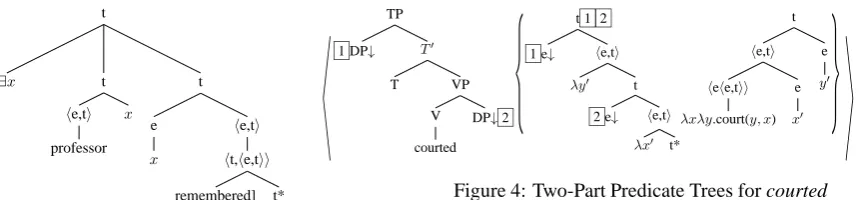
Let us be specific about how this works. The semantic elementary tree set for transitive verb, such as courted, will contain two pieces. One, which we call the “variable part”, will include the lexical predicate with each of its argument po-sitions saturated by variables. The other, which we call the “scope part”, contains a lambda op-erator binding each of the variables in the vari-able part, with substitution nodes to which each of the lambda operators applies. The resulting tree set is depicted in Figure 4. To use this tree set to derive an example like Mitt courted some
De-troiters, the subject and object DP arguments will
∃z t
he,ti
Detroiters z
t e Mitt
he,ti
λy′ t
e z
he,ti
λx′ t
he,ti hehe,tii
λxλy.court(y, x) e x′
e y′
[image:4.595.77.290.71.251.2]Figure 5: Derived semantic tree for derivation of Mitt courted some Detroiters
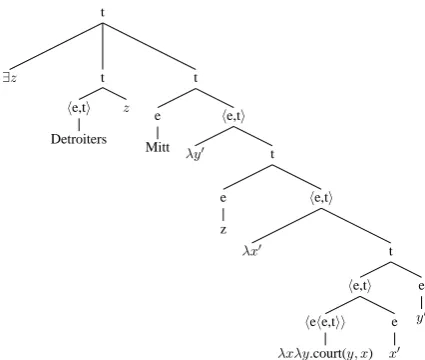
Mitt through substitution into the higher enode, and some Detroiters through substitution into the lowereand adjoining to the roott. When a deriva-tion results with two trees in a single tree set, we assume that they may combine together, with the scope part adjoining to the variable part, result-ing in the derived semantic structure in Figure 5. Turn now to the derivation of the putatively prob-lematic inverse linking case (1), repeated here.
(1) Mitt courted every person at some
fundraiser. (∃>∀,∀>∃)
Note first of all, that our multicomponent proach to the semantics of predicates can be ap-plied to prepositions as well, as seen in Figure 6. Following the derivation tree in Figure 7, the com-ponents of some fundraiser compose tree-locally into the scope part of at, one via substitution and the other via adjoining, just as in the derivation just sketched. Next, both components of at’s semantics combine (tree locally) with the scope component of every person, via adjoining at either of the 2-linkedtnodes in the quantifier tree set of the same form as the one in Figure 1. If such
NPNP* PP
P at
DP↓1
t 11 e↓ he,ti
λz′ t*
he,ti
he,ti* ∧ he,ti
hehe,tii
λxλy.at(y, x) e z′
[image:4.595.74.332.664.739.2]Figure 6: Two-Part Predicate Trees for at
joining targets the highertnode, the inverse link-ing obtains, while surface scope derives from the lower attachment. Now, the derived object quanti-fier every person at some fundraiser can combine with the verbal predicate as we saw, with scope ambiguity with respect to the subject determined by the ordering of the combinations into the ver-bal scope tree.
Our conception of predicate-headed elemen-tary trees also yields a tree-local treatment of cases of scopal interleaving like (2), repeated here:
(2) Some professor remembered to review
every paper (that he promised to review). (∃>∀>remembered)
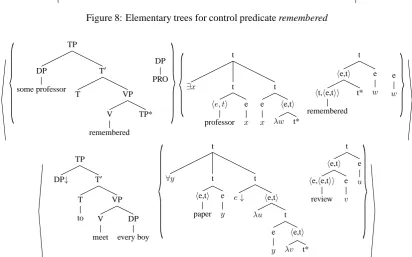
As before, the tree set representing the object quantifier (tree locally) adjoins and substitutes into the scope component of the (embedded) verb, whose representation will be like the verbal tree in Figure 4. The semantics of the matrix verb
remember will also involve both scope and
vari-able components, though this time there be an ad-ditional variable component corresponding to the controlled argument in the embedded clause. The resulting tree set is given in Figure 8. Interest-ingly, this tree set is in fact identical to the one adopted by Nesson and Shieber (2008) in their treatment of control. Although they do not ex-plain their motivation for adopting this tree, it is clear that the use of lambda abstraction is driven by the need to have the subject argument of the matrix predicate to bind the variables saturating the external arguments of both the control and embedded predicates. What is less clear is why the lambda operator lies in a separate component from the lexical predicate, and it is this separation that is necessary to derive the scope interleaving. Under the current proposal, the separation of the lambda expression from the lexical predicate into two components is a general property of seman-tic elementary tree sets. Returning to the
deriva-courted
every person
at
some fundraiser
two politicians
T VP
V
remembered TP*
DP
PRO
t
e↓ he,ti
λw t*
t
he,ti
ht,he,tii remembered
t* e
w e
w
[image:5.595.88.501.165.422.2]Figure 8: Elementary trees for control predicate remembered
TPDP
some professor
T′
T VP
V
remembered TP*
DP
PRO
t
∃x t
he, ti professor
e
x t
e
x
he,ti
λw t*
t
he,ti
ht,he,tii remembered
t* e
w e
w
TP
DP↓ T′ T
to
VP
V
meet DP
every boy
t∀y t
he,ti
paper e
y t
e↓ he,ti
λu t
e
y
he,ti
λv t*
t
he,ti he,he,tii
review e
v e
u
Figure 9: Matrix and embedded derived auxiliary trees for interleaving scope in (2)
tion of (2), the matrix quantifier some professor will combine tree-locally into the scope compo-nent of the remembered tree set. The result of these derivational steps is the two derived tree sets in Figure 9. The matrix clause’s tree set will now combine tree locally into the scope component of the embedded clause’s tree: because of the control relation, it must combine with this tree if we are to be able to substitute the e-type variable (con-tributed by the control predicate) into the exter-nal argument slot of review. Now, by adjoining the scope component of the matrix clause at the root of this scope component, and adjoining the predicate+variable component of the matrix at the foot node of this component, we derive the de-sired relative scopes. As before, we assume that the remaining components are composed to com-plete the derivation.
Our approach extends to cases discussed by Nesson and Shieber, where additional scopal in-terleaving arises because of matrix adverbials:
(4) Every boy always wants to eat some food. (always>∃>∀>wants)
The treatment of such cases depends crucially on the incorporation of temporal arguments into semantic elementary trees, about which see Storoshenko and Frank (this volume). We assume that such arguments are lambda bound in the same way as othere-type arguments, in distinct scope components, and this allows us to treat temporal dependencies in a manner similar to control. In the (semantic side of the) derivation of (4), always combines with the temporal scope component of
point in the derivation, even if they remain tree lo-cal. Specifically, we first adjoin the variable and e-type scope components of the matrix predicate to the scope component of the eat tree set. Then, we combine the scope component of eats together with its variable component, and finally we adjoin the temporal scope component.
As already noted, Nesson and Shieber argue that tree local derivations cannot generate inter-pretations for relative clauses with pied-piping, as in (3).
(3) John saw a soccer player whose picture every boy bought.
(∃soccer player>∀boy>∃picture)
In fact, we can generate an interpretation for this example by making use of a relative clause tree rather different from the one assumed by Nesson and Shieber. First of all, we apply our split seman-tics to the verbally-headed relative clause tree set, shown in Figure 10. This tree includes the famil-iar structure of a t-recursive scope part, and the predicate component. We assume that the exis-tential force associated with pied-piped relatives is in fact associated with this verbally-headed tree set, and is present in the scope part of this set. In addition, this tree set includes a component rep-resenting the relative operator, into which the re-maining components may substitute. To a degree, this mirrors those accounts that treat the lambda operator associated with the relative as a part of the semantics of the relative pronoun in that the
he,ti-recursive tree carries only that operator, and takes the remainder of the clause material as an argument via substitution. Though space prevents us form justifying this assumption, we take the semantics of a relativizing DP with a possessive wh-phrase to be of type he,he,tii, so that a wh-phrase like whose picture is assigned an interpre-tation like λxλy.yis a picture ofx. The deriva-tion of (3) proceeds by substituting such a rela-tivizing DP and its associated semantics into the 1 -annotated nodes in Figure 10, and combining the universal quantifier at the 2 -annotated nodes. By adjoining the scope part of the quantifier to the higher t node, we can derive the scope indicated in (3), while adjoining at the lower t node will yield a narrow scope interpretation for the uni-versal (where the choice of picture does not vary scope with the boy).
4 Scope Rigidity
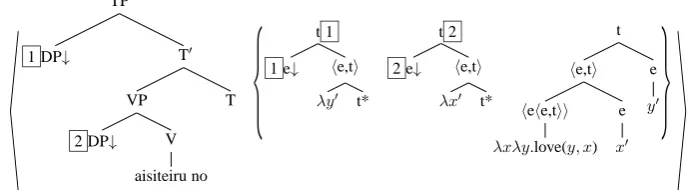
In addition to providing a tree-local analysis of certain problematic cases, our proposal for the structure of semantic elementary trees also pro-vides an account of a phenomenon that has re-ceived relatively little attention in the TAG liter-ature (but cf. Freedman and Frank (2010), Freed-man (2012)). In contrast to English, where sub-ject and obsub-ject quantifiers often permit both linear and inverse scope, languages like Japanese exhibit scope rigidity, where the scopal relation among quantifiers is fixed by hierarchical order. This is shown in the following example from Hoji (1985).
(5) Dareka-ga someone-NOM
daremo-o everyone-ACC
aisiteiru. love ‘Someone loves everyone.’ (∃>∀, *∀>∃)
Such scope facts are challenging for any analy-sis which relies on multiple adjoining at a sin-gletnode for all arguments of a given predicate, as scope permutations are predicted to take place freely within a clause so long as the two argu-ments can combine with verb in either order.
NP CP
DPi↓1 C′
C TP
DP↓2 T′
T VP
V
bought DPi
t
he,ti
he,ti* ∧ he,ti
λx t↓
t 2
∃y t
he.ti
1he,he.tii↓ e
y
e
x
t 2
he,ti
λz t* e↓2
t
he,ti
he,he,tii
bought e
y
e
z
[image:7.595.79.514.75.214.2]Figure 10: Elementary tree set for pied-piped relative clause in 3
TP1 DP↓ T′
VP
2 DP↓ V aisiteiru no
T
t 1
1 e↓ he,ti
λy′ t*
t 2
2 e↓ he,ti
λx′ t*
t
he,ti
hehe,tii
λxλy.love(y, x) e
x′
e
y′
Figure 11: Split scope components for scope rigidity in (5)
combination must take place in a tree-local man-ner, we derive the unavoidable conclusion that the quantifiers cannot permute with one another: each quantifier tree set substitutes and adjoins to its as-sociated verbal scope tree, with no possibilities for multiple adjoining.
Scope is however not always rigid in Japanese. When an object scrambles past the subject, as in (6), we find the kind of ambiguity familiar from English.
(6) Daremo-oi
someone-NOM
dareka-ga everyone-ACC
ti
aisiteiru. love
‘Everyone, someone loves.’ (∃>∀,∀>∃)
Such circumvention of canonical scope could of course be modeled by allowing clauses involving scrambling to be derived by an English-like tree set. However, a more intriguing possibility re-tains the idea of multiple scope trees in Japanese, as in in Figure 11, but removes the hierarchy con-straint that we have imposed on the final positions of the scope trees. Scope ambiguity then results because of multiple possibilities for collapsing the
verbal tree set at the end of the derivation. But why would the verbal tree underlying (6) differ in this way from the one underlying (5)? We propose that hierarchy constraints on components of a se-mantic multicomponent set are the reflection of syntactic hierarchy. In a canonical sentence, the syntax determines a unique hierarchical relation among the arguments, giving rise to a unique pos-sibility for scope. With scrambling, where the ob-ject is represented syntactically in both a base and surface position, the hierarchical relation between subject and object is underdetermined, yielding scopal flexibility.
5 A Note on Expressiveness: Scope vs. Scrambling
[image:7.595.121.467.255.350.2]associated verbs. The reviewer cites examples of the form in 7, claiming that all scopal orderings of the quantifiers are possible.
(7) Every professor wanted to ask some TA to tell every student to stay at home.
If this is right, the results in Becker et al. (1992) concerning the complexity of scrambling would immediately tell us that scopal dependen-cies could not be completely captured using tree-local MCTAG.
We see a number of difficulties with this argu-ment. The first of these concerns commutativity of quantifiers. As is well-known, two formulas of first order logic that are distinguished only by the relative order of two quantifiers of the same type (i.e., both universal or both existential) do not have distinct truth conditions. As a result, it is not possible on meaning grounds to distinguish between an ordering of the quantifiers in (7) un-der which the most embedded universal has scope above the matrix universal or immediately below it. Because of the limited number of quantifier types of natural language, the number of distin-guishable scopes will be limited in way that does not parallel the situation with scrambling, where all word orders are easily distinguished. As a re-sult, it remains to be determined whether Becker et al.’s arguments can be adapted to the case of scope, where the set of (semantically distinct) scopes is not equivalent to the set of permutations of the quantifiers.
A second problem for this argument parallels a similar one that has been pointed out for scram-bling. As Joshi et al. (2000) note, all word or-der permutations up to a certain depth of embed-ding can be generated with tree-local MCTAG using elementary trees of a linguistically plau-sible sort. To show that a grammar for scram-bling requires greater power, we must appeal to more complex cases, whose empirical status is not clear. And although it is not unreasonable to as-sume that the grammar of scrambling does indeed generalize in way that produces all permutations of arguments over arbitrary levels of embedding including the empirically murky cases (as Ram-bow (1994) does), Joshi et al. (2000) argue that it is equally sensible to assume that the grammar generates only a subset of the possible cases, be-cause of limits on its generative capacity, so long as this includes all of the cases that are
indis-putably acceptable to speakers. The situation with scope seems to us completely parallel. Although many scopings are imaginable in examples like (7) and more complex cases along the same lines, the empirical situation is far from clear with re-spect to which interpretations are actually avail-able to speakers. Therefore, the prudent course seems to us to be one which explores the empiri-cal landscape of these cases, in an attempt to find cases that demand additional power.
Acknowledgments
We would like to thank the TAG+11 anonymous reviewers for their helpful comments. This work has been partially funded by SSHRC Postdoc Fel-lowship 756-2010-0677 to Storoshenko.
References
Tilman Becker, Owen Rambow, and Michael Niv. 1992. The derivational generative power of scram-bling is beyond LCFRS. Technical Report IRCS 92-38, Institute for Research in Cognitive Science, University of Pennsylvania.
Daniel Feinstein and Shuly Wintner. 2008. Highly constrained unification grammars. Journal of Logic, Language and Information, 17(3):345–381. Michael Freedman and Robert Frank. 2010.
Re-stricting inverse scope in STAG. In Proceedings of the 10thInternational Workshop on Tree Adjoining Grammars and Related Formalisms. Yale Univer-sity.
Michael Freedman. 2012. Scope economy and TAG locality. In Proceedings of the 11th International Workshop on Tree Adjoining Grammars and Re-lated Formalisms.
Hajime Hoji. 1985. Logical Form and Configura-tional Structures in Japanese. Ph.D. thesis, Uni-versity of Washington.
Mark Johnson. 1988. Attribute Value Logic and Theory of Grammar. CSLI Lecture Notes Series. Chicago: University of Chicago Press.
Aravind K. Joshi, Tilman Becker, and Owen Rambow. 2000. Complexity of scrambling: A new twist on the competence-performance distinction. In Anne Abeill´e and Owen Rambow, editors, Tree Adjoin-ing Grammars: Formalisms, LAdjoin-inguistic Analysis and Processing, pages 167–181. CSLI Publications, Stanford, CA.
Laura Kallmeyer and Maribel Romero. 2008. Scope and situation binding in LTAG using semantic uni-fication. Research on Language and Computation, 6(3):3–52.
William Marsh and Barbara Partee. 1984. How non-context-free is variable binding? In M. Cobler, S. MacKaye, and M. Wescoat, editors, Proceedings of the West Coast Conference on Formal Linguis-tics, pages 179–190. Stanford University.
Rebecca Nesson and Stuart M. Shieber. 2008. Syn-chronous vector TAG for syntax and semantics: Control verbs, relative clauses, and inverse linking. In Claire Gardent and Anoop Sarkar, editors, Pro-ceedings of the 9thInternational Workshop on Tree Adjoining Grammars and Related Formalisms. Owen Rambow. 1994. Formal and Computational
Aspects of Natural Language Syntax. Ph.D. thesis, University of Pennsylvania, Philadelphia, PA. Yves Schabes and Stuart M. Shieber. 1994. An
alternative conception of tree-adjoining derivation. Computational Linguistics, 20(1):91–124.