On the Robustness of Syntactic and Semantic
Features for Automatic MT Evaluation
Jes ´us Gim´enez and Llu´ıs M`arquez
TALP Research Center, LSI Department Universitat Polit`ecnica de Catalunya Jordi Girona Salgado 1–3, E-08034, Barcelona
{jgimenez,lluism}@lsi.upc.edu
Abstract
Linguistic metrics based on syntactic and semantic information have proven very effective for Automatic MT Evaluation. However, no results have been presented so far on their performance when applied to heavily ill-formed low quality transla-tions. In order to glean some light into this issue, in this work we present an empirical study on the behavior of a heterogeneous set of metrics based on linguistic analysis in the paradigmatic case of speech transla-tion between non-related languages. Cor-roborating previous findings, we have ver-ified that metrics based on deep linguis-tic analysis exhibit a very robust and sta-ble behavior at the system level. How-ever, these metrics suffer a significant de-crease at the sentence level. This is in many cases attributable to a loss of recall, due to parsing errors or to a lack of parsing at all, which may be partially ameliorated by backing off to lexical similarity.
1 Introduction
Recently, there is a growing interest in the devel-opment of automatic evaluation metrics which ex-ploit linguistic knowledge at the syntactic and se-mantic levels. For instance, we may find metrics which compute similarities over shallow syntac-tic structures/sequences (Gim´enez and M`arquez, 2007; Popovic and Ney, 2007), constituency trees (Liu and Gildea, 2005) and dependency trees (Liu and Gildea, 2005; Amig´o et al., 2006; Mehay and Brew, 2007; Owczarzak et al., 2007). We may also find metrics operating over shallow semantic structures, such as named entities and se-mantic roles (Gim´enez and M`arquez, 2007).
Linguistic metrics have been proven to produce more reliable system rankings than metrics
limit-ing their scope to the lexical dimension, in partic-ular when applied to test beds with a rich system typology, i.e., test beds in which there are auto-matic outputs produced by systems based on dif-ferent paradigms, e.g., statistical, rule-based and human-aided (Gim´enez and M`arquez, 2007). The reason is that they are able to capture deep MT quality distinctions which occur beyond the shal-low level of lexical similarities.
However, these metrics have the limitation of relying on automatic linguistic processors, tools which are not equally available for all languages and whose performance may vary depending on the type of analysis conducted and the applica-tion domain. Thus, it could be argued that lin-guistic metrics should suffer a significant quality drop when applied to a different translation do-main, or to ill-formed sentences. Clearly, met-ric scores computed on partial or wrong syntac-tic/semantic structures will be less informed. But, should this necessarily lead to less reliable eval-uations? In this work, we have analyzed this is-sue by conducting a contrastive empirical study on the behavior of a heterogeneous set of metrics over several evaluation scenarios of decreasing transla-tion quality. In particular, we have studied the case of Chinese-to-English speech translation, which is a paradigmatic example of low quality and heavily ill-formed output.
2 A Heterogeneous Metric Set
We have used a heterogeneous set of metrics se-lected out from the metric repository provided with the IQMT evaluation package (Gim´enez and M`arquez, 2007)1. We have considered several metric representatives from different linguistic levels (lexical, syntactic and semantic). A brief description of the metric set is available in Ap-pendix A.
In addition, taking advantage of newly available semantic processors, we have designed a novel family of metrics based on the Discourse Repre-sentation Theory, a theoretical framework offer-ing a representation language for the examination of contextually dependent meaning in discourse (Kamp, 1981). A discourse is represented in a discourse representation structure (DRS), which is essentially a variation of first-order predicate cal-culus —its forms are pairs of first-order formulae and the free variables that occur in them.
2.1 Exploiting Semantic Similarity for Automatic MT Evaluation
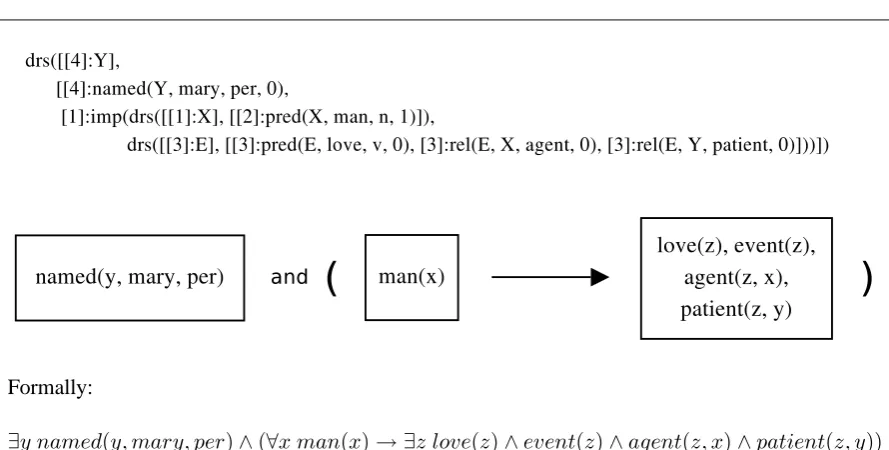
‘DR’ metrics analyze similarities between auto-matic and reference translations by comparing their respective DRSs. These are automatically obtained using the C&C Tools (Clark and Cur-ran, 2004)2. Sentences are first parsed on the basis of a combinatory categorial grammar (Bos et al., 2004). Then, the BOXER component (Bos, 2005) extracts DRSs. As an illustration, Figure 1 shows the DRS representation for the sentence “Every man loves Mary.”. The reader may find the out-put of the BOXER component (top) together with the equivalent first-order formula (bottom).
DRS may be viewed as semantic trees, which are built through the application of two types of DRS conditions:
basic conditions: one-place properties (pred-icates), two-place properties (relations), named entities, time-expressions, cardinal expressions and equalities.
complex conditions: disjunction, implication, negation, question, and propositional attitude operations.
Three kinds of metrics have been defined:
1
http://www.lsi.upc.edu/∼nlp/IQMT
2http://svn.ask.it.usyd.edu.au/trac/
candc
DR-STM-l (Semantic Tree Matching) These
metrics are similar to the Syntactic Tree Matching metric defined by Liu and Gildea (2005), in this case applied to DRSs instead of constituency trees. All semantic subpaths in the candidate and the reference trees are retrieved. The fraction of matching subpaths of a given length, l ∈ [1..9], is computed. Then, average accumulated scores up to a given length are retrieved. For instance, ‘DR-STM-4’ corresponds to the average accumu-lated proportion of matching subpaths up to length-4.
DR-Or-t These metrics compute lexical
overlap-ping3between discourse representation struc-tures (i.e., discourse referents and discourse conditions) according to their type ‘t’. For instance, ‘DR-Or-pred’ roughly reflects lexi-cal overlapping between the referents associ-ated to predicates (i.e., one-place properties), whereas ‘DR-Or-imp’reflects lexical overlap-ping between referents associated to implica-tion condiimplica-tions. We also introduce the
‘DR-Or-⋆’metric, which computes average lexical overlapping over all DRS types.
DR-Orp-t These metrics compute
morphosyn-tactic overlapping (i.e., between parts of speech associated to lexical items) between discourse representation structures of the same type t. We also define the ‘DR-Or p-⋆’ metric, which computes average morphosyn-tactic overlapping over all DRS types.
Note that in the case of some complex condi-tions, such as implication or question, the respec-tive order of the associated referents in the tree is important. We take this aspect into account by making order information explicit in the con-struction of the semantic tree. We also make ex-plicit the type, symbol, value and date of condi-tions when these are applicable (e.g., predicates, relations, named entities, time expressions, cardi-nal expressions, or anaphoric conditions).
Finally, the extension to the evaluation setting based on multiple references is computed by as-signing the maximum score attained against each individual reference.
Formally:
[image:3.595.76.521.53.278.2]∃y named(y, mary, per)∧(∀x man(x)→ ∃z love(z)∧event(z)∧agent(z, x)∧patient(z, y))
Figure 1: DRS representation for “Every man loves Mary.”
3 Experimental Work
In this section, we present an empirical study on the behavior of a heterogeneous set of metrics based on linguistic analysis in the case of speech translation between non-related languages.
3.1 Evaluation Scenarios
We have used the test bed from the Chinese-to-English translation task at the “2006 Evalua-tion Campaign on Spoken Language TranslaEvalua-tion” (Paul, 2006)4. The test set comprises 500 transla-tion test cases corresponding to simple conversa-tions (question/answer scenario) in the travel do-main. In addition, there are 3 different evalua-tion subscenarios of increasing translaevalua-tion diffi-culty, according to the translation source:
CRR: Translation of correct recognition results
(as produced by human transcribers).
ASR read: Translation of automatic read speech
recognition results.
ASR spont: Translation of automatic
sponta-neous speech recognition results.
For the purpose of automatic evaluation, 7 hu-man reference translations and automatic outputs by 14 different MT systems for each evaluation subscenario are available. In addition, we count on the results of a process of manual evaluation.
4
http://www.slc.atr.jp/IWSLT2006/
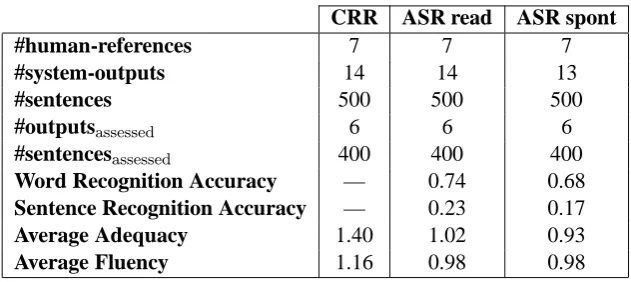
For each subscenario, 400 test cases from 6 differ-ent system outputs were evaluated, by three human assessors each, in terms of adequacy and fluency on a 1-5 scale (LDC, 2005). A brief numerical de-scription of these test beds is available in Table 1. It includes the number of human references and system outputs available, as well as the number of sentences per output, and the number of system outputs and sentences per system assessed. For the sake of completeness, we report the performance of the Automatic Speech Recognition (ASR) sys-tem, in terms of accuracy, over the source Chinese utterances, both at the word and sentence levels. Also, in order to give an idea of the translation quality exhibited by automatic systems, average adequacy and fluency scores are also provided.
3.2 Meta-Evaluation
Our experiment requires a mechanism for evaluat-ing the quality of evaluation metrics, i.e., a meta-evaluation criterion. The two most prominent are:
CRR ASR read ASR spont
#human-references 7 7 7
#system-outputs 14 14 13
#sentences 500 500 500
#outputsassessed 6 6 6
#sentencesassessed 400 400 400
Word Recognition Accuracy — 0.74 0.68
Sentence Recognition Accuracy — 0.23 0.17
Average Adequacy 1.40 1.02 0.93
[image:4.595.141.457.60.201.2]Average Fluency 1.16 0.98 0.98
Table 1: IWSLT 2006 MT Evaluation Campaign. Chinese-to-English test bed description
• Human Likeness: Metrics are evaluated in terms of their ability to capture the fea-tures which distinguish human from auto-matic translations. The underlying assump-tion is that good translaassump-tions should resemble human translations. Human likeness is usu-ally measured on the basis of discriminative power (Lin and Och, 2004b; Amig´o et al., 2005).
In this work, metrics are evaluated both in terms of human acceptability and human likeness. In the case of human acceptability, metric quality is mea-sured on the basis of correlation with human as-sessments both at the sentence and document (i.e., system) levels. We compute Pearson correlation coefficients. The sum of adequacy and fluency is used as a global measure of quality. Assessments from different judges have been averaged.
In the case of human likeness, we use the proba-bilistic KING measure defined inside theQARLA Framework (Amig´o et al., 2005). KING repre-sents the probability, estimated over the set of test cases, that the score attained by a human reference is equal or greater than the score attained by any automatic translation. Although KING computa-tions do not require human assessments, for the sake of comparison, we have limited to the set of test cases counting on human assessments.
3.3 Results
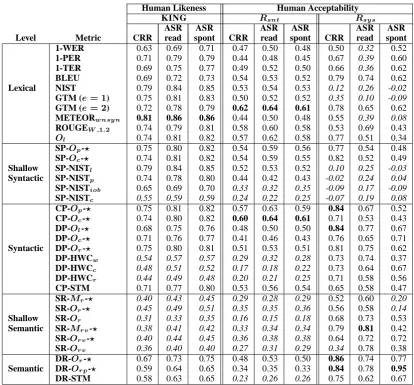
Table 2 presents meta-evaluation results for a set of metric representatives from different linguistic levels over the three subscenarios defined (‘CRR’, ‘ASR read’ and ‘ASR spont’). Highest scores in each column have been highlighted. Lowest scores appear in italics.
System-level Behavior
At the system level (Rsys, columns 7-9), the
high-est quality is in general attained by metrics based on deep linguistic analysis, either syntactic or se-mantic. Among lexical metrics, the highest cor-relation is attained by BLEU and the variant of GTM rewarding longer matchings (e= 2).
As to the impact of sentence ill-formedness, while most metrics at the lexical level suffer a sig-nificant variation across the three subscenarios, the performance of metrics at deeper linguistic levels is in general quite stable. However, in the case of the translation of automatically recognized spon-taneous speech (ASR spont) we have found that the ‘SR-Or-⋆’ and ‘SR-Mr-⋆’ metrics, respectively
based on lexical overlapping and matching over semantic roles, suffer a very significant decrease far below the performance of most lexical metrics. Although ‘SR-Or-⋆’ has performed well on other
test beds (Gim´enez and M`arquez, 2007), its low performance over the BTEC data suggests that it is not fully portable across all kind of evaluation scenarios.
Finally, it is highly remarkable the degree of ro-bustness exhibited by semantic metrics introduced in Section 2.1. In particular, the metric variants based on lexical and morphosyntactic overlapping over discourse representations (‘DR-Or-⋆’and
‘DR-Orp-⋆’, respectively), obtain a high system-level correlation with human assessments across the three subscenarios.
Sentence-level Behavior
At the sentence level (KING and Rsnt, columns
Human Likeness Human Acceptability
KING Rsnt Rsy s
ASR ASR ASR ASR ASR ASR
Level Metric CRR read spont CRR read spont CRR read spont
1-WER 0.63 0.69 0.71 0.47 0.50 0.48 0.50 0.32 0.52
1-PER 0.71 0.79 0.79 0.44 0.48 0.45 0.67 0.39 0.60
1-TER 0.69 0.75 0.77 0.49 0.52 0.50 0.66 0.36 0.62
BLEU 0.69 0.72 0.73 0.54 0.53 0.52 0.79 0.74 0.62
Lexical NIST 0.79 0.84 0.85 0.53 0.54 0.53 0.12 0.26 -0.02
GTM (e= 1) 0.75 0.81 0.83 0.50 0.52 0.52 0.35 0.10 -0.09
GTM (e= 2) 0.72 0.78 0.79 0.62 0.64 0.61 0.78 0.65 0.62
METEORw nsy n 0.81 0.86 0.86 0.44 0.50 0.48 0.55 0.39 0.08
ROUGEW1.2 0.74 0.79 0.81 0.58 0.60 0.58 0.53 0.69 0.43
Ol 0.74 0.81 0.82 0.57 0.62 0.58 0.77 0.51 0.34
SP-Op-⋆ 0.75 0.80 0.82 0.54 0.59 0.56 0.77 0.54 0.48
SP-Oc-⋆ 0.74 0.81 0.82 0.54 0.59 0.55 0.82 0.52 0.49
Shallow SP-NISTl 0.79 0.84 0.85 0.52 0.53 0.52 0.10 0.25 -0.03
Syntactic SP-NISTp 0.74 0.78 0.80 0.44 0.42 0.43 -0.02 0.24 0.04
SP-NISTiob 0.65 0.69 0.70 0.33 0.32 0.35 -0.09 0.17 -0.09
SP-NISTc 0.55 0.59 0.59 0.24 0.22 0.25 -0.07 0.19 0.08
CP-Op-⋆ 0.75 0.81 0.82 0.57 0.63 0.59 0.84 0.67 0.52
CP-Oc-⋆ 0.74 0.80 0.82 0.60 0.64 0.61 0.71 0.53 0.43
DP-Ol-⋆ 0.68 0.75 0.76 0.48 0.50 0.50 0.84 0.77 0.67
DP-Oc-⋆ 0.71 0.76 0.77 0.41 0.46 0.43 0.76 0.65 0.71
Syntactic DP-Or-⋆ 0.75 0.80 0.81 0.51 0.53 0.51 0.81 0.75 0.62
DP-HWCw 0.54 0.57 0.57 0.29 0.32 0.28 0.73 0.74 0.37
DP-HWCc 0.48 0.51 0.52 0.17 0.18 0.22 0.73 0.64 0.67
DP-HWCr 0.44 0.49 0.48 0.20 0.21 0.25 0.71 0.58 0.56
CP-STM 0.71 0.77 0.80 0.53 0.56 0.54 0.65 0.58 0.47
SR-Mr-⋆ 0.40 0.43 0.45 0.29 0.28 0.29 0.52 0.60 0.20
SR-Or-⋆ 0.45 0.49 0.51 0.35 0.35 0.36 0.56 0.58 0.14
Shallow SR-Or 0.31 0.33 0.35 0.16 0.15 0.18 0.68 0.73 0.53
Semantic SR-Mr v-⋆ 0.38 0.41 0.42 0.33 0.34 0.34 0.79 0.81 0.42
SR-Or v-⋆ 0.40 0.44 0.45 0.36 0.38 0.38 0.64 0.72 0.72
SR-Or v 0.36 0.40 0.40 0.27 0.31 0.29 0.34 0.78 0.38
DR-Or-⋆ 0.67 0.73 0.75 0.48 0.53 0.50 0.86 0.74 0.77
Semantic DR-Or p-⋆ 0.59 0.64 0.65 0.34 0.35 0.33 0.84 0.78 0.95
[image:5.595.91.506.59.444.2]DR-STM 0.58 0.63 0.65 0.23 0.26 0.26 0.75 0.62 0.67
Table 2: Meta-evaluation results for a set of metric representatives from different linguistic levels
same domain in which systems have been trained. Therefore, translation outputs have a strong ten-dency to share the sublanguage (i.e., word selec-tion and word ordering) represented by the prede-fined set of human reference translations.
Metrics based on lexical overlapping and matching over shallow syntactic categories and syntactic structures (‘SP-Op-⋆’,‘SP-Oc-⋆’,‘CP-Op-⋆’,
‘CP-Oc-⋆’, ‘DP-Ol-⋆’,‘DP-Oc-⋆’, and ‘DP-Or-⋆’)
per-form similarly to lexical metrics. However, com-puting NIST scores over base phrase chunk se-quences (‘SP-NISTiob’, ‘SP-NISTc’) is not as
effec-tive. Metrics based on head-word chain match-ing (‘DP-HWCw’,‘DP-HWCc’,‘DP-HWCr’) suffer also
a significant decrease. Interestingly, the metric based on syntactic tree matching (‘CP-STM’) per-formed well in all scenarios.
Metrics at the shallow semantic level suffer also a severe drop in performance. Particularly signif-icant is the case case of the‘SR-Or’metric, which
does not consider any lexical information. Inter-estingly, the ‘SR-Orv’ variant, which only differs in that it distinguishes between SRs associated to different verbs, performs slightly better.
At the semantic level, metrics based on lex-ical and morphosyntactic overlapping over dis-course representations (‘DR-Or-⋆’ and ‘DR-Orp-⋆’)
suffer only a minor decrease, whereas semantic tree matching (‘DR-STM’) reports as a specially bad predictor of human acceptability (Rsnt).
Human Likeness Human Acceptability
KING Rsnt Rsy s
ASR ASR ASR ASR ASR ASR
Level Metric CRR read spont CRR read spont CRR read spont
Lexical NIST 0.79 0.84 0.85 0.53 0.54 0.53 0.12 0.26 -0.02
GTM (e= 2) 0.72 0.78 0.79 0.62 0.64 0.61 0.78 0.65 0.62
METEORw nsy n 0.81 0.86 0.86 0.44 0.50 0.48 0.55 0.39 0.08
Ol 0.74 0.81 0.82 0.57 0.62 0.58 0.77 0.51 0.34
CP-Op-⋆ 0.75 0.81 0.82 0.57 0.63 0.59 0.84 0.67 0.52
Syntactic CP-Oc-⋆ 0.74 0.80 0.82 0.60 0.64 0.61 0.71 0.53 0.43
DP-Ol-⋆ 0.68 0.75 0.76 0.48 0.50 0.50 0.84 0.77 0.67
SR-Mr-⋆ 0.40 0.43 0.45 0.29 0.28 0.29 0.52 0.60 0.20
SR-Mr-⋆b 0.68 0.72 0.73 0.31 0.30 0.31 0.52 0.60 0.20
SR-Mr-⋆i 0.84 0.86 0.88 0.34 0.34 0.34 0.56 0.63 0.25
SR-Or-⋆ 0.45 0.49 0.51 0.35 0.35 0.36 0.56 0.58 0.14
SR-Or-⋆b 0.71 0.75 0.78 0.38 0.38 0.38 0.56 0.58 0.14
SR-Or-⋆i 0.84 0.88 0.89 0.41 0.41 0.41 0.62 0.60 0.22
SR-Or 0.31 0.33 0.35 0.16 0.15 0.18 0.68 0.73 0.53
SR-Or b 0.54 0.58 0.60 0.19 0.18 0.20 0.68 0.73 0.53
Shallow SR-Or i 0.72 0.77 0.79 0.26 0.26 0.27 0.80 0.73 0.67
Semantic SR-Mr v-⋆ 0.38 0.41 0.42 0.33 0.34 0.34 0.79 0.81 0.42
SR-Mr v-⋆b 0.70 0.73 0.74 0.34 0.35 0.34 0.79 0.81 0.42
SR-Mr v-⋆i 0.88 0.90 0.92 0.36 0.38 0.37 0.81 0.82 0.45
SR-Or v-⋆ 0.40 0.44 0.45 0.36 0.38 0.38 0.64 0.72 0.72
SR-Or v-⋆b 0.72 0.76 0.77 0.38 0.40 0.39 0.64 0.72 0.72
SR-Or v-⋆i 0.88 0.90 0.91 0.40 0.42 0.41 0.69 0.74 0.74
SR-Or v 0.36 0.40 0.40 0.27 0.31 0.29 0.34 0.78 0.38
SR-Or v b 0.66 0.70 0.71 0.29 0.32 0.30 0.34 0.78 0.38
SR-Or v i 0.83 0.86 0.88 0.33 0.36 0.33 0.49 0.82 0.56
DR-Or-⋆ 0.67 0.73 0.75 0.48 0.53 0.50 0.86 0.74 0.77
DR-Or-⋆b 0.69 0.75 0.77 0.50 0.53 0.50 0.90 0.69 0.56
Semantic DR-Or-⋆i 0.83 0.87 0.89 0.53 0.57 0.53 0.88 0.70 0.61
DR-Or p-⋆ 0.59 0.64 0.65 0.34 0.35 0.33 0.84 0.78 0.95
DR-Or p-⋆b 0.61 0.65 0.67 0.35 0.36 0.34 0.86 0.71 0.57
DR-Or p-⋆i 0.80 0.84 0.85 0.43 0.46 0.43 0.90 0.75 0.70
DR-STM 0.58 0.63 0.65 0.23 0.26 0.26 0.75 0.62 0.67
DR-STM-b 0.64 0.68 0.71 0.23 0.26 0.27 0.75 0.62 0.67
[image:6.595.92.505.59.444.2]DR-STM-i 0.83 0.87 0.87 0.33 0.36 0.36 0.84 0.63 0.66
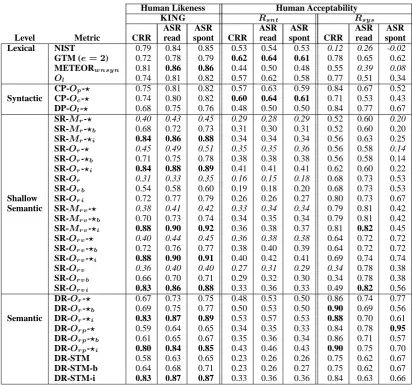
Table 3: Meta-evaluation results. Improved sentence-level evaluation of SR and DR metrics
Improved Sentence-level Behavior
By inspecting particular instances, we have found that linguistic metrics are, in many cases, unable to produce any evaluation result. The number of un-scored sentences is particularly significant in the case of SR metrics. For instance, the ‘SR-Or-⋆’
metric is unable to confer an evaluation score in 57% of the cases. Several reasons explain this fact. The first and most important is that linguistic met-rics rely on automatic processors trained on out-of-domain data, which are, thus, prone to error. Second, we argue that the test bed itself does not allow for fully exploiting the capabilities of these metrics. Apart from being based on a reduced vo-cabulary (2,346 distinct words), test cases consist mostly of very short segments (14.64 words on av-erage), which in their turn consist of even shorter sentences (8.55 words on average)5.
5Vocabulary size and segment/sentence average lengths have been computed over the set of reference translations.
A possible solution could be to back off to a measure of lexical similarity in those cases in which linguistic processors are unable to produce any linguistic analysis. This should significantly increase their recall. With that purpose, we have designed two new variants for each of these met-rics. Given a linguistic metricx, we define:
• xb →by backing off to lexical overlapping, Ol, only when the linguistic processor was
not able to produce a parsing. Lexical scores are conveniently scaled so that they are in a similar range to x scores. Specifically, we multiply them by the averagexscore attained over all other test cases for which the parser succeeded. Formally, given a test case t be-longing to a set of test casesT:
xb(t) =
(
x(t) if t∈ok(T)
Ol(t) P
j∈ok(T)x(j)
whereok(T) is the subset of test cases inT
which were successfully parsed.
• xi → by linearly interpolating x and Ol
scores for all test cases, via arithmetic mean:
xi(t) =
x(t) +Ol(t)
2
In both cases, system-level scores are calculated by averaging over all sentence-level scores.
Table 3 shows meta-evaluation results on the performance of these variants for several repre-sentatives from the SR and DR families. For the sake of comparison, we also show the scores at-tained by the base versions, and by some of the top-scoring metrics from other linguistic levels.
The first observation is that in all cases the new variants outperform their respective base metric, being linear interpolation the best alternative. The increase is particularly significant in terms of hu-man likeness. New variants even outperform lex-ical metrics, including the Ol metric, which
sug-gests that, in spite of its simplicity, this is a valid combination scheme. However, in terms of human acceptability, the gain is only moderate, and still their performance is far from top-scoring metrics.
Sentence-level improvements are also reflected at the system level, although to a lesser extent. Interestingly, in the case of the translation of au-tomatically recognized spontaneous speech (ASR spont, column 9), mixing with lexical overlap-ping improves the low-performance ‘SR-Or’ and ‘SR-Orv’ metrics, at the same time that it causes
a significant drop in the high-performance‘DR-Or’ and‘DR-Orp’metrics. Still, the performance of
lin-guistic metrics at the sentence level is under the performance of lexical metrics. This is not sur-prising. After all, apart from relying on automatic processors, linguistic metrics focus on very par-tial aspects of quality. However, since they operate at complementary quality dimensions, their scores are suitable for being combined.
4 Conclusions and Future Work
We have presented an empirical study on the ro-bustness of a heterogeneous set of metrics operat-ing at different loperat-inguistic levels for the particular case of Chinese-to-English speech translation of basic travel expressions. As an additional contri-bution, we have presented a novel family of met-rics which operate at the semantic level by analyz-ing discourse representations.
Corroborating previous findings by Gim´enez and M`arquez (2007), results at the system level, show that metrics guided by deeper linguistic knowledge, either syntactic or semantic, are, in general, more effective and stable than metrics which limit their scope to the lexical dimension.
However, at the sentence level, results indicate that metrics based on deep linguistic analysis are not as reliable overall quality estimators as lexical metrics, at least when applied to low quality trans-lations, as it is the case. This behavior is mainly at-tributable a drop in recall due to parsing errors. By inspecting particular sentences we have observed that in many cases these metrics are unable to pro-duce any result. In that respect, we have showed that backing off to lexical similarity is a valid and effective strategy so as to improve the performance of these metrics.
But the most remarkable result, in relation to the goal of this work, is that syntactic and semantic metrics exhibit a very robust behavior across the three evaluation subscenarios of decreasing trans-lation quality analyzed. Therefore, sentence ill-formedness is not a limiting factor in the perfor-mance of linguistic metrics. The quality drop, when moving from the system to the sentence level, seems, thus, more related to a shift in the application domain.
For future work, we are currently studying the possibility of further improving the sentence-level behavior of present evaluation methods by com-bining the outcomes of metrics at different linguis-tic levels into a single measure of quality (citation omitted for the sake of anonymity).
Acknowledgements
This research has been funded by the Span-ish Ministry of Education and Science, project OpenMT (TIN2006-15307-C03-02). Our NLP group has been recognized as a Quality Research Group (2005 SGR-00130) by DURSI, the Re-search Department of the Catalan Government. We are grateful to the SLT Evaluation Campaign organizers and participants for providing such valuable test beds.
References
Pro-ceedings of the 43rd Annual Meeting of the Associa-tion for ComputaAssocia-tional Linguistics (ACL).
Enrique Amig ´o, Jes´us Gim´enez, Julio Gonzalo, and Llu´ıs M`arquez. 2006. MT Evaluation: Human-Like vs. Human Acceptable. In Proceedings of the Joint 21st International Conference on Com-putational Linguistics and the 44th Annual Meet-ing of the Association for Computational LMeet-inguistics (COLING-ACL).
Satanjeev Banerjee and Alon Lavie. 2005. METEOR: An Automatic Metric for MT Evaluation with Im-proved Correlation with Human Judgments. In Pro-ceedings of ACL Workshop on Intrinsic and Extrin-sic Evaluation Measures for MT and/or Summariza-tion.
Johan Bos, Stephen Clark, Mark Steedman, James R. Curran, and Julia Hockenmaier. 2004. Wide-Coverage Semantic Representations from a CCG Parser. In Proceedings of the 20th International Conference on Computational Linguistics (COL-ING), pages 1240–1246.
Johan Bos. 2005. Towards Wide-Coverage Seman-tic Interpretation. In Proceedings of the Sixth In-ternational Workshop on Computational Semantics, pages 42–53.
Stephen Clark and James R. Curran. 2004. Parsing the WSJ using CCG and Log-Linear Models. In Pro-ceedings of the 42nd Annual Meeting of the Asso-ciation for Computational Linguistics (ACL), pages 104–111.
George Doddington. 2002. Automatic Evaluation of Machine Translation Quality Using N-gram Co-Occurrence Statistics. In Proceedings of the 2nd In-ternation Conference on Human Language Technol-ogy, pages 138–145.
Jes´us Gim´enez and Llu´ıs M`arquez. 2007. Linguis-tic Features for AutomaLinguis-tic Evaluation of Heteroge-neous MT Systems. In Proceedings of the ACL Workshop on Statistical Machine Translation, pages 256–264.
Hans Kamp. 1981. A Theory of Truth and Seman-tic Representation. In J.A.G. Groenendijk, T.M.V. Janssen, , and M.B.J. Stokhof, editors, Formal Meth-ods in the Study of Language, pages 277–322, Ams-terdam. Mathematisch Centrum.
LDC. 2005. Linguistic Data Annotation Specification: Assessment of Adequacy and Fluency in Trans-lations. Revision 1.5. Technical report, Linguis-tic Data Consortium. http://www.ldc.upenn.edu/-Projects/TIDES/Translation/TransAssess04.pdf.
Chin-Yew Lin and Franz Josef Och. 2004a. Au-tomatic Evaluation of Machine Translation Qual-ity Using Longest Common Subsequence and Skip-Bigram Statics. In Proceedings of the 42nd Annual Meeting of the Association for Computational Lin-guistics (ACL).
Chin-Yew Lin and Franz Josef Och. 2004b. OR-ANGE: a Method for Evaluating Automatic Evalu-ation Metrics for Machine TranslEvalu-ation. In Proceed-ings of the 20th International Conference on Com-putational Linguistics (COLING).
Ding Liu and Daniel Gildea. 2005. Syntactic Features for Evaluation of Machine Translation. In Proceed-ings of ACL Workshop on Intrinsic and Extrinsic Evaluation Measures for MT and/or Summarization.
Dennis Mehay and Chris Brew. 2007. BLEUATRE: Flattening Syntactic Dependencies for MT Evalu-ation. In Proceedings of the 11th Conference on Theoretical and Methodological Issues in Machine Translation (TMI).
I. Dan Melamed, Ryan Green, and Joseph P. Turian. 2003. Precision and Recall of Machine Transla-tion. In Proceedings of the Joint Conference on Hu-man Language Technology and the North American Chapter of the Association for Computational Lin-guistics (HLT-NAACL).
Sonja Nießen, Franz Josef Och, Gregor Leusch, and Hermann Ney. 2000. An Evaluation Tool for Ma-chine Translation: Fast Evaluation for MT Research. In Proceedings of the 2nd International Conference on Language Resources and Evaluation.
Karolina Owczarzak, Josef van Genabith, and Andy Way. 2007. Dependency-Based Automatic Eval-uation for Machine Translation. In Proceedings of SSST, NAACL-HLT/AMTA Workshop on Syntax and Structure in Statistical Translation, pages 80–87.
Kishore Papineni, Salim Roukos, Todd Ward, and Wei-Jing Zhu. 2001. Bleu: a method for automatic eval-uation of machine translation, RC22176. Technical report, IBM T.J. Watson Research Center.
Michael Paul. 2006. Overview of the IWSLT 2006 Evaluation Campaign. In Proceedings of the In-ternational Workshop on Spoken Language Trans-lation, pages 1–15.
Maja Popovic and Hermann Ney. 2007. Word Error Rates: Decomposition over POS classes and Appli-cations for Error Analysis. In Proceedings of the Second Workshop on Statistical Machine Transla-tion, pages 48–55, Prague, Czech Republic, June. Association for Computational Linguistics.
Matthew Snover, Bonnie Dorr, Richard Schwartz, Lin-nea Micciulla, and John Makhoul. 2006. A Study of Translation Edit Rate with Targeted Human An-notation. In Proceedings of AMTA, pages 223–231.
A Metric Set
Metrics are grouped according to the linguistic di-mension at which they operate:
• Lexical Similarity
WER (Nießen et al., 2000). PER (Tillmann et al., 1997). BLEU (Papineni et al., 2001). NIST (Doddington, 2002). GTM (Melamed et al., 2003). ROUGE (Lin and Och, 2004a).
METEOR. (Banerjee and Lavie, 2005). TER (Snover et al., 2006).
Ol(Gim´enez and M`arquez, 2007). Ol is a
short name for lexical overlapping. Au-tomatic and reference translations are considered as unordered sets of lexical items. Ol is computed as the
cardinal-ity of the intersection of the two sets di-vided into the cardinality of their union.
• Shallow Syntactic Similarity (SP)
SP-Op-⋆. Average lexical overlapping over
parts-of-speech.
SP-Oc-⋆. Average lexical overlapping over
base phrase chunk types.
SP-NIST. NIST score over sequences of: SP-NISTlLemmas.
SP-NISTpParts-of-speech. SP-NISTcBase phrase chunks. SP-NISTiobChunk IOB labels.
• Syntactic Similarity
On Dependency Parsing (DP)
DP-HWC Head-word chain matching
(HWCM), as presented by Liu and Gildea (2005), but slightly modi-fied so as to consider different head-word chain types:
DP-HWCwwords. DP-HWCccategories. DP-HWCrrelations.
In all cases only chains up to length 4 are considered.
DP-Ol|Oc|Or These metrics
cor-respond exactly to the LEVEL, GRAM and TREE metrics intro-duced by Amig´o et al. (2006):
DP-Ol-⋆ Average overlapping
be-tween words hanging at the same level of the tree.
DP-Oc-⋆Average overlapping
be-tween words assigned the same grammatical category.
DP-Or-⋆Average overlapping
be-tween words ruled by the same type of grammatical relations.
On Constituency Parsing (CP)
CP-STM Syntactic tree matching (STM), as presented by Liu and Gildea (2005), i.e., limited up to length-4 subtrees.
CP-Op-⋆ Average lexical
overlap-ping over parts-of-speech, similarly to ‘SP-Op-⋆’, except that
parts-of-speech are now consistent with the full parsing.
CP-Oc-⋆ Average lexical overlapping
over phrase constituents. The differ-ence between this metric and‘SP-Oc
-⋆’ is in the phrase scope. In trast to base phrase chunks, con-stituents allow for phrase embed-ding and overlapping.
• Shallow-Semantic Similarity
On Semantic Roles (SR)
SR-Or-⋆ Average lexical overlapping
between SRs of the same type.
SR-Mr-⋆ Average lexical matching
between SRs of the same type.
SR-OrOverlapping between semantic
roles independently from their lexi-cal realization.
We also consider a more restrictive ver-sion of these metrics (‘SR-Mr v-⋆’,
‘SR-Or v-⋆’, and ‘SR-Or v’), which require SRs to be associated to the same verb.
• Semantic Similarity
On Discourse Representations (DR) DR-STM Average semantic tree
matching considering semantic subtrees up to length 4.
DR-Or-⋆Average lexical overlapping
between DRSs of the same type.
DR-Orp-⋆ Average morphosyntactic