Improving Twitter Named Entity Recognition using Word
Representations
Zhiqiang Toh, Bin Chen and Jian Su Institute for Infocomm Research
1 Fusionopolis Way Singapore 138632
{ztoh,bchen,sujian}@i2r.a-star.edu.sg
Abstract
This paper describes our system used in the ACL 2015 Workshop on Noisy User-generated Text Shared Task for Named Entity Recognition (NER) in Twitter. Our system uses Conditional Random Fields to train two separate classifiers for the two evaluations: predicting 10 fine-grained types, and segmenting named entities. We focus our efforts on generating word rep-resentations from large amount of unla-beled newswire data and tweets. Our experiment results show that cluster fea-tures derived from word representations significantly improve Twitter NER perfor-mances. Our system is ranked 2nd for both evaluations.
1 Introduction
Named Entity Recognition (NER) is the task of identifying and categorizing the various mentions of people, organizations and other named entities within the text. NER has been an essential analysis component in many Natural Language Processing (NLP) systems, especially information extraction and question answering.
Traditionally, the NER system is trained and applied on long and formal text such as the newswire. From the beginning of the new millen-nium, user-generated content from the social me-dia websites such as Twitter and Weibo presents a huge compilation of informative but noisy and in-formal text. This rapidly growing text collection becomes more and more important for NLP tasks such as sentiment analysis and emerging topic de-tection.
However, standard NER system trained on for-mal text does not work well on this new and chal-lenging style of text. Therefore, adapting the NER system to the new and challenging Twitter
domain has attracted increasing attention of re-searchers. The ACL 2015 Workshop on Noisy User-generated Text (W-NUT) Shared Task for NER in Twitter is organized in response to these new changes (Tim Baldwin, 2015).
We participated in the above Shared Task, which consists of two separate evaluations: one where the task is to predict 10 fine-grained types (10types) and the other in which only named entity segments are predicted (notypes).
For both evaluations, we model the problem as a sequential labeling task, using Conditional Ran-dom Fields (CRF) as the training algorithm. An additional postprocessing step is applied to further refine the system output.
The remainder of this paper is structured as fol-lows. In Section 2, we report on the external re-sources used by our system and how they are ob-tained and processed. In Section 3, the features used are described in details. In Section 4, the ex-periment and official results are presented. Finally, Section 5 summarizes our work.
2 External Resources
External resources have shown to improve the per-formances of Twitter NER (Ritter et al., 2011). Our system uses a variety of external resources, either publicly available, or collected and prepro-cessed by us.
2.1 Freebase Entity Lists
We use the Freebase entity lists provided by the task organizers. For some of the lists that are not provided (e.g. a list of sports facilities), we man-ually collect them by calling the appropriate Free-base API.
2.2 Unlabeled Corpora
We gather unlabeled corpora from three differ-ent sources: (1) Pre-trained word vectors gen-erated using the GloVe tool (Pennington et al.,
2014)1, (2) English Gigaword Fifth Edition2, and
(3) raw tweets collected between the period of March 2015 and April 2015.
For English Gigaword, all articles ofstorytype are collected and tokenized. Further preprocess-ing is performed by followpreprocess-ing the cleanpreprocess-ing step described in Turian et al. (2010). This results in a corpus consisting of 76 million sentences.
The collected raw tweets are tokenized3
and non-English tweets are removed using langid.py (Lui and Baldwin, 2012), resulting in a total of 14 million tweets.
3 Features
This section briefly describes the features used in our system. Besides the features commonly used in traditional NER systems, we focus on the use of word cluster features that have shown to be ef-fective in previous work (Ratinov and Roth, 2009; Turian et al., 2010; Cherry and Guo, 2015).
3.1 Word Feature
The current word and its lowercase format are used as features. To provide additional context in-formation, the previous word and next word (in original format) are also used.
3.2 Orthographic Features
Orthographic features based on regular expres-sions are often used in NER systems. We only use the following two orthographic features: Initial-Cap ([A-Z][a-z].*) and AllCaps ([A-Z]+). In addition, the first character and last two charac-ters of each word are used as features.
3.3 Gazetteer Feature
The current word is matched with entries in the Freebase entity lists and the feature value is the type of entity list matched.
3.4 Word Cluster Features
Unsupervised word representations (e.g. Brown clustering) have shown to improve the perfor-mance of NER. Besides brown clusters, we also use clusters generated using the K-means algo-rithm. These two kinds of clusters are generated from the processed Gigaword and tweet corpora (Section 2.2).
1http://nlp.stanford.edu/projects/glove/ 2https://catalog.ldc.upenn.edu/LDC2011T07
3The tweet tokenization script can be found at https://github.com/myleott/ark-twokenize-py
Brown clusters are generated using the imple-mentation by Percy Liang4. We experiment with
different cluster sizes ({100,200,500,1000}), re-sulting in different cluster files for each of the cor-pora. For each cluster file, different minimum oc-currences ({5,10,20}) and binary prefix lengths ({4,6,· · ·,14,16}) are tested. For each word in the tweet, its corresponding binary prefix string representation is used as the feature value.
K-means clusters are generated using two dif-ferent methods. The first method uses the word2vectool (Mikolov et al., 2013)5. By
vary-ing the minimum occurrences ({5,10,20}), word vector size ({50,100,200,500,1000}), cluster size ({50,100,200,500,1000}) and sub-sampling threshold ({0.00001,0.001}), different cluster files are generated and tested. Similar to the Brown cluster feature, the name of the cluster that each word belongs to is used as the feature value.
The second method uses the GloVe tool to generate global vectors for word representation6.
As the GloVe tool does not output any form of clusters, K-mean clusters are generated from the global vectors using the K-means implementa-tion from Apache Spark MLlib7. Similarly, by
varying the minimum count ({5,10,20,50,100}), window size ({5,10,15,20}), vector size ({50,100,200,500,1000}), and cluster size ({50,100,200,500,1000}), different cluster files are generated and tested.
We also generate K-mean cluster files us-ing the pre-trained GloVe word vectors (trained from Wikipedia 2014 and Gigaword Fifth Edi-tion, Common Crawl and Twitter data) in the same manner.
We create a cluster feature for each cluster file that is found to improve the 5-fold cross valida-tion performance. As there are over 800 cluster files, we only test a random subset of cluster files each time and select the best cluster file from the subset to create a new cluster feature. The proce-dure is repeated for a new subset of cluster files, until no (or negligible) improvement is obtained. Our final settings use one Brown cluster feature and six K-means cluster features (for both 10types and notypes settings).
4https://github.com/percyliang/brown-cluster/ 5https://code.google.com/p/word2vec/
6Due to memory constraints, only the tweet corpus is used to generate global vectors.
10types
[image:3.595.117.482.61.161.2]Feature Fold 1 Fold 2 Fold 3 Fold 4 Fold 5 Overall Word Feature 25.76 23.93 27.59 28.01 9.69 23.94 + Orthographic Features 36.48 35.64 41.20 43.27 25.34 37.03 + Gazetteer Feature 44.36 43.94 48.22 44.84 30.35 42.94 + Word Cluster Features 55.85 57.49 60.07 58.35 44.99 55.95 + Postprocessing 56.09 57.82 60.07 58.88 45.78 56.31
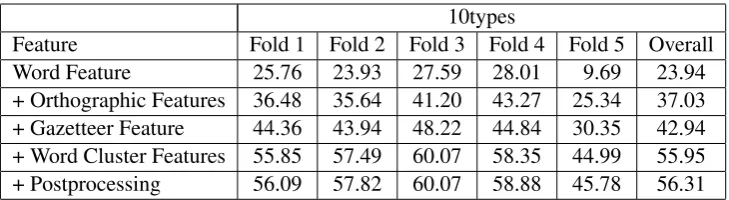
Table 1: 5-fold cross-validation F1 performances for the 10types evaluation. Each row uses all features added in the previous rows.
notypes
[image:3.595.118.483.206.306.2]Feature Fold 1 Fold 2 Fold 3 Fold 4 Fold 5 Overall Word Feature 30.91 30.08 33.41 36.99 20.69 31.09 + Orthographic Features 52.06 54.29 52.22 53.11 44.49 51.62 + Gazetteer Feature 52.26 56.70 58.78 56.74 47.45 54.77 + Word Cluster Features 65.14 65.57 66.77 68.13 55.31 64.66 + Postprocessing 65.44 65.85 67.30 68.70 56.00 65.13
Table 2: 5-fold cross-validation F1 performances for the notypes evaluation. Each row uses all features added in the previous rows.
4 Experiments and Results
Our system is trained using the CRF++ tool8. We
trained separate classifiers for the two different evaluations (10types and notypes).
To select the optimum settings, we make use of all available training data (train, dev, dev_2015) and conduct 5-fold cross validation experiments. For easier comparisons with other systems, the 5 folds are split such thatdevis the test set for Fold 1, whiledev_2015is the test set for Fold 5.
4.1 Preliminary Results on Training Data
Table 1 and Table 2 shows the 5-fold cross val-idation performances after adding each feature group for the 10types and notypes evaluations re-spectively. The use of word clusters significantly improves the performances for both evaluations. There is an overall improvement of13% and9%
for the 10types and notypes evaluation respec-tively when word cluster features are added. This demonstrates the usefulness of word vectors in im-proving the accuracy of a Twitter NER system.
Comparing the performances of Fold 1 (tested on dev) and Fold 5 (tested on dev_2015), we observe a significant performance difference.
8http://taku910.github.io/crfpp/
Similar observations can also be seen for the other three folds (tested on a subset of train) when compared with Fold 5. This suggests that there are notable differences between the data provided during the training period (trainanddev) and evaluation period (dev_2015), probably because the two sets of data are collected in different time periods.
4.2 Postprocessing
10types notypes
System Rank Precision Recall F1 Rank Precision Recall F1 NLANGP 2 63.62 43.12 51.40 2 67.74 54.31 60.29
[image:4.595.108.492.62.158.2]1st 1 57.66 55.22 56.41 1 72.20 69.14 70.63 2nd 2 63.62 43.12 51.40 2 67.74 54.31 60.29 3rd 3 53.24 38.58 44.74 3 63.81 56.28 59.81 Baseline – 35.56 29.05 31.97 – 53.86 46.44 49.88
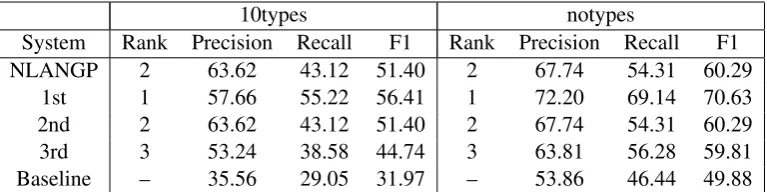
Table 3: Comparison of our system (NLANGP) with the top three participating systems and official baselines for the 10types and notypes evaluations.
10types notypes
System Precision Recall F1 Precision Recall F1 NLANGP 63.62 43.12 51.40 67.74 54.31 60.29 - Word Cluster Features 57.99 25.26 35.19 62.56 38.43 47.61 Table 4: System performances on the test data when word cluster features are not used.
4.3 Evaluation Results
Table 3 presents the official results of our 10types and notypes submissions. We also include the re-sults of the top three participating systems and of-ficial baselines for comparison.
As shown from the table, our system (NLANGP) is ranked 2nd for both evalua-tions. Based on our preliminary Fold 5 perfor-mances, our system performances on the test data (test_2015, collected in the same period as dev_2015) are within expectation. In general, the fine-grained evaluation is a more challeng-ing task, as seen from the huge performance difference between the F1 score of 10types and notypes.
Type Precision Recall F1 COMPANY 80.00 41.03 54.24 FACILITY 52.17 31.58 39.34 GEO-LOC 63.81 57.76 60.63 MOVIE 100.00 33.33 50.00 MUSICARTIST 50.00 9.76 16.33 OTHER 50.00 30.30 37.74 PERSON 70.70 64.91 67.68 PRODUCT 20.00 8.11 11.54 SPORTSTEAM 79.41 38.57 51.92 TVSHOW 0.00 0.00 0.00 Overall 63.62 43.12 51.40
Table 5: Performance of each fine-grained type of our system.
Table 5 shows the performance of each fine-grained type of our system. Unlike traditional
NER where state-of-the-art systems can achieve performances over 90 F1 for the 3 MUC types (PERSON, LOCATION and ORGANIZATION), Twitter NER poses new challenges in accurately extracting entity information in such genre that does not exist in the past.
We are interested to know the performance con-tribution of the word clusters on the test data. Ta-ble 4 shows the performances on the test data when word cluster features are not used. Simi-larly to the observations observed in the training data, word clusters are important features for our system: a performance drop greater than16%and
12%is observed for the 10types and notypes eval-uation respectively.
5 Conclusion
References
Colin Cherry and Hongyu Guo. 2015. The Unrea-sonable Effectiveness of Word Representations for Twitter Named Entity Recognition. In Proceed-ings of the 2015 Conference of the North Ameri-can Chapter of the Association for Computational Linguistics: Human Language Technologies, pages 735–745, Denver, Colorado, May–June. Association for Computational Linguistics.
Marco Lui and Timothy Baldwin. 2012. langid.py: An Off-the-shelf Language Identification Tool. In Pro-ceedings of the ACL 2012 System Demonstrations, pages 25–30, Jeju Island, Korea, July. Association for Computational Linguistics.
Tomas Mikolov, Wen-tau Yih, and Geoffrey Zweig. 2013. Linguistic Regularities in Continuous Space Word Representations. InProceedings of the 2013 Conference of the North American Chapter of the Association for Computational Linguistics: Human Language Technologies, pages 746–751, Atlanta, Georgia, June. Association for Computational Lin-guistics.
Jeffrey Pennington, Richard Socher, and Christopher Manning. 2014. Glove: Global Vectors for Word Representation. In Proceedings of the 2014 Con-ference on Empirical Methods in Natural Language Processing (EMNLP), pages 1532–1543, Doha, Qatar, October. Association for Computational Lin-guistics.
Lev Ratinov and Dan Roth. 2009. Design Chal-lenges and Misconceptions in Named Entity Recog-nition. In Proceedings of the Thirteenth Confer-ence on Computational Natural Language Learning (CoNLL-2009), pages 147–155, Boulder, Colorado, June. Association for Computational Linguistics. Alan Ritter, Sam Clark, Mausam, and Oren Etzioni.
2011. Named Entity Recognition in Tweets: An Ex-perimental Study. InProceedings of the 2011 Con-ference on Empirical Methods in Natural Language Processing, pages 1524–1534, Edinburgh, Scotland, UK., July. Association for Computational Linguis-tics.
Marie Marie Catherine de Marneffe Young-Bum Kim Alan Ritter Wei Xu Tim Baldwin, Bo Han. 2015. Findings of the 2015 Workshop on Noisy User-generated Text. InProceedings of the Workshop on Noisy User-generated Text (WNUT 2015). Associa-tion for ComputaAssocia-tional Linguistics.