Create a Manual Chinese Word Segmentation Dataset Using
Crowdsourcing Method
Shichang Wang, Chu-Ren Huang, Yao Yao, Angel Chan Department of Chinese and Bilingual Studies
The Hong Kong Polytechnic University Hung Hom, Kowloon, Hong Kong [email protected]
{churen.huang, y.yao, angel.ws.chan}@polyu.edu.hk
Abstract
The manual Chinese word segmentation datasetWordSegCHC 1.0which was built by eight crowdsourcing tasks conducted on the Crowdflower platform contains the manual word segmentation data of 152 Chinese sentences whose length ranges from20 to46 characters without punctu-ations. All the sentences received200 seg-mentation responses in their correspond-ing crowdsourccorrespond-ing tasks and the numbers of valid response of them range from123 to143 (each sentence was segmented by more than 120 subjects). We also pro-posed an evaluation method called man-ual segmentation error rate(MSER) to evaluate the dataset; the MSER of the dataset is proved to be very low which in-dicates reliable data quality. In this work, we applied the crowdsourcing method to Chinese word segmentation task and the results confirmed again that the crowd-sourcing method is a promising tool for linguistic data collection; the framework of crowdsourcing linguistic data collection used in this work can be reused in simi-lar tasks; the resultant dataset filled a gap in Chinese language resources to the best of our knowledge, and it has potential ap-plications in the research of word intuition of Chinese speakers and Chinese language processing.
1 Introduction
Chinese word segmentation which can be con-ducted by human or computer in the form of writ-ten or oral, is a hot topic receiving great inter-est from several branches of linguistics especially
from theoretical, computational and psychological linguistics, simply because it relates to or perhaps is the key to several critical theoretical and appli-cational issues, for example word definition, word intuition and Chinese language processing.
However in the traditional laboratory setting, limited by budget and/or the difficulty of large scale subject recruitment, etc., it is very difficult or even impossible to build large manual Chinese word segmentation dataset (the defining feature of this kind of dataset is that each sentence must be segmented by a large group of people in order to measure word intuition of Chinese speakers) and this hinders the availability of such language re-source. Fortunately, the crowdsourcing method perhaps can help us to solve this problem. Be-ing aware of this background, the crowdsourced manual Chinese word segmentation dataset Word-SegCHC 1.0 was built with multiple purposes in our mind.
The first purpose is to further explore the ap-plication of crowdsourcing method in language re-source building and linguistic studies in the context of the Chinese language. Crowdsourcing method is a promising tool to solve the linguistic data bot-tleneck problem which widely happens in vari-ous linguistic studies; it is efficient and economic and can help us realize much higher randomness and much larger scale in sampling; in annotation tasks we can also get much higher redundancy to help us make decisions on ambiguous cases with more confidence; although its signal-to-noise ratio (SNR) is usually lower than the traditional labora-tory method, it can yield high quality data as good as or even better than the traditional method when combined with several data quality control mea-sures including parameter optimization, screening questions, performance monitoring, data
tion, data cleansing, majority voting, peer review, spammer monitor, etc (Crump et al., 2013; Al-lahbakhsh et al., 2013; Mason and Suri, 2012; Behrend et al., 2011; Buhrmester et al., 2011; Callison-Burch and Dredze, 2010; Paolacci et al., 2010; Ipeirotis et al., 2010; Munro et al., 2010; Snow et al., 2008).
We have already successfully applied crowd-sourcing method to the semantic transparency of compound rating task and built a semantic parency dataset which contains the semantic trans-parency rating data of about 1,200 disyllabic Chi-nese nominal compounds (Wang et al., 2014a); we want to further extend the application of crowd-sourcing method to Chinese word segmentation task to further evaluate the crowdsourcing method and to build new language resource.
The second purpose is to support the studies on word intuition of Chinese speakers in general and to examine the effect of semantic transparency on word intuition in particular. Word intuition is speakers’ intuitive knowledge on wordhood, i.e., what a word is. Laymen’s word segmentation be-havior is not instructed by linguistic theories on word, but by their word intuition, hence reflects their word intuition; because of this, the word seg-mentation task has been used to measure and study word intuition (王立, 2003; Hoosain, 1992). The basic idea is like this: if a Chinese sentence is seg-mented by, for example, 100 subjects, we can then observe what slices of the sentence are consistently treated as words by these subjects, what slices are consistently treated as non-words, and what slices are not so consistent by being treated as words by some and non-words by others. This kind of seg-mentation consistency can be a convenient mea-surement of Chinese speakers’ word intuition.
Word intuition per se is an important issue awaiting more research which can contribute to the investigation of cognitive mechanism of humans’ language competence and shed new light on the theoretical problem of word definition for the the-oretical definition of word should generally accord with the speakers’ word intuition (王洪君, 2006; 王立, 2003;胡明扬, 1999;陆志韦, 1964).
Semantic transparency/compositionality of a multi-morphemic form, simply speaking, is the ex-tent to which the lexical meaning of the whole form can be derived from the lexical meanings of its constituents. More accurately speaking, this definition is merely the definition of overall
se-mantic transparency (OST) of a multi-morphemic form; besides that, there is constituent semantic transparency (CST) too which means the extent to which the lexical meaning of each constituent as a independent lexical form retains itself in the lexi-cal meaning of the whole form.
In the context of theoretical linguistics, seman-tic transparency is used as an empirical criterion of wordhood (Duanmu, 1998; 吕叔湘, 1979; Chao, 1968), but for Chinese disyllabic forms this crite-rion seems to be ignored to some extent by some linguists based on word intuition (王洪君, 2006; 冯胜利, 2004; 王立, 2003; 冯胜利, 2001; 胡明 扬, 1999;冯胜利, 1996;吕叔湘, 1979); it is also treated as an indicator of lexicalization (Packard, 2000;董秀芳, 2002;李晋霞and李宇明, 2008). In the context of psycholinguistics, it is an “ex-tremely important factor” (Libben, 1998) affect-ing the mechanism of mental lexicon, for exam-ple the representation, processing/recognition, and memorizing of multi-morphemic words (Han et al., 2014; Mok, 2009;王春茂and彭聃龄, 2000; 王春茂 et al., 2000; 王春茂 and彭聃龄, 1999; Libben, 1998; Tsai, 1994). Following this line of investigations, it is significant to examine the role semantic transparency plays in Chinese speakers’ word intuition towards Chinese disyllabic forms. When we build the dataset, we carefully select sen-tence stimuli which contain word stimuli that cover all possible kinds of semantic transparency types to enable us to examine the role semantic trans-parency plays in word intuition of Chinese speak-ers.
The widely used Chinese segmented corpora, for example, the Sinica corpus (Chen et al., 1996), are usually segmented firstly by segmentation pro-grams and then revised by experts according to certain word segmentation standard. From the in-consistent segmentation cases we can find plenty useful information to explore word intuition. But from the perspective of the measurement of Chi-nese speakers’ word intuition, the data are biased by segmentation programs and word segmentation standards, so they are not so suitable and reliable for this purpose.
seg-mentation standard. This kind of dataset which is both large and publicly accessible, to the best of our knowledge, is still a gap in Chinese language resources.
And the third purpose is that the resultant man-ual Chinese word segmentation dataset may have potential applications in the studies of Chinese lan-guage processing especially in the studies of au-tomatic Chinese word segmentation and cognitive models of Chinese language processing.
2 Construction
2.1 Materials
The stimuli of word segmentation tasks are at least phrases, but we prefer naturally occurred sen-tences. In order to cover more linguistic phenom-ena to better support the studies of word intuition, we decide to use more than 150 long sentences (the crowdsourcing method makes this possible). Meanwhile, the resultant dataset must be able to support the examination of the effect of semantic transparency on word intuition; so these sentence stimuli should also contain the words which cover all the word stimuli to be used in the examination of semantic transparency effect. So the stimuli se-lection procedure consists of two steps: (1) word selection, i.e., to select an initial set of word which covers all the word stimuli would be used in the examination of semantic transparency effect, and (2) sentence selection, i.e., to select a set of sen-tences which contains the words selected in step 1 (each sentence carries one word) and at the same time satisfy other requirements.
Word Selection
We have already created a crowdsourced seman-tic transparency dataset SimTransCNC 1.0which contains the overall and constituent semantic trans-parency rating data of about 1,200 Chinese bi-morphemic nominal compounds which have mid-range word frequencies (Wang et al., 2014a). Based on this dataset,152words are selected, for the distribution of these words, see Table 1.
These words are bimorphemic nominal com-pounds of the structure modifier-head, and cover three substructures: NN, AN, and VN. Follow-ing (Libben et al., 2003), we differentiate four transparency types: TT, TO, OT, and OO; “T” means “transparent”, and “O” means “opaque”. TT words show the highest OST scores and the most balanced CST scores, e.g., “江 水”; OO
Word Structure
Transaprency Type NN AN VN
TT 20 10 10
TO 20 6 10
OT 20 10 10
[image:3.595.339.496.64.138.2]OO 20 10 6
Table 1: Distribution of types of selected words.
words have the lowest OST scores and the most balanced CST scores, e.g., “脾 气”; TO and OT words bear mid-range OST scores and the most im-balanced CST scores, e.g., “音色” (TO) and “贵 人” (OT).
Sentence Selection
The words selected in step 1 are used as indexes, and all the sentences carrying them in Sinica cor-pus 4.0 are extracted. One sentence is selected for each word roughly according to the following cri-teria: (1) the length of sentence should be between 20 to50 characters (punctuations excluded); (2) the sentence should not contain too many punctu-ations; (3) prefer concrete and narrative sentences to abstract ones which are difficult to understand; (4) if we cannot find proper sentences from Sinica corpus for some words, we will use other corpora (only 5 sentences). In this way, a total of152 sen-tences are selected, for the length (in character) distribution, see Table 2.
Length of Sentence
Min 20
Max 46
Sum 4,946 Mean 32.54
SD 5.46
Table 2: Length distribution of selected sentences.
2.2 Crowdsourcing Task Design
Questionnaires
The core of each crowdsourcing task is a question-naire. Each questionnaire consists of five sections: (1) title, (2) instructions, (3) demographic ques-tions, (4) screening quesques-tions, and (5) segmenta-tion task; both simplified and tradisegmenta-tional Chinese character versions are provided. Section 3, de-mographic questions, asks the on-line subjects to provide their identity information on gender, age, level of education, email address (optional). Sec-tion 4, screening quesSec-tions, consists of four sim-ple questions on the Chinese language which can be used to test if a subject is a Chinese speaker or not; the first two questions are open-ended Chinese character identification questions, each question shows a picture containing a simple Chinese char-acter and asks the subject to identify that charchar-acter and type it in the text-box blow it; the third ques-tion is a close-ended homophonic character identi-fication question, it shows the subject a character and asks him/her to identify its homophonic char-acter in 10 different charchar-acters; the fourth one is a close-ended antonymous character identification question, asks the subject to identify the antony-mous character of the given one from 10 differ-ent characters. The section 4s of the eight crowd-sourcing tasks share the same question types but have different question instances. Section 5, the segmentation task, shows the subjects 19 sentence stimuli and asks them to insert a word boundary symbol (“/”) at each word boundary they perceive; the subjects are required to insert a “/” behind each punctuation and the last character of a sentence; the subjects are also informed that they need not to care about right or wrong, but just follow their intuition.
Parameters of Tasks
These eight crowdsourcing tasks are created with the following parameters: (1) each worker ac-count can only submit one response to one task; (2) each IP address can only submit one response to one task; (3) we only accept the responses from mainland China, Hong Kong, Macao, Tai-wan, Singapore, Indonesia, Malaysia, Thailand, Australia, Canada, Germany, United States, and New Zealand; (4) we pay 0.25USD for one re-sponse.
Quality Control Measures
The following quality control measures are used: (1) the section 4, screening questions, is used to
discriminate Chinese speakers from non-Chinese speakers and to block bots; (2) the section 5, the segmentation task, will keep invisible unless the first two screening questions are correctly an-swered; (3) the answers to the segmentation ques-tions in section 5 must comply with prescribed for-mat to prevent random string: a) the segmentation answer to each sentence must be only composed by the original sentence with one or zero “/” be-hind each Chinese character and each punctuation, b) in the answers behind each punctuation there must be a “/”, c) the end of an answer must be a “/”; (4) the submission attempts will be blocked unless all the required questions are answered and the answers satisfy the above conditions; (5) data cleansing will be conducted after data collection to rule out invalid responses.
2.3 Procedure
We firstly ran a small pretest task to test if the tasks were correctly designed, and it turned out that the pretest task could run smoothly. Then we launched the first task and let it run alone for about two days to further test the task design. After we finally confirmed that the tasks could really run smoothly, we launched the other seven tasks and let them run concurrently. Our aim was to collect 200responses for each task; the speed was amaz-ingly fast in the beginning, and all eight tasks re-ceived their first100responses in the first three to six days; then the speed became slower and slower, it eventually took us about 1.3 months to reach our aim; after all,Crowdfloweris not a Chinese native crowdsourcing platform, this kind of speed is un-derstandable.
2.4 Data Cleansing
All tasks successfully obtained 200 responses, however not all responses are valid. Compared to the laboratory setting, the crowdsourcing environ-ment is quite noisy by nature, so before the newly collected data can be used in any seriously analysis to draw reliable conclusions, data cleansing must be conducted.
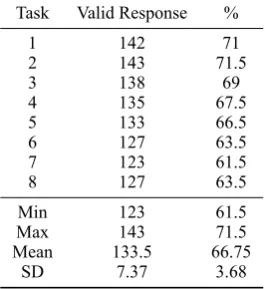
seg-ments of its 19 sentences; (4) the completion time of the response is shorter than five minutes; (5) the completion time of the response is longer than one hour. Invalid responses were ruled out; the num-bers of valid response of the eight tasks are listed in Table 3.
2.5 Results
The resultant dataset contains the manual Chinese word segmentation data of 152 sentences whose length ranges from 20 to 46 characters (M = 32.54, SD = 5.46), and each sentence is seg-mented by at least123 and at most143 subjects (M = 133.5, SD= 7.37).
Task Valid Response %
1 142 71
2 143 71.5
3 138 69
4 135 67.5
5 133 66.5
6 127 63.5
7 123 61.5
8 127 63.5
[image:5.595.115.248.265.410.2]Min 123 61.5 Max 143 71.5 Mean 133.5 66.75 SD 7.37 3.68
Table 3: Numbers of valid response of the tasks.
3 Evaluation
Although Fleiss’ kappa can be used to measure the agreement between raters, high agreement does not necessarily means high data quality especially in the situation of intuition measurement where variations among subjects are expected. And it cannot show directly how many errors the resul-tant dataset actually contains either. Knowing how many errors the dataset contains is very important to assess the reliability of the conclusions drawn from the dataset. We firstly define two kinds of manual segmentation errors, and based on that, a evaluation method called manual segmentation er-ror rate (MSER) is proposed to evaluate the resul-tant dataset.
3.1 Types of Manual Segmentation Errors
In Chinese phrases/sentences, there are three types of non-monosyllabic segments from the point of view of manual word segmentation: ridiculous segments, indivisible segments, and modest seg-ments. A ridiculous segment usually cannot be
treated as one valid unit/word, because it makes no sense in the context of the phrase/sentence; for ex-ample, in the phrase “这是好东西”, the segment “好东” cannot be treated as one unit/word, because it is incomprehensible. An indivisible segment usually cannot be divided, because it is an fixed unit and its lexical meaning cannot be derived eas-ily from the lexical meanings of its constituents (or semantically opaque); it will become incom-prehensible if it is divided; for example, in the phrase example, the segment “东西” is of this type. A modest segment can be either treated as one unit/word or divided into two or more units/words, because it is equally comprehensible no matter di-vided or not; the segment “这是” in the phrase ex-ample is of this type.
Two circumstances can be treated as errors of manual word segmentation; firstly, if a ridiculous segment appears in segmentation results, it can be treated as an error (type I error); and secondly, if an indivisible segment is divided in segmentation results, it can also be treated as an error (type II er-ror). These two circumstances are not compatible with our general word intuition even to the least extent because they are simply incomprehensible; and they cannot be explained by variations of word intuition among speakers; normally, when the sub-jects do word segmentation tasks carefully accord-ing to their word intuition, these would not occur; so we can treat them as errors. Human word seg-mentation errors will occur when the subjects try to cheat by segmenting randomly or make accidental mistakes.
3.2 Manual Segmentation Error Rate
A subject divides the phrase/sentence S into n(n ∈ N+)segments by nsegmentation
opera-tions (notn−1; the subject left the remaining seg-ment at the tail as one word, it means the subject had “confirmed” that; this is a segmentation opera-tion too). A segmentaopera-tion operaopera-tion can only yield one of the following four possible results: one type I error, one type II error, one type I error plus one type II error (two errors; e.g., “好东/西”), or no error. Supposee′ (e′ ∈N)is the number of times the type I error occurred during the segmentation process, ande′′(e′′ ∈N), the number of times the type II error occurred, then we can define manual segmentation error rate (MSER):
In extreme cases, MSER could be greater than one, for example, in the segmentation result “去 哈/尔 滨/”, e′ = 2, e′′ = 1, n = 2, so MSER = 3/2. If this happens, we just assume thatMSER= 1.MSERcan be used to evaluate manual word segmentation results; lowerMSER means better data quality. Let’s consider its col-lective form; ifS is segmented bym (m ∈ N+) subjects, and theith(1⩽i⩽m)subject’s type I error count, type II error count, and segmentation operation count are e′i, e′′i, ni respectively, then the collective form ofMSERis:
MSER=
m
∑
i=1(e
′ i+e′′i) m
∑
i=1ni
As a convenient way, we can find type I errors and their counts in the unigram frequency list of the segmentation results, and find type II errors and their counts in the bigram frequency list of the seg-mentation results.
3.3 Evaluation Procedure and Results
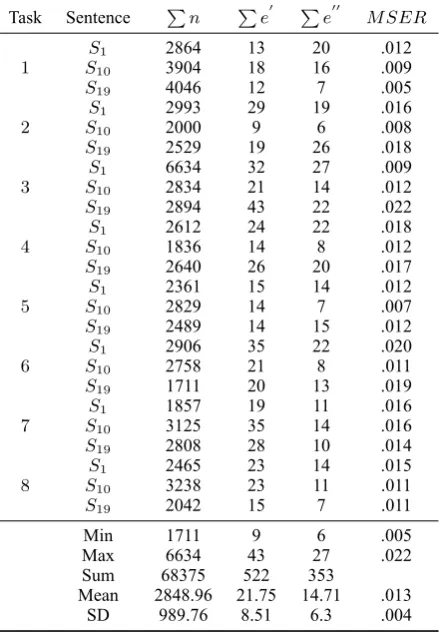
Among the 19 sentences of each task, three tences were sampled for evaluation: the first sen-tence, the middle (10th) sentence, and the last (19th) sentence. We calculated the MSER for each of them, see Table 4 for details. TheMSERs of the segmentation results of these sentences are all very low (< .05), and the mean is only.013 (SD=.004); this means the resultant dataset only contains few error and indicates that the data qual-ity is good.
4 Conclusion
We created the manual Chinese word segmentation dataset WordSegCHC 1.0 using the crowdsourc-ing method; to the best of our knowledge, there is no publicly available resources of this kind; it can support the studies of word intuition especially the effect of semantic transparency on word intuition and has potential applications in Chinese language processing.
We also proposed an evaluation method called manual segmentation error rate (MSER) to eval-uate manual word segmentation dataset. The error rate of the dataset is proved to be very low, and this indicates that its data quality is reliable.
This work also confirmed again that the crowd-sourcing method is a feasible, convenient, and
re-Task Sentence ∑n ∑e′ ∑e′′ MSER
1 SS101 28643904 1318 2016 .012.009
S19 4046 12 7 .005
2 SS101 29932000 299 196 .016.008
S19 2529 19 26 .018
3 SS101 66342834 3221 2714 .009.012
S19 2894 43 22 .022
4 SS101 26121836 2414 228 .018.012
S19 2640 26 20 .017
5 SS101 23612829 1514 147 .012.007
S19 2489 14 15 .012
6 SS101 29062758 3521 228 .020.011 S19 1711 20 13 .019
7 SS101 18573125 1935 1411 .016.016
S19 2808 28 10 .014
8 SS101 24653238 2323 1411 .015.011
S19 2042 15 7 .011 Min 1711 9 6 .005 Max 6634 43 27 .022 Sum 68375 522 353
[image:6.595.309.530.65.382.2]Mean 2848.96 21.75 14.71 .013 SD 989.76 8.51 6.3 .004
Table 4: Segmentation error rates (MSER) of the segmentation results of the eight tasks.
liable tool to collect linguistic data. And through this work, a reusable general framework of crowd-sourcing linguistic data collection is also pre-sented. Following this framework, larger similar Chinese language resources can be constructed.
We will use this dataset to examine the role of semantic transparency in word intuition of Chinese speakers and to induce the factors affecting word intuition. The consequent discoveries will deepen our understanding of the word definition problem in the Chinese language which has both theoretical and applicational significance.
In the future, once the factors modulating Chi-nese Speakers’ word intuition are clear, perhaps a computational cognitive model of Chinese word segmentation (Wu, 2011) can be proposed and we believe that this could be an interesting new direc-tion of Chinese word segmentadirec-tion research.
Acknowledgments
References
M Allahbakhsh, B Benatallah, A Ignjatovic,
HR Motahari-Nezhad, E Bertino, and S
Dust-dar. 2013. Quality control in crowdsourcing
systems: Issues and directions. IEEE Internet
Computing, 17(2):76–81.
Tara S Behrend, David J Sharek, Adam W Meade, and Eric N Wiebe. 2011. The viability of
crowdsourc-ing for survey research.Behavior research methods,
43(3):800–813.
Michael Buhrmester, Tracy Kwang, and Samuel D Gosling. 2011. Amazon’s mechanical turk a new
source of inexpensive, yet high-quality, data?
Per-spectives on Psychological Science, 6(1):3–5.
Chris Callison-Burch and Mark Dredze. 2010. Cre-ating speech and language data with amazon’s
me-chanical turk. InProceedings of the NAACL HLT
2010 Workshop on Creating Speech and Language Data with Amazon’s Mechanical Turk, pages 1–12. Association for Computational Linguistics.
Yuen Ren Chao. 1968.A grammar of spoken Chinese.
University of California Pr.
Keh-Jiann Chen, Chu-Ren Huang, Li-Ping Chang, and Hui-Li Hsu. 1996. Sinica corpus: Design method-ology for balanced corpora. In B.-S. Park and J.B.
Kim, editors, Proceeding of the 11th Pacific Asia
Conference on Language, Information and Compu-tation, pages 167–176. Seoul:Kyung Hee Univer-sity.
Matthew JC Crump, John V McDonnell, and Todd M Gureckis. 2013. Evaluating amazon’s mechanical turk as a tool for experimental behavioral research.
PloS one, 8(3):e57410.
San Duanmu. 1998. Wordhood in chinese. New
ap-proaches to Chinese word formation: Morphology, phonology and the lexicon in modern and ancient Chinese, pages 135–196.
Yi-Jhong Han, Shuo-chieh Huang, Chia-Ying Lee, Wen-Jui Kuo, and Shih-kuen Cheng. 2014. The modulation of semantic transparency on the
recogni-tion memory for two-character chinese words.
Mem-ory & Cognition, pages 1–10.
Rumjahn Hoosain. 1992. Psychological reality of the
word in chinese. Advances in psychology, 90:111–
130.
Panagiotis G Ipeirotis, Foster Provost, and Jing Wang. 2010. Quality management on amazon mechanical
turk. InProceedings of the ACM SIGKDD workshop
on human computation, pages 64–67. ACM.
Gary Libben, Martha Gibson, Yeo Bom Yoon, and Do-miniek Sandra. 2003. Compound fracture: The role of semantic transparency and morphological
headed-ness. Brain and Language, 84(1):50 – 64.
Gary Libben. 1998. Semantic transparency in the pro-cessing of compounds: Consequences for
represen-tation, processing, and impairment. Brain and
Lan-guage, 61(1):30 – 44.
Winter Mason and Siddharth Suri. 2012. Conducting
behavioral research on amazon’s mechanical turk.
Behavior research methods, 44(1):1–23.
Leh Woon Mok. 2009. Word-superiority effect as a function of semantic transparency of chinese
bimor-phemic compound words. Language and Cognitive
Processes, 24(7-8):1039–1081.
Robert Munro, Steven Bethard, Victor Kuperman, Vicky Tzuyin Lai, Robin Melnick, Christopher
Potts, Tyler Schnoebelen, and Harry Tily. 2010.
Crowdsourcing and language studies: the new
gen-eration of linguistic data. In Proceedings of the
NAACL HLT 2010 Workshop on Creating Speech and Language Data with Amazon’s Mechanical
Turk, pages 122–130. Association for Computational
Linguistics.
Jerome L Packard. 2000. The morphology of
Chi-nese: A linguistic and cognitive approach. Cam-bridge University Press.
Gabriele Paolacci, Jesse Chandler, and Panagiotis G Ipeirotis. 2010. Running experiments on amazon
mechanical turk. Judgment and Decision making,
5(5):411–419.
Rion Snow, Brendan O’Connor, Daniel Jurafsky, and Andrew Y Ng. 2008. Cheap and fast—but is it good?: evaluating non-expert annotations for
natu-ral language tasks. InProceedings of the conference
on empirical methods in natural language
process-ing, pages 254–263. Association for Computational
Linguistics.
Chih-Hao Tsai. 1994. Effects of semantic transparency on the recognition of chinese two-character words: Evidence for a dual-process model. Master’s thesis, Graduate Institute of Psychology, National Chung Cheng University, Chia-Yi, Taiwan.
Shichang Wang, Chu-Ren Huang, Yao Yao, and An-gel Chan. 2014a. Building a semantic transparency dataset of chinese nominal compounds: A practice
of crowdsourcing methodology. In Proceedings of
Workshop on Lexical and Grammatical Resources for Language Processing, pages 147–156, Dublin, Ireland, August. Association for Computational Lin-guistics and Dublin City University.
Shichang Wang, Chu-Ren Huang, Yao Yao, and Angel Chan. 2014b. Exploring mental lexicon in an ef-ficient and economic way: Crowdsourcing method
for linguistic experiments. In Proceedings of the
Zhijie Wu. 2011. A cognitive model of chinese word
segmentation for machine translation. Meta :
jour-nal des traducteurs / Meta: Translators’ Jourjour-nal, 56(3):631–644, 9.
冯胜利. 1996.论汉语的“韵律词”.中 社 科学,
(1):161–176.
冯胜利. 2001. 从韵律看汉语“词”“语”分流之大
界.中 语 , (1):27–37.
冯胜利. 2004.论汉语“词”的多维性. 语 学,
3(3):161–174.
吕叔湘. 1979.汉语语 分 .商务印书馆.
李晋霞and李宇明. 2008. 论词义的透明度.语
, (3):60–65.
王春茂and彭聃龄. 1999. 合成词加工中的词频,词
素频率及语义透明度. 学 , 31(3):266–273.
王春茂and彭聃龄. 2000. 多词素词的通达表征:分
解还是整体. 科学, 23(4):395–398.
王春茂,彭聃龄, et al. 2000. 重复启动作业中词的语
义透明度的作用. 学 , 32(2):127–132.
王洪君. 2006.从本族人语感看汉语的“词”.语
科学.
王立. 2003. 汉语词的社 语 学 . 商务印书
馆.
胡明扬. 1999.说“词语”.语 用, 3.
董秀芳. 2002. 词 : 汉语 音词的 .
四川民族出版社.