Argument linking in LTAG:
A constraint-based implementation with XMG
Laura Kallmeyer and Timm Lichte and Rainer Osswald and Simon Petitjean University of D¨usseldorf, Germany
{kallmeyer,lichte,osswald,petitjean}@phil.hhu.de
Abstract
This paper develops a first systematic approach to argument linking in LTAG, building on typologically oriented work in Van Valin (2005). While Van Valin’s ar-gument linking mechanism is procedurally defined, we propose a constraint-based im-plementation. The advantage is that we can separate between the linguistic gen-eralizations to be captured and algorith-mic considerations. The implementation is couched into the metagrammar framework eXtensible MetaGrammar (XMG).
1 Introduction
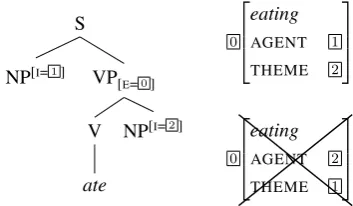
The syntax-semantics interface of Lexicalized Tree Adjoining Grammar (LTAG) builds on the as-sumptions that (i) the elementary tree of a cate contains slots for the arguments of the predi-cate, (ii) this elementary tree is paired with a se-mantic representation with sese-mantic arguments, (iii) there is a linking between syntactic argument slots and semantic arguments that makes sure that the filling of an argument node in the syntax trig-gers the insertion of a corresponding semantic rep-resentation into the linked semantic argument po-sition. This holds for the unification-based ap-proach from Kallmeyer and Joshi (2003), Gar-dent and Kallmeyer (2003) and Kallmeyer and Romero (2008) using predicate logic, for the ap-proach based on synchronous TAG (Shieber, 1994; Nesson and Shieber, 2006; Nesson and Shieber, 2008) and also for the frame-based approach of Kallmeyer and Osswald (2013). However, none of these approaches has implemented a theory which explains why only certain patterns of argument linking are allowed. In Fig. 1, for instance, the elementary tree for ate is paired with the upper
frame while the lower frame is not grammatical
S
VP[E=0]
NP[I=2] V
ate
NP[I=1]
0
eating
AGENT 1
THEME 2
0
eating
AGENT 2
THEME 1
[image:1.595.325.502.212.315.2]
Figure 1: Simple linking example
in combination with this tree because of the incor-rect linking. TheAGENThas to be contributed by
the subject while theTHEME slot is filled via the
object substitution node.
The principles and constraints underlying link-ing have been extensively investigated (Levin and Rappaport Hovav, 2005; Wechsler, 2015). Dowty (1991), for instance, introduces proto-AGENTand
proto-PATIENT as intermediate roles linking syn-tax to semantics. Van Valin (2005) presents an elaborated linking algorithm based on the macro-roles ACTOR and UNDERGOER and on the actor-undergoer-hierarchy. This algorithm is not fully
formalized, however, and it is formulated in a procedural way that mixes constraints which ex-press linguistic generalizations with algorithmic aspects. The latter point is problematic insofar as Van Valin’s linking system is intended to be used both for language understanding and lan-guage generation. It is thus desirable for a for-malization and implementation of the system to keep the principles and constraints separate from aspects of processing order.
ele-mentary pairs of tree and semantic representation. In other words, they act on the level of elementary structures in the grammar and are therefore part of the metagrammar, together with syntactic tree fragments and fragments of semantic representa-tions. This is the part of the grammar that pro-vides a systematic constraint-based definition of the set of elementary trees along with the seman-tic representations they can be paired with (Crabb´e and Duchier, 2004; Duchier et al., 2004). We will use the metagrammar compiler XMG (Crabb´e et al., 2013; Lichte and Petitjean, 2015) with frames as semantic representations (Kallmeyer and Oss-wald, 2013). Since argument linking is indepen-dent from the choice of the semantic representa-tion, our analysis could also be applied to an LTAG syntax-semantics interface using one of the other frameworks mentioned above.
2 The syntax-semantics interface
We assume familiarity with the basic notions of LTAG (Joshi and Schabes, 1997; Abeill´e and Rambow, 2000), enriched with syntactic feature structures in the usual way (Vijay-Shanker and Joshi, 1988).
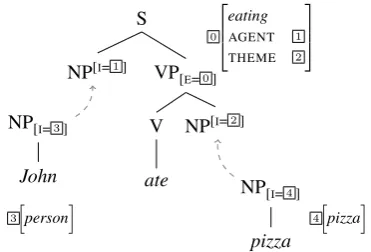
Following Kallmeyer and Osswald (2013), we pair syntactic trees with frame-semantic represen-tations, which instantiate a slightly extended vari-ant of typed feature structure. An example is given in Fig. 2. We use interface features on the
syn-tactic nodes that are responsible for triggering se-mantic composition (i.e., frame unification) via the syntactic feature unifications during substitu-tion and adjuncsubstitu-tion. These features here areI(for
“individual”) andE(for “event”), whose values are
variables that also occur in the frames. Upon sub-stituting the elementary tree ofJohninto the
sub-ject NP slot of the elementary tree ofate, the
vari-ables 1 and 3 get equated, hence triggering the unification of the frame of John with the AGENT
component of the frame ofate.
In the rest of the paper, we will be focusing on the properties of single elementary entries of verbs such asate.
3 Constraints on elementary entries
Given that in LTAG, the set of composition op-erations is rather small, the actual domain of lin-guistic theorizing lies mainly in the way elemen-tary entries like that ofatein Fig. 2 are designed,
or rather constrained. Hence, constraints
pertain-NP[I=3]
John
3 h
person
i
S
VP[E=0]
NP[I=2] V
ate
NP[I=1]
0
eating
AGENT 1
THEME 2
NP[I=4]
pizza
4 h
pizza
[image:2.595.324.510.50.176.2]i
Figure 2: Sample derivation
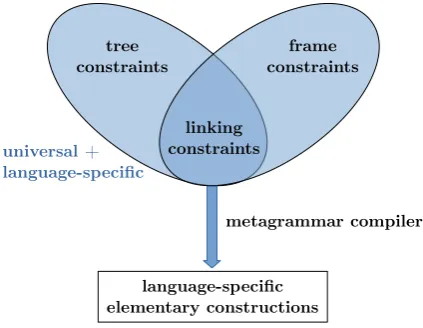
ing to the tree structure, the frame-semantic rep-resentation, and the linking among the two make up an important part of theories expressed within this framework. These constraints on elemen-tary structures constitute what is commonly called a metagrammar, the general outline of which is shown in Fig.3.
3.1 Constraints on tree structure
The most explicit and systematic proposal to constrain the shape and structure of elementary trees was made in works of Robert Frank (1992; 2002).1 Based on the Fundamental TAG
Hypothe-sis (“Every syntactic dependency is expressed lo-cally within an elementary tree.”), the inner struc-ture (Condition on Elementary Tree Minimality) and the number of non-terminal leaf nodes (θ -Criterion for TAG) are covered, the latter aspect, of course, being the more relevant here. The θ
-Criterion for TAG states that there is a bijective mapping between “θ-roles”, i.e. semantic
argu-ments, and non-terminal leaf nodes. This is met, for example, in the tree ofatebased on the shown eatingframe. Yet there is no particular
constrain-ing on what this mappconstrain-ing might look like. In other words, it is unclear how to prevent the deficient linking pattern in Fig. 1 from coming into exis-tence. This is exactly the gap that our contribution is supposed to fill.
One important remaining issue is the status of the θ-Criterion for TAG when dealing with
se-mantic frames. In its original formulation, the
θ-Criterion requires the numbers of syntactic and
semantic arguments to be equal, whereas modi-fiers are neglected. However, in a frame, there is no principled distinction between arguments and modifiers anymore – both get represented as or-dinary functional attributes. Hence, combining
theθ-Criterion, as is, with frame semantics would
have the unwanted effect that modifiers are repre-sented as nonterminal leaves just like arguments. This is unwanted because it would increase the number and size of elementary trees massively, though not ad infinitum due to the functional na-ture of frame attributes (therefore being reminis-cent of the treatment of optional arguments). Pos-sible remedies could be to apply the θ-Criterion
to descriptions of lexical frames where modifiers have not yet entered, or to insert a mediating va-lency layer that helps to abstract away from the full set of semantic roles (cf. Lichte, 2015). However, this discussion touches the issue of argument-modifier distinction more generally, and therefore should be treated elsewhere.
3.2 Constraints on frame structure
Following Kallmeyer and Osswald (2013), we for-malize semantic frames as typed feature struc-tures with base labels and relations. The frame constraints used in this paper are basically Horn clauses built from atomic attribute-value descrip-tions of the form P:a and P=. Q, where P and Q
are (possibly empty) feature paths andais a type
(including⊤and⊥). For example, the constraint thateatinginvolves anACTORand aTHEMEbut no PATHcan be formalized in this logic as follows:
eating⇒ACTOR:⊤ ∧THEME:⊤ eating∧PATH:⊤ ⇒ ⊥
3.3 Constraints on argument linking
The linking constraints in the metagrammar ba-sically combine tree constraints with frame con-straints. For instance, regarding the elementary entry ofatein Fig. 2, one such constraint could be
paraphrased as “in an active sentence, theAGENTis realized as the subject, and theTHEMEis realized
as the object”. We will learn about a systematic and typologically oriented linking theory in Sec-tion 5, which will be the starting point for our im-plementation in Section 6. The overall structure of the metagrammar, together with the metagrammar compiler, is shown in Fig. 3.
4 eXtensible MetaGrammar
The framework of eXtensible MetaGrammar (XMG, Crabb´e et al., 2013) provides description languages and dedicated compilers for generating a wide range of linguistic resources.2 Descriptions
2https://sourcesup.cru.fr/xmg/
tree constraints
frame constraints
linking constraints
metagrammarcompiler
language-specific elementary constructions
[image:3.595.312.524.52.216.2]universal+ language-specific
Figure 3: Metagrammar components
are organized into classes, alluding to the class
concept in object-oriented programming. Simi-larly, classes have encapsulated name spaces and inheritance relations may hold between them. The crucial elements of a class aredimensions. They
can be equipped with specific description lan-guages and are compiled independently, thereby enabling the grammar writer to treat the levels of linguistic information separately.
As our focus is on argument linking, the follow-ing three class dimensions, which contain the three different sorts of constraints mentioned in Fig. 3, are most relevant to us: <syn> holds tree con-straints that express dominance and precedence re-lations among nodes. Moreover, the nodes may carry (untyped) feature structures. <frame> holds frame descriptions, i.e. descriptions of typed feature structures. Feature structure constraints,
on the other hand, are specified globally outside classes. Finally,<iface>is an interface dimen-sion where (non-typed) feature structures are used to share information between other dimensions and classes. This dimension will obviously serve as a place for expressing linking constraints. The general structure of a class then looks as follows:
class classname
import someOtherClass[] export ?someVariable declare ?someVariable
{
<syn>{ ... }; <frame>{ ... }; <iface> { ... } }
ex-presses the conjunction of contents. One can also express disjunction with the operator|.
The description language used inside<frame> is a simple recursive bracket notation with the fol-lowing ingredients:
?variable1 [
type1, type2 , ... , feature2:?variable2, feature3:?variable3[ ... ] ]
Variables here correspond to the boxed variables in Fig. 1 and 2 and are optional as well. Also note that there can be more than one atomic type specified (making up conjunctive types). Fea-tures and their values are separated with the colon (:), and values can be either variables, or feature structures. See Lichte and Petitjean (2015) for a detailed definition. The descriptions inside the
<iface>dimension look very similar, the main
difference being that the feature-value separator is the equal sign (=) for historical reasons. As far as the description language in <syn>is concerned, we will ignore it for now and use graphical repre-sentations in the further presentation.
As mentioned before, feature structure con-straints (and type concon-straints), which hold globally for all frame structures inside the classes, are specified externally (see, again, Lichte and Petitjean, 2015). They are constructed in the fol-lowing way, building on the description language from (Kallmeyer and Osswald, 2013) as sketched in Section 3.2:
Constraint::=Description->Description Description::=type ... type|
feature ... feature:type|
feature ... feature=feature ... feature
-> is the implication operator, feature ...
feature stands for a path in the feature
structure, and feature ... feature =
feature ... feature for a path equation.
The atomic types which can be used in the con-straints are defined by the user. To this set are added the predefined types+and−, standing for
⊤(the most generic type) and⊥(the “false” type). Note that constraints are treated differently in the compiler: type constraints (with only types on the left-hand side) are precompiled into a type hi-erarchy, that is, the constraints on types are used to compute the set of valid conjunctive types. The result is a maximal model of the type constraints, meaning that all combinations of atomic types which are not explicitly prohibited are authorized.
The remaining set of constraints is checked at run-time.
Based on a set of constraints, XMG compiles full models (i.e., trees and frames such as in Fig. 2), which then enter into parsing. Hence, un-der this perspective, the metagrammar constraints act as lexical constraints proper. Note, however, that metagrammar constraints could also be used in parsing more directly (de la Clergerie, 2013).
5 Argument linking in Van Valin (2005)
In this section, we describe the core general-izations on argument linking proposed in Van Valin (2005), which will serve as a basis for our constraint-based implementation of argument linking in elementary trees. The basic idea is to as-sign the macrorolesACTOR(AC) and UNDERGOER
(UG) to certain semantic arguments, which are
then syntactically realized in a specific way that depends on the language and the voice type ex-pressed in the elementary tree, among others. For the purposes of this paper, we put aside the link-ing of a possible third, non-macrorole argument, which is typically realized with oblique case or by a prepositional phrase.
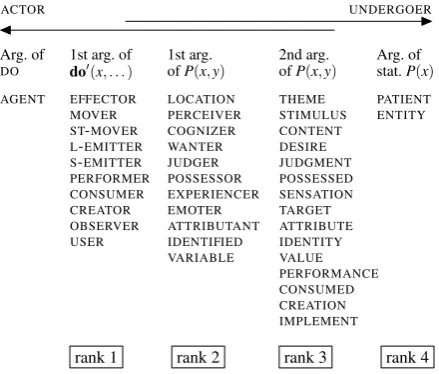
The relation between semantic roles and macro-roles is captured in the actor-undergoer hierar-chyshown in Fig. 4. Since our approach employs
frame-semantic representations, we do not make use of the positional encoding in logical structures sketched in the top line of the figure but build di-rectly on the associated semantic roles. Depend-ing on its semantic role, an event participant ob-tains a higher or a lower rank with respect to the hierarchy. For example, Fig. 4 implies that a STIMULUSargument gets assigned a lower rank
than anEXPERIENCERargument. (Note that rank 1
is considered the highest rank while rank 4 is the lowest rank.)
UNDERGOER ACTOR
Arg. of DO
1st arg. of
do′(x, . . .)
1st arg. ofP(x,y)
2nd arg. ofP(x,y)
Arg. of stat.P(x)
AGENT EFFECTOR MOVER ST-MOVER L-EMITTER S-EMITTER PERFORMER CONSUMER CREATOR OBSERVER USER
LOCATION PERCEIVER COGNIZER WANTER JUDGER POSSESSOR EXPERIENCER EMOTER ATTRIBUTANT IDENTIFIED VARIABLE
THEME STIMULUS CONTENT DESIRE JUDGMENT POSSESSED SENSATION TARGET ATTRIBUTE IDENTITY VALUE PERFORMANCE CONSUMED CREATION IMPLEMENT
PATIENT ENTITY
[image:5.595.73.293.47.234.2]rank 1 rank 2 rank 3 rank 4
Figure 4: Actor-undergoer hierarchy with seman-tic roles; adapted from Van Valin (2005, p. 58)
Macrorole assignment is only one of the steps of the linking algorithm laid out in Van Valin (2005); the subsequent step is concerned with the morpho-syntactic realization of arguments based on the assigned marcroroles. This step is dependent on the language type and it is also sensitive to voice-modulation, among others. In the case of English, for instance, if a transitive verb is anchored to an active-voice elementary tree, which can be seen as the default anchoring, then the highest ranking argument, i.e. the actor, is realized as the privi-leged syntactic argument, i.e. in subject position,
while the undergoer is realized as the direct ob-ject. In passive voice, on the other hand, the undergoer becomes the privileged syntactic argu-ment while the actor may be optionally realized by a by-clause. The general observation is that
in languages with an accusative syntactic system such as German and English, the highest ranking argument is by default realized as the privileged syntactic argument. In particular, the macrorole assignment does not matter for intransitive verbs (since there is only one argument); the single argu-ment becomes the privileged syntactic arguargu-ment, which receives nominative case in German (1-b).
(1) a. Der the.NOM
Junge
boy[AC].NOM
zerbrach broke den
the.ACC
Teller.
plate[UG].ACC
b. Der the.NOM
Teller
plate[UG].NOM
zerbrach. broke
In ergative languages, by contrast, thelowest
argu-ment with respect to the hierarchy is by default se-lected as the privileged syntactic argument, which appears in the absolutive case. If the language is syntactically accusative but morphologically erga-tive then the highest ranking argument becomes the privileged syntactic argument while the lowest ranking argument receives absolutive case. This is illustrated in the following Warlpiri examples (Van Valin, 2005, p. 109; taken from Hale 1973): the actor in (2-a) and the undergoer in (2-b) both re-ceive absolutive case.
(2) a. Ngaju-∅ 1SG[AC]-ABS
ka-rna
PRES-1SG
purla-mi. shout-NPAST
‘I am shouting.’ b. Ngaju-rlu
1SG[AC]-ERG
ka-rna-∅
PRES-1SG-3SG
wawiri-∅
kangaroo[UG]-ABS
pura-mi. cook-NPAST
‘I am cooking the kangaroo.’
6 Constraint-based implementation of Van Valin (2005)
6.1 Universal constraints on semantic frames
As a first element of our linking system, we de-fine universal constraints on semantic roles and on macroroles. Macroroles are taken to be attributes in our semantic frames, just like semantic roles.
A selection of these constraints is given in Fig. 5. The constraints are notated with the XMG syntax. They correspond to formulas in the frame logic introduced in Kallmeyer and Osswald (2013), the last constraint in Fig. 5 for instance corresponds to change-of-state ⇒ PATIENT =. RESULT PATIENT in this logic. The first two
con-straints express the fact that rank 1 arguments (=
EFFECTOR) are actors while rank 4 arguments are
undergoers. The next two constraints are two of many constraints on hierarchical relations between roles. The roles listed in Fig. 4 under a specific rank, for instance rank 2, are hierarchically or-dered. The last three constraints in this list are constraints for lifting semantic roles from the re-cursive structure of an event to a higher level. Take for instance the frame at the top of Fig. 6 for a
smashingevent, which is analyzed as a causation
involving an activity as the causing event. The 5th constraint in Fig. 5 tells us that in a causa-tionevent, theEFFECTOR of the embeddedCAUSE
is also theEFFECTORof the entirecausation.
To support these constraints, XMG’s frame di-mension has been extended, compared to Lichte and Petitjean (2015), such that it allows not only single attributes but also sequences of attributes on the left-hand sides of theφ1->φ2implications.
The example in Fig. 6 shows how these con-straints enrich the frame structure by adding new attributes to it. At the top, we have the frame rep-resenting lexical semantics ofsmash. A smashing
event is a causation where an effector performs some activity and, as a result of this, a patient changes its state into the state of being smashed. The second frame in Fig. 6 shows the enriched frame we obtain when applying the constraints from Fig. 5 to this first frame.
6.2 Semantic argument classes
The universal constraints introduced so far take care of the fact that rank 1 arguments are actors and rank 4 arguments are undergoers. But for rank 2 and rank 3 arguments, macrorole assignment is more complicated. In the following, we introduce
0 causation CAUSE " activity EFFECTOR 1 # EFFECT change-of-state PATIENT 2
RESULT hsmashed-statei
Applying the constraints from Fig. 5 yields
[image:6.595.308.519.45.339.2]0 causation EFFECTOR 1 ACTOR 1 PATIENT 2 UNDERGOER 2 CAUSE activity EFFECTOR 1 ACTOR 1 EFFECT change-of-state PATIENT 2 UNDERGOER 2 RESULT smashed-state PATIENT 2 UNDERGOER 2
Figure 6: Frame forsmashing
XMG classes for these arguments and for the dif-ferent ways of linking them to the macroroles. In contrast to the universal constraints, these classes describe possible frame fragments, i.e., they are used as being existentially quantified whenever they are integrated into some class that gets com-piled in the MG. Fig. 7 gives the classes for the arguments with a disjunction of the possible se-mantic roles. In all the XMG classes given in this section,?eand?xare XMG variables that are al-ways exported.
Concerning macrorole assignment, we have to make sure that for combinations of these argu-ments, macroroles are assigned in accordance with the constraints stated above. To this end, we use interface features. Interface features are a spe-cial dimension in our XMG classes, the<iface> dimension. They form an untyped non-recursive feature structure. When combining two classes, the interface features have to unify. In other words, their values (where specified) have to be equal. For our purposes, we need the following link-ing interface features: A featurehighest-rank that gives the highest rank in the combination of arguments, and boolean features und-lower2
and und-lower3 that indicate whether there
constraint explanation
effector:+ -> effector=actor if an effector exists, then it is the actor
patient:+ -> patient=undergoer a patient is always an undergoer mover:+ -> mover=effector a mover is always an effector
emoter:+ -> emoter=experiencer an emoter is always an experiencer
cause effector:+ ->
cause effector=effector
if the cause of a causation has an effector, then this is also the effector of the entire causation
effect patient:+ ->
effect patient=patient
if the effect of a causation has a patient, this is also the patient of the causation event
change-of-state ->
patient=result patient
[image:7.595.103.490.48.197.2]the patient of a change-of-state is the patient of the embedded result state
Figure 5: Universal constraints for semantic roles and macroroles
class argRank1
<frame>{?e[event, effector:?x] | ?e[event, mover:?x] |
?e[event, st-mover:?x] | ...}
class argRank2
<frame>{?e[event, location:?x] | ?e[event, perceiver:?x] | ...}
class argRank3
<frame>{?e[event, theme:?x] | ?e[event, stimulus:?x] | ...}
class argRank4
<frame>{?e[event, patient:?x] |
?e[event, entity:?x] }
Figure 7: XMG classes for rankiarguments
These features are needed for macrorole assign-ment. In addition, we also need the following in-terface features for linking the resulting semantic frame with a syntactic tree: features ranki that
give the frame node of the argument with rank i,
if it is present, and featureshighest-arg and
lowest-arg where highest-arg gives the
frame node of the argument with the highest rank while lowest-arggives the one with the low-est rank provided there exists a higher ranked ar-gument.
As a further step of factorizing possible argu-ment realizations in the metagrammar, for each rank, we then introduce new classes for argu-ments of this rank a) being an actor, b) be-ing an undergoer, c) without macrorole and d) not realized (if applicable). Fig. 8 gives these classes for rank 2, where all four cases are pos-sible. For each possibility, the interface features are set accordingly. For instance, if a rank 2 argument is an undergoer (see the second class in Fig. 8), there has to be a higher argument
class Rank2_actor import argRank2[]
<frame>{?e[event, actor:?x]};
<iface>{[highest-rank=r2,highest-arg=?x, rank2=?x]}
class Rank2_undergoer import argRank2[]
<frame>{?e[event,undergoer:?x]}; <iface>{[highest-rank=r1,rank2=?x,
und-lower2=false,lowest-arg=?x]}
class Rank2_no_macrorole
import argRank2[]
<iface>{[highest-rank=r1, und-lower2=true,rank2=?x]}
class Rank2_no_arg <frame>{?e[event]}
Figure 8: Rank-specific XMG classes for the dif-ferent macrorole assignments: classes for rank 2
(highest-rank=r1) and there cannot be any other lower undergoer (und-lower2=false, und-lower3=false).
The classes for rank 3 arguments are given in Fig. 9. Such an argument can either be the un-dergoer (no rank4 argument is present) or
with-out macrorole (there is a rank4argument) or not realized. In the latter case, captured in the class class Rank3 no arg, the interface features state that either there is no undergoer lower than rank 2, which allows for combinations with the first two rank 2 classes in Fig. 8. Or there is a rank 4 undergoer. In this case, a rank 2 undergoer is ex-cluded via the assignmentund-lower2=true.
Finally, for each ranki, we have a classRanki
com-class Rank3_undergoer import argRank3[]
{<frame>{?e0[event, undergoer:?x]}; <iface>{[und-lower3=false,
und-lower2=true, rank3=?x, lowest-rank=r3, lowest-arg=?x]}}
class Rank3_no_macrorole
import argRank3[]
{<iface>{[und-lower3=true, rank3=?x]}}
class Rank3_no_arg <frame>{?e[event]};
{<iface>{[und-lower2=false]} | <iface>{[und-lower2=true,
[image:8.595.304.506.53.267.2]und-lower3=true]}}
Figure 9: Classes for different macrorole assign-ments for arguassign-ments of rank3
bines theseRankiclasses (see Fig. 10).
class Rank2
{?arg=Rank2_actor[] | ?arg=Rank2_no_arg[] | ?arg=Rank2_undergoer[] | ?arg=Rank2_no_macrorole[]}; ?e=?arg.?e
class event
import Rank1[] Rank2[] Rank3[] Rank4[]
Figure 10: XMG classesRank2andevent
XMG compiles the class event into all pos-sible semantic role combinations while comput-ing the correct macrorole assignments, creatcomput-ing thereby all possible event frames.
6.3 Linking syntax and semantics
The part of the MG described in the previous two sections is language-independent. Depending on the language, the arguments with the highest and the lowest rank are realized differently in the syn-tax (see section 5). In the following, we will only introduce the XMG classes for syntax-semantics linking for English.
Recall that the interface feature
highest-arg gives the argument with the
highest rank and that lowest-arg gives the one with the lowest, provided there is a higher one. Besides these two, we also use the interface featuresrankifor linking.
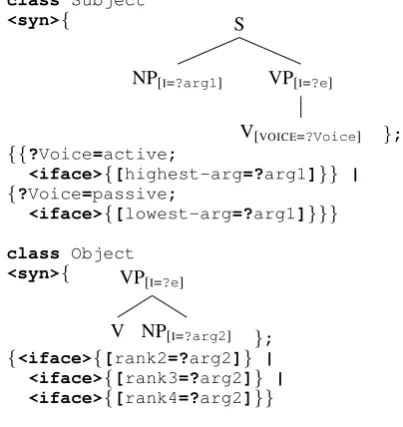
A simplified version of the syntactic XMG classes implemented for English is given in Fig. 11. The two classes for subject and object combine into the classn0Vn1for transitive verbs. Note that in our actual implementation,Subject if further decomposed and, furthermore, a range of
class Subject
<syn>{ S
VP[I=?e]
V[VOICE=?Voice]
NP[I=?arg1]
};
{{?Voice=active;
<iface>{[highest-arg=?arg1]}} |
{?Voice=passive;
<iface>{[lowest-arg=?arg1]}}}
class Object <syn>{ VP[I=?e]
NP[I=?arg2]
V };
{<iface>{[rank2=?arg2]} | <iface>{[rank3=?arg2]} | <iface>{[rank4=?arg2]}}
class n0Vn1
import Subject[] Object[] event[]
Figure 11: Language-specific XMG classes for English (simplified)
additional boolean interface features is used in or-der to constrain the combinations of arguments of different ranks in the two syntactic argument slots. The Subjectclass expresses that in active sen-tences, the highest-arg fills the subject slot while in passive sentences, this slot is filled by thelowest-arg. Further boolean interface fea-tures check that in these cases, highest-arg andlowest-argare actually given.
When limiting the semantic argument classes argRanki to just one single semantic role, the
Fur-thermore, a rank 2 argument requires a rank 3 ar-gument that could, however, be promoted to the rank 1. The implementation yields a total of 23
linking patterns. Note that this simplified imple-mentation ofn0Vn1leaves out a lot of possibil-ities for argument realizations. It considers only the case of canonical subject and object positions and does not take the possibility into account that the highest argument in passive constructions can be realized as aby-PP. All these other cases would
of course lead to more tree frame pairs.
Our analysis allows for tree frame pairs where only some of the arguments listed in the frame have corresponding syntactic slots. In other words, we implement a relaxation of the θ
-criterion for LTAG mentioned in section 3 that re-quires that each syntactic argument slot in the el-ementary tree of a predicate corresponds to a se-mantic argument slot in the frame but not nec-essarily vice versa. To what extend the stronger version of theθ-criterion, requiring a bijection
be-tween syntactic and semantic arguments, should be applied, is an open question (see section 7).
6.4 Lexical insertion
When combining a lexical item, for instance
smashed paired with the frame from Fig. 6, with
an unanchored class such asn0Vn1, the two event frames unify. Due to our relaxed implementation of the θ-criterion, this unification can enrich the
lexical frame with further semantic roles and there might even be roles coming from the lexical ele-ment that do not have a corresponding syntactic argument slot. Sometimes this might be desired. The semantics ofwalkfor instance does not
nec-essarily contain aGOALcomponent. Such a
com-ponent can however be added by a directed-motion construction as in (3).
(3) John walked into the house.
One way to prevent additional roles from being added is to constrain the frame via the interface features. We have implemented this for the ex-ample ofsmashto the effect that when anchoring
ourn0Vn1 class with the lemma smash, we
ob-tain only the elementary tree frame pair where we have active voice, theEFFECTORlinked to the
sub-ject and thePATIENTlinked to the object.
7 Conclusion
We proposed a constraint-based formulation of the principles underlying the linking algorithm from Van Valin (2005), instead of a procedural speci-fication. The advantage is not only that we can separate between the linguistic generalizations to be captured and algorithmic considerations. There is also a straightforward way to implement this with XMG and, within this metagrammar frame-work, to connect it with existing implementations of LTAG, allowing for a neat separation between language-specific and language-independent link-ing constraints. From a less technical perspective, the presented work can be seen as the first attempt to fill an important gap in the theory of the shape of elementary entries that Frank’sθ-Criterion left
open.
Acknowledgments
We thank the three anonymous reviewers for help-ful comments. The work presented in this paper was financed by the Deutsche Forschungsgemein-schaft (DFG) within the CRC 991.
References
Anne Abeill´e and Owen Rambow. 2000. Tree Ad-joining Grammar: An Overview. In Anne Abeill´e and Owen Rambow, editors,Tree Adjoining Gram-mars: Formalisms, Linguistic Analysis and Process-ing, pages 1–68. CSLI.
Benoit Crabb´e and Denys Duchier. 2004. Metagram-mar Redux. In International Workshop on Con-straint Solving and Language Processing,
Copen-hagen.
Benoit Crabb´e, Denys Duchier, Claire Gardent, Joseph Le Roux, and Yannick Parmentier. 2013. XMG: eXtensible MetaGrammar. Computational Linguis-tics, 39(3):1–66.
´Eric Villemonte de la Clergerie. 2013. Exploring beam-based shift-reduce dependency parsing with DyALog: Results from the SPMRL 2013 shared task. In4th Workshop on Statistical Parsing of Mor-phologically Rich Languages (SPMRL’2013),
Seat-tle.
David Dowty. 1991. Thematic proto-roles and argu-ment selection. Language, 67(3):547–619.
Robert Frank. 1992. Syntactic Locality and Tree Ad-joining Grammar: Grammatical, Acquisition and Processing Perspectives. Ph.D. thesis, University of
Pennsylvania.
Robert Frank. 2002. Phrase Structure Composi-tion and Syntactic Dependencies. MIT Press,
Cam-bridge, Mass.
Claire Gardent and Laura Kallmeyer. 2003. Seman-tic Construction in FTAG. InProceedings of EACL 2003, pages 123–130, Budapest.
Aravind K. Joshi and Yves Schabes. 1997. Tree-Adjoning Grammars. In G. Rozenberg and A. Salo-maa, editors,Handbook of Formal Languages, pages
69–123. Springer, Berlin.
Laura Kallmeyer and Aravind K. Joshi. 2003. Factor-ing Predicate Argument and Scope Semantics: Un-derspecified Semantics with LTAG. Research on Language and Computation, 1(1–2):3–58.
Laura Kallmeyer and Rainer Osswald. 2013. Syntax-driven semantic frame composition in Lexicalized Tree Adjoining Grammar. Journal of Language Modelling, 1:267–330.
Laura Kallmeyer and Maribel Romero. 2008. Scope and situation binding in LTAG using semantic uni-fication. Research on Language and Computation,
6(1):3–52.
Beth Levin and Malka Rappaport Hovav. 2005. Ar-gument Realization. Cambridge University Press,
Cambridge.
Timm Lichte and Simon Petitjean. 2015. Implement-ing semantic frames as typed feature structures with XMG. Journal of Language Modelling, 3(1):185–
228.
Timm Lichte. 2015. Syntax und Valenz. Zur Mod-ellierung koh¨arenter und elliptischer Strukturen mit Baumadjunktionsgrammatiken. Number 1 in
Empir-ically Oriented Theoretical Morphology and Syntax. Language Science Press, Berlin.
Rebecca Nesson and Stuart M. Shieber. 2006. Simpler TAG semantics through synchronization. In Pro-ceedings of the 11th Conference on Formal Gram-mar, Malaga, Spain, 29–30 July.
Rebecca Nesson and Stuart M. Shieber. 2008. Syn-chronous vector tag for syntax and semantics: Con-trol verbs, relative clauses, and inverse linking. In
Proceedings of the Ninth International Workshop on Tree Adjoining Grammars and Related Formalisms (TAG+ 9), T¨ubingen, Germany.
Stuart M. Shieber. 1994. Restricting the weak-generative capacity of synchronous Tree-Adjoining Grammars. Computational Intelligence, 10(4):271–
385.
Robert D. Van Valin, Jr. 2005. Exploring the Syntax-Semantics Interface. Cambridge University Press.
K. Vijay-Shanker and Aravind K. Joshi. 1988. Feature structures based tree adjoining grammar. In Pro-ceedings of COLING, pages 714–719, Budapest.
Stephen Wechsler. 2015. Word Meaning and Syntax.