1
Influences on developing Collaborative Learning Practices in Schools:
Three Cases in Three Different Countries
Justina Naujokaitiene, Department of Educational Science, Vytautas Magnus University, Kaunas, Lithuania
2
Influences on developing Collaborative Learning Practices in Schools:
Three Cases in Three Different Countries
This paper explores influences on the development of collaborative learning practices in schools. Evidence from three cases in three countries is detailed and analysed, using a theoretical framework concerned with school curricula – aims and intended learning outcomes; syllabus, learning and teaching methods; and assessment. In each of the three cases (England, Germany, and Lithuania), a review of national statutory requirements and non-statutory guidelines is supported by evidence from teacher practice (in-depth case studies), which are then viewed through a comparative case study method approach. The paper highlights influences on practice, and draws conclusions about developing effective future policy and practices.
Keywords: collaborative learning; school curriculum; policy analysis; national perspectives; curriculum development
1. Introduction
3 practices in school curricula are considered in three cases in three countries – England, Germany, and Lithuania. These countries were purposively selected, because of their different curricular backgrounds and reported collaborative learning practices: England was selected because of a lack of curricular requirements for collaborative practices, but with some specific schools implementing these; Germany was selected because schools have guidelines on curricular requirements for collaborative practices, and these are assessed; and Lithuania was selected because schools have guidelines on curricular requirements for collaborative practices, and widespread uses are reported. Comparative in-depth case studies were made in all three countries (England, Germany and
Lithuania). The evidence provides perspectives through three theoretical framework elements (grouped from the original five described by van der Akker) – aims and intended learning outcomes, syllabus, learning and teaching methods, and assessment.
2. Research Questions
This paper addresses three key research questions - what and how national and school-based influences affect teachers in developing collaborative learning practices in schools, in terms of:
• Curriculum aims and intended learning outcomes.
• Syllabus, learning and teaching methods.
• Assessment.
3. Defining Collaborative Learning
4 review of research literature on collaborative learning, educators across educational sectors have used such approaches for a long time. Collaborative learning’s most recent origins arise from concerns for adopting constructionism with social learning
approaches — sometimes referred to as “social constructivism” (Vygotsky, 1978; Wertsch, 1985; Laurillard, 2009). According to social constructivist theory, individuals develop knowledge through reflecting on, conceptualising, making links, testing and improving existing capabilities and skills. Collaboration is an action that is concerned with learning together, encouraging individual cognitive processes. In this regard, according to Papert (1997), knowledge is created in social contexts and is shaped by the way we use such contexts, while, according to Vygotsky (1978), cognitive development cannot happen without social inter-relations. Additionally, Vygotsky (1978) indicated that thinking should not be separated from affective influences, stating that social contacts are influenced not only by cognitive factors, but also by emotional elements, encouraging motivation, raising self-esteem and giving opportunity to feel and
understand one another. In developing shared understanding, self-directed learning is an iterative process in which learners discover appropriate tools and mediation that best supports exploration of specific issues (Luckin, 2010). Indeed, seeking mediation can itself clearly require collaborative endeavour.
In the research literature, collaborative learning can be described by and embedded in different terms: cooperative learning; collective learning; learning communities; peer teaching; peer learning; or team learning. The meaning of these
5 terms collaborative and cooperative learning or agreement on precisely what their differences or commonalities are. As Lai (2011) stated:
“cooperation is typically accomplished through the division of labor, with each
person responsible for some portion of the problem solving. Collaboration, on the
other hand, involves participants working together on the same task, rather than in
parallel on separate portions of the task. However, Dillenbourg et al. (1996) note
that some spontaneous division of labor may occur during collaboration. Thus, the
distinction between the two is not necessarily clear-cut.” (Lai, 2011, p. 6)
In the broadest sense, collaboration can be defined as “involving two or more people working together for a special purpose” (Cambridge Dictionary, 2016). Dillenbourg (1999) stated that the adjective “collaborative” concerns four aspects of learning: peers are more or less at the same level and can perform the same actions, have a common goal and work together; interactions take place between group members that have interactivity, synchronicity and “negotiability”; learning mechanisms must be similar to those involved in individual learning processes - induction, cognitive load, (self)-explanation, conflict; and there are effects of collaborative learning that have the potential to be measured. Kirschner (2001) later offered a view that collaborative learning has the following dimensions: learning is active; the teacher is usually more a
facilitator than an organiser of learning processes; teaching and learning are shared experiences; students participate in small-group activities; students take responsibility for learning; students reflect on their own assumptions and thought processes; and social and team skills are developed through group processes.
Collaborative learning and its benefits
6 class or society), but also it is not clear what these people are learning and, of course, whether the interaction is face-to-face or mediated via technologies. Van Boxtel, van der Linden, and Kanselaar (2000) stress that collaborative learning may be a
consequence of social interaction, stimulating the elaboration of conceptual knowledge; hence, in collaborative learning situations, students verbalise their understanding. Each approach to collaborative learning, therefore, may focus on a different aspect of the learning process, and different approaches consequently generate different conventional teaching methods, perhaps using different resources or digital technologies (Laurillard, 2009).
In the process of collaborative learning, understanding that students are
responsible for their own and each other’s learning means that an important objective is for students to help each other to understand and learn (Dooly, 2008). While learning, students take responsibility and make decisions on how they will work together, and make their contributions to the development of knowledge.
7 • Social (developing social support systems; building understanding of diversity;
establishing positive modelling and cooperation practices; developing learning communities);
• Psychological (increased self-esteem; reducing anxiety; developing positive attitudes towards teachers);
• Academic (promoting critical thinking skills; active involvement of students; improving classroom results; modelling problem-solving techniques;
personalising learning; motivating students); and
• Assessment (utilising a variety of assessment techniques). Collaborative learning in the classroom
Pedagogical practices offering collaborative approaches in classrooms have been discussed in the literature, but these are often dependent on subject content and aims. For example, Lin (2015) describes how specific subject-oriented learning interactions supported learning in English as a Foreign Language (EFL), outlining the different roles of ‘think-pair-share, three-step-interview, co-op co-op, match mine, role-taking, and finding differences and making comparisons’. Examples of collaborative practices highlighted by previous researchers offer categories illustrating different approaches (considered in this paper across a range of curriculum subjects). In these eight
categories, pupils are involved in and making decisions about tasks in different ways. ‘Learning together’ activities (Gokkurt, Dundar, Soylu, & Akgun, 2012) allow pupils to look for decisions together, while in ‘group research’ (Sharan, & Sharan, 1992) pupils analyse and summarise information together, engaging with problems being
8 solution individually, then discussed with other pupils. The activity ‘pencils on the table’ (Nieto, 2005) allows pupils opportunities to present their ideas to others one-by-one when they put the pencil on the table, while ‘puzzle’ activities (Schweizer,
Paechter, & Weidenmann, 2003) give pupils the broader picture of a problem when they seek an appropriate solution through decisions in groups. ‘Four corners’ (Kagan & Kagan, 1998) lets pupils discuss problems, where they give arguments from different perspectives, while ‘project methods’ (Brindley, Walti, & Blaschke, 2009) engage pupils in solving real-life problems and presenting their work.
From this review of the literature, it is not clear what influences adoption of collaborative learning practices in schools in specific contexts, or how contextual influences enable teachers to undertake effective practice. But three broad elements of influence are indicated (consistent with the theoretical framework elements chosen for the study, and related to the research questions):
• Curriculum aims and intended learning outcomes (whether collaboration is seen as an important need, whether reflection or conceptualisation are intended, whether mutual understanding is planned).
• Syllabus, learning and teaching methods (whether learners identify appropriate tools and mediation, adopt strategic ways to work together, what range of pedagogic approaches teachers use).
• Assessment (whether learners can articulate their gained understandings,
9 Gathering contextual evidence about these individual elements will enable a more nuanced way to explore influences on adopting collaborative learning practices within schools.
4. Methodological Approaches
Case studies and a comparative case study approach
For case study research, Yin (1994) suggests that researchers provide: an overview of the case study project (objectives, issues, and topics being investigated); field
procedures (role of the researcher, access to sites, and sources of information); case study questions (specific questions for data collection); and analysis of results (including relevance and relationship to the proposed framework). The first of these details is provided in section 3 above, while others are explored in this and subsequent sections. In this study, as Creswell (2013: 97) said: “The case study method explores a real-life, contemporary bounded system (a case) or multiple bounded systems (cases) over time, through detailed, in-depth data collection involving multiple sources of information… and reports a case description and case themes”. In this study, document analyses of policies and guidelines were undertaken, through key word searches. Following an initial case study in England, cases to subsequently explore the research questions and key points arising were undertaken in two other countries (Germany and Lithuania), purposively selected to gain additional insights The first case study
10 For this reason, the third case study gathered evidence in a country where collaborative activities have been in place for some time – Lithuania.
The findings of the research identified categories of learning activities that were in place and influences on them. The cases were then subjected to a comparative case study approach (Bartlett, & Vavrus, 2017). Evidence from the three case studies
allowed a comparison on the basis of the three theoretical framework areas: curriculum aims and intended learning outcomes; syllabus, learning and teaching methods; and assessment.
The case study in England
Collaborative learning in schools in England is not now regarded as commonplace (discussed more in section 5). Following documentary analysis, the illustrative case study (reported in Passey, 2015) detailed practices in a school where collaborative learning was known to be in place (purposively selected). The case study in England explored collaborative learning for pupils who were 5-11-years-of-age.
The case study gathered evidence across an entire year. Data were gathered from key people involved: the head teacher (an interview and questionnaire); an external consultant (an interview and questionnaire); the digital learning leader (an interview and questionnaire); teachers (3 interviews, 7 initial and 10 end-of-study questionnaires); pupils (271 early and 298 late questionnaires); one observation; and parents (28 early, 14 mid-stage and 10 end-of-study questionnaires).
Questionnaire data were analysed using descriptive statistics, interview data were analysed using a grounded approach, and observation data were analysed thematically using the collaborative learning categories detailed in section 3. The case study in Germany
11 undertaken in a secondary school, a gymnasium, in Nordrhein-Westfalen (NRW), over a one-year-long period. The school catered for pupils aiming for university entrance, with around 930 pupils on roll, 64 teachers, 9 student teachers and 4 specialist subject teachers covering for other teachers on a semi-permanent basis. Teachers were subject specialists.
Data were gathered through: email updates from the lead teacher (12);
interviews with two teachers; initial (3) and end-of-study teacher questionnaires (10); initial (134) and end-of-study pupil questionnaires (134); pupil group discussions (7); and two lesson observations (2).
Questionnaire data were analysed using descriptive statistics, interview data were analysed using a grounded approach, and observation data were analysed thematically using the collaborative learning categories detailed in section 3. The case study in Lithuania
Following document analysis, the case study gathered evidence through: interviews with teachers (12), end-of-study teacher questionnaires (16); initial (32) and end-of-study pupil questionnaires (97); pupil group discussions (1); and two lesson observations. The case study was undertaken in a secondary school, a gymnasium in Lithuania. Research was undertaken over a one-year-long period. At the gymnasium, there were 888 pupils (aged between 14-19 years), and 83 teachers. All of the
graduating pupils further their learning in national and foreign universities.
12 5. Collaborative Learning in Schools in England
Historical and contextual factors
The National Curriculum in England was introduced by the 1988 Education Reform Act. Before 1988, schools had greater responsibility for designing their curriculum, with
guidelines from local authorities. In primary schools, project- and topic-based learning was commonplace, entailing collaborative learning activity. The National Curriculum was subject-based, across primary and secondary schools. With a focus on attainment, teachers used stated levels to judge pupil attainment in each subject for pupils at 5-, 11-, 14- and 16-years-of-age. Teachers followed national requirements to ensure a subject curriculum was accessible, but this meant that collaborative learning through project- and topic-based activities became reduced over time, in favour of less group-based approaches. Within this context, the initial case chose to study a school known to be adopting collaborative practices.
Curriculum aims and intended learning outcomes
In spite of a subject-based curriculum and reduced group-work activity, collaborative learning is a topic widely discussed by educationalists and educational policy makers in England (see the Education Endowment Foundation, n.d., for example). However, there is sparse mention of either collaboration or collaborative learning or even group-work in the statutory programmes of study for the National Curriculum in England (DfE, 2014). Specific mentions (or not) of these terms are shown in Table 1.
13 Subject Mentions of ‘collaborative
work’ Mentions of ‘group-work’
Art and
design None None
Citizenship None None
Computing Key Stage 2 - opportunities they (computer networks) offer for communication and collaboration
None
Design and
technology None None
English Key Stages 1 and 2 – spoken language - maintain attention and participate actively in collaborative conversations, staying on topic and initiating and responding to comments Key Stage 4 – spoken language - continuing to develop their skills in working collaboratively with their peers to discuss reading, writing and speech across the curriculum
Key Stages 1 and 2 – spoken language non-statutory guidance - opportunities to work in groups of different sizes – in pairs, small groups, large groups and as a whole class
Years 3 and 4 - read their own writing aloud to a group or the whole class
Key Stage 4 - working effectively in groups of different sizes and taking on required roles, including leading and managing discussions,
involving others productively, reviewing and summarising, and contributing to meeting
goals/deadlines
Geography None None
History None None
Languages None None
Mathematics None None
Music None None
Physical
education Key Stage 2 - enjoy communicating, collaborating and competing with each other
Key Stage 3 - be encouraged to work in a team, building on trust and developing skills to solve problems, either individually or as a group
Key Stage 4 - encourage pupils to work in a team, building on trust and developing skills to solve problems, either individually or as a group
Science None None
14 rather than approaches to learning. Indeed, the ‘National Curriculum in England: Key stages 1 and 2 framework document’ (2013), whilst being a 201-page document,
providing framework guidance for all primary school teachers, contains no references to ‘collaborative learning’. And even for ‘collaboration’, there is only one reference, in computing, where pupils 7- to 11-years-of-age should be taught to: “understand
computer networks including the internet; how they can provide multiple services, such as the world wide web; and the opportunities they offer for communication and
collaboration” (p.179). Teachers are, therefore, not often directly encouraged or required to consider collaborative learning or collaboration. Attainment is determined by levels of subject outcomes at an individual learner level, with no required measures of oral work, or of collaboration or group work.
Syllabus, learning and teaching methods
Ofsted (the inspection service of schools and colleges) inspected the school in 2012 and placed it in a ‘Requires Improvement’ category. The inspection indicated that teaching quality varied too much and was considered ‘dusty’, achievement in the subjects of English and mathematics was not high, and lessons were often too dominated by the teacher.
In response to this report, the head teacher led a school-wide development to integrate collaborative approaches to teaching and learning, involving all staff, pupils and parents. Consequently, a variety of ways of engaging learners in classrooms were developed, aligned with collaboration and collaborative activity, evident from
15 Classroom observation indicated that pupils were involved in easy turn-taking (a practice the teacher said he needed to actively develop through discussion and practice). The teacher encouraged collaboration (pupils working together and supporting each other), which increased co-operation, and stated by the teacher to impact engagement and learning. The teacher encouraged practices concerned with “supporting one another” rather than “contributing”. After learners had completed group work on interactive whiteboards, learners returned to their desks and worked on paper. They initially worked in collaborative ways on a ‘transitory medium’ (where they could easily change and amend what was on the interactive whiteboard) and were then
encouraged to work independently on a more ‘committed medium’ (paper-based, where it was more difficult to make changes). On the transitory medium they could easily amend what they did, as they discussed it; on a committed medium they could amend things less easily, as they worked on their own. The large-screen interactive
whiteboards supported learners in sharing and seeing easily what others were doing and demonstrating.
These forms of collaborative learning activities were short-term, all based within lessons. Using the categorisation from section 3, these were: ‘learning together’
activities allowing pupils to look for decisions together; ‘think, discuss and share’ activities where pupils were encouraged to find a problem solution individually and then discuss it with other pupils; and ‘puzzle’ activities giving pupils the broader picture of the problem and then seeking an appropriate solution through group decisions.
Assessment
16 tests, and attendance data showing absences from school. In this school, both attainment data and attendance data showed positive improvement across a 2-year period when collaborative learning was integrated across school practices: the level of absence decreased; and the levels of reading, writing and mathematics attainment increased (although an interim drop was noted in attainment in reading attainment, undertaken by pupils through largely non-collaborative endeavours). The school did not record
attainment focusing on collaboration itself. However, teacher, pupil and parent responses all indicated that they felt the focus on collaboration resulted in greater engagement and commitment, itself leading to increases in absence and attainment.
6. Collaborative Learning in Schools in Germany
Historical and contextual factors
Education in Germany is a state, rather than a federal (national), matter. Germany is made up of 16 states, each state defining and supporting its own education system. In NRW, in 2015, there were 5,449 state schools and 539 private schools (Ministerium für Schule und Weiterbildung des Landes Nordrhein-Westfalen, 2016).
17 Curriculum aims and intended learning outcomes
Schools are required to offer multiple, rich opportunities for pupils to reflect on their learning (Ministerium für Schule und Weiterbildung des Landes Nordrhein-Westfalen, 2013a). In mathematics, teachers need to support pupils in argumentation, discussion, and modelling of mathematics, communicating through verbal and written forms, and using tools such as a graphical calculator, dynamic and interactive tools (Ministerium für Schule und Weiterbildung des Landes Nordrhein-Westfalen, 2013b). From
observations, teachers translate these requirements through learning activities requiring pupils to discuss in lessons, present in lessons, and share and critique work with each other. Collaborative practices are encouraged through these forms of activities.
In current curriculum guidelines for mathematics (Ministerium für Schule und Weiterbildung des Landes Nordrhein-Westfalen, 2013b), teachers need to support critical reflection, concern for social diversity, social responsibility and attitudes, and exchange and communication of mathematical thinking of practice and theory. In English (Ministerium für Schule und Weiterbildung des Landes Nordrhein-Westfalen, 2013a), the curriculum is based on active, cooperative and independent learning, and teachers need to support intercultural competence, communicative and intercultural competence skills. Communication, therefore, is a key requirement, which is translated through collaboration in a range of ways.
Syllabus, learning and teaching methods
A wide range of activities were undertaken by the teachers across the one-year period, which would be regarded by Naujokaitiene and Passey (2016) as short-term
18 • Expanding the quality of text composition involved a teacher and pupils in
discussing a piece of writing, and then how to expand its quality. Pupils put forward and discussed ideas with each other and with the teacher; they were involved in dialogic and collaborative endeavour.
• The teacher used the turn-over game in the IWB software to match parts of phrases; this game involved memory as well as understanding how words were formed into phrases with meaning. In this activity, pupils needed to remember position as well as the match of phrases grammatically, putting forward their ideas to others in the class, discussing and reasoning through dialogue.
• A Year 12 English class was divided into two groups, each having to answer questions about the play ‘A Midsummer Night’s Dream, Act 1 Scene1’ on one of two IWBs, which were moved to opposite ends of the classroom so that the groups were hidden from each other. After the allocated time, the groups turned the IWBs to face each other. Pupils presented their answers to others, and then discussed them with the other group and the teacher; discussion, argument, persuasion, reasoning and analysis were all encouraged in this activity.
• A teacher used the divided circles facility in the IWB software to visualise fractions and how they could be added, which required developing a common denominator. She put the visualisation on the IWB, asking pupils what it showed. She then asked them to consider how to add three-eighths and one-twelfth. Pupils needed to put forward their ideas, listen to others, reason and reflect, through dialogue and collaboration.
19 curriculum in English. Pupils exposed their ideas to others in the class, who then picked up and added further thoughts, in discussion with the teacher.
These forms of collaborative learning activities were all short-term, based in lessons. Using the section 3categorisation, these were: ‘learning together’ activities allowing pupils to look for decisions together; ‘think, discuss and share’ activities where pupils were encouraged to find a problem solution individually and then discuss it with other pupils; and ‘puzzle’ activities giving pupils the broader picture of the problem, then seeking an appropriate group solution.
Assessment
In assessing pupil performance, teachers assess (even for Abitur – the final school examination) all aspects of pupil work through ‘oral’ as well as ‘written’ marks. From Years 5 to 9 (10-16-years-of-age), pupils have 2 or 3 written tests in each core subject each semester (half year), which count for 50% of the semester performance mark. The other 50% is an oral mark, which can be measured in different ways, according to course topic and teacher choice (Ministerium für Schule und Weiterbildung des Landes Nordrhein-Westfalen, 2010), such as: answering questions in class; presentations of topics to the class; a presentation of how homework was done; minutes or reports by pupils of their involvement in lessons. Some teachers now set, discuss and mark homework online (via a virtual learning environment), and use levels of online discussion, online homework completion and online review as measures of active participation.
20 7. Collaborative Learning in Schools in Lithuania
Historical and contextual factors
Collaborative learning has been researched specifically in Lithuania for some time. Since 1996, Lithuanian researchers have highlighted the importance of developing collaborative skills (Butkienė, & Kepalaitė, 1996; Lepeškienė, 1996). Teachers today still recognise that the development of collaborative skills is important, emphasised by ministerial recommendations, as well as through wider international research from the Programme for International Student Assessment (PISA) results (OECD, 2015). In terms of providing teaching practice support, Teresevičienė and Gedvilienė’s (2000) research focused on outcomes in schools in Lithuania, indicating forms of collaborative learning methods that teachers could use, how these methods could help to enhance teaching and learning processes and develop necessary collaborative skills.
Curriculum aims and intended learning outcomes
In the Lithuanian national document defining the school curriculum (LR švietimo įstatymo pakeitimo įstatymas, 2011), there is limited detail about collaboration or
collaborative learning. However, in the directive from the Ministry of Education for school curricula (Dėl pradinio, pagrindinio ir vidurinio ugdymo programų aprašo patvirtinimo, 2015), there is mention 23 times of the word ‘collaboration’. These references discuss collaboration in two different ways: collaboration as a concept, to be understood as an attitude, to be developed across all pupil age groups; and collaboration as an ability, to be developed in primary and middle schools.
21 solving problems, learning from one another, sharing experiences, discussing, being involved in real-world situations or virtual teams. In the same document, it states that the school environment should be adapted for group-working, for collaborative learning and individual learning, with parents integrated into school life. This indicates that schools should support different kinds of learning, including collaborative learning.
Syllabus, learning and teaching methods
For teachers, there are no national documents offering suggestions for developing or using collaborative learning in educational or lesson plans. Educational plans are one of the main documents teachers use when planning lessons, and while in one document, Geros mokyklos koncepcija (2015), there is mention made of pupils needing to gain cooperative skills, there are no suggestions about how to do this. During collaborative learning lessons, teachers can use different educational activities to engage pupils (described in section 3), and which of these might help pupils make the most of any lesson is a teacher’s choice.
Teachers state the importance of thinking through learning content and highlighting learning goals. For any specific clear goal, a teacher will select relevant content for the lesson, and choose appropriate pedagogical methods. Though teachers face a challenge in choosing appropriate and suitable methods, there are a range of different teaching methods that can be used in a lesson. Teachers tend to select the same methods, such as ‘interview’, ‘learning together’, ‘group research’, or ‘project work’ (for work in several lessons), that have already been tried before and that work for them and their pupils in a lesson. Usually, such methods involve all pupils as well as
provoking their creativity.
22 technologies were important tools in lessons and that they enhanced teaching methods in different ways. Teachers were likely to use mobile telephones or tablets in their lessons not only for searching for information, but for collaborative activities, such as ‘think, discuss and share’ or ‘puzzle’.
Assessment
Formally, teachers assess pupils’ written work giving marks for formative assessment purposes. Besides the marks for written work, teachers assess learning through
reflection in every lesson. The goal of reflection is to understand what knowledge pupils have gained in a lesson, and what the teacher needs to highlight in future lessons. The case study data showed that evaluation and reflection in collaborative learning lessons was particularly important for teachers and for pupils. However, teachers used
evaluation and reflection methods independently of different pupil age groups,
indicating that teachers were aware of different methods they could adapt for use across the entire age range. The most commonly-used evaluation and reflection methods were to assess the ‘input of each pupil’, ‘presentation of results’, and ‘self-assessment’. Teachers and pupils also indicated that technologies were important for supporting reflection, as learning continues during online discussions, and when they are doing homework.
23 8. Influences on Collaborative Learning in the Different Cases in the Three
Different Countries
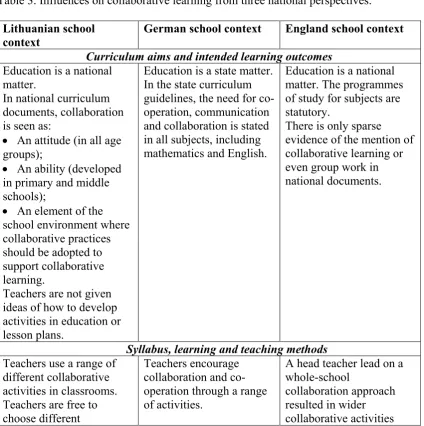
[image:23.595.88.513.340.767.2]From the three different cases reported, collaborative learning has been developed in schools and in classrooms in all three countries – England, Germany, and Lithuania. While the national extent of this collaborative activity is not known at this time, it is clear that drivers for developing collaborative learning vary across the three cases, as does the nature of collaborative learning activities. Table 3 provides a view of key influences on the development of collaborative learning activities in the three cases in the three countries, drawn from the evidence base.
Table 3. Influences on collaborative learning from three national perspectives. Lithuanian school
context German school context England school context Curriculum aims and intended learning outcomes
Education is a national matter.
In national curriculum documents, collaboration is seen as:
• An attitude (in all age groups);
• An ability (developed in primary and middle schools);
• An element of the school environment where collaborative practices should be adopted to support collaborative learning.
Teachers are not given ideas of how to develop activities in education or lesson plans.
Education is a state matter. In the state curriculum guidelines, the need for co-operation, communication and collaboration is stated in all subjects, including mathematics and English.
Education is a national matter. The programmes of study for subjects are statutory.
There is only sparse evidence of the mention of collaborative learning or even group work in national documents.
Syllabus, learning and teaching methods Teachers use a range of
different collaborative activities in classrooms. Teachers are free to choose different
Teachers encourage collaboration and co-operation through a range of activities.
A head teacher lead on a whole-school
24 educational activities in
lessons, but tend to use ‘learning together’, ‘group research’ and ‘project work’ more commonly, across age groups. Teachers tend to select collaborative activities that are either long, or short or home-based.
Interactive technologies and resources are used to support collaborative activities.
Collaborative activities are short-term rather than long-term, but some are home-based.
inside and outside classrooms.
Interactive technologies and resources are used to support collaborative activities.
Teachers plan different short-term activities, using different educational approaches to
collaborative learning. Assessment
Teachers choose different evaluation–reflection methods, but commonly chosen methods are ‘input of each student’,
‘presentation of the results’ and
‘self-assessment’, independent of the kind of school, different age group, or length or location of the activity.
Both teachers and pupils recognise benefits of collaborative learning. Assessment of pupil outcomes requires 50% of marks to measure oral work, which includes collaboration.
Teachers use different methods to measure oral contributions and
outcomes, both in class and online.
The Ofsted inspection system assesses pupil performance on the basis of two key measures - attendance and attainment. Pupil attainment is not determined by measures of oral or collaborative work.
9. Conclusions
From a strategic perspective, prior research and practice demonstrates the value of collaborative learning in schools. Table 3 shows a range of influences that impinge on collaborative learning developments in schools. Taking the three conceptual framework elements, these are:
• Aims and intended learning outcomes – prior research has identified the
25 • Syllabus, learning and teaching methods – teachers use different forms of
collaborative activities in classrooms, and different collaborative activity types are used in different subject or context areas (England, Germany, Lithuania); lengths and locations of activities can be chosen by teachers (Lithuania); interactive technologies can support collaborative activities in a range of ways (England, Germany); head teachers and senior teachers can guide, lead and encourage uptake of collaborative approaches (England).
• Assessment – teachers choose a range of different evaluation and reflection methods to assess outcomes of collaborative learning (Lithuania); these different methods can be applied in different subject or context areas (Germany).
Evidence indicates that collaborative learning is of value to pupils, and can be developed by teachers in schools. To support collaborative learning development in any country, qualitative and quantitative evidence of the forms gathered in this study can enable details of width and depth of practice to be understood more clearly. Schools in each country have developed specific practices that could be of value to others in their collaborative learning developments. From the current cases in the three countries, recommended strategic priority approaches would be to:
• In England, provide in national policy or guidance documents an overview of background research and the value of collaborative learning, and how it can be defined in pedagogic terms (aims and intended learning outcomes, and
26 • In Germany and Lithuania, exemplify how appropriate resources and interactive
technologies can support collaborative activities in a range of ways (syllabus, learning and teaching methods).
Further recommendations for research to support future developments are, to:
• In England, study how collaborative learning activities can be related to different age groups of pupils, and to different subject and conceptual needs; exemplify different collaborative activity types in different subject or context areas and how different lengths and locations of activities can be developed, used and chosen by teachers; exemplify how appropriate resources and
interactive technologies support collaborative activities; exemplify how different evaluation and reflection methods are used in different subject or context areas (syllabus, learning and teaching methods; assessment).
• In Germany and Lithuania, study more widely how appropriate resources and interactive technologies can support collaborative activities (syllabus, learning and teaching methods; assessment).
As argued earlier in this paper, collaborative activities are important for short- and long-term developments of learning. Collaborative activities can support
understanding and subject knowledge, as well as practices pupils can continue to use throughout their lifetimes, within social, educational and employment contexts. Evidence in this paper provides a picture of current development in this field; future pupil needs are already known to some extent (including important elements of
27 Acknowledgements
The authors would like to thank the head teachers, teachers, pupils, parents and advisors of all schools involved, and key personnel in SMART Technologies and Steljes who supported studies in Germany and England respectively.
References
Alexander, R.J. (2008). Towards Dialogic Teaching: rethinking classroom talk (4th edition). Cambridge: Dialogos.
Bartlett, L. & Vavrus, F. (2017). Comparative Case Studies: An Innovative Approach. Nordic Journal of Comparative and International Education, 1(1), 5-17. Bennett, B., Rolheiser-Bennett, C., Stevahn, L. (1991). Cooperative learning: Where
heart meets mind. Toronto, ON: Educational Connections.
Bransford, J.D., Brown, A.L., Cocking, R.R. (eds.) (2000). How People Learn: Brain, Mind, Experience, and School. Washington, DC: National Academy Press. Brindley J.E., Walti, C., Blaschke, L.M. (2009). Creating Effective Collaborative
Learning Groups in an Online Environment. The International Review of Research in Open and Distributed Learning, 10(3).
Budd, J.W. (2004). Mind maps as Classroom Exercises. The Journal of Economic Education, 35(1), 35-46.
Butkienė, G., Kepalaitė A. (1996). Mokymasis ir asmenybės brendimas. Vilnius, Lithuania: Margi raštai.
Cambridge Dictionary (2016). Retrieved from
http://dictionary.cambridge.org/dictionary/english/collaborative
Creswell, J.W. (2013). Qualitative inquiry and research design: Choosing among five approaches. Thousand Oaks, CA: Sage.
Dėl pradinio, pagrindinio ir vidurinio ugdymo programų aprašo patvirtinimo (2015). Retrieved from
https://www.e-tar.lt/portal/lt/legalAct/37350520a7bc11e5be7fbe3f919a1ebe
Department for Education (2013).The National Curriculum in England: Key stages 1 and 2 framework document. London: Department for Education.
28 Dillenbourg, P. (1999). What do you mean by collaborative learning? In P. Dillenbourg
(Ed.).Collaborative-learning: Cognitive and Computational Approaches. Oxford: Elsevier.
Donovan, S.M., Bransford, J.D., Pellegrino, J.W. (1999). How People Learn: Bridging Research and Practice. Washington, DC: National Academy of Sciences. Dooly, M. (2008). Constructing knowledge together. In M. Dooly (Ed.).
Telekolaborative language learning. A guidebook to moderating intercultural collaboration online. Retrieved from
http://www.newbooks-services.de/MediaFiles/Texts/0/9783035105650_Intro_005.pdf
Education Endowment Foundation (n.d.). Collaborative learning. Retrieved from https://educationendowmentfoundation.org.uk/resources/teaching-learning-toolkit/collaborative-learning/
Education Reform Act (1988). Education Reform Act 1988 Chapter 40 –Vol. 1/2. London: Her Majesty’s Stationery Office.
Geros mokyklos koncepcija (2015). Rereived from https://www.e-tar.lt/portal/lt/legalAct/f2f65120a7bb11e5be7fbe3f919a1ebe
Gokhale, A.A. (1995). Collaborative learning enhances critical thinking. Journal of Technology Education, 7(1). Retrieved from
http://scholar.lib.vt.edu/ejournals/JTE/v7n1/gokhale.jte-v7n1.html
Gokkurt, B., Dundar, S., Soylu, Y., Akgun, L. (2012). The effects of learning together technique which is based on cooperative learning on students’ achievement in mathematics class. Procedia-Social and Behavioral Sciences, 46, 3431-3434. Kagan, S., Kagan, M. (1998). Multiple Intelligences: The Complete MI Book. San
Clemente, CA: Kagan Publishing.
Kirschner, P.A. (2001). Using integrated electronic environments for collaborative teaching/learning. Learning and Instruction, 10(2), 1-9.
Laal, M., Ghodsi, S.M. (2012). Benefits of collaborative learning. Procedia - Social and Behavioral Sciences, 31, 486 – 490.
Lai, E.R. (2011). Collaboration: A Literature Review. Research Report. Pearson. Retrieved from
http://images.pearsonassessments.com/images/tmrs/collaboration-review.pdf Laurillard, D. (2009). The pedagogical challenges to collaborative technologies.
29 Lepeškienė, V. (1996). Humanistinis ugdymas mokykloje. Vilnius, Lithuania:
Valstybinis leidybos centras.
Lin, L. (2015). Exploring Collaborative Learning: Theoretical and Conceptual
Perspectives. In L. Lin, Investigating Chinese HE EFL Classrooms. pp. 11-28. Springer-Verlag: Heidelberg, Germany.
LR švietimo įstatymo pakeitimo įstatymas (2011). Retreived from https://www.e-tar.lt/portal/lt/legalAct/TAR.E2EBE95E7723
Luckin, R. (2010). Re-designing learning contexts: Technology-rich, learner-centred ecologies. London: Routledge.
Mercer, N., Littleton, K. (2007) Dialogue and the Development of children’s thinking. London: Routledge.
Ministerium für Schule und Weiterbildung des Landes Nordrhein-Westfalen (2010). Retrieved from
http://www.standardsicherung.schulministerium.nrw.de/lehrplaene-gs/
Ministerium für Schule und Weiterbildung des Landes Nordrhein-Westfalen (2013a). Kernlehrplan für die Sekundarstufe II Gymnasium/Gesmatschule in Nordrhein-Westfalen. Englisch. Düsseldorf, Germany: Ministerium für Schule und
Weiterbildung des Landes Nordrhein-Westfalen.
Ministerium für Schule und Weiterbildung des Landes Nordrhein-Westfalen (2013b). Kernlehrplan für die Sekundarstufe II Gymnasium/Gesmatschule in Nordrhein-Westfalen. Mathematik. Düsseldorf, Germany: Ministerium für Schule und Weiterbildung des Landes Nordrhein-Westfalen.
Ministerium für Schule und Weiterbildung des Landes Nordrhein-Westfalen (2016). Das Schulwesen in Nordrhein-Westfalen aus quantitativer Sicht 2015/16: Statistische Übersicht 391. Düsseldorf, Germany: Ministerium für Schule und Weiterbildung des Landes Nordrhein-Westfalen. Retrieved from
https://www.schulministerium.nrw.de/docs/bp/Ministerium/Service/Schulstatisti k/Amtliche-Sch uldaten/Quantita_2015.pdf
Naujokaitiene, J., Passey, D. (2016). Collaborative learning in Lithuanian schools: Findings from a nationwide teacher survey. Lancaster: Lancaster University. Retrieved from
30 Nieto, E. Q. (2005). Are synthetic phonics and cooperative learning suitable
methodologies for CLIL teaching? A classroom experience. Retrieved from http://digibuo.uniovi.es/dspace/bitstream/10651/30739/3/TFM_Quiros%20Nieto %2C%20Enrique.pdf
OECD (2015). PISA 2015 Results: Collaborative Problem Solving – Volume 5. Paris, France: OECD.
Papert, S. (1997). Looking at Technology Through School-Colored Spectacles. Retrieved from
http://www.papert.org/articles/LookingatTechnologyThroughSchool.html Passey, D. (2015). Digital technologies, collaborative endeavour and school
improvement: A case study of Pheasey Park Farm Primary School. Bagshot: Steljes.
Passey, D. (2016). Collaboration, visibility, inclusivity and efficiencies: A case study of a secondary school in Germany using interactive whiteboards. Lancaster: Lancaster University. Retrieved from
http://eprints.lancs.ac.uk/83695/1/German_School_Report_Final.pdf Resta, P., Laffière, T. (2007). Technology in support of collaborative learning.
Educational Psychology Review, 19(1), 65-83. Retrieved from
https://www.researchgate.net/publication/225727210_Technology_in_Support_o f_Collaborative_Learning
Sand, O., Davis, D., Lammel, R., Stone, T. (1960). Components of the Curriculum. Review of Educational Research, 30(3), 226-245.
Schweizer, K., Paechter, M., Weidenmann, B. (2003). Blended learning as a Strategy to Improve Collaborative Task Performance. Journal of Educational Media, 28, 211 – 224.
Sharan, S., Sharan, Y. (1992). Expanding Cooperative Learning Through Group Investigation. New York, NY: Teacher’s College Press, Columbia University. Teresevičienė, M., Gedvilienė, G. Mokymasis grupėse ir asmenybės kaita. Kaunas,
Lithuania: VDU.
Van Boxtel, C., van der Linden, J., Kanselaar G. (2000).Collaborative learning tasks and the elaboration of conceptual knowledge. Learning and Instruction, 10, 311–330.
31 Akker, W.Kuiper & U. Hameyer (Eds.), Curriculum landscapes and trends (pp. 1-10). Dordrecht, The Netherlands: Kluwer Academic Publishers.
Vygotsky, L. (1978). Interaction between learning and development. In: Mind and Society, pp. 79–91. Cambridge, MA: Harvard University Press.
Wertsch, J.V. (1985). Culture, communication, and cognition: Vygotskian perspectives. New York, NY: Cambridge University Press.