32
Fingerprint Compression using Sparse Representation
Priya Bharti
Student
ABSTRACT
Biometric identification systems are in use for last many years for the purpose of personal identification, uncompressed graphics, audio and video data require considerable storage capacity and transmission bandwidth dealing with such enormous amount of information can often present difficulties. As per my literature survey, there is no such method that uses compressive sensing and adaptive learning dictionary to compress image along with neural network to estimate the results. In the given algorithm, a dictionary of predefined fingerprint patches is constructed which is than quantized and encoded.
Keywords
Minutiae, Sparse representation, Image separation, Standard Deviation.
1.
INTRODUCTION
Biometric identification systems are in use for last many years for the purpose of personal identification, i.e., to associate a particular individual with an identity. Typical application includes security systems, security locks, identity recognition, attendance system, secure financial services, health care, electronic commerce, telecommunication, government, etc. Among all biometric traits, fingerprints have one of the highest levels of reliability and have been extensively used by forensic experts in criminal investigations [2]. A fingerprint refers to the flow of ridge patterns in the tip of the finger. The ridge flow exhibits anomalies in local regions of the fingertip, and it is the position and orientation of these anomalies that are used to represent and match fingerprints. However, fingerprints are not distinguished by their ridges and furrows, but by minutiae, which are some abnormal points on the ridges. Among the variety of minutiae types reported in literatures, two are mostly significant and in heavy usage: one is called termination, which is the immediate ending of a ridge; the other is called bifurcation, which is the point on the ridge from which two branches drive. Bifurcation makes an angle between two branches which in detection of a distance. Minutiae also refer to any small or otherwise incidental details. But the focus when matching is only on the two main minutiae: ridge ending and ridge bifurcation. The algorithm includes construction of dictionary, compression using Discrete Cosine transform, Image separation using sparse representation and authenticating the person by simulating Neural network based upon mean and standard deviation features. [6]
2. PROBLEM FORMULATION
Uncompressed graphics, audio and video data require considerable storage capacity and transmission bandwidth. Despite rapid progress in mass storage density, processor speeds and digital communication system performance demand for data storage capacity and data transmission bandwidth continues to out strip the capabilities of the available technologies. Dealing with such enormous amount of information can often present difficulties. Digital information must be stored and retrieved in
an efficient manner in order to put it to practical use. Without some sort of compression, sorting, storing and searching for data would be nearly impossible.
Typically television image generates data rates exceeding 10 million bytes/sec. There are other image sources that generate even higher data rates. Storage and transmission of such data require large capacity and bandwidth, which could be expensive. Image data compression technique, concerned with the reduction of the number of bits required to store or transmit image without any appreciable loss of information.
3. RESEARCH METHODOLOGY
3.1 Load the Input Image
3.2 Perform the pre-processing using Image
resize and Rgb to Gray Conversion
3.3 Basic three-step process
:
Get the red, green, and blue values of a pixel Use fancy math to turn those numbers into a single gray value. Replace the original red, green, and blue values with the new gray value. For Each Pixel in Image
3.4 Calculate the Histogram
In mathematics, a histogram is a function mi that counts the number of observations that falls in each of the category (bins). Thus, if n is the total number of observations and k is the total number of bins, the histogram mi meets the following conditions:
n =sum (mi) when i=1to k
Apply Low Pass filtering and Down sampling Determine ridge Orientations
A fingerprint pattern is composed by ridges and valleys. Ridges present various kinds of discontinuities (minutiae), able to capture the invariant and discriminatory information, used to recognize fingerprints.
𝑉𝑥 𝑖, 𝑗 = 2𝜕𝑥(𝑢, 𝑣)𝜕𝑦(𝑢, 𝑣) 𝑗 +𝑊2
𝑣=𝑗 −𝑊2 𝑖+𝑊2
𝑖−𝑊2
𝑉𝑦 𝑖, 𝑗 = 𝜕𝑥2(𝑢, 𝑣)𝜕𝑥2(𝑢, 𝑣)
𝑗 +𝑊2 𝑣=𝑗 −𝑊2 𝑖+𝑊2
𝑢=𝑖−𝑊2
𝜃 𝑖, 𝑗 =12𝑡𝑎𝑛−1(𝑉𝑦(𝑖,𝑗 ) 𝑉𝑥(𝑖,𝑗 ))
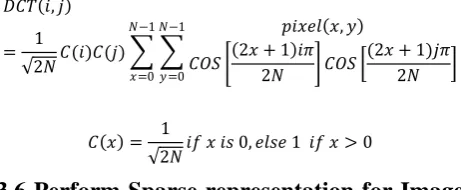
𝐷𝐶𝑇 𝑖, 𝑗 = 1
2𝑁𝐶(𝑖)𝐶(𝑗) 𝑝𝑖𝑥𝑒𝑙(𝑥, 𝑦)𝐶𝑂𝑆
(2𝑥+1)𝑖𝜋
2𝑁 𝐶𝑂𝑆
(2𝑥+1)𝑗𝜋 2𝑁 𝑁−1 𝑦 =0 𝑁−1 𝑥=0
33 varying magnitudes and frequencies. DCT has the property that,
for a typical image most of the visually significant information about an image is concentrated in just few coefficients of DCT. After the computation of DCT coefficients, they are normalized according to a quantization table with different scales provided by the JPEG standard computed by psycho visual evidence. Selection of quantization table affects the entropy and compression ratio. The value of quantization is inversely proportional to quality of reconstructed image, better mean square error and better compression ratio. In a lossy compression technique, during a step called Quantization, the less important frequencies are discarded, and then the most important frequencies that remain are used to retrieve the image in decomposition process. After quantization, quantized coefficients are rearranged in a zigzag order for further compression by an efficient lossy coding algorithm. [7]
𝐷𝐶𝑇 𝑖, 𝑗
= 1
2𝑁𝐶(𝑖)𝐶(𝑗)
𝑝𝑖𝑥𝑒𝑙 𝑥, 𝑦
𝐶𝑂𝑆 2𝑥 + 1 𝑖𝜋
2𝑁 𝐶𝑂𝑆
(2𝑥 + 1)𝑗𝜋 2𝑁 𝑁−1
𝑦 =0 𝑁−1
𝑥=0
𝐶 𝑥 = 1
2𝑁𝑖𝑓 𝑥 𝑖𝑠 0, 𝑒𝑙𝑠𝑒 1 𝑖𝑓 𝑥 > 0
3.6 Perform Sparse representation for Image
separation
Sparse representation has the ability by updating the dictionary. 1. Construct a base matrix whose columns represent features of the fingerprint images, referring the matrix dictionary whose columns are called atoms.
2. For a given whole fingerprint, divide it into small blocks called patches
3. Use the method of sparse representation to obtain the coefficients; then, quantize the coefficients
4. Encode the coefficients and other related information using lossless coding methods
3.7 Calculate PSNR
Peak Signal-to-Noise Ratio is an expression for the ratio between the maximum possible value (power) of a signal and the power of distorting noise that affects the quality of its representation. The higher the PSNR, the better degraded image has been reconstructed to match the original image and the better the reconstructive algorithm
𝑃𝑆𝑁𝑅 = 10. 𝑙𝑜𝑔10 𝑀𝐴𝑋𝐼2
𝑀𝑆𝐸
= 20. 𝑙𝑜𝑔10(
𝑀𝐴𝑋𝐼
𝑀𝑆𝐸)
= 20. 𝑙𝑜𝑔10 𝑀𝐴𝑋𝐼 − 10. 𝑙𝑜𝑔10 (MSE)
3.8 Calculate Mean and Standard Deviation
𝑋 = 𝑋
𝑁
𝜎 = (𝑋−𝑋 )2 𝑛
Where
𝜎 𝑖𝑠 𝑠𝑡𝑎𝑛𝑑𝑎𝑟𝑑 𝑑𝑒𝑣𝑖𝑎𝑡𝑖𝑜𝑛 𝑋 𝑖𝑠 𝑡𝑒 𝑚𝑒𝑎𝑛 𝑜𝑓 𝑎𝑙𝑙 𝑣𝑎𝑙𝑢𝑒𝑠
3.9 Simulate the Neural Network
The main characteristics of neural networks are that they have the ability to learn complex nonlinear input-output relationships, use sequential training procedures, and adapt themselves to the data. Neural networks used here is the feed-forward network, which includes multilayer perceptron and Radial-Basis Function (RBF) networks.
3.10 Show final results.
4. RESULTS
[image:2.595.56.287.261.356.2]4.1 Case: Authentication of finger print as
Bad category
Fig 1: Grayscale converted image
Fig 2: Histogram of an image
34 Fig 4: histogram equalization of an image
[image:3.595.349.520.80.183.2]Fig 5: Ridge segmentation of an image
Fig 6: Ridge oriented of an image Figure
Fig 7: Low pass filtered image
[image:3.595.319.535.213.355.2]Fig 8: down sampled image
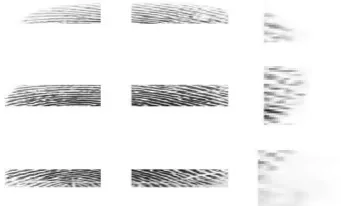
Fig 9: Down sampled image in blocks
[image:3.595.311.541.393.577.2]Fig 10: PSNR value of the compressed image 105.99dB
[image:3.595.308.539.471.703.2]Fig 11: Representation of Level 1 and Level 2 DWT of an image
35
[image:4.595.320.534.68.380.2]4.2 Case: Authentication of finger print as
Good category
[image:4.595.52.284.86.611.2]Fig 13: Original Grayscale converted image
[image:4.595.51.285.106.369.2]Fig 14: Histogram of an image
Fig 15: Ridge segmentation of an image
Fig 16: Ridge oriented of an image
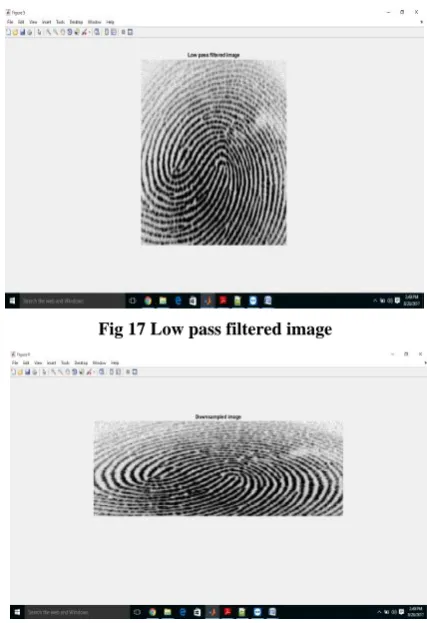
Fig 17 Low pass filtered image
Fig 18: down sampled image
Fig 19: Orthogonal Block matching progress representation
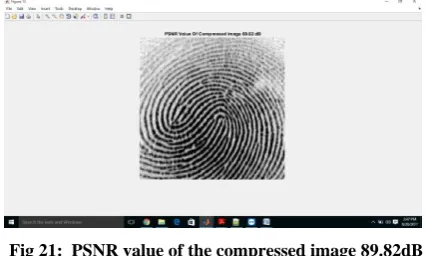
[image:4.595.315.539.419.557.2] [image:4.595.316.530.587.710.2]36 Fig 21: PSNR value of the compressed image 89.82dB
Fig 22: Representation of Level 1 and Level 2 DWT of an image
Fig 23: Matching authentication of the input finger image as Good
5. CONCLUSION
Fingerprint authentication and classification are represented in this research work. Sparse representation is used for compression process. In this algorithm, construct a dictionary for predefined fingerprint image patches. For a new given fingerprint images, represent its patches according to the dictionary by computing l0-minimization and then quantize and encode the representation. It provides high Peak Signal to Noise Ratio and high compression ratio. Existing methods have
compressed fingerprint images. The proposed method is fingerprint compressed images are authenticated and classified using neural networks. After that compressed images two finger combination based new finger print create for high secure privacy protection. A novel system for protecting fingerprint privacy by combining two different fingerprints into a new identity for authentication. And also, to classify the training samples should include fingerprints with different quality (“good”, “bad”).
6. FUTURE SCOPE
The work can be improved in the future; by the use of other region of interest calculation algorithm of images. It is because these are the most time consuming step in this algorithm. Another recommended future work is to apply this algorithm on real time devices or databases. In this dissertation only two images are taken at a moment. The efficiency of the algorithm can b investigated when applied on several images together.
7.
REFERENCES
[1] Zhang Qinghui and Zhang Xiangfei, “Research of Key Algorithm in the Technology of Fingerprint Identification,” Second IEEE International Conference on Computer Modeling and Simulation, pp. 282-284, 2010. [2] A. J. Ferreira and M. A. T. Figueiredo, “On the use of
independent component analysis for image compression,” Signal Process., Image Commun., vol. 21, no. 5, pp. 378– 389, 2006.
[3] P. Paatero and U. Tapper, “Positive matrix factorization: A nonnegative factor model with optimal utilization of error estimates of data values,” Environmetrics, vol. 5, no. 1, pp. 111–126, 1994.\
[4] D. D. Leeand and H. S. Seung, “Learning the parts of objects by nonnegative matrix factorization,” Nature, vol. 401, pp. 799–791, Oct. 1999.
[5] Criminal Justice Information Services Division, „Gray-Scale Fingerprint Image Compression Specification‟, Federal Bureau of Investigation,2010
[6] Ms.Mansi Kamblin , „Fingerprint Image Compression‟, International Journal of Engineering Science and Technology Vol. 2(5),2010
[7] V. Conti, C.Militello, F.Sorbello,et.al. “Introducing Pseudo Singularity Points for Efficient Fingerprints Classification and Recognition,” IEEE International Conference on Complex, Intelligent and Software Intensive Systems, pp. 368-375,2010.
[image:5.595.56.283.353.451.2]