I
2
/Nanostructured Pyrophosphate: A Mild and Efficient
Catalyst
for the Selective Protection of
Carbonyl Compounds
Asmae Lemaanni1, Asmae Snik1,Karima Abdelouahdi2, Abderrahim Solhy3, Mohamed Zahouily1,3*
1
Laboratoire de Catalyse, Chimiométrie et Environnement, URAC 24
(Unité de Recherche Associée au Centre National de Recherche Scientifique et Technique), Faculté des Sciences et Techniques, Université Hassan II, Mohammedia, Morocco
2
Centre National pour la Recherche Scientifique et Technique (CNRST), Division, Unités d’Appui Technique à la Recherche Scientifique, Angle Allal Fassi/FAR, Hay Riad, Rabat, Morocco
3
MAScIR Foundation, Institute of Nanomaterials & Nanotechnology, L’Ecole Normale Supérieure de l’Enseignement Technique, Rabat, Morocco
Email: *[email protected]
Received April 20, 2012; revised May 30, 2012; accepted June 17,2012
ABSTRACT
A new solvent free method for protection of carbonyl compounds as their thioacetals has been accomplished through the use of iodine supported on nanostructured pyrophosphate. Advantages of the methodology include very short reaction time, the requirement for minimum amounts of catalyst, the remarkably simple experimental procedure, and no necessity for solvents or inert atmospheres, excellent yields and recyclability of the catalyst used. An efficient method for the chemoselective thioacetalization of ketones in the presence of aldehydes using I2/nanostructured pyrophosphate is also
reported in this article. The nanostructured pyrophosphate was characterized by scanning electron microscopy, X-ray diffraction, infrared spectroscopy, Transmission electron microscopy and thermal gravimetric analysis, respectively.
Keywords: Catalyst; Free Solvent; Nanostructured Pyrophosphate; Protection of Carbonyl Compounds; Iodine
1. Introduction
Designing of new specific catalysts and exploring their catalytic activity has caused profound effects in optimiz-ing the efficiency of a wide range of organic synthesis. Development of such catalysts has resulted in more eco-nomical and environmentally friendly chemistry through replacing nonselective, unstable, or toxic catalysts [1,2]. In the last few years, literature has highlighted the im-portance of nanosized materials in several scientific and technological areas, and many research councils have intensified investments in nanotechnology for the coming years [3].
The protection of carbonyl functionality as a dithio-acetal or a thioketal is important in the multistep total synthesis of complex natural and non-natural products [4,5]. Among carbonyl protecting groups, 1,3-dithiolanes, 1,3-oxathiolanes, and 1,3-dithianes are important as they are inherently stable under both mildly acidic and basic conditions [6]. In addition, these are also utilized as masked acyl anions [7] or masked methylene functional groups [8] in carbon-carbon bond forming reactions. This
‘umpolung’ or inversion of polarity is an integral step of many multistep organic syntheses. In this view, there have been continued improvements in the methods of preparation of thioacetals. Generally, they are prepared by condensation of carbonyl compounds with thiols in the presence of strong acid catalysts such as such as AlCl3 [9], LnCl3 [10], ZnCl2 [11], TiCl4 [12], WCl6 [13],
InCl3 [14], In(OTf)3 [15], Sc(OTf)3 [16,17], Bi(NO3)3 [18]
and VO(OTf)2 [19] A number of milder procedures
em-ploying lithium salts [20-24], NiCl2 [25], CoCl2 [26],
NBS [27], and I2 [28] have also been reported for this
purpose. Although some of these methods have been carried out under mild reaction conditions, most of them require [29] reflux temperature [30], long reaction times and use expensive and not readily available reagents [31]. They also suffer from a tedious work-up procedure [32] and require the use of stoichiometric reagents [11]. Some of the methods mentioned above are incompatible with other protecting groups and fail to protect deactivated aromatic substrates [33].
Recently, a number of solid supported reagents have also been used for thioacetalization of various types of carbonyl compounds, e.g. ZrCl4-SiO2 [33], SOCl2-SiO2
*
[34], CoBr2-SiO2 [35], TaCl5-SiO2 [36], Cu(OTf)2-SiO2
[37], NaHSO4-SiO2 [38], I2/natural phosphate [39],
ZnCl2/natural phosphate [40] and Si(CH2)2SO3H-SiO2 [41].
Finally, the main disadvantage of almost all the exist-ing methods is that the catalysts are destroyed in the work-up procedure and cannot be recovered or reused. Therefore, there is further scope in exploring mild, chemoselective and efficient methods for thioacetaliza-tion of carbonyl compounds.
Furthermore, many studies have been published de-scribing the synthesis and use of the pyrophosphate (Na2CaP2O7) in various fields, particularly in
heteroge-neous catalysis [42-45]. Bennazha et al. were able to synthesize and characterize a series of pyrophosphates by adopting a dry technique [46]. Recently, we have devel-oped a method to tailor the nanostructure of this pyro-phosphate by focusing on reactant crashing and the speed of calcination. This nanostructured phosphate has been used with great success to catalyze the synthesis of 2-amino-chromenes [47]. As a part of our continuing interest in the development of new synthetic methodolo-gies; an efficient method for the chemoselective thio-acetalization of aliphatic and both activated and deacti-vated aromatic carbonyl compounds using iodine sup-ported on nanostructured pyrophosphate (N-Na2CaP2O7)
catalyst at room temperature under solvent-free is re-ported here (Scheme 1).
2. Experimental
2.1. General Remarks
All commercial reagents were purchased from Aldrich Chemical Company and were used without further puri-fication. 1H and 13C NMR spectra were recorder at 400 and 100 MHZ, respectively, on a Bruker DRX-400 spec-trometer in CDCl3, using CDCl3 as internal standard. IR
spectra were obtained on a FTIR (Bruker Vector 22 spectrometer) and reported in wave numbers (cm–1). Thermogravimetric analyses (TGA) were conducted un-der air using a TA Instruments Q 500 apparatus with 10C min ramp between 25 and 1000˚C. X-ray diffrac-tion (XRD) patterns of the catalyst were obtained at room
Scheme 1. Selective protection of carbonyl compounds I2/nanostructured pyrophosphate.
temperature on a Bruker AXS D-8 diffractometer using Cu-Ka radiation in Bragg-Brentano geometry (q-2q). Scanning electron microscopy (SEM) pictures were re-corded on a FEI Quanta 200 microscope after carbon metallization. The TEM micrographs were obtained on a Tecnai G2 microscope at 120 kV. The specific surface areas were determined from the nitrogen adsorption/des- orption isotherms (at –196˚C) measured with a Quanta-chrome Autosorb-1 automatic analyzer, using the BET equation at p p0 = 0.98. Melting points were
deter-mined using a Stuart SN5228 apparatus. Melting points were determined with a ‘Thomas Hoover’ melting (cap-illary method) apparatus and are uncorrected.
2.2. Preparation of the Catalyst and Structural Characteristics
The synthesis of Na2CaP2O7 was carried out by a dry
technique. The pyrophosphate was prepared as a white powder starting from Na2CO3, CaCO3 and NH4H2PO4 of
high purity grade and in a 1:1:2 molar ratios, respectively (Scheme 2). These materials were ground together in an agate mortar and progressively heated to 723 K in a por-celain crucible. In order to obtain a homogeneous single phase product, additional grinding and progressive heat-ing steps were carried out. The size of the final product does not only depend on the quality of the starting prod-ucts but also on the precision of the weighing, grinding and grinding-heating from 373 to 723 K.
Thermogravimetric analysis (TGA) of a mixture of these three reagents showed that the thermal behavior of this blend was suitable to form the desired pyrophosphate (Figure 1). Three major mass losses were observed and corresponded to the dehydration reaction, the loss of NH3
and CO2 as well as the crystallization of this material. X-ray
diffraction (XRD) of Na2CaP2O7 showed that this system
crystallized in the triclinic system with the space group
P1bar (Figure 2). The lattice parameters of the prepared
Na2CaP2O7 were in excellent agreement with standard data:
a = 5.361 Å, b = 7.029 Å and c = 8.743 Å, with the char-acteristic peaks of this pyrophosphate all present [Green].
Scheme 2. Synthesis of nanostructured pyrophosphate (N-Na2CaP2O7).
Figure 1. Thermal gravimetric analysis (TGA) of Na2CaP2O7.
Figure 2. XRD pattern of Na2CaP2O7.
The FTIR spectrum of N-Na2CaP2O7 is presented on
the Figure 3. The existence of P2O7 units was confirmed
by the symmetrical vibration bands of P-O-P at 720 cm–1 as well as the anti-symmetric vibration bands at 893 cm–1
. The related vibrations of the PO4 groups were shared
between two fields: a field of symmetrical vibrations at 996 cm–1 and 1031 cm–1 and another that ranged from 1130 to 1278 cm–1 (Figure 3). Scanning Electronic Mi-croscopy (SEM) was used to study the morphology of the surface of N-Na2CaP2O7 (Figure 4). This micrograph
shows a homogeneous microstructure that consisted of layers of various sizes and forms.
The shape, size, and morphology of N-Na2CaP2O7
par-ticles were revealed by Transmission electron micros-copy “TEM” (Figure 5). The micrograph shows nano- particles that are rod-like which agglomerate to form superstructures with different aspect ratios of grain crys-tals (i.e. length/diameter). N-Na2CaP2O7 is characterized
[image:3.595.308.538.86.245.2]by an average grain diameter and length of 15 nm and 40 nm, respectively.
[image:3.595.308.539.267.368.2]Figure 3. FTIR spectrum of Na2CaP2O7.
Figure 4. SEM images of Na2CaP2O7 nanopowder.
Figure 5. TEM of Na2CaP2O7.
2.3. General Procedure for the Thioacetalization of Carbonyl Compounds
To a freshly prepared catalyst (0.2 g, 0.2 mmol of iodine) under stirring, a mixture of carbonyl compound 1 (2 mmol) and monothiol or dithiol (4.2 or 2.1 mmol, re-spectively) was added and the mixture was stirred at room temperature and the progress was monitored by TLC using hexane: dichloromethane as an eluent. Fol-lowing completion of the reaction, the crude reaction mixture was filtered and the catalyst washed with di-chloromethane. After concentration of the filtrate under reduced pressure the residue was subjected to chroma-tography (eluent: 95% hexane and 5% ethyl acetate) leading to the respective thioacetal (2, 3 or 4, Scheme 1). The product structure was analysed by 1H, 13C NMR, IR spectrometry and melting points. When NP and I2 are
mixed one pot in the reaction mixture without previous
[image:3.595.58.287.291.466.2] [image:3.595.307.539.396.509.2]Copyright © 2012 SciRes. MRC absorption the thioacetal (2, 3 or 4) was obtained in
slightly lower yields.
2.4. Typical Procedure for the Recycling of the N-Na2CaP2O7 (Catalyst)
After completion of the reaction, the reaction mixture was filtered and the catalyst washed with dichloro-methane. The N-Na2CaP2O7 was washed with acetone 3 -
4 times and drying at 423 K in vacuum or calcined at 723 K to confirm the complete removal of any residual mate-rial. The same process was repeated after each reaction cycle to isolate and reuse the N-Na2CaP2O7 as catalyst.
3. Results and Discussion
The scope and failure of the catalyst nanostructured py-rophosphate (N-Na2CaP2O7) as a heterogeneous catalyst
in dithioacetalization of a variety of carbonyl compounds under solvent-free examined. Benzaldehyde, thiophenol and iodine (Scheme 1) were chosen as model substrates to determine suitable conditions. The optimum weight of
N-Na2CaP2O7 is 200 mg. In a blank reaction (20 min),
N-Na2CaP2O7 alone or 0.1 mmol alone the thioacetal 4a
was obtained with low yields 13% or 31%, respectively. The N-Na2CaP2O7 was the preferred choice as a catalyst
and support to keep the reaction medium under mild and neutral conditions.
Interestingly, the experimental procedure for thio-acetalization is remarkably simple and does not require the use of solvents or inert atmospheres. A catalytic quantity of I2 supported on nanostructured pyrophosphate
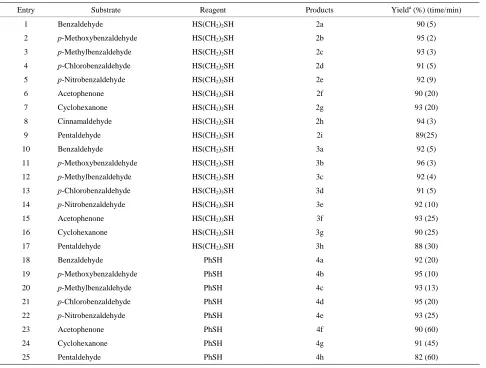
was added to the carbonyl compound, to this was added the required monothiols or dithiols (2.1 or 1.1 equiv., respectively) and the mixture was stirred at room tem-perature. The generality of this process has been proved in a wide range of aromatic, aliphatic and, α,β-unsatur- ated carbonyl compounds. Accordingly, dithioacetals, 1,3-dithiolanes and 1,3-dithianes have been obtained by the reaction of thiophenol, 1,2-ethanedithiol and 1,3-pro- panedithiol, respectively, in the presence of catalytic amounts of I2/N-Na2CaP2O7 (Scheme 1); the results are
[image:4.595.58.544.372.740.2]illustrated in Table 1.
Table 1. I2 supported on nanostructured pyrophosphate (I2/N-Na2CaP2O7) catalysed selective dithioacetalization of carbonyl compoundsa.
Entry Substrate Reagent Products Yielda (%) (time/min)
1 Benzaldehyde HS(CH2)2SH 2a 90 (5)
2 p-Methoxybenzaldehyde HS(CH2)2SH 2b 95 (2)
3 p-Methylbenzaldehyde HS(CH2)2SH 2c 93 (3)
4 p-Chlorobenzaldehyde HS(CH2)2SH 2d 91 (5)
5 p-Nitrobenzaldehyde HS(CH2)2SH 2e 92 (9)
6 Acetophenone HS(CH2)2SH 2f 90 (20)
7 Cyclohexanone HS(CH2)2SH 2g 93 (20)
8 Cinnamaldehyde HS(CH2)2SH 2h 94 (3)
9 Pentaldehyde HS(CH2)2SH 2i 89(25)
10 Benzaldehyde HS(CH2)3SH 3a 92 (5)
11 p-Methoxybenzaldehyde HS(CH2)3SH 3b 96 (3)
12 p-Methylbenzaldehyde HS(CH2)3SH 3c 92 (4)
13 p-Chlorobenzaldehyde HS(CH2)3SH 3d 91 (5)
14 p-Nitrobenzaldehyde HS(CH2)3SH 3e 92 (10)
15 Acetophenone HS(CH2)3SH 3f 93 (25)
16 Cyclohexanone HS(CH2)3SH 3g 90 (25)
17 Pentaldehyde HS(CH2)3SH 3h 88 (30)
18 Benzaldehyde PhSH 4a 92 (20)
19 p-Methoxybenzaldehyde PhSH 4b 95 (10)
20 p-Methylbenzaldehyde PhSH 4c 93 (13)
21 p-Chlorobenzaldehyde PhSH 4d 95 (20)
22 p-Nitrobenzaldehyde PhSH 4e 93 (25)
23 Acetophenone PhSH 4f 90 (60)
24 Cyclohexanone PhSH 4g 91 (45)
We observed that the reaction of aldehydes takes place rapidly in the presence of I2/N-Na2CaP2O7 when
com-pared to that of ketones (see Table 1). This method is suitable for aldehydes and ketones both aromatic and aliphatic as well as, α,β-unsaturated carbonyl compounds. It is free from the problem of Michael addition encoun-tered in some case of, α,β-unsaturated carbonyl systems (Table 1, Entry 8) with some reagents [48].
It is clear from the mechanism (Figure 6), that the corresponding methyl ketones show a lower yield as compared to the aldehydes (Table 1, Entry-1 and 6; 10 and 15; 18 and 23 can be chosen as representative exam-ples of aromatic and aliphatic carbonyl compounds for proving this point). This might have been because of steric factors (the extra bulk imposed by the methyl group on the attaching thiol nucleophile), or electronic factors (the electron-donating inductive effect of methyl
group renders the carbonyl carbon less electrophilic) or a combination of both.
Amongst the aromatic carbonyl compounds, the reac-tion mechanism suggests that the electron donating sub-stituents would activate the benzene ring and thus in-crease the yield of the products. On the other hand, the electron withdrawing substituents (Table 1, Entry-2 and 5, 11 and 14) would show a slight decrease in the yield of the corresponding 1,3-dithiolanes.
The difference in reactivity of the I2/N-Na2CaP2O7
[image:5.595.101.501.307.465.2]catalyst towards aldehydes and ketones gave us impetus to study chemoselective reactions. With this objective, as a representative example we carried out some experi-ments with equimolar mixtures of an aldehyde and a ke-tone (Scheme 3). It was observed that in this mixture, the corresponding aldehyde formed the 1, 3-dithiolane whilst the ketone was almost completely recovered.
Figure 6. Proposed mechanism for the protection of carbonyl compound using ethane dithiol over I2 supported on nanos-tructured pyrophosphate (I2/N-Na2CaP2O7) catalyst.
Scheme 3. Chemioselective protection in presence I2/Nanostructured Pyrophosphate catalyst.
[image:5.595.137.455.516.718.2]This method has also been extended to the intramo- lecular chemoselectivity between keto and ester func-tionalities (Scheme 3). Only keto functionality was thio-acetalized by this method in a short period (25 min) with a high yield (87%). When compared with the existing method, the present method was found to be superior in many respects.
In all these cases, the aldehyde reacted in almost quan-titative yields while the ketone remained unreacted. These reactions are kinetically controlled. The reaction time is only 10 min and thus equilibrium is not allowed to set in. The final step of the reaction mechanism is ir-reversible as the water which is eliminated separates out from the organic phase into an aqueous phase. In this way, our claim of having developed a gentle methodol-ogy for the chemoselective protection of aldehydes using 1,3-dithiolanes in the presence of ketones is justified.
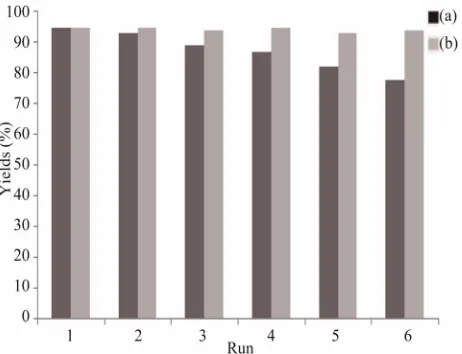
The N-Na2CaP2O7 could be recycled by separating
them from the reaction mixture by simple filtration. They could be used as a catalyst for the same reaction again and the change in their catalytic activity was studied. The relation between the number of cycles of the reaction and the catalytic activity in terms of yield is presented in the Figure 7. The catalyst can be recovered and reused at least six times without appreciable loss of activity.
It was observed that with the increasing number of cy-cles of the reaction, the catalytic activity of the N-Na2CaP2O7 slightly decreased. This might have been
due to the slow poisoning of N-Na2CaP2O7.
4. Conclusion
[image:6.595.59.290.511.688.2]In conclusion a new solvent free method for protection of carbonyl compounds as their thioacetals has been ac-complished through the use of iodine supported on nanos
Figure 7. Recycling of the N-Na2CaP2O7 catalyst in the synthesis 2a. (a) Catalyst recoverable dried at 423 K for 1 h; (b) Catalyst recoverable, washed with acetone, dried and calcined at 723 K for 15 - 30 min.
tructured pyrophosphate. Advantages of the methodology include very short reaction time, the requirement for minimum amounts of catalyst, the remarkably simple experimental procedure, and no necessity for solvents or inert atmospheres, excellent yields and recyclability of the catalyst used. Furthermore, the relatively slow reac-tion rate of ketones allows chemoselective protecreac-tion of aldehydes in the presence of ketones, making this an im-portant tool in the synthetic organic chemistry.
5. Acknowledgements
The authors thank Centre National de la RechercheSci-entifiqueet Technique (CNRST) for funding this project under the RS program. We also thank the technical and administrative support teams of the MAScIR Foundation.
REFERENCES
[1] R. Singh, R. M. Kissling, M. A. Letellier and S. P. Nolan, “Transesterification/Acylation of Secondary Alcohols Mediated by N-heterocyclic Carbene Catalysts,” Journal
of Organic Chemistry, Vol. 69, No. 1, 2004, pp. 209-212. doi:10.1021/jo035431p
[2] P. T. Anastas, L. B. Bartlett, M. M. Kirchhof and T. C. Williamson, “The Role of Catalysis in the Design, De-velopment, and Implementation of Green Chemistry,”
Catalysis Today, Vol. 55, No. 1-2, 2000, pp. 11-22. doi:10.1016/S0920-5861(99)00222-9
[3] P. Claus, A. Bruckner, C. Mohr and H. Hofmeister, “Sup-ported Gold Nanoparticles from Quantum Dot to Mesoscopic Size Scale: Effect of Electronic and Struc-tural Properties on Catalytic Hydrogenation of Conju-gated Functional Groups,” Journal of the American
Chemical of Society, Vol. 122, No. 46, 2000, pp. 11430- 11439. doi:10.1021/ja0012974
[4] T. W. Greene and P. G. M. Wuts, “Protective Groups in Organic Synthesis,” Third Edition, Wiley, New York, 1999. doi:10.1002/0471220574
[5] P. J. Kocienski, “Protecting Groups, Stuttgart,” Thieme, 1994.
[6] E. L. Eliel and S. M. Natschke, “Asymmetric Syntheses Based on 1,3-Oxathianes. 1. Scope of the Reaction,”
Journal of the American Chemical of Society, Vol. 106, No. 10, 1984, pp. 2937-2942.
[7] B. T. Grobel and D. Seebach, “Reactivity of Car-bonyl-Compounds through Sulfur-Containing Reagents,”
Synthesis, Vol. 6, 1977, pp. 357-402. doi:10.1055/s-1977-24412
[8] G. R. Pettit and E. E. V. Tamelen, “Desulfurization with Raney Nickel,” Organic Reactions, Vol. 12, 1962, pp. 356-529.
[9] B. S. Ong, “A Simple and Efficient Method of Thioacetal —And Ketalization,” Tetrahedron Letters, Vol. 21, No. 51, 1980, pp. 4225-4228.
doi:10.1016/S0040-4039(00)92868-5
[10] L. Garlaschelli and G. Vidari, “Anhydrous Lanthanum
Trichloride, a Mild and Convenient Reagent for Thio-acetalization,” Tetrahedron Letters, Vol. 31, No. 40, 1990, pp. 5815-5816. doi:10.1016/S0040-4039(00)97967-X [11] D. A. Evans, L. K. Truesdule, K. G. Grimm and S. L.
Nesbitt, “Thiosilanes, a Promising Class of Reagents for Selective Carbonyl Protection,” Journal of the American
Chemical of Society, Vol. 99, No. 15, 1977, pp. 5009- 5017. doi:10.1021/ja00457a020
[12] V. Kumar and S. Dev, “Titanium Tetrachloride, an Effi-cient and Convenient Reagent for Thioacetalization1,1,”
Tetrahedron Letters, Vol. 24, No. 12, 1983, pp. 1289- 1292. doi:10.1016/S0040-4039(00)81637-8
[13] H. Firouzabadi, N. Iranpoor and B. Karimi, “Tungsten Hexachloride (WCl6) as an Efficient Catalyst for
Chemoselective Dithioacetalization of Carbonyl Com-pounds and Transthioacetalization of Acetals,” Synlett, Vol. 7, 1998, pp. 739-740. doi:10.1055/s-1998-1756 [14] S. Muthusamy, S. Arulanada Babu and C. Gunanathan,
“Indium(III) Chloride as an Efficient, Convenient Cata-lyst for Thioacetalization and Its Chemoselectivity,” Tet-rahedron Letters, Vol. 42, No. 3, 2001, pp. 359-362. doi:10.1016/S0040-4039(00)01966-3
[15] S. Muthusamy, S. Arulananda Babu and C. Gunanathan, “Indium Triflate: A Mild Lewis Acid Catalyst for Thio-acetalization and TransthioThio-acetalization,” Tetrahedron, Vol. 58, No. 39, 2002, pp. 7897-7901.
doi:10.1016/S0040-4020(02)00897-9
[16] A. Kamal and G. Chouhan, “Scandium Triflate as a Re-cyclable Catalyst for Chemoselective Thioacetalization,”
Tetrahedron Letters, Vol. 43, No. 7, 2002, pp. 1347-1350. doi:10.1016/S0040-4039(01)02378-4
[17] A. Kamal and G. Chouhan, “Chemoselective Thio-acetalization and TransthioThio-acetalization of Carbonyl Compounds Catalyzed by Immobilized Scandium(III) Triflate in Ionic Liquids,” Tetrahedron Letters, Vol. 44, No. 16, 2003, pp. 3337-3340.
doi:10.1016/S0040-4039(03)00580-X
[18] N. Komatsu, M. Uda and H. Suzuki, “Bismuth(III) Hal-ides and Sulfate as Highly Efficient Catalyst for the Sulf-enylation of Carbonyl and Related Compounds,” Synlett, Vol. 9, 1995, pp. 984-986.
doi:10.1055/s-1995-5137
[19] S. K. De, “Vanadyl Triflate as an Efficient and Recycla-ble Catalyst for Chemoselective Thioacetalization of Al-dehydes,” Journal of Molecular Catalysis A: Chemical, Vol. 226, No. 1, 2005, pp. 77-79.
doi:10.1016/j.molcata.2004.09.044
[20] H. Firouzabadi, N. Iranpoor and B. Karimi, “Lithium Bromide-Catalyzed Highly Chemoselective and Efficient Dithioacetalization of α,β-Unsaturated and Aromatic Al-dehydes under Solvent-Free Conditions,” Synthesis, Vol. 22, 1999, pp. 58-60. doi:10.1055/s-1999-3679
[21] V. G. Saraswathy, V. Geetha and S. Sankararaman, “Chemoselective Protection of Aldehydes as Dithioacet-als in Lithium Perchlorate-Diethyl Ether Medium. Evi-dence for the Formation of Oxocarbenium Ion Intermedi-ate from Acetals,” Journal of Organic Chemistry, Vol. 59, No. 16, 1994, pp. 4665-4670.
doi:10.1021/jo00095a049
[22] L. F. Tietze, B. Weigand and C. A. Wulff, “Mild and Efficient Method for the Preparation of 1,3-Dithianes from Aldehydes and Ketones,” Synthesis, Vol. 2000, No. 1, 2000, pp. 69-71. doi:10.1055/s-2000-6226
[23] J. S. Yadav, B. V. S. Reddy and S. K. Pandey, “LiBF4
Catalyzed Chemoselective Conversion of Aldehydes to 1,3-Oxathiolanes and 1,3-Dithianes,” Synlett, Vol. 2, No. 1, 2001, pp. 238-239.
[24] H. Firouzabadi, B. Karimi and S. Eslami, “Lithium Trifluoromethanesulfonate (LiOTf) as a Highly Efficient Catalyst for Chemoselective Dithioacetalization of Car-bonyl Compounds under Neutral and Solvent-Free Con-ditions,” Tetrahedron Letters, Vol. 40, No. 21, 1999, pp. 4055-4058. doi:10.1016/S0040-4039(99)00647-4
[25] T. H. Khan, E. Mondal, D. R. Sahu and S. Islam, “Nickel(II) Chloride as an Efficient and Useful Catalyst for Chemoselective Thioacetalization of Aldehydes,” Tet-rahedron Letters, Vol. 44, No. 5, 2003, pp. 919-922. doi:10.1016/S0040-4039(02)02771-5
[26] S. K. De, “Cobalt(II) Chloride Catalyzed Chemoselective Thioacetalization of Aldehydes,” Tetrahedron Letters, Vol. 45, No. 5, 2004, pp. 1035-1036.
doi:10.1016/j.tetlet.2003.11.082
[27] A. Kamal and G. Chouhan, “Mild and Efficient Chemoselective Protection of Aldehydes as Dithioacetals Employing N-Bromosuccinimide,” Synlett, Vol. 3, 2002, pp. 474-476. doi:10.1055/s-2002-20469
[28] S. Samajdar, M. K. Basu, F. F. Becker and B. K Banik, “A New Molecular Iodine-Catalyzed Thioketalization of Carbonyl Compounds: Selectivity and Scope,” Tetrahe-dron Letters, Vol. 42, No. 27, 2001, pp. 4425-4427. doi:10.1016/S0040-4039(01)00752-3
[29] Y. Kamitori, M. Hojo, R. Masuda, T. Kimura and T. Yo-shida “Selective Protection of Carbonyl Compounds. Sil-ica Gel Treated with Thionyl Chloride as an Effective Catalyst for Thioacetalization,” Journal of Organic.
Chemistry, Vol. 51, No. 9, 1986, pp. 1427-1431. doi:10.1021/jo00359a009
[30] C. Djerassi and M. Gorman, “Studies in Organic Sulfur Compounds. Cyclic Ethylene and Trimethylene Hemi- thioketals,” Journal of the American Chemical of Society, Vol. 75, No. 13, 1953, pp. 3704-3708.
doi:10.1021/ja01111a029
[31] N. M. Leonard, M. C. Oswald, D. A. Friederg, B. A. Nat-tier, R. C. Smith and R. S. Mohan, “A Simple and Versa-tile Method for the Synthesis of Acetals from Aldehydes and Ketones Using Bismuth Triflate,” Journal of Organic Chemistry, Vol. 67, No. 7, 2002, pp. 5202-5207.
doi:10.1021/jo0258249
[32] B. S. Ong, “A Simple and Efficient Method of Thioacetal and Ketalization,” Tetrahedron Letters, Vol. 21, No. 44, 1980, pp. 4225-4228.
doi:10.1016/S0040-4039(00)92868-5
[33] H. K. Pantey and S. Margan, “Zirconium(IV) Chloride- Silica Catalysed Thioacetalisation of Carbonyl Com-pounds,” Tetrahedron Letters, Vol. 37, 1996, pp. 4621- 4622. doi:10.1016/0040-4039(96)00892-1
[34] Y. Kamitori, M. Hojo, R. Masuda, T. Kimura and T.
Copyright © 2012 SciRes. MRC
shida, “Selective Protection of Carbonyl Compounds. Sil-ica Gel Treated with Thionyl Chloride as an Effective Catalyst for Thioacetalization,” Journal of Organic
Chemistry,Vol. 51, No. 9, 1986, pp. 1427-1431. doi:10.1021/jo00359a009
[35] H. K. Patney, “Anhydrous Cobalt(II) Bromide Dispersed on Silica Gel: A Mild and Efficient Reagent for Thio-acetalisation of Carbonyl,” Tetrahedron Letters, Vol. 35, No. 31, 1994, pp. 5717-5718.
doi:10.1016/S0040-4039(00)77287-X
[36] S. Chandrasekhar, M. Takhi, Y. R. Reddy, S. Mohapatra, C. R. Rao and K. V. Reddy, “TaCl5-Silicagel and TaCl5
as New Lewis Acid Systems for Selective Tetrahydro-pyranylation of Alcohols and Thioacetalisation, Trimeri-sation and AldoliTrimeri-sation of Aldehydes,” Tetrahedron, Vol. 53, No. 44, 1997, pp. 14997-15004.
doi:10.1016/S0040-4020(97)01051-X
[37] R. V. Anand, P. Sarvanan and V. K. Sigh, “Solvent Free Thioacetalization of Carbonyl Compounds Catalyzed by Cu(OTf)2-SiO2,” Synlett, Vol. 4, 1999, pp. 415-416.
doi:10.1055/s-1999-2635
[38] B. Das, R. Ramu, M. R. Reddy and G. Mahender, “Sim-ple, Mild and Efficient Thioacetalization and Transthio-acetalization of Carbonyl Compounds and Deprotection of Thioacetals: Unique Role of Thiols in the Selectivity of Thioacetalization,” Synthesis, Vol. 280, No. 1-2, 2005, pp. 250-254. doi:10.1055/s-2004-834934
[39] M. Zahouily, A. Mezdar, J. Rakik, A. Elmakssoudi, A. Rayadh and S. Sebti, “A Mild and Efficient Method for the Protection of Carbonyl Compounds as Dithioacetals, Dithiolanes and Dithianes Catalysed by Iodine Supported on Natural Phosphate,” Journal of Molecular Catalysis A:
Chemical, Vol. 233, No. 1-2, 2005, pp. 233, 43-47. [40] M. Zahouily, A. Mezdar, J. Rakik, A. Elmakssoudi, B.
Mounir,A. Rayadh, S. Sebti and H. B. Lazrek, “Solvent Free Lewis Acid Catalyzed Vinylogous Condensation,”
ARKIVOC, Vol. 2, 2006, pp. 31-40.
[41] B. Karimi and M. Khalkhali, “Silica Functionalized
Sul-fonic Acid as a Recyclable Interphase Catalyst for Chemoselective Thioacetalization of Carbonyl Com-pounds in Water,” Journal of Molecular Catalysis A:
Chemical, Vol. 271, No. 1-2, 2007, pp. 75-79. doi:10.1016/j.molcata.2007.02.018
[42] A. Elmakssoudi, M. Zahouily, A. Mezdar, A. Rayadh and S. Sebti, “Na2CaP2O7 a New Catalyst for the Synthesis of
α-Amino Phosphonates under Solvent-Free Conditions at Room Temperature,” Comptes Rendus Chimie, Vol. 8, No. 11-12, 2005, pp. 1954-1959.
doi:10.1016/j.crci.2005.05.006
[43] J. Bennazha, M. Zahouily, S. Sebti, A. Boukhari and E. M. Holt, “Na2CaP2O7, a New Catalyst for Knoevenagel
Reaction,” Catalysis Communications, Vol. 2, No. 3-4, 2001, pp. 101-104. doi:10.1016/S1566-7367(01)00015-2 [44] M. Zahouily, M. Salah, J. Bennazha, A. Rayadh and S.
Sebti, “Na2CaP2O7, a New Catalyst for the Synthesis of
Unsaturated Arylsulfones,” Tetrahedron Letters, Vol. 44, No. 16, 2003, pp. 3255-3257.
doi:10.1016/S0040-4039(03)00630-0
[45] M. Zahouily, Y. Abrouki and A. Rayadh, “Na2CaP2O7, a
new Catalyst for Michael Addition,” Tetrahedron Letters, Vol. 43, No. 43, 2002, pp. 7729-7730.
doi:10.1016/S0040-4039(02)01846-4
[46] J. Bennazha, A. Boukhari and E. M. Holt, “Synthesis and Crystal Structure of Na2CaP2O7,” Solid State Sciences,
Vol. 1, No. 6, 1999, pp. 373-380. doi:10.1016/S1293-2558(00)80091-6
[47] A. Solhy, A. Elmakssoudi, R. Tahir, M. Karkouri, M. Larzek, M. Bousmina and M. Zahouily, “Clean Chemical Synthesis of 2-Amino-chromenes in Water Catalyzed by Nanostructured Diphosphate Na2CaP2O7,” Green
Chem-istry, Vol. 12, 2010, pp. 2261-2267. doi:10.1039/c0gc00387e
[48] E. J. Corey and K. Shimoji, “Magnesium and Zinc-Cata-lyzed Thioketalization,” Tetrahedron Letters, Vol. 24, No. 2, 1983, pp. 169-172.

![Table 1, Entry 8) with some reagents [48]. It is clear from the mechanism (Figure 6), that the corresponding methyl ketones show a lower yield as](https://thumb-us.123doks.com/thumbv2/123dok_us/9290362.424925/5.595.137.455.516.718/table-entry-reagents-mechanism-figure-corresponding-methyl-ketones.webp)