Date: July 3, 2019
The influence of domestic interest groups on the Dutch position on
quantitative easing
Simon Couwenberg s1739131
Bachelor Thesis
Management, Society and Technology University of Twente, Enschede
Abstract
Acknowledgement
This paper represents my bachelor thesis study into the influence of domestic groups on the national preference formation regarding quantitative easing in the Netherlands. I would like to thank everyone who helped and supported me in writing my bachelor thesis. I would
Table of Content
Introduction ... 1
Theory ... 4
Hypotheses ... 7
Methods ... 9
Research Design ... 9
Case selection ... 10
Data collection ... 11
Operationalisation ... 11
Data analysis ... 12
Data ... 12
Data analysis ... 16
Domestic groups ... 16
DNB and the national government ... 17
Before the start of the QE programme ... 17
During the QE programme ... 20
After the QE programme ... 25
Other actors ... 26
Hypotheses ... 28
Conclusion ... 34
References ... 38
Introduction
In January 2015 the European Central Bank (ECB) announced that it would start buying government bonds from banks, this is also referred to as quantitative easing (QE). This programme was started, because of the low inflation levels around the 1% in 2014, which dipped further down in December 2014 (Dunne, Everett, & Stuart, 2015). The aim of the programme was to return the inflation levels to just below 2% (Draghi, 2015). This was to be done through providing more money to the banking system. This increases the amount of money available which makes interest rates fall and loans become cheaper. As a result, companies and people can borrow more money from the bank at a lower interest rate, which encourages consumer spending and investments by businesses. Higher spending and
investments boost the economy thereby providing economic growth and creating more jobs. And as prices rise from a bigger demand the inflation will increase too. Furthermore, the QE programme demonstrates the intention of the ECB to achieve its preferred inflation level of just below 2% and that the interest rates will remain low. This is also important besides the actual bond buying programme since it provides investors and companies with more certainty and should increase their confidence, which are important factors in the economy.
The ECB was not the first to start a programme of QE, the Bank of Japan already started with such a programme in 2001. The Bank of England and the Federal Reserve started similar bond buying programmes at the beginning of the financial crisis of 2008. Even the ECB already had a similar programme, the Securities Markets Programme, ongoing since 2010 but on a much smaller scale than the QE of 2015 (Dunne et al., 2015). The ECB decided to end the QE programme in December 2018 but did intend to continue reinvesting the money that became available from maturing bonds. Over the course of the programme between 2015 and 2018 the ECB spend in total 2600 billion euros on its bond buying scheme (Koranyi, 2018).
The purpose of this study is to find out why the Netherlands in general and the DNB specifically was against the introduction of QE. This will be done at the hand of a theory of liberal intergovernmentalism by Moravcsik (1993), which provides a framework through which such a situation can be analysed. According to this theory European negotiations can be seen as a game that takes place on two levels. On the first stage liberal
intergovernmentalism assumes that national preference positions are adopted based on the positions of various domestic interest groups on the issue. Governments listen to these domestic groups, because they require their support for their policies if they want to maintain their positions in office. On the second stage the governments negotiate with each other to achieve their own national preference position. However, Moravcsik (1993) does specify a situation in which domestic interest groups may be of less importance in the formation of a national preference position. In this situation it often concerns macroeconomic policy, this type of policy is often vaguer than normal policies and the consequences are not always clear. This makes that interest groups may be divided on what the best position is or even that they do not know what the best position for themselves would be due to the ambiguousness of macroeconomic policy. This leaves more room for national government to determine their own position.
Moravcsik’s (1993) theory of liberal intergovernmentalism focusses on how governments are influenced by domestic groups. However, in this study, it is of special interest whether the DNB was influenced by domestic groups, besides whether the Dutch government was influenced. The DNB is an independent institution and as such may or may not be influenced in the same manner as governments are according to liberal
intergovernmentalist theory. Moravcsik’s (1993) liberal intergovernmentalism does not contain anything about special institutions such as the DNB, but as it is the president of the DNB that sits on the governing council of the ECB and not the Dutch government, the main interest of this study is on the preference formation of the DNB.
To what extent did domestic groups influence the Dutch government to adopt a negative position against the quantitative easing programme of the European Central Bank?
This question links up directly with the theory of liberal intergovernmentalism since it focusses on how and to what extent Dutch domestic interest groups were influential in the adoption of the negative Dutch position towards the programme of QE by the ECB.
Specifically, the influence of domestic groups on the DNB and more generally according to liberal intergovernmentalism their influence on the Dutch government is examined. Two sub questions were formulated to help answer the main question:
Whose position was first made public, those of the interest groups or of the Dutch government and the DNB?
What are the positions of the Dutch domestic interest groups based upon, material interests or macroeconomic ideas?
This research question is an evaluation of how the negative position was reached. The first sub question assists with determining the exact causality of the relationship if this is indeed such as liberal intergovernmentalism would suggest based on the two-level game or whether macroeconomic policy may play a role and reverse the causality. The second sub question helps with determining the motivations of the domestic groups upon which they base their preference position and also helps with establishing the causality of the relationship. This is of interest since liberal intergovernmentalism would suggest that interest groups are focussed on their own material benefits. If this is not the case and their argumentation is based on
macroeconomic ideas, this may mean that the causality is reversed with the domestic interest groups adopting the position of the DNB.
Theory
This chapter describes the theory of liberal intergovernmentalism which is used to analyse the situation in the Netherlands and how the position of the Dutch government and the DNB came to be. At the end of this chapter some hypotheses will be formulated, based on the theory described which will help guide the examination and analysis of the data.
Liberal intergovernmentalism makes a distinction between two stages to explain the process of European integration. One stage concerns itself with the interactions within each nation and one stage is about the interactions between nations. The political process of international negations can also be seen as a two-level game (Putnam, 1988). The focus of this chapter lies with the formation of a national preference position under the pressure of various domestic groups that have a stake in the policy area (Cini & Borragán, 2013). The interstate negotiations based on these national preferences are of lesser importance since this study focusses on how a national preference was reached.
Moravcsik’s (1993) theory of liberal intergovernmentalism seeks to clarify and explain the process of European integration in an approach which encompasses two consecutive stages. The first is a domestic phase, in which national preference formation takes place. The second stage is where interaction between states through bargaining takes place. These two stages are built upon the assumption that states behave in a rational manner, this is mainly reflected in the assumption that economic costs and benefits are the main drivers of national preferences. The two consecutive stages are linked together through a process of supply and demand. In the first stage a demand is formed by domestic groups through a process of national
that if they are not accommodated that they may reject the outcome (Schimmelfennig, 2018). This shows how important the first stage of national preference formation can be.
In the first stage national preferences are formed. Politicians and political parties are embedded in society and then specifically in the group of citizens they seek to represent. Political parties compete and seek to expand their constituencies and as such are very sensitive to domestic groups that represent a part of the domestic population or a part of the domestic interests. Such representative practices shape how preferences of citizens or specific groups are translated into governmental preferences (Moravcsik, 1997). Aside, from the political sphere which is sensitive to societal moods and changes there is also and ideological and institutional context which can be of importance in the formation of national preferences (Frieden & Walter, 2019). The influence of the interests and ideas of societal groups on national preference formation is therefore significant. This makes their preference positions influential to national governments which are formed by these political parties. Their backing or at least not their outright opposition can be important for politicians and parties whose aim it is to get re-elected and maintain their power. Which domestic groups are important in each case may differ as some domestic groups are only active in specific sectors while others are engaged in multiple sectors. It is the role of the politicians to structure all the domestic opinions and aggregate them into coalitions which are strong enough to help maintain themselves in office (Moravcsik, 1993).
Moravcsik (1993) sees a few factors that are important with regards to the respective influence domestic groups can exert. One is what they stand to gain or lose from a specific policy. Those that stand to benefit the most or are hit the hardest tend to be the most influential parties, but this may change over time and is dependent on context such as the policy area at stake. For domestic groups that stand to gain the most, mobilising their
influence becomes worthwhile due to the expectation of a large gain. When a domestic group stands to lose a lot mobilisation is equally likely, since they will try to maintain the current situation and avoid those potential losses. Both cases form an incentive structure for domestic groups to attempt to influence the national government to ensure that their material interests are best met (Moravcsik, 2018). For groups that do not stand to lose much, the cost of mobilising may be more than what they stand to lose, or it may be the case that some groups may prefer to move away from the specific sector. The same goes for interest groups that only stand to gain a little from a policy change.
risk is lower. Besides risk, uncertainty also plays a role as the positions of domestic interest groups are not always clearly defined. This may be the case when the effects of a specific policy are unclear. In these situations, governments get more discretion in deciding what the national preference position is. However, when over time the policy becomes clearer due to interstate bargaining about specific aspects or because the effects of the policy have become known, domestic groups can start to take more pronounced positions or even start to mobilise to oppose the policy. As such all the positions at either of the extremes, whether it is about costs and benefits, uncertainty or risk, encourages the mobilisation of domestic interest groups because they either want to defend the status quo or want the policy change to happen.
The type of policy is also of importance as policies about commercial interests tend to engender more mobilisation of domestic groups than macroeconomic policies about which domestic groups are often more divided and uncertain. This is also the case, because
macroeconomic policies often affect multiple sectors or even the whole economy. Therefore, the preferences of domestic groups can vary over different sectors or parts of the policy. Due to a lack of unity among domestic interest groups or uncertainty with regards to the
consequences of the macroeconomic policy it can be the case that the national preference reflects the macroeconomic position of the government instead of those of the domestic groups (Schimmelfennig, 2018). In such a situation the government would take the initiative and the domestic groups would adopt the preference position of the government. An
additional factor according to Schimmelfennig (2015), is that the preferences of domestic groups for further integration also stem from either positive or negative consequences of interdependence within the euro area. Domestic groups are likely to be positive about further integration and common policies when they think the benefits from a collective approach outweigh the benefits a unilateral policy can bring. However, when the effects of a policy are uncertain the national preference position becomes less predictable. In this case it becomes an option that the national position that is adopted by government stems from politicians
that are attached to this goal are shouldered and shared among all participating nations in the Eurozone.
Critiques of liberal intergovernmentalism are that although it is very useful in
organising data and therefore a very helpful tool in empirical studies it is difficult to reconcile with other theories of European integration (Cini & Borragán, 2013). Additionally, with its focus on economic costs and benefits of domestic groups it has become less useful when the issue areas of European integration moves beyond the economic policy areas (Finke, 2009). Postfunctionalism, another theory of European integration, challenges the single-issue approach of liberal intergovernmentalism and argues that because of its limitation to mainly economic aspects it disregards mass mobilisation based mostly on identity rather than material interests (Kleine & Pollack, 2018). Another criticism on liberal
intergovernmentalism is that its focus in national preference formation on governments is limited due to a narrow view of what accounts for government. While a more detailed account of the domestic situation may be warranted since the institutional structure may also be of importance (Cini & Borragán, 2013).
According to liberal intergovernmentalism, costs and benefits are important factors for the mobilisation of domestic interest groups and thereby the pressure they exert on the
government to adopt a specific national preference position. However, in the case of
macroeconomic policy when the outcome of a policy is less clear and the scope of the policy is broader or at least has broader effects, pressure may be more ambiguous or even completely absent. This gives governments more room to take the initiative themselves and lead to
formation of a national preference position. This means that there is more room for discretion and therefore for the ideology of the governing party or coalition.
Hypotheses
This section will set out four hypotheses which have been derived from the discussion of the stage of national preference formation of liberal intergovernmentalism above. These
government as well as the DNB are included in the hypotheses below as parties which could be influenced.
The theory of liberal intergovernmentalism would expect domestic groups to exert their influence to maximise their material benefits from each policy by which they are affected. Therefore, they will try to influence the national government and, in this case, also the DNB. As such the first hypothesis tests whether this is indeed the case.
H1: Domestic interest groups made their preference publicly clear before the Dutch government or the DNB did.
The second presupposition tests what party, either the DNB or the national government, was addressed if domestic groups did indeed try to exert their influence. This is of interest since liberal intergovernmentalism does not say anything concerning independent institutions like the DNB.
H2: Domestic interest groups aimed their statements at the DNB and not at the national government.
Based on Moravcsik’s (1993) theory, domestic interest groups are motivated by their own material interests and not by what would be best for everyone or what would be best for the country. Therefore, their own material interest will be their motivation to mobilise and try to influence the process of national preference formation in such a way that they can benefit the most or minimise their losses. This leads to the third hypothesis.
H3: Domestic interest groups motivated their position based on their material interests.
However, if a domestic interest group is not motivated by their own material interest, but in macroeconomic ideas than this may be an indicator that the national preference position is determined by the DNB or the national government. The theory of liberal
over the working of the whole economy, examples are monetary policy and inflation but also unemployment.
H4: Domestic interest groups motivated their position based on macroeconomic ideas.
Methods
In this section the research methods will be discussed that will be used in this study. Starting with the planned research design in which it is set out how this study is designed to help answer the research question. Secondly, the selection of the various domestic groups is discussed and why this fits with the research design. Following that, the data collection and operationalisation of the theoretical concepts that are used are discussed. Lastly, the analysis of the data is elaborated upon and how conclusions can be drawn from the analysis of domestic groups, the Dutch government and the DNB.
Research Design
This is an empirical study into how the Dutch position on quantitative easing was achieved. It is a causal study in which the influence of domestic groups on the Dutch government and the DNB is examined. As such it can be considered as congruence research in which theory is applied to assess the relation between domestic interest groups and the government. With the goal to determine whether such a relation exists. Additionally, it is of interest on who the domestic groups were focussed, since there is significant difference between the Dutch government and the DNB. As in this case the national government is not the party that
represents the Netherlands, rather it is the DNB which is on the board of the European Central Bank.
The theory of liberal intergovernmentalism is used to provide a framework, with regards to how such causal relations work between domestic interest groups and governments in a European setting. Based on the theory of liberal intergovernmentalism the main focus lies with the formation of national preferences. With which the observations in this specific case can be compared, to see whether the theory fits with the observed case. Therefore, the preferences of interest groups are examined and ranked on a scale. Based on this
sensitive to domestic support. A possible reversal of the expected causality is also examined and this all is compared with the framework liberal intergovernmentalism offers.
At the hand of newspaper articles, press interviews and public documents from domestic interest groups the views and positions of various groups will be examined. These sources are also used for data on the position of the Dutch government and the DNB. Through these documents the positions of all actors will be charted. With these data, an analysis can be made about the domestic interest groups and their possible attempts to influence the national preference position.
A possible issue that may arise with regards to the research design is that the
organisations that are of interest have not taken a firm position on the QE programme of the ECB, because it was for example unclear what effect it would have on their specific group. This would mean that the causal connection may be absent as it was formulated in the
research question. As a result, it may be the case that the causal connection reverses, because the national preference position was determined by the government and domestic groups adopted this position.
Case selection
In this study the case is about the Dutch position on the QE programme of the ECB. However, to investigate this position the focus lies with Dutch domestic interest groups as these are the units of measurement. These groups have been selected through non-probability sampling, since the selection of the units of observation is based on consideration other than chance. One of these factors is that the domestic group needs to be active in the specific policy field, which in this case is macroeconomic policy.
therefore the two largest which are the FNV and the CNV will be examined. The labour unions are chosen because they represent Dutch employees and they are the domestic interest groups which represents a considerable part of the Dutch citizens who will also be impacted by QE.
Data collection
The most important data that will be used are news articles and interviews by the press of the various domestic interest groups described above. The position of the Dutch government and the DNB is also of interest therefore the search will include whether they have made their position known. The choice for press articles is made because, interest groups often use the press to pressure the government. The LexisNexis Academic database will be used to search for articles relevant to this study. This database provides access to multiple Dutch
newspapers, such as NRC Handelsblad, NRC Next, de Volkskrant and het Financieele Dagblad (fd). These newspapers will be used to research the positions of the interest groups. Additionally, interviews given by the interest groups will be used.
The time frame which is investigated is between 2014 and 2018. The choice for 2014 is made, because the QE programme started in January 2015, thus any discussion about the QE programme would have mainly been in the year before. 2018 is chosen because this is the year in which the programme was cancelled.
Operationalisation
From the data that is gathered the positions of the various interest groups, the Dutch
government and the DNB will be identified. This will be done in two different steps. The first step catalogues the date, the source, whether it is an interview or not and which actor
groups did not make their positions known until after the Dutch government or the DNB did, it may well be the case that the causality is reversed. A codebook can be found in the separate appendix to this thesis.
Data analysis
Based on the data that is gathered the positions can be categorised and placed on a scale. After this is done for both the domestic groups, the Dutch government and the DNB a
comprehensive overview can be made of their position, the date and their motivations for that position. Through a congruence analysis the theoretical framework which provides some expectations and the observed reality of this specific case can be compared. Through this process of comparison, it can be determined whether the positions of the DNB and the government matched the positions of the domestic groups. The causality can be examined through the dates of the article and the motivations for the various positions taken.
Based on the outcomes of these comparisons some conclusions can be drawn about the influence of the domestic interest groups on the national preference position. It can be checked whether the causality matches with what the theoretical framework would suggest. Lastly, some conclusions may be drawn about whether the expectations of liberal
intergovernmentalism matches with reality when politically independent institutions such as central banks are involved.
Data
Through the use of the LexisNexis Academic database Dutch newspaper articles have been collected which concern any expression of a possible preference position on QE of
The various newspapers that were used are de Volkskrant, NRC Handelsblad, NRC Next, Het Financieele Dagblad and de Telegraaf. Finally interviews on Buitenhof, a television programme, were also used. De Volkskrant is generally regarded as slightly left on the
spectrum of opinion and progressive, the NRC Handelsblad and NRC Next are considered liberal and are therefore on the right side of the political spectrum, the same goes for Het Financieele Dagblad which is also positioned on the right. De Telegraaf is seen as a right-wing and slightly populist newspaper, which is positioned further to the right than the NRC. Finally, the presenters and thereby interviewers of Buitenhof vary but it is a programme of the Dutch public broadcaster which is most often considered to be positioned left on the political spectrum.
Articles from the various newspapers in which the various actors were interviewed or quoted were preferred in this study, rather than newspaper articles which only discussed those actors and their positions. This choice was made to increase the reliability of this study. The articles were examined for the preference positions of actors. When such a preference was expressed then it was first determined whether the preference position was positive, negative or neutral. Additionally, the argumentation the actors gave for their specific position, was also of interest and was divided into two categories. The first category is material interests, in this case the actor involved motivates their choice because of their perceived material interest of the QE programme. The second category is macroeconomic ideas, if this is the case then the actor motivated their preference based on, for example, changes to inflation or economic growth. Both concern macroeconomics and as such do not concern their own specific or material interests. This distinction is made because liberal intergovernmentalism expects that in cases where macroeconomics prevail the government is the one that takes the initiative. When material interests form the main arguments of the government or the DNB that may indicate that domestic groups were able to influence them.
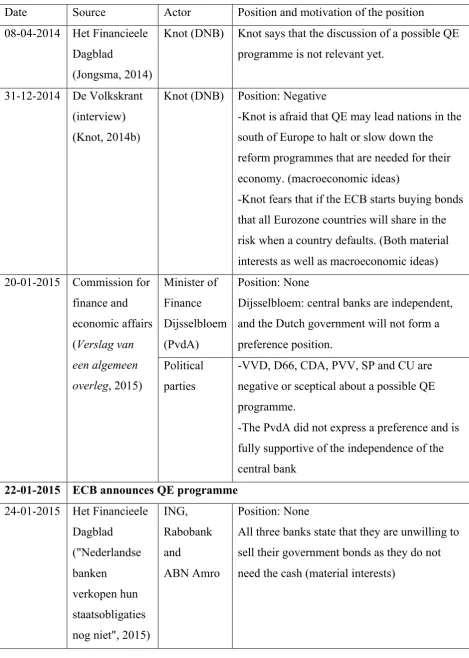
Thus, from the motivations used by the various actors, deductions can be made as to the causality of the relationship between domestic groups, the government and the DNB. Table 1 below provides a timeline which offers a general overview of which actors had which positions at what moment in time. Additionally, their argumentations are listed and
Table 1: Timeline media activity actors
Date Source Actor Position and motivation of the position 08-04-2014 Het Financieele
Dagblad
(Jongsma, 2014)
Knot (DNB) Knot says that the discussion of a possible QE programme is not relevant yet.
31-12-2014 De Volkskrant (interview) (Knot, 2014b)
Knot (DNB) Position: Negative
-Knot is afraid that QE may lead nations in the south of Europe to halt or slow down the reform programmes that are needed for their economy. (macroeconomic ideas)
-Knot fears that if the ECB starts buying bonds that all Eurozone countries will share in the risk when a country defaults. (Both material interests as well as macroeconomic ideas) 20-01-2015 Commission for
finance and economic affairs (Verslag van een algemeen overleg, 2015)
Minister of Finance Dijsselbloem (PvdA)
Position: None
Dijsselbloem: central banks are independent, and the Dutch government will not form a preference position.
Political parties
-VVD, D66, CDA, PVV, SP and CU are negative or sceptical about a possible QE programme.
-The PvdA did not express a preference and is fully supportive of the independence of the central bank
22-01-2015 ECB announces QE programme 24-01-2015 Het Financieele
Dagblad ("Nederlandse banken
verkopen hun staatsobligaties nog niet", 2015)
ING, Rabobank and
ABN Amro
Position: None
26-01-2015 Buitenhof (television interview) (Knot, 2015)
Knot (DNB) Position: negative
-Knot doubts the necessity of a QE programme. (macroeconomic ideas). -Knot doubts the effectivity of a QE programme. (macroeconomic ideas) -Knot fears the creation of bubbles in the economy. (macroeconomic ideas)
-Knot is afraid that nations will slow down or halt their reform programmes.
(macroeconomic ideas) 27-05-2015 De Telegraaf
(Visser, 2015)
APG Position: Negative
Unwilling to sell the government bonds in their possession and they doubt whether the QE programme will be effective. (material interests and macroeconomic ideas) 24-03-2016 NRC
Handelsblad (interview) (Knot, 2016b)
Knot (DNB) Position: Negative
Knot is against an expansion of QE from €60 billion to €80 billion a month.
29-01-2017 Buitenhof (television interview) (Knot, 2017)
Knot (DNB) Position: Negative
QE programme currently at €60 billion a month. Knot wants to start phasing out QE
28-01-2018 Buitenhof (television interview) (Knot, 2018a)
Knot (DNB) Position: Negative
QE programme currently at €30 billion a month.
Knot wants to end QE as soon as possible after September 2018.
13-12-2018 ECB announces end to QE programme 31-12-2018 NRC.Next
(interview) (Knot, 2018b)
Data analysis
In this chapter the data that was collected will be analysed. This will be done at the hand of the method identified above. First the domestic interest groups which were identified in the methods chapter will be discussed, after which the national government and the DNB will be examined. Finally, some other actors are examined which were identified but did not belong to the domestic groups that were originally selected. This all will be done at the hand of table 1 which offers an overview of the timeline, the actors, the positions taken and the arguments used of the parties involved. These will be more elaborately discussed and analysed. In the last part of the chapter the four hypotheses will be discussed at the hand of the data that has been analysed.
Domestic groups
The first and main conclusion that can be drawn based on the newspaper articles and the television interviews is that domestic groups were not very present in the media about the quantitative easing programme by the ECB. To what extent they were active will be discussed below.
they only managed to remove government bonds from the balance sheets of banks. It would only have been successful if the central banks were able to buy government bonds from other non-bank parties and when that party then started spending or lending out their extra cash they got in return (Knot, 2015).
The view of the commercial banks was repeated on February 2, 2015 when a Rabobank director stated in a newspaper that he does not see a use in selling government bonds, since they were also required to maintain a certain amount of government bonds (Grol, 2015). As such he would need to sell them and then purchase new ones to fulfil that
requirement. Again, no explicit mention was made of their preference with regards to the QE programme however, there was at least a distinct lack of enthusiasm towards the practical implications of QE. Their argumentation behind their expressions about QE was based on their material interests as the commercial banks only discussed the impact it had on themselves.
In the articles that were examined there was no case in which the VNO-NCW expressed their view on QE. The same goes for the labour unions, FNV and CNV, which were selected as domestic interest groups which might make their position known.
DNB and the national government
In this section the presence of the DNB and the Dutch national government will be discussed. The analysis will be structured in three periods. The period from 2014 until January 22, 2015 when the ECB made its decision to start QE. Then from that point until the ECB decided to stop its QE programme on December 13, 2018 and finally shortly on the period thereafter until the end of 2018.
Before the start of the QE programme
Netherlands had a long tradition of independence of the central bank and therefore monetary policy and that he did not have an opinion on the QE programme, because the decision whether QE should be started should be taken by the ECB. Additionally, he stated explicitly that the Dutch government would not form a preference position since the ECB should, within their mandate, determine their policies independently (Verslag van een algemeen overleg, 2015). This took place on January 20, 2015 two days before the final decision by the ECB on the QE programme was made. Dijsselbloem also stated that it is the president of the DNB Klaas Knot who was in the positions to have a preference on this matter and that he had made his position known (Verslag van een algemeen overleg, 2015).
This sums up the contribution of the national government on the preference formation with regards to the QE programme. What is of note is that if Dijsselbloem discussed QE in the media, he remained neutral suggesting both benefits and risks were attached to the
programme. Further his insistence on the independence of the central bank is of course important and indicates that the government had the intention of letting the DNB keep the initiative on this subject. Thus, the main focus in this section will further be on Klaas Knot the president of the DNB.
Knot has been much more active on this subject in the media than any other
representative of the Netherlands. He has given various interviews to newspapers in which the subject of QE was discussed and additionally he has given four television interviews on the programme Buitenhof on the Dutch television in which QE was also discussed in the time frame between 2014 and 2018. Apart from the interviews he has given he was also the main actor who was discussed in the newspapers when it concerned QE.
Therefore, a cost benefit analysis should have been made to determine what the costs of such a programme would be and what benefits would likely result from it. Thus, Knot was not convinced of the effectivity of a possible QE programme. From this it can be concluded that the president of the DNB did not have a positive opinion and that his preference position was closer to a negative opinion. The doubts about the effectivity of a QE programme were macroeconomic as they concerned the working and the effect of QE. It was not based on material interests as it was not about whether it would be good for the DNB or the Netherlands.
In November of 2014 the inflation lowered further to 0.3% and the economic growth was also low with 0.2%. This led to further debates within Europe on QE, Knot still doubted the effectivity and necessity of the measure (Hofs, 2014). In an interview with de Volkskrant, Knot (2014b) stated that it was up to the politicians to decide on how budgetary risks should be divided within the Eurozone and that this was not something which should be decided by the central banks. If the ECB was to start a QE programme, then the default risk that comes with buying bonds would be shared equally among all Eurozone countries. Such a decision he stated should be decided upon by politicians and not central bankers. Additionally, he feared that QE would lead countries in the south of Europe to suspend or slow their reform plans which were necessary to improve their economic strength. It can be concluded that his preference position on QE had become much more clearly negative in comparison with the beginning of 2014.
political question. Otherwise he was afraid that the support for the euro could diminish, especially in countries like Germany and the Netherlands which were more critical of QE (Knot, 2014b). The motivation behind this argument is more complex as it concerns both material interests as well as macroeconomic ideas. The material interest centres around an unwillingness to be at risk when another Eurozone country were to default. While the
macroeconomic idea behind this is that such a sharing of the risks makes the whole Eurozone more vulnerable while otherwise a default would at first at least be more confined to the country and the holders of their bonds. Although this confinement is far from absolute since it does concerns countries that all share the euro and government bonds are also often held by foreign parties.
During the QE programme
The ECB announced on the January 22, 2015 that the decision was made to initiate a QE programme. Four days later the president of the DNB, Klaas Knot appeared in a television interview and discussed QE extensively. In the interview Knot (2015) stated explicitly that he was against the introduction of the quantitative easing programme. He called it a very
abnormal instrument and that therefore the necessity and effectivity of the programme should be clear, however as he still had serious doubts about both he did not vote in favour of the programme (Knot, 2015). He raised multiple arguments as to why he believed the decision to start a QE programme was not the right one.
they could intervene in the economy (Knot, 2015). All of the arguments that were used to support his assessment of the necessity of QE were fully based on macroeconomic ideas, as it is the job of the central bankers to assess the inflation levels of the whole of Europe and what the impact thereof is on the economy of the Eurozone.
With regards to his doubts about the effectivity of such a programme, Knot (2015) stated that even in the various countries where QE programmes have been used there are still doubts whether they were really effective. He added that even if you were convinced as to the effectivity of QE in the US, that does not give any guarantees as to whether it will also be a success in the Eurozone since there were considerable differences between both regions. This is both in terms of the financial system and also the state the economy was in when the QE programmes were implemented. The effectivity arguments from Knot (2015) as to why he was against QE are based on macroeconomic ideas.
A third argument as to why Knot (2015) was against QE was mentioned already earlier on, namely that all countries in the Eurozone would share in the risks when the ECB would start buying government bonds. So, if a country were to default on its bonds then the costs would need to be shouldered by the other Eurozone nations. Knot (2015) stated that the whole governing council of the ECB felt that this created a risk that they would enter the political playing field thereby endangering the independence of the central banks. Therefore, the council made sure that the risk sharing was minimalised thus removing one of the
arguments Knot used against QE. This argument concerned the material interests of all central bankers in the Eurozone and the northern ones particularly. This is both in terms of not being willing to share the risks of defaults of other countries across all countries and because the decisions with regards to the redistribution of risks were seen as belonging rather more in the political domain than in the field of monetary policy. This argument is also based on
macroeconomic ideas as spreading less risks is also desirable for the stability of the Eurozone. Additionally, the choice to mitigate this facet of quantitative easing was also concerned with the legitimacy of the various national central banks and the European central bank. As they wanted to maintain their independence from the political debate as much as possible.
can have a considerable effect on the whole economy. According to Knot (2015) there was already in 2015 a difference between the financial market and the real economy, as financial market prices had become detached from the underlying value of companies. QE would only lead to a larger difference between the financial markets and the real economy. This was the case since QE would provide more money which could be invested into the stock markets thereby driving up stock prices, which might lead to the formation of bubbles. Since bubbles can eventually burst this can have consequences for the wider economic health. This
argument is closely connected to the fifth argument of Knot (2015) which was that monetary policy can never be a solution to structural economic problems. Such structural economic reforms have as one of their goals to build the strongest and healthiest economy for a nation. The idea is that when the economy is structurally sound, bubbles can be weathered more easily than when structural problems in the economy exist. Therefore, Knot (2015) strongly preferred the continuation of the reform programmes various countries were implementing. However, the fear was that nations might halt their reform programmes when QE was in effect, since it would spur economic growth which could make reform programmes seem unnecessary. Additionally, policies which seek to reform are often difficult politically, since most of the time the policy is very clear, and their effect is known. Reform is often not a popular choice as even the threat of changes to the status quo mobilises all domestic groups which stand to lose in comparison with the status quo. They will thus try to influence the national preference formation, to keep everything as it was and block any reforms. Thus, contributing to the political difficulty of reform programmes. These two arguments are both based on macroeconomic ideas. One is concerned with the effects of bubbles on the wider economy whereas the other argument is about how such bubbles can be mitigated through economic reforms.
According to Knot (2015), there was a long tradition of central bank independence in the Netherlands therefore he would not state that he felt supported by Dutch politicians in his decision. According to him politicians should withhold themselves from commenting upon monetary policy and central bankers should not give them any reason to comment upon it.
that the risks of deflation was high enough to necessitate QE as a pre-emptive measure against deflation and a part of the council thought that was not necessary. He saw a north-south distinction as a simplification of reality and did not like the suggestions that they might have other motives than those that were used as arguments to support a decision. This north-south divide may not exist, however there are differences between the central bankers in the Eurozone. The fact that most of the arguments of Knot are macroeconomic does not necessarily mean that the argumentations of his colleagues of other central banks are completely based on their material interests. Their motivations to vote in favour of QE may just as well be based on macroeconomic ideas. This may be the case since there are different streams within the field of economics and then specifically monetary theory which disagree on some aspects. Or may set different standards by which they make their assessment as to the desirability of quantitative easing. In the discussion on QE the Eurozone is often separated into two parts a hawkish side and a dovish side. They have different interpretations of what the current situations is and what the best measures are to intervene in the market. On the subject of QE, Knot as well as Weidmann, the president of the German central bank, are some of the central bankers which are seen as hawkish (Jongsma, 2014). While Draghi is in the dovish camp (Beunderman, 2016). The dovish side is often in favour of expansionary monetary policy, such as QE to stimulate economic growth. While the hawkish side often opposes expansionary monetary policies such as QE. However, what should be noted is that Klaas Knot has not opposed all expansionary policies of the ECB, as the measures the ECB took earlier on starting in 2007 were also expansionary (Knot, 2016a). So was the lowering of the interest rates which was the first measure the ECB took against the low inflation. Thus, while it can be stated that with regards to QE Knot is in the hawkish camp he is not
principally so as he had supported more conventional expansionary monetary policies in the past.
During the following years when the QE programme was active, Knot kept expressing his position in the media on QE. However, both the frequency with which it was discussed as well as the extent to which it was discussed decreased dramatically in comparison with 2015, the year in which QE was started.
his German and Estonian colleagues voted against this expansion (Beunderman, 2016). In an interview at the end of March Knot (2016b) stated that he was aware of the increasing criticism in the Netherlands on the ECB, because of the low interest rates. The critique was that because the interest rates are so low that the capital positions of the Dutch pension funds were being harmed. However, he stated that this was not due to the ECB only, since the ageing population, the tendency of people to save their money and the low productivity growth also contributed to a low interest rate (Knot, 2016b). The effect on the pension funds and their expressions in the media will be further discussed further down.
After the QE programme was expanded to €80 billion, the ECB decided in December of 2016 that in March of 2017 they would scale it back down again to €60 billion euros (Jones & Moore, 2016). Knot (2017), was still not in favour of the QE programme and he doubted whether it had the effects that they wished for even though it had some positive effects. The inflation had risen somewhat, so according to Knot (2017) there was no more reason to continue on with the programme. However, such a programme could not be stopped
immediately and should be slowly phased out. The decision to reduce QE back to €60 billion should be seen in light of their aim to slowly reduce the dependence of the economy upon QE. The most important negative side effect QE had over the past few years, is that the financial markets have lost touch with their ability to estimate risks. When the financial markets wanted to invest in something, they first estimated the risks of their investments. However, QE had intervened in this aspect by suppressing the pricing of risk. Therefore, while the suppression of risk might have been necessary in the beginning of the programme to help boost spending, these kinds of effects are unwelcome and therefore QE should be phased out. Furthermore, the programme should also be phased out since the reasons the ECB had to start the programme in 2015 are no longer present. Therefore, the governing council had decided to place limits on the programme and these limits would be reached towards the end of 2017, which meant that there will be gradual process to the end of the programme.
governing council committed itself to continue the programme to September of 2018 and then according to Knot (2018a) it should be phased out as fast as possible.
Over the years since 2015 and his interview shortly after the announcement of the QE programme Knot did not elaborate further on his argumentation even though he did
sometimes refer to his motivations for his negative opinion of QE. The main issue in 2016 regarding QE was the further expansion of the programme to €80 billion (Knot, 2016b). In 2017 the negative side effects became more pronounced for example in terms of the risk assessments by the financial markets. The inflation had risen, thus QE should be slowly phased out according to Knot (2017). Finally, in 2018 the programme, down to €30 billion a month, could be rapidly phased out after September of that year as it had increased economic growth and there was no longer any risk of deflation (Knot, 2018a). Over the years he less often and less explicitly expressed his opinion in comparison with the time around the start of the QE programme in 2015, however it was clear that he remained sceptical of the
programme. The argumentation during these years were mainly that QE had achieved enough to be halted and that the negative side effects were disrupting the proper functioning of the economy. These arguments were macroeconomic in nature since they concerned his
interpretation of the economic situation in the Eurozone and his assessment that the economy was strong enough to end QE.
After the QE programme
On December 13, 2018 the ECB announced an end to the QE programme. On December 28 the president of the DNB Knot (2018b) gave an interview to the NRC.Next in which he stated that the QE programme did have some positive effects. Such as lowering the borrowing costs, thereby decreasing the differences between the north and the south of Europe and it had supported the recovery of the economy. It also had as goal to restore the inflation to a level of just below 2% and the inflation got closer to the 2%. However, when the price volatile
products were removed the core inflation remains around the 1% and as such had not shown very much movement. Finally, the exchange rate of the euro lowered as a consequence of QE, which had a positive effect on all Eurozone countries especially the exporting ones (Knot, 2018b).
they had used QE once, it had not become a standard instrument. It should only be used when the risk of deflation was imminent, since it had considerable negative side effects. A negative side effect was that QE also forced the interest rates lower, this meant that they no longer showed the risk of the loan which was normally visible in a high or low rate. However, the effect of so much extra money on the economy forced the interest rates so much lower that the interest rates did no longer display this risk thereby enabling non-viable companies to keep existing. Since they could keep borrowing to remain alive, however if the interest rates were to rise, they would no longer be capable of repaying their loans. Therefore, they also formed a risk for the banks which lent them their money and such companies also decreased the growth of productivity.
Knot (2018b) did not express any explicit opinion anymore on whether the introduction of QE was the right decision or not. He charted the effects that he witnessed which were, according to him, tilted towards the negative side as the inflation had for
example still not recovered to just below 2% while that was the main goal of the programme.
Other actors
There were also actors discovered that expressed themselves in some manner in the media on the subject of QE. These actors do not belong to the domestic groups which were originally identified, namely the labour unions (FNV and CNV), the association for banks (NVB) and the association for employers (VNO-NCW). This concerns actors such as parties active on the financial markets which in this context are mostly investment bankers and asset managers but also Dutch political parties and APG a Dutch pension. These actors and their statements in the media will be discussed below.
With regards to the financial markets, their position on QE was positive and their motivation was purely material ("Nederlandse banken verkopen hun staatsobligaties nog niet", 2015). Their material interests stemmed from the effect the QE programme had on stock markets. Because, the ECB was buying bonds more money became available that could be invested in stocks. Thereby increasing the valuation of companies and the more valuable the stocks were the more potential for profit there was for investment bankers and asset managers. However, while profit could be made through the rising stock markets this could also become a bubble which was the fear of the president of the DNB and one of his
arguments as to why he was against QE.
if the price of the bonds were to rise due to the demand that the ECB created through their QE programme (Visser, 2015). There are multiple reasons why APG has government bonds in their possession. Bonds keep their investments diverse, they help dampen the consequences of interest rate changes and they serve as collateral if necessary. APG doubted whether the QE programme would lead to more lending and economic growth and they feared that bubbles might form because of the programme (Visser, 2015). With regards to the estimation of the effects of QE the spokesperson stated that they were more aligned with the expectations Knot had than with the view of Draghi, the president of the ECB. The APG incorporated in their motivation both their material interests which was reflected in their unwillingness to sell their government bonds and macroeconomic ideas which made them think that QE would not be effective to create more economic growth. Furthermore, one of the measures the ECB took before the start of the QE programme was to lower their interest rates hoping to encourage spending and thereby increase economic growth and inflation. However, this resulted in very low interest rates and these rates only decreased further with the introduction of QE. In 2016 the critique on the monetary policy of the ECB increased in the Netherlands, because the low interest rates were detrimental to the capital positions of the Dutch pension funds (Knot, 2016b).
Finally, Dutch political parties also had an opinion on QE. In the commission for finance and economic affairs, some members of parliament expressed their negative opinion or at least scepticism about a possible QE program on January 20, 2015. These representatives were from VVD, CDA, D66, PVV, SP and CU while the PvdA did not express a preference and was fully supportive of the independence of the central bank (Verslag van een algemeen overleg, 2015). What should be noted is that at the time the minister of finance Dijsselbloem was from the PvdA, which may have had an influence on their standpoint. The VVD and D66 were two parties that were sceptical about QE, but they did express their support for the independence of the ECB. The motivations for their positions were mixed, partly they used similar arguments as Knot had been using, such as a fear of bubbles, questions as to the effectivity and doubts whether countries would keep reforming their economies. But there were also questions regarding whether QE fell within the mandate of the ECB and the risk redistribution was also an important aspect. Only the VVD explicitly used the same argument as Knot with regards to their doubts whether other countries would continue with their
members of parliament were somewhat varied, and included both arguments based on
macroeconomic ideas, namely those where they follow Knot. But also, arguments concerning their material interests, with in this case their material interest being looking out for their voters, such as the redistribution of risks across the Eurozone which they thought should be a political decision. Finally, their wish to express themselves at all even though monetary policy is the responsibility of the central banks could be seen as based on their material interests. Furthermore, the members of the Second Chamber were also vocal about the impact the low interest rates set by the ECB had on the Dutch Pension funds (Jonker, 2016). The members of parliament were all very concerned and the Second Chamber wanted to know the possible consequences that the low interest rate could have on the unique Dutch system, because the subject was very important for the Dutch people (Jonker, 2016). Some parties were of the opinion that this violated the mandate the ECB had and wanted the government to confirm this opinion, the government however did not agree with this position (Jonker, 2016).
Hypotheses
In this section the hypotheses that were formed based on the theory of liberal intergovernmentalism will be discussed based on the data analysed above.
Liberal intergovernmentalism predicts that there is a stage of national preference formation that takes place before a second stage of international bargaining begins. This stage of national preference formation is in most cases according to Moravcsik (1993) heavily influenced by domestic interest groups. National governments rely on these domestic groups for the support they can provide in their aim to perform well enough to be able to get re-elected. Dependent upon what sector of the economy or society is subject to a policy change different domestic groups mobilise to either defend the status quo or to encourage the
adoption of the new policy. Thereby influencing the national preference formation. However, Moravcsik (1993) predicts that in some cases domestic groups do not play a large role, this is mainly when macroeconomics play a role. In the case of macroeconomics, the effects are often uncertain and ambiguous, which makes it difficult for domestic groups to determine the preference positions that is optimal to their material interest. Therefore, in such situations the national government often takes the initiative and bases the preference position on
macroeconomic ideas or in some cases on ideology of the parties in government.
Three domestic groups which were thought to have an interest in the consequences of QE were originally identified. One of those domestic groups was the Dutch association of bank (NVB), however no media expressions of this association have been found. What has been found is some activity in the media by the three biggest Dutch commercial banks, the ING, Rabobank and ABN Amro. These banks expressed their unwillingness to sell the government bonds in their possession. They did not, however, adopt an explicit preference position with regards to whether they thought QE was a good idea or not. The first expression of these three banks in the Dutch media was on January 24, 2015 two days after the ECB announced their decision that they would start a QE programme. After this there was one more instance in which the Rabobank stated again that they did not see the use of selling their government bonds on February 2, 2015.
With regards to the other two domestic interest groups that were identified in advance, namely the two biggest Labour unions (FNV and CNV) and the Dutch employers association (VNO-NCW). There were no media articles found in which they expressed their view on the QE programme of the ECB or where they discussed the possible impact on the groups that they represent.
There were also other domestic groups discovered that were not identified in advance. These domestic groups have been included in the data and have also been analysed above.
One of these groups were firms that are active in the financial markets such as
investment bankers and asset manager, the Dutch commercial banks have been excluded from this group. These firms were in favour of QE, since it was expected that QE would drive up the stock markets. These actors were not active in the media themselves, or at least no representative of the firms active on the financial markets was interviewed or quoted in the various newspaper articles. They were however, discussed by the press as a group who were in favour of QE. The actual reaction of the financial markets on the announcement of the QE programme was telling; European stocks went up, the exchange rate of the euro lowered and the rates of German government bonds declined further too ("Nederlandse banken verkopen hun staatsobligaties nog niet", 2015). All this indicates that investors were enthusiastic about the measure taken by the ECB.
a macroeconomic perspective as they were sceptical about the effectivity of the programme and were worried about possible bubbles on the stock markets. APG made their preference position clear by explicitly expressing their negative opinion and their own statement that they were more in line with the position of Knot than with Draghi.
Finally, members of parliament discussed QE and the possible consequences in the Second Chamber. This first took place on January 20, 2015 two days before the QE programme was announced by the ECB. Here several Dutch parties expressed a negative opinion or at least their doubts about a possible QE programme of the ECB. Their
argumentation was mixed and consisted of several arguments also used by Knot, but also included questions concerning the mandate of the ECB. Finally, in March of 2016 members of parliament expressed their discontent with the low interest rates as set by the ECB and the consequences they had on the Dutch pension funds.
The Dutch government did not involve itself in the discussion about QE, with the minister of finance stating explicitly on January 20 of 2015 that the DNB was independent and that the government would not adopt a preference position (Verslag van een algemeen overleg, 2015).
Knot, the president of the DNB, was the first actor to publicly discuss QE. On April 8, 2014 Knot stated that any discussion of a possible QE programme was not relevant yet (Jongsma, 2014). However, on April 26, 2014 he already had a more elaborate standpoint on the programme which was more clearly negative as he stated that he was not convinced of the necessity of such a programme (Knot, 2014a). Knot would continue to repeat his negative preference position over the years including his argumentation as to why he eventually voted against QE. With regards to the decision about QE Knot was also very clear in stating that this was a decision that would be taken by the DNB and that politicians should withhold
themselves from commenting on this subject (Knot, 2015).
With regards to the first hypotheses liberal intergovernmentalism expects that in cases of macroeconomics that the national government takes initiative. However, in this case it is not the Dutch government, but the DNB which took the initiative. The first hypothesis is
disproven since the domestic groups did not make their preferences publicly known before this was done by Knot. Additionally, the fact that the three biggest Dutch banks did not take an explicit preference position and that what they did say is more about the practical
made that QE would take place. The same goes for the other groups that were identified they were all active in the media after Knot had expressed his negative position and APG even stated that their position was in line with the position of Knot on QE.
What is shown here is that the DNB is acting, while the other groups are at most reacting to the preference position set by Knot. Furthermore, Knot is selective in what he sees as important arguments against QE, since he does not for example include the effect of QE on the interest rates and the consequences on the pension funds in his argumentation against QE.
H2: Domestic interest groups aimed their statements at the DNB and not at the national government.
The theory of liberal intergovernmentalism always speaks of the national government as the party that is influenced. In this case though, it is the DNB that is in charge of monetary policy for the Netherlands and not the Dutch government. Most domestic groups, such as the Dutch banks, did not explicitly state which actor they addressed, because they were only reacting to the initiative shown by the DNB and were not trying to proactively influence anyone. APG however, explicitly stated that they agreed more with Knot than with Draghi this shows they follow the DNB and not the national government (Visser, 2015). Only the members of parliament addressed the government, in a commission meeting with the minister of finance regarding QE (Verslag van een algemeen overleg, 2015). In the Second Chamber debate on the effects of the low interest rates on the pension funds which they attributed at least partly to QE, they discussed it also with the national government and not the DNB (Jonker, 2016). However, in this case there is some overlap in who is responsible, since the pensions are something which fall under the responsibility of the government. What should also be noted is that it is the task of the members of parliament to address the government on the issues that they have concerns about. Finally, what is interesting to note is that the Dutch government very clearly distanced itself from the decision making around QE and from being addressed by other actors about the programme. The minister of finance emphasised the independence of the central bank and that the Dutch government did not have a position on the matter (Verslag van een algemeen overleg, 2015).
Liberal intergovernmentalism expects that domestic groups base their action on their material interests either to preserve the status quo or to encourage the policy change in an attempt if they see the opportunity to benefit from the new policy. However, in cases of
macroeconomics, if domestic interest groups start to motivate their argumentation based on macroeconomic ideas this may be one of the indicators that they adopted the preference position of the DNB.
Most of the domestic interest groups did not adopt a specific preference position on QE. The three big Dutch banks for example only stated that they were not interested in selling their government bonds. But this was motivated by their material interests as they did not see any benefit in selling the bonds they owned. The labour unions and the employers’
organisation did not adopt a preference position at all. The same goes for the financial
markets which also did not express a position but were one of the groups that stood to benefit considerably from the effects of QE. APG had a negative preference position which was motivated partly by their material interest. They did not want to sell their government bonds for example, this was based on their material interests. Their fear of bubbles was also partly based on their material interest since bubbles in the stock markets could lead to negative consequences for their investments and thereby their capital positions. However, they also had arguments based on macroeconomic ideas, which will be discussed further down. With
regards to the political parties most were negative or doubtful about the QE programme, however the argumentation they used was largely the same as the various arguments Knot had against the programme. Except, for one argument which concerned how the risk of countries defaulting on their bonds would be shared across the Eurozone. In this case, Knot stated that such redistribution decisions should be taken by politicians and not by central bankers. The political parties agreed with this and were of the opinion that redistribution should either be minimised or non-existent. Eventually, the ECB also decided to minimise the redistribution of risks with the argument that this falls within the scope of the politicians and not the central bankers. The use of this argument by the members of parliament, however, was based on their material interests as they did not want the Netherlands and thereby their voters to be at risk of other nations that might default. Finally, the debate in the second chamber about the low interest rates and their effect on the pension funds was also based on their material interest as this is an important subject in the Netherlands especially if the pensions are at risk of being lowered.
The last hypothesis concerns whether domestic interest groups motivated their position based on the macroeconomic implications of the QE programme. Most of the domestic groups examined either did not adopt a firm position on QE or did not adopt a position at all. And what they did say regarding the programme was mostly based on their material interest. These domestic groups were the Dutch banks whose expressions in the media were purely material. With statements such as that they did not see a benefit in selling their bonds to the national central bank. Similarly, the financial markets were purely motivated by their material interest. The labour unions and the association for employers were not present at all in the discussion. The only two groups which used macroeconomic ideas in their motivations were APG, a pension fund, and the political parties. The APG stated that they believed more in the
estimations of Knot with regards to the effectivity than those of the ECB president, Draghi. The pension fund also feared bubbles would form due to QE, however, this fear was based on both their material interests and macroeconomic ideas. The second group that used
macroeconomic ideas were the members of parliament who agreed with the assessment of Knot on QE. These two groups adopted clearer positions towards the quantitative easing programme which were both in line with the position that DNB had been expressing in the media.
The APG mainly adopted the macroeconomic arguments against QE which concerned the doubts about the effectivity of such a programme and the concern for the possible
formation of bubbles in the stock markets as a possible consequence. While the political parties mainly displayed more a general agreement with the argumentation of the DNB and a need to at least express themselves. Of all domestic groups examined only two political parties, the VVD and the D66, explicitly expressed most of the arguments used by Knot, such as the sharing of risks, the fear of bubbles, the doubts as to the effectivity of the programme and the doubt whether reform programs would be continued in the Eurozone countries after QE was implemented (Verslag van een algemeen overleg, 2015).
Conclusion
At the start of this paper the following research question was formulated; To what extent did domestic groups influence the Dutch government to adopt a negative position against the quantitative easing programme of the European Central Bank?
The first thing that is of note is that it was not the Dutch government which was the actor that needed to be influenced if a domestic group wanted to have an impact on the
preference position. Rather it was the DNB which played the leading role in the discussion on QE. This deviates from what the theory of liberal intergovernmentalism suggests, namely that it is about national governments especially in areas concerning macroeconomic policy. The leading role of the DNB can be seen from their activity in the media, as Knot was very active in the media and repeatedly discussed in newspapers and on television his negative view of QE and why he was against. The DNB was already active in 2014 in the media on the
discussion about QE and this continued at least until the end of the programme in 2018. In the beginning of 2014 Knot still tried to keep QE out of the discussion, however towards the end of 2014 that was no longer possible, and he had adopted a firm negative opinion based upon macroeconomic arguments. This preference position did not change over time, this is shown from the negative evaluation of the programme by Knot as he thought that the costs
outweighed the benefits it provided (Knot, 2018b). But the leading role of the DNB also becomes apparent from the position the minister of finance Dijsselbloem adopted on this subject. Dijsselbloem was neutral in his discussion of QE in the media and in a commission meeting of the Second Chamber he explicitly stated that the central bank was independent (Verslag van een algemeen overleg, 2015). As such the Dutch government would also not adopt a preference position on this matter, since decisions in this area are the responsibility of the national central bank.