3rd July 2019
Bachelor Thesis –
Future Self-Dialogue and its Effect on
Connectedness to a Future Self
University of Twente, Enschede, NL
Faculty of Behavioural, Management and Social Sciences
B.Sc. in Psychology Semester 2019
First supervisor: B.G. Ganschow, MSc Second supervisor: L.J.M Cornet, PhD Department: PCRS
Abstract
1. Introduction
When deciding how to act, people vary in their tendency to consider how their behaviors will impact them in the future. Some decisions not only influence the present but also carry important long-term consequences. By not exercising when they should exercise, choosing to eat unhealthy when they should eat healthy, or spending money when they should save, people experience pleasant short-term goals but fail to make decisions that would benefit their well-being over time (Rutchick et al., 2018). Research has shown that people often prefer an immediate reward to a distant reward (Rutchick et al., 2018). When people prioritize needs and desires in the present and de-value future rewards this is referred to as temporal or delay discounting (Bartels & Rips, 2010; Ersner-Hershfield, Wimmer, & Knutson, 2009a; Parthasarathi, McConnel, Luery, & Kable, 2017; Rutchick et al. 2018).
What influences people’s choices when they face dilemmas where they have to make trade-offs between immediate enjoyment and well-being in the future? Research by Bartels and Urminsky (2011) on temporal discounting provides evidence that the degree of connectedness people feel between their present self and their future self is one powerful predictor of the choices they make. Their findings reveal that a greater feeling of connectedness to the future self leads to more patient choices in the present, which benefits future well-being. Other research has found the same positive link between perceived connectedness to a future self and more future-oriented choices (Rutchick et al., 2018; Hershfield, 2018). For instance, Rutchick et al. (2018) emphasize that people find it generally difficult to resist their temptations because a single unhealthy choice does not appear to have serious effects on their long-term future health. However, the authors theorized that people who perceive a greater sense of similarity and connectedness between their current and future self, which they termed future self-continuity (FSCon), act more in the interest of their future self because they appreciate that every healthy act today, repeated over time, belongs to the same person. These choices all increment greater health benefits (Rutchick et al., 2018).
continuity to a future self by having participants complete a writing task. In line with their hypothesis, those participants who were instructed to write a letter to a distant future self, compared to writing to the near future self, were more likely to physically exercise. Similarly, Bartels and Urminsky (2011) provide evidence of a causal relation between a manipulated reduced sense of connectedness to a future self and increased impatient behavior (i.e., temporal discounting). These insights point to the importance of interventions to focus on increasing the felt connectedness between selves over time to help facilitate long-term decision-making.
1.1 Previous Research on FSCon
Interventions seeking to increase FSCon show that it can be helpful to encourage people to interact with their future self through visual representations and to communicate and think about a future self. For example, a study by Hershfield et al. (2011) shows that exposure to a visual representation of one’s future self leads to greater FSCon. Furthermore, research involving children shows that conversing about one’s future self with an adult, helps them to become more future-oriented and act in interest of their future self, which implies an understanding of a connection between future-events and the present self (even though this effect was greater for close future-events than distant ones) (Chernyak, Leech, & Rowe, 2017). In another study by Pronin and Ross (2006) participants who were asked to contemplate about their future self’s thoughts and feelings made more actor-like attributions about this self, which presumes an appreciation of personal continuity. This is because actor-like attributions imply that a person is aware of internal states and therefore more inclined to explain behavior by focusing on situational factors (Pronin & Ross, 2006).
1.2 Conversing with One’s Future Self Through Embodiment
therapeutic process starts by expressing an emotional problem to the imagined other sitting in an empty chair placed in front of oneself, and then to switch seats and formulate answers from the perspective of the imagined other (Greenberg and Malcom, 2002). This form of self-dialogue seeks to enhance emotional arousal, which allows participants to confront and restructure inhibited feelings and perceptions toward the self and the significant other (Greenberg & Malcolm, 2002). In a study by Paivio and Greenberg (1995) this, in turn, helped participants to achieve a greater understanding and tolerance of themselves and their significant other. Accordingly, it is interesting to study whether the EC dialogue, in a similar way as it helped to access and restructure inhibited feelings and perceptions, and to understand and tolerate the self and others, would also help people to access future feelings and perceptions, and to understand and tolerate a future self, which may then strengthen the emotional bond between present and future selves.
look-alike version of Sigmund Freud, participants experienced an embodiment illusion due to the synchronous body movements.
Based on this, we assume that similar to how people are able to perceive an embodiment illusion over an avatar that looks like a different person, they might also have an embodiment illusion over a virtual body representing a distant future self, whom they often perceive as a different person on a trait-level basis (Pronin and Ross, 2006), and on neural levels (Ersner-Hershfield et al., 2009a). Although the virtual avatar in this study is not made to look like a future version of one’s self, it might stimulate to imagine “being” the future self, as participants are less distracted from visual cues of their real-world body of their present self. Over and above an effective illusion of being embodied in a virtual avatar, Osimo et al. (2015) demonstrated that the embodiment of Freud yielded better counseling outcomes. The authors suggest that embodiment of Freud provided participants access to mental states other than their usual ways of thinking which may have helped them to come up with novel ideas that increased understanding and emotional connection with their present self’s problem. This
fits with the idea of body semantics, which describes that the illusion of embodying a virtual avatar is accompanied by an illusion of gaining access to mental states that are associated with the type of avatar (Slater & Sanchez-Vives, 2014). Hence, an effective embodiment illusion of the future self may encourage people to come up with novel insights and a more positive attitude towards their own future, just as stepping out of their body and into the perspective of Freud has helped participants to raise their mood and find solutions to personal issues.
In sum, sophisticated VR technology may further stimulate to imagine an embodiment of the future self as it engulfs people in an environment, in which they are less distracted from the real world and the feeling of being in the present. VR can generate an embodiment illusion over a virtual body and has the means to induce the feeling of virtual time-travel. Future self-embodiment in EC dialogue, in contrast, lacks this virtual embellishment and may depend more on a person’s ability to visualize themselves at a later point in time. Since there is little research into whether EC dialogue and VR can also be used to increase FSCon, investigating them first and foremost provides knowledge about their effectiveness in this regard, and second, enables direct comparison to see whether one might be more effective than the other and why. This is important because it will help guide future research on how to increase FSCon.
According to Rutchick et al. (2018), most definitions of FSCon agree that it describes the extent to which a person feels psychologically connected and similar to his or her future self, for example in terms of sharing personality, beliefs, and values. Research supports this continuity-based account that highlights the importance of feeling connected and similar to a distant self in terms of important psychological characteristics. For example, a literature review by Eisenberg and Miller (1987) reveals that inducing a feeling of similarity to another person increases one’s identification with that person and leads to more empathy, which was linked to prosocial behavior. Besides, research by Ersner-Hershfield et al. (2009a) showed that participants who perceived greater similarity to their future self processed future self-relevant information in a way that yielded less temporal discounting, which presumes that feeling a sense of similarity is similar to the feeling of connectedness and therefore makes one act more in the interest of a future self. Lastly, although not summarized as FSCon, Bartels and Urminsky (2011) also regard the feeling of being connected to a future self as perceiving an overlap in personal identity (i.e., similarity in psychological characteristics) between the current and the future self.
According to Hershfield (2011), however, FSCon is not only composed of a sense of connection in terms of feeling similar. He proposes a model that includes two other components presumed to play a role in understanding FSCon: Vividness and valence. Hershfield (2011) argues that just as people feel more connected to victims who are perceived more vividly, a more vividly imagined future self should increase a person’s feeling of
connection as well. Furthermore, he claims that just as people share a greater sense of connection and form friendships with others whom they like, a person would feel more connected to a distant, future self if that self were perceived in positive terms. Although it is not fully understood how these three components interrelate, Hershfield (2011) believes that they interact in ways that explain FSCon and its effects on decision-making.
was found to lead to greater anticipation of how actions can have delayed consequences for oneself and therefore to greater consideration for the future self in the decisions that are made in the present (Van Gelder et al., 2015). For instance, a study by Van Gelder et al. (2013) found that increasing vividness of the future self through writing a letter to the future self or through virtual exposure to an age-rendered version of one’s self leads to a reduced likelihood of engaging in unethical behavior. We assume this finding can be explained by that a vivid image of one’s future self stokes a sense of connection, as Van Gelder et al. (2013) already
mentioned that viewing vivid images of victims induces greater sympathy and connection toward them. In addition to evidence for the role of vividness, research emphasizes that people enjoy the company of like-minded individuals (Chen & Kenrick, 2002; Lankau, Riordan, & Thomas, 2005), which confirms that if the valence of a future self is high, this may be accompanied by a sense of connectedness in terms of feeling similar to that self, hence FSCon. Interestingly, research by Blouin-Hudon and Pychyl (2015) found a link between being able to experience greater positive emotions and having higher cognitive flexibility and broadening, which could mean that those individuals are more likely to anticipate goals, feelings and thoughts of a future self and thus more able to establish a connection.
In sum, there seems to be some support for a FSCon model including the three components (similarity, vividness, and valence) as proposed by Hershfield (2011). However, this study continues with the most agreed upon definition of FSCon: the degree of connectedness that is felt through similarities in psychological characteristics to a future self. Vividness of a future self (FSViv) and valence of a future self (FSVal) will be seen as two separate measures representing connectedness to a future self. Together, FSCon, FSViv and FSVal will be summarized as ‘future self measures’.
1.4 Are EC Dialogue and VR Possible Means to Increase FSCon, FSViv, and FSVal?
Drawing on the findings above, interventions should focus on increasing the perceived FSCon, as well as FSViv and FSVal between the present and a future self. The current study examines whether VR and EC self-dialogue heightens the degree to which someone perceives FSCon, FSViv, and FSVal.
the imagined other that will over and above induce a sense of being with the other (Greenberg & Malcom, 2002). Thus, EC dialogue might aid the imagination of a future self because it involves embodiment (or role-playing) of the imagined other rather than merely thinking about it. Research by Greenberg and Malcom (2002) found that perspective-taking in EC dialogue enhanced emotional arousal and allowed people to access and re-experience emotions, thoughts and feelings of past selves. This gives reason to believe that in a similar way EC dialogue might aid people to access and experience mental states of future selves. Hypothetically, future self-embodiment should then stoke a more vivid representation of the future self. Likewise, being able to access mental states of a future self through future self-embodiment in EC dialogue may also increase a feeling of similarity toward that self. A meta-analysis by Pettigrew and Tropp (2008) supports that intergroup contact reduces intergroup biases because, among other things, it allows for perspective-taking, judging similarities and facilitates to learn about the outgroup. In a similar way, interaction with a future self through future self-embodiment in EC dialogue might enable one to recognize mutual interests, goals, and values. Lastly, even when EC dialogue involved dealing with negative emotions caused by interpersonal problems it was found to foster positive changes in attitudes and perceptions toward the significant other (Paivio & Greenberg, 1995). Thus, it is believed that when future self-embodiment in EC dialogue involves conversing about something that is fun and engaging, it should also increase positive affect in this case toward a future self. In sum, we hypothesize that a future self-dialogue exercise,involving embodiment of the future self, will lead to greater perceived FSCon, FSViv, and FSVal compared to the absence of such exercise (H1).
Lastly, although less clear, it is hypothesized that a high degree of virtual embodiment adds a positive contribution to the VR condition in predicting FSVal (H2c). In this study, participants were instructed to think of a successful future self who just achieved an important goal. Therefore, it is presumed that when the embodiment or role-play of that future self is stronger and they actually come to believe that they are their successful future self, it will likely elicit positive emotions that may come to be associated with the future self. Overall, we hypothesize that a virtual future self-dialogue exercise leads to a greater increase in FSCon, FSViv, and FSVal compared to a future self-dialogue exercise in EC (H2).
Taken together, both EC and VR interventions can be used in ways that would help increase a person’s perception of FSCon, FSViv, and FSVal. However, sophisticated
technology, such as VR, has the ability to get a person to detach from the real world and the present self because it engulfs people in an alternative environment and an alternative body to the extent that they come to believe in actually “being there” in the virtual world and body. Furthermore, it might be easier to simulate a time-travel into the future because VR enables to alternate between different virtual bodies within the virtual environment. The possibility for such virtual cues is an advantage over EC dialogue as it aids a person’s imagination of embodying a future self and therefore increases the chance of losing oneself in the illusion.
1.5 Summary of Current Research
This research aims to investigate if connectedness to a future self can be enhanced through experimental manipulations. More precisely, it examines the question: Does FSCon, FSViv, and FSVal increase through a future self-dialogue involving embodiment of the future self, and is this effect stronger in VR compared to EC dialogue? Drawing on existing research, the following hypotheses are formulated:
H1. A future self-dialogue exercise leads to a significantly greater increase in FSCon, FSViv, and FSVal compared to no future self-dialogue exercise.
H2. A future self-dialogue exercise in VR leads to a significantly greater increase in FSCon, FSViv, and FSVal compared to the EC condition.
H2a. A high degree of virtual embodiment adds a positive contribution to the VR condition in predicting FSCon.
H2b. A high degree of virtual embodiment adds a positive contribution to the VR condition in predicting FSViv.
These hypotheses were investigated by comparing three conditions, in which participants will either interact with their 10-year-older future self in VR, interact with their 10-year-older future self in an EC dialogue or they will have no interaction with their future self in a control condition.
2. Methods 2.1 Ethics
This research was approved as a two-part study by the BMS Ethics Committee of the University of Twente. All participants gave their consent prior to participation of the first part of the study. Ethical considerations included the right to withdraw and have the data removed at any time. Upon arrival to the second part of the study all participants received a more detailed informed consent including the purpose of the study, procedures, any potential risks and benefits, confidentiality, compensation for taking part in the study, the right to withdraw at any time, and the statement of consent. Inclusion criteria were to be at least 16 years old and a student from a higher educational institution, while exclusion criteria encompassed suffering from any mental disorder. The exclusion criteria were included in the study advertisement displayed in the student participation panel as well as in the informed consent of the second part of the study.
2.2 Participants
This study originally consisted of a convenience sample including a total of (N = 53) healthy university students, but was comprised for analysis to a total of (N = 45) participants after excluding three pilots, and another five cases were there was no identification number and either a pre- or a post-questionnaire was missing. The final sample (N = 45) included participants who were aged between 18 to 28 years (M = 21.36, SD = 2.13), and mostly of female gender (77.8 %). Each participant was randomly allocated to one of three conditions with (n = 15) in each condition. The sample was recruited through the student participation panel for online studies of the University of Twente in Enschede and via advertisement and word of mouth marketing around the campus. The study was online from the 25th of March 2019 until the beginning of May 2019.
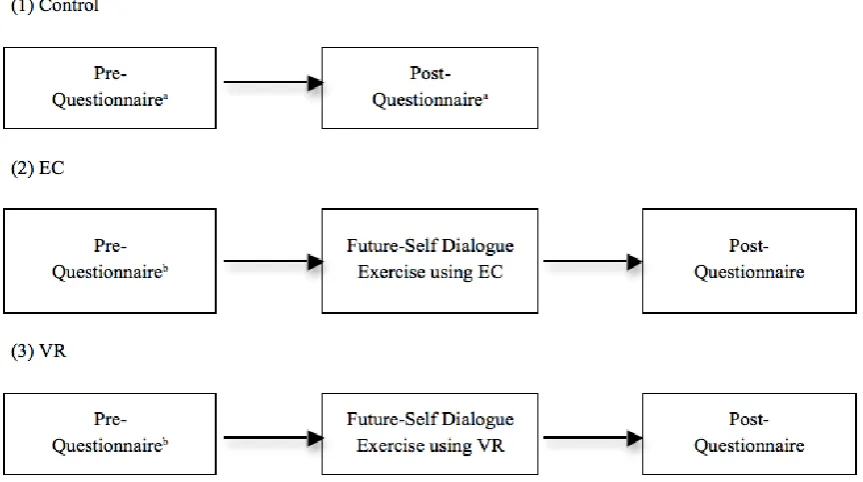
In this research a between-groups experimental design was employed. Participants were randomly assigned to three conditions (control, EC, and VR). All conditions were scheduled as a two-part study, first to fill in a pre-questionnaire and second to visit the laboratory for further collection of post-data. In the control condition, this involved filling-in another post-questionnaire, which was identical to the pre-questionnaire. In the EC and VR condition participants first completed a future self-dialogue exercise either using the EC method or in VR, which was the manipulation in this study. Afterwards they were instructed to fill in another post-questionnaire for collection of post-exposure data. All questionnaires used in the present research were constructed in Qualtrics. The dependent variables on which the three conditions were later compared were the perceived FSCon, FSViv, and FSVal.
2.4 Apparatus and Materials
2.4.1 Control Condition. The control condition comprised two identical 18-items pre- and post-questionnaires. However, 12 of these items are part of a larger study and not relevant to this research. Only the other six items were of interest, of which one item assessed the participant’s gender and five items represented the future self measures. These included two
pictorial items assessing FSCon. They were phrased: “How connected do you feel to yourself 10 years into the future?” and “How similar do you feel to yourself 10 years into the future?”. Each item was followed by an instruction to choose one of seven Euler circles that ranged from no overlap to almost complete overlap. The design was borrowed from Ersner-Hershfield et al. (2009b). They adopted a psychometric measure of FSCon based on the “Inclusion of Other in the Self” scale by Aron, Aron, and Smollan (1992). Furthermore, two
items measured the perceived FSViv on a 7-point Likert scale ranging from strongly disagree to strongly agree. These items were adopted from Van Gelder et al. (2015) and were phrased as follows: “I find it easy to imagine myself 10 years from now”, and “I find it easy to describe myself 10 years from now”. FSVal was measured by only one item on a 7-point
Likert scale ranging from don’t like at all to like a lot. This item was invented by the researchers and phrased as follows: “In the following, please tell us how you feel about your future self 10 years from now”.
“Please try to imagine that in the next 10 years, you can achieve whatever you want. There
are no limits, no constraints (for example when it comes to energy, money and knowledge).
You can do and become everything you ever wished for. Perhaps you would like to run your
own business, write a successful book, build your own house or become a nomad traveling
around the world. Think of what you want to do or become without any constraints. Again,
everything is possible... you just have to let go of limitations that you have in mind. This might
sound like a difficult exercise, but once you think of something you would really like to do or
become, your thoughts will start to flow. Take at least five minutes and write down one or
multiple things you wish, dream or hope to attain in the next 10 years. Please keep on writing
(in English) and aim for a paragraph or two. Try to remember, everything is possible. If
everything is possible, then in the upcoming years, I would like to:…”.
Of the 19 items in this questionnaire only the open-ended item and the other six items already discussed for the control condition were relevant for this study.
The post-questionnaire contained 27 items, of which 10 items were of interest for the present research. These included the same five items that represented the future self measures and one item measuring gender as discussed in the control condition. Furthermore, we invented four additional items aimed at assessing the embodiment of the future self on a 7-point Likert scale ranging from strongly disagree to strongly agree. These items were phrased as follows: “When sitting in the chair of my future self, I felt as if I was my future self”, “When sitting in the chair of my future self, my thoughts changed from how I normally think”, “When sitting in the chair of my future self, I felt as if I was someone else”, and “I felt as if someone was sitting across from me”.
2.4.3 VR Condition. Materials included the same 19-items pre-questionnaire as used in the EC condition, of which only seven items (see control and EC condition) were of interest. Next, this condition comprised a 42-items post-questionnaire. However, only the 10 items as discussed in the EC condition were of interest. These included one item measuring gender, five items representing the future self measures, and four items measuring the embodiment of the future self.
Besides the questionnaires, few materials that were the same as in the EC condition were made use of. These included the recording device (Zoom H4nPro), adapted to version 2.3.1 of Audacity® recording and editing software (Audacity Team, 2019); the transcription program AmberScript (AmberScript B.V., 2018) to transcribe the audio recordings; external loudspeaker; and a storage device for safe keep of the data. The VR equipment included an HTC VIVE head-mounted display controlling head movements, with a field-of-view of 110°, and a resolution of 1080 x 1200 pixels per eye displayed at 90 Hz; two controllers providing control over arms and torso; and two base stations with a 360° play area tracking coverage.
All data assessed by the questionnaires of the three conditions were analyzed using SPSS.
2.5 Variables
2.5.1 Independent Measures. This study mainly focused on three conditions and how they influenced scores on the three dependent variables (FSCon, FSViv, and FSVal). Furthermore, it was investigated whether the embodiment of the future self plays a role in predicting an increase on the three dependent variables (FSCon, FSViv, and FSVal). To check if the manipulation of the embodiment illusion worked in the EC and VR condition participants received four statements about their experience in the embodiment exercise.
sampling adequacy was .63 (the cut-off is .50 according to Yong & Pearce, 2013), and Bartlett’s Test of Sphericity was significant at p < .05, which means that it is suitable to
conduct an EFA using PAF with the three remaining items.
The factor analysis resulted in a one-factor solution explaining 59% of the variance with an Eigenvalue of 1.78. Items that loaded high on this factor were “When sitting in the chair of my future self, I felt as if I was my future self” with a loading of .71 and “When sitting in the chair of my future self, my thoughts changed from how I normally think” with a
loading of .77, suggesting that it represents embodiment of the future self. The third item “When sitting in the chair of my future self, I felt as if I was someone else” had a factor
loading of .41 (.40 is considered as a cut-off according to Neill, 2008), which was considerably lower compared to the other two items that started with “When sitting in the chair of my future self …”. An explanation for this could be that the item was not well
worded and therefore unclear whether by “… I felt as if I was someone else” participants actually meant that they felt as if they were their future self. It was decided to exclude this item because this slightly increased Cronbach’s Alpha from .62 to .67. Furthermore, factor analysis with the two remaining items revealed a one-factor solution explaining 77% of the variance with an Eigenvalue of 1.55. For simplicity, the composite of these two items (hence “embodiment of the future self”) was used in subsequent analyses. The composite score was computed by summing up the raw scores and divide them by the number of items to obtain an average score. In this way, the scale metric was retained, which allowed for easier interpretation.
2.5.2 Dependent Measures. Figure 1 displays the three dependent measures in this study: FSCon, FSViv, and FSVal. To assess the validity of the two items that were supposed to measure FSCon they were also subjected to an EFA using PAF. Preliminary interpretations revealed weak correlations between the two items (see Appendix B), weak communalities (see Table 1), the Kaiser-Meyer-Olkin was just at the cut-off of .5 and Bartlett’s Test of Sphericity was not significant with p > .05. Although these indicators suggest that factor analysis with both items is not suitable, it is interesting to report that the analysis resulted in a one-factor solution explaining 64% of the variance with an Eigenvalue of 1.28. Both items loaded fairly desirable on the factor, suggesting that to some extent they may have the same latent factor in common (i.e., FSCon) that influences how people answer to those items. However, Cronbach’s Alpha revealed that the two items have rather low internal consistency
common. This outcome is surprising because, according to the literature FSCon is defined as feeling connected and similar in terms of important psychological characteristics (e.g., Rutchick et al., 2018). Hence, it seems like feeling connected and feeling similar go hand in hand, that is, feeling connected to a future self is deemed equivalent with feeling similar on several psychological characteristics. Based on the EFA and practical considerations it has been decided to retain the item “How connected do you feel to yourself 10 years into the future” as a measure of FSCon. It is presumed that judging connectedness may implicitly
already involve an appreciation of similarity between the current and the future self. Most importantly, the manner in which the item is phrased reflects directly what this study aimed to research, namely perceived connectedness to a future self. This was just for simplicity and based on other research findings linked with feeling similar to a future self and together summarized as FSCon.
Initially to the EFA using PAF for the two items that were supposed to measure FSViv it was observed that both items correlated highly (see Appendix B), had rather high communalities (see Table 1), Kaiser-Meyer-Olkin was at the cut-off of .5, and Bartlett’s Test of Sphericity was significant at p < .05. Given these indicators factor analysis was regarded as suitable with both items. Results indicated a one-factor solution explaining 90% of the variance with an Eigenvalue of 1.80. Both items loaded high on the extracted factor, suggesting that it represents FSViv. Cronbach’s Alpha of the two items revealed high internal consistency (α = .88). For simplicity, the composite of these two items (hence “PreFSViv” and “PostFSViv”) was used in subsequent analyses. Composite scores were computed in the
same way as described for embodiment of the future self (see section 2.5.1).
[image:16.595.85.517.580.714.2]FVal was measured by only one item, which is why there was no EFA performed.
Table 1. Factor Loadings, Communalities and Cronbach’s Alpha based on Principal-Axis Factoring of Embodiment of the Future Self Scale, FSCon Scale, and FSViv Scale.
Items Factor loadings Communality α
Embodiment of the future self .67b
When sitting in the chair of my future self, I felt as if I was my future self.
.71 .34
When sitting in the chair of my future self, my thoughts changed from how I normally think.
.77 .32
When sitting in the chair of my future self, I felt as if I was someone else.a
.41 .12
I felt as if someone was sitting across from me.a
.27 .06
FSCon .44
How connected do you feel to yourself 10 years into the future?
.53 .08
How similar do you feel to yourself 10 years into the future?a
.53 .08
FSViv .88
I find it easy to imagine myself 10 years from now.
.89 .63
I find it easy to describe myself 10 years from now.
.89 .63
Note.aItems were eliminated from the scale. bCronbach’s Alpha without the eliminated items.
2.6 Procedure
[image:17.595.68.517.99.482.2]Figure 2. Path diagrams showing the procedural differences between conditions.
aPre- and post questionnaire were the same in the control condition. bEC and VR used an identical pre-questionnaire.
2.6.1 Control Condition. In the first part, participants were sent a 15-minutes online questionnaire, which they filled in at home. They were assessed on a number of items which were discussed under section 2.4 “Apparatus and Materials”. After completion of the questionnaire, participants signed up for the second part of the study by choosing a date scheduled at least one week later. Upon arrival in the laboratory at the University of Twente they first received a more detailed informed consent and subsequently were instructed to fill in a second online questionnaire, which was exactly the same as in the first part of the study.
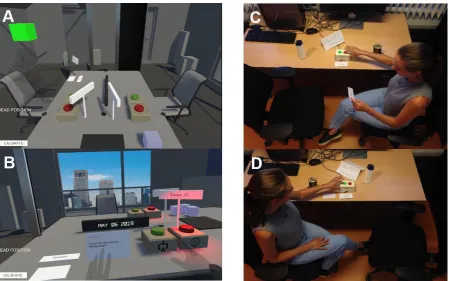
embodiment of their present self who asks questions and the embodiment of their future self who answers. To prepare this exercise it was first figured out a goal that participants would discuss with their future self based on their answer to the unrestricted thought question. Afterwards, participants were told to create a name card including name, current age and date on one side of the paper, and their name, but age and date 10 years from now, on the other side. Then, after modeling the exercise once, participants were instructed to practice it on their own with four tutorial questions. In order to stoke the embodiment illusion, they were told to imagine how they think and look like 10 years from now whenever they sit in the chair of their future self. To begin the real exercise, the researcher informed participants about starting the audio recording and left the room. During the exercise, participants had to perform several steps. First, as their present self, they picked up a question from a pile of cards, with nine questions in total. They then pressed the red button on a box placed next to them, which begins recording their voice. To stop recording participants had to press the red button again. Next, they switched to an empty chair placed in front of them, to put themselves into the perspective of their future self. Pressing the green button enabled them to listen to the recorded question via an external loudspeaker. As their future self, they thought of an answer and recorded it via the red button. After switching back to the other chair (their present self), participants again pressed the green button and listened to the answer via an external loudspeaker. This continued until the participants asked and gave answers to all nine questions (see Figure 3 for the set up of the experiment). They then informed the researcher that they completed the task, whereupon the audio recording was stopped and participants were asked a few follow-up semi-structured interview questions about their experience during the exercise. Finally, they were assessed on several items in an online post-questionnaire (see Apparatus and Materials for a list of the relevant items).
several items in an online post-questionnaire (see Apparatus and Materials for a list of the relevant items).
Figure 3. The future self-dialogue exercise in VR and EC. (A) A bird’s eye view from the VR environment. The participant is embodied in an avatar that has the shape of either a woman or a man depending on the participant’s gender. (B) Stereo 1PP view from the participant embodied in the present self-avatar. The participant sees herself from a 1PP and also in a mirror to the left. Note that there is a name card displaying the participants’ name and current age and a clock showing the date of the experiment. When embodied in the future self-avatar the participant will find herself on the other side of the table seeing her age and the date in 10 years from now. (C) The researcher models the recording of a question in the chair of the present self. A name card on the table displays the name, current age and the date of the experiment. (D) Modeling how to listen to the recorded question in the chair of the future
3. Results
3.1 Randomization Check
condition consisted of 3 males and 12 females. The three conditions did not differ
significantly by gender (X2(2, N = 45) = .26, p = .879).
Furthermore, a one-way analysis of variance (ANOVA) was conducted to compare the age of participants in the three conditions. There was no significant difference found in the age of participants for the control (M = 20.47, SD = 1.46), the EC (M = 21.73, SD = 2.66), and the VR condition (M = 21.87, SD = 1.96) (F(2,42) = 2.06, p = .140).
[image:22.595.68.531.477.659.2]Lastly, it was checked for baseline differences between the three conditions on FSCon, FSViv, and FSVal. This is important because if in one condition participants for example already have had a high degree of connectedness to their future self while those in the other two groups did not, this would explain why an intervention worked better for participants in one condition than in another. Results of three ANOVAs indicated that there was no significant difference found between the three conditions in FSCon (F(2,42) = .25, p = .784), in FSViv (F(2,42) = .22, p = .803), and in FSVal (F(2,42) = .37, p = .696). Pre-test scores in all three conditions indicated that participants on average felt around medium FSCon, scored around medium high on FSViv, and scored on average between like some and like on FSVal. Hence, only on FSVal participant’s scores were in the upper quartile. See Table 2 for means and standard deviations.
Table 2. Results of the One-Way ANOVAs Comparing the Pre-Test Scores in FSCon, FSViv, and FSVal between Three Conditions
Condition
aVariable Control EC VR F p
FSCon 3.67 (1.95) 4.13 (1.96) 3.87 (1.55) .25 .784
FSViv 4.13 (1.86) 4.23 (1.74) 3.83 (1.54) .22 .803
FSVal 5.87 (1.41) 5.47 (1.36) 5.53 (1.36) .37 .696
Note. FSCon was measured by seven Euler circles ranging from no overlap to almost complete overlap. FSViv was measured on a 7-point likert scale ranging from strongly disagree to strongly agree. FSVal was measured on a 7-point likert scale ranging from don’t like at all to like a lot.
3.2 Testing the Hypotheses
3.2.1 Experimental Conditions Compared Against Control. First of all, it was hypothesized that a future self-dialogue exercise leads to a significantly greater increase in FSCon, FSViv, and FSVal compared to no future self-dialogue exercise (H1). To test whether participants in the EC and the VR condition had a significantly greater increase in FSCon, FSVal, and FSViv compared to the control condition new variables displaying the “difference score” had to be computed for each of these three dependent variables by subtracting the post-test score from the pre-post-test score. Subsequently, three separate one-way ANOVAs were employed to test whether the “mean difference scores” for each dependent variable differed significantly between the three conditions. The first one-way ANOVA revealed that there was no statistically significant difference between conditions in the increase on FSCon at the p < .05 level (F(2, 42) = .15, p = .865). More specifically, by inspecting all possible pairwise comparisons a Tukey post hoc test revealed that the increase in FSCon was not significantly higher after performing a future self-dialogue exercise in EC (M = .40, SD = 2.06, p = .975) and VR (M = .60, SD = 1.59, p = .854) compared to the control condition (M = .27, SD = 1.39). The second one-way ANOVA found no statistically significant difference between conditions in the increase on FSViv at the p < .05 level either (F(2, 42) = .15, p = .864). More specifically, a Tukey post hoc test indicated that the increase in FSViv was not significantly higher after performing a future self-dialogue exercise in EC (M = .57, SD = 1.39, p = .988) and VR (M = .73, SD = 1.07, p = .859) compared to the control condition (M = .50, SD = 1.16). Lastly, the third ANOVA revealed that there was again no statistically significant difference between conditions in the increase on FSVal at the p < .05 level (F(2, 42) = 2.44, p = .100). The Tukey post hoc test indicated that the increase in FSVal was not significantly higher after performing a future self-dialogue exercise in EC (M = .23, SD = .49, p = .350) and VR (M = .40, SD = .66, p = .087) compared to the control condition (M = -.07, SD = .59).
to post-test) between the VR and the control condition was almost significant at an alpha level of .05.
3.2.2 VR Compared Against EC. Secondly, it was hypothesized that a future self-dialogue exercise in VR leads to a significantly greater increase in FSCon, FSViv, and FSVal compared to the EC condition (H2). Based on the previous analyses it is not expected that the two conditions will differ significantly in the change from pre-test to post-test on these dependent variables. Nevertheless, it must be verified whether there is a trend effect that is relevant for future research. For this purpose, three separate one-way ANOVAs were employed. Results indicated that the differences between the EC and the VR condition in the average increase in FSCon (F(1, 28) = .09, p = .769), the average increase in FSViv (F(1, 28) = .14, p = .715), and the average increase in FSVal (F(1, 28) = .61, p = .441) were not found to be statistically significant at the p < .05 level. See Table 3 for means and standard deviations.
[image:24.595.69.531.553.729.2]Overall, these results indicated that H2 must be rejected as well. Although participants had on average a slightly greater increase in their scores on FSCon, FSViv, and FSVal after having completed the future self-dialogue exercise in VR compared to EC, these differences were not found to be statistically significant. It cannot be ruled out that they actually occurred due to random chance. Rejecting H2 means that it becomes redundant to test whether embodiment of the future self adds predictive value to the VR condition (as compared to the EC) in predicting an increase in FSCon (H2a), FSViv, (H2b), FSVal (H2c).
Table 3. Results of the One-Way ANOVAs Comparing the Change from Pre-Test to Post-Test in FSCon, FSViv, and FSVal between Conditions
Condition
aVariable Control EC VR F* F**
FSCon .27 (1.39) .40 (2.06) .60 (1.59) .15 .09
FSViv .50 (1.16) .57 (1.39) .73 (1.07) .15 .14
FSVal -.07 (.59) .23 (.49) .40 (.66) 2.44 .61
Note. aVariables are denoted as mean (SD).
3.3 Exploratory Findings
3.3.1 The Role of Embodiment. Since H2 has been rejected there is no reason to test for H2a, H2b, H2c anymore. It is interesting, however, to explore whether there was an effect of the embodiment of the future self in general and if this differed significantly between the two experimental conditions. For this reason, an independent-samples t-test was performed to first compare the mean scores on the embodiment of the future self between the EC and the VR condition. There was no significant difference found in the scores for embodiment of the future self between the EC (M = 5.20, SD = .98) and the VR condition (M = 4.63, SD = 1.29) at the p < .05 level (t(28) = 1.36, p = .186). We also compared the medians for EC (Mdn = 5.50) and for VR (Mdn = 5.00) as another measure of central tendency. Despite the non-statistical significance, it is still interesting to see that contrary to what was initially presumed participants in the EC condition did on average score slightly higher on the embodiment of the future self.
Furthermore, it is interesting to explore whether high embodiment of the future self, independent of the condition, does predict an increase in FSCon, FSViv, and FSVal. Three separate simple linear regressions were performed. The first simple linear regression found that embodiment of the future self only explained almost 2% of the variation in the increase of
FSCon (R2 = .02, F(1, 28) = .46, p = .504). It was found that embodiment of the future self did not significantly predict an increase in FSCon (b = -.13, t(28) = 1.00, p = .327). Results of the second regression indicated that embodiment of the future self only explained 11% of the
variation in the increase of FSViv (R2 = .11, F(1, 28) = 3.47, p = .073). It was found that embodiment of the future self did not significantly predict an increase in FSViv either (b = .33, t(28) = -1.13, p = .269). Results of the third regression indicated that embodiment of the
future self only explained 2% of the variation in the increase of FSVal (R2 = .02, F(1, 28) = .59, p = .450). Embodiment of the future self was no significant predictor of an increase in FSVal (b = .14, t(28) = -.07, p = .942).
observed difference from pre-test to post-test in FSCon (r(43) = -.06, p = .770), and a positive, but non-significant correlation between the embodiment of the future self and the observed difference from pre-test to post-test in FSVal (r(43) = .17, p = .368).
3.3.2 Qualitative Analyses. A few preliminary analyses with six cases were performed to see whether future research could benefit from a content analysis of the future self-dialogue. Taking participants narrative style into account might be worthwhile because it could provide additional information on how well embodied they felt in their future self. In a study by Chernyak et al. (2017), the number of personal pronouns was used to determine children’s ability to project themselves into the future. They found that children used more personal pronouns when they talked about events in the near future compared to temporally distant events. Based on this, it was interesting to explore how the number of personal pronouns (including I, my, myself, we) used during the future self-dialogue exercise in this study relates to (1) embodiment of the future self, (2) the degree of FSCon, FSViv, and FSVal in general, and (3) the increase in FSCon, FSViv, and FSVal. Due to the small sample, it was not expected to find significant relations. Nonetheless, Spearman’s rank correlations indicated that the number of pronouns correlates positively and more strongly with embodiment of the future self (r(4) = .70, p = .123) compared to when correlating the number of pronouns per words with embodiment of the future self (r(4) = .33, p = .518). Furthermore, Spearman’s rank correlations found that the number of pronouns used had a negative correlation with FSCon (r(4) = -.50 p = .312), no correlation with FSViv (r(4) = .06, p = .913), and a positive correlation with FSVal (r(4) = .49, p = .326). Lastly, results of Pearson product-moment correlations revealed a negative correlation with FSCon (r(4) = -.54, p = .270), a positive correlation with FSViv (r(4) = .60, p = .205), and a positive correlation with FSVal (r(4) = .48, p = .336). In sum, although it is difficult to draw meaningful conclusions with six cases, the analyses showed that the relations between pronouns and embodiment of the future self; pronouns and FSVal; and pronouns and the increase in FSViv and FSVal are into the intended direction.
covariate, gender, was not significantly related to the increase in FSCon (F(1, 41) = .38, p = .543), the increase in FSViv (F(1, 41) = .10, p = .749), and the increase in FSVal (F(1, 41) = 1.74, p = .195). After controlling for the effect of gender, the three conditions still did not significantly differ in terms of greater increase in FSCon (F(2, 41) = .16, p = .850), in FSViv (F(2, 41) = .15, p = .858), and in FSVal (F(2, 41) = 2.26, p = .117). Similarly, age was not significantly related to the increase in FSCon (F(1, 41) = .12, p = .731), in FSViv (F(1, 41) = .00, p = .989), and in FSVal (F(1, 41) = .35, p = .560). After controlling for the effect of age, the three conditions still did not significantly differ in terms of greater increase in FSCon (F(2, 41) = .18, p = .833), in FSViv (F(2, 41) = .13, p = .875), and in FSVal (F(2, 41) = 1.86, p = .169). In sum, it appears that after controlling for the effect of gender and the effect of age, the effect of condition on greater increase in FSCon, FSViv and FSVal did not change substantially. This means that gender and age had no additional moderating influence.
3.4 Summary
Overall, there was no support found for H1, which means that a future self-dialogue exercise did not lead to a significantly greater increase in FSCon, FSViv, and FSVal compared to no future self-dialogue exercise as it was previously expected. Despite this it was interesting to see that on average participants’ scores on FSCon, FSViv, and FSVal tend to have increased more after having had a future self-dialogue exercise compared to when the participants conducted no such exercise. Furthermore, it was observed that on average FSViv had the greatest increase from pre-test to post-test, followed by FSVal and lastly FSCon, and that the greater increase in FSVal in the VR condition compared to the control condition was almost significant at an alpha level of .05.
Likewise, when testing for H2, it was observed that participants had on average a slightly greater increase in their scores on FSCon, FSViv, and FSVal after having completed the future self-dialogue exercise in VR compared to EC. However, these differences did not turn out to be significant, which is why H2 had to be rejected as well. Thereupon, there was no need to test the three sub-hypotheses, which hypothesized that in predicting an increase in FSCon, FSViv, and FSVal, high scores on embodiment of the future self adds predictive value to the VR condition.
and FSVal. Qualitative exploratory analyses with six cases found non-significant but positive relations between the number of personal pronouns used during the future self-dialogue and embodiment of the future self, FSVal, and the increase in FSViv and FSVal. Lastly, exploratory findings revealed that there was no substantial change observed in the effect of condition on the greater increase in FSCon, FSViv and FSVal after controlling for the effects of gender and age.
4. Discussion
This study examined if connectedness to a future self (hence FSCon) can be enhanced through interventions using a future self-dialogue exercise in which participants embodied their future self from a 1PP either in EC or in VR, and to see whether one intervention worked better than the other. Furthermore, it was investigated whether FSViv and FSVal can be increased through these interventions, as the literature supports that both may be related to feeling connected to a future self (e.g., Hershfield et al., 2018; Hershfield, 2011). Hence, the study, more specifically, investigated the research question: Does FSCon, FSViv, and FSVal increase through a future self-dialogue involving embodiment of the future self, and is this effect stronger in VR compared to EC dialogue? This is important to investigate because research already found that feeling connected to a future self is associated with more future-oriented behaviors, such as less temporal discounting (e.g., Ersner-Hershfield et al., 2009b) and increased exercise behavior (Rutchik et al., 2018). Some research even found a causal relation between connectedness to a future self and more health-aware behaviors (Rutchik et al., 2018). In other words, feeling connected to a future self increases the likelihood to act in ways that would benefit that self.
The most important findings were that, contrary to what was expected, participants who conducted a future self-dialogue exercise in EC and VR did not have a significantly greater increase in FSCon, FSViv, and FSVal compared to participants in the control condition. Unexpectedly, there was also no significant evidence found that the manipulation worked better in VR compared to EC. Hence, H1 and H2 had to be rejected. This outcome cannot be explained due to baseline differences between conditions in these future self measures. Nor can it be explained due to already high levels in FSCon and FSViv. Participants’ medium-ranged baseline levels in FSCon is comparable to Adelman et al. (2017)
difference between present- and future self, the baseline level in FSViv in a study by Van Gelder et al. (2015) is around the middle of the measurement scale (indicating don’t disagree/don’t agree), which is similar to ours. In the case of FSVal, it was difficult to find
comparable studies, in which pre-test scores were not manipulated and which used comparable age groups and measurement scales. Nonetheless, based on that participants scored on average in the upper quartile of the scale, it is assumed that they already had high levels of FSVal and therefore it might explain why the increase in FSVal was the lowest among the future self measures in all conditions because there was less room for improvement. Although the differences were not statistically significant, it is notable that the results pointed into the intended direction. On average the increase in FSCon, FSViv, and FSVal from pre-test to post-test was the greatest in the VR condition. The EC condition had the second greatest increase and the control condition the lowest. When looking at this tendency only it seems like results are not entirely at odds with what was hypothesized and somewhat fit with the ideas mentioned in the literature.
In particular, past research has repeatedly demonstrated that vividness of a future self can be experimentally manipulated and that one way to do this is through the use of VR (Hershfield et al., 2018; Van Gelder et al., 2013; Hershfield et al., 2011). For example, in a study by Hershfield et al. (2011) immersive VR hardware increased the vividness of a future self because it enabled participants to interact with realistic age-progressed versions of themselves. However, in the current study, it was not made use of age-progression software, instead vividness and imagination was aided through, for instance, a virtual time travel that enhanced the feeling of switching from a representation of the present self to the embodiment of a future self. As exemplified by a study by Osimo et al. (2015), the embodiment of a virtual avatar can be vivid, in the sense that people come to feel some sort of “presence” due to control over virtual body movements, even when this avatar does not resemble oneself. Hence, the potential for such virtual embellishment to the ‘imagined experience’ may provide some understanding of why there was a slightly greater increase observed in FSViv for participants who were in the VR condition compared to those in EC.
(Hershfield et al., 2011) and decreasing delinquency (Van Gelder et al., 2013), because they enhance connectedness to a future self.
Besides FSCon and FSViv there was a trend observed that on average the scores in FSVal increased more after having had a future self-dialogue exercise in VR or EC while in the control condition they slightly decreased on average. If ignoring the non-statistically significance, this result would fit with the idea that manipulating participants to imagine a successful future self increases a positive attitude toward that self. Interestingly, there was almost a significant difference found between VR and the control condition, which indicates that it is worth to examine whether VR significantly increases FSVal when repeating the experiment with a larger sample. The observed difference (although non-significant) between VR and EC, on the other hand, may be explained by Hershfield et al. (2011), namely, that interventions using VR are more engaging and fun to follow through than more traditional techniques. We also believe that conversing with a future self in VR is a particularly exciting venture and could have elicited greater positive emotions, which were then associated with the future self. In a study by Osimo et al. (2015) it was found that embodiment of a virtual body that looked like the self as well as one that resembled Freud led to mood improvements in participants with minor personal issues. Besides, it can be useful to refer back to research by Blouin-Hudon and Pychyl (2015), which found a link between being able to experience greater positive emotions and having higher cognitive flexibility and broadening. With regard to this finding, it is interesting to consider whether greater positive emotions elicited due to the use of VR made it likely that participants were able to better imagine their successful future self and therefore came to like the idea of being that self more.
random chance. This could also be inferred just by looking at the mean scores of the control condition, which revealed that there was an effect where none was expected.
Interestingly, results showed that of the three future self measures the average increase was the highest for FSViv in all conditions. Increased FSViv in the control condition could mean that simply asking people to think and answer questions about their future self already makes it more vividly imagined. A slightly greater increase in EC compared to control could be explained by that conversing with the future self is more vivid than only contemplating about it. Research shows that EC dialogue increases emotional arousal and enables to access and re-experience emotions, thoughts and feelings that were suppressed in the past (Greenberg and Malcom, 2002). Hence, it was expected that EC dialogue might help to access mental states of future selves and therefore to make the future more vividly experienced. As already discussed, VR adds embellishment to the ‘imagined experience’, which is why it might have had the greatest increase in FSViv. Yet, interpretations must be treated with caution because these differences between conditions were not significant and might as well be due to random chance. Especially the difference between EC and the control condition in the increase in FSViv and FSCon was highly non-significant, which makes it difficult to draw conclusions about the effectiveness of the intervention.
median for future self-embodiment in the VR condition is comparably lower than the medians for two similar embodiment items (“vrbody” and “agency”) that measured the degree of embodiment in a virtual avatar representing Einstein in a study by Banakou et al. (2018). This could be explained by the design of this study: unlike Banakou et al. (2018) and those studies reported by Banakou and Slater (2014), the avatar in this study was less realistic because it was merely a silhouette of a man or a woman. Therefore, the illusion of being embodied in one’s future self greatly depended on one’s ability for imagination.
Lastly, exploratory analyses revealed that embodiment, independent of the condition, did not significantly predict an increase in FSCon, FSViv, and FSVal. This makes sense, considering that the embodiment manipulation did not work as well as expected in the experiment. However, correlation analyses revealed a moderate, positive and significant relation between embodiment and FSViv. This means that as embodiment increases, FSViv increases as well. This is plausible because when having the illusion of embodying a future self, this should also come with the greater vividness of that self. Conversely, when an intervention is more vivid, participants likely come to believe in the embodiment illusion more.
4.1 Limitations and Future Directions
One limitation of the current study, which explains why the manipulation might not have worked as well as intended, was that the experimental set up, in both EC and VR, still very much depended on someone’s imagination. It was predicted that using VR technology would be a particularly effective method that does not rely heavily on differences in one’s ability to envision the future because it adds embellishment to the ‘imagined experience’ by presenting people with a new environment and a new body, as well as virtual cues such as a virtual time-travel. However, results and participant’s remarks revealed that even in the VR condition it was at times still hard to imagine being one’s future self. This study did not make
already accounts for some change. Future research may benefit from technology that further increases the imagination of the future self in VR, such as age-progression or voice changer software. The experiment cannot address the issue as to whether the result is due to a lack of imagination, which is why future studies might want to check for baseline differences in the ability for imagination.
A second limitation was that the scale measuring the embodiment of the future self might not have worked as intended, because it was not found to be highly reliable. The item “When sitting in the chair of my future self, I felt as if I was my future self” clearly measures
embodiment of the future self. The other item was phrased as follows: “When sitting in the chair of my future self, my thoughts changed from how I normally think”. Research provides
evidence that virtual embodiment (Osimo et al., 2015) and EC embodiment (Greenberg & Malcom, 2002) can lead to cognitive changes and allows to step out of one’s own body and into the perspective of another. It could be, however, that participant’s misinterpreted this item because it does not clearly ask whether one experiences the thoughts of the future self. Preliminary analyses with six cases revealed that it might be worthwhile for future studies to dig deeper into qualitative data from the future-self dialogue exercise as an additional measure of the embodiment of the future self. Although non-significant, results revealed a positive correlation between the number of personal pronouns used and the embodiment of a future self.
Furthermore, FSCon was measured by only one item after factor analysis revealed low internal consistency between the item “How connected do you feel to yourself 10 years into the future?” and “How similar do you feel to yourself 10 years into the future?”. FSCon is a
rather abstract construct, which is why a single item might not grasp its essence. Especially, depicting connectedness to a future self through overlapping circles might be too vague and participants might have difficulties to accurately portray what they feel. Hence, it might be worthwhile to improve the measurement scale in future research by adding items that assess FSCon in more than one way.
compensation for participation. The healthy choice might indicate greater FSCon as it implies an understanding of how eating behavior affects well-being in the future.
Next, the period in which the study was conducted may be too short in order to have a significant influence on how connected a person feels to a future self, how vividly a future self is imagined or how much it is valued. Being confronted with one’s future self over a
longer time period rather than a single-shot setting might have had a greater effect because people have time to let the experience sink in and to properly reflect on how they felt. Hence, future research could benefit from an experiment that lasts over several weeks.
Another limitation is the size of the sample. This was inferred from the large spread observed in the “difference mean scores” on the future self measures. Including more participants in future studies helps obtain a sample statistic with less variability and therefore provides a more precise estimate of a population parameter. A further indication for increasing the sample size was an almost significant difference between the increase in FSVal in VR compared to the control condition.
Lastly, some participants reported having problems with the record and playback buttons during the experiment, both in EC and VR. They either did not work occasionally or were confusing and therefore distracted from the actual task. Participants reported the buttons reminded them of reality and thus mitigated the illusion of being embodied in the future self.
4.2 Implications
significantly predict the increase in the future self measures, it directs future research to look into other factors that could possibly have influenced the tendency observed, such as the ability for imagination.
References
Adelman, R. M., Herrmann, S. D., Bodford, J. E., Barbour, J. E., Graudejus, O., Okun, M. A., & Kwan, V. S. Y. (2017). Feeling Closer to the Future Self and Doing Better :
Temporal Psychological Mechanisms Underlying Academic Performance. Journal of Personality, 85(3), 398-408 (June). doi:10.1111/jopy.12248
AmberScript B.V. (2019). AmberScript [Computer Software]. Retrieved on March 12, 2019, from https://www.amberscript.com/en/about-us.
Aron, A., Aron, E. N., & Smollan, D. (1992). Inclusion of the other in the self scale and the structure of interpersonal closeness. Journal of Personality and Social Psychology, 63(4), 596-612. Retrieved on April 7, 2019, from http://dx.doi.org/10.1037/0022-3514.63.4.596.
Audacity Team (2019). Audacity(R): Free Audio Editor and Recorder (Version 2.3.1) [Computer application]. Retrieved from https://audacityteam.org/ [1].”
Banakou, D., Kishore, S., & Slater, M. (2018). Virtually Being Einstein Results in an
Improvement in Cognitive Task Performance and a Decrease in Age Bias. Frontier in Psychology, 9. doi:10.3389/fpsyg.2018.00917
Banakou, D., Slater, M. (2014). Body ownership causes illusory self-attribution of speaking and influences subsequent real speaking. Proc. Natl. Acad. Sci. U.S.A., 111(49), 17678-17683. doi:10.1073/pnas.1414936111
Bartels, D. M., & Rips, L. J. (2010). Psychological connectedness and intertemporal choice. Journal of Experimental Psychology: General,139(1), 49-69.
doi:10.1037/a0018062
Bartels, D. M., & Urminsky, O. (2011). On Intertemporal Selfishness: How the Perceived Instability of Identity Underlies Impatient Consumption. Journal of Consumer Research, 38, 182-198. doi:10.1086/ 658339
Blouin-Hudon, E. C., & Pychyl, T. A. (2015). Experiencing the temporally extended self: Initial support for the role of affective states, vivid mental imagery, and future self-continuity in the prediction of academic procrastination. Personality and Individual Differences, 86, 50-56.
Chen, F. F., & Kenrick, D. T. (2002). Repulsion or Attraction? Group Membership and Assumed Attitude Similarity. Journal of Personality and Social Psychology,83(1), 111-125. doi:10.1037//0022-3514.83.1.111