policy information available from the repository home page for
further information.
To see the final version of this paper please visit the publisher’s website.
Access to the published version may require a subscription.
Author(s): Maud Oortwijn
Article Title: Isomorphic immigrant effect in foreign entry
Year of publication: 2011
Link to published article:
http://dx.doi.org/10.1504/GBER.2011.041855
Isomorphic immigrant effect in foreign entry
Maud Oortwijn
Warwick Business School, The University of Warwick, CV4 7AL Coventry, UK Fax: +44 (0)24 7652 3719
E-mail: [email protected]
Abstract: The key problem for commitment to international business activities is the limited knowledge of a host country. A firm’s host country experience and its history of entry patterns in other countries shapes entry preferences into a foreign country (Pan and Tse, 2000; Chung and Enderwick, 2001; Yiu and Makino, 2002; Li and Meyer, 2008). In the past decade, scholars became aware of the effect of a specific kind of international experience within the firm: the immigrant effect (Chung and Enderwick, 2001; Tadesse and White, 2008; White and Tadesse, 2008; Madhavan and Iriyama, 2009). The present paper reports on the role immigrants fulfil in foreign entry plans and how their involvement relates to the outcome of the foreign entry go/no-go decision. Findings confirm that among the firms that continue in entry, the presence of immigrants in the firm is relatively high. But, and this is unexpected, the same is true for firms that cancel entry plans (Oortwijn, 2010a).
Keywords: case studies; foreign entry; isomorphic; immigrant; go/no-go; strategy process; China; experience; social ties; host country.
Reference to this paper should be made as follows: Oortwijn, M. (xxxx) ‘Isomorphic immigrant effect in foreign entry’, Global Business and Economics Review, Vol. X, No. Y, pp.000–000.
Biographical notes: Maud Oortwijn obtained a Master degree in Industrial Management as well as in Philosophy before she started as a Strategy Consultant with Gemini consulting (Capgemini Group). She worked as a Management Consultant in the Netherlands, the UK, China and Belgium on topics including international business, portfolio management, business development and supply chain optimisation. She combines her consulting work with academic research in the area of international business.
This paper is a revised and expanded version of a paper entitled ‘Empirical comparative case study on the foreign entrance success rate and the role in the process of immigrants within the firm’ presented at EMRBI, Cyprus, 4–5 November 2010.
1 Introduction
social networks in the foreign country support internationalisation. Also, the professional experience and personal background of managers plays a role in foreign entry choices (Collinson and Houlden, 2005; Oortwijn, 2010c).
In the past decade scholars became more aware of the effect of a specific kind of international experience within the firm: the immigrant effect (Chung and Enderwick, 2001; Tadesse and White, 2008; White and Tadesse, 2008; Madhavan and Iriyama, 2009). The immigrant effect refers to the positive impact immigrant entrepreneurs, employees and managers have on the success of international operations, principally when an organisation engages in the immigrant’s country or region of origin (Hyde and Chung, 2002; Chung, 2004). Multicultural entrepreneurs, employees and managers support development and realisation of foreign entry strategies. The general insight that organisations learn form individuals and individuals from organisations (March, 1991) traditionally was ignored in international business research.
1.1 Contribution
This paper adds a new angle to research on the immigrant effect. During two years internationalisation plans of Dutch firms for China are followed in time even before final decisions on entry are made. This longitudinal study allows for unique insight in how entry plans evolve, or, do not evolve. The contribution lies partly in the fact that some of the companies decide not to continue with China, while others cancel, alter or postpone plans. Of the 54 plans under consideration, only 33 continue in a manner similar to what was intended.
An important limitation of existing internationalisation research is that data is gathered post entrance. Due to the origin of the statistical data of previous work, the firms analysed are those that decided on entry into the host country and are still present. This study provides unique access before the entry decision. Of the 15 plans that involve immigrants from within the firm, five plans are cancelled and ten continue as planned. To the best of my knowledge, so far there are no studies that report on the immigrant effect in relation to the go/no-go decision of foreign entry.
2 Literature review
The perception of international business opportunities becomes more realistic, when based on experiential learning (Barkema and Vermeulen, 1998; Delios and Beamish, 1999; Petersen et al., 2008). Decisions on foreign entry are based on insight in local conditions and general international business know-how. These can be obtained through international business experience of the firm, by knowledge gathered through others outside the firm or by involving managers with in-depth knowledge of the host and home country (Oortwijn, 2006).
2.1 Host region experience
differences and institutional differences are studied extensively as explanatory factors for patterns of internationalisation (Pedersen and Thomsen, 1997; Xu and Shenkar, 2002; Henisz, 2005; Chetty et al., 2006; Chan and Makino, 2007; Dow and Larimo, 2007; Ellis, 2008; Jansson et al., 2009).
Companies prefer activities in foreign countries they are familiar with. Previous experience in a country supports new activities in the same host country and increases performance (Luo and Peng, 1999). Experience in a host country or in neighbouring countries provides managers insight in the new business environment and reduces uncertainty. It enables firms to make better judgements for entry and manage operations abroad with more success (Barkema et al., 1996).
2.2 Social networks
Firms are well able to acquire international knowledge from a social network (Chetty and Eriksson, 1998; Andersen, 2006). Learning about (opportunities in) foreign markets often occurs through local firms (Eriksson and Chetty, 2003; Oortwijn, 2010b). A local network helps reduce host country uncertainties by providing resources, access to a local business network, and knowledge of the business environment. An existing network in a host country facilitates business activities in the decision making phase, in the start-up phase and can help solve any dispute that might occur later on (Jensen, 2003; Chen et al., 2009). Network ties thus increase foreign firms’ expansion and profitability of activities abroad (Johanson and Mattson, 1988; Welch and Welch, 1996; Wilkinson et al., 2000; Griffith and Harvey, 2004; Li et al., 2009).
Analysis of business activities between countries shows how business activities are embedded in the history between countries, as the length of diplomatic ties (Tse et al., 1997) and the historical colonial ties (Dow and Karunaratna, 2006) relate to more business activities in present times. A shared history between countries is often a motivation for immigration or travelling to a country.
2.3 Immigrant effect
Another approach for firms to learn about foreign markets is through entrepreneurs, employees and managers with a multicultural background. An immigrant within the firm can compensate a lack of firm experience in the host country and can help overcome any differences which might occur while working in cultural distant environments. Their experience with the home and host country supports cultural understanding and increases confidence in working across borders.
In the past decade the immigrant effect is studied from various points of view (White and Tadesse, 2008). On a country level, the presence of immigrants relates positively to bilateral trade volume and investment flows (Gould, 1994; Gao, 2003; Greaney, 2005). Also, in foreign entry, firms established by immigrants originating from the host country tend to choose higher commitment FDI modes (Chung and Enderwick, 2001). Immigrants bring in business skills, knowledge of the foreign country, social networks and financial resources, which provides a foundation for international trade and foreign investments (Lever-Tracey et al., 1991; Duncan et al., 1997).
operations (Gould, 1994; Chung, 2002; Wagner et al., 2002; Chung, 2004). Knowledge in these areas increases the chance of success.
The impact of immigrant presence becomes increasingly important with further business globalisation and increased immigration worldwide (Andersen, 2006). So far, hardly any academic work studies the subject in-depth, taking into account the business decisions in which immigrants are involved.
3 Methodology
This paper reports on the process and the outcome of the foreign entry decision process. During 2006 and 2007, a number of 25 Dutch firms are studied while they consider to conduct business in or with China. This results in a comparative case study on a total of 54 entry plans for business activities in or with China, of which 15 involve immigrants. Data is gathered by conducting several short telephonic interviews with the main decision maker during the time period, followed by an in-depth semi-structured interview of several hours conducted after choices for entry are made. Before any interview takes place, documentation on the company background is collected through desk research, e.g., internet search, company website, and – when available – the annual report.
The result is an analysis on the entry strategy process, the outcome of the go/no-go decision, and the demographics of managers involved in decisions. The findings reveal four different outcomes of the go/no-go decision, e.g., cancel, postpone, continue and alter. So far, there are no studies that report on the immigrant effect in relation to the go/no-go decision for foreign entry.
The set of cases is well balanced with regard to firm and investment characteristics (Eisenhardt, 1989; Bell et al., 2004). The selection criteria for the cases are well-known influencing factors for foreign entry choices, e.g., foreign entry motivation, firm size, industry and level of international business experience of the firm. As a result, findings are grounded in varied empirical evidence (Eisenhardt and Graebner, 2007).
4 Results
This paper reveals how go/no-go decisions relate to the involvement of immigrants and/or their family in China. The entry plans of firms with family ties are discussed in-depth below, covering the process and outcome of entry decisions. It reveals how these firms either cancel or continue plans, depending on the role of immigrants and their families in the entry strategy. Some firms benefit from family ties, while others do not.
4.1 Outcome of the go/no-go decision
Immigrants are important for international business success. In interviews, decision makers spontaneously mention the role of an immigrant in the firm. The analysis shows how firms that postpone or alter plans have no managers or employees with family ties involved in the entry process (Figure 1). Ten of the 33 cases that do continue are from firms that involve immigrants in international business plans. There is an immigrant effect in these firms which supports a positive entry decision into a new host country.
Decision making managers explain in interviews how the presence of multicultural employees is perceived an advantage for conducting business in China.
“… He is Dutch and already lived in Shanghai for a while. Married a Chinese woman. Speaks Chinese. He did not even have a business background, but an entrepreneurial character and we just believed in him. We are lucky to have him… ” (General manager, Consumer products manufacturer)
[image:6.595.106.430.285.395.2]This particular company decides to increase commitment and continue plans for China. Figure 1 Outcome go/no-go decisions for 54 investment plans (see online version for colours)
Outcome Go/No-Go entrance decision
0% 25% 50% 75% 100%
Cancel (N=8) Postpone (N=6) Continue (N=33) Alter (N=7)
%
of
#
pl
a
n
s
No family ties Family ties
The analysis of the outcomes of the go/no-go decision also reveals an opposite effect. A large portion of plans that are cancelled are from firms who actively involve family ties. Actually, plans from firms with family ties in China, more often cancel than firms with only a business network or no social ties to China. From the 15 plans that involve employees, owners or managers with family ties in China, five out of 15 cancel plans.
Decision making managers from firms who cancel in the end, initially explain in interviews how the presence of immigrants is perceived an advantage for conducting business in China.
“I am not at all worried about manufacturing in China. My local partner will take care of that. That’s my brother. My family still lives in China, so it is easy to organize manufacturing locally.” (Entrepreneur, Consumer products start-up)
The question remains how within some firms the presence of immigrants leads to a positive entry decision, while in others it results in a no-go decision. Below theentrance process of firms that cancel (in §4.2) and firms that continue (in §4.3) are discussed.
4.2 How entry plans are cancelled
4.2.1 Firm 1 cancelled: start-up in consumer products
The case reveals how limited experience in international business ends with a cancellation of plans, despite market opportunity, industry experience and available assets. The Dutch team relies strongly on Chinese family ties to overcome a lack of international business knowledge.
1 Family ties
The case concerns a small start-up, founded by two Dutch brothers and a Chinese friend who lives in the Netherlands for some years now. They aim to enter the fast moving consumer goods market in China. The company develops their plans together with a Chinese family, which is the family of the Chinese founder in the Netherlands. The idea to conduct business in China actually originates from the perceived opportunity in these friendship and family ties.
2 International business experience
The start-up has no international business experience. None of the Dutch founders has relevant international business experience and neither does the family in China. One of the Dutch founders has industry experience and is thus involved in the assessment of commercial opportunities in China. Of course, the Chinese Dutch founder knows China as a country.
3 Objectives for internationalisation
The main objective is to sell Western consumer products in China. As the Chinese family is involved in real estate investments, products can be sold from the high-end retail outlet they possess. Their plan is to export products from the Netherlands to China, while the Chinese family manages the retail outlet in China.
4 Process of decision making
The personal relationship between a Chinese family and a Dutch family is what initially triggers the idea to conduct business in China:
“Last year, my brother and his Chinese friend talked again about starting a business in China. Then his Chinese family said they intend to buy retail real estate, for investment purposes more than anything. There was something physical in China that we could actually work with.”
When the Chinese family brings in a retail outlet in China, the Dutch entrepreneurs decide to give it a chance. All three Dutch entrepreneurs are able to bring in an amount similar to the investment brought in by the Chinese family, which makes them equal partners.
“The friendship ties between the two families exist for six years now. These are strong ties, more important than the business opportunities itself. The powerful thing is: two families work together, a Dutch one and a Chinese one. We talk like we are one big family. But this is also a weakness. It is difficult to make business arrangements in a professional manner. Well, we will find a way to deal with that.”
During the visits to China, the Dutch entrepreneurs spend limited time gathering information at local authorities. They discuss business ideas and client propositions with the Chinese family, while strengthening personal ties. The retail outlet is assessed and appreciated as a perfect location for business.
The partners try to discuss how to move forward, but while there are no disagreements, there is also no detailed business plan. They do agree on an equal partnership of four founders, in which everyone brings in a similar investment and shares equally in profit. In terms of governance, they prefer two separate businesses: a Dutch company and a Chinese company.
“We can not be responsible for activities in China. Thus we shouldn’t own local business activities. Else, we should be actively involved in China instead of working with the Chinese family. Our model is based on working with the Chinese family. As a consequence, we see it as two companies. We agree to share investments and profit equally, so that requires a more careful calculations beforehand to assure profit is divided equally.”
How it should work in practice, is not clear let alone agreed on paper. And they so far do not discuss the legal structure of the companies, the main business processes, roles and responsibilities, a governance structure, or concrete plans to move forward. How the business model works for everyone involved is not arranged, nor who will do what to start-up business activities. There is no calculated business case with clear benefits for all parties involved. The agreements remain high-level and informal. 5 Outcome and results
When after two years limited progress is made, they decide to cancel plans. Their knowledge of China as a host country is still limited. The Dutch brothers do not intend to manage a business in China themselves. And the local partner is not experienced in managing a consumer goods business. The realisation depends highly on the local partnership with one specific Chinese family. In the end, activities are cancelled, despite the market opportunities, strong personal relationships and the perfect retail outlet location.
4.2.2 Comparison firms
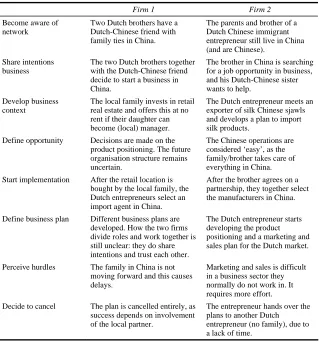
The two firms who involve Chinese immigrants within the firm, cancel in total five plans. The first firm is discussed above. Both firms are shortly presented below. These small startups develop international business plans and would have been born globals. The plans are based on an existing personal relationship in China. This personal relationship is considered a unique advantage and it in fact triggers the intention to develop business activities in China.
Table 1 Event flow analysis for small firms cancelling plans
Firm 1 Firm 2
Become aware of network
Two Dutch brothers have a Dutch-Chinese friend with family ties in China.
The parents and brother of a Dutch Chinese immigrant entrepreneur still live in China (and are Chinese).
Share intentions business
The two Dutch brothers together with the Dutch-Chinese friend decide to start a business in China.
The brother in China is searching for a job opportunity in business, and his Dutch-Chinese sister wants to help.
Develop business context
The local family invests in retail real estate and offers this at no rent if their daughter can become (local) manager.
The Dutch entrepreneur meets an exporter of silk Chinese sjawls and develops a plan to import silk products.
Define opportunity Decisions are made on the product positioning. The future organisation structure remains uncertain.
The Chinese operations are considered ‘easy’, as the family/brother takes care of everything in China.
Start implementation After the retail location is bought by the local family, the Dutch entrepreneurs select an import agent in China.
After the brother agrees on a partnership, they together select the manufacturers in China.
Define business plan Different business plans are developed. How the two firms divide roles and work together is still unclear: they do share intentions and trust each other.
The Dutch entrepreneur starts developing the product positioning and a marketing and sales plan for the Dutch market.
Perceive hurdles The family in China is not moving forward and this causes delays.
Marketing and sales is difficult in a business sector they normally do not work in. It requires more effort.
Decide to cancel The plan is cancelled entirely, as success depends on involvement of the local partner.
The entrepreneur hands over the plans to another Dutch entrepreneur (no family), due to a lack of time.
Firms that cancel plans for China are all startups with limited international business experience and limited experience in China. The opportunities they pursue, are triggered by a personal relationship. They have family ties in China with whom they want to conduct business. The family ties are perceived a unique competitive advantage and are actually the main reason to start business activities. The partnerships are based on trust, which is why they focus less on the details of business arrangements. When later on progress is dissatisfying, plans are cancelled entirely. They do not have the time, experience, or resources to develop opportunity independently of each other.
4.3 How entry plans continue
evolve. Afterwards, the entry processes are compared for all firms. They show similarities.
4.3.1 Firm 1 continued: large financial services firm
A large financial services firm invests worldwide, but has no subsidiary in China. The highly experienced firm in international business prefers partnerships and project based participation. The case reveals how firms can realise projects worldwide with a minimum of local presence by working closely with local partners. The Dutch decision making manager is very experienced in international business and perceives his Chinese background as an additional advantage.
1 Family ties
The main decision maker was born in the Netherlands from Chinese parents. He lived in Hong Kong as a child, until his family moved back to the Netherlands. His first job was in financial services in Hong Kong. He now lives and works in the Netherlands.
2 International business experience
It concerns a large financial services firm which invests worldwide. The firm is very experienced in international business. They are involved in international activities for over 25 years now and invested before in China and other countries in Asia. The decision maker is very experienced in international investments as well. He knows China inside-out: he invested before in China, visited China frequently and has access to an extensive business network over there.
“… I see what is happening. I know both cultures. And I understand how people on the other side think [in China]…”
3 Objectives for internationalisation
International business investments are the core business of this firm. Working with local partners is the main approach to realise projects. Moreover, they believe that a well maintained local partner network might be a better way to gain insights in market opportunities.
4 Process of decision making
The firm deliberately works with local partners, e.g., banks, funds, and informal network partners. These partners bring project opportunities to their attention.
“We trust in them. And projects come our way. But that only happens when we frequently visit our local partners. In the end, you work with people you know well and people you like. We work hard to maintain our network.”
5 Outcome and results
The firm works with a network of local informal partners. The limited physical presence abroad assures the organisation structure remains simple. Of course it does require more travelling. The firm is most experienced in developing business activities with high involvement from a long distance through a network of partners. The firm experience and in-depth country knowledge of managers is what allows them to manage activities long distance.
4.3.2 Comparison firms
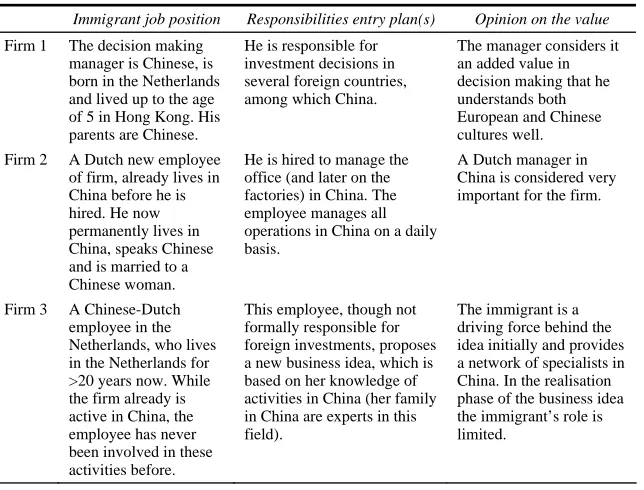
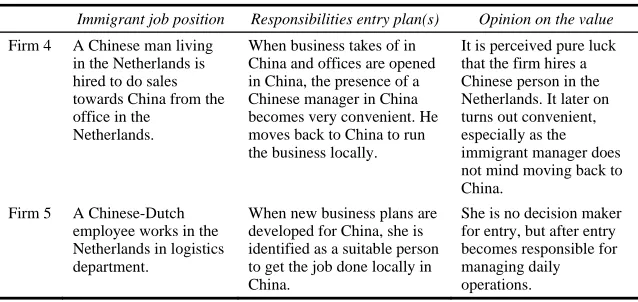
[image:11.595.107.429.330.575.2]Of the firms who involve immigrants, five firms decide to continue a total of ten plans. The entry strategy process evolves according to varying patterns. What the plans have in common is that the Chinese manager’s background plays a limited role. The firms do not rely heavily on the role of immigrants, yet benefit from it. The in-depth knowledge of both the home and host country of immigrant managers is perceived an additional advantage. Another important difference is the firm size. The five firms who continue vary in firm size from medium-sized (2) to large firms (2) and a large corporation (1), while none of these firms is a small firm or start-up.
Table 2 Involvement immigrant and effect on entry for plans continuing
Immigrant job position Responsibilities entry plan(s) Opinion on the value
Firm 1 The decision making manager is Chinese, is born in the Netherlands and lived up to the age of 5 in Hong Kong. His parents are Chinese.
He is responsible for investment decisions in several foreign countries, among which China.
The manager considers it an added value in decision making that he understands both European and Chinese cultures well. Firm 2 A Dutch new employee
of firm, already lives in China before he is hired. He now permanently lives in China, speaks Chinese and is married to a Chinese woman.
He is hired to manage the office (and later on the factories) in China. The employee manages all operations in China on a daily basis.
A Dutch manager in China is considered very important for the firm.
Firm 3 A Chinese-Dutch employee in the Netherlands, who lives in the Netherlands for >20 years now. While the firm already is active in China, the employee has never been involved in these activities before.
This employee, though not formally responsible for foreign investments, proposes a new business idea, which is based on her knowledge of activities in China (her family in China are experts in this field).
Table 2 Involvement immigrant and effect on entry for plans continuing (continued)
Immigrant job position Responsibilities entry plan(s) Opinion on the value
Firm 4 A Chinese man living in the Netherlands is hired to do sales towards China from the office in the
Netherlands.
When business takes of in China and offices are opened in China, the presence of a Chinese manager in China becomes very convenient. He moves back to China to run the business locally.
It is perceived pure luck that the firm hires a Chinese person in the Netherlands. It later on turns out convenient, especially as the immigrant manager does not mind moving back to China.
Firm 5 A Chinese-Dutch employee works in the Netherlands in logistics department.
When new business plans are developed for China, she is identified as a suitable person to get the job done locally in China.
She is no decision maker for entry, but after entry becomes responsible for managing daily operations.
Firms who continue plans often are able to involve a Chinese immigrant in realisation. The plan itself however, does not heavily depend on the involvement of the immigrant. The immigrant’s background is perceived an additional advantage from which the firm benefits.
5 Findings
The paper reports on the immigrant effect in the foreign entry go/no-go decision. It shows the isomorphic effect of the involvement of immigrants on the outcome of the go/no-go decision. An in-depth analysis of the cases reveals how the role of immigrants varies between firms who cancel and firms who continue activities in China.
5.1 Isomorphic immigrant effect
Scholars discussed the positive effect of immigrants within firms in establishing international business activities (Gould, 1994; Bates, 1997; Chung and Enderwick, 2001; Chung, 2004; Chung, 2008; Tadesse and White, 2008; White and Tadesse, 2008). The present work adds to this discussion the awareness of an isomorphic effect in the role of immigrants in entry success.
For firms who continue the entry plan for activities in China, a relatively large proportion involves employees with a multicultural background, e.g., both Chinese and Dutch. An involvement of immigrant entrepreneurs, employees and managers supports efficiency in the decision making process as none of these firms decides to consider alternative solutions or postpone plans. This supports the notion that multicultural orientation brings insight, confidence or ‘direct knowing’ to the entry strategy process (Hadley and Wilson, 2003; Andersen, 2006).
5.2 Entry decision making process
What the companies who cancel have in common, is that the family ties in China actually trigger the intention to conduct business with China. The perceived opportunity is based on the family ties of the entrepreneurs in China. These are seen is a unique competitive advantage for business. When the business relationship is not developing according to expectations, these small firms do not search for new opportunities.
This is different for those firms who do continue in China. The immigrant is seen as an added value. It is not the reason to conduct business in or with China. Also, the entry strategy itself does not involve family ties of the immigrant in the host country. The firms just benefit from the professional expertise of immigrant entrepreneurs, employees and managers and sometimes their business network.
In cases that cancel, the role of the immigrant is different. The Dutch-Chinese entrepreneurs want to start a business together with a relative in China. They both have an active role in strategy development and the future day-to-day operations. The business plans depend on the involvement of both the immigrant and their relatives. Yet, the business relationship so far is based on shared intentions and mutual trust.
Firms that cancel investment plans are mostly small firms with limited international business experience and limited resources. Our findings confirm previous studies that suggest young and small firms are often resource-constraint and have limited alternatives. They rely on collaboration with foreign partners to make initial entry into foreign markets (Shrader, 2001; Oviatt and McDougall, 2005). Their local network is important for business success (Rhee, 2008). When they face too many disappointments, they are not able to explore alternative options to go forward alone.
For the firms who do continue, immigrant employees are actively involved and their contributions is valued. But the business opportunity does not depend on their involvement. The immigrant entrepreneurs, employees and managers work directly for the parent company and are asked for participation in the business plan in a manner most beneficial for the company. They are valued as an unique competitive advantage.
5.3 Suggestions for future research
For future work, a more detailed process analysis of the entry strategy process is recommended, including roles, behaviours and background of managers, to understand how firms arrive at entry choices (Harris and Forbes, 2000; Sarasvathy, 2001; Chandler et al., 2009).
A limitation of this research is that it is conducted on foreign entry decisions of only 25 Dutch firms evaluating 54 business opportunities for China. Additional research is recommended with larger sample sizes including various home and host countries.
References
Andersen, P.H. (2006) ‘Listening to the global grapevine: SME export managers’ personal contacts as a vehicle for export information generation’, Journal of World Business, Vol. 41, No. 1, pp.81–96.
Barkema, H.G., Bell, H.J. and Pennings, J.M. (1996) ‘Foreign entry, cultural barriers, and learning’, Strategic Management Journal, Vol. 17, No. 2, pp.151–166.
Bates, T. (1997) ‘Financing small business creation: the case of Chinese and Korean immigrant entrepreneurs’, Journal of Business Venturing, Vol. 12, No. 2, pp.109–124.
Bell, J., Crick, D. and Young, S. (2004) ‘Small firm internationalization and business strategy’,
International Small Business Journal, Vol. 22, No. 1, pp.23–56.
Cavusgil, S.T., Zou, S., and Naidu, G.M. (1993) ‘Product and promotion adaptation in export venture: an empirical investigation’, Journal of International Business Studies, Vol. 24, No. 3, pp.479–505.
Chan, C.M. and Makino, S. (2007) ‘Legitimacy and multi-level institutional environments: implications for foreign subsidiary ownership structure’, Journal of International Business Studies, Vol. 38, No. 4, pp.621–638.
Chandler, G.N., DeTienne, D.R., McKelvie, A. and Mumford, T.V. (2009) ‘Causation and effectuation processes: a validation study’, Journal of Business Venturing.
Chen, Y-R., Yang, C., Hsu, S-M. and Wang, Y-D. (2009) ‘Entry mode choice in China’s regional distribution markets: institution vs. transaction costs perspectives’, Industrial Marketing Management, Vol. 38, No. 7, pp.702–713.
Chetty, S. and Eriksson, K. (1998) ‘Mutual commitment and experiential knowledge in international business relationships’, Working paper, University of Uppsala, Uppsala. Chetty, S., Eriksson, K. and Lindbergh, J. (2006) ‘The effect of specificity of experience on a
firm’s perceived importance of institutional knowledge in an ongoing business’, Journal of International Business Studies, Vol. 37, No. 5, pp.699–712.
Chung, H.F.L. (2002) ‘An empirical investigation of marketing programme and process elements in the home-host scenario’, Journal of Global Marketing, Vol. 16, Nos. 1–2, pp.141–186. Chung, H.F.L. (2004) ‘An empirical investigation of immigrant effects: the experience of firms
operating in the emerging markets’, International Business Review, Vol. 13, pp.705–728. Chung, H.F.L. (2008) ‘Contribution of immigrant employees to international marketing
standardisation strategies selection: an exploratory study’, European Journal of Marketing, Vol. 42, Nos. 1–2, pp.16–22.
Chung, H.F.L. and Enderwick, P. (2001) ‘An investigation of market entry strategy selection: exporting vs. foreign direct investment modes – a home-host country scenario’, Asia Pacific Journal of Management, Vol. 18, No. 4, pp.443–460.
Chung, H.F.L., Rose, E. and Huang, P.H. (2010) ‘Linking international adaptation strategy, immigrant effect, and performance: the case of home-host and cross-market scenario’,
International Business Review, p.19.
Collinson, S. and Houlden, J. (2005) ‘Decision-making and market orientation in the internationalization process of small and medium-sized firms’, Management International Review, Vol. 45, No. 4, pp.413–436.
Delios, A. and Beamish, P. (1999) ‘Ownership strategy of Japanese firms: transactional, institutional and experience influences’, Strategic Management Journal, Vol. 20, No. 10, pp.915–933.
Dow, D. and Karunaratna, A. (2006) ‘Developing a multidimensional instrument to measure psychic distance stimuli’, Journal of International Business Studies, Vol. 37, No. 5, pp.578–602.
Dow, D. and Larimo, J. (2007) ‘Entry mode choice: testing new approaches to measuring psychic distance and international experience’, European International Business Academy, Catania. Duncan, I., Bollard, A. and Yeabsley, J. (1997) ‘New Zealand migration: business related
flows-their roles in internationalisation’, New Zealand Institute of Economic Research, Wellington. Dunning, J.H. (2009) ‘Location and the multinational enterprise: a neglected factor?’, Journal of
International Business Studies, Vol. 40, No. 1, pp.5–19.
Comment [t1]: Author: Please cite the
reference in the text or delete from the list if not required.
Comment [t2]: Author: Please cite the
Eisenhardt, K.M. (1989) ‘Building theories from case study research’, Academy of Management Review, Vol. 14, No. 4, pp.532–550.
Eisenhardt, K.M. and Graebner, M.E. (2007) ‘Theory building from cases: opportunities and challenges’, Academy of Management Journal, Vol. 50, No. 1, pp.25–32.
Ellis, P.D. (2008) ‘Does psychic distance moderate the market size-entry sequence relationship?’,
Journal of International Business Studies, Vol. 39, No. 3, pp.351–369.
Eriksson, K. and Chetty, S. (2003) ‘The effect of experience and absorptive capacity on foreign market knowledge’, International Business Review, Vol. 12, No. 6, pp.673–695.
Gao, T. (2003) ‘Ethnic Chinese networks and international investment: evidence from inward FDI in China’, Journal of Asian Economics, Vol. 14, No. 4, pp.611–629.
Gould, D.M. (1994) ‘Immigrant links to the home country: empirical implications for US bilateral trade flows’, Review of Economics and Statistics, Vol. 76, pp.302–316.
Greaney, T.M. (2005) ‘Measuring network effects on trade: Are Japanese affiliates distinctive?’,
Journal of the Japanese and International Economies, Vol. 19, No. 2, pp.194–214.
Griffith, D.A. and Harvey, M.G. (2004) ‘The influence of individual and firm level social capital of marketing managers in a firm’s global network’, Journal of World Business, Vol. 39, No. 3, pp.244–254.
Hadley, R.D. and Wilson, H.I.M. (2003) ‘The network model of internationalization and experiential knowledge’, International Business Review, Vol. 12, No. 6, pp.697–717.
Harris, S. and Forbes, T. (2000) ‘Taught and enacted strategic approaches in young enterprises’,
International Journal of Entrepreneurial Behaviour & Research, Vol. 6, No. 3, pp.125–144. Henisz, W.J. (2005) ‘The institutional environment for international business’,
in P.J. Buckley (Ed.): What is International Business?, pp.85–109, Palgrave, London. Hyde, K. and Chung, F.L. (2002) ‘The impact of ‘immigrant effects’ on international marketing
strategy’, Proceedings of Australia-New Zealand Marketing Academy Conference 2002 (ANZMAC), Deakin University, Melbourne Australia.
Jansson, H., Hilmersson, M. and Sandberg, S. (2009) ‘The perceived institutional distance in the internationalization process of firms: a proposed model for measuring managerial perception in emerging country markets’, AIB, San Diego, California, USA.
Jensen, M. (2003) ‘The role of network resources in market entry: commercial banks’ entry into investment banking, 1991–1997’, Administrative Science Quarterly, Vol. 48, No. 3, pp.466–497.
Johanson, J. and Mattson, L-G. (1988) ‘Internationalization in industrial systems: a network approach’, in N. Hood and J-E. Vahlne (Eds.): Strategies in Global Competition, pp.303–321, Croom Helm, New York.
Johanson, J. and Vahlne, J.E. (1977) ‘The internationalization process of the firm: a model of knowledge development and increasing foreign market commitment’, Journal of International Business Studies, Vol. 8, No. 1, pp.23–32.
Lever-Tracey, C., Ip, D., Kitay, J., Phillips, I. and Tracy, N. (1991) ‘Asian entrepreneurs in Australia: ethnic small business in the Chinese and Indian communities of Brisbane and Sydney’, Report to the Office of Multicultural Affairs, Australia.
Li, J.J., Zhou, K.Z. and Shao, A.T. (2009) ‘Competitive position, managerial ties, and profitability of foreign firms in China: an interactive perspective’, Journal of International Business Studies, Vol. 40, No. 2, pp.339–352.
Li, P.Y. and Meyer, K. (2008) ‘Contextualizing experience effects in international business: a study of ownership strategies’, Journal of World Business, Vol. 44, No. 4, pp.370–382.
Madhavan, R. and Iriyama, A. (2009) ‘Understanding global flows of venture capital: human networks as the ‘carrier wave’ of globalization’, Journal of International Business Studies, Vol. 40, No. 8, pp.1241–1259.
March, J.G. (1991) ‘Exploration and exploitation in organizational learning’, Organization Science, Vol. 2, No. 1, pp.71–87.
Miles, M.B. and Huberman, A.M. (1984) Qualitative Data Analysis: A Sourcebook of New Methods, Sage Publishing, Beverly Hills, USA.
Millington, A., Eberhardt, M. and Wilkinson, B. (2006) ‘Guanxi and supplier search mechanisms’,
Human Relations, Vol. 59, No. 4, pp.505–531.
Oortwijn, G.J.M. (2006) ‘How do companies arrive at entry mode choices? A multilevel process analysis of entry mode decision making of Dutch companies’ entry into China’, Judge Business School, University of Cambridge, Cambridge, MPhil: 63.
Oortwijn, M. (2010a) ‘Empirical comparative case study on the foreign entrance success rate and the role in the process of immigrants within the firm’, EMRBI, Cyprus.
Oortwijn, M. (2010b) ‘Firms opt for higher involvement of local partners in international business, when firms are confident and experienced in operating abroad’, International Manufacturing Symposium, Cambridge, UK.
Oortwijn, M. (2010c) ‘Manager’s international experience and the commitment to new market entry, go/no-go decision’, EMRBI, Cyprus.
Oviatt, B. and McDougall, P.P. (2005) ‘Towards a theory of international new ventures’, Journal of International Business Studies, Vol. 36, pp.29–41.
Pan, Y. and Tse, D.K. (2000) ‘The hierarchical model of market entry modes’, Journal of International Business Studies, Vol. 31, No. 4, pp.535–554.
Pedersen, T. and Thomsen, S. (1997) ‘European patterns of corporate ownership: a twelve-country study’, Journal of International Business Studies, Vol. 28, No. 4, pp.759–778.
Petersen, B., Pedersen, T. and Lyles, M.A. (2008) ‘Closing knowledge gaps in foreign markets’,
Journal of International Business Studies, Vol. 39, No. 7, pp.1097–1113.
Rhee, J.H. (2008) ‘International expansion strategies of Korean venture firms: entry mode choice and performance’, Asian Business & Management, Vol. 7, pp.95–114.
Sarasvathy, S. (2001) ‘Causation and effectuation: toward a theoretical shift from economic inevitability to entrepreneurial contingency’, Academy of Management Journal Review, Vol. 26, No. 2, pp.243–263.
Shrader, R.C. (2001) ‘Collaboration and performance in foreign markets: the case of young high-technology manufacturing firms’, Academy of Management Journal, Vol. 44, No. 1, pp.45–60.
Tadesse, B. and White, R. (2008) ‘Do immigrants counter the effect of cultural distance on trade? Evidence from US state-level exports’, Journal of Socio-Economics Vol. 37, No. 6, pp.2304–2318.
Tse, D.K., Pan, Y. and Au, K.Y. (1997) ‘How MNCs choose entry modes and form alliances: the China experience’, Journal of International Business Studies, Vol. 28, No. 4, pp.779–805. Wagner, D., Head, K. and Ries, J. (2002) ‘Immigration and the trade of provinces’, Scottish
Journal of Political Economy, Vol. 49, No. 5, pp.507–525.
Welch, D.E. and Welch, L.S. (1996) ‘The internationalization process and networks: a strategic management perspective’, Journal of International Marketing, Vol. 4, No. 3, pp.11–17. White, R. and Tadesse, B. (2008) ‘Immigrants, cultural distance and U.S. state-level exports of
cultural products’, The North American Journal of Economics and Finance, Vol. 19, No. 3, pp.331–348.
Wilkinson, I.F., Mattson, L-G. and Easton, G. (2000) ‘International competitiveness and trade promotion policy from a network perspective’, Journal of World Business, Vol. 35, No. 3, pp.275–299.
Comment [t3]: Author: Please cite the
Xu, D. and Shenkar, O. (2002) ‘Institutional distance and multinational enterprise’, Academy of Management Review, Vol. 27, No. 4, pp.608–618.