Collaborative Reinforcement Learning of Autonomic Behaviour
Jim Dowling, Raymond Cunningham, Eoin Curran and Vinny Cahill
Distributed Systems Group, Trinity College Dublin
{jpdowlin,rcnnnghm,[email protected], [email protected]}Abstract
This paper introduces Collaborative Reinforcement Learning (CRL), a coordination model for solving system-wide optimisation problems in distributed sys-tems where there is no support for global state. In CRL the autonomic properties of a distributed system emerge from the coordination of individual agents solv-ing discrete optimisation problems ussolv-ing Reinforcement Learning. In the context of an ad hoc routing protocol, we show how system-wide optimisation in CRL can be used to establish and maintain autonomic properties for decentralised distributed systems.
1
Introduction
Massive autonomic distributed computer systems, on a scale comparable with biological autonomic sys-tems, require a decentralised, bottom-up approach to their construction. The benefits of such an approach include improved robustness and scalability, the pos-sibility of regulation, configuration and self-organisation, the lack of centralised points of failure or attack, as well as possible evolution of the system through evolving the local rules of the agents [1].
Collaborative Reinforcement Learning (CRL) is a bottom-up approach to tackling the complex time-varying problems of engineering autonomic behaviour for distributed systems where there is no support for global state. It is an extension to Reinforcement Learn-ing [2] (RL) for solvLearn-ing system-wide optimisation prob-lems in decentralised multi-agent systems. In CRL, in-dividual agents solve discrete optimisation problems us-ing RL and share solution information with their neigh-bours, contributing towards the solution of the system-wide optimisation problem. Agents are part of a dy-namic population, with support for agents joining and leaving the system and establishing connections with neighbours. CRL does not make use of system-wide knowledge and individual agents only know about and
communicate with their neighbours.
It is our belief that many autonomic properties of distributed systems that can be represented as system-wide optimisation problems can be solved using CRL. Distributed systems such as ad hoc networks, peer-to-peer and grid computing applications contain optimisa-tion problems such as how to optimise load-balancing in a grid-computing system or the optimal distribution of meta-data in a peer-to-peer system. In this paper we introduce SAMPLE, a routing protocol for ad hoc net-works [3], as an implementation of CRL and describe its autonomic properties such as the adaptation of traffic flows to congestion and interference and the favouring of stable network links by network traffic.
2
CRL
Collaborative Reinforcement Learning (CRL) is an extension to RL that uses system-wide optimisation to establish and maintain system-wide properties over a group of decentralised agents, e.g. properties such as fault tolerant or load-balanced. We view an autonomic property of a distributed system as a system-wide prop-erty that contributes to the system’s self-management. Existing techniques that introduce system-wide proper-ties into distributed systems, such as group communi-cation protocols, communicating sequential processes and dynamic software architectures, do so in a top-down manner, decomposing system behaviour and making it amenable to formal analysis. These approaches are not suitable for dynamic environments or environments that have no support for global state, such as wireless ad-hoc networks.
result-ing in near-optimal use of system-wide resources. Each DOP is modelled as an absorbing Markov Decision Pro-cess (MDP).
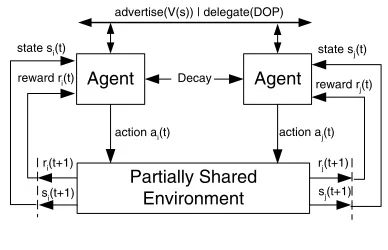
CRL solves system-wide optimisation problems by specifying how individual agents can either solve a DOP using reinforcement learning and share their re-sults with neighbours using localised advertisement or delegate the solution of a DOP to a neighbouring agent by transferring responsibility for the solution to the DOP, see Figure 1. DOPs can be delegated multiple
Agent Agent
advertise(V(s)) | delegate(DOP)
Partially Shared Environment
action ai(t) reward ri(t)
state si(t)
rj(t+1)
sj(t+1) reward rj(t) state sj(t)
action aj(t)
si(t+1)
ri(t+1)
[image:2.612.84.278.263.388.2]Decay
Figure 1. CRL
times across many neighbours before they are handled. An agent delegates the solution to a DOP to a neighbour when it either cannot solve the problem locally or when the estimated cost of solving it locally is higher than the estimated cost of a neighbour solving it.
2.0.1 Optimal Policy in CRL
In RL, the cost of solving a DOP is described by the estimated value function, V(s) - the expected perfor-mance of the agent if it starts in state,s, and executes an optimal state transition policy thereafter. We can also use the optimal action-value function,Q(s, a), instead ofV(s), to describe the perfomance of the agent if the optimal set of actions are executed starting from state,
s. The value function and action-value function for the optimal policy are related usingV(s) = maxaQ(s, a).
In CRL state transitions may be local on the current agent or be remote to a neighbouring agent. When es-timating the cost of the transition to a state on a neigh-bouring agent we also have to take into consideration the connection cost to the neighbouring agent. For this reason, we use a different estimated optimal action-value function,Qi(s, a)at agentnithat includes both
the optimal value function for the state,Vi(s), and the
connection cost to the state,Di(s, a, s). The
connec-tion cost for transiconnec-tion to a state that is on the same agent as the agent is zero, whereas the connection cost for a transition to a state located on a neighbouring agent
should reflect the underlying network cost as well as the cost of transferring control from the source agent to the target agent. The transfer of control involves termi-nating the DOP at the origitermi-nating agent and starting the solution to a new DOP at the destination agent.
2.0.2 Advertisement
When an agent executes actions it receives reinforce-ments from its environment that cause updates to theV
values of an agent. In CRL, neighbours are informed of changes to an agent’sV values usingadvertisementto broadcastV values to neighbours, see Figure 1. Each neighbour then uses theV values and their estimated connection cost to the agent to update their cachedVi
values. Examples of mechanisms for implementing ad-vertisement updates in distributed systems include pe-riodic broadcast of updates, conditional broadcast and event-based notification. In our ad hoc routing proto-col, SAMPLE, we use the shared radio communication channel to piggy-backV updates inside 802.11 unicast and broadcast packets that are promiscuously received by neighbours.
2.0.3 Dynamic Environments
Reinforcement learning is not suitable for non-stationary (dynamic) environments. In decentralised distributed systems, it is not possible for an agent to have perfect and complete knowledge of the state of its neighbours, connections and environment. However, similar to RL, CRL models are based on MDP learn-ing methods that require complete observability [2]. To overcome problems related to partially observable envi-ronments our statistical models favour more recent ob-servations using a finite-history-window [2].
In decentralised distributed systems, it also is impor-tant for agents to be able to both discover new agents and to be able to ’forget’ old agents and solutions as the environment changes. CRL provides additional sup-port for a discovery action that an agent can execute in any state to attempt to find new neighbours. In SAM-PLE, the discovery action is implemented using 802.11 broadcast. There is also a model for the decay ofVi
is similar to autopoeisis found in self-organising sys-tems [1].
2.0.4 Model-Based RL
Reinforcement learning strategies can be either model-free or model-based [2]. We favour a model-based ap-proach to building autonomic distributed systems using CRL, as the use of a model can be seen as allowing ’virtual experiments’. For example, if a V(s) gener-ated value changes, a model-free method may require many experiences of actions resulting in state s be-fore this change can be incorporated into neighbouring states. However, a method that uses a model can use the observed, statistical information about state transi-tion probabilities, T(s, a, s), about which actions re-sulted in statesin the past to propagate this change in
V(s)to neighbouring states without the need for actu-ally executing actions which result in states. In dis-tributed systems where real-world experience is expen-sive, the model based approach has a distinct advantage over model-free methods.
2.1 CRL Algorithm
The CRL algorithm can be used to solve system-wide optimisation problems that can be characterised as a multi-agent system, and where agents solve dis-crete optimisation problems modelled as MDPs in the following schema:
• A set of agents N = {n1, n2, . . . , nM}
corre-sponding to nodes in a distributed system.
• Each agentnihas a set,Vi, of neighbouring agents
whereVi⊆ N andni∈ V/ i.
• Each agentnihas a set of statesSi, whereSi⊆ S
andSis the system-wide set of states.
• Nodes have bothinternalandexternal states. Int: N → P(S)is the function that maps from the set of agents to a non-empty set of internal states that are not visible by neighbouring agents.
Ext:N → P(S)is the function that maps from the set of agents to a set of externally visible states.
Ext(ni)is the set of states visible to neighbours of
ni. The relationship between internal and external
states is the following:
Int(ni)⊂ Si
Ext(ni)⊂ Si ∧
Int(ni)∪Ext(ni) =Si
Int(ni)∩Ext(ni) ={}
• We define a set ofcausally connected states be-tween agentsniandnjas:
Cninj =Int(ni)∩Ext(nj)wherenj∈ Vi.
s ∈ Cninj is a causally connected state where an internal state sat ni corresponds to an external
statesatnj. Causally connected states enable the
delegation of a MDP from one node to another. In CRL a state transition to sat ni terminates the
MDP at ni and initiates a new MDP starting at
statesatnj.
• Each agentni has a set of actionsAi = Adi ∪
Api∪discovery, whereAi ⊆ A. Adiare the set of delegation actions that represent an action that attempts to delegate a MDP fromnitonj,Apiare the set of DOP actions that attempt to solve the MDP locally, anddiscoveryis a discovery action.
discovery updates the set of neighbours,Vi, for
agent,ni, and queries if discovered neighbouring
agentnj provides the capabilities to accept a
del-egated MDP from ni. If it does,Adi is updated to include a new delegation action that can result in a state transition to s ∈ Cninj, delegating a MDP fromnitonj. The discovery action isnot
included in our calculation of the Vi values,
be-cause it should never be part of the pure exploita-tive strategy which theQivalues represent.
• Di : Si× Adi× Si → Ris the connection cost
function that observes the cost for the attempted use of a connection in a distributed system. The connection cost is based on a statistical model that estimates the cost of using a connection in a dis-tributed system.
• We define a cache at ni as Cachei =
{(Qi(s, a), rj) :rj ∈R∧s∈ Cninj}. The value
rjin the pair(Qi(s, aj), rj)corresponds to the last
advertisedVj(s)received by agentnifrom agent
nj.
• For eachnj∈ Vi,Cachejis updated by aVj ad-vertisementfor a shared causally connected state. The update replaces the rj element of the pair
(Qi(s, a), rj) in Cachei with the advertised Vj
value .
• Decay(rj) → Ris the decay model that updates
therjelement inCachei,
Decay(rj) =rj+ρtd
wheretdis the amount of time elapsed since the last received advertisement forrjfrom agentnj.
• The distributed model-basedQ-learning algorithm is:
Qi(s, a) = R(s, a) +γ
s∈Si T(s, a, s
).
(Di(s, a, s) +Decay(Vj(s)))
(1) where a ∈ Ad. Ifa /∈ Ad, this defaults to the
standard model-based Q-Learning algorithm [2].
R(s, a)is the MDP termination cost,P(s|s, a)is the state transition model that computes the prob-ability of the actionaresulting in a state transition to states,Di(s|s, a)is the estimated connection
cost andVj(s)isrj∈ (Q(s, a), rj)∈ Cacheiif
a∈ Ad, andVi(s)otherwise.
• Vivalues, at nodeni, can be calculated using the
Bellman optimality equation [2]:
Vi(s) = max
a [Qi(s, a)]
• Finally, a cleanup updater is available at each agent, ni, to remove stale elements from its set
of neighbours, Vi, delegation actions, Adi, con-nected states, Cninj and its Cachei. When a
(Qi(s, aj), rj) entry in the cache drops below
a specified threshold, the cleanup updater re-moves the delegation action aj from Adi, the stale connected states fromCninj, and the pair
(Qi(s, aj), rj)fromCachei. If after removings,
csisj ={}for j some neighbour ofni, thennjis
removed fromVi.
3
SAMPLE: Ad-hoc Routing using CRL
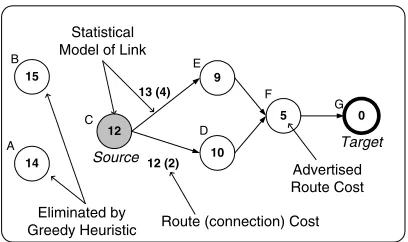
Ad hoc routing exhibits challenging problems such as the lack of global knowledge at any particular node in the ad hoc network and the requirement for the system-wide autonomic properties of the protocol to emerge from local routing decisions at routing agents. SAM-PLE is a probabilistic on-demand ad hoc routing proto-col based on CRL [3] that possesses system-wide prop-erties, such as the adaptation of network traffic patterns around areas of congestion and wireless interference and the exploitaton of stable routes. Whereas standard ad hoc routing protocols such as Ad hoc On-Demand Distance Vector Routing (AODV) and Dynamic Source Routing protocol (DSR) use discrete models of links in the network, in SAMPLE, we use a statistical model of links based on RL and routing agents share their link information with neighbours using CRL. Routing deci-sions are based both on locally acquired experience us-ing RL and information acquired from neighbours usus-ing CRL, see Figure 2.
9
10 12
12 (2) 13 (4)
0 5
E
F
A
C
D B
15
14
G
Eliminated by
Greedy Heuristic Route (connection) Cost Advertised Route Cost
Target Source
[image:4.612.308.512.134.255.2]Statistical Model of Link
Figure 2. Routing Decision in SAMPLE
0 0.2 0.4 0.6 0.8 1 1.2
10 15 20 25 30 35 40 45 50
Delivery Ratio
Offered Kbps Delivery Ratio vs Offered Kbps
Routing Protocol AODV DSR SAMPLE
(a) Delivery Ratio
-5 0 5 10 15 20 25 30 35 40
10 15 20 25 30 35 40 45 50
Transmissions per Packet Sent
Offered Kbps Transmissions per Packet Sent vs Offered Kbps
Routing Protocol AODV DSR SAMPLE
[image:5.612.76.512.140.306.2](b) Throughput
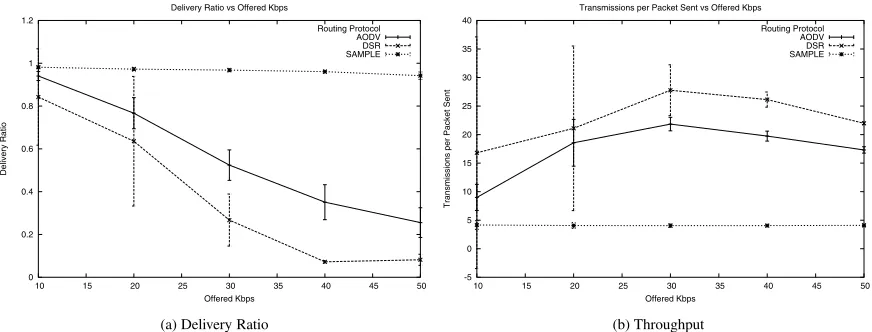
Figure 3. SAMPLE Performance with Varying Load. 64 byte packets
3.1 Autonomic Properties of SAMPLE
From a system perspective, routing can be consid-ered as a system-wide, continuous optimisation prob-lem but from the perspective of an individual peer rout-ing can be considered as a discrete optimisation prob-lem - each packet will have start and termination states and make a discrete number of state transitions. Individ-ual agents, from a population of agents, attempt to find a minimum cost solution to a routing problem, see Fig-ure 2, and inform their neighbours of their lowest cost solution, who may use that information to update their solutions to the same routing problem. System-wide autonomic properties that can be observed in SAM-PLE include the exploitation of stable routes by packets where possible and the re-routing of network traffic pat-terns around congestion and interference spots. Both of these properties emerge from the solution to and inter-action of the individual discrete optimisation problems, i.e. routing decisions, that operate only on local statis-tical models. As can be seen from the results in fig-ure 3, the autonomic properties of the routing protocol improve routing performance, particularly in congested and lossy wireless networks.
3.2 Discussion and Future Work
We are currently investigating the relationship be-tween system-wide optimisation and the establishment and maintanance of various autonomic properties in de-centralised distributed systems. As a different applica-tion of CRL, we are building a system that optimises resource utilisation in an ad hoc networks using load-balancing. While certain autonomic properties, such as
self-optimisation can often be cast as system-wide op-timisation problems, it is less clear how self-healing, self-configuration and self-protection can fit into this scheme. CRL relies on agents being able to represent an activity using a cost, and we are investigating how we can represent different autonomic properties using the cost model.
4
Conclusions
This paper introduces Collaborative Reinforcement Learning, a coordination model for solving system-wide optimisation problems in distributed systems where there is no support for global state. It can be used as a technique for establishing autonomic distributed system properties using only local discrete optimisation rules and information sharing among agents. We have shown in SAMPLE that autonomic behaviour can be in-troduced into distributed systems using CRL.
References
[1] J. Kennedy and R. C. Eberhart, Swarm Intelli-gence. San Francisco, California: Morgan Kauf-mann, 2001.
[2] R. Sutton and A. Barto, Reinforcement Learning. MIT Press, 1998.
[3] E. Curran and J. Dowling, “Sample: An on-demand probabilistic routing protocol for ad-hoc networks,”