1
Transfer in Deep Reinforcement Learning using Knowledge Graphs
Prithviraj Ammanabrolu School of Interactive Computing
Georgia Institute of Technology Atlanta, GA
Mark O. Riedl
School of Interactive Computing Georgia Institute of Technology
Atlanta, GA
Abstract
Text adventure games, in which players must make sense of the world through text tions and declare actions through text descrip-tions, provide a stepping stone toward ground-ing action in language. Prior work has demon-strated that using a knowledge graph as a state representation and question-answering to pre-train a deep Q-network facilitates faster control policy learning. In this paper, we explore the use of knowledge graphs as a representation for domain knowledge transfer for training text-adventure playing reinforce-ment learning agents. Our methods are tested across multiple computer generated and hu-man authored games, varying in domain and complexity, and demonstrate that our transfer learning methods let us learn a higher-quality control policy faster.
1 Introduction
Text adventure games, in which players must make sense of the world through text descrip-tions and declare acdescrip-tions through natural language, can provide a stepping stone toward more real-world environments where agents must communi-cate to understand the state of the world and af-fect change in the world. Despite the steadily in-creasing body of research on text-adventure games (Bordes et al.,2010;He et al.,2016;Narasimhan et al., 2015; Fulda et al., 2017; Haroush et al.,
2018; Cˆot´e et al., 2018; Tao et al., 2018; Am-manabrolu and Riedl,2019), and in addition to the ubiquity of deep reinforcement learning applica-tions (Parisotto et al.,2016;Zambaldi et al.,2019), teaching an agent to play text-adventure games re-mains a challenging task. Learning a control pol-icy for a text-adventure game requires a signifi-cant amount of exploration, resulting in training runs that take hundreds of thousands of simula-tions (Narasimhan et al.,2015;Ammanabrolu and Riedl,2019).
One reason that text-adventure games require so much exploration is that most deep reinforcement learning algorithms are trained on a task without a real prior. In essence, the agent must learn ev-erything about the game from only its interactions with the environment. Yet, text-adventure games make ample use of commonsense knowledge (e.g., an axe can be used to cut wood) and genre themes (e.g., in a horror or fantasy game, a coffin is likely to contain a vampire or other undead monster). This is in addition to the challenges innate to the text-adventure game itself—games are puzzles— which results in inefficient training.
Ammanabrolu and Riedl(2019) developed a re-inforcement learning agent that modeled the text environment as a knowledge graph and achieved state-of-the-art results on simple text-adventure games provided by the TextWorld (Cˆot´e et al.,
2018) environment. They observed that a simple form of transfer from very similar games greatly improved policy training time. However, games beyond the toy TextWorld environments are be-yond the reach of state-of-the-art techniques.
games, demonstrating that our transfer learning methods enable us to learn a higher-quality con-trol policy faster.
2 Background and Related Work
Text-adventure games, in which an agent must in-teract with the world entirely through natural lan-guage, provide us with two challenges that have proven difficult for deep reinforcement learning to solve (Narasimhan et al.,2015;Haroush et al.,
2018; Ammanabrolu and Riedl, 2019): (1) The agent must act based only on potentially incom-plete textual descriptions of the world around it. The world is thus partially observable, as the agent does not have access to the state of the world at any stage. (2) the action space is combinatorially large—a consequence of the agent having to de-clare commands in natural language. These two problems together have kept commercial text ad-venture games out of the reach of existing deep reinforcement learning methods, especially given the fact that most of these methods attempt to train on a particular game from scratch.
Text-adventure games can be treated as par-tially observable Markov decision processes (POMDPs). This can be represented as a 7-tuple of hS, T, A,Ω, O, R, γi: the set of environment states, conditional transition probabilities between states, words used to compose text commands, ob-servations, conditional observation probabilities, the reward function, and the discount factor re-spectively (Cˆot´e et al.,2018).
Multiple recent works have explored the chal-lenges associated with these games (Bordes et al.,
2010; He et al., 2016; Narasimhan et al., 2015;
Fulda et al., 2017; Haroush et al., 2018; Cˆot´e et al., 2018; Tao et al., 2018;Ammanabrolu and Riedl, 2019). Narasimhan et al.(2015) introduce the LSTM-DQN, which learns to score the ac-tion verbs and corresponding objects separately and then combine them into a single action. He et al.(2016) propose the Deep Reinforcement Rel-evance Network that consists of separate networks to encode state and action information, with a fi-nal Q-value for a state-action pair that is computed between a pairwise interaction function between these. Haroush et al. (2018) present the Action Elimination Network (AEN), which restricts ac-tions in a state to the top-k most likely ones, us-ing the emulator’s feedback. Hausknecht et al.
(2019b) design an agent that uses multiple
mod-ules to identify a general set of game play rmod-ules for text games across various domains. None of these works study how to transfer policies between dif-ferent text-adventure games in any depth and so there exists a gap between the two bodies of work.
Transferring policies across different text-adventure games requires implicitly learning a mapping between the games’ state and action spaces. The more different the domain of the two games, the harder this task becomes. Previ-ous work (Ammanabrolu and Riedl,2019) intro-duced the use of knowledge graphs and question-answering pre-training to aid in the problems of partial observability and a combinatorial action space. This work made use of a system called TextWorld (Cˆot´e et al.,2018) that uses grammars to generate a series of similar (but not exact same) games. An oracle was used to play perfect games and the traces were used to pre-train portions of the agent’s network responsible for encoding the observations, graph, and actions. Their results show that this form of pre-training improves the quality of the policy at convergence it does not show a significant improvement in the training time required to reach convergence. Further, it is generally unrealistic to have a corpus of very similar games to draw from. We build on this work, and explore modifications of this algorithm that would enable more efficient transfer in text-adventure games.
Work in transfer in reinforcement learning has explored the idea of transferring skills (Konidaris and Barto,2007;Konidaris et al.,2012) or trans-ferring value functions/policies (Liu and Stone,
2006). Other approaches attempt transfer in model-based reinforcement learning (Taylor et al.,
2008; Nguyen et al., 2012; Gasic et al., 2013;
Wang et al., 2015;Joshi and Chowdhary, 2018), though traditional approaches here rely heavily on hand crafting state-action mappings across do-mains. Narasimhan et al. (2017) learn to play games by predicting mappings across domains us-ing a both deep Q-networks and value iteration networks, finding that that grounding the game state using natural language descriptions of the game itself aids significantly in transferring useful knowledge between domains.
In transfer for deep reinforcement learning,
ini-tializes the network for a target task using these parameters. Yin and Pan (2017) also use policy distillation, using task specific features as inputs to a multi-task policy network and use a hierarchi-cal experience sampling method to train this multi-task network. Similarly,Rusu et al.(2016) attempt to transfer parameters by using frozen parameters trained on source tasks to help learn a new set of parameters on target tasks. Rajendran et al.
(2017) attempt something similar but use atten-tion networks to transfer expert policies between tasks. These works, however, do not study the re-quirements for enabling efficient transfer for tasks rooted in natural language, nor do they explore the use of knowledge graphs as a state representation.
3 Knowledge Graphs for DQNs
A knowledge graph is a directed graph formed by a set of semantic, or RDF, triples in the form of hsubject, relation, objecti—for
exam-ple, hvampires, are, undeadi. We follow the
open-world assumption that what is not in our knowledge graph can either be true or false.
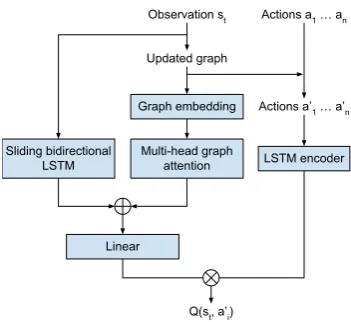
Ammanabrolu and Riedl(2019) introduced the Knowledge Graph DQN (KG-DQN) and touched on some aspects of transfer learning, show-ing that pre-trainshow-ing portions of the deep Q-network using question answering system on per-fect playthroughs of a game increases the qual-ity of the learned control policy for a generated text-adventure game. We build on this work and use KG-DQN to explore transfer with both knowl-edge graphs and network parameters. Specifically we seek to transfer skills and knowledge from (a) static text documents describing game play and (b) from playing one text-adventure game to a sec-ond complete game in in the same genre (e.g., hor-ror games). The rest of this section describes KG-DQN in detail and summarizes our modifications.1 For each step that the agent takes, it automat-ically extracts a set of RDF triples from the re-ceived observation through the use of OpenIE (Angeli et al., 2015) in addition to a few rules to account for the regularities of text-adventure games. The graph itself is more or less a map of the world, with information about objects’ affor-dances and attributes linked to the rooms that they are place in in a map. The graph also makes a dis-tinction with respect to items that are in the agent’s
1We use the implementation of KG-DQN found at https://github.com/rajammanabrolu/KG-DQN
Graph embedding
Multi-head graph attention Sliding bidirectional
LSTM
Linear
Observation st
Updated graph
LSTM encoder Actions a1 … an
Actions a’1 … a’n
[image:3.595.328.504.64.225.2]Q(st, a’i)
Figure 1: The KG-DQN architecture.
possession or in their immediate surrounding en-vironment. We make minor modifications to the rules used in Ammanabrolu and Riedl (2019) to better achieve such a graph in general interactive fiction environments.
The agent also has access to all actions accepted by the game’s parser, followingNarasimhan et al.
(2015). For general interactive fiction environ-ments, we develop our own method to extract this information. This is done by extracting a set of templates accepted by the parser, with the objects or noun phrases in the actions replaces with a OBJ tag. An example of such a template is ”place OBJ in OBJ”. These OBJ tags are then filled in by look-ing at all possible objects in the given vocabulary for the game. This action space is of the order of A = O(|V| × |O|2) where V is the number
of action verbs, and O is the number of distinct objects in the world that the agent can interact with. As this is too large a space for a RL agent to effectively explore, the knowledge graph is used to prune this space by ranking actions based on their presence in the current knowledge graph and the relations between the objects in the graph as inAmmanabrolu and Riedl(2019).
the Bellman equation (Sutton and Barto,2018):
Qt+1(st+1,at+1) =
E[rt+1+γmax
a∈At
Qt(s, a)|st, at] (1)
where γ refers to the discount factor and rt+1 is
the observed reward. The whole system is trained using prioritized experience replay Lin(1993), a modified version of-greedy learning, and a tem-poral difference loss that is computed as:
L(θ) =rk+1+
γ max
a∈Ak+1
Q(st,a;θ)−Q(st,at;θ) (2)
whereAk+1 represents the action set at stepk+ 1 andst,atrefer to the encoded state and action representations respectively.
4 Knowledge Graph Seeding
In this section we consider the problem of trans-ferring a knowledge graph from a static text re-source to a DQN—which we refer to asseeding. KG-DQN uses a knowledge graph as a state repre-sentation and also to prune the action space. This graph is built up over time, through the course of the agent’s exploration. When the agent first starts the game, however, this graph is empty and does not help much in the action pruning process. The agent thus wastes a large number of steps near the beginning of each game exploring ineffectively.
The intuition behind seeding the knowledge graph from another source is to give the agent a prior on which actions have a higher utility and thereby enabling more effective exploration. Text-adventure games typically belong to a particular genre of storytelling—e.g., horror, sci-fi, or soap opera—and an agent is at a distinct disadvantage if it doesn’t have any genre knowledge. Thus, the goal of seeding is to give the agent a strong prior.
This seed knowledge graph is extracted from online general text-adventure guides as well as game/genre specific guides when available.2 The graph is extracted from this the guide using a sub-set of the rules described in Section 3 used to extract information from the game observations, with the remainder of the RDF triples coming from OpenIE. There is no map of rooms in the en-vironment that can be built, but it is possible to
2An example of a guide we use is found herehttp:// www.microheaven.com/IFGuide/step3.html
people tell
You
can multiple
items
can use
go north
go south
object examine
knife cut
take is
lock key
is
is
opens take drop
drop
drop
verb is
is . . . . . .
can
can
do
do
is
command
inventory
. . .
[image:4.595.318.515.62.258.2]. . .
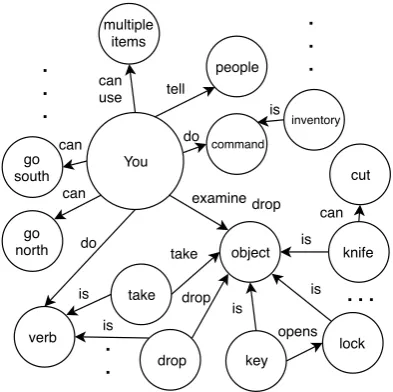
Figure 2: Select partial example of what a seed knowl-edge graph looks like. Ellipses indicate other similar entities and relations not shown.
extract information regarding affordances of fre-quently occurring objects as well as common ac-tions that can be performed across a wide range of text-adventure games. This extracted graph is thus potentially disjoint, containing only this generaliz-able information, in contrast to the graph extracted during the rest of the exploration process. An ex-ample of a graph used to seed KG-DQN is given in Fig. 2. The KG-DQN is initialized with this knowledge graph.
5 Task Specific Transfer
The overarching goal of transfer learning in text-adventure games is to be able to train an agent on one game and use this training on to improve the learning capabilities of another. There is grow-ing body of work on improvgrow-ing traingrow-ing times on target tasks by transferring network parameters trained on source tasks (Rusu et al.,2016;Yin and Pan, 2017;Rajendran et al.,2017). Of particular note is the work byRusu et al.(2016), where they train a policy on a source task and then use this to help learn a new set of parameters on a target task. In this approach, decisions made during the training of the target task are jointly made using the frozen parameters of the transferred policy net-work as well as the current policy netnet-work.
walk-through descriptions of the game found online as described in Section4.
We use the parameters of the question-answering system to pre-train portions of the deep Q-network for a different game within in the same domain. The portions that are pre-trained are the same parts of the architecture as inAmmanabrolu and Riedl(2019). This game is referred to as the
source task. The seeding of the knowledge graph is not strictly necessary but given that state-of-the-art DRL agents cannot complete real games, this makes the agent more effective at the source task. We then transfer the knowledge and skills ac-quired from playing the source task to another game from the same genre—thetarget task. The parameters of the deep Q-network trained on the source game are used to initialize a new deep Q-network for the target task. All the weights indi-cated in the architecture of KG-DQN as shown in Fig.1 are transferred. UnlikeRusu et al.(2016), we do not freeze the parameters of the deep Q-network trained on the source task nor use the two networks to jointly make decisions but instead just use it to initialize the parameters of the target task deep Q-network. This is done to account for the fact that although graph embeddings can be trans-ferred between games, the actual graph extracted from a game is non-transferable due to differences in structure between the games.
6 Experiments
We test our system on two separate sets of games in different domains using the Jericho and TextWorld frameworks (Hausknecht et al.,2019a;
Cˆot´e et al.,2018). The first set of games is “slice of life” themed and contains games that involve mun-dane tasks usually set in textual descriptions of normal houses. The second set of games is “hor-ror” themed and contains noticeably more diffi-cult games with a relatively larger vocabulary size and action set, non-standard fantasy names, etc. We choose these domains because of the avail-ability of games in popular online gaming com-munities, the degree of vocabulary overlap within each theme, and overall structure of games in each theme. Specifically, there must be at least three games in each domain: at least one game to train the question-answering system on, and two more to train the parameters of the source and target task deep Q-networks. A summary of the statistics for the games is given in Table1. Vocabulary overlap
is calculated by measuring the percentage of over-lap between a game’s vocabulary and the domain’s vocabulary, i.e. the union of the vocabularies for all the games we use within the domain. We ob-serve that in both of these domains, the complex-ity of the game increases steadily from the game used for the question-answering system to the tar-get and then source task games.
We perform ablation tests within each domain, mainly testing the effects of transfer from seed-ing, oracle-based question-answerseed-ing, and source-to-target parameter transfer. Additionally, there are a couple of extra dimensions of ablations that we study, specific to each of the domains and explained below. All experiments are run three times using different random seeds. For all the experiments we report metrics known to be impor-tant for transfer learning tasks (Taylor and Stone,
2009; Narasimhan et al., 2017): average reward collected in the first 50 episodes (init. reward), av-erage reward collected for 50 episodes after con-vergence (final reward), and number of steps taken to finish the game for 50 episodes after gence (steps). For the metrics tested after conver-gence, we set= 0.1following bothNarasimhan et al.(2015) andAmmanabrolu and Riedl(2019). We use similar hyperparameters to those reported in (Ammanabrolu and Riedl,2019) for training the KG-DQN with action pruning, with the main dif-ference being that we use 100 dimensional word embeddings instead of 50 dimensions for the hor-ror genre.
6.1 Slice of Life Experiments
TextWorld uses a grammar to generate simi-lar games. Following Ammanabrolu and Riedl
Table 1: Game statistics
Slice of life Horror
QA/Source Target QA Source Target
TextWorld 9:05 Lurking Horror Afflicted Anchorhead
Vocab size 788 297 773 761 2256
Branching factor 122 677 - 947 1918
Number of rooms 10 7 25 18 28
Completion steps 5 25 289 20 39
Words per obs. 65.1 45.2 68.1 81.2 114.2 New triples per obs. 6.4 4.1 - 12.6 17.0 % Vocab overlap 19.70 21.45 22.80 14.40 66.34
Max. aug. reward 5 27 - 21 43
You 're in bathroom have gold watch soiled clothing have bedroom north of is luxurious keys tele-phone wallet has has has has end table sink toilet shower has has has cleaner clothes hasdresser has extremely sparse is You 're in bathroom have gold watch soiled chothing have bedroom north of is luxurious keys tele-phone wallet has has has has end table sink toilet shower has has has Bedroom
This bedroom is extremely spare, with dirty laundry scattered haphazardly all over the floor. Cleaner clothing can be found in the dresser. A bathroom lies to the south, while a door to the east leads to the living room. On the end table are a telephone, a wallet and some keys. >inventory
You are carrying:
some soiled clothing (being worn) a gold watch (being worn) >go south
Bathroom
This is a far from luxurious but still quite functional bathroom, with a sink, toilet and shower. The bedroom lies to the north.
cleaner clothes hasdresser has extremely sparse is
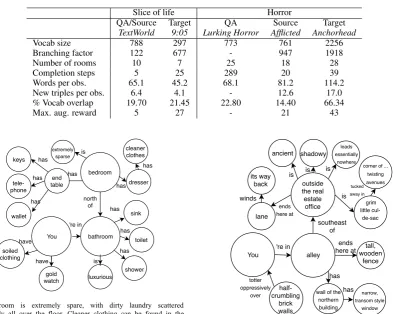
Figure 3: Partial unseeded knowledge graph example given observations and actions in the game9:05.
evaluated on the test set.
We then pick a random game from the test set to train our source task deep Q-network for this do-main. For this training, we use the reward function provided by TextWorld: +1 for each action taken that moves the agent closer to finishing the quest; -1 for each action taken that extends the minimum number of steps needed to finish the quest from the current stage; 0 for all other situations.
We choose the game, 9:053 as our target task game due to similarities in structure in addition to the vocabulary overlap. Note that there are multi-ple possible endings to this game and we pick the simplest one for the purpose of training our agent.
3https://ifdb.tads.org/viewgame?id= qzftg3j8nh5f34i2 alley half-crumbling brick walls tall, wooden fence ends here at You
wall of the northern building narrow, transom style window has has totter oppressively over outside the real estate office southeast of lane its way back ends here at winds grim little cul-de-sac ancient leads essentially nowhere shadowy
corner of ... twisting avenues
is is is
is
tucked away in
Outside the Real Estate Office
A grim little cul-de-sac, tucked away in a corner of the claustrophobic tangle of narrow, twisting avenues that largely constitute the older portion of Anchorhead. Like most of the streets in this city, it is ancient, shadowy, and leads essentially nowhere. The lane ends here at the real estate agent's office, which lies to the east, and winds its way back toward the center of town to the west. A narrow, garbage-choked alley opens to the southeast.
>go southeast
Alley
This narrow aperture between two buildings is nearly blocked with piles of rotting cardboard boxes and overstuffed garbage cans. Ugly, half-crumbling brick walls to either side totter oppressively over you. The alley ends here at a tall, wooden fence. High up on the wall of the northern building there is a narrow, transom-style window.
're in alley half-crumbling brick walls tall, wooden fence ends here at You
wall of the northern building narrow, transom style window has has totter oppressively over outside the real estate office southeast of lane its way back ends here at winds grim little cul-de-sac ancient leads essentially nowhere shadowy
corner of ... twisting avenues
is is is
is tucked away in
Outside the Real Estate Office
A grim little cul-de-sac, tucked away in a corner of the claustrophobic tangle of narrow, twisting avenues that largely constitute the older portion of Anchorhead. Like most of the streets in this city, it is ancient, shadowy, and leads essentially nowhere. The lane ends here at the real estate agent's office, which lies to the east, and winds its way back toward the center of town to the west. A narrow, garbage-choked alley opens to the southeast.
>go southeast Alley
This narrow aperture between two buildings is nearly blocked with piles of rotting cardboard boxes and overstuffed garbage cans. Ugly, half-crumbling brick walls to either side totter oppressively over you. The alley ends here at a tall, wooden fence. High up on the wall of the northern building there is a narrow, transom-style window.
're in
Figure 4: Partial unseeded knowledge graph example given observations and actions in the game Anchor-head.
6.2 Horror Experiments
For the horror domain, we choose Lurking Hor-ror4 to train the question-answering system on. The source and target task games are chosen as Af-flicted5 and Anchorhead6 respectively. However, due to the size and complexity of these two games some modifications to the games are required for the agent to be able to effectively solve them.
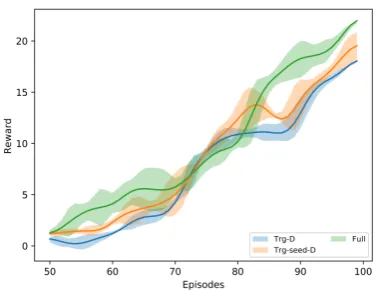
Figure 5: Reward curve for select experiments in the slice of life domain.
We partition each of these games and make them smaller by reducing the final goal of the game to an intermediate checkpoint leading to it. This checkpoints were identified manually using walk-throughs of the game; each game has a natural in-termediate goal. For example,Anchorheadis seg-mented into 3 chapters in the form of objectives spread across 3 days, of which we use only the first chapter. The exact details of the games after partitioning is described in Table 1. For Lurking Horror, we report numbers relevant for the oracle walkthrough. We then pre-prune the action space and use only the actions that are relevant for the sections of the game that we have partitioned out. The majority of the environment is still available for the agent to explore but the game ends upon completion of the chosen intermediate checkpoint.
6.3 Reward Augmentation
The combined state-action space for a commer-cial text-adventure game is quite large and the corresponding reward function is very sparse in comparison. The default, implied reward signal is to receive positive value upon completion of the game, and no reward value elsewhere. This is problematic from an experimentation perspec-tive as text-adventure games are too complex for even state-of-the-art deep reinforcement learning agents to complete. Even using transfer learning methods, a sparse reward signal usually results in ineffective exploration by the agent.
To make experimentation feasible, we augment the reward to give the agent a dense reward sig-nal. Specifically, we use an oracle to generate state-action traces (identical to how as when
train-Figure 6: Reward curve for select experiments in the horror domain.
ing the question-answering system). An oracle is an agent that is capable of playing and finishing a game perfectly in the least number of steps pos-sible. The state-action pairs generated using per-fect walkthroughs of the game are then used as checkpoints and used to give the agent additional reward. If the agent encounters any of these state-action pairs when training, i.e. performs the right action given a corresponding state, it receives a proportional reward in addition to the standard re-ward built into the game. This rere-ward is scaled based on the game and is designed to be less than the smallest reward given by the original reward function to prevent it from overpowering the built-in reward. We refer to agents usbuilt-ing this technique as having “dense” reward and “sparse” reward oth-erwise. The agent otherwise receives no informa-tion from the oracle about how to win the game.
7 Results/Discussion
The structure of the experiments are such that the for each of the domains, the target task game is more complex that the source task game. The slice of life games are also generally less complex than the horror games; they have a simpler vocabulary and a more linear quest structure. Additionally, given the nature of interactive fiction games, it is nearly impossible—even for human players— to achieve completion in the minimum number of steps (as given by the steps to completion in Ta-ble1); each of these games are puzzle based and require extensive exploration and interaction with various objects in the environment to complete.
[image:7.595.316.505.78.223.2]do-Table 2: Results for the slice of life games. “KG-DQN Full” refers to KG-DQN when seeded first, trained on the source, then transferred to the target. All experiment with QA indicate pre-training. S, D indicate sparse and dense reward respectively.
Experiment Init. Rwd. Final Rwd. Steps Source Game (TextWorld)
KG-DQN no transfer 2.6±0.73 4.7±0.23 110.83±4.92 KG-DQN w/ QA 2.8±0.61 4.9±0.09 88.57±3.45 KG-DQN seeded 3.2±0.57 4.8±0.16 91.43±1.89 Target Game (9:05)
KG-DQN untuned (D) - 2.5±0.48 1479.0±22.3 KG-DQN no transfer (S) - - 1916.0±33.17 KG-DQN no transfer (D) 0.8±0.32 16.5±1.58 1267.2±7.5
[image:8.595.163.436.108.243.2]KG-DQN w/ QA (S) - - 1428.0±11.26 KG-DQN w/ QA (D) 1.3±0.24 17.4±1.84 1127.0±31.22 KG-DQN seeded (D) 1.4±0.35 16.7±2.41 1393.33±26.5 KG-DQN Full (D) 2.7±0.65 19.7±2.0 274.76±21.45
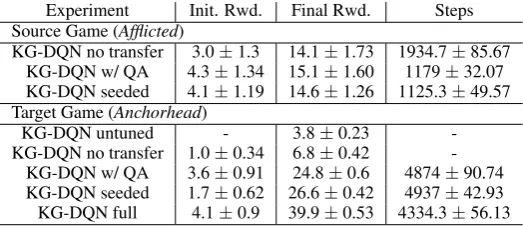
Table 3: Results for horror games. Note that the reward type is dense for all results. “KG-DQN Full“ refers to KG-DQN seeded, transferred from source. All experiment with QA indicate pre-training.
Experiment Init. Rwd. Final Rwd. Steps Source Game (Afflicted)
KG-DQN no transfer 3.0±1.3 14.1±1.73 1934.7±85.67 KG-DQN w/ QA 4.3±1.34 15.1±1.60 1179±32.07 KG-DQN seeded 4.1±1.19 14.6±1.26 1125.3±49.57 Target Game (Anchorhead)
KG-DQN untuned - 3.8±0.23 -KG-DQN no transfer 1.0±0.34 6.8±0.42
-KG-DQN w/ QA 3.6±0.91 24.8±0.6 4874±90.74 KG-DQN seeded 1.7±0.62 26.6±0.42 4937±42.93 KG-DQN full 4.1±0.9 39.9±0.53 4334.3±56.13
mains seeding and QA pre-training improve per-formance by similar amounts from the baseline on both the source and target task games. A series of t-tests comparing the results of the pre-training and graph seeding with the baseline KG-DQN show that all results are significant withp <0.05. Both the pre-training and graph seeding perform similar functions in enabling the agent to explore more effectively while picking high utility actions.
Even when untuned, i.e. evaluating the agent on the target task after having only trained on the source task, the agent shows better performance than training on the target task from scratch using the sparse reward. As expected, we see a further gain in performance when the dense reward func-tion is used for both of these domains as well. In the horror domain, the agent fails to converge to a state where it is capable of finishing the game without the dense reward function due to the hor-ror games being more complex.
When an agent is trained using on just the tar-get task horror game,Anchorhead, it does not con-verge to completion and only gets as far as achiev-ing a reward of approximately 7 (max. observed reward from the best model is 41). This
corre-sponds to a point in the game where the player is required to use a term in an action that the player has never observed before, “look up Verlac” when in front of a certain file cabinet—“Verlac“ being the unknown entity. Without seeding or QA pre-training, the agent is unable to cut down the ac-tion space enough to effectively explore and find the solution to progress further. The relative effec-tiveness of the gains in initial reward due to seed-ing appears to depend on the game and the cor-responding static text document. In all situations except Anchohead, seeding provides comparable gains in initial reward as compared to QA — there is no statistical difference between the two when performing similar t-tests.
[image:8.595.168.430.285.398.2]used. We further see in Figures5,6that transfer-ring knowledge results in the agent learning this higher quality policy much faster. In fact, we note that training a full system is more efficient than just training the agent on a single task, i.e. train-ing a QA system then a source task game for 50 episodes then transferring and training a seeded target task game for 50 episodes is more effective than just training the target task game by itself for even 150+ episodes.
8 Conclusions
We have demonstrated that using knowledge graphs as a state representation enables effi-cient transfer between deep reinforcement learn-ing agents designed to play text-adventure games, reducing training times and increasing the quality of the learned control policy. Our results show that we are able to extract a graph from a general static text resource and use that to give the agent knowl-edge regarding domain specific vocabulary, object affordances, etc. Additionally, we demonstrate that we can effectively transfer knowledge using deep Q-network parameter weights, either by pre-training portions of the network using a question-answering system or by transferring parameters from a source to a target game. Our agent trains faster overall, including the number of episodes re-quired to pre-train and train on a source task, and performs up to 80% better on convergence than an agent not utilizing these techniques.
We conclude that knowledge graphs enable transfer in deep reinforcement learning agents by providing the agent with a more explicit–and interpretable–mapping between the state and ac-tion spaces of different games. This mapping helps overcome the challenges twin challenges of partial observability and combinatorially large ac-tion spaces inherent in all text-adventure games by allowing the agent to better explore the state-action space.
9 Acknowledgements
This material is based upon work supported by the National Science Foundation under Grant No. IIS-1350339. Any opinions, findings, and conclusions or recommendations expressed in this material are those of the author(s) and do not necessarily reflect the views of the National Science Foundation.
References
Prithviraj Ammanabrolu and Mark O. Riedl. 2019. Playing text-adventure games with graph-based deep reinforcement learning. In Proceedings of 2019 Annual Conference of the North American Chapter of the Association for Computational Lin-guistics: Human Language Technologies, NAACL-HLT 2019.
Gabor Angeli, Johnson Premkumar, Melvin Jose, and Christopher D. Manning. 2015. Leveraging Lin-guistic Structure For Open Domain Information Ex-traction. In Proceedings of the 53rd Annual Meet-ing of the Association for Computational LMeet-inguistics and the 7th International Joint Conference on Natu-ral Language Processing (Volume 1: Long Papers).
Antoine Bordes, Nicolas Usunier, Ronan Collobert, and Jason Weston. 2010. Towards understanding sit-uated natural language. InProceedings of the 2010 International Conference on Artificial Intelligence and Statistics.
Danqi Chen, Adam Fisch, Jason Weston, and Antoine Bordes. 2017. Reading Wikipedia to answer open-domain questions. In Association for Computa-tional Linguistics (ACL).
Marc-Alexandre Cˆot´e, ´Akos K´ad´ar, Xingdi Yuan, Ben Kybartas, Emery Fine, James Moore, Matthew Hausknecht, Layla El Asri, Mahmoud Adada, Wendy Tay, and Adam Trischler. 2018. TextWorld : A Learning Environment for Text-based Games. In
Proceedings of the ICML/IJCAI 2018 Workshop on
Computer Games, page 29.
Nancy Fulda, Daniel Ricks, Ben Murdoch, and David Wingate. 2017.What can you do with a rock? affor-dance extraction via word embeddings. In Proceed-ings of the Twenty-Sixth International Joint Con-ference on Artificial Intelligence, IJCAI-17, pages 1039–1045.
Milica Gasic, Catherine Breslin, Matthew Hender-son, Dongho Kim, Martin Szummer, Blaise Thom-son, Pirros Tsiakoulis, and Steve J. Young. 2013. Pomdp-based dialogue manager adaptation to ex-tended domains. InSIGDIAL Conference.
Matan Haroush, Tom Zahavy, Daniel J Mankowitz, and Shie Mannor. 2018. Learning How Not to Act in Text-Based Games. In Workshop Track at ICLR 2018, pages 1–4.
Matthew Hausknecht, Prithviraj Ammanabrolu, Marc-Alexandre Cˆot´e, and Xingdi Yuan. 2019a. Interac-tive fiction games: A colossal adventure. CoRR, abs/1909.05398.
Ji He, Jianshu Chen, Xiaodong He, Jianfeng Gao, Li-hong Li, Li Deng, and Mari Ostendorf. 2016. Deep Reinforcement Learning with a Natural Language Action Space. In Association for Computational Linguistics (ACL).
Girish Joshi and Girish Chowdhary. 2018. Cross-domain transfer in reinforcement learning using tar-get apprentice. InProceedings of the International
Conference on Robotics and Automation, pages
7525–7532.
George Konidaris and Andrew G. Barto. 2007. Build-ing portable options: Skill transfer in reinforcement learning. InIJCAI.
George Konidaris, Ilya Scheidwasser, and Andrew G. Barto. 2012. Transfer in reinforcement learning via shared features. The Journal of Machine Learn-ing Research, 13:1333–1371.
Long-Ji Lin. 1993. Reinforcement learning for robots using neural networks. Ph.D. thesis, Carnegie Mel-lon University.
Yaxin Liu and Peter Stone. 2006. Value-function-based transfer for reinforcement learning using structure mapping. InAAAI.
Karthik Narasimhan, Regina Barzilay, and Tommi Jaakkola. 2017. Deep transfer in reinforcement learning by language grounding. Journal of Artifi-cial Intelligence Research, 63.
Karthik Narasimhan, Tejas Kulkarni, and Regina Barzilay. 2015. Language Understanding for Text-based Games Using Deep Reinforcement Learning.
In Conference on Empirical Methods in Natural
Language Processing (EMNLP).
Trung Thanh Nguyen, Tomi Silander, and Tze-Yun Leong. 2012. Transferring expectations in model-based reinforcement learning. InNIPS.
Emilio Parisotto, Jimmy Ba, and Ruslan R. Salakhutdi-nov. 2016. Actor-mimic: Deep multitask and trans-fer reinforcement learning.CoRR, abs/1511.06342.
Janarthanan Rajendran, Aravind S. Lakshminarayanan, Mitesh M. Khapra, P. Prasanna, and Balaraman Ravindran. 2017. Attend, adapt and transfer: At-tentive deep architecture for adaptive transfer from multiple sources in the same domain. InICLR.
Andrei A. Rusu, Neil C. Rabinowitz, Guillaume Des-jardins, Hubert Soyer, James Kirkpatrick, Koray Kavukcuoglu, Razvan Pascanu, and Raia Had-sell. 2016. Progressive neural networks. CoRR, abs/1606.04671.
Richard S Sutton and Andrew G Barto. 2018. Rein-forcement Learning: An Introduction. MIT Press.
Ruo Yu Tao, Marc-Alexandre Cˆot´e, Xingdi Yuan, and Layla El Asri. 2018. Towards solving text-based
games by producing adaptive action spaces. In Pro-ceedings of the 2018 NeurIPS Workshop on
Word-play: Reinforcement and Language Learning in
Text-based Games.
Matthew E. Taylor, Nicholas K. Jong, and Peter Stone. 2008. Transferring instances for model-based rein-forcement learning. InECML/PKDD.
Matthew E. Taylor and Peter Stone. 2009. Trans-fer learning for reinforcement learning domains: A survey. Journal of Machine Learning Research, 10:1633–1685.
Zhuoran Wang, Tsung-Hsien Wen, Pei hao Su, and Yannis Stylianou. 2015. Learning domain-independent dialogue policies via ontology param-eterisation. InSIGDIAL Conference.
H. Yin and S. J. Pan. 2017. Knowledge transfer for deep reinforcement learning with hierarchical experience replay. In Proceedings of the Thirty-First AAAI Conference on Artificial Intelligence, AAAI’17, pages 1640–1646. AAAI Press.