Decentering the Dancing Text:
From Dance Intertext to Hypertext
Timothy Miles-Board
Intelligence, Agents,Multimedia Group University of Southampton
Southampton, UK
Deveril
Department of Dance Studies University of Surrey
Guildford, UK
Janet Lansdale
Department of Dance StudiesUniversity of Surrey Guildford, UK
Leslie Carr
Intelligence, Agents,Multimedia Group University of Southampton
Southampton, UK
Wendy Hall
Intelligence, Agents,Multimedia Group University of Southampton
Southampton, UK
ABSTRACT
This paper explains and draws together two projects from different disciplines: dance studies and hypertext writing. Each project sets out to examine the processes and prac-tices of hypertextuality, and to develop new ways of writing using electronic technology and the Internet. The dance studies project seeks to link the critical theory of intertex-tuality (as a means of dance interpretation) with the theo-retical and practical concerns of hypertextuality. It hopes to show a convergence of the two into a working system for analysing dance in a network of people, institutions and information. The Associative Writing Framework (AWF) project seeks to explore how writers could best be sup-ported in representing and exploring hypertextuality in a Web environment, and in producing new hypertexts which integrate or “glue together” existing Web resources (ideas, concepts, data, descriptions, experiences, claims, theories, suggestions, reports,etc.). Following the combining of the two projects we report on some initial evaluation of the AWF system by dance experts, and discuss where the relationship might lead and potential future outcomes of the collabora-tion.
Categories and Subject Descriptors
J.5 [ARTS AND HUMANITIES]: Performing Arts; H.5.4 [INFORMATION INTERFACES AND PRESENTA-TION]: Hypertext/Hypermedia
Permission to make digital or hard copies of all or part of this work for personal or classroom use is granted without fee provided that copies are not made or distributed for profit or commercial advantage and that copies bear this notice and the full citation on the first page. To copy otherwise, to republish, to post on servers or to redistribute to lists, requires prior specific permission and/or a fee.
HT’03, August 26–30, 2003, Nottingham, United Kingdom.
Copyright 2003 ACM 1-58113-704-4/03/0008 ...$5.00.
General Terms
Theory, Human Factors, Experimentation
Keywords
Dance Analysis, Intertextuality, Hypertextuality
1.
INTRODUCTION
The terms hypertextual and intertextual are used to de-scribe the ways in which culturally-produced items and works (including written texts, paintings, photographs, films, and aural texts) relate and connect to other cultural ‘objects’. The relationships between many cultural objects are often characterised by terms such as ‘genre’ or ‘style’, and these can form the basis for creation and subsequent analysis ac-cording to the conventions and defining qualities of a given style. When a work imitates the style or content of another work or genre, it can be said to reference or quote the pre-vious example. This allows both the maker of the new work and the person analysing it the chance to play with what meanings can be derived from a knowledge of and familiar-ity with different genres and styles, and the ways and con-texts in which they have been used in the past. Sometimes this relationship may take the form of pastiche or parody, destabilising the original form and creating a new, often socio-political and critical, set of meanings.
texts as the interpreter sees fit. Intertextuality as an ap-proach is not rigidly defined, and it can be viewed as a ‘way of seeing’ rather than as an authoritative system of analy-sis [30]. With an emphaanaly-sis on open-ended interpretations, as opposed to closed, definitive readings, intertextuality also challenges the concept of a finished work of art. But this, in practice, is difficult to maintain when each interpretation must be presented in some ‘finished’ form. Intertextuality has been used to analyse literature, film, and music [4, 5, 11] and latterly, theatre and dance [2].
One reason why the intertextual approach may be appro-priately represented in a hypertext model is tenuously sup-ported by the claim of “some hypertext enthusiasts [...] that hypertext is the most natural way to organize human ideas because its semantic network-like structure matches the hu-man brain” [29, p90]; interpreting intertextually allows for the tangential and various thoughts humans have when en-gaged in any activity. Svedjedal gives a broad definition that sees “hypertext as a certain structural form, possible to achieve in any medium, but nevertheless best realized when texts are digitized and available in computer networks” [33]. The terms used to describe the structure of hypertexts are often borrowed from literary criticism discourses, yet hy-pertext is seen most regularly as, in a way, the opposite to traditional literary works. If traditional works are defined as linear or monosequential, then hypertexts “may be called non-linear, multilinear, multisequential, or multicursal” [33]; they invite and require an active reader, interaction and de-cision making. They may allow for the hypertext user to be able to create a new path each time. A number of writers make connections between the principles of hypertext and what Aarseth calls “ergodic literature” and “cybertext” [1]. In Aarseth’s picture of cybertexts, hypertext is a type of dig-ital ergodic text, with a (mostly) distinctive set of character-istics, born out of the original conceptualisations of the form. The number of literary and critical hypertexts is growing. See, for example, Cayley’s Hypertext/Cybertext/Poetext [9] and Memmott’s Lexia to Perplexia [23]. The Web has also already been used to analyse such texts as a key section of the film Singin’ in the Rain [24]. In this hypertext the ana-lysts incorporate streamed video clips of the piece into what they describe as “not so much an essay as a text in the deep-est sense: a fabric of ideas deeply and multiply connected”; a collection of linked theoretical and interpretive nodes.
It must be stressed that these constructs continue to shift and develop to consider new approaches and practices in cultural and theoretical landscapes, particularly the notion of intertextuality. It can be appropriated and adapted for a number of analytical needs and biases, therefore, added to their unstable theoretical basis are the various schools of thought from structuralist and poststructuralist analysis to Marxist, feminist and psychoanalytic theories.
The project ‘Decentering the Dancing Text’, based at the University of Surrey, is an investigation of how it might be possible to use a hypertext system to record the intertextual-ities that an interpreter discovers in a dance piece, beginning from the analysis of the piece, through the development of a web of interconnected references, reminiscences, related texts and readers’ notes. Restated, a primary aim of this project is to develop a hypertextual model for the intertex-tual analysis of digitised dance video1. The proposal rests 1In this paper the words ‘dance’ or ‘dance piece’ are used
on the notion that any analysis of a dance piece is an on-going and open process. It produces a continuously evolving set of interpretations and ‘meanings’, which do not exist in a strictly linear relationship to one another, but can be seen as forming a hermeneutic network.
The term ‘decentering’ is used because of its polysemous relationship to a number of disciplines and approaches, no-tably (post)structuralist analysis and intertextuality, hyper-text theory, literary theories of the subject and author and certain psychoanalytical conceptualisations of the self. For example [20] aligns the way in which hypertext allows us to navigate our own paths through it, thereby destabilising the concepts of reader and writer, with the Derridean sug-gestion that we live in a decentred world in which norms are replaced by relativity. The processes of hypertextuality and decentering can be seen to be connected to Barthes’s notion of the text and intertextuality. ‘Decentering’ also has a connection to the dance performances of well-known choreographers such as Merce Cunningham, who removed the actual and metaphorical centre of the dance, for exam-ple, by allowing the audience to choose their own focus on the dance through presenting a number of actions on stage. The processes of watching and analysing a dance piece are complex and require a number of skills in order to make ‘sense’ (in personal and inter-personal ways) of the work, and the related experiences: the creating, the dancing, the watching, the interpreting, etc. The background training and socio-cultural experiences of a person will direct their interpretations of a dance piece, as they will affect any cul-tural experience. Their ‘tastes’ and preferences for particu-lar forms of dance are shaped by these experiences, and, as a combination, are unique to every person. The ways in which these experiences play off each other when watching some-thing like a dance piece form the basis for an interpretation, which takes form when it is expressed as language, verbal (including ‘thought’) or written. There are a range of things that can be considered as valid responses to a dance piece: other dance pieces and selected movements or gestures, pic-tures, sounds — many of which cannot be adequately de-scribed in words and necessitate the actual experience of ‘experiencing’ them.
The purpose of this paper is to describe our search for a hypertext system well-suited to recording and linking the intertexts that may be discovered and made apparent in the process of analysing of a dance piece.
2.
CURRENT PROCESS
A human interpreter, whom we shall refer to as the mean-ing maker, watches a (streamed digital) video of a dance piece. At certain points throughout the piece they may be reminded of another ‘work’ (or some artifact from their life or past experience), or simply follow directions of enquiry as they respond to the performance (for example, the response
why has the writer chosen to use the name Carla for the main character? may lead to the meaning maker searching the Web for the origins and definition of the name to form the basis of further interpretation). From these initial levels of descriptive analysis and ‘first impressions’ (or primary in-terpretations), the network of interpretation is expanded by
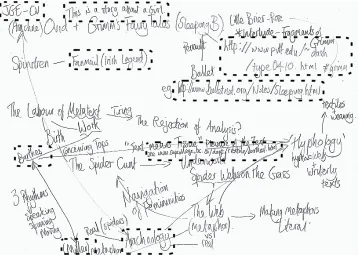
Figure 1: Mapping intertextualities of dance performance ‘Spinstren’.
the meaning maker to include any number of subsequent ref-erences and links as intertextually connected works move in and out of the meaning maker’s focus of analysis, effectively ‘decentering’ the dance piece.
[image:3.612.349.525.350.415.2]A brief informal survey of dance researchers at the Uni-versity of Surrey revealed that the most common process for meaning makers to represent their intertextual interpre-tations of a dance performance was to construct a ‘map’. Figure 1 shows one of a series of maps created in response to the dance piece ‘Spinstren’2. This example is particu-larly interesting as it includes a number of hypertextual devices (highlighted) in the interpretation network, such as references to the performance (verbatim transcripting of narrative — “This is a story about a girl”) and intertex-tual references by name (‘Arachnology’, ‘Fanmail’), author (‘Barthes’, ‘Miller’), URL, and personal encodings (‘JGE-CV’ refers to the CV of Jools Gilson-Ellis, the choregrapher). Where the dance piece being interpreted has no narrative to which the meaning maker can refer directly, the map may include fragments of movement notation refering to specific parts of the performance (figure 2). This map then forms the basis of an academic work presenting the meaning maker’s interpretation of the piece, such as a linear essay/paper or non-linear (Web-based) hypertext.
The ‘map method’, somewhat ad-libbed and anarchic, based on the good old fashioned technique of writing by
2http://www.auneheadarts.org.uk/halfangel/
spinstren/index.html. Spinstren spins together the story of Carla (a girl who steals a spinning top), with the story of The Spinstren (a breed of magical women), combining spinning stories such as Sleeping Beauty and that of the contest between the mythical characters Athena and Arachne. The Spinstren are themselves strangely quasi-mythical/fictional, because the choreographer Jools Gilson-Ellis created them for this piece.
Figure 2: Benesh notation [26] for referring to spe-cific movements in dance performance.
hand using pencil and paper, develops organically as the meaning maker is struck by points in a text worthy of note and endeavours to make the relationships apparent between them. It has the obvious advantage of being a quick and easy way to record an overview of the hypertextual struc-ture of the interpretation. However, the map quickly be-comes unmanageable and messy. Furthermore, the amount of information that can be included is limited to the most basic of notes (which in fact helps provide an ‘overview’ of the intertextual connections, but does not aid the meaning maker in transforming the map into a presentation of the interpretation — texts have to be revisited to recall exactly what part was being referred to in the map). A map also makes combining or comparing interpretations with other meaning makers difficult.
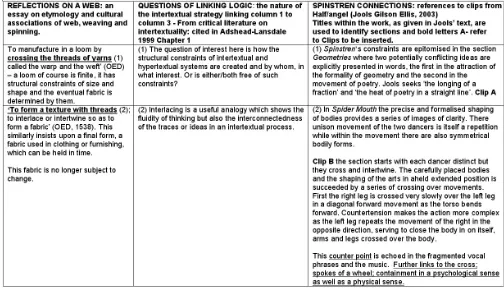
Figure 3: 3-column representation (Deveril).
Figure 4: 3-column representation (Janet Lansdale).
uses the first column to show references into the dance piece (by transcribing the actual words said in the performance). The middle column records the meaning maker’s primary responses to the piece, including descriptions of movement in the dance, and intertextual connections to other texts. The third column records potential avenues of further explo-ration (each of which may in turn necessitate a new 3-column layout). In figure 4, the meaning maker takes a slightly dif-ferent approach to recording her interpretations. The third column (“Spinstren connections”) records primary responses to the piece; column 1 records intertextual connections with other works; the middle column attempts to further inter-pret the nature of the intertextual connection between the outer columns. This method makes the combining or com-parison of interpretations much easier (and the ‘unlimited’ supply of electronic pages means more detailed interpreta-tions can be recorded), but it lacks the expressiveness of the map approach - (inter)texts which transcend the physical boundaries of the columns cannot easily be represented.
2.1
Practical Requirements for a Dance
Hy-pertext System
Given the limitations of the current methods for record-ing intertextual interpretations of a dance perfomance, this section presents (from the perspective of dance researchers) a broad list of requirements for a hypothetical ‘dance
hy-pertext system’ to support this activity, in order to focus a critical review of existing hypertext systems.
1. Facilitate hypertext representation of current dance analysis process
To best support the dance analysis activity, a hyper-text system should facilitate the user in a number of tasks in the pursuit of realising their own ideas and constructing a navigable network stemming from their interpretive work on a specific dance piece. More specifically, the meaning maker should be able to ‘tag’ the video (or other performance medium, including images and text) at specific points with links to the first level of interpretation (or responses), removing the need to transcribe the narrative of the piece or use dance notation to indicate specific movements — an important advantage at this stage where quick and easy recording of responses is important (cf. ease of expression using pencil and paper map). References to narrative and movement used in figures 1, 3, and 4 would therefore be replaced with a hypertext link con-necting the response to a specific portion of video. The meaning maker should also be able to indicate directly the relevant portions of related (intertextual) works, whether text (cf. copying and pasting of text from other sources into 3-column diagram), image, sound, or video, and be able to easily shift the focus of analy-sis to these works before returning to continue analyanaly-sis of the dance performance. The ability to add seman-tic information to responses, existing materials, and intertextual connections may also be useful in record-ing the intentions and purposes of the meanrecord-ing maker (see section 2.1.1).
2. Network overview facilities
The hypertext system should act as both a recording device and a navigation tool, noting the series of steps taken by the meaning maker in constructing the inter-pretation. This will allow the meaning maker to get an overview of the emerging interpretation (analogous to, but more powerful than the current map approach outlined above), and quickly revisit previous responses (perhaps to add further connections). An overview map also helps to remove the metaphorical central po-sitioning of the original dance piece in the network as the number of intertextual connections grows. As the network begins to incorporate other online dance pieces and works of art, and therefore provide an in-creasing number of entry points, an overview map be-comes vital. The inclusion offiltering, indexing, and searching facilities would also be beneficial, particu-larly semantic and linguistic searches, and automatic theme extraction.
3. Open access to dance hypertext
[image:4.612.53.305.256.401.2]should be able to add their own responses to the in-terconnected texts (including being able to respond to interpretations of other meaning makers). Each interpretive response and connection should be per-sonally tagged with the user’s identity and context to help others understand the authority and perspective of the interpretations. This facility is a natural exten-sion of attempts with the 3-column method to improve the possibilities of combining and comparing interpre-tations. The inclusion of semantic information in the network becomes particularly important in the light of this desired feature. Semantics help to understand the often personal, sometimes tacit, interpretations of oth-ers; overview maps help users orient themselves in the polyvocal network and identify promising entry points.
4. Support for writing
The hypertext system should aid meaning makers in transforming interpretive structures into a presenta-tion suitable for disseminapresenta-tion. For example, a Web-based hypertext with intertextual connections presented as links, or a linear essay (formatted to any one of a number of conventions for dissemination and publica-tion) with citations to intertexts.
5. Integration with the existing Web environment
The hypertext system should be grounded in the Web environment, to complement the current practice of watching streamed digital videos through a Web browser and searching, exploring, and reading within the Web environment. Dance researchers at the University of Surrey typically do not have experience of comput-ing environments outside of everyday activities such as using the Web, email, and word processing. It is therefore necessary that the hypertext system be user-friendly and intuitive, and be based on familiar inter-actions.
2.1.1
Semantics of Dance Analysis
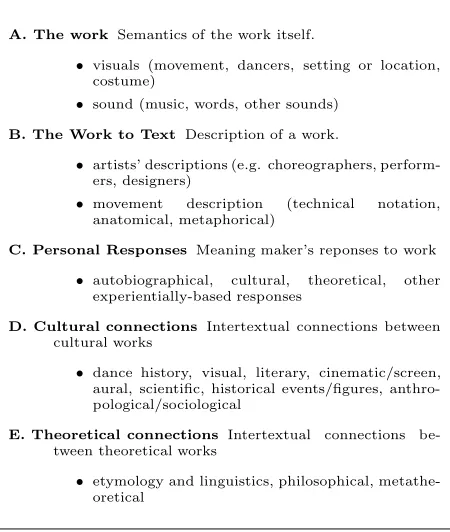
After suggesting the possibility of allowing meaning mak-ers (and other usmak-ers in the dance hypertext) to add semantic information to their interpretations to help explicate their intentions and purposes (requirement 1), researchers at the University of Surrey began to explore the semantics inher-ent in the interpretation of a dance performance, primarily through comparison and discussion of the interpretations recorded using the 3-column method. The initial results of this investigation are presented in figure 5 as a set of 5 inter-linked categories (which themselves may be intertextual, for example, a comment made by a choreographer describing the work may also refer to dance and literary history). The intention is not to define a rigorous and complete taxonomy of possible types, but to begin to explore the kinds of se-mantics inherent in the analysis of a dance performance: the semantics of the work itself (A) emerge through the trans-formation of the work to text through description (B) and the personal responses of the meaning maker (C), which may then be connected to (descriptions/responses to) other works according to cultural (D) and theoretical (E) inter-pretations.
A. The work Semantics of the work itself.
• visuals (movement, dancers, setting or location, costume)
• sound (music, words, other sounds)
B. The Work to Text Description of a work.
• artists’ descriptions (e.g. choreographers, perform-ers, designers)
• movement description (technical notation, anatomical, metaphorical)
C. Personal Responses Meaning maker’s reponses to work • autobiographical, cultural, theoretical, other
experientially-based responses
D. Cultural connections Intertextual connections between cultural works
• dance history, visual, literary, cinematic/screen, aural, scientific, historical events/figures, anthro-pological/sociological
E. Theoretical connections Intertextual connections be-tween theoretical works
[image:5.612.318.543.56.322.2]• etymology and linguistics, philosophical, metathe-oretical
Figure 5: Initial analysis of the semantics of dance intertexts
3.
SURVEY OF HYPERTEXT SYSTEMS
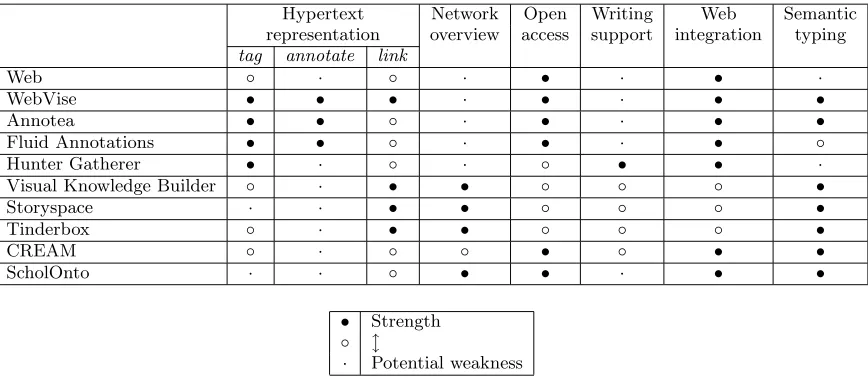
Table 1 summarises the potential support for dance anal-ysis provided by a number of recent hypertext tools. The requirements listed in Section 2.1 have been summarised to form the dimensions of the table; this section provides a brief discussion of each system according to these dimensions.
3.1
Hypertext Representation
Does the hypertext system facilitate the meaning maker in constructing a hypertext network stemming from their in-terpretative work on a dance piece, through tagging rele-vant pieces of works, annotating works with descriptions, responses, and interpretations, and linkingthese responses into a network of intertextual connections?
The Web’s limited hypertext model [7, 34] does not al-low meaning makers to tag or add links to existing works directly, but links to these works from documents ‘owned’ by the meaning maker can be created (although these are simple uni-directional, binary links). By augmenting the Web hypertext model through the services of an open hy-permedia structure server, WebVise [14] overcomes these limitations to allow meaning makers to tag existing works, add annotations, and connect content using bi-directional, multi-headed (n-ary) links. Interpretations could also be gathered into ‘contexts’ (layers of related structure). The Web browser-based annotation tools Annotea [18] and Fluid Annotations [8] also utilise an external ‘structure service’ to facilitate annotation of otherwise read-only Web pages. In each case, the service is queried for structures or annotations whenever a new page is viewed in the Web browser, and any received structures are merged into the document.
Hypertext Network Open Writing Web Semantic
representation overview access support integration typing
tag annotate link
Web ◦ · ◦ · • · • ·
WebVise • • • · • · • •
Annotea • • ◦ · • · • •
Fluid Annotations • • ◦ · • · • ◦
Hunter Gatherer • · ◦ · ◦ • • ·
Visual Knowledge Builder ◦ · • • ◦ ◦ ◦ •
Storyspace · · • • ◦ ◦ ◦ •
Tinderbox ◦ · • • ◦ ◦ ◦ •
CREAM ◦ · ◦ ◦ • ◦ • •
ScholOnto · · ◦ • • · • •
• Strength
◦
[image:6.612.89.523.52.241.2]· Potential weakness
Table 1: Comparison of support for dance analysis provided by surveyed systems.
annotations in Annotea include a related attribute which may be the URI of a related annotation or other Web re-source. Templates can also be specialised to specific appli-cations, for example [19] demonstrates how Annotea can be extended to support “threaded annotation discussions” by adding reply-to and root-of-thread attributes. Using both Annotea and Fluid Annotations, the meaning maker can also create HTML links inside the body of the annotation. In both cases, however, links are limited by the Web’s hyper-text model. Hunter-Gather [31], also a Web browser-based tool, allows meaning makers to tag works by ‘gathering’ rel-evant spans of its content into a collection — links between gathered content can be implied by gathering related con-tent into the same collection.
The map-based tools Visual Knowledge Builder (VKB) [32], Storyspace [6], and Tinderbox3provide a separate workspace for hypertext representation. VKB’s spatial workspace widens the conventional node-link model embodied by the Web by allowing users to use spatial proximity and visual clues (colour, shape, font, etc.) to implicitly represent connections be-tween nodes. More explicit (cross-space) relationships can also be made between nodes that are placed far away from each other (although no visible ‘link’ connects them). Sto-ryspace also provides opportunities for spatial clustering and node colouring, but with explicit links displayed as arrows between nodes. Tinderbox also allows both implicit and ex-plicit links, and visual cues to capture interpretations. Both VKB and Tinderbox allow nodes in the workspace to refer to external works via Web URLs, although note that the spe-cific parts of the works are not ‘tagged’, nor are linksintothe interpretation workspace visible from the works themselves. The Semantic Web initiatives CREAM [16] and ScholOnto [21] also have potential in this area, in their shared aim to facilitate the capture of interconnected metadata for the Se-mantic Web. CREAM provides an annotation-based inter-face, using anOntology Browser (loaded with an ontology describing the domain of interest) in parallel with a Docu-ment Viewer(Web browser). In a dance context, a meaning maker could tag a work by first defining it as an instance of a particular ontological concept (for example, aPainting), and
3http://eastgate.com/tinderbox/
then dragging and dropping spans of content from the docu-ment into attribute ‘slots’ for that concept (for example, the
name of the painting, anddate it was painted). The work can also be related to other works, according to the allowable relationships defined by the ontology, by dragging instances in the Ontology Browser onto relation slots of the Painting instance (for example, selecting the Van Gogh instance of thePainter concept, and dragging it to thepainted by rela-tion). Subsequently, whenever that work is displayed in the Document Viewer, the metadata is retrieved from a “knowl-edge service” and displayed in the Ontology Browser.
Using ScholOnto’s form based interface, meaning mak-ers can create a (centralised) shared Semantic Web of con-cepts (succinct summaries of a work) andclaims(how con-cepts intertextually relate to other works, which may sup-port or contest existing claims made by other meaning mak-ers). However, in the case of both ScholOnto and CREAM, where tagging and linking is strictly governed by an on-tology, there are concerns that perhaps the formal nature of these ontologies may leave little room for the more or-ganic interpretation of intertextual connections surrounding a dance performance.
3.2
Network Overview
Does the hypertext system provide a graphical overview of the interpretation network?
Web browser-based tools WebVise, Annotea, Fluid Annota-tions, and Hunter-Gatherer, do not provide such views.
3.3
Open Access
Is the hypertext open for other meaning makers to explore and contribute to?
One of the main advantages of the Web for distributing a meaning maker’s interpretations is that it is a publica-tion platform which is (generally) open to any user with a Web browser. Although WebVise, Annotea, Fluid Anno-tations, CREAM, and Scholonto provide the potential for creating richer interpretation structures, users must install a tool (client) which is able to communicate with the (open) services which manage these structures (for example, struc-tures created in WebVise are available to other meaning makers using WebVise, or a tool which understands We-bVise protocols and structures). Interpretations captured using VKB, StorySpace, Tinderbox, and Hunter Gatherer can also be shared with other meaning makers, by email or by publishing files on the Web (see below).
3.4
Writing Support
Does the hypertext system aid the meaning maker in trans-forming interpretive structures into a presentation suitable for dissemination?
StorySpace and Tinderbox provide facilities for meaning makers to ‘export’ interpretations as a set of Web pages (in the case of Tinderbox, page layout and design can be speci-fied, and ‘compound pages’ built from the combined content of several nodes). Tinderbox (and also VKB) can also ex-port the workspace as an XML document, which could form the basis of further editing in another application. How-ever, since these tools do not support the direct ‘tagging’ of works, exported forms do not link directly to the parts (e.g. video frames, image regions, text spans) of those works under consideration. By way of contrast, Hunter-Gatherer’s “Collection View” is an exported linear list of gathered con-tent in which there is no copying of concon-tent, only referencing ofspecific content addresses (via XPointers).
CREAM’s “authoring mode” [15] allows metadata from the Ontology Browser to be dragged into a new Web doc-ument — dropping instances, attributes, and relationships from the Ontology Browser into the document creates con-tent and, where possible, hypertext links.
3.5
Web Integration
Is the hypertext system integrated with the Web?
Most of the approaches surveyed here are integrated di-rectly with the Web. WebVise, Annotea, Fluid Annotations, Hunter-Gatherer and CREAM integrate directly with exist-ing Web browsers, whilst interaction with ScholOnto typi-cally takes place through a series of Web-based forms. The VKB, StorySpace, and Tinderbox workspaces, by contrast, are separate from the ‘normal’ Web interface, although some integration is provided through URL awareness and HTML export capabilities.
3.6
Semantic Typing
Does the hypertext system allow intextual responses and interpretations to be semantically typed?
Although the Web itself does not provide a (widely imple-mented) mechanism for supporting link types, links in We-bVise can be assigned types from a hierarchy constructed
by the meaning maker using a special editor [17]. Annotea’s annotation type hierarchy could also be extended, by defin-ing new (dance specific) types (possibly with custom at-tributes). Semantic types for Fluid Annotations may be implied throughpresentation specifications(PSpecs), which describe the visual style of the anchor and gloss (e.g. colour, font): through an agreed mapping between PSpec and mean-ings, a group of meaning makers can assign implicit semantic types to fluid annotations.
The visual ‘languages’ (e.g. colour, shape, placement) supported by VKB and Tinderbox may emerge or evolve as the user’s understanding of a task (such as the analysis of a dance piece) evolves [22]. As interpretations become more concrete, nodes can be assigned more explicit types (for example, by using prototype nodes in Tinderbox). Ex-plicit links in Tinderbox and StorySpace can be assigned an arbitrary text label to denote semantic type.
In CREAM and ScholOnto, allowable node and relation-ship types are defined by an underlying ontology. Whereas CREAM uses adomainontology to modelwhatis being dis-cussed in a particular domain, ScholOnto models discourse and argumentation — how the domain is being discussed. However, concerns that it may be difficult to formalise the current understanding of dance semantics (which is by no means complete) have been raised.
3.7
Summary
From this survey, it was concluded that the requirements of the dance analysis task are broader than anyone of the hypertext systems surveyed here. However, table 1 does highlight some interesting trends in the context of this task. Of the surveyed approaches, the Web browser-based tools (WebVise, Annotea, Fluid Annotations, Hunter-Gatherer) show strengths in the areas of tagging, annotating, open access, and Web integration, whereas the map-based tools (VKB, StorySpace, and Tinderbox) have strengths in linking and network overview facilities. The potential weaknesses of the Semantic Web approaches (CREAM, ScholOnto) in supporting the more organic interpretation of intertextual connections surrounding a dance performance are also ap-parent. However, a more detailed investigation of how these systems could be extended or perhaps used in conjunction with one another was pre-empted by the exciting possibil-ities offered a by a project underway at the University of Southampton; the Associative Writing Framework.
4.
THE ASSOCIATIVE WRITING
FRAME-WORK
In testing ideas about how writers could best be supported in representing and exploring hypertextuality in a Web envi-ronment, the Associative Writing Framework (AWF) project at the University of Southampton has reached similar con-clusions about the various strengths and weaknesses of exist-ing Web browser and map-based approaches in more general writing scenarios, and has produced a prototype system to demonstrate a new approach to hypertext writing which at-tempts to unify the strengths of both approaches.
etc.) using associative links [10].4 The project is motivated by an earlier analysis of Web pages in the Internet Archive5, which suggested that little evidence of such “integrated writ-ing” exists on the Web [25].
The AWF project came to the attention of dance researchers at the University of Surrey in October 2002, when a proto-type of the system was presented at the Decentering the Dancing Text Experts Seminar (DDTES).6 A collaboration between the authors of this paper was agreed, in order to evaluate AWF as a system for representing and exploring the intertextuality of dance performances, and to determine the suitability of the approach.
4.1
The AWF Approach
As the survey in section 3 highlighted, Web browser-based systems allow users to capture implicit hypertextualities whilst directly engaged with Web media; as interpretations and re-ponses occur to the meaning maker whilst ‘experiencing’ works, so they can be immediately recorded. However, the potential weakness of such approaches is that an overview of the emerging network of interpretation often not avail-able. A further weakness is that intertextually related works (which the meaning maker has connected using, for exam-ple, WebVise) may be visible in separate browser windows on the meaning maker’s desktop, but remain disconnected at the physical boundaries of each window.
The surveyed map-based approaches avoid these pitfalls by virtue of their workspace-based interactions. In these systems, related information is always ‘visibly’ connected, whether explicitly (Storyspace, Tinderbox) or implicitly through spatial proximity (VKB, StorySpace, Tinderbox). However, these systems suffer the potential weakness of ‘dis-connecting’ the meaning-maker from the (Web-based) works under analysis; as a result the meaning maker must con-stantly shift their “forced divided attention” [31] between experiencing works in the Web and recording interpretations and intertextualities in the workspace. As table 1 also illus-trates, support for ‘integrated’ writing is weak in both ap-proaches (with the possible exception of Hunter-Gatherer’s “Collection View”, which could form the basis of a new hy-pertext).
The Associative Writing Framework attempts to combine the strengths of both approaches in a single, open, writing environment. It should be noted, however, that in the con-text of the AWF project, we do not wish to replace either type of system — indeed, the surveyed systems offer many features above and beyond those of AWF — the purpose of the AWF prototype is to explore the effects of ‘blurring’ the boundaries between Web brower-based and map-based systems. However, the current prototype (with all its limita-tions) seemed well-suited to meet the requirements of dance analysis (table 2), as the next section will demonstrate in more detail (note that although the AWF prototype was cre-ated with more general writing tasks in mind, the overview focuses on a specific dance analysis application).
4.2
Overview of AWF Components
4This terminology has (independently) been used elsewhere to describe similar processes; for example, the Associative Writing Toolkit [35].
5http://www.archive.org/
6Presentation available online at http://www.ecs.soton.
ac.uk/~tmb/awf/
Figure 6: Tagging text using AWF’s Annotate com-ponent.
The Associative Writing Framework has been implemented as a toolkit of components which currently integrate with the Internet Explorer browser and the Microsoft Frontpage Web editor. User interaction with AWF takes place through three main components: Annotate, Relate, and AWF Server.
4.2.1
Annotate
Annotate allows meaning makers to tag relevant content in existing Web-based works, optionally adding interpreta-tions/responses and assigning semantics (figure 6). Like We-bVise and Fluid Annotations, AWF’s Annotate component integrates with the Internet Explorer browser; in this case by adding a new toolbar to the browser interface (visible in figure 8). The AWF project utilises and extends the anno-tation templates proposed by the Annotea project to rep-resent annotations and links within the system, and hence provides similar opportunities for extending or customising the hierarchy of semantic types available to the meaning maker. Annotations created by a group of meaning makers are stored externally by a shared AWF Server (also based on Annotea).
4.2.2
Relate
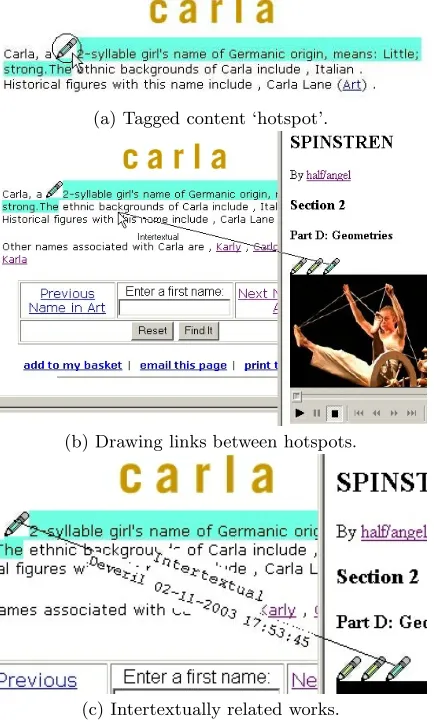
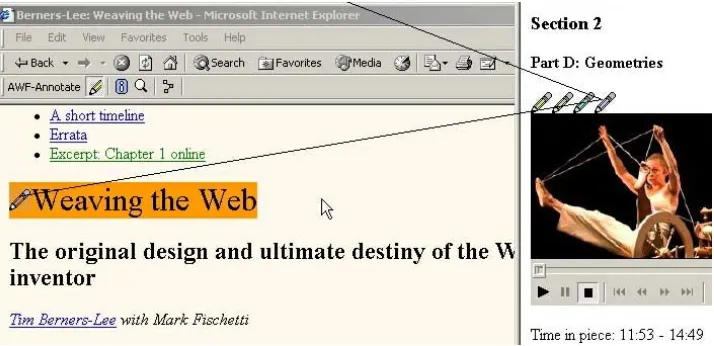
In an attempt to blur the boundaries between map-based and Web browser-based approaches, AWF’s Relate compo-nent allows the meaning maker to carry out map-like inter-actions in a Web browser-based context. Meaning makers can express intertextual relationships between tagged con-tent in situ — without having to divide attention between ‘experience’ and representation — by ‘drawing’ connections directly onto the desktop7(figure 7b), optionally specifying a semantic type for the relationship (note that many links can be created from a single tag — figure 8). Once recorded, these connections are displayed whenever the two endpoints are visible on the desktop, following the movement of win-dows and scrollbars, and thus keeping intertextually related works visibly and tangibly linked across the physical bound-aries of Web browser windows (figure 7c, 8).
Such visible hypertext link connections are not an entirely new concept. Nelson advocated visible connections between documents forside-by-side comparison as early as 1972 [27] (for which he more recently coined the term “transpointing windows” [28]). Nelson states that transpointing windows address “the fundamental problem of hypertext: being able to see connections side by side,” whether the user is looking at separate pages, different versions of the same document, commentaries on one document by another, or any other parallel document structure8. Nelson’s CosmicBook Reader application demonstrated this concept in 20019.
7Currently implemented only on the Microsoft Windows platform.
(a) Tagged content ‘hotspot’.
(b) Drawing links between hotspots.
[image:9.612.68.285.62.425.2](c) Intertextually related works.
Figure 7: Using AWF’s Relate component to cap-ture intertextual relationships between works.
We should note at this point that AWF’s use of “trans-pointing windows” as an attempt to bridge the advantages of map-based and Web browser-based approaches was not directly influenced by the CosmicBook project, but rather by a desire to extend the user interaction of existing Web browser-based hypertext tools such as WebVise, and earlier systems such as Microcosm [12], towards that of a map-based system such as StorySpace. For example, to capture an intertextual connection in WebVise, a meaning maker must highlight a source anchor (tag), choose the ‘new link’ action, highlight a target anchor, and finally choose the ‘add anchor’ action. By comparison, using StorySpace the mean-ing maker simply chooses an existmean-ing node (or span of node text), selects the ‘link’ action, and ‘draws’ a link to the tar-get node. In AWF therefore, tags and intertextual links can also be created independently — as and when interpre-tations, responses, and intertextual links are uncovered in the experiencing of the works under consideration, so the meaning maker is able to record them directly.
It is hoped that the initial evaluation work presented here may be useful to other researchers interested in evaluating the “transpointing windows” approach, since the current AWF prototype demonstrates a number of features beyond
those of the current CosmicBook release, including open Web integration (rather than proprietary viewer and doc-ument format), full authoring capabilities (creation of tags and links ‘on the fly’), and visible connection metadata (fig-ure 7c).
4.2.3
AWF Server
As well as providing transparent storage and management facilities for structures created by the meaning maker, the AWF Server also generates customisable overview maps of the emerging network of interpretation10 — clicking on a tag opens an overview map showing the local interpretation network around that tag. At this stage, the overview map is interactive only in that clicking on a node of the map leads to the original tagged content in the original work. The aim of the overview map is to provide the meaning maker with a mechanism for revisiting and re-evaluating the in-terpretive structures they have created around the dance performance (and other intertextually related works), and for other meaning makers to explore this network in ref-erence to the works. The map is filterable by creator (e.g. show only interpretations made by specified meaning makers or groups), creation date (e.g. show only recent interpreta-tions), and URL (show only the hyperstructures surrounding a particular work). We eventually hope to replace this mech-anism with a fully interactive map-based workspace, with tagged content and intertextual links created using AWF’s Annotate and Relate components automatically appearing as nodes in the workspace, and changes to the interpretive structures made in the workspace reflected back to the Web browser-based visualisation (an approach under considera-tion involves leveraging Tinderbox’s XML capabilities).
4.2.4
Integration with Microsoft Frontpage
AWF’s integration with Microsoft Frontpage supports meaning makers in presenting and/or discussing their in-terpretations in the form of a new (Web-based) hypertext, which builds on (or integrates) the interpreted works them-selves. Each ‘tag’ created with AWF’s Annotate component has a context menu — by choosing the ‘link’ action from this menu, the meaning maker automatically inserts a di-rect link to the tagged position in the original work into the currently open Frontpage document. Overview maps gener-ated by the AWF Server also have a context menu, allowing meaning makers to automatically insert a link to a specific structure in the interpretation network (which then leads the reader to the intertextually connected works underlying the structure). When the new hypertext is published on the Web, it therefore becomes visibly and tangibly integrated with existing works and may now be tagged and intertex-tually connected in AWF as part of the interpretations of other meaning makers.5.
INITIAL EVALUATION
In order to obtain some initial feedback as to the suit-ability of AWF as a hypertext system for supporting dance analysis, a short demonstration was put together which il-lustrated how AWF could be used to interpret a short clip of the dance piece ‘Spinstren’. In order to facilitate this demon-stration, a number of minor extensions to AWF needed to
Figure 8: Capturing interpretations and intertextual connections on the desktop.
Hypertext Network Open Writing Web Semantic
representation overview access support integration typing
tag annotate link
Associative Writing Framework • • • • • • • •
Table 2: Support for dance analysis provided by AWF.
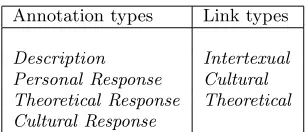
be made, most importantly the extension of the Annotate component to allow users to tag specific segments of digital video (by interactively setting frame markers during play-back) and images (by interactively selecting a region). The number of options given for defining the semantics of anno-tations and links were kept to a minimum for the purposes of the demonstration and evaluation (table 3).
A small number of dance experts (both students and re-searchers) were presented with a series of screen-capture videos of the AWF system being used to analyse the ‘Spin-stren’ clip. These videos represented a mock-up of a sce-nario involving a dance researcher (Deveril) watching the streamed ‘Spinstren’ clip and responding to it by captur-ing interpretations and intertextual connections with other works, with the choreographer of ‘Spinstren’ (Jools Gilson-Ellis) and another researcher (Janet Lansdale) also con-tributing their perspectives on the piece and on Deveril’s interpretations. The videos were described and elaborated to small groups or individuals, who were free to ask ques-tions and discuss what they were seeing at any time during the presentation. Each participant was presented with a questionnaire divided into two sections — the first section was filled out before the AWF demonstration, and the sec-ond section after the demonstration. The questions were designed to firstly gain insight into the participants’ prior knowledge and experience of intertextual analysis, and sub-sequently to gauge how they felt AWF might facilitate future work in such analyses.
The feedback on the questionnaires and from the experts in discussion with the authors was generally favourable to-wards AWF. Responses stated that the system seemed “much more useful than working on paper which doesn’t capture movement and image in the same way” and “easy to use for one with some Internet experience”. There was some con-cern that the system would require time to get to grips with, although the fact that AWF was based in familiar
interac-tions would mean that this process would be quicker than with a completely new application. To help with learning AWF it was generally thought that an on-screen demonstra-tion and tutorial would be a good start, but that a live run-through of the procedures and hands-on experience would be the main ways of learning how to use the system.
The responses of the participants reflect the relative new-ness of this approach in dance analysis, although it is one which has a growing usage in scholarly appreciation of dance works. Intertextual method(s) of dance analysis have been pioneered by Janet Lansdale and others at the University of Surrey [2] at a mostly postgraduate level, but an awareness of it as an approach is spreading. The processes of the ap-proach, as we have discussed, are at the same time ‘intuitive’ and difficult, particularly when it comes to expressing them. Even though some responses stated that the student hadn’t used intertextual analysis, it was apparent, on reflection and following discussion, that often students had worked ‘inter-textually’ without realising that this was what they were doing. The available annotation and link types were felt to be adequate for continued work on the system, with an understanding that this may be amended and adapted as the system is used for the developing of intertextual and analytical networks on dance.
6.
CONCLUSION
[image:10.612.81.534.257.303.2]Annotation types Link types
[image:11.612.97.250.51.117.2]Description Intertexual Personal Response Cultural Theoretical Response Theoretical Cultural Response
Table 3: AWF semantics for dance analysis demon-stration.
observed in other Web browser-based and mbased ap-proaches. This paper has shown the contexts in which the two projects were conceived and the critical and practical overlaps of these contexts.
The importance of any system for intertextual dance anal-ysis is that it allows for and demonstrates the open-endedness of dance pieces, in terms of meaning and interpretation. These two concepts are played with and explored practi-cally as users of the system watch and respond to dance texts, and to the responses of others who may have used the system before. The dance pieces might already have been commented on by their makers (the choreographers, di-rectors, performers, composers, etc.), giving contextual and background information on sources, references, intentions and after-thoughts on the piece and its creation. This is not to be considered the definitive reading of a piece, merely an-other layer of material which could be incorporated into an individual interpretation.
The Associative Writing Framework appears to provide, at the very least, an important testing ground for the inter-textual analysis of dance in digital video form. It shows how a multitude of media and information types can be linked and made use of in a developing area of research. The pre-vious problems presented by writing in an intertextual and hypertextual mode are shown to be reduced by AWF, and potentially allow for more work to be produced in this field. Further to the initial testing presented here a working (stable and robust) system, based on AWF, should be pre-sented to dance experts, students, and academics, to de-velop and appraise. As it will be presented on the World Wide Web, it will be accessible to anyone with an interest in it. It would be naive to imagine that this system would be utilised and wanted by everybody. There are clearly specific groups that would benefit from and have need of such a tool. These, however, are not limited to dance studies, but also areas such as drama and film studies — anything that has as its primary texts screen-based media. The individuals in these groups could be students, teachers, researchers, critics, writers of other sorts, and inquisitive audience members. It could also act as a tool for performers, choreographers, di-rectors and designers, who wish to analyse or describe their own works in an intertextual manner, or who want to exam-ine the work of others for links to their own work or between artists.
7.
ACKNOWLEDGEMENTS
The Decentering the Dancing Text project is a one year project initiated in April 2002, funded by the Arts and Hu-manities Research Board (UK) ‘Innovation Awards’ scheme.
8.
REFERENCES
[1] E. Aarseth.Cybertext: Perspectives on Ergodic
Literature. The Johns Hopkins University Press, Baltimore, 1997.
[2] J. Adshead-Lansdale, editor.Dancing texts: intertextuality in interpretation. Dance Books, London, 1999.
[3] G. Allen.Intertextuality. Routledge, London, 2000. [4] R. Barthes. The Death of the Author. InImage Music
Text, pages 142–148. Fontana Press, London, 1977. [5] R. Barthes. Textual Analysis: Poe’s “Valdemar”. In
D. Lodge, editor,Modern Criticism and Theory: A Reader, pages 172–194. Longman, Harlow, 1988. [6] M. Bernstein. Storyspace 1. InProceedings of the
ACM Hypertext 2002 Conference, Maryland, USA, pages 172–181, June 2002.
[7] M. Bieber, F. Vitali, H. Ashman,
V. Balasubramanian, and H. Oinas-Kukkonen. Fourth Generation Hypermedia: Some Missing Links for the World Wide Web.International Journal of
Human-Computer Studies, 47(1):31–65, 1997.
[8] N. O. Bouvin, P. T. Zellweger, K. Grønbæk, and J. D. Mackinlay. Fluid Annotations Through Open
Hypermedia: Using and Extending Emerging Web Standards. InProceedings of the Eleventh
International World Wide Web Conference, Honolulu, Hawaii, USA, May 2002.
[9] J. Cayley. Hypertext/Cybertext/Poetext.
http://www.shadoof.net/in/hcp000.html, 1996. [10] S. J. DeRose. Expanding the notion of links. In
Proceedings of the Hypertext ’89 Conference on Hypertext, Pittsburgh, Pennsylvania, USA, Usability, Links, and Fiction, pages 249–257, 1989.
[11] U. Eco. Casablanca: Cult movies and intertextual collage. In D. Lodge, editor,Modern Criticism and Theory: A Reader, pages 446–455. Longman, Harlow, 1988.
[12] A. Fountain, W. Hall, I. Heath, and H. C. Davis. Microcosm: An Open Model for Hypermedia With Dynamic Linking. InProceedings of the Hypertext ’90 Conference, INRIA, France, pages 298–311, Nov. 1990. [13] E. R. Gansner and S. C. North. An open graph
visualization system and its applications to software engineering.Software — Practice and Experience, 30(11):1203–1233, Sept. 2000.
[14] K. Grønbæk, L. Sloth, and P. Ørbæk. Webvise: Browser and proxy support for open hypermedia structuring mechanisms on the world wide web. In
Proceedings of the Eighth International World-Wide Web Conference, 1999.
[15] S. Handschuh and S. Staab. Authoring and
Annotation of Web Pages in CREAM. InProceedings of the Eleventh International World Wide Web Conference (WWW2002), Honolulu, Hawaii, USA, May 2002.
[16] S. Handschuh, S. Staab, and A. Maedche. CREAM — Creating relational metadata with a component-based, ontology-driven annotation framework. InProceedings of the First International Conference on Knowledge Capture (KCAP 2001), Victoria, B.C., Canada, Oct. 2001.
users with typed links in open hypermedia. In
European Conference on Digital Libraries, pages 254–273, 1999.
[18] J. Kahan, M.-R. Koivunen, E. Prud’Hommeaux, and R. R. Swick. Annotea: An open RDF infrastructure for shared web annotations. InProceedings of the Tenth International World Wide Web Conference, Hong Kong, 2001.
[19] M.-R. Koivunen and R. Swick. Metadata Based Annotation Infrastructure offers Flexibility and Extensibility for Collaborative Applications and Beyond. InProceedings of the First International Conference on Knowledge Capture (KCAP 2001), Victoria, B.C., Canada, Oct. 2001.
[20] G. Landow.Hypertext 2.0. John Hopkins University Press, Baltimore, 1997.
[21] G. Li, V. Uren, E. Motta, S. Buckingham-Shum, and J. Domingue. ClaiMaker: Weaving a Semantic Web of Research Papers. InProceedings of the 1st
International Semantic Web Conference, Sardinia, June 2002.
[22] C. C. Marshall and F. M. Shipman, III. Effects of hypertext technology on the practice of information triage. InProceedings of the ACM Hypertext ’97 Conference, Southampton, UK, pages 167–176, 1997. [23] T. Memmott. Lexia to perplexia.http:
//trace.ntu.ac.uk/newmedia/lexia/index.htm, 2000.
[24] A. Miles. Singin’ in the rain: A hypertextual reading.
Postmodern Culture, 8(2), January 1998.
[25] T. Miles-Board, L. Carr, and W. Hall. Looking for linking: Associative links on the web. InProceedings of the ACM Hypertext 2002 Conference, Maryland, USA, 2002.
[26] R. Neagle. Dance movement notation.http://www. comp.leeds.ac.uk/royce/ugreport/node7.html, 2001.
[27] T. H. Nelson. As we will think. InProceedings of the Online ’72 Conference, Brunei University, Uxbridge, UK, 1972.
[28] T. H. Nelson. The heart of connection: hypermedia unified by transclusion. Communications of the ACM, 38(8):31–33, August 1995.
[29] J. Nielsen.Multimedia and Hypertext: The Internet and Beyond. Academic Press, London, 1995. [30] L. S. Roudiez.Desire in Language: A Semiotic
Approach to Literature and Art, chapter Introduction. Blackwell, Oxford, 1980.
[31] m. c. schraefel, Y. Zhu, D. Modjeska, D. Wigdor, and S. Zhao. Hunter Gatherer: Interaction Support for the Creation and Management of Within-Web-Page Collections. InProceedings of the Eleventh International World Wide Web Conference (WWW2002), Honolulu, Hawaii, USA, May 2002. [32] F. M. Shipman, H. Hsieh, P. Maloor, and J. M.
Moore. The visual knowledge builder: A second generation spatial hypertext. InProceedings of the ACM Hypertext 2001 Conference, Arhus, Denmark, pages 113–122, 2001.
[33] J. Svedjedal. A note on the concept of hypertext.
http://www.hb.se/bhs/ith/3-99/js.htm, 1999. [34] F. Vitali and M. Bieber. Hypermedia on the Web:
what will it take? ACM Computing Surveys, 31(4es), Dec. 1999.