Proceedings of the 57th Annual Meeting of the Association for Computational Linguistics, pages 5570–5581 5570
Towards Explainable NLP: A Generative Explanation
Framework for Text Classification
Hui Liu1, Qingyu Yin2, William Yang Wang3 1 Peking University, China
2 Harbin Institute of Technology, China 3 University of California, Santa Barbara, USA
[email protected] [email protected] [email protected]
Abstract
Building explainable systems is a critical prob-lem in the field of Natural Language Process-ing (NLP), since most machine learnProcess-ing mod-els provide no explanations for the predictions. Existing approaches for explainable machine learning systems tend to focus on interpret-ing the outputs or the connections between in-puts and outin-puts. However, the fine-grained information(e.g. textual explanations for the labels) is often ignored, and the systems do not explicitly generate the human-readable ex-planations. To solve this problem, we pro-pose a novel generative explanation frame-work that learns to make classification deci-sions and generate fine-grained explanations at the same time. More specifically, we intro-duce the explainable factor and the minimum risk training approach that learn to generate more reasonable explanations. We construct two new datasets that contain summaries, rat-ing scores, and fine-grained reasons. We con-duct experiments on both datasets, compar-ing with several strong neural network base-line systems. Experimental results show that our method surpasses all baselines on both datasets, and is able to generate concise expla-nations at the same time.
1 Introduction
Deep learning methods have produced state-of-the-art results in many natural language process-ing (NLP) tasks (Vaswani et al.,2017;Yin et al.,
2018;Peters et al.,2018;Wang et al.,2018; Han-cock et al.,2018;Ma et al.,2018). Though these deep neural network models achieve impressive performance, it is relatively difficult to convince people to trust the predictions of such neural net-works since they are actually black boxes for hu-man beings (Samek et al., 2018). For instance, if an essay scoring system only tells the scores of a given essay without providing explicit rea-sons, the users can hardly be convinced of the
judgment. Therefore, the ability to explain the rationale is essential for a NLP system, a need which requires traditional NLP models to provide human-readable explanations.
In recent years, lots of works have been done to solve text classification problems, but just a few of them have explored the explainability of their systems (Camburu et al.,2018;Ouyang et al.,
2018).Ribeiro et al.(2016) try to identify an inter-pretable model over the interinter-pretable representa-tion that is locally faithful to the classifier.Samek et al.(2018) use heatmap to visualize how much each hidden element contributes to the predicted results. Although these systems are somewhat promising, they typically do not consider fine-grained information that may contain information for interpreting the behavior of models. However, if a human being wants to rate a product, s/he may first write down some reviews, and then score or summarize some attributes of the product, like price, packaging, and quality. Finally, the over-all rating for the product will be given based on the fine-grained information. Therefore, it is cru-cial to build trustworthy explainable text classifi-cation models that are capable of explicitly gener-ating fine-grained information for explaining their predictions.
generate reasonable explanations for the overall predict results. Meanwhile, such a strategy brings strong connections between the explanations and predictions, which in return leads to better perfor-mance. To the best of our knowledge, we are the first to explicitly explain the predicted results by utilizing the abstractive generative fine-grained in-formation.
In this work, we regard the summaries (texts) and rating scores (numbers) as the fine-grained in-formation. Two datasets that contain these kinds of fine-grained information are collected to eval-uate our method. More specifically, we construct a dataset crawled from a website called PCMag1.
Each item in this dataset consists of three parts: a long review text for one product, three short text comments (respectively explains the property of the product from positive, negative and neutral perspectives) and an overall rating score. We re-gard the three short comments as fine-grained in-formation for the long review text. Besides, we also conduct experiments on the Skytrax User Re-views Dataset2, where each case consists of three parts: a review text for a flight, five sub-field rat-ing scores (seat comfortability, cabin stuff, food, in-flight environment, ticket value) and an overall rating score. As for this dataset, we regard the five sub-field rating scores as fine-grained information for the flight review text.
Empirically, we evaluate our model-agnostic method on several neural network baseline mod-els (Kim,2014;Liu et al.,2016;Zhou and Wang,
2018) for both datasets. Experimental results sug-gest that our approach substantially improves the performance over baseline systems, illustrating the advantage of utilizing fine-grained informa-tion. Meanwhile, by providing the fine-grained information as explanations for the classification results, our model is an understandable system that is worth trusting. Our major contributions are three-fold:
• We are the first to leverage the generated fine-grained information for building a genera-tive explanation framework for text classifi-cation, propose an explanation factor, and in-troduce minimum risk training for this hybrid generative-discriminative framework;
• We evaluate our model-agnostic explanation 1https://www.pcmag.com/
2https://github.com/quankiquanki/
skytrax-reviews-dataset
framework with different neural network ar-chitectures, and show considerable improve-ments over baseline systems on two datasets;
• We provide two new publicly available ex-plainable NLP datasets that contain fine-grained information as explanations for text classification.
2 Task Definition and Notations
The research problem investigated in this paper is defined as: How can we generate fine-grained explanations for the decisions our classification model makes? To answer this question, we may first investigate what are good fine-grained expla-nations. For example, in sentiment analysis, if a productAhas three attributes: i.e., quality, practi-cality, and price. Each attribute can be described as “HIGH” or “LOW”. And we want to know whether A is a “GOOD” or “BAD” product. If our model categorizesA as “GOOD” and it tells that the quality of A is “HIGH”, the practicality is “HIGH” and the price is “LOW”, we can regard these values of attributes as good explanations that illustrate why the model judgesAto be “GOOD”. On the contrary, if our model produces the same values for the attributes, but it tells that A is a “BAD” product, we then think the model gives bad explanations. Therefore, for a given classification prediction made by the model, we would like to explore more on the fine-grained information that can explain why it comes to such a decision for the current example. Meanwhile, we also want to figure out whether the fine-grained information in-ferred from the input texts can help improve the overall classification performance.
We denote the input sequence of texts to be
S{s1, s2, . . . , s|S|}, and we want to predict which categoryyi(i∈[1,2, . . . , N])the sequenceS be-longs to. At the same time, the model can also pro-duce generative fine-grained explanations ec for
yi.
3 Generative Explanation Framework
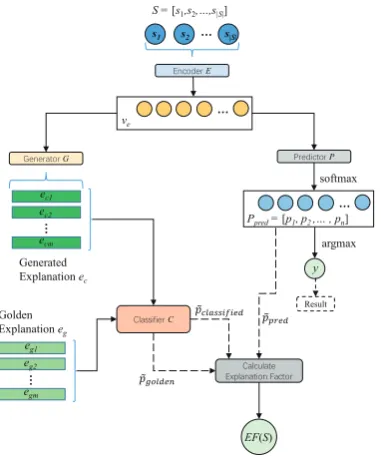
In this part, we introduce our proposed Genera-tive Explanation Framework (GEF). Figure 1 il-lustrates the architecture of our model.
3.1 Base Classifier and Generator
…
s1
濘瀁濶瀂濷濸瀅澳E
s|S|
s2
…
S = [s1,s2,…,s|S|]
濣瀅濸濷濼濶瀇瀂瀅澳P
…
ve
softmax
Ppred=[p1, p2 ,… , pn]
y argmax
濚濸瀁濸瀅濴瀇瀂瀅澳G
…
Generated Explanation ec
ec1
ec2
ecm
濖濿濴瀆瀆濼濹濼濸瀅澳C
…
Golden Explanation eg
eg1
eg2
egm
濖濴濿濶瀈濿濴瀇濸澳 濘瀋瀃濿濴瀁濴瀇濼瀂瀁澳濙濴濶瀇瀂瀅
ௗ
௦௦ௗ
ௗ
EF(S)
[image:3.595.89.280.65.294.2]Result
Figure 1: The architecture of the Generative Explana-tion Framework. E encodes S into a representation vector ve. P gives the probability distribution Ppred
for categories. We extract the ground-truth probability ˜
ppred fromPpred. GeneratorGtakesve as input and
generates explanationsec. ClassifierC and Predictor P both predict classes y. C will predict a probabil-ity distributionPclassif iedwhen takingecas input, and
predictPgoldenwhen takingegas input, and then
out-put the ground-truth probabilityp˜classif iedandp˜golden.
The explanation factor EF(S) is calculated through ˜
ppred,p˜classif iedandp˜golden.
et al.,2015;Lai et al.,2015). As shown in Figure
1, a text encoder E takes the input text sequence
S, and encodesS into a representation vectorve. A category predictorP then getsve as input and outputs the categoryyiand its corresponding prob-ability distributionPpred.
As mentioned above, a desirable model should not only predict the overall resultsyi, but also pro-vide generative explanations to illustrate why it makes such predictions. A simple way to generate explanations is to feed ve to an explanation gen-eratorGto generate fine-grained explanationsec. This procedure is formulated as:
ve=Encoder([s1, s2,· · ·, s|S|]) (1)
Ppred=P redictor(ve) (2)
y= arg max
i
(Ppred,i) (3)
ec=fG(WG·ve+bG) (4)
where Encoder maps the input sequence
[s1, s2,· · ·, s|S|]into the representation vectorve;
the P redictor takes the ve as input and outputs the probability distribution over classification categories by using thesof tmax.
During the training process, the overall lossLis composed of two parts, i.e., the classification loss
Lpand explanation generation lossLe:
L(eg, S, θ) =Lp+Le (5)
whereθrepresents all the parameters.
3.2 Explanation Factor
The simple supervised way to generate explana-tions, as demonstrated in the previous subsection, is quite straightforward. However, there is a sig-nificant shortcoming of this generating process: it fails to build strong connections between the gen-erative explanations and the predicted overall re-sults. In other words, the generative explanations seem to be independent of the predicted overall re-sults. Therefore, in order to generate more rea-sonable explanations for the results, we propose to use an explanation factor to help build stronger connections between the explanations and predic-tions.
As we have demonstrated in the introduction section, fine-grained information will sometimes reflect the overall results more intuitively than the original input text sequence. For example, given a review sentence, “The product is good to use”, we may not be sure if the product should be rated as 5 stars or 4 stars. However, if we see that the at-tributes of the given product are all rated as 5 stars, we may be more convinced that the overall rating for the product should be 5 stars.
So in the first place, we pre-train a classifier
C, which also learns to predict the categoryy by directly taking the explanations as input. More specifically, the goal ofCis to imitate human be-ings’ behavior, which means thatCshould predict the overall results more accurately than the base model that takes the original text as the input. We prove this assumption in the experiments section.
also get the golden probability distribution Pgold by feeding the golden explanationseg toC. The process can be formulated as:
Pclassif ied =sof tmax(fC(WC·ec+bC)) (6)
Pgold =sof tmax(fC(WC·eg+bC)) (7)
In order to measure the distance among pre-dicted results, generated explanations and golden generations, we extract the ground-truth probabil-ityp˜classif ied,p˜pred,p˜gold fromPclassif ied,Ppred,
Pgold respectively. They will be used to measure the discrepancy between the predicted result and ground-truth result in minimum risk training.
We define our explanation factorEF(S)as:
EF(S) =|p˜classif ied−p˜gold|+
|p˜classif ied−p˜pred| (8)
There are two components in this formula.
• The first part|p˜classif ied −p˜gold|represents the distance between the generated expla-nations ec and the golden explanations eg. Since we pre-trainC using golden explana-tions, we hold the view that if similar ex-planations are fed to C, similar predictions should be generated. For instance, if we feed a golden explanation “Great performance” to the classifierCand it tells that this explana-tion means “a good product”, then we feed another explanation “Excellent performance” toC, it should also tell that the explanation means “a good product”. For this task, we hope thatec can express the same or similar meaning aseg.
• The second part |p˜classif ied −p˜pred| repre-sents the relevance between the generated ex-planations ec and the original texts S. The generated explanations should be able to in-terpret the overall result. For example, if the base model predicts S to be “a good prod-uct”, but the classifier tends to classifyec to be the explanations for “a bad product”, then
eccannot properly explain the reason why the base model gives such predictions.
3.3 Minimum Risk Training
In order to remove the disconnection between fine-grained information and input text, we use Mini-mum risk training (MRT) to optimize our models, which aims to minimize the expected loss, i.e., risk
over the training data (Ayana et al.,2016). Given a sequenceSand golden explanationseg, we define
Y(eg, S, θ) as the set of predicted overall results with parameter θ. We define Δ(y,y˜) as the se-mantic distance between predicted overall results
yand ground-truthy˜. Then, the objective function is defined as:
LM RT(eg, S, θ) =
(eg,S)∈D
EY(eg,S,θ)Δ(y,y˜)
(9)
whereDpresents the whole training dataset. In our experiment,EY(eg,S,θ) is the expectation over the setY(eg, S, θ), which is the overall loss in Equation 5. And we define Explanation Fac-torEF(S)as the semantic distance of input texts, generated explanations and golden explanations. Therefore, the objective function of MRT can be further formalized as:
LM RT(eg, S, θ) =
(eg,S)∈D
L(eg, S, θ)EF(S)
(10)
MRT exploits EF(S) to measure the loss, which learns to optimize GEF with respect to the specific evaluation metrics of the task. Though
LM RT can be 0 or close to 0 when p˜classif ied,
˜
ppred and p˜gold are close, this cannot guarantee that generated explanations are close to the golden explanations. In order to avoid the total degrada-tion of loss, we define our final loss funcdegrada-tion as the sum of MRT loss and explanation generation loss:
Lf inal=
(eg,S)∈D
L+LM RT (11)
We try different weighting scheme for the over-all loss, and get best performance with1 :1.
3.4 Application Case
Generally, the fine-grained explanations are in dif-ferent forms for a real-world dataset, which means thateccan be in the form of texts or in the form of numerical scores. We apply GEF to both forms of explanations using different base models.
3.4.1 Case 1: Text Explanations
CVAE ve
p1=0.3
p2=0.1 p3=0.2
p4=0.4
Ppred
is cheap , but too heavy . it
ec ec1: pricy . ec2: heavy .
ec3: just good .
eg eg1: cheap .
eg2: heavy .
eg3: worthy to buy . classifier
p1=0.5
p2=0.2
p3=0.1
p4=0.2
Pclassified
p1=0.2 p2=0.3
p3=0.3
p4=0.2 Pgold
௦௦ௗ= 0.2
ௗ= 0.3
ௗ= 0.1
ܧܨ ܵ= |௦௦ௗെ ௗ| + |௦௦ௗെ ௗ|
=0.2െ0.3 + 0.2െ0.1
= 0.2
[image:5.595.82.280.64.273.2]y=4
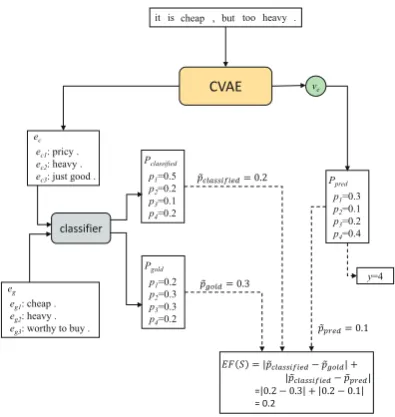
Figure 2: Structure of CVAE+GEF. There are totally 4 categories for the classification, and the ground-truth category is 2 in this example. We assume that the pre-trained classifier is a ”perfect” classifier that will cor-rectly predict the final label to be 2 when takingeg as
input. So we wish the classifier can also predict the fi-nal result as label 2 when takingec as input. This is
why we focus onp˜classif iedandp˜gold.
is found to be capable of generating emotional texts and capturing greater diversity than tradi-tional SEQ2SEQ models.
We give an example of the structure of CVAE+GEF in Figure2. For space consideration, we leave out the detailed structure of CVAE, and will elaborate it in the supplementary materials. In this architecture, golden explanations eg and generated explanations ec are both composed of three text comments: positive comments, negative comments, and neutral comments, which are fine-grained explanations for the final overall rating. The classifier is a skip-connected model of bidi-rectional GRU-RNN layers (Felbo et al.,2017). It takes three kinds of comments as inputs, and out-puts the probability distribution over the predicted classifications.
3.4.2 Case 2: Numerical Explanations
Another frequently employed form of the fine-grained explanations for the overall results is nu-merical scores. For example, when a user wants to rate a product, s/he may first rate some attributes of the product, like the packaging, price, etc. Af-ter rating all the attributes, s/he will give an over-all rating for the product. So we can say that the rating for the attributes can somewhat explain
why the user gives the overall rating. LSTM and CNN are shown to achieve great performance in text classification tasks (Tang et al.,2015), so we use LSTM and CNN models as the encoderE spectively. The numerical explanations are also re-garded as a classification problem in this example.
4 Dataset
We conduct experiments on two datasets where we use texts and numerical ratings to represent fine-grained information respectively. The first one is crawled from a website called PCMag, and the other one is the Skytrax User Reviews Dataset. Note that all the texts in the two datasets are pre-processed by the Stanford Tokenizer3 (Manning et al.,2014).
4.1 PCMag Review Dataset
This dataset is crawled from the website PCMag. It is a website providing reviews for electronic products, like laptops, smartphones, cameras and so on. Each item in the dataset consists of three parts: a long review text, three short comments, and an overall rating score for the product. Three short comments are summaries of the long review respectively from positive, negative, neutral per-spectives. An overall rating score is a number ranging from 0 to 5, and the possible values that the score could be are{1.0, 1.5, 2.0, ..., 5.0}.
Since long text generation is not what we focus on, the items where review text contains more than 70 sentences or comments contain greater than 75 tokens are filtered. We randomly split the dataset into 10919/1373/1356 pairs for train/dev/test set. The distribution of the overall rating scores within this corpus is shown in Table1.
4.2 Skytrax User Reviews Dataset
We incorporate an airline review dataset scraped from Skytraxs Web portal. Each item in this dataset consists of three parts: i.e., a review text, five sub-field scores and an overall rating score. The five sub-field scores respectively stand for the user’s ratings for seat comfortability, cabin stuff, food, in-flight environment, and ticket value, and each score is an integer between 0 and 5. The over-all score is an integer between 1 and 10.
Similar to the PCMag Review Dataset, we filter out the items where the review contains more than
3https://nlp.stanford.edu/software/
Overall Score 1.0 1.5 2.0 2.5 3.0 3.5 4.0 4.5 5.0
Number 21 60 283 809 2399 3981 4838 1179 78
Table 1: Distribution of examples by each overall rating score in PCMag Review Dataset.
Overall Score 1 2 3 4 5 6 7 8 9 10
Number 4073 2190 1724 1186 1821 1302 2387 3874 4008 4530
Table 2: Distribution of examples by each overall rating score in Skytrax User Reviews Dataset.
Embedding hidden batch size
PCMag GloVe, 100 128 32
Skytrax random, 100 256 64
Table 3: Experimental settings for our experiments. Note that for CNN, we additionally set filter number to be256and filter sizes to be[3,4,5,6].
300 tokens. Then we randomly split the dataset into 21676/2710/2709 pairs for train/dev/test set. The distribution of the overall rating scores within this corpus is shown in Table2.
5 Experiments and Analysis
5.1 Experimental Settings
As the goal of this study is to propose an ex-planation framework, in order to test the effec-tiveness of proposed GEF, we use the same ex-perimental settings on the base model and on the base model+GEF. We use GloVe (Pennington et al.,2014) word embedding for PCMag dataset and minimize the objective function using Adam (Kingma and Ba,2014). The hyperparameter set-tings for both datasets are listed in Table3. Mean-while, since the generation loss is larger than clas-sification loss for text explanations, we stop updat-ing the predictor after classification loss reaches a certain threshold (adjusted based on dev set) to avoid overfitting.
5.2 Experimental Results
5.2.1 Results of Text Explanations
We use BLEU (Papineni et al., 2002) scores to evaluation the quality of generated text explana-tions. Table4shows the comparison results of ex-planations generated by CVAE and CVAE+GEF.
There are considerable improvements on the BLEU scores of explanations generated by CVAE+GEF over the explanations generated by CVAE, which demonstrates that the explanations generated by CVAE+GEF are of higher quality.
BLEU-1 BLEU-2 BLEU-3 BLEU-4
Pos. CVAE 36.1 13.5 3.7 2.2
CVAE+GEF 40.1 15.6 4.5 2.6
Neg. CVAE 33.3 14.1 3.1 2.2
CVAE+GEF 35.9 16.0 4.0 2.9
Neu. CVAE 30.0 8.8 2.0 1.2
[image:6.595.329.501.381.424.2]CVAE+GEF 33.2 10.2 2.5 1.5
Table 4: BLEU scores for generated explanations. Pos., Neg., Neu. respectively stand for positive, neg-ative and neural explanations. The low BLEU-3 and BLEU-4 scores are because the target explanations contain many domain-specific words with low fre-quency, which makes it hard for the model to generate accurate explanations.
Acc% (Dev) Acc% (Test)
CVAE 42.07 42.58
CVAE+GEF 44.04 43.67
Oracle 46.43 46.73
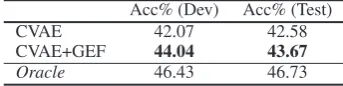
Table 5: Classification accuracy on PCMag Review Dataset. Oracle means if we feed ground-truth text explanations to the ClassifierC, the accuracy C can achieve to do classification. Oracleconfirms our as-sumption that explanations can do better in classifica-tion than the original text.
CVAE+GEF can generate explanations that are closer to the overall results, thus can better illus-trate why our model makes such a decision.
classifica-s% c% f% i% t% LSTM 46.59 52.27 43.74 41.82 45.04 LSTM+GEF 49.13 53.16 46.29 42.34 48.25
CNN 46.22 51.83 44.59 43.34 46.88
[image:7.595.340.491.63.127.2]CNN+GEF 49.80 52.49 48.03 44.67 48.76
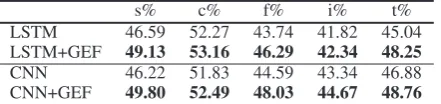
Table 6: Accuracy of sub-field numerical explanations on Skytrax User Reviews Dataset. s, c, f, t, v stand for seat comfortability, cabin stuff, food, in-flight environ-ment and ticket value, respectively.
tion, we shall get better results than using the orig-inal input texts. Therefore, we list the performance of the classifierCin Table5to make the compar-ison. Experiments show thatC has better perfor-mance than both CVAE and CVAE+GEF, which proves our assumption to be reasonable.
5.2.2 Results of Numerical Explanations
In the Skytrax User Reviews Dataset, the overall ratings are integers between 1 to 10, and the five sub-field ratings are integers between 0 and 5. All of them can be treated as classification problems, so we use accuracy to evaluate the performance.
The accuracy of predicting the sub-field ratings can indicate the quality of generated numerical ex-planations. In order to prove that GEF can help generate better explanations, we show the accu-racy of the sub-field rating classification in Table
6. The 5 ratings evaluate the seat comfortability, cabin stuff, food, in-flight environment, and ticket value, respectively. As we can see from the results in Table6, the accuracy for 5 sub-field ratings all get enhanced comparing with the baseline. There-fore, we can tell that GEF can improve the quality of generated numerical explanations.
Then we compare the result for classification in Table7. As the table shows, the accuracy or top-3 accuracy both get improved when the models are combined with GEF.
Moreover, the performances of the classifier are better than LSTM (+GEF) and CNN (+GEF), which further confirms our assumption that the classifier C can imitate the conceptual habits of human beings. Leveraging the explanations can provide guidance for the model when doing final results prediction.
5.3 Human Evaluation
In order to prove our model-agnostic framework can make the basic model generate explanations more closely aligned with the classification re-sults, we employ crowdsourced judges to evaluate
Acc% Top-3 Acc%
LSTM 38.06 76.89
LSTM+GEF 39.20 77.96
CNN 37.06 76.85
CNN+GEF 39.02 79.07
[image:7.595.73.294.64.116.2]Oracle 45.00 83.13
Table 7: Classification accuracy on Skytrax User Re-views Dataset. Oraclemeans if we feed ground-truth numerical explanation to the ClassifierC, the accuracy
Ccan achieve to do classification.
Win% Lose% Tie% CVAE+GEF 51.37 42.38 6.25
Table 8: Results of human evaluation. Tests are con-ducted between the text explanations generated by ba-sic CVAE and CVAE+GEF.
a random sample of100items in the form of text, each being assigned to 5 judges on the Amazon Mechanical Turk. All the items are correctly clas-sified both using the basic model and using GEF, so that we can clearly compare the explainability of these generated text explanations. We report the results in Table 8, and we can see that over half of the judges think that our GEF can generate explanations more related to the classification re-sults. In particular, for57.62%of the tested items, our GEF can generate better or equal explanations comparing with the basic model.
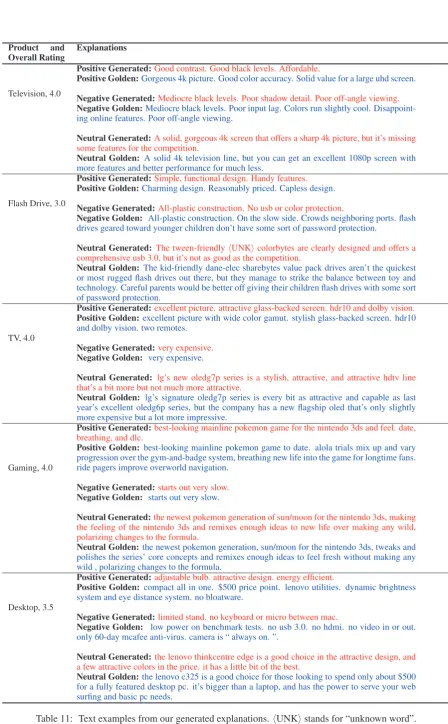
In addition, we show some the examples of text explanations generated by CVAE+GEF in Table
11. We can see that our model can accurately cap-ture some key points in the golden explanations. And it can learn to generate grammatical com-ments that are logically reasonable. All these illus-trate the efficient of our method. We will demon-strate more of our results in the supplementary ma-terials.
5.4 Error and Analysis
We focus on the deficiency of generation for text explanation in this part.
Product and Overall Rating
Explanations
Monitor, 3.0
Positive Generated:very affordable. unique and ergonomic design. good port selection.
Positive Golden:unique design. dual hdmi ports. good color quality. energy efficient.
Negative Generated:relatively faint on some features. relatively high contrast ratio. no auto port.
Negative Golden: expensive. weak light grayscale performance. features are scarce.
Neutral Generated: the samsung series is a unique touch-screen monitor featuring a unique design and a nice capacitive picture, but its color and grayscale performance could be better.
Neutral Golden:the samsung series is a stylish 27-inch monitor offering good color reproduction and sharp image quality. however, it ’s more expensive than most tn monitors and has a limited feature set.
Table 9: Examples of our generated explanations. Some key points are underlined.
Second, there areUNKs in the generated ex-planations. Since we are generating abstractive comments for product reviews, there may exist some domain-specific words. The frequency of these special words is low, so it is relatively hard for GEF to learn to embed and generated these words. A substituted way is that we can use copy-mechanism (Gu et al., 2016) to generate these domain-specific words.
6 Related Work
Our work is closely aligned with Explainable Artificial Intelligence (Gunning, 2017), which is claimed to be essential if users are to understand, and effectively manage this incoming generation of artificially intelligent partners. In artificial in-telligence, providing an explanation of individual decisions has attracted attention in recent years. The traditional way of explaining the results is to build connections between the input and output, and figure out how much each dimension or ele-ment contributes to the final output. Some previ-ous works explain the result in two ways: evalu-ating the sensitivity of output if input changes and analyzing the result from a mathematical perspec-tive by redistributing the prediction function back-ward (Samek et al.,2018). There are some works connecting the result with the classification model.
Ribeiro et al.(2016) selects a set of representative instances with explanations via submodular opti-mization. Although the method is promising and mathematically reasonable, they cannot generate explanations in natural forms. They focus on how to interpret the result.
Some of the previous works have similar moti-vations as our work. Lei et al.(2016) rationalize neural prediction by extracting the phrases from the input texts as explanations. They conduct their
work in an extractive way, and focus on rational-izing the predictions. However, our work aims not only to predict the results but also to generate abstractive explanations, and our framework can generate explanations both in the forms of texts and numerical scores. Hancock et al.(2018) pro-poses to use a classifier with natural language ex-planations that are annotated by human beings to do the classification. Our work is different from theirs in that we use the natural attributes as the explanations which are more frequent in reality.
Camburu et al. (2018) proposes e-SNLI4 by ex-tending SNLI dataset with text explanations. And their simple but effective model proves the fea-sibility of generating text explanations for neural classification models.
7 Conclusion
In this paper, we investigate the possibility of us-ing fine-grained information to help explain the decision made by our classification model. More specifically, we design a Generative Explanation Framework (GEF) that can be adapted to different models. Minimum risk training method is applied to our proposed framework. Experiments demon-strate that after combining with GEF, the perfor-mance of the base model can be enhanced. Mean-while, the quality of explanations generated by our model is also improved, which demonstrates that GEF is capable of generating more reasonable ex-planations for the decision.
Since our proposed framework is model-agnostic, we can combine it with other natural processing tasks, e.g. summarization, extraction, which we leave to our future work.
4
References
Shiqi Shen Ayana, Zhiyuan Liu, and Maosong Sun. 2016. Neural headline generation with minimum risk training. arXiv preprint arXiv:1604.01904.
Oana-Maria Camburu, Tim Rockt¨aschel, Thomas Lukasiewicz, and Phil Blunsom. 2018.e-snli: Natu-ral language inference with natuNatu-ral language
expla-nations. In S. Bengio, H. Wallach, H. Larochelle,
K. Grauman, N. Cesa-Bianchi, and R. Garnett, ed-itors, Advances in Neural Information Processing Systems 31, pages 9539–9549. Curran Associates, Inc.
Bjarke Felbo, Alan Mislove, Anders Søgaard, Iyad Rahwan, and Sune Lehmann. 2017. Using millions of emoji occurrences to learn any-domain represen-tations for detecting sentiment, emotion and sar-casm. In Proceedings of the 2017 Conference on Empirical Methods in Natural Language Process-ing, pages 1615–1625.
J Gu, Z Lu, H Li, and VOK Li. 2016. Incorporating copying mechanism in sequence-to-sequence learn-ing. InAnnual Meeting of the Association for Com-putational Linguistics (ACL), 2016. Association for Computational Linguistics.
David Gunning. 2017. Explainable artificial intelli-gence (xai). Defense Advanced Research Projects Agency (DARPA), nd Web.
Braden Hancock, Paroma Varma, Stephanie Wang, Martin Bringmann, Percy Liang, and Christopher R´e. 2018. Training classifiers with natural
lan-guage explanations. InProceedings of the 56th
An-nual Meeting of the Association for Computational Linguistics (Volume 1: Long Papers), pages 1884– 1895. Association for Computational Linguistics.
Yoon Kim. 2014. Convolutional neural networks for sentence classification. EMNLP.
Diederik P Kingma and Jimmy Lei Ba. 2014. Adam: A method for stochastic optimization. InProc. 3rd Int. Conf. Learn. Representations.
Siwei Lai, Liheng Xu, Kang Liu, and Jun Zhao. 2015. Recurrent convolutional neural networks for text classification. In AAAI, volume 333, pages 2267– 2273.
Tao Lei, Regina Barzilay, and Tommi Jaakkola. 2016. Rationalizing neural predictions. EMNLP.
Pengfei Liu, Xipeng Qiu, and Xuanjing Huang. 2016.
Recurrent neural network for text classification with
multi-task learning. InProceedings of International
Joint Conference on Artificial Intelligence.
Xuezhe Ma, Zecong Hu, Jingzhou Liu, Nanyun Peng, Graham Neubig, and Eduard Hovy. 2018.
Stack-pointer networks for dependency parsing. In
Pro-ceedings of the 56th Annual Meeting of the Associa-tion for ComputaAssocia-tional Linguistics (Volume 1: Long
Papers), pages 1403–1414. Association for Compu-tational Linguistics.
Christopher Manning, Mihai Surdeanu, John Bauer, Jenny Finkel, Steven Bethard, and David McClosky. 2014. The stanford corenlp natural language pro-cessing toolkit. In Proceedings of 52nd annual meeting of the association for computational lin-guistics: system demonstrations, pages 55–60.
Sixun Ouyang, Aonghus Lawlor, Felipe Costa, and Peter Dolog. 2018. Improving explainable recom-mendations with synthetic reviews. arXiv preprint arXiv:1807.06978.
Kishore Papineni, Salim Roukos, Todd Ward, and Wei-Jing Zhu. 2002. Bleu: a method for automatic eval-uation of machine translation. In Proceedings of the 40th annual meeting on association for compu-tational linguistics, pages 311–318. Association for Computational Linguistics.
Jeffrey Pennington, Richard Socher, and Christopher Manning. 2014. Glove: Global vectors for word representation. InProceedings of the 2014 confer-ence on empirical methods in natural language pro-cessing (EMNLP), pages 1532–1543.
Matthew E. Peters, Mark Neumann, Mohit Iyyer, Matt Gardner, Christopher Clark, Kenton Lee, and Luke Zettlemoyer. 2018. Deep contextualized word rep-resentations. InProc. of NAACL.
Marco Tulio Ribeiro, Sameer Singh, and Carlos Guestrin. 2016. Why should i trust you?: Explain-ing the predictions of any classifier. In Proceed-ings of the 22nd ACM SIGKDD international con-ference on knowledge discovery and data mining, pages 1135–1144. ACM.
Wojciech Samek, Thomas Wiegand, and Klaus-Robert M¨uller. 2018. Explainable artificial intelligence: Understanding, visualizing and interpreting deep
learning models. ITU Journal: ICT Discoveries
- Special Issue 1 - The Impact of Artificial Intel-ligence (AI) on Communication Networks and Ser-vices, 1(1):39–48.
Kihyuk Sohn, Honglak Lee, and Xinchen Yan. 2015. Learning structured output representation using deep conditional generative models. In Advances in Neural Information Processing Systems, pages 3483–3491.
Duyu Tang, Bing Qin, and Ting Liu. 2015. Document modeling with gated recurrent neural network for
sentiment classification. InProceedings of the 2015
Conference on Empirical Methods in Natural Lan-guage Processing, pages 1422–1432, Lisbon, Portu-gal. Association for Computational Linguistics.
Wei Wang, Ming Yan, and Chen Wu. 2018. Multi-granularity hierarchical attention fusion networks for reading comprehension and question answering. In Proceedings of the 56th Annual Meeting of the Association for Computational Linguistics (Volume 1: Long Papers), volume 1, pages 1705–1714.
Qingyu Yin, Yu Zhang, Weinan Zhang, Ting Liu, and William Yang Wang. 2018. Deep reinforcement learning for chinese zero pronoun resolution. ACL.
Xiang Zhang, Junbo Zhao, and Yann LeCun. 2015. Character-level convolutional networks for text clas-sification. In Advances in neural information pro-cessing systems, pages 649–657.
Supplemental Material
Structure of CVAE
By extending the SEQ2SEQ structure, we can easily get a Conditional Variational Antoencoder (CVAE) (Sohn et al., 2015; Zhou and Wang,
2018). Figure3shows the structure of the model.
Input ncoder
Explanations Encoder
Input Text
Explanations vc
v0
Prior Network Recog Network
x
c
z z’
[image:11.595.322.510.62.136.2]ve
Figure 3: The structure of CVAE. The Input Encoder encodes the input text inv0, andvcis the control
sig-nal that determines the kind of fine-grained information (positive, negative and neutral). ve is the initial input
for the decoder. The Explanations Encoder encodes the short comment inx. Recognition Network takesxas input and produces the latent variablez. In our experi-ment, the Recognition Network and the Prior Network are both MLPs, and we use bidirectional GRU as the Explanations Encoder and Input Encoder.
To train CVAE, we need to maximize a varia-tional lower bound on the condivaria-tional likelihood ofxgivenc, wherexandcare both random vari-ables. In our experiment,c= [vc;v0], andxis the text explanations we want to generate. This can be rewritten as:
p(x|c) =
p(x|z, c)p(z|c)dz (12)
z is the latent variable. The decoder is used to approximatep(x|z, c), denoted aspD(x|z, c), and Prior Network is used to approximatep(z|c), de-noted aspP(z|c). In order to approximate the true
Overall s c f i t
9.0 predgold 4.04.0 5.05.0 5.05.0 4.04.0 5.04.0
6.0 predgold 3.0 5.0 3.0 3.0 4.0 4.0 5.0 3.0 3.0 4.0
[image:11.595.85.281.180.433.2]2.0 predgold 2.02.0 1.02.0 2.01.0 2.02.0 2.02.0
Table 10: Examples from the results on Skytrax User Reviews Dataset. s, c, f, i, t stand for seat comfortabil-ity, cabin stuff, food, in-flight environment and ticket value, respectively.
posteriorp(z|x, c), we introduce Recognition Net-workqR(z|x, c). According toSohn et al.(2015), we can have the lower bound oflogp(x|c)as:
− L(x, c;θ) =KL(qR(z|x, c)||pP(z|c))
−EqR(z|x,c)(logpD(x|z, c)) (13)
θis the parameters in the network. Notice that dur-ing traindur-ing,zis used to trainzand passed to the decoder, but during testing, the ground truth expla-nations are absent andzis passed to the decoder.
Output Sample
In this part, we provide some samples from our experiment.
Numerical Explanation Cases
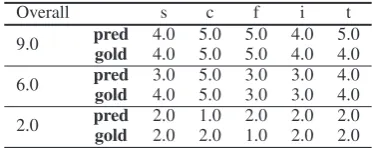
We provide some numerical explanation cases in Table10.
Text Explanation Cases
We provide some text explanation cases in Table
Product and Overall Rating
Explanations
Television, 4.0
Positive Generated:Good contrast. Good black levels. Affordable.
Positive Golden:Gorgeous 4k picture. Good color accuracy. Solid value for a large uhd screen.
Negative Generated:Mediocre black levels. Poor shadow detail. Poor off-angle viewing.
Negative Golden:Mediocre black levels. Poor input lag. Colors run slightly cool. Disappoint-ing online features. Poor off-angle viewDisappoint-ing.
Neutral Generated:A solid, gorgeous 4k screen that offers a sharp 4k picture, but it’s missing some features for the competition.
Neutral Golden: A solid 4k television line, but you can get an excellent 1080p screen with more features and better performance for much less.
Flash Drive, 3.0
Positive Generated:Simple, functional design. Handy features.
Positive Golden:Charming design. Reasonably priced. Capless design.
Negative Generated:All-plastic construction. No usb or color protection.
Negative Golden: All-plastic construction. On the slow side. Crowds neighboring ports. flash drives geared toward younger children don’t have some sort of password protection.
Neutral Generated: The tween-friendlyUNKcolorbytes are clearly designed and offers a comprehensive usb 3.0, but it’s not as good as the competition.
Neutral Golden: The kid-friendly dane-elec sharebytes value pack drives aren’t the quickest or most rugged flash drives out there, but they manage to strike the balance between toy and technology. Careful parents would be better off giving their children flash drives with some sort of password protection.
TV, 4.0
Positive Generated:excellent picture. attractive glass-backed screen. hdr10 and dolby vision.
Positive Golden:excellent picture with wide color gamut. stylish glass-backed screen. hdr10 and dolby vision. two remotes.
Negative Generated:very expensive.
Negative Golden: very expensive.
Neutral Generated: lg’s new oledg7p series is a stylish, attractive, and attractive hdtv line that’s a bit more but not much more attractive.
Neutral Golden: lg’s signature oledg7p series is every bit as attractive and capable as last year’s excellent oledg6p series, but the company has a new flagship oled that’s only slightly more expensive but a lot more impressive.
Gaming, 4.0
Positive Generated:best-looking mainline pokemon game for the nintendo 3ds and feel. date, breathing, and dlc.
Positive Golden: best-looking mainline pokemon game to date. alola trials mix up and vary progression over the gym-and-badge system, breathing new life into the game for longtime fans. ride pagers improve overworld navigation.
Negative Generated:starts out very slow.
Negative Golden: starts out very slow.
Neutral Generated:the newest pokemon generation of sun/moon for the nintendo 3ds, making the feeling of the nintendo 3ds and remixes enough ideas to new life over making any wild, polarizing changes to the formula.
Neutral Golden:the newest pokemon generation, sun/moon for the nintendo 3ds, tweaks and polishes the series’ core concepts and remixes enough ideas to feel fresh without making any wild , polarizing changes to the formula.
Desktop, 3.5
Positive Generated:adjustable bulb. attractive design. energy efficient.
Positive Golden: compact all in one. $500 price point. lenovo utilities. dynamic brightness system and eye distance system. no bloatware.
Negative Generated:limited stand. no keyboard or micro between mac.
Negative Golden: low power on benchmark tests. no usb 3.0. no hdmi. no video in or out. only 60-day mcafee anti-virus. camera is “ always on. ”.
Neutral Generated:the lenovo thinkcentre edge is a good choice in the attractive design, and a few attractive colors in the price. it has a little bit of the best.
[image:12.595.72.521.26.751.2]Neutral Golden:the lenovo c325 is a good choice for those looking to spend only about $500 for a fully featured desktop pc. it’s bigger than a laptop, and has the power to serve your web surfing and basic pc needs.