4884
Handling Divergent Reference Texts when Evaluating
Table-to-Text Generation
Bhuwan Dhingra†∗ Manaal Faruqui‡ Ankur Parikh‡ Ming-Wei Chang‡
Dipanjan Das‡ William W. Cohen†‡
†Carnegie Mellon University ‡Google Research [email protected]
{mfaruqui,aparikh,mingweichang,dipanjand,wcohen}@google.com
Abstract
Automatically constructed datasets for gener-ating text from semi-structured data (tables), such as WikiBio (Lebret et al., 2016), of-ten contain reference texts that diverge from the information in the corresponding semi-structured data. We show that metrics which rely solely on the reference texts, such as BLEU and ROUGE, show poor correlation with human judgments when those references diverge. We propose a new metric, PAR-ENT, which aligns n-grams from the refer-ence and generated texts to the semi-structured data before computing their precision and re-call. Through a large scale human evalua-tion study of table-to-text models for WikiBio, we show that PARENT correlates with human judgments better than existing text generation metrics. We also adapt and evaluate the infor-mation extraction based evaluation proposed inWiseman et al.(2017), and show that PAR-ENT has comparable correlation to it, while being easier to use. We show that PARENT is also applicable when the reference texts are elicited from humans using the data from the WebNLG challenge.1
1 Introduction
The task of generating natural language descrip-tions of structured data (such as tables) (Kukich, 1983; McKeown, 1985; Reiter and Dale, 1997) has seen a growth in interest with the rise of se-quence to sese-quence models that provide an easy way of encoding tables and generating text from them (Lebret et al., 2016;Wiseman et al., 2017; Novikova et al.,2017b;Gardent et al.,2017).
For text generation tasks, the only gold standard metric is to show the output to humans for judg-ing its quality, but this is too expensive to apply
∗
Work done during an internship at Google.
1Code and Data: http://www.cs.cmu.edu/
~bdhingra/pages/parent.html
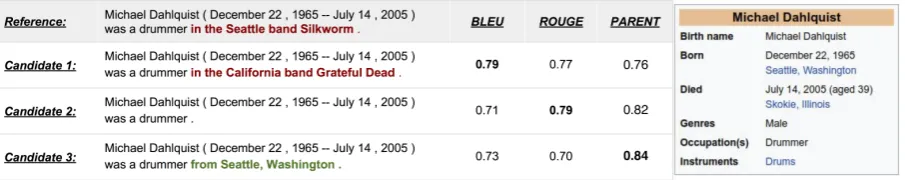
repeatedly anytime small modifications are made to a system. Hence, automatic metrics that com-pare the generated text to one or more reference texts are routinely used to compare models ( Ban-galore et al.,2000). For table-to-text generation, automatic evaluation has largely relied on BLEU (Papineni et al., 2002) and ROUGE (Lin, 2004). The underlying assumption behind these metrics is that the reference text is gold-standard, i.e., it is the ideal target text that a system should gener-ate. In practice, however, when datasets are col-lected automatically and heuristically, the refer-ence texts are often not ideal. Figure1shows an example from the WikiBio dataset (Lebret et al., 2016). Here the reference contains extra informa-tion which no system can be expected to produce given only the associated table. We call such ref-erence textsdivergentfrom the table.
We show that existing automatic metrics, in-cluding BLEU, correlate poorly with human judg-ments when the evaluation sets contain divergent references (§5.4). For many table-to-text genera-tion tasks, the tables themselves are in a pseudo-natural language format (e.g., WikiBio, WebNLG (Gardent et al.,2017), and E2E-NLG (Dušek et al., 2019)). In such cases we propose to compare the generated text to the underlying table as well to improve evaluation. We develop a new metric, PARENT (Precision And Recall of Entailed N -grams from theTable) (§3). When computing pre-cision, PARENT effectively uses a union of the reference and the table, to reward correct informa-tion missing from the reference. When computing recall, it uses an intersection of the reference and the table, to ignore extra incorrect information in the reference. The union and intersection are com-puted with the help of an entailment model to de-cide if a text n-gram is entailed by the table.2 We
Figure 1: A table from the WikiBio dataset (right), its reference description and three hypothetical generated texts with scores assigned to them by automatic evaluation metrics. Text which cannot be inferred from the table is in
red, and text which can be inferred but isn’t present in the reference is ingreen. PARENT is our proposed metric.
show that this method is more effective than us-ing the table as an additional reference. Our main contributions are:
• We conduct a large-scale human evaluation of the outputs from 16 table-to-text models on
1100examples from the WikiBio dataset, many of which have divergent references (§5.2).
• We propose a new metric, PARENT (§3), and show that it improves correlation with human judgments over existing metrics, both when comparing similar systems (such as different hyperparameters of a neural network) and when comparing vastly different systems (such as template-based and neural models).
• We also develop information extraction based metrics, inspired from Wiseman et al. (2017), by training a model to extract tables from the reference texts (§4). We find that these metrics have comparable correlation to PARENT, with the latter being easier to use out of the box.
• We analyze the sensitivity of the metrics to di-vergence by collecting labels for which refer-ences contain only information also present in the tables. We show that PARENT maintains high correlation as the number of such exam-ples is varied. (§5.5).
• We also demonstrate the applicability of PAR-ENT on the data released as part of the WebNLG challenge (Gardent et al., 2017), where the references are elicited from humans, and hence are of high quality (§5.4).
2 Table-to-Text Generation
We briefly review the task of generating natu-ral language descriptions of semi-structured data, which we refer to as tables henceforth (Barzilay
the corresponding table. In practice, we use simple lexical entailment models to determine this.
and Lapata,2005;Liang et al.,2009). Tables can be expressed as set of records T = {rk}Kk=1, where each record is a tuple (entity, attribute, value). When all the records are about the same entity, we can truncate the records to (attribute, value)pairs. For example, for the table in Figure1, the records are{(Birth Name, Michael Dahlquist), (Born, December 22 1965), ...}. The task is to gen-erate a textGwhich summarizes the records in a fluent and grammatical manner.3 For training and evaluation we further assume that we have a ref-erence descriptionRavailable for each table. We letDM ={(Ti, Ri, Gi)}Ni=1denote an evaluation set of tables, references and texts generated from a modelM, andRi
n,Gindenote the collection of n-grams of orderninRiandGi, respectively. We use #Ri
n(g) to denote the count of n-gram g in Rin, and#Gi
n,Rin(g)to denote the minimum of its
counts inRinandGin. Our goal is to assign a score to the model, which correlates highly with human judgments of the quality of that model.
Divergent References. In this paper we are in-terested in the case where reference textsdiverge from the tables. In Figure1, the reference, though technically correct and fluent, mentions informa-tion which cannot be gleaned from the associ-ated table. It also fails to mention useful infor-mation which a generation system might correctly include (e.g. candidate 3 in the figure). We call such referencesdivergent from the associated ta-ble. This phenomenon is quite common – in Wik-iBio we found that 62% of the references men-tion extra informamen-tion (§5.5). Divergence is com-mon in human-curated translation datasets as well (Carpuat et al.,2017;Vyas et al.,2018).
How does divergence affect automatic
evalua-3In some cases the system is expected to summarize all
tion? As a motivating example, consider the three candidate generations shown in Figure1. Clearly, candidate 1 is the worst since it “hallucinates” false information, and candidate3is the best since it is correct and mentions more information than candidate2. However, BLEU and ROUGE, which only compare the candidates to the reference, pe-nalize candidate3for both excluding the divergent information in the reference (in red) and includ-ing correct information from the table (in green).4
PARENT, which compares to both the table and reference, correctly ranks the three candidates.
3 PARENT
PARENT evaluates each instance (Ti, Ri, Gi) separately, by computing the precision and recall ofGiagainst bothTiandRi.
Entailment Probability. The table is in a semi-structured form, and hence not directly compa-rable to the unstructured generated or reference texts. To bridge this gap, we introduce the notion of entailment probability, which we define as the probability that the presence of an n-gramg in a text is “correct” given the associated table. We de-note this probability asw(g) =P r(g⇐Ti). Es-timating this probability is in itself a challenging language understanding task, since the informa-tion in the table may be expressed in varied forms in text. Here, we describe two simple models of lexical entailment, inspired by work on the Recog-nizing Textual Entailment Challenge (Dagan et al., 2006). We found these simple models to be effec-tive; while more sophisticated models may be used if there are complex inferences between the table and text, they are beyond the scope of this paper.
1. Word Overlap Model: Let T¯i denote all the lexical items present in the tableTi, including both attribute names and their values. Then,
w(g) = Pn
j=11(gj ∈ T¯i)/n, where nis the length ofg, andgjis thejth token ing.
2. Co-occurrence Model:(Glickman and Dagan, 2005) Originally proposed for the RTE task, this model computes the probability of a term
gj in the n-gram being entailed by the table as the maximum of its probabilities of being
en-4BLEU is usually computed at the corpus-level, however
here we show its value for a single sentence purely for illus-tration purposes. The remaining BLEU scores in this paper are all at the corpus-level.
tailed by each lexical itemvin the table:
P r(gj ⇐Ti) = max
v∈T¯iP r(gj ⇐v). (1)
P r(gj ⇐ v)is estimated using co-occurrence counts from a training set of table-reference pairs. Then the overall probability of the n-gram being entailed is taken as the geometric
averagew(g) =
Qn
j=1P r(gj ⇐Ti)
1/n
.5
We note that these models are not sensitive to paraphrases between the table and text. For tasks where this is important, embedding-based similar-ities may be used, but those are beyond the scope of this paper. Next we discuss how to compute the precision and recall of the generation.
Entailed Precision. When computing precision, we want to check what fraction of the n-grams in
Gin are correct. We consider an n-gram g to be correct either if it occurs in the referenceRin6, or if it has a high probability of being entailed by the table (i.e. w(g) is high). Let P r(g ∈ Rin) =
#Gi
n,Rin(g)
#Gi
n(g)
denote the probability that an n-gram
inGi
nalso appears inRni. Then, the entailed pre-cisionEpnfor n-grams of ordernis given by:
Enp =
P g∈Gi
n
P r(g∈Rni) +P r(g /∈Rin)w(g)
#Gi n(g)
P g∈Gi
n#G i n(g)
,
=
P g∈Gi
n#G i
n(g)w(g) + #Gin,Rin(g)[1−w(g)]
P g∈Gi
n#G i n(g)
.
(2)
In words, an n-gram receives a reward of 1 if it appears in the reference, with probabilityP r(g∈ Rin), and otherwise it receives a reward of w(g). Both numerator and denominator are weighted by the count of the n-gram inGin. P r(g ∈ Rin) re-wards an n-gram for appearing as many times as it appears in the reference, not more. We combine precisions for n-gram orders1-4using a geometric
5Glickman and Dagan(2005) used a product instead of
geometric mean. Here we use a geometric mean to ensure that n-grams of different lengths have comparable probabili-ties of being entailed.
6
It is unlikely that an automated system produces the same extra n-gram as present in the reference, thus a match with the reference n-gram is considered positive. For example, in
Figure1, it is highly unlikely that a system would produce
average, similar to BLEU:
Ep = exp 4
X
n=1 1 4logE
n p
!
(3)
Entailed Recall. We compute recall against both the reference (Er(Ri)), to ensure proper sen-tence structure in the generated text, and the table (Er(Ti)), to ensure that texts which mention more information from the table get higher scores (e.g. candidate3in Figure1). These are combined us-ing a geometric average:
Er =Er(Ri)(1−λ)Er(Ti)λ (4)
The parameter λtrades-off how much the gener-ated text should match the reference, versus how much it should cover information from the table. The geometric average, which acts as an AND op-eration, ensures that the overall recall is high only when both the components are high. We found this necessary to assign low scores to bad systems which, for example, copy values from the table without phrasing them in natural language.
When computing Er(Ri), divergent references will have n-grams with loww(g). We want to ex-clude these from the computation of recall, and hence their contributions are weighted byw(g):
Ern(Ri) =
P
g∈Ri
n#Gin,Rni(g)w(g) P
g∈Ri
n#Rin(g)w(g)
. (5)
Similar to precision, we combine recalls forn = 1-4using a geometric average to getEr(Ri).
For computing Er(Ti), note that a table is a set of records Ti = {rk}Kk=1. For a record rk, let r¯k denote its string value (such as “Michael Dahlquist”or“December 22 1965”). Then:
Er(Ti) = 1 K
K
X
k=1 1 |r¯k|
LCS(¯rk, Gi), (6)
wherer¯kdenotes the number of tokens in the value string, andLCS(x, y)is the length of the longest common subsequence betweenxandy. TheLCS
function, borrowed from ROUGE, ensures that en-tity names inr¯kappear in the same order in the text as the table. Higher values ofEr(Ti)denote that more records are likely to be mentioned inGi.
The entailed precision and recall are combined into an F-score to give the PARENT metric for one instance. The system-level PARENT score for a
modelMis the average of instance level PARENT scores across the evaluation set:
1 N
N
X
i=1
P AREN T(Gi, Ri, Ti) (7)
Smoothing & Multiple References. The dan-ger with geometric averages is that if any of the components being averaged become0, the average will also be0. Hence, we adopt a smoothing tech-nique from Chen and Cherry(2014) that assigns a small positive valueto any ofEpn,Ern(Ri)and
Er(Ti)which are0. When multiple references are available for a table, we compute PARENT against each reference and take the maximum as its overall score, similar to METEOR (Denkowski and Lavie, 2014).
Choosingλand. To set the value ofλwe can tune it to maximize the correlation of the metric with human judgments, when such data is avail-able. When such data is not available, we can use the recall of thereferenceagainst the table, using Eq.6, as the value of1−λ. The intuition here is that if the recall of the reference against the table is high, it already covers most of the information, and we can assign it a high weight in Eq.4. This leads to a separate value ofλautomatically set for each instance.7 is set to10−5for all experiments.
4 Evaluation via Information Extraction
Wiseman et al.(2017) proposed to use an auxil-iary model, trained to extract structured records from text, for evaluation. However, the extrac-tion model presented in that work is limited to the closed-domain setting of basketball game tables and summaries. In particular, they assume that each table has exactly the same set of attributes for each entity, and that the entities can be identified in the text via string matching. These assumptions are not valid for the open-domain WikiBio dataset, and hence we train our own extraction model to replicate their evaluation scheme.
Our extraction system is a pointer-generator network (See et al.,2017), which learns to produce a linearized version of the table from the text.8 The network learns which attributes need to be popu-lated in the output table, along with their values. It is trained on the training set of WikiBio. At test
7
For WikiBio, on averageλ= 0.6using this heuristic.
8All
time we parsed the output strings into a set of (at-tribute, value)tuples and compare it to the ground truth table. The F-score of this text-to-table system was 35.1%, which is comparable to other chal-lenging open-domain settings (Huang et al.,2017). More details are included in the AppendixA.1.
Given this information extraction system, we consider the following metrics for evaluation, along the lines of Wiseman et al. (2017). Con-tent Selection (CS): F-score for the (attribute, value) pairs extracted from the generated text compared to those extracted from the reference. Relation Generation (RG):Precision for the (at-tribute, value)pairs extracted from the generated text compared to those in the ground truth table. RG-F:Since our task emphasizes the recall of in-formation from the table as well, we consider an-other variant which computes the F-score of the extracted pairs to those in the table. We omit the content ordering metric, since our extraction sys-tem does not align records to the input text.
5 Experiments & Results
In this section we compare several automatic eval-uation metrics by checking their correlation with the scores assigned by humans to table-to-text models. Specifically, givenlmodelsM1, . . . , Ml, and their outputs on an evaluation set, we show these generated texts to humans to judge their quality, and obtain aggregated human evaluation scores for all the models,h¯ = (h1, . . . , hl)(§5.2). Next, to evaluate an automatic metric, we com-pute the scores it assigns to each model, ¯a = (a1, . . . , al), and check the Pearson correlation be-tween¯handa¯(Graham and Baldwin,2014).9
5.1 Data & Models
Our main experiments are on the WikiBio dataset (Lebret et al.,2016), which is automatically con-structed and contains many divergent references. In §5.6we also present results on the data released as part of the WebNLG challenge.
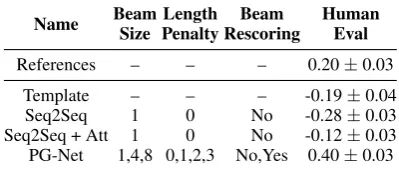
We developed several models of varying qual-ity for generating text from the tables in WikiBio. This gives us a diverse set of outputs to evaluate the automatic metrics on. Table1 lists the mod-els along with their hyperparameter settings and their scores from the human evaluation (§5.2). Our focus is primarily on neural sequence-to-sequence methods since these are most widely used, but we
9We observed similar trends for Spearman correlation.
Name Beam
Size
Length Penalty
Beam Rescoring
Human Eval
References – – – 0.20±0.03
Template – – – -0.19±0.04
Seq2Seq 1 0 No -0.28±0.03
Seq2Seq + Att 1 0 No -0.12±0.03
[image:5.595.316.516.64.149.2]PG-Net 1,4,8 0,1,2,3 No,Yes 0.40±0.03
Table 1: Models used for WikiBio, with the human evaluation scores for these model outputs and the ref-erence texts. PG-Net: Pointer-Generator network. Human scores computed using Thurstone’s method (Tsukida and Gupta,2011).
also include a template-based baseline. All neural models were trained on the WikiBio training set. Training details and sample outputs are included in AppendicesA.2&A.3.
We divide these models into two categories and measure correlation separately for both the cat-egories. The first category, WikiBio-Systems, includes one model each from the four families listed in Table 1. This category tests whether a metric can be used to compare different model families with a large variation in the quality of their outputs. The second category, WikiBio-Hyperparams, includes13different hyperparam-eter settings of PG-Net (See et al., 2017), which was the best performing system overall.9of these were obtained by varying the beam size and length normalization penalty of the decoder network (Wu et al., 2016), and the remaining 4 were obtained by re-scoring beams of size8with the information extraction model described in §4. All the models in this category produce high quality fluent texts, and differ primarily on the quantity and accuracy of the information they express. Here we are test-ing whether a metric can be used to compare simi-lar systems with a small variation in performance. This is an important use-case as metrics are often used to tune hyperparameters of a model.
5.2 Human Evaluation
Figure 2: Instructions to crowd-workers for comparing two generated texts.
(Callison-Burch et al., 2007). However, for mea-suring correlation the comparisons need to be ag-gregated into real-valued scores,h¯= (h1, . . . , hl), for each of the l = 16 models. For this, we use Thurstone’s method (Tsukida and Gupta, 2011), which assigns a score to each model based on how many times it was preferred over an alternative.
The data collection was performed separately for models in theWikiBio-Systemsand WikiBio-Hyperparamscategories. 1100tables were sam-pled from the development set, and for each table we got8different sentence pairs annotated across the two categories, resulting in a total of8800 pair-wise comparisons. Each pair was judged by one worker only which means there may be noise at the instance-level, but the aggregated system-level scores had low variance (cf. Table 1). In total around500different workers were involved in the annotation. References were also included in the evaluation, and they received a lower score than PG-Net, highlighting the divergence in WikiBio.
5.3 Compared Metrics
Text only: We compare BLEU (Papineni
et al., 2002), ROUGE (Lin, 2004), METEOR
(Denkowski and Lavie,2014), CIDEr and CIDEr-D (Vedantam et al., 2015) using their publicly available implementations.
Information Extraction based: We compare the CS, RG and RG-F metrics discussed in §4. Text & Table: We compare a variant of BLEU, denoted as BLEU-T, where the values from the table are used as additional references. BLEU-T draws inspiration from iBLEU (Sun and Zhou, 2012) but instead rewards n-grams which match the table rather than penalizing them. For PARENT, we compare both the word-overlap model (PARENT-W) and the co-occurrence model (PARENT-C) for determining entailment. We also compare versions where a singleλis tuned on the entire dataset to maximize correlation with human judgments, denoted as PARENT*-W/C.
Metric
WikiBio Systems
WikiBio
Hyperparams Avg
ROUGE 0.518±0.07C,W -0.585±0.15C,W -0.034
CIDEr 0.674±0.06C,W -0.516±0.15C,W 0.079
CIDEr-D 0.646±0.06C,W -0.372±0.16C,W 0.137
METEOR 0.697±0.06C,W -0.079±0.24C,W 0.309
BLEU 0.548±0.07C,W 0.407±0.15C,W 0.478
CS 0.735±0.06W -0.604±0.16C,W 0.066
BLEU-T 0.688±0.11W 0.587±0.14C,W 0.638
RG 0.645±0.07C,W 0.749±0.12 0.697
RG-F 0.753±0.06W 0.763±0.12 0.758
PARENT-C 0.776±0.05W 0.755±0.12 0.766
PARENT-W 0.912±0.03 0.763±0.12 0.838
PARENT*-C 0.976±0.01 0.793±0.11 0.885
PARENT*-W 0.982±0.01 0.844±0.10 0.913
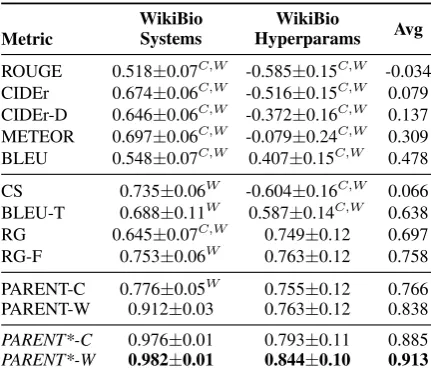
Table 2: Correlation of metrics with human judgments on WikiBio. A superscript ofC/W indicates that the correlation is significantly lower than that of PARENT-C/W using a bootstrap confidence test forα= 0.1.
5.4 Correlation Comparison
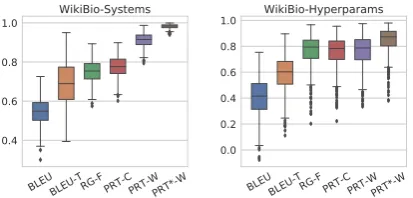
We use bootstrap sampling (500 iterations) over the1100tables for which we collected human an-notations to get an idea of how the correlation of each metric varies with the underlying data. In each iteration, we sample with replacement, tables along with their references and all the generated texts for that table. Then we compute aggregated human evaluation and metric scores for each of the models and compute the correlation between the two. We report the average correlation across all bootstrap samples for each metric in Table2. The distribution of correlations for the best performing metrics are shown in Figure3.
Table2also indicates whether PARENT is sig-nificantly better than a baseline metric. Graham and Baldwin (2014) suggest using the William’s test for this purpose, but since we are computing correlations between only4/13systems at a time, this test has very weak power in our case. Hence, we use the bootstrap samples to obtain a 1 −α
BLEUBLEU-TRG-FPRT-CPRT-WPRT*-W
0.4 0.6 0.8
1.0 WikiBio-Systems
BLEUBLEU-TRG-FPRT-CPRT-WPRT*-W
0.0 0.2 0.4 0.6 0.8
[image:7.595.308.524.67.167.2]1.0 WikiBio-Hyperparams
Figure 3: Distribution of metric correlations across500 bootstrap samples. PRT=PARENT.
between PARENT and any other metric and check whether this is above0(Wilcox,2016).
Correlations are higher for the systems cate-gory than the hyperparams catecate-gory. The latter is a more difficult setting since very similar mod-els are compared, and hence the variance of the correlations is also high. Commonly used metrics which only rely on the reference (BLEU, ROUGE, METEOR, CIDEr) have only weak correlations with human judgments. In the hyperparams cat-egory, these are often negative, implying that tun-ing models based on these may lead to selecttun-ing worse models. BLEU performs the best among these, and adding n-grams from the table as refer-ences improves this further (BLEU-T).
Among the extractive evaluation metrics, CS, which also only relies on the reference, has poor correlation in the hyperparams category. RG-F, and both variants of the PARENT metric achieve the highest correlation for both settings. There is no significant difference among these for the hy-perparams category, but for systems, PARENT-W is significantly better than the other two. While RG-F needs a full information extraction pipeline in its implementation, PARENT-C only relies on co-occurrence counts, and PARENT-W can be used out-of-the-box for any dataset. To our knowl-edge, this is the first rigorous evaluation of using information extraction for generation evaluation.
On this dataset, the word-overlap model showed higher correlation than the co-occurrence model for entailment. In §5.6 we will show that for the WebNLG dataset, where more paraphrasing is involved between the table and text, the oppo-site is true. Lastly, we note that the heuristic for selecting λ is sufficient to produce high correla-tions for PARENT, however, if human annotacorrela-tions are available, this can be tuned to produce signifi-cantly higher correlations (PARENT*-W/C).
0 20 40 60 80 100
% Entailed
0.0 0.2 0.4 0.6 0.8
1.0 WikiBio-Systems
BLEU BLEU-T RG-F PARENT-W
0 20 40 60 80 100
% Entailed
1.0 0.5 0.0 0.5
1.0 WikiBio-Hyperparams
BLEU BLEU-T RG-F PARENT-W
Figure 4: Correlation of the metrics to human judgment as the percentage of entailed examples in WikiBio is varied.
5.5 Analysis
In this section we further analyze the performance of PARENT-W10 under different conditions, and compare to the other best metrics from Table2.
Effect of Divergence. To study the correlation as we vary the number of divergent references, we also collected binary labels from workers for whether a reference isentailedby the correspond-ing table. We define a reference as entailed when it mentions only information which can be inferred from the table. Each table and reference pair was judged by3independent workers, and we used the majority vote as the label for that pair. Overall, only 38% of the references were labeled as en-tailed by the table. Fleiss’κwas 0.30, which in-dicates a fair agreement. We found the workers sometimes disagreed on what information can be reasonably entailed by the table.
Figure4shows the correlations as we vary the percent of entailed examples in the evaluation set of WikiBio. Each point is obtained by fixing the desired proportion of entailed examples, and sam-pling subsets from the full set which satisfy this proportion. PARENT and RG-F remain stable and show a high correlation across the entire range, whereas BLEU and BLEU-T vary a lot. In the hy-perparams category, the latter two have the worst correlation when the evaluation set containsonly
entailed examples, which may seem surprising.
However, on closer examination we found that this subset tends to omit a lot of information from the tables. Systems which produce more information than these references are penalized by BLEU, but not in the human evaluation. PARENT overcomes this issue by measuring recall against the table in addition to the reference.
[image:7.595.75.282.68.167.2]BLEU BLEU-T RG-F PARENT-W PARENT-C
0.556 0.567∗ 0.588∗ 0.598‡ 0.606†
Table 3: Accuracy on making the same judgments as humans between pairs of generated texts. p <
0.01∗/0.05†/0.10‡: accuracy is significantly higher than the next best accuracy to the left using a paired McNemar’s test.
Ablation Study. We check how different com-ponents in the computation of PARENT contribute to its correlation to human judgments. Specifi-cally, we remove the probability w(g) of an n-gram g being entailed by the table from Eqs. 2 and5.11 The average correlation for PARENT-W drops to0.168in this case. We also try a variant of PARENT withλ= 0, which removes the con-tribution of Table Recall (Eq.4). The average cor-relation is0.328in this case. With these compo-nents, the correlation is0.838, showing that they are crucial to the performance of PARENT.
Sentence Level Discrimination. Chaganty et al. (2018) point out that hill-climbing on an automatic metric is meaningless if that metric has a low instance-levelcorrelation to human judgments. In Table3we show the average accuracy of the met-rics in making the same judgments as humans be-tween pairs of generated texts. Both variants of PARENT are significantly better than the other metrics, however the best accuracy is only60%for the binary task. This is a challenging task, since there are typically only subtle differences between the texts. Achieving higher instance-level accura-cies will require more sophisticated language un-derstanding models for evaluation.
5.6 WebNLG Dataset
To check how PARENT correlates with human judgments when the references are elicited from humans (and less likely to be divergent), we check its correlation with the human ratings provided for the systems competing in the WebNLG challenge (Gardent et al.,2017). The task is to generate text describing 1-5 RDF triples (e.g. John E Blaha, birthPlace, San Antonio), and human ratings were collected for the outputs of9participating systems on223instances. These systems include a mix of pipelined, statistical and neural methods. Each in-stance has upto 3 reference texts associated with
11When computing precision we setw(g) = 0, and when
computing recall we setw(g) = 1for allg.
Metric Grammar Fluency Semantics Avg
METEOR 0.788±0.04 0.792±0.04 0.576±0.06 0.719
ROUGE 0.788±0.04 0.792±0.04 0.576±0.06 0.719
CIDEr 0.804±0.03 0.753±0.04 0.860±0.02 0.806
BLEU 0.858±0.02 0.811±0.03 0.775±0.03 0.815
BLEU-T 0.849±0.02 0.801±0.03 0.816±0.02 0.822
CIDErD 0.838±0.04 0.796±0.04 0.853±0.02 0.829
PARENT-W 0.821±0.03 0.768±0.04 0.887±0.02 0.825
PARENT-C 0.851±0.03 0.809±0.04 0.877±0.02 0.846
Table 4: Average pearson correlation across500 boot-strap samples of each metric to human ratings for each aspect of the generations from the WebNLG challenge.
the RDF triples, which we use for evaluation. The human ratings were collected on 3 dis-tinct aspects –grammaticality,fluencyand seman-tics, wheresemanticscorresponds to the degree to which a generated text agrees with the meaning of the underlying RDF triples. We report the corre-lation of several metrics with these ratings in Ta-ble4.12 Both variants of PARENT are either com-petitive or better than the other metrics in terms of the average correlation to all three aspects. This shows that PARENT is applicable for high quality references as well.
While BLEU has the highest correlation for the grammar and fluency aspects, PARENT does best for semantics. This suggests that the inclusion of source tables into the evaluation orients the metric more towards measuring the fidelity of the content of the generation. A similar trend is seen compar-ing BLEU and BLEU-T. As modern neural text generation systems are typically very fluent, mea-suring their fidelity is of increasing importance. Between the two entailment models, PARENT-C is better due to its higher correlation with the grammaticality and fluency aspects.
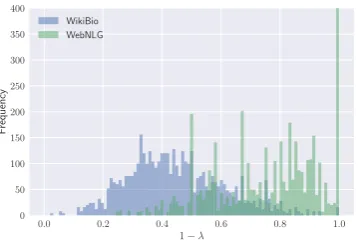
Distribution ofλ. Theλparameter in the calcu-lation of PARENT decides whether to compute re-call against the table or the reference (Eq.4). Fig-ure5shows the distribution of the values taken by
1−λusing the heuristic described in §3 for in-stances in both WikiBio and WebNLG. For Wik-iBio, the recall of the references against the table is generally low, and hence the recall of the gener-ated text relies more on the table. For WebNLG, where the references are elicited from humans, this recall is much higher (often 1.0), and hence
12 We omit extractive evaluation metrics since no
0.0 0.2 0.4 0.6 0.8 1.0
1−λ
0 50 100 150 200 250 300 350 400
F
requency
[image:9.595.90.270.67.190.2]WikiBio WebNLG
Figure 5: Histogram of the recall of the references against the table (Eq.6), which is used to set1−λ. Lower values indicate that the metric relies more on the table and less on the reference.
the recall of the generated text relies more on the reference.
6 Related Work
Over the years several studies have evaluated au-tomatic metrics for measuring text generation per-formance (Callison-Burch et al.,2006;Stent et al., 2005; Belz and Reiter, 2006; Reiter, 2018; Liu et al.,2016;Kilickaya et al.,2017;Gatt and Krah-mer,2018). The only consensus from these studies seems to be that no single metric is suitable across all tasks. A recurring theme is that metrics like BLEU and NIST (Doddington,2002) are not suit-able for judging content quality in NLG. Recently, Novikova et al.(2017a) did a comprehensive study of several metrics on the outputs of state-of-the-art NLG systems, and found that while they showed acceptable correlation with human judgments at thesystemlevel, they failed to show any correla-tion at thesentence level. Ours is the first study which checks the quality of metrics when table-to-text references are divergent. We show that in this case even system level correlations can be un-reliable.
Hallucination (Rohrbach et al.,2018;Lee et al., 2018) refers to when an NLG system generates text which mentions extra information than what is present in the source from which it is generated. Divergence can be viewed as hallucination in the reference text itself. PARENT deals with halluci-nation by discounting n-grams which do not over-lap with either the reference or the table.
PARENT draws inspiration from iBLEU (Sun and Zhou, 2012), a metric for evaluating para-phrase generation, which compares the generated text to both the source text and the reference.
While iBLEU penalizes texts which match the source, here we reward such texts since our task values accuracy of generated text more than the need for paraphrasing the tabular content (Liu et al.,2010). Similar to SARI for text simplifica-tion (Xu et al., 2016) and Q-BLEU for question generation (Nema and Khapra, 2018), PARENT falls under the category of task-specific metrics.
7 Conclusions
We study the automatic evaluation of table-to-text systems when the references diverge from the ta-ble. We propose a new metric, PARENT, which shows the highest correlation with humans across a range of settings with divergent references in WikiBio. We also perform the first empirical evaluation of information extraction based metrics (Wiseman et al., 2017), and find RG-F to be ef-fective. Lastly, we show that PARENT is compa-rable to the best existing metrics when references are elicited by humans on the WebNLG data.
Acknowledgements
Bhuwan Dhingra is supported by a fellowship from Siemens, and by grants from Google. We thank Maruan Al-Shedivat, Ian Tenney, Tom Kwiatkowski, Michael Collins, Slav Petrov, Jason Baldridge, David Reitter and other members of the Google AI Language team for helpful discussions and suggestions. We thank Sam Wiseman for shar-ing data for an earlier version of this paper. We also thank the anonymous reviewers for their feed-back.
References
Srinivas Bangalore, Owen Rambow, and Steve Whit-taker. 2000. Evaluation metrics for generation. In
Proc. of INLG.
Regina Barzilay and Mirella Lapata. 2005. Collective content selection for concept-to-text generation. In
Proc. of EMNLP.
Anja Belz and Ehud Reiter. 2006. Comparing auto-matic and human evaluation of nlg systems. InProc. of EACL.
Chris Callison-Burch, Cameron Fordyce, Philipp Koehn, Christof Monz, and Josh Schroeder. 2007. (meta-) evaluation of machine translation. InProc. of WMT.
Marine Carpuat, Yogarshi Vyas, and Xing Niu. 2017. Detecting cross-lingual semantic divergence for neural machine translation. InProc.of Workshop on NMT.
Arun Chaganty, Stephen Mussmann, and Percy Liang. 2018. The price of debiasing automatic metrics in natural language evalaution. InProc. of ACL.
Boxing Chen and Colin Cherry. 2014. A systematic comparison of smoothing techniques for sentence-level bleu. InProc. of WMT.
Ido Dagan, Oren Glickman, and Bernardo Magnini. 2006. The pascal recognising textual entailment challenge. InMachine Learning Challenges. Eval-uating Predictive Uncertainty, Visual Object Classi-fication, and Recognising Tectual Entailment, pages 177–190, Berlin, Heidelberg. Springer Berlin Hei-delberg.
Michael Denkowski and Alon Lavie. 2014. Meteor universal: Language specific translation evaluation for any target language. InProc. of WMT.
George Doddington. 2002. Automatic evaluation of machine translation quality using n-gram co-occurrence statistics. InProc. of HLT.
Ondˇrej Dušek, Jekaterina Novikova, and Verena Rieser. 2019. Evaluating the state-of-the-art of end-to-end natural language generation: The E2E NLG Chal-lenge.arXiv preprint arXiv:1901.11528.
Claire Gardent, Anastasia Shimorina, Shashi Narayan, and Laura Perez-Beltrachini. 2017. Creating train-ing corpora for micro-planners. InProc. of ACL.
Albert Gatt and Emiel Krahmer. 2018. Survey of the state of the art in natural language generation: Core tasks, applications and evaluation. Journal of Artifi-cial Intelligence Research, 61:65–170.
Oren Glickman and Ido Dagan. 2005. A probabilistic setting and lexical cooccurrence model for textual entailment. InProceedings of the ACL Workshop on Empirical Modeling of Semantic Equivalence and Entailment, pages 43–48. Association for Compu-tational Linguistics.
Yvette Graham and Timothy Baldwin. 2014. Testing for significance of increased correlation with human judgment. InProc. of EMNLP.
Lifu Huang, Avirup Sil, Heng Ji, and Radu Florian. 2017. Improving slot filling performance with at-tentive neural networks on dependency structures.
Mert Kilickaya, Aykut Erdem, Nazli Ikizler-Cinbis, and Erkut Erdem. 2017. Re-evaluating automatic metrics for image captioning. InProc. of EACL.
Karen Kukich. 1983. Design of a knowledge-based re-port generator. InProc. of ACL.
Rémi Lebret, David Grangier, and Michael Auli. 2016. Neural text generation from structured data with application to the biography domain. In Proc. of EMNLP.
Katherine Lee, Orhan Firat, Ashish Agarwal, Clara Fannjiang, and David Sussillo. 2018. Hallucinations in neural machine translation.
Percy Liang, Michael I Jordan, and Dan Klein. 2009. Learning semantic correspondences with less super-vision. InProc. of ACL.
Chin-Yew Lin. 2004. Rouge: A package for automatic evaluation of summaries. InProc. of Workshop on Text Summarization Branches Out.
Chang Liu, Daniel Dahlmeier, and Hwee Tou Ng. 2010. PEM: A paraphrase evaluation metric exploit-ing parallel texts. InProc. of EMNLP.
Chia-Wei Liu, Ryan Lowe, Iulian Serban, Mike Nose-worthy, Laurent Charlin, and Joelle Pineau. 2016. How not to evaluate your dialogue system: An em-pirical study of unsupervised evaluation metrics for dialogue response generation. InProc. of EMNLP.
Kathleen R. McKeown. 1985. Text Generation: Using Discourse Strategies and Focus Constraints to Gen-erate Natural Language Text. Cambridge University Press, New York, NY, USA.
Preksha Nema and Mitesh M Khapra. 2018. Towards a better metric for evaluating question generation sys-tems. InProc. of EMNLP.
Jekaterina Novikova, Ondˇrej Dušek, Amanda Cercas Curry, and Verena Rieser. 2017a. Why we need new evaluation metrics for NLG. InProc. of EMNLP.
Jekaterina Novikova, Ondˇrej Dušek, and Verena Rieser. 2017b. The E2E dataset: New challenges for end-to-end generation. InProc. of SIGDIAL.
Kishore Papineni, Salim Roukos, Todd Ward, and Wei-Jing Zhu. 2002. Bleu: A method for automatic eval-uation of machine translation. InProc. of ACL.
Jeffrey Pennington, Richard Socher, and Christopher Manning. 2014. Glove: Global vectors for word rep-resentation. InProceedings of the 2014 conference on empirical methods in natural language process-ing (EMNLP), pages 1532–1543.
Ehud Reiter. 2018. A structured review of the validity of bleu.Computational Linguistics, pages 1–12.
Ehud Reiter and Robert Dale. 1997. Building applied natural language generation systems. Nat. Lang. Eng., 3(1):57–87.
Abigail See, Peter J. Liu, and Christopher D. Manning. 2017. Get to the point: Summarization with pointer-generator networks. InProc. of ACL.
Amanda Stent, Matthew Marge, and Mohit Singhai. 2005. Evaluating evaluation methods for generation in the presence of variation. InProc. of CICLing.
Hong Sun and Ming Zhou. 2012. Joint learning of a dual smt system for paraphrase generation. InProc. of ACL.
Kristi Tsukida and Maya R Gupta. 2011. How to analyze paired comparison data. Technical report, Washington University Seattle Dept of Electrical Engineering.
Ramakrishna Vedantam, C Lawrence Zitnick, and Devi Parikh. 2015. Cider: Consensus-based image de-scription evaluation. In Proceedings of the IEEE conference on computer vision and pattern recog-nition, pages 4566–4575.
Yogarshi Vyas, Xing Niu, and Marine Carpuat. 2018. Identifying semantic divergences in parallel text without annotations. InProc. of NAACL.
Rand R Wilcox. 2016. Comparing dependent robust correlations. British Journal of Mathematical and Statistical Psychology, 69(3):215–224.
Sam Wiseman, Stuart M Shieber, and Alexander M Rush. 2017. Challenges in data-to-document gen-eration. InProc. of EMNLP.
Yonghui Wu, Mike Schuster, Zhifeng Chen, Quoc V. Le, Mohammad Norouzi, Wolfgang Macherey, Maxim Krikun, Yuan Cao, Qin Gao, Klaus Macherey, Jeff Klingner, Apurva Shah, Melvin Johnson, Xiaobing Liu, Å ˛Aukasz Kaiser, Stephan Gouws, Yoshikiyo Kato, Taku Kudo, Hideto Kazawa, Keith Stevens, George Kurian, Nishant Patil, Wei Wang, Cliff Young, Jason Smith, Jason Riesa, Alex Rudnick, Oriol Vinyals, Greg Corrado, Macduff Hughes, and Jeffrey Dean. 2016. Google’s neural machine translation system: Bridging the gap between human and machine translation. CoRR, abs/1609.08144.
Wei Xu, Courtney Napoles, Ellie Pavlick, Quanze Chen, and Chris Callison-Burch. 2016. Optimizing statistical machine translation for text simplification.
Transactions of the Association for Computational Linguistics, 4:401–415.
A Appendices
A.1 Information Extraction System
For evaluation via information extraction ( Wise-man et al., 2017) we train a model for WikiBio which accepts text as input and generates a table as the output. Tables in WikiBio are open-domain, without any fixed schema for which attributes may be present or absent in an instance. Hence we
Text:
michael dahlquist ( december 22 , 1965 – july 14 , 2005 ) was a drummer in the seattle band silkworm .
Table:
name<C>michael dahlquist<R>birth date<C>22 december 1965<R>birth place<C>seattle , washington <R>death date<C>14 july 2005<R>death
place<C>skokie , illinois<R>genres<C>male <R>occupation(s)<C>drummer<R>instrument <C>drums
Figure 6: An input-output pair for the information ex-traction system. <R>and<C>are special symbols used to separate (attribute, value) pairs and attributes from values, respectively.
Precision Recall F-score
0.428 0.310 0.351
Table 5: Performance of the Information Extraction system.
employ the Pointer-Generator Network (PG-Net) (See et al.,2017) for this purpose. Specifically, we use a sequence-to-sequence model, whose encoder and decoder are both single-layer bi-directional LSTMs. The decoder is augmented with an at-tention mechanism over the states of the encoder. Further, it also uses a copy mechanism to option-ally copy tokens directly from the source text. We do not use the coverage mechanism of See et al. (2017) since that is specific to the task of sum-marization they study. The decoder is trained to produce a linearized version of the table where the rows and columns are flattened into a sequence, and separate by special tokens. Figure6shows an example.
Clearly, since the references are divergent, the model cannot be expected to produce the entire ta-ble, and we see some false information being hal-lucinated after training. Nevertheless, as we show in §5.4, this system can be used for evaluating gen-erated texts. After training, we can parse the out-put sequence along the special tokens <R> and
<C>to get a set of (attribute, value) pairs. Ta-ble 5 shows the precision, recall and F-score of these extracted pairs against the ground truth ta-bles, where the attributes and values are compared using an exact string match.
A.2 Hyperparameters
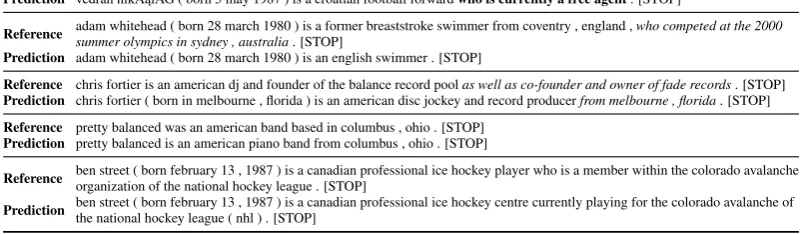
Reference vedran nikÅ ˛aiÄ ˘G ( born 5 may 1987 in osijek ) is a croatian football striker . [STOP]
Prediction vedran nikÅ ˛aiÄ ˘G ( born 5 may 1987 ) is a croatian football forwardwho is currently a free agent. [STOP]
Reference adam whitehead ( born 28 march 1980 ) is a former breaststroke swimmer from coventry , england ,who competed at the 2000
summer olympics in sydney , australia. [STOP]
Prediction adam whitehead ( born 28 march 1980 ) is an english swimmer . [STOP]
Reference chris fortier is an american dj and founder of the balance record poolas well as co-founder and owner of fade records. [STOP] Prediction chris fortier ( born in melbourne , florida ) is an american disc jockey and record producerfrom melbourne , florida. [STOP]
Reference pretty balanced was an american band based in columbus , ohio . [STOP] Prediction pretty balanced is an american piano band from columbus , ohio . [STOP]
Reference ben street ( born february 13 , 1987 ) is a canadian professional ice hockey player who is a member within the colorado avalanche organization of the national hockey league . [STOP]
[image:12.595.98.503.80.197.2]Prediction ben street ( born february 13 , 1987 ) is a canadian professional ice hockey centre currently playing for the colorado avalanche of the national hockey league ( nhl ) . [STOP]
Table 6: Sample references and predictions from PG-Net with beam size8. Information which is absent from the reference, but can be inferred from the table is inbold. Information which is present in the reference, but cannot be inferred from the table is initalics.
was set to200. The input and output vocabularies were set to50000most common words in the cor-pus, with additional special symbols for table at-tribute names (such as “birth-date”). The embed-dings of the tokens in the vocabulary were initial-ized with Glove (Pennington et al.,2014). Learn-ing rate of0.0003was used during training, with the Adam optimizer, and a dropout of 0.2 was also applied to the outputs of the biLSTM. Mod-els were trained till the loss on the dev set stopped dropping. Maximum length of a decoded text was set to40 tokens, and that of the tables was set to
120 tokens. Various beam sizes and length nor-malization penalties were applied for the table-to-text system, which are listed in the main paper. For the information extraction system, we found a beam size of8and no length penalty to produce the highest F-score on the dev set.
A.3 Sample Outputs